
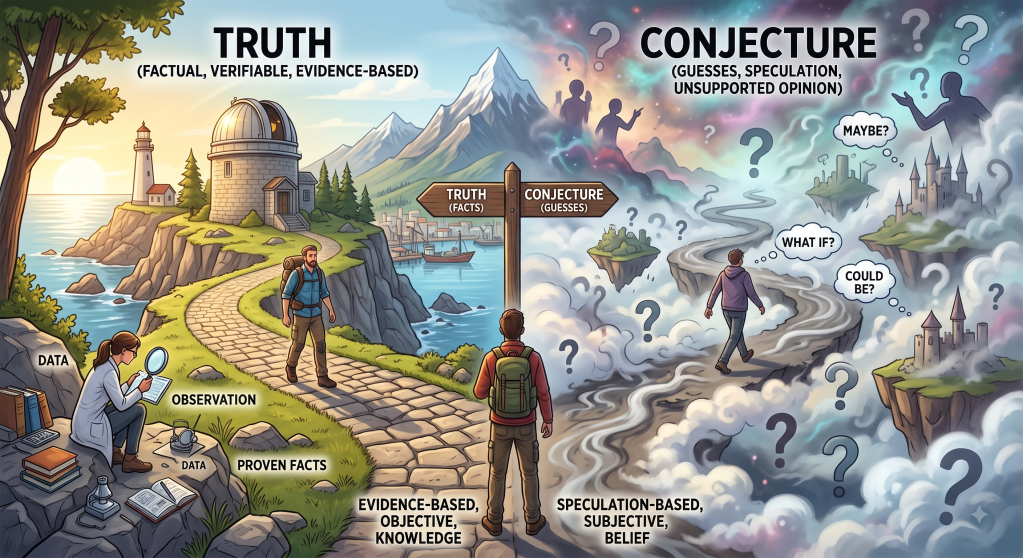
Presented by Gemini for Zia H Shah MD
Audio teaser: Truth Versus Speculation in the Quran
Abstract
The Quran constructs a rigorous epistemological framework that sharply differentiates between speculative conjecture (ẓann) and objective truth (al-ḥaqq), mediated by verified knowledge (‘ilm) and existential certainty (yaqīn). Within the Quranic discourse, ẓann represents not merely an accidental cognitive slip, but a systemic epistemological pathology rooted in unsubstantiated assumptions, inherited dogmatism, subjective desires, and logical fallacies such as the appeal to majority consensus (argumentum ad populum). Conversely, al-ḥaqq signifies both the ontological foundation of reality—anchored in the Divine Essence—and the objective standard to which human cognition and moral judgment must conform. This research report provides an exhaustive analysis of the semantic, theological, philosophical, and social dimensions governing ẓann and al-ḥaqq. Through an examination of key Quranic passages, their corresponding Arabic texts, and multi-disciplinary commentaries, this study demonstrates how the Quranic critique of conjecture establishes a precursor to empirical verification, rational accountability, and ethical integrity, repudiating both unexamined dogmatism and materialist or polytheistic assertion.
Epistemological Foundations: The Lexical Spectrum of Ẓann and Al-Ḥaqq
The epistemological architecture of the Quran is anchored in a structural polarity between objective reality and subjective projection. To analyze this binary, one must first examine the semantic boundaries of ẓann (ظَنّ) and al-ḥaqq (الْحَقّ) within classical Arabic lexicography and Quranic hermeneutics.
The term ẓann carries a multi-layered semantic range depending on its contextual deployment. While in specific jurisprudence (fiqh) contexts or particular existential states ẓann can denote a high degree of probability or conviction short of absolute certainty, its primary critique in Quranic creedal discourse centers on baseless speculation, guesswork, and cognitive illusion. In matters of faith, metaphysics, and historical reality, ẓann represents an epistemic void—an unverified mental construct elevated to the status of truth without empirical, rational, or revelatory justification. The Quran repeatedly links ẓann with kharṣ (conjecture/surmise) and hawā (caprice/subjective desire), highlighting that speculative thinking is rarely neutral; it is driven by psychological inclinations and systemic cognitive biases.
Conversely, al-ḥaqq is a foundational term encompassing ontological, epistemological, and ethical dimensions. Ontologically, Al-Ḥaqq is one of the primary names of Allah, signifying the Absolute Reality that exists independently of human perception, language, or consensus. Epistemologically, al-ḥaqq refers to statements, propositions, and beliefs that accurately correspond to objective facts. Epistemically, al-ḥaqq is immutable; it cannot be altered, compromised, or negated by widespread societal belief or long-standing tradition. The Quran asserts that the universe itself was created bi-l-ḥaqq (in truth and with a purposeful, coherent reality), meaning that nature operates under discoverable laws rather than chaotic delusion.
| Epistemic Category | Ontological / Cognitive Basis | Quranic Assessment & Function |
|---|---|---|
| Ẓann (ظَنّ) | Subjective assumption, speculative conjecture, unverified bias, reliance on majority opinion. | Condemned in creedal/metaphysical matters; leads to misguidance and false reality. |
| ‘Ilm (عِلْم) | Verified knowledge, empirical observation, rigorous rational demonstration (burhān). | Celebrated as the necessary bridge to truth; mandatory for cognitive accountability. |
| Al-Ḥaqq (الْحَقّ) | Absolute objective reality, Divine Essence, truth corresponding to facts. | The ultimate criterion; independent of human desire or popular consensus. |
Quranic Condemnations of Conjecture in Matters of Faith and Reality
The Quran systematically dismantles reliance on conjecture across various domains of human thought, including polytheistic theology, fatalistic excuses, sectarian dogmatism, and materialist reductionism.
The Fallacy of Majority Opinion (Argumentum ad Populum)
In Surah Al-An’am (6:116), the Quran explicitly warns against mistaking democratic prevalence or cultural consensus for objective truth. Human consensus, when detached from verified knowledge, frequently coalesces around shared illusions and inherited biases.
Arabic Text:
وَإِن تُطِعْ أَكْثَرَ مَن فِي الْأَرْضِ يُضِلُّوكَ عَن سَبِيلِ اللَّهِ ۚ إِن يَتَّبِعُونَ إِلَّا الظَّنَّ وَإِنْ هُمْ إِلَّا يَخْرُصُونَ
(Surah Al-An’am 6:116)
[cite: 7, 10, 11]
Translation: “If you obey most of those upon the earth, they will mislead you from the way of Allah. They follow not except assumption, and they are not but falsifying.”
This verse exposes the cognitive vulnerability of appealing to the popular majority. The term yakhruṣūn (they do nothing but guess or speculate) emphasizes that mass opinion often relies on unverified hypotheses. The critical insight emerging from this passage is an early critique of conformity bias: numerical superiority provides zero epistemic weight regarding the actual truth of a proposition.
Fatalistic Deflection and Epistemic Evasion
In Surah Al-An’am (6:148), the Quran records the argument of the polytheists who attempted to justify their idolatry and arbitrary social taboos through a fatalistic theological framing. They argued that if God had willed otherwise, they would not have practiced polytheism—thereby attempting to use divine sovereignty to excuse human responsibility.
Arabic Text:
سَيَقُولُ الَّذِينَ أَشْرَكُوا لَوْ شَاءَ اللَّهُ مَا أَشْرَكْنَا وَلَا آبَاؤُنَا وَلَا حَرَّمْنَا مِن شَيْءٍ ۚ كَذَلِكَ كَذَّبَ الَّذِينَ مِن قَبْلِهِمْ حَتَّىٰ ذَاقُوا بَأْسَنَا ۗ قُلْ هَلْ عِندَكُم مِّنْ عِلْمٍ فَتُخْرِجُوهُ لَنَا ۖ إِن تَتَّبِعُونَ إِلَّا الظَّنَّ وَإِنْ أَنتُمْ إِلَّا تَخْرُصُونَ
(Surah Al-An’am 6:148)
[cite: 13]
Translation: “Those who associate partners [with Allah] will say, ‘If Allah had willed, we would not have associated [anything] and neither would our fathers, nor would we have prohibited anything.’ Likewise did those before them deny until they tasted Our punishment. Say, ‘Do you have any knowledge that you can produce for us? You follow not except assumption, and you do not but guess.’”
The divine critique ignores their philosophical sophistry and demands empirical or revelatory proof: “Say: Do you have any knowledge that you can produce for us?”. By framing their excuse as mere ẓann and kharṣ, the Quran establishes that constructing sweeping deterministic arguments without proof is an act of intellectual fabrication.
The Inadequacy of Conjecture Against Objective Reality
Surah Yunus (10:36) formulates the core epistemological principle governing the relationship between ẓann and al-ḥaqq.
Arabic Text:
وَمَا يَتَّبِعُ أَكْثَرُهُمْ إِلَّا ظَنًّا ۚ إِنَّ الظَّنَّ لَا يُغْنِي مِنَ الْحَقِّ شَيْئًا ۚ إِنَّ اللَّهَ عَلِيمٌ بِمَا يَفْعَلُونَ
(Surah Yunus 10:36)
[cite: 15, 16]
Translation: “And most of them follow not except an assumption. Indeed, assumption does not avail against the truth at all. Indeed, Allah is Knowing of what they do.”
The declaration Inna al-ẓanna lā yughnī mina al-ḥaqqi shay’ā (“Indeed, assumption does not avail against the truth at all”) asserts the absolute autonomy of objective reality. Human beliefs, preferences, or cultural projections cannot alter the fabric of reality. Subjective confidence cannot transform a speculative premise into an objective fact.
False Ontologies and Idolatrous Projections
In Surah Yunus (10:66), the Quran addresses the practice of attributing divine authority or ontological status to entities that lack independent reality.
Arabic Text:
أَلَا إِنَّ لِلَّهِ مَن فِي السَّمَاوَاتِ وَمَن فِي الْأَرْضِ ۗ وَمَا يَتَّبِعُ الَّذِينَ يَدْعُونَ مِن دُونِ اللَّهِ شُرَكَاءَ ۚ إِن يَتَّبِعُونَ إِلَّا الظَّنَّ وَإِنْ هُمْ إِلَّا يَخْرُصُونَ
(Surah Yunus 10:66)
[cite: 4, 17]
Translation: “Unquestionably, to Allah belongs whoever is in the heavens and whoever is on the earth. And those who invoke other than Allah do not [actually] follow [His] partners. They follow not except assumption, and they are not but conjecturing.”
This verse asserts total divine sovereignty over all beings in the heavens and the earth. Consequently, those who invoke false entities are not following actual entities with real power; they are pursuing psychological projections born of speculation (ẓann) and imaginative guessing (kharṣ).
Speculative Metaphysics and Inherited Dogma
Surah An-Najm (53:28) critiques the pagan practice of asserting specific details about the unseen realm—such as declaring angels to be female offspring of God—without an epistemic foundation.
Arabic Text:
وَمَا لَهُم بِهِ مِنْ عِلْمٍ ۖ إِن يَتَّبِعُونَ إِلَّا الظَّنَّ ۖ وَإِنَّ الظَّنَّ لَا يُغْنِي مِنَ الْحَقِّ شَيْئًا
(Surah An-Najm 53:28)
[cite: 6, 8, 19]
Translation: “And they have thereof no knowledge. They follow not except assumption, and indeed, assumption avails not against the truth at all.”
By reiterating that assumption cannot substitute for truth, the text rejects dogmatic assertions about metaphysics that lack revelatory or rational proof.
The Materialist Creed (Ad-Dahriyyah) as Speculative Projection
In Surah Al-Jathiyah (45:24), the Quran addresses the philosophy of absolute materialist reductionism, historically known as the creed of Ad-Dahriyyah.
Arabic Text:
وَقَالُوا مَا هِيَ إِلَّا حَيَاتُنَا الدُّنْيَا نَمُوتُ وَنَحْيَا وَمَا يُهْلِكُنَا إِلَّا الدَّهْرُ ۚ وَمَا لَهُم بِذَٰلِكَ مِنْ عِلْمٍ ۖ إِنْ هُمْ إِلَّا يَظُنُّونَ
(Surah Al-Jathiyah 45:24)
[cite: 5, 20, 21]
Translation: “And they say, ‘There is not but our worldly life; we die and we live and nothing destroys us except time.’ But they have of that no knowledge; they are only conjecturing.”
The materialists assert three core propositions: life is strictly confined to worldly existence (ḥayātunā al-dunyā), biological life and death are self-contained mechanical cycles (namūtu wa-naḥyā), and ultimate destruction is caused solely by the impersonal passage of temporal flux (al-dahr). The Quranic response to this philosophical position critiques their underlying epistemology: “They have no knowledge of that; they do nothing but speculate” (in hum illā yaẓunnūn).
The Quran highlights that while materialists claim to rely strictly on observable reality, their sweeping negative assertion—that nothing exists beyond physical space-time—is itself an unverified metaphysical leap. To assert dogmatically that there is no metaphysical realm, no post-mortem reality, and no transcendent Creator requires omniscience across all dimensions of reality. Lacking such complete knowledge, the absolute denial of the metaphysical realm remains an act of conjecture (ẓann) disguised as empirical rigor.
| Quranic Reference | Focal Phenomenon | Specific Cognitive / Epistemic Error | Corrective Principle |
|---|---|---|---|
| Surah 6:116 | Majority belief. | Conflating widespread adoption with truth (argumentum ad populum). | Epistemic independence from popular consensus. |
| Surah 6:148 | Fatalistic excuses. | Using unproven deterministic claims to evade moral responsibility. | Demand for demonstrable, verified evidence (‘ilm). |
| Surah 10:36 | Subjective bias. | Assuming belief or feeling can alter objective reality. | Absolute autonomy of al-ḥaqq over speculative belief. |
| Surah 10:66 | Idolatrous myth. | Projecting ontological power onto non-existent partners. | Recognition that false deities are mere cognitive inventions. |
| Surah 53:28 | Unseen claims. | Asserting detailed metaphysical claims without empirical/revelatory grounding. | Rejection of dogmatic assertions lacking revelatory or logical proof. |
| Surah 45:24 | Materialism. | Reducing existence strictly to physical time (dahr) based on unverified assumption. | Identifying absolute materialist dogmatism as speculative ẓann. |
| Surah 17:36 | Unverified assertions. | Following claims without verifying through sensory and intellectual tools. | Ethical accountability of auditory, visual, and cognitive faculties. |
| Surah 49:12 | Interpersonal suspicion. | Unwarranted negative assumptions and paranoia in social relations. | Prohibition of bad faith assumptions to preserve social integrity. |
The Epistemological Imperative: Verification, Empirical Responsibility, and Social Ethics
The Quranic repudiation of conjecture is complemented by an explicit mandate for verified knowledge (‘ilm) and empirical responsibility. The quest for truth is portrayed not merely as an abstract academic exercise, but as a moral and spiritual obligation.
Epistemic Accountability of Human Perception
In Surah Al-Isra (17:36), the Quran establishes an explicit imperative against making unverified statements or adopting unexamined beliefs.
Arabic Text:
وَلَا تَقْفُ مَا لَيْسَ لَكَ بِهِ عِلْمٌ ۚ إِنَّ السَّمْعَ وَالْبَصَرَ وَالْفُؤَادَ كُلُّ أُولَٰئِكَ كَانَ عَنْهُ مَسْئُولًا
(Surah Al-Isra 17:36)
[cite: 9, 10]
Translation: “And do not pursue that of which you have no knowledge. Indeed, the hearing, the sight and the heart—about all those [you] will be questioned.”
This verse synthesizes empirical observation with ethical responsibility. The command wa-lā taqfu (“and do not pursue/follow”) prohibits asserting as fact that which has not been authenticated. The Quran enumerates the primary instruments of human perception and cognition: al-sam‘ (hearing/auditory input), al-baṣar (sight/visual observation), and al-fu’ād (the intellect/evaluative heart).
By declaring that every individual will be held accountable (mas’ūlā) for how they employ these faculties, the Quran frames cognitive negligence as a moral failing. Accepting uncritically what one hears, failing to observe carefully what one sees, or allowing the intellect to yield to emotional assumptions constitutes a misuse of God-given faculties. This epistemological mandate lays a foundation for empirical investigation and rational verification.
Social Ethics and Negative Suspicion in Interpersonal Dynamics
While ẓann is heavily criticized in metaphysical and creedal contexts, the Quran also addresses its psychological and social dimensions. In Surah Al-Hujurat (49:12), the text focuses on interpersonal ethics.
Arabic Text:
يَا أَيُّهَا الَّذِينَ آمَنُوا اجْتَنِبُوا كَثِيرًا مِّنَ الظَّنِّ إِنَّ بَعْضَ الظَّنِّ إِثْمٌ ۖ وَلَا تَجَسَّسُوا وَلَا يَغْتَب بَّعْضُكُم بَّعْضًا ۚ أَيُحِبُّ أَحَدُكُمْ أَن يَأْكُلَ لَحْمَ أَخِيهِ مَيْتًا فَكَرِهْتُمُوهُ ۚ وَاتَّقُوا اللَّهَ ۚ إِنَّ اللَّهَ تَوَّابٌ رَّحِيمٌ
(Surah Al-Hujurat 49:12)
[cite: 23, 25, 26]
Translation: “O you who have believed, avoid much [negative] assumption. Indeed, some assumption is sin. And do not spy or backbite each other. Would one of you like to ea…sourceul.”
In social dynamics, ẓann manifests as unwarranted suspicion, paranoia, and bad-faith interpretations of others’ motives. The Quran orders believers to avoid “much suspicion” (kathīran mina al-ẓann) because unfounded assumptions inevitably lead to invasive behaviors like spying (tajassus) and backbiting (ghībah). The epistemological continuum remains coherent across domains: just as conjecture in theology leads to false deities and fabricated dogmas, conjecture in social relations leads to systemic paranoia, character assassination, and the breakdown of community trust.
Philosophical, Theological, and Scientific Implications
The Quranic distinction between ẓann and al-ḥaqq yields second- and third-order insights across philosophy, theology, and the methodology of modern science.
| Domain | Pathological State (Ẓann) | Verified Process (‘Ilm) | Epistemic Destination (Al-Ḥaqq) |
|---|---|---|---|
| Epistemology & Philosophy | Unchecked bias, logical fallacies, dogmatic leaps. | Empirical scrutiny, logical deduction, falsification. | Justified True Belief, objective reality independent of mind. |
| Science & Empirical Inquiry | Reifying untested hypotheses, scientific dogmatism. | Rigorous experimentation, peer review, data analysis. | Verified natural laws, empirical facts. |
| Theology & Metaphysics | Fabricating divine traits, blind ancestral tradition. | Systematic revelatory synthesis, rational contemplation. | Alignment with Divine Essence, ultimate transcendental truth. |
| Interpersonal Ethics | Unfounded suspicion, paranoia, prejudice. | Benefit of the doubt, direct verification, charity. | Justice, community cohesion, social truth. |
Cognitive Biases and Philosophy of Mind
From a philosophical perspective, the Quranic critique of ẓann anticipates modern cognitive science findings regarding cognitive biases. The Quran identifies several classic psychological pitfalls:
- Confirmation Bias and Wishful Thinking: Following hawā (desire) alongside ẓann, where individuals selectively embrace assumptions that validate their preexisting desires or social anxieties.
- In-Group Conformity and Authority Bias: Following ancestral traditions (ābā’anā) or popular majorities without independent verification.
- Reification of Hypotheses: Treating speculative mental constructs as objective, established facts.
In the framework of philosophy, al-ḥaqq corresponds to a robust Correspondence Theory of Truth, wherein a proposition is true if and only if it accurately reflects objective reality. However, Quranic epistemology extends beyond strict logical positivism; it demands that rational justification (burhān) be integrated with moral integrity and spiritual awareness.
Science and Scientific Method
In the context of empirical science, ẓann aligns with an unverified hypothesis. Hypotheses are necessary starting points for scientific inquiry, but mistaking a speculative model for established reality constitutes a severe methodological error.
The Quranic imperative in Surah 17:36—to utilize hearing, sight, and analytical reasoning before reaching conclusions—forms an early foundational ethos for the scientific method. Islamic natural philosophers historically drew directly upon these Quranic principles to develop pioneering approaches to experimental verification, optics, and medicine.
Furthermore, modern commentaries note that scientific materialism can fall into the trap of ẓann when it makes broad metaphysical assertions. For instance, moving from the empirical observation that physical mechanics govern material interactions to the metaphysical claim that nothing exists outside physical matter represents an unverified leap from empirical observation (‘ilm) into speculative reductionism (ẓann).
Theology and Informed Faith versus Blind Dogma
Theologically, the Quran rejects the dichotomy between faith and reason. Faith (īmān) in the Quran is not an act of blind belief or intellectual surrender to irrational dogmas. Rather, genuine faith is portrayed as an informed response to clear signs (āyāt) spread throughout the cosmos and human consciousness.
The Quran repeatedly prompts: A-fa-lā ta‘qilūn (“Do you not use your reason?”) and A-fa-lā tatafakkarūn (“Do you not reflect?”). By defining polytheism, idolatry, and materialist fatalism as products of ẓann, the Quran argues that error stems not from excessive reliance on reason, but from a failure to think rigorously. True theology is the systematic alignment of human understanding with divine reality (al-ḥaqq) through verified knowledge (‘ilm) and sound reasoning.
Thematic Epilogue
The Quranic discourse on ẓann (conjecture) versus al-ḥaqq (truth) establishes a comprehensive epistemological framework designed to liberate human consciousness from intellectual servitude. By identifying conjecture as a primary source of cognitive distortion, moral failure, and social fragmentation, the Quran offers a systematic remedy centered on intellectual humility, empirical verification, and moral accountability.
The journey from conjecture to certainty (yaqīn) requires a continuous commitment to truth. The Quran urges humanity to dismantle the idols of unexamined tradition, popular consensus, emotional bias, and speculative dogmatism. In their place, it establishes an epistemic ethics where sensory perceptions and cognitive faculties are recognized as sacred trusts that must be exercised with rigor.
Ultimately, al-ḥaqq is not merely an abstract philosophical category within the Quranic worldview; it is the fundamental structure of existence. Because the universe was created in truth, and because human beings are equipped with the faculties to perceive truth, alignment with al-ḥaqq brings cognitive clarity, spiritual peace, and social justice. Falsehood and conjecture, no matter how widespread or culturally entrenched, remain inherently fragile—ephemeral shadows destined to dissolve in the presence of verified reality. In an age characterized by information overload, subjective relativism, and echo chambers, the Quranic insistence on distinguishing unverified conjecture from objective truth remains a vital beacon for human thought.




Leave a Reply