
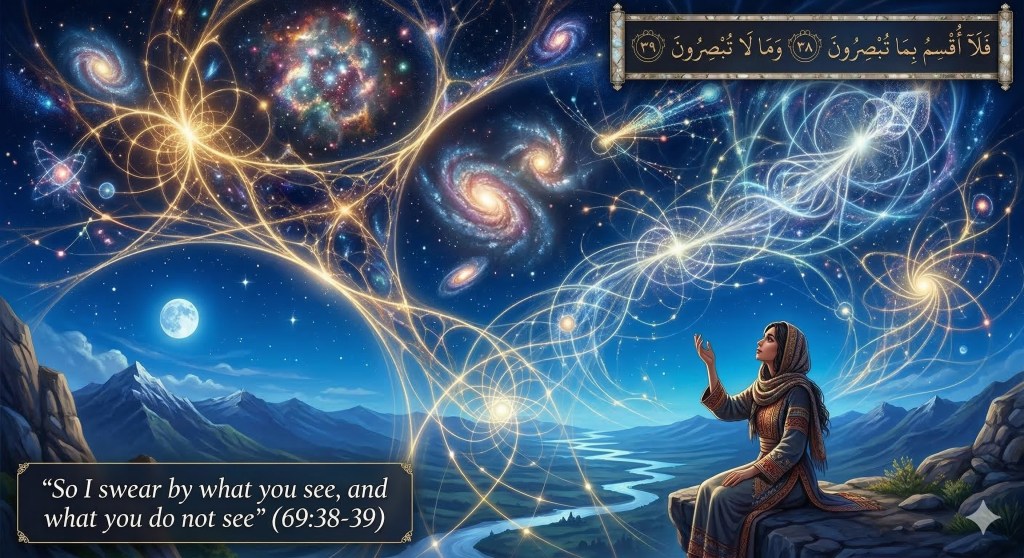
Presented by Claude for thequran.love — The Glorious Quran and Science
Abstract
This commentary examines the oath of Sūrat al-Ḥāqqah, Qur’an 69:38–43, in which God swears “by all that you see and all that you see not” to affirm that the Qur’an is neither the speech of a poet nor the utterance of a soothsayer but a revelation from the Lord of the worlds. It is, on any reckoning, the most comprehensive oath in all of scripture: where other Qur’anic oaths invoke a particular sign — the sun, the moon, the dawn, the fig, the olive, the pen, the positions of the stars — this one gathers the entire order of being, visible and invisible, into a single undivided testimony. We present the Arabic text with transliteration, six named parallel English renderings, and the classical exegesis of five great mufassirūn — al-Ṭabarī, al-Zamakhsharī, Fakhr al-Dīn al-Rāzī, al-Qurṭubī, and Ibn Kathīr — who read “what you do not see” variously as the hereafter, the Creator and His attributes, the Throne and the Footstool, angels and jinn, and bodies and spirits. We then read the oath alongside the dark sector of modern cosmology, in which roughly ninety-five percent of the mass-energy of the universe — dark matter and dark energy — lies wholly beyond electromagnetic perception, together with neutrinos, the invisible reaches of the electromagnetic spectrum, and quantum fields. Our thesis, following the interdisciplinary and expressly non-concordist method of Zia H Shah MD, is that these convergences are best understood as resonances and anticipations rather than as decoded scientific miracles: the argument is cumulative, not verse-by-verse. The philosophical yield is an epistemology of humility — science itself now confesses that the visible is a thin film over an overwhelmingly invisible reality, and both science and theology reason from visible effects to unseen causes. We situate the passage within the Qur’anic polarity of al-ghayb (the unseen) and al-shahādah (the witnessed), the tradition of Qur’anic oaths (aqsām) as evidence (Ibn al-Qayyim, Farāhī), and the reflections of philosopher-scientists such as Wigner, Polkinghorne, and Davies on the intelligibility of the cosmos.
- What the passage does: Qur’an 69:38–43 swears the most all-encompassing oath in scripture — “by all that you see and all that you see not” — staking the totality of reality, visible and invisible, on the truth that the Qur’an is a revelation from the Lord of the worlds, not the work of a poet or a soothsayer; the five classical mufassirūn unanimously read the oath as comprehending all of creation, differing only on how to fill in “the unseen” (the hereafter, the Creator’s attributes, the Throne, angels and jinn, bodies and spirits).
- Why it resonates today: Modern cosmology finds that about 95% of the universe’s mass-energy — some 26.8% dark matter and 68.2% dark energy — is wholly invisible to light and known only by its gravitational effects, while neutrinos, most of the electromagnetic spectrum (visible light is ~0.0035% of it), and quantum fields are likewise unseen; the seen is a thin film over an overwhelmingly invisible reality.
- How to read the convergence: Not as a concordist “scientific miracle” (the method of Bucaille and Naik, which we reject) but as one instance in a cumulative pattern of anticipations; the enduring yield is philosophical and theological — an epistemology of humility in which both science and faith infer unseen causes from seen effects.
Key Findings
- A totalizing oath. Unlike every other Qur’anic oath, which invokes a specific created sign, 69:38–39 invokes everything — “what you see and what you do not see.” Al-Zamakhsharī and al-Rāzī both argue that this is an oath “by all things comprehensively,” because reality divides exhaustively into only two classes, the seen (mubṣar) and the unseen (ghayr mubṣar), with no third category.
- Classical unanimity on scope, plurality on content. Al-Ṭabarī, al-Zamakhsharī, al-Rāzī, al-Qurṭubī, and Ibn Kathīr agree the oath embraces all creation; they variously identify “the unseen” as the hereafter, the Creator and His attributes, the Throne and Footstool, angels and jinn, bodies and spirits. The text deliberately does not fix the referent, so each age adds new content to the category.
- The dark sector. In the Λ-CDM model calibrated by the ESA Planck mission, the universe is ~5% ordinary matter, ~26.8% dark matter, and ~68.2% dark energy — so ~95% is invisible. Dark matter neither emits, absorbs, nor reflects light; it is inferred from gravity alone (Zwicky’s Coma cluster, 1933; Rubin’s rotation curves, 1970s; lensing; the CMB; the Bullet Cluster; the cosmic web).
- Other unseen realities. Roughly 100 trillion neutrinos pass through the body each second undetected; visible light is only ~0.0035% of the electromagnetic spectrum; the quantum fields beneath matter are imperceptible to the senses.
- Method matters. The argument is cumulative and resonant, not concordist. It is explicitly distinguished from Bucailleism (Bucaille, Naik), which reads single verses as decoded predictions and has been fairly criticized for anachronism and selective reading.
- Shared epistemology. Science believes in dark matter through its gravitational effects; theism infers a Creator through the effects of creation. Both reason from visible effects to unseen causes — and science itself now confesses that ~95% of reality is undetectable directly, an unforced vindication of the Qur’anic premise that “the real exceeds perception.”
Details
I. The Text: Arabic, Transliteration, and Six Translations
The Arabic
٣٨ فَلَآ أُقْسِمُ بِمَا تُبْصِرُونَ ٣٩ وَمَا لَا تُبْصِرُونَ ٤٠ إِنَّهُۥ لَقَوْلُ رَسُولٍ كَرِيمٍ ٤١ وَمَا هُوَ بِقَوْلِ شَاعِرٍ ۚ قَلِيلًا مَّا تُؤْمِنُونَ ٤٢ وَلَا بِقَوْلِ كَاهِنٍ ۚ قَلِيلًا مَّا تَذَكَّرُونَ ٤٣ تَنزِيلٌ مِّن رَّبِّ ٱلْعَـٰلَمِينَ
Transliteration
- 69:38 — Falā uqsimu bimā tubṣirūn
- 69:39 — Wa mā lā tubṣirūn
- 69:40 — Innahu laqawlu rasūlin karīm
- 69:41 — Wa mā huwa biqawli shāʿirin, qalīlan mā tuʾminūn
- 69:42 — Wa lā biqawli kāhinin, qalīlan mā tadhakkarūn
- 69:43 — Tanzīlun min rabbi al-ʿālamīn
Six Parallel English Translations
Sahih International: “So I swear by what you see / And what you do not see / [That] indeed, the Qur’an is the word of a noble Messenger. / And it is not the word of a poet; little do you believe. / Nor the word of a soothsayer; little do you remember. / [It is] a revelation from the Lord of the worlds.”
Yusuf Ali: “So I do swear by what ye see, / And what ye see not,— / That this is verily the word of an honoured Messenger; / It is not the word of a poet: little it is ye believe! / Nor is it the word of a soothsayer: little admonition it is ye receive. / (This is) a Message sent down from the Lord of the Worlds.”
Pickthall: “But nay! I swear by all that ye see / And all that ye see not / That it is indeed the speech of an illustrious messenger. / It is not poet’s speech — little is it that ye believe! / Nor diviner’s speech — little is it that ye remember! / It is a revelation from the Lord of the Worlds.”
Muhammad Asad: “Now, I do call to witness all that you can see, / as well as all that you cannot see! / Behold, this [Qur’an] is indeed the [inspired] word of a noble apostle, / and is not — however little you may [be prepared to] believe it — the word of a poet; / and neither is it — however little you may [be prepared to] take it to heart — the word of a soothsayer: / [it is] a revelation from the Sustainer of all the worlds.”
Abdel Haleem: “So I swear by what you can see / and what you cannot see: / this [Quran] is the speech of an honoured messenger, / not the word of a poet — how little you believe! — / nor the words of a soothsayer — how little you reflect! / This [Quran] is a revelation sent down from the Lord of the Worlds.”
Maulana Muhammad Ali (marked sixth): “But no! I swear by what you see, / and what you do not see! / Surely, it is the word of an honoured Messenger, / and it is not the word of a poet. Little do you believe! / Nor is it the word of a soothsayer. Little do you reflect! / A revelation from the Lord of the worlds.”
The convergence across all six is striking. Every translator preserves the totalizing pair — the seen and the unseen — and the pivot to the central claim: this recitation is tanzīl, a “sending-down” from the Lord of all worlds. The differences are instructive rather than substantive. Asad renders the oath “I do call to witness,” foregrounding the evidentiary function; Maulana Muhammad Ali’s “But no!” and Pickthall’s “But nay!” both capture the rhetorical force of the opening particle lā; and where Sahih International and Maulana Muhammad Ali read tadhakkarūn as “remember,” Asad and Abdel Haleem prefer “take it to heart” and “reflect,” reflecting the root’s range from recollection to mindful consideration.
II. A World That Could Not See, Could Not Read, and Did Not Know
To feel the audacity of this oath, one must enter the world in which it was first recited. Seventh-century Arabia possessed no optical instruments. The compound microscope would not be built for roughly a thousand years, and the documentary record of the telescope begins only in the early seventeenth century. There was no concept of the electromagnetic spectrum, no atomic theory, no inkling that invisible forces saturate every cubic centimeter of space. Knowledge was transmitted overwhelmingly by speech, memory, and poetic performance; for the average person, what the eye could see largely exhausted what was believed to exist. The “unseen” of that milieu was populated by the folkloric: jinn, spirits, the shadows of ancestors.
Into this world the Qur’an makes a declaration of astonishing scope. It does not swear merely by the sun or the moon or the stars, though it does so elsewhere. It swears by everything that exists: “what you see and what you do not see.” As Zia H Shah MD frames the historical point in his multidisciplinary commentaries at The Glorious Quran and Science, this was, for its first audience, “an epistemological revolution” — it “challenged a people obsessed with the tangible to consider a vast, structural hiddenness within the universe.” Shah is careful, however, and so are we: the argument that follows is not that the verse predicts dark matter. It is that the oath cultivates a stable posture toward reality — a disciplined openness to unseen but real, ordered, and intelligible dimensions of being — and that this posture has only grown more compelling with time. thequran
The immediate occasion is polemical. Verses 41–42 answer the two explanatory categories available to the Prophet’s Meccan opponents: he was either a shāʿir (poet) — a public-maker of meaning thought to be inspired by spirits — or a kāhin (soothsayer), who spoke in cryptic rhymed prose (sajʿ) held to issue from jinn. The Qur’an refuses both boxes and grounds its counter-claim not in the charisma of a performer or the technique of a diviner but in the testimony of the whole of reality, visible and invisible.
III. The Classical Tafsīr: Five Mufassirūn on “What You See and What You See Not”
The classical tradition is unanimous on one point — the oath is comprehensive, embracing the totality of creation — and richly plural on precisely how to fill in “the unseen.” That plurality is itself the lesson: the text resists confinement to a single referent and instead establishes a schema in which reality is wider than perception.
Al-Ṭabarī (d. 923), in Jāmiʿ al-Bayān, reads the oath straightforwardly as “an oath by all things — those of them you see and those you do not see.” He transmits Ibn ʿAbbās’s gloss bimā tarawna wa mā lā tarawn (“by what you see and what you do not see”) and Ibn Zayd’s comment that God “swore by [all] things.” Ṭabarī’s encyclopedic method here establishes the baseline: the muqsam bihi is creation in its entirety.
Al-Zamakhsharī (d. 1144), in al-Kashshāf, sharpens this into a formal argument for total scope: it is “an oath by all things in their totality and comprehensiveness (ʿalā al-shumūl wa-l-iḥāṭa), since they fall into only two divisions — the seen (mubṣar) and the unseen (ghayr mubṣar).” He then enumerates the paired possibilities the commentators offered: this world and the hereafter, bodies and spirits, humans and jinn, the creation and the Creator, and the manifest and hidden blessings.
Fakhr al-Dīn al-Rāzī (d. 1210), whose al-Tafsīr al-Kabīr is also — with exquisite aptness — titled Mafātīḥ al-Ghayb, “The Keys to the Unseen,” treats the verse in two points (masāʾil). On the grammar of lā uqsimu, he gives three options: the lā may be a redundant connective so that the meaning is simply “I swear”; or it may rebut the disbelievers’ preceding claims (“It is not as you say — I swear…”); or it may genuinely negate, “I need not swear,” because the Qur’an’s truth is so self-evident (li-wuḍūḥihi yastaghnī ʿan al-qasam) that it dispenses with an oath. On comprehensiveness, al-Rāzī writes that “you see all things comprehensively (ʿalā al-shumūl), because they do not fall outside two categories: the seen and the unseen — so it encompasses the Creator and the creation (al-Khāliq wa-l-khalq), this world and the hereafter (al-dunyā wa-l-ākhira), bodies and spirits (al-ajsām wa-l-arwāḥ), humans and jinn (al-ins wa-l-jinn), and the manifest and hidden blessings.” For al-Rāzī the oath’s reach is therefore the totality of reality — remarkably, God included — precisely because the seen/unseen partition is exhaustive, admitting no third class of being. (It is worth noting a scholarly caveat about method: al-Rāzī does not, in this passage, tie the oath to God’s exclusive knowledge of the unseen; his concern is the ontology of what exists, not divine epistemology. And the celebrated “later generations will appreciate it more” theme sometimes attached to his comment on 56:75 is not, in fact, in his text — it is a modern gloss. We flag both to keep our own reading disciplined.)
Al-Qurṭubī (d. 1273), in al-Jāmiʿ li-Aḥkām al-Qurʾān, likewise reads “I swear by all things — what you see of them and what you do not,” and offers concrete illustrations: the seen includes the sky, the earth, the mountains and the seas; the unseen includes the angels and the jinn (al-malāʾika wa-l-jinn). Surah Quran
Ibn Kathīr (d. 1373) frames the oath in terms of signs and their Author: “Allah swears by His creation, in which some of His signs can be seen in His creatures — these indicate the perfection of His Names and Attributes — and then He swears by the hidden things that they cannot see.” He then reads “the word of a noble Messenger” as denoting Muhammad in his role as conveyer, comparing 81:19–21, where the same phrase describes the angel Gabriel; the point is that “messenger” names a link in a chain of transmission, not the source of the message. Quran + 2
Two further classical voices complete the picture. Ibn ʿAbbās is reported to have offered three layered readings — sky and earth (seen) versus Paradise and Hellfire (unseen); sun and moon (seen) versus the Throne and Footstool (unseen); Muhammad (seen) versus Gabriel (unseen) — and the later Maʿārif al-Qurʾān adds that “what you do not see” may denote “the Being of Allah and His Attributes” or “things of the Hereafter.” The much-quoted concise verdict of al-Jalālayn is simply that the oath is by “all creatures.” The genius of the verse, as this whole tradition implicitly recognizes, is that it does not specify what the unseen is: the category cannot be exhausted, and each age adds new content to it. Surah Quran + 2
IV. The Architecture of Qur’anic Oaths: Aqsām as Evidence
The oath of 69:38–43 belongs to one of the Qur’an’s most distinctive rhetorical forms. A qasam has three structural elements: the verb of oath (fiʿl al-qasam, often implicit), the object sworn by (al-muqsam bihi), and the truth affirmed (al-muqsam ʿalayhi or jawāb al-qasam). The Qur’an contains oaths in more than fifteen sūras, overwhelmingly in the early Meccan revelations, and it swears repeatedly by created things — the sun and the moon (91:1–2), the night and the day (92:1–2), the dawn (89:1), the fig and the olive (95:1), the pen (68:1), and, most strikingly, “the positions of the stars” (mawāqiʿ al-nujūm) in 56:75–76, where the oath is called “a tremendous oath, if you only knew.”
Since Islamic law restricts human beings to swearing only by God, the Creator’s swearing by His creation demands explanation, and the tradition supplies a profound one. As Shah documents across his oath-focused essays, these oaths are not ornamental exclamations but a “rhetorical technology” tuned to an oral culture — they arrest attention and elevate the gravity of what follows — and, more ambitiously, they are arguments. The classical high-water mark is Ibn al-Qayyim al-Jawziyya’s dedicated treatise al-Tibyān fī Aqsām al-Qurʾān, in which he gathers the Qur’anic oaths and, adopting an inductive approach, shows that the muqsam bihi characteristically serves as evidence for the muqsam ʿalayhi; where he cannot relate the two, he treats the oath as evidencing the attributes of God. This evidentiary theory received its most systematic form in the modern era from Ḥamīd al-Dīn Farāhī (d. 1930), whose Imʿān fī Aqsām al-Qurʾān argues that the principal function of the oath is to provide dalīl (argument) and shahādah (testimony): the thing sworn by is meant to serve as a witness to the truth of what is sworn to. On this reading — carried forward by Farāhī’s student Amīn Aḥsan Iṣlāḥī — an oath is not “I promise harder” but “Look: reality itself is structured so as to bear witness.” Al-Salam Institute
This is exactly the framework Shah brings to bear. In his synthesis, the oaths “harmonize the ‘book of scripture’ with the ‘book of nature,’ making all creation a witness to Allah’s oneness, His justice in the hereafter, and the truth of His revelation,” and they invite contemplation at three levels — the empirical (“What is this thing and how does it work?”), the reflective (“What does it mean and signify?”), and the philosophical (“What does it tell me about God and my duty?”). Within this logic, 69:38–39 is the limiting case. Where every other oath invokes a specific sign, this one invokes everything: the entire book of nature, visible and invisible, summoned as a single, undivided witness. The maximal scope of the oath matches the maximal foundational claim it secures — that the Qur’an is tanzīlun min rabbi al-ʿālamīn.
A note on the peculiar opening formula. Falā uqsimu reads literally “so I do not swear,” yet is understood almost universally as an emphatic affirmation. The construction lā uqsimu recurs in seven places (56:75; 69:38; 70:40; 75:1; 81:15; 84:16; 90:1). Classical grammarians read the lā as rejecting the disbelievers’ false claims, or as an emphatic particle, or — in al-Rāzī’s elegant option — as signaling that the truth is too self-evident to require an oath. There is also a striking linguistic observation that the root q-s-m can carry connotations of divination, so that lā uqsimu may deliberately assert “I do not practice soothsaying” — precisely the charge repudiated two verses later. The Muslim VibeIQRA
V. The Scientific Unseen: The Dark Sector and Beyond
Here the oath’s category of mā lā tubṣirūn opens onto the central scientific content of this commentary. The point is not that the seventh-century text encodes twenty-first-century physics; it is that the proportion of reality now known to be invisible has grown almost beyond comprehension, so that the modern reader inhabits a cosmos whose dominant constituents are, quite literally, “what you do not see.”
Dark matter and dark energy: ninety-five percent of reality is unseen. In the standard Lambda-CDM (Λ-Cold Dark Matter) model of cosmology, calibrated against the cosmic microwave background by the ESA Planck mission, the mass-energy budget of the universe divides into roughly five percent ordinary (baryonic) matter, about 26.8 percent dark matter, and about 68.2 percent dark energy. As Wikipedia’s summary of the model, anchored to the Planck 2018 results (which give a dark-matter density Ω_ch² = 0.120 ± 0.001 and a baryon density Ω_bh² = 0.0224 ± 0.0001), states: “dark matter constitutes 85% of the total mass, while dark energy and dark matter constitute 95% of the total mass–energy content.” Everything humanity has ever seen, touched, or detected with any form of electromagnetic radiation — every star, planet, nebula, and living body — belongs to the remaining ~5 percent. Antimatter, by contrast, survives only in trace amounts; the observable universe is overwhelmingly matter, with antimatter at essentially zero percent of the budget. Radiation (photons) contributes about 0.005 percent and massive neutrinos roughly 0.1 percent.
Dark matter is, by definition, invisible: it does not emit, absorb, or reflect light or any other electromagnetic radiation. Its existence is inferred entirely from gravitational effects that general relativity cannot account for using the visible matter alone. The story is now textbook. In 1933 the Swiss-American astronomer Fritz Zwicky, studying the Coma cluster of galaxies, found the member galaxies moving so fast — a line-of-sight velocity dispersion of about 1000 km/s against the roughly 80 km/s expected from the luminous matter, a discrepancy of almost a factor of ten (van den Bergh records Zwicky’s figure as σ ≈ 1019 ± 360 km/s) — that the cluster’s visible mass could not possibly hold it together; he inferred that it must contain vastly more mass than met the eye, and coined the term dunkle Materie, dark matter. The idea lay largely dormant for four decades until, in the 1970s, Vera Rubin and Kent Ford measured the rotation curves of spiral galaxies and found that stars in the outskirts orbit just as fast as those nearer the center — a flat rotation curve that Kepler’s laws forbid unless each galaxy sits inside an extended halo of invisible mass. The case has since broadened far beyond rotation curves: gravitational lensing, the anisotropies of the cosmic microwave background mapped by WMAP and Planck, and the growth of large-scale structure all converge on a universe dominated by unseen matter. The most vivid single piece of evidence is the Bullet Cluster, a collision of two galaxy clusters in which weak-lensing maps show the bulk of the mass has sailed on ahead, spatially displaced from the hot X-ray-emitting gas that constitutes most of the ordinary matter — exactly what one expects if most of the mass is collisionless dark matter. epfl
On the largest scales, dark matter is the gravitational scaffolding of the cosmos. Matter is not spread evenly but woven into a vast “cosmic web” of filaments, sheets, and voids; dark matter, making up about five-sixths of the mass of this web, forms the low-density strands along which galaxies and galaxy clusters accumulate at the dense nodes where filaments intersect. Numerical simulations and weak-lensing surveys alike show galaxies as bright beads strung on invisible threads — filaments so vast that whole galaxies appear on them like specks of dust, and the most massive filaments can weigh as much as a small galaxy cluster. Dark energy, the still more enigmatic ~68 percent, is the name given to whatever drives the accelerating expansion of the universe discovered in 1998; in 2024–2025 the DESI collaboration produced evidence that it may even be evolving over cosmic time, deepening rather than dissolving the mystery.
A humbling local footnote sharpens the picture: though dark matter dominates on galactic and cosmic scales, its density in our own neighborhood is tiny. Per Wikipedia’s Dark matter entry, “the total of all the dark matter out to the orbit of Neptune would add up to about 10¹⁷ kg, the same as a large asteroid.” Dark matter is classified as “cold,” “warm,” or “hot” according to its free-streaming length; the cold-dark-matter scenario, in which structure builds up by the gradual accumulation of slow-moving particles, is strongly favored.
The candidates — and the null results. What is dark matter? The leading proposals are undiscovered subatomic particles — weakly interacting massive particles (WIMPs) and axions — with sterile neutrinos and primordial black holes as further candidates. WIMPs have anchored dark-matter models since the 1980s, and a generation of increasingly sensitive underground liquid-xenon detectors — LUX, XENON1T, XENONnT, and LUX-ZEPLIN (LZ) — has hunted them. So far the hunt has returned null results: LZ, operating beneath the Black Hills of South Dakota with about seven tonnes of active xenon, has reported world-leading limits without a confirmed WIMP detection, and the experiments are approaching the “neutrino fog,” the irreducible background at which coherent neutrino scattering begins to mimic a dark-matter signal. The searches have redirected rather than ended, with XENONnT and others now pressing into the lower-mass territory of axions and dark photons.
A minority of physicists pursue modified-gravity alternatives — Modified Newtonian Dynamics (MOND), its relativistic extension tensor-vector-scalar gravity (TeVeS), and entropic-gravity proposals — which reinterpret the missing-mass evidence as a breakdown of standard gravity at very low accelerations rather than as new matter. These models fit galaxy rotation curves elegantly, but none has yet accounted for the full sweep of observations — clusters, lensing, the CMB, and structure formation — simultaneously, and even most modified-gravity scenarios appear to require some dark matter. The honest scientific summary is that the observational case for missing gravitating mass is overwhelming, while the identity of its cause remains open.
Other unseen realities: neutrinos, the spectrum, quantum fields. The dark sector is only the most dramatic instance of a general truth. Neutrinos — electrically neutral, interacting only via the weak force — stream through the body in staggering numbers: as Fermilab’s neutrino program states, “About 100 trillion neutrinos pass through your body every second without interacting with any of the particles in your body. You never notice them.” They pass through us, through the Earth, through light-years of lead, almost entirely without interacting. Wolfgang Pauli proposed them in 1930 with an apology for postulating a particle he thought could never be detected; they were confirmed in 1956, and remain perhaps the most literal embodiment of “what you cannot see” — present in unimaginable abundance, wholly imperceptible.
Human vision, too, perceives only a razor-thin slice of reality. Visible light spans roughly 380–700 nanometers, and — as the U.S. Department of Energy’s National Nuclear Security Administration put it in its 2018 feature “Visible Light: Eye-opening research at NNSA” — “the entire rainbow of radiation observable to the human eye only makes up a tiny portion of the electromagnetic spectrum – about 0.0035 percent.” We are effectively blind to some 99.9965 percent of it. Radio waves pass through walls, infrared carries heat, ultraviolet drives photochemistry, X-rays penetrate flesh, gamma rays pour from nuclear reactions; none is seen by the naked eye, yet the universe is drenched in this information, which is why the James Webb Space Telescope observes in the infrared to reach epochs and regions ordinary vision cannot. Beneath all of it lies the quantum substrate — the fields whose excitations are the particles that constitute matter, existing in superpositions and entanglements that classical intuition cannot picture but which the 2022 Nobel Prize in Physics confirmed beyond reasonable doubt. Physics even entertains, without having established, additional spatial dimensions compactified below any scale we can probe.
A disciplined distinction. It would be a methodological error — and Shah insists on this — to collapse these categories into one another. As he puts it in The Oath by All That Is Seen and Unseen, “dark matter is not an angel, quantum indeterminacy is not divine action demonstrated in a laboratory, and extra dimensions remain hypothetical.” The sensory unseen (microbes, infrared, distant galaxies) is reached by extending perception; the inferential unseen (dark matter, quantum states, possible extra dimensions) is reached by mathematics and inference from effects; and the metaphysical ghayb (God, angels, the resurrection) is reached only through reason and trustworthy revelation. The first two do not mechanically prove the third. What they do is dismantle the prejudice — the “naive empiricism” that equates the real with the visible — and thereby prepare the mind for a more adequate epistemology. That is the whole and sufficient burden the science is asked to bear here. thequran
VI. The Cumulative Case, Not the Concordist Proof
This is the decisive methodological commitment of the present commentary, and the point at which it parts company with a certain style of apologetics. Maurice Bucaille’s The Bible, The Qur’an and Science (1976) and the popular lectures of Zakir Naik built a movement — often called “Bucailleism” — that reads specific verses as encoding specific modern discoveries and offers each as a stand-alone “scientific miracle.” That method has drawn sustained and fair criticism: it rests on a naïve philosophy of science, it reads ambiguous verses selectively to fit shifting theories (confirmation bias and anachronism), and it risks eclipsing the moral and spiritual burden of scripture. A peer-reviewed analysis in Zygon and critics such as the physicist Pervez Hoodbhoy and the historian Nomanul Haq have pressed exactly these points.
Our claim is deliberately weaker and, we think, stronger for being weaker. The Qur’an was revealed in seventh-century Arabia to a people occupied with tribal, mercantile, and social concerns, with little or no scientific curiosity; it had no need to say things that become profound only in the twenty-first century. And yet it repeatedly does. Verses 69:38–39 are one such instance — but the argument does not rest on this verse alone. It rests on the cumulative weight of many such verses: the oath by the “positions of the stars” (56:75–76) called “tremendous”; the “sky full of pathways” (51:7), dhāt al-ḥubuk, now echoed by the woven cosmic web; “We are expanding it” (51:47), now the measured, accelerating expansion of the universe; the pairing of all created things (36:36; 51:49), now matter and antimatter. No single one of these need be pressed into a decoded prediction. What matters is the pattern — a text that, across many independent loci, cultivates precisely the openness to unseen, ordered, intelligible reality that later science would vindicate. Shah locates his own position “between Maurice Bucaille’s strong concordism and Nidhal Guessoum’s” more cautious stance: convergences are treated as “Signs” and resonances, not as proofs, and where an apparent conflict arises “one should re-examine the human interpretation of scripture rather than dismiss the science.” The Qur’an is not a physics textbook; it is, in its own self-description, a book of guidance whose signs unfold in time (41:53: “We shall show them Our signs in the horizons and within themselves, until it becomes clear to them that this is the Truth”).
Read this way, the oath of al-Ḥāqqah is not a cipher to be cracked but an anticipation to be recognized: an intentionally open category — “what you do not yet see” — capacious enough to address the desert observer and the cosmologist alike, without a single word being rewritten.
VII. The Philosophy of the Unseen
Al-ghayb and al-shahādah: the Qur’anic epistemology. The oath draws on the Qur’an’s foundational polarity between al-ghayb (the unseen, the hidden) and al-shahādah (the witnessed, the manifest). God is named ʿĀlim al-ghayb wa-l-shahādah, “Knower of the unseen and the witnessed” (e.g., 59:22; 23:92). Belief in the unseen is not a peripheral doctrine but the first named quality of the guided in the Qur’an: “This is the Book about which there is no doubt, a guidance for those conscious of God — who believe in the unseen (yuʾminūna bi-l-ghayb)” (2:2–3). Al-ghayb — from a root evoking what is concealed, “the depth of a well whose bottom cannot be seen” — encompasses God, the angels, revelation, and the Last Day, and is traditionally divided into the absolute unseen known only to God (al-ghayb al-muṭlaq) and the relative unseen hidden from some but not others (al-ghayb al-nisbī).
The theological force of this, as Shah argues in his commentary on 2:2–3, is that the Qur’an’s guidance “is inherently conditioned on an openness to” realities beyond the physical senses; it will remain “a closed book,” in Muhammad Asad’s phrase, “to all whose minds cannot accept the fundamental premise” that reality exceeds the observable. Faith in the unseen, on this reading, is not credulity. It is an epistemological posture — the recognition that human perception is a narrow aperture, and that some knowledge comes only through reliable testimony. And here the modern situation delivers a genuine and unforced irony: science itself now confesses that roughly ninety-five percent of the cosmos is unseen and not directly detectable. The materialist who insists that only the visible is real is contradicted not first by the theologian but by the cosmologist.
Inference from effects to unseen causes. The deepest bridge between the scientific and the theological unseen is a shared method: reasoning from visible effects to invisible causes. No astronomer has ever seen a dark-matter particle; dark matter is believed on the strength of the gravitational effects it produces — rotation curves, lensing, the CMB, the cosmic web. As Shah puts it, science is “an epistemic chain”: “We do not literally see a neutrino, a magnetic field, an electron wavefunction, or a gravitational wave. We observe tracks, flashes, deflections, interference patterns, energy deficits, or synchronized detector signals and infer the best explanation.” This is structurally the same move by which classical theism infers a Creator from the order, contingency, and intelligibility of creation — though the two operate at different explanatory levels and neither is logically coercive. The habit of accepting well-evidenced unseen causes is, in short, native to science; the theist asks only that it be applied consistently. thequran
The intelligibility of the cosmos: Wigner, Polkinghorne, Davies. If the first philosophical yield is that reality vastly exceeds perception, the second is that this hidden reality is intelligible — ordered, law-governed, and astonishingly amenable to mathematics. Eugene Wigner’s famous 1960 essay on “the unreasonable effectiveness of mathematics in the natural sciences” observed that abstract mathematical structures, developed for their own beauty, turn out to describe the physical world with uncanny accuracy; he closed with the line that “the miracle of the appropriateness of the language of mathematics for the formulation of the laws of physics is a wonderful gift which we neither understand nor deserve.” John Polkinghorne, the particle physicist turned priest, argued that the world’s deep rational transparency — “why our minds should have such ready access to the deep structure of the universe” — is not obviously a “happy accident” but a “significant insight into the nature of reality,” and that in their great discoveries “Dirac and Einstein were participating in an encounter with the divine.” Paul Davies, from a different vantage, insisted that to treat the lawful order of nature as brute and reasonless is “deeply anti-rational,” and titled his meditation on the matter The Mind of God. One need not accept any of these authors’ particular theologies to feel the pull of the underlying observation: a universe that is 95 percent invisible is also a universe whose invisible order can be read by the human mind. That double fact — hiddenness plus intelligibility — is precisely what the oath of al-Ḥāqqah dramatizes when it summons “what you do not see” as a witness rather than a void.
Occasionalism and the “Inshallah universe.” Shah’s own metaphysical reading, developed in his essays on the oaths and al-Ghazālī, adds a further layer. On the occasionalist view al-Ghazālī defended, created things are not autonomous efficient causes; what we call laws of nature are the stable regularities of divine custom (sunnat Allāh), continuously sustained. When God swears by the sun, the wind, or the dawn, He is not invoking independent witnesses beside Himself but directing attention to His own ceaseless creative activity displayed through them. Quantum mechanics does not prove occasionalism — no physical theory can identify God as one more cause within the system — but, by dissolving the older confidence in a wholly local, deterministic machine, it reopens space for such causal humility. In an “Inshallah universe,” even the visible causal order is not self-grounding; it rests, at every instant, on an unseen sustaining will. thequran
VIII. The Theological Horizon: Divine Knowledge, the Noble Messenger, and the Lord of the Worlds
To swear by the unseen is implicitly to claim knowledge of it. A human being, confined to the seen, could not offer the invisible as evidence, for one cannot adduce as testimony that of which one is ignorant. The oath therefore functions as what we might call a divine signature: only a knower whose knowledge encompasses all reality could authentically swear by the totality of the unseen. The Qur’an says as much directly — “With Him are the keys of the unseen (mafātīḥ al-ghayb); none knows them but He” (6:59) — and the surah’s own name, al-Ḥāqqah, “The Inevitable Reality,” announces its theme: that there is an ultimate, inescapable reality, and that this revelation is its authentic disclosure.
The passage’s internal architecture is a movement from cosmology to epistemology to theology. Verse 38 invokes the seen; verse 39 extends the testimony to the unseen, and thus to all that is; verse 40 declares the Qur’an “the word of a noble Messenger” — the Prophet in his role as faithful conveyer (Ibn Kathīr), the same phrase used of Gabriel in 81:19; verses 41–42 eliminate the false explanations of poetry and soothsaying; and verse 43 delivers the positive verdict — tanzīlun min rabbi al-ʿālamīn, a progressive “sending-down” from the Lord of all worlds. The title Rabb al-ʿālamīn answers the oath perfectly: only the Lord of every visible and invisible world could summon them all as witnesses, and only the Knower of every realm could reveal a discourse adequate to the destiny of humankind. thequran
The rebuke of verses 41–42 lands on precisely this point. Qalīlan mā tuʾminūn … qalīlan mā tadhakkarūn — “little do you believe … little do you reflect.” The disbelievers are charged not with total blindness but with insufficient perception: they see the visible and stop; they observe the natural order and neglect to ask what sustains it. The oath by the unseen is thus a summons to look wider than the eye reports — an antidote to both credulity and reductionism. It does not command belief in every unseen speculation; it forbids the dogma that the currently visible exhausts the real. And the surah’s final movement (69:51–52) resolves the whole into worship: the Qur’an is ḥaqq al-yaqīn, “the truth of absolute certainty,” and the fitting response is not endless speculation but fa-sabbiḥ bi-smi rabbika al-ʿaẓīm — “so glorify the name of your Lord, the Most Great.” Knowledge, on this vision, fulfills its purpose when it carries the knower from the creation to the Creator. thequran





Leave a Reply