
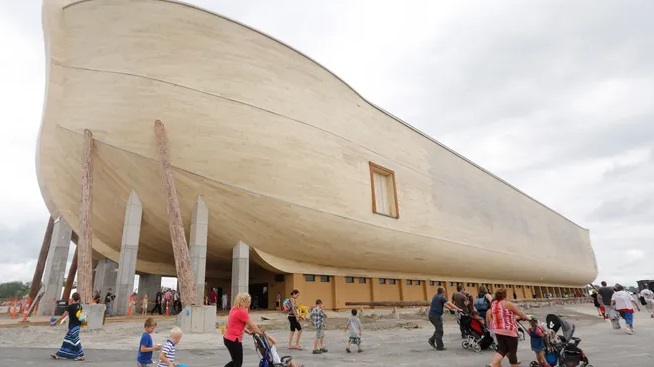
A commentary on Surah Hud 11:44, Surah Al-Qamar 54:13–15, and Surah Al-Ankabut 29:15 presented by Claude
Abstract
The Quran is strikingly specific about the end of the Flood narrative: the ark of Noah, it declares, came to rest ʿalā al-Jūdiyy — upon Mount Judi (Q 11:44). This single geographical notice, unique among ancient flood accounts in its precision, is joined in the Quran to a theological claim of equal weight: that the vessel and its story were deliberately left behind as an āyah, a sign — “And We left it as a sign; is there, then, any who will remember?” (Q 54:15); “and We made it a sign for the worlds” (Q 29:15). This essay reads these three passages together as a unified statement about divine pedagogy: God does not merely act in history; He archives His acts within history, in geography, in collective memory, and in scripture, so that later generations may read them. The essay examines the celebrated rhetorical perfection of 11:44, surveys the classical exegetical tradition (al-Ṭabarī, al-Zamakhsharī, al-Rāzī, al-Qurṭubī, Ibn Kathīr) on the identity of al-Jūdī, and then situates the Quranic notice within a remarkable convergence of independent ancient witnesses — the Babylonian priest Berossus, Josephus, the Syriac Peshitta and the Aramaic Targums, and the continuous local veneration of Cudi Dağı in southeastern Turkey — all of which point not to the modern Mount Ararat of popular imagination but to the mountains of the ancient Qardu/Gordyene region where Judi stands. Far from contradicting the Hebrew Bible, the Quran is shown to sharpen it: Genesis names a region (“the mountains of Ararat,” i.e., Urartu); the Quran names the peak. The essay closes by reflecting on what it means, in an age of satellites and sediment cores, for a mountain to remain a sign — and on the Quran’s refrain that signs avail only those who are willing to remember.
I. Introduction: A Mountain with a Name
Every great flood narrative of the ancient world ends with a landfall. The Mesopotamian survivor Utnapishtim grounds his vessel on Mount Nimush; the hero of the Sumerian tale emerges to sunlight and sacrifice; Genesis brings Noah’s ark to rest “upon the mountains of Ararat” (Genesis 8:4). What is distinctive about the Quran is the economy and exactness of its notice. In a single verse of twenty-odd Arabic words — a verse that Muslim rhetoricians would celebrate for a millennium as a summit of eloquence — the Quran ends the deluge, dries the earth, settles the ark, and pronounces the verdict of history:
وَقِيلَ يَا أَرْضُ ابْلَعِي مَاءَكِ وَيَا سَمَاءُ أَقْلِعِي وَغِيضَ الْمَاءُ وَقُضِيَ الْأَمْرُ وَاسْتَوَتْ عَلَى الْجُودِيِّ وَقِيلَ بُعْدًا لِّلْقَوْمِ الظَّالِمِينَ
“And it was said, ‘O earth, swallow your water, and O sky, withhold [your rain].’ And the water subsided, and the matter was accomplished, and the ship came to rest on the [mountain of] Jūdiyy. And it was said, ‘Away with the wrongdoing people.’” (Q 11:44)
The Quran does not leave the ark on an anonymous summit. It names the mountain — al-Jūdī — and in two other passages it tells us why the landfall mattered enough to be named. The vessel was not simply a means of rescue, discarded once the danger passed. It was retained, preserved, left:
وَلَقَد تَّرَكْنَاهَا آيَةً فَهَلْ مِن مُّدَّكِرٍ
“And We left it as a sign; so is there any who will remember?” (Q 54:15)
فَأَنجَيْنَاهُ وَأَصْحَابَ السَّفِينَةِ وَجَعَلْنَاهَا آيَةً لِّلْعَالَمِينَ
“But We saved him and the companions of the ship, and We made it a sign for the worlds.” (Q 29:15)
Three verses, three registers: geography (11:44), memory (54:15), universality (29:15). Read together they articulate a theology in which the physical world is a page on which God writes, and a mountain in the borderlands of Anatolia and Mesopotamia becomes a footnote of revelation — locatable, visitable, and, as we shall see, continuously venerated for well over two thousand years by Jews, Christians, Muslims, and the ancient peoples who preceded them all.
II. The Anchor Verse in Six Translations
Following the convention of this platform, the pivotal verse 11:44 is presented in six well-known English renderings, so that the reader may triangulate the Arabic through several interpretive temperaments.
Sahih International: “And it was said, ‘O earth, swallow your water, and O sky, withhold [your rain].’ And the water subsided, and the matter was accomplished, and the ship came to rest on the [mountain of] Jūdiyy. And it was said, ‘Away with the wrongdoing people.’”
Abdel Haleem: “Then it was said, ‘Earth, swallow up your water, and sky, hold back,’ and the water subsided, the command was fulfilled. The Ark settled on Mount Judi, and it was said, ‘Gone are those evildoing people!’”
Muhammad Asad: “And the word was spoken: ‘O earth, swallow up thy waters! And, O sky, cease [thy rain]!’ And the waters sank into the earth, and the will [of God] was done, and the ark came to rest on Mount Jūdī. And the word was spoken: ‘Away with these evildoing folk!’”
Yusuf Ali: “Then the word went forth: ‘O earth! swallow up thy water, and O sky! withhold (thy rain)!’ and the water abated, and the matter was ended. The Ark rested on Mount Judi, and the word went forth: ‘Away with those who do wrong!’”
Pickthall: “And it was said: O earth! Swallow thy water and, O sky! be cleared of clouds! And the water was made to subside. And the commandment was fulfilled. And it (the ship) came to rest upon (the mount) Al-Jūdī and it was said: A far removal for wrongdoing folk!”
Maulana Muhammad Ali: “And it was said: O earth, swallow thy water, and O cloud, clear away. And the water was made to abate, and the affair was decided, and it rested on the Jūdī, and it was said: Away with the iniquitous people!”
Whatever their differences of idiom, all six converge without hesitation on the same proper noun. There is no textual variant, no exegetical dispute about the reading itself: the ark rested ʿalā al-Jūdiyy.
III. The Eloquence of the Verse: A Deluge in One Breath
Before turning to geography, the verse itself deserves a moment of contemplation, for the classical tradition regarded Q 11:44 as one of the most perfect sentences ever composed in Arabic. Rhetoricians from ʿAbd al-Qāhir al-Jurjānī’s school onward returned to it as a touchstone of balāghah — of how much can be said in how little, and with what music.
Consider its architecture. The verse contains a chain of tightly compressed movements: a double apostrophe (earth and sky are addressed as living servants — yā arḍu, yā samāʾu); a pair of imperatives whose very sounds enact their meanings (iblaʿī, “swallow,” with its liquid gulp; aqliʿī, “desist,” clipped and final); two passive verbs that erase every intermediate agent (ghīḍa al-māʾ, “the water was made to subside”; quḍiya al-amr, “the matter was concluded”); the single verb of repose (istawat, “it settled”) followed by the naming of the mountain; and a closing formula of judgment (buʿdan li-l-qawm al-ẓālimīn) that functions like the fall of a gavel. Al-Zamakhsharī, in al-Kashshāf, lingers over this verse precisely because it fuses majesty of command (jazālah) with delicacy of construction: the cosmos obeys not through mechanism but through address — the Flood ends the way it began, by a word.
There is a theological point folded into the rhetoric. The earth and sky are commanded as one commands obedient creatures, and they comply instantly. This is the Quran’s pervasive vision — the same vision that animates the tasbīḥ verses in which “the seven heavens and the earth and whatever is in them” glorify God (Q 17:44) — of a universe that is not inert matter but continuous, responsive servanthood (sunnat Allāh). The Flood is not a suspension of nature; it is nature unveiled as command. And when the command is complete, the narrative does something ancient myth never quite does: it files a report. The ark rested on al-Jūdī. Revelation, having spoken to the sky, turns and speaks to the cartographer.
IV. Al-Jūdī in the Classical Tafsīr Tradition
The great commentators are unanimous that al-Jūdī is a real and identifiable mountain, and remarkably consistent about where it stands.
Al-Ṭabarī (d. 310/923), the father of the exegetical tradition, records in his Jāmiʿ al-bayān that al-Jūdī is a mountain in the land of the Jazīrah — the upper Mesopotamian region between the Tigris and Euphrates — with early authorities locating it near Mosul in the district of the Qardā country. He preserves the striking remark of the Successor Qatādah that God caused the ark to remain upon al-Jūdī “until it was seen by the first generations of this ummah” — that is, that recognizable remains were believed to survive into the early Islamic period as a standing admonition.
Al-Zamakhsharī (d. 538/1144) identifies al-Jūdī as a mountain by Mosul and devotes his real energy, as noted above, to the verse’s inimitable eloquence — treating the geographical notice as sober fact requiring little defense.
Fakhr al-Dīn al-Rāzī (d. 606/1210), in the Mafātīḥ al-ghayb, draws out the theology of the passage: the addressing of earth and sky demonstrates that all things are, with respect to divine power, as an obedient, discerning servant is to a master; the passive constructions (ghīḍa, quḍiya) teach that the true agent behind every secondary cause is God alone. For al-Rāzī the verse is a compact treatise on divine omnipotence — and the resting of the ark on a named mountain is the moment omnipotence condescends to leave an address.
Al-Qurṭubī (d. 671/1273) likewise places al-Jūdī in the Jazīrah region and transmits the tradition that the ark’s landfall was associated with the day of ʿĀshūrāʾ — a memory preserved in a report in the Musnad of Aḥmad ibn Ḥanbal that connects the fast of that day with gratitude for the deliverance of Noah.
Ibn Kathīr (d. 774/1373) is the most geographically concrete of all: al-Jūdī, he writes, is a mountain in the vicinity of Jazīrat Ibn ʿUmar (the modern town of Cizre on the Tigris, in Şırnak province, southeastern Turkey), and he too transmits reports that remnants of the ark were long pointed out upon it. Later geographers agreed: Yāqūt al-Ḥamawī’s Muʿjam al-buldān places al-Jūdī above the Tigris near Jazīrat Ibn ʿUmar, and travelers such as al-Masʿūdī before him mention the mountain and the village at its foot associated with the “Eighty” survivors (Thamānīn).
The tradition, in short, is not vague. From the first Islamic centuries the referent of Q 11:44 was fixed: the mountain the Kurds and Syriac Christians called Qardū and the Turks today call Cudi Dağı — a limestone massif rising to roughly 2,100 metres above the Tigris near Cizre, at the hinge of Anatolia and Mesopotamia.
V. Judi and Ararat: Reading the Two Scriptures Together
At first hearing, the Quran and the Hebrew Bible seem to disagree. Genesis 8:4 says the ark rested “upon the mountains of Ararat”; popular imagination — and a century of expeditions — has therefore fixed on the magnificent volcanic cone in far eastern Turkey that modern maps label Mount Ararat (Ağrı Dağı, 5,137 m). But this is to misread Genesis through a medieval lens.
In the Hebrew Bible, “Ararat” (אֲרָרָט) is not the name of a mountain at all. It is the name of a country — the kingdom the Assyrians called Urartu, centered on Lake Van and extending across the highlands of eastern Anatolia and northern Mesopotamia (cf. 2 Kings 19:37; Jeremiah 51:27, where Ararat is listed among kingdoms). “The mountains of Ararat” is a regional expression — “the Urartian highlands” — exactly as one might say “the mountains of Switzerland” without naming a peak. The identification of the ark’s landfall with the great volcano of Ağrı Dağı is a relatively late development in Christian tradition, gaining currency only in the medieval period; the volcano’s own older Armenian name was Masis, not Ararat.
The earlier Jewish and Christian traditions, in fact, point south — to precisely the region of Cudi Dağı. The Aramaic Targums (Onkelos among them) render Genesis 8:4 as the “mountains of Qardū“; the Syriac Peshitta — the Bible of the very Christians who lived in the shadow of the mountain — reads the same. Qardū is the ancient name of the Gordyene/Corduene district, the land of the Carduchians through whose mountains Xenophon’s Ten Thousand fought their way, the district in which Cudi Dağı stands. In other words: when the oldest translators of Genesis wanted to specify where within Urartu the ark had landed, they named the very district of al-Jūdī.
Seen in this light, the Quran does not contradict Genesis; it resolves it. Genesis gives the region; the Quran gives the peak — and the peak lies within the region. The two scriptures relate as a country and its address. This is a small but beautiful instance of a pattern this platform has often traced: the Quran’s self-description as muṣaddiq (confirming) and muhaymin (a guardian-arbiter) over prior revelation (Q 5:48) — confirming the shared narrative while quietly adjusting its focus. And it is a point on which honest interfaith conversation can proceed without polemic on any side: the Jewish Targumic tradition, the Syriac Christian tradition, and the Quran stand together on Qardū/Jūdī, while the popular Ararat of expedition documentaries rests on a later reidentification.
VI. The Witness of Antiquity: A Convergence of Independent Voices
What makes the Judi tradition intellectually arresting is that it does not depend on Islamic sources at all. Long before the Quran’s revelation, a chain of independent witnesses — Babylonian, Jewish-Hellenistic, and Christian — testified that the remains of the Flood vessel were shown in these same mountains.
Berossus (early third century BCE), a priest of Marduk in Babylon writing in Greek, recorded that part of the vessel of the Flood survivor “still remains in the mountains of the Gordyaeans” and that people scraped bitumen from it to carry off as talismans and amulets. His account survives through Alexander Polyhistor as quoted by Eusebius. The Gordyaean mountains are Gordyene — Qardū — the Judi district.
Josephus (first century CE), in the Antiquities of the Jews (I.3), writes that the ark’s remains were displayed in his own day and that the locals called the place “the Place of Descent” (Greek apobatērion), the spot where Noah came down. He cites, besides Berossus, the historians Hieronymus the Egyptian, Mnaseas, and Nicolaus of Damascus — a small library of now-lost ancient authors — as witnesses to the tradition, and he locates the relics in the territory associated with the Carduchians/Gordyene. Josephus is a Jewish historian writing for a Roman audience, with no conceivable stake in a mountain that a scripture revealed six centuries later would name.
The Epic of Gilgamesh (Tablet XI), older than all of these, grounds Utnapishtim’s vessel on Mount Nimush (formerly read Niṣir), generally sought in the ranges east of the Tigris. The Mesopotamian memory, whatever its precise peak, belongs to the same world of mountains rimming the Mesopotamian plain to the north and east — not to the distant volcano by the Araxes. The deep human memory of the deluge, in its oldest recoverable strata, looks toward the highlands above Assyria.
The Syriac Christian tradition made the mountain a living sanctuary. A monastery known as the Cloister of the Ark stood near the summit of Cudi in late antiquity until, as the chroniclers record, it was destroyed by lightning in 766 CE. Assyrian rock reliefs of Sennacherib, carved at the foot of the mountain, attest that the massif was already a place of royal and sacred significance in the eighth–seventh centuries BCE.
The continuous local veneration is perhaps the most touching witness of all. When the English traveler and archaeologist Gertrude Bell climbed Cudi Dağı in 1909 — an account published in Amurath to Amurath (1911) — she found on the summit a shrine the local people called Sefīnet Nebī Nūḥ, “the Ship of the Prophet Noah,” and recorded that Muslims, Christians, Jews, and Yezidis alike gathered on the mountain to commemorate the sacrifice of Noah. Four communities, otherwise divided by everything history could devise, kept a single appointment on a single summit. It is difficult to imagine a more literal fulfillment of “a sign for the worlds” (āyatan li-l-ʿālamīn).
None of this, it must be said plainly, constitutes archaeological proof that timbers of a fourth-millennium vessel lie on Cudi Dağı; no scientifically excavated remains of the ark exist there or anywhere. The convergence is of testimony and toponymy, not of artifacts. But the convergence is real, ancient, multi-confessional, and geographically precise — and it converges on al-Jūdī, not on the mountain the modern world assumes.
VII. “And We Left It as a Sign”: The Theology of the Āyah
Surah Al-Qamar sets the Flood within a litany of divine judgments, each sealed with the refrain “And We have certainly made the Quran easy for remembrance; so is there any who will remember?” (Q 54:17). But before the refrain comes a statement particular to Noah:
وَحَمَلْنَاهُ عَلَىٰ ذَاتِ أَلْوَاحٍ وَدُسُرٍ تَجْرِي بِأَعْيُنِنَا جَزَاءً لِّمَن كَانَ كُفِرَ وَلَقَد تَّرَكْنَاهَا آيَةً فَهَلْ مِن مُّدَّكِرٍ
“And We carried him on a [construction of] planks and nails, sailing under Our observation — a recompense for him who had been denied. And We left it as a sign; so is there any who will remember?” (Q 54:13–15)
The vocabulary rewards attention. The ark is described with almost technical humility — dhāt alwāḥ wa-dusur, “a thing of planks and nails (or fibers).” The Quran declines to mythologize the vessel; it is carpentry, borne up not by its own magnificence but because it “sailed under Our eyes” (tajrī bi-aʿyuninā). Salvation, the phrase insists, lay never in the wood but in the watching.
Then: wa-laqad taraknāhā āyah — “and We left it as a sign.” The verb taraka is deliberate and slightly startling. God does not merely make the event a sign (as in 29:15); He leaves it — the language of deposit, of something set down and allowed to remain. The commentators divided over the referent of the feminine pronoun -hā: the ship itself (so Qatādah, who held that its remains persisted on al-Jūdī into living memory), or the event and its narrative (so others, noting that the Flood’s story was left imperishably in revelation and in the memory of nations). The two readings are not rivals; they are layers. A sign was left in wood upon a mountain, in a name upon the map, in a story upon the tongues of every people on earth — for it is among the most remarkable facts of comparative religion that flood narratives are preserved across Mesopotamian, Indic, Chinese, Greek, and indigenous American traditions alike, as if humanity itself were the archive in which the āyah was deposited.
Surah Al-Ankabut universalizes the point: wa-jaʿalnāhā āyatan li-l-ʿālamīn — “We made it a sign for the worlds” (Q 29:15). The Flood is not tribal history; it is a possession of al-ʿālamīn, all peoples and all ages. And here the Quran’s characteristic epistemology comes into view. An āyah, in Quranic usage, is never coercive. The mountain stands; the traditions converge; the story is universal — and still the question at the end of 54:15 is a question: fa-hal min muddakir? “Is there any who will remember?” The sign does not compel; it invites. Between the evidence and the assent stands the human will — a space this platform has elsewhere argued is precisely where moral freedom lives. God, in His courtesy, leaves signs rather than proofs: enough light for the seeker, enough shadow for the free.
There is a further nuance worth preserving. The Quran nowhere requires the reader to hold that the waters covered the entire globe. Its Flood is consistently the judgment of “the people of Noah” (qawm Nūḥ — Q 25:37, Q 53:52); its geography, as we have seen, is concretely Mesopotamian. Many modern Muslim scholars therefore read the deluge as a vast regional catastrophe — total from the horizon of those it judged — which comports comfortably with the geology and archaeology of lower Mesopotamia, where excavators such as Leonard Woolley at Ur famously encountered massive ancient flood deposits, and where the memory of a civilization-drowning inundation entered the very king-lists of Sumer (“after the Flood swept over…”). We advance this, in keeping with the method of this platform, not as a concordist proof but as a resonance: the scripture’s restraint and the earth’s testimony do not collide, and each leaves the other room.
VIII. The Sign in an Age of Satellites
What does it mean for a mountain to remain a sign in the twenty-first century? Not, certainly, that believers should await a triumphant excavation. The worth of the āyah was never forensic. Berossus’s pilgrims scraping bitumen amulets from the wreck had, in one sense, the strongest “evidence” any generation ever possessed — and Babylon believed no more for it. Conversely, the mixed company Gertrude Bell found praying together on the summit in 1909 possessed nothing but a shrine, a name, and a memory — and their remembrance was the very thing 54:15 asks for.
The sign functions today on at least three levels. First, as convergence: the quiet agreement of Targum, Peshitta, Berossus, Josephus, classical tafsīr, and continuous local tradition upon one district of the earth is the kind of fact that rewards the patient mind — the Quran’s naming of al-Jūdī aligns with the oldest, not the most popular, stratum of the tradition. Second, as correction: the case of Judi and Ararat is a standing lesson in how scriptures are misread when late traditions are projected backward, and how often the Quran’s precision, examined without prejudice, honors rather than embarrasses the earlier revelations. Third, as parable: the ark itself — planks and nails, sailing under the eyes of God — remains the Quran’s great image of how the fragile survives the overwhelming: not by size, but by obedience; not by walls, but by watchfulness from above.
Epilogue: The Mountain That Remembers
There is a mountain above the Tigris that has never been allowed to forget.
Assyrian kings carved their images at its feet. A Babylonian priest wrote that pilgrims climbed it for talismans of bitumen. A Jewish historian in Rome recorded that its people called their high place “the Descent.” Aramaic translators wrote its district’s name into the margins of Genesis. Syriac monks built the Cloister of the Ark upon it and kept lamps burning there until lightning took the monastery in the eighth Christian century. And in the seventh century, in a valley of Arabia a thousand kilometers away, a revelation descending upon an unlettered Prophet named it in a single breath of twenty-three words that Arab rhetoricians would never stop quoting — wa-stawat ʿalā al-Jūdiyy — and then told us why: We left it as a sign. Is there any who will remember?
The question is the point. The Quran might have said: We left it as evidence — is there any who can be convinced? It did not. Remembrance (dhikr) is a deeper faculty than persuasion; it is the soul recognizing what it somehow already knows — the primordial covenant, the fiṭrah, the flood-story sleeping in every culture’s oldest dreams. The mountain does not argue. It stands where the oldest witnesses said it stood, bearing a name the Quran confirmed, gathering — in better centuries — Muslim and Christian, Jew and Yezidi, to a single summit in a single act of memory.
And perhaps that is the final teaching of the ark at rest. The waters of every age rise: violence, forgetfulness, the flood-tide of distraction. What survives is what sails under the eyes of God — the community of remembrance, planks and nails, nothing grand — until the word goes forth again, the waters are swallowed, and the vessel settles, always, on higher ground. The mountain remembers. The question the Quran leaves ringing over its summit is addressed to us:
Fa-hal min muddakir? — Is there any who will remember?
Sources and Further Reading
Quranic passages: Q 11:44; Q 54:13–15; Q 29:15; with Q 25:37, Q 53:52, Q 5:48, Q 17:44, Q 54:17.
Classical tafsīr: al-Ṭabarī, Jāmiʿ al-bayān; al-Zamakhsharī, al-Kashshāf; Fakhr al-Dīn al-Rāzī, Mafātīḥ al-ghayb; al-Qurṭubī, al-Jāmiʿ li-aḥkām al-Qurʾān; Ibn Kathīr, Tafsīr al-Qurʾān al-ʿaẓīm — ad Q 11:44 and Q 54:15. Geographical notices: Yāqūt al-Ḥamawī, Muʿjam al-buldān, s.v. “al-Jūdī”; al-Masʿūdī, Murūj al-dhahab.
Biblical and para-biblical: Genesis 8:4; 2 Kings 19:37; Jeremiah 51:27; Targum Onkelos and the Peshitta ad Gen 8:4 (“mountains of Qardū”).
Greco-Roman and Mesopotamian witnesses: Berossus, Babyloniaca (apud Alexander Polyhistor, in Eusebius); Josephus, Antiquities of the Jews I.3; Epic of Gilgamesh, Tablet XI (Mount Nimush).
Modern accounts: Gertrude Bell, Amurath to Amurath (1911), on the summit shrine of Sefīnet Nebī Nūḥ and the joint commemoration; Leonard Woolley’s excavation reports from Ur on the flood stratum; standard studies of Urartu for the identification of biblical Ararat with the kingdom of Urartu.
Note on method: In keeping with the editorial convention of The Glorious Quran and Science, convergences between scripture, history, and geology are presented as resonances and invitations to reflection, not as demonstrative proofs; and the essay is offered in a spirit of interfaith fellowship with the Jewish and Christian traditions whose oldest witnesses stand, on this question, beside the Quran.




Leave a Reply