
Promoted post: Two Hundred Verses about Compassionate Living in the Quran

Written by Kashif Chaudhry ; Physician. Human rights activist. Writer.
Source: Medium
The Quran describes marriage as a relationship intended to cultivate sakīnah, mawaddah, and rahmah — tranquility, affection, and mercy. Yet it also recognizes that marriages can become strained, emotionally unsafe, or deeply conflicted.
Saving a marriage, therefore, should not mean preserving the nikāh at any cost. Nikāh gives marriage legitimacy, accountability, and legal protection. But sakīnah gives it life. If the legal bond survives while emotional safety, affection, and mercy are continually destroyed, the form may endure while its Quranic purpose disappears.
The Quran does not ask spouses to choose immediately between silently enduring misery and abruptly ending the marriage. In verses 4:34–35, I understand it to offer a gradual, emotionally intelligent process for addressing serious marital discord:
“As for the women on whose part you fear ill will, first advise them, then keep away from them in their beds, then separate from them. If they respond to you, seek no further action against them. Surely Allah is Most High, Great.”
— Quran 4:34
The following verse continues:
“If you fear a breach between them, appoint an arbiter from his family and an arbiter from hers. If they desire reconciliation, Allah will bring about harmony between them. Surely Allah is All-Knowing, All-Aware.”
— Quran 4:35
Read together, these verses describe an escalating process intended to prevent impulsive divorce while also preventing marital conflict from continuing indefinitely:
- Honest admonition
- Sleeping apart
- Physical separation
- Family-based arbitration
- Reconciliation — or, if reconciliation fails, dignified divorce
1. Admonition: Naming the Problem Without Attacking the Person
The first step is sincere advice or admonition.
This begins with self-awareness. Before confronting a spouse, one should ask: What exactly am I feeling? What behavior has caused it? Am I responding to the present situation, or are older wounds shaping my reaction? What outcome am I seeking — understanding, change, punishment, or victory?
Repair cannot begin until the problem is named honestly. But honesty does not require cruelty.
A spouse should be able to explain which behaviors are causing pain and threatening the relationship. This requires specific examples rather than sweeping accusations. “When this happened, I felt dismissed and alone” invites reflection. “You never care about me” usually invites defensiveness.
The objective is not humiliation, domination, or winning an argument. It is to awaken conscience and create an opportunity for change before resentment hardens into contempt.
Admonition also requires empathy. Even when one spouse initiates the conversation, both must be willing to listen without immediately preparing a defense. Understanding another person’s experience does not necessarily mean agreeing with every interpretation. It means taking their pain seriously enough to examine it. Both spouses are responsible for the emotional environment they create.
The Quran’s broader command remains:
“Live with them in kindness.”
— Quran 4:19
Admonition must therefore be delivered with the same kindness one is asking the other person to restore.
2. Sleeping Apart: De-escalation, Not Punishment
If honest conversation repeatedly produces anger rather than understanding, 4:34 recommends separation in sleeping arrangements.
From the perspective of emotional intelligence, this is an act of self-regulation. When people become emotionally flooded, their capacity for empathy, nuanced thinking, and careful speech diminishes. Continuing the argument in that state often causes wounds that outlast the original disagreement.
A temporary pause allows the nervous system to settle.
Sleeping apart also acknowledges that physical intimacy should not be used to conceal an unresolved emotional rupture. It communicates that the problem is serious while stopping short of immediately leaving the home or dissolving the marriage.
But this step should not become punishment, coercion, or indefinite emotional abandonment. Silence used to regulate emotions is different from silence used to control another person. Healthy space should have an expressed purpose:
“I do not want us to say things we will regret. Let us pause, reflect, and return to this conversation when we can speak more constructively.”
Sometimes hearts cannot hear one another until the argument becomes quiet.
3. Physical Separation: Creating Safety and Perspective
The next instruction contains the disputed Arabic word wa-ḍribūhunna. It has frequently been translated as “strike them.” I understand it in this context to mean “separate from them” or physically remove oneself from the shared space.
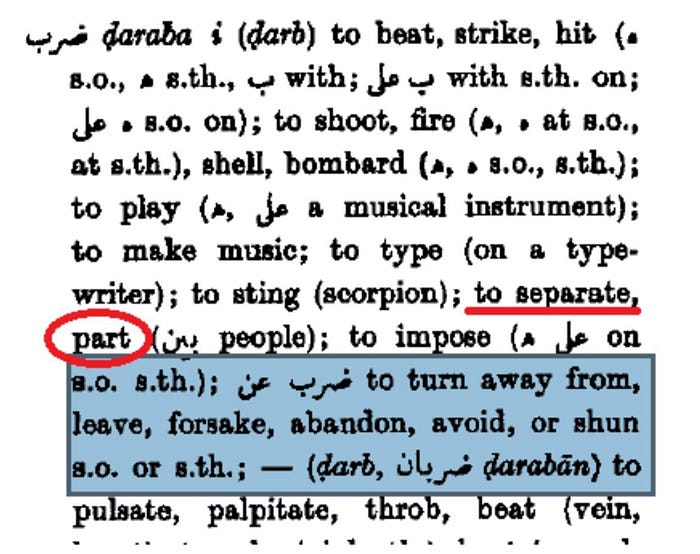
The Arabic root ḍ-r-b carries multiple meanings depending on context, including striking, departing, separating, and turning away. Meaning cannot be determined by selecting one possible dictionary definition in isolation. It must be understood within the verse’s structure, the Quran’s moral vision, and the Prophet’s example.
The progression, as I understand it, is coherent:
- First, discuss the problem.
- Then, create distance within the bedroom.
- If that fails, create greater physical distance.
- If the breach continues, involve trusted mediators.
Inserting “beat her” at the third stage breaks this moral and emotional progression.
Get Kashif Chaudhry’s stories in your inbox
Join Medium for free to get updates from this writer.Subscribe
Remember me for faster sign in
Why would a spouse who already feels alienated suddenly become loving after being struck? Violence may produce fear, silence, or outward compliance, but it cannot cultivate sakīnah, mawaddah, or rahmah. It intensifies the very resentment the process is supposed to resolve.
Emotional intelligence requires recognizing the difference between compliance and reconciliation. A terrified spouse may stop objecting, but the disappearance of open disagreement does not mean that peace has been restored.
This nonviolent reading is also more consistent with the Prophet Muhammad’s (pbuh) example. He instructed Muslim men not to beat or revile their wives, taught that the best believers are those who are best to their families, and did not strike his own wives.
Wife-beating has no place in a framework intended to restore emotional safety.
Physical separation, by contrast, can interrupt a destructive cycle and create the perspective needed to determine whether trust can realistically be rebuilt. It should have a defined purpose and, where possible, an agreed period for reassessment. It must not become a way of keeping the other spouse trapped in indefinite uncertainty.
Where children are involved, their routines and emotional security must remain central. They should never be turned into messengers, sources of information, bargaining instruments, or judges of either parent.
4. Family-Based Mediation: Replacing Advocacy With Understanding
If separation does not resolve the conflict, the Quran moves the process beyond the couple:
“If you fear a breach between them, appoint an arbiter from his family and an arbiter from hers.”
— Quran 4:35
This is structured mediation — not a family trial.
The mediators are not supposed to behave like opposing lawyers, each defending their relative regardless of the facts. Their responsibility is to understand both perspectives, identify harmful patterns, restrain injustice, and determine whether the conditions for reconciliation can be restored.
Emotionally intelligent mediators must be able to listen without immediately assigning blame. They should distinguish intention from impact, isolated incidents from recurring patterns, and ordinary incompatibility from abuse or coercion.
They must also possess the courage to correct their own child. A parent who excuses every harmful action by their son or daughter is not mediating; they are reinforcing the conflict.
Good mediation should help the couple answer concrete questions:
- What does each spouse believe has been damaged?
- Does each person understand the other’s experience?
- Is there genuine accountability without excuses?
- What specific behavior must change?
- What boundaries are necessary?
- How will progress be measured?
- Can emotional safety realistically be restored?
Confidentiality is equally important. Marital vulnerability should not become material for family gossip, public humiliation, or character assassination.
5. Reconciliation — or Dignified Divorce
Verse 4:35 identifies reconciliation as the goal:
“If they desire reconciliation, Allah will bring about harmony between them.”
But reconciliation cannot simply mean returning two people to the same conditions that produced the conflict.
True ṣulḥ requires more than promises made under family pressure. It requires accountability, changed behavior, restored boundaries, and a credible plan for rebuilding trust. Apology matters, but an apology without sustained behavioral change does not restore emotional safety.
Reconciliation should therefore be evaluated by evidence:
- Is communication becoming more respectful?
- Can both spouses express pain without retaliation?
- Has contempt decreased?
- Are boundaries being honored?
- Is affection gradually returning?
- Does each spouse feel safer, more heard, and more valued?
The goal is not merely to save the nikāh. It is to restore sakīnah within it.
If that cannot be achieved, the Quran does not command that the legal bond be preserved at any human cost:
“Either retain them in kindness or release them with excellence.”
— Quran 2:229
It also offers reassurance:
“If they separate, Allah will enrich each of them from His abundance.”
— Qur’an 4:130
Divorce should not be the first response to marital conflict, but neither is it necessarily a moral failure. Sometimes ending a marriage respectfully is more faithful to Quranic ethics than preserving its legal shell while fear, contempt, or emotional harm continually destroy its purpose. When separation becomes necessary and is pursued with justice and dignity, the Quran offers both parties hope rather than shame or guilt(4:130). Divorce, therefore, need not signify abandonment by Allah; it may open a new path toward healing, growth, and divine grace.
Emotional intelligence is required in separation too. Neither spouse should use private disclosures as weapons, recruit children into the conflict, or attempt to erase the other parent’s place in the child’s life. The marriage may end, but the obligation to act with justice and iḥsān does not.
The Quranic path, as I understand it, is neither “remain married at any cost” nor “leave whenever marriage becomes difficult.” It is a deliberate progression from communication to distance, from distance to mediation, and from mediation to an honest decision.
Sometimes restoring sakīnah will save the nikāh. But when sakīnah can no longer be restored within it, Islam permits the nikāh to end without requiring dignity, compassion, and emotional safety to end with it.






Leave a Reply