
Presented by Claude for Zia H Shah MD
Abstract
This essay examines one of the oldest and most consequential distinctions in the theory of knowledge—the division between a priori knowledge (justified by pure reason, independent of sensory experience) and a posteriori knowledge (justified by empirical observation and evidence)—and sets it in dialogue with the epistemic method of the Holy Qur’an. Part one traces the philosophical landscape from the rationalist–empiricist debates of the seventeenth and eighteenth centuries through Kant’s “synthetic a priori” and Kripke’s fracturing of the modal categories. Part two presents the empirical state of the question among professional philosophers, drawing on the 2020 PhilPapers Survey of David Bourget and David Chalmers: 72.84% of respondents accept or lean toward the existence of a priori knowledge, against only 18.47% who reject it. Part three examines the internal division among secular and atheist philosophers, contrasting the anti-a-priori naturalism of W. V. O. Quine and Michael Devitt with the vigorous defense of the a priori mounted by Paul Boghossian and David Chalmers. Part four turns to the Qur’an, arguing—in the framework long developed by Zia H. Shah MD on thequran.love—that scripture does not recognize a sharp wall between the two kinds of knowledge but weaves them together, reasoning characteristically “from the tangible to the intangible” and, complementarily, from the intangible to the tangible. Throughout, convergences between the philosophy of knowledge, the sciences, and the Qur’an are framed as resonances and anticipations rather than as concordist “scientific-miracle” proofs. A thematic epilogue ties the survey’s vindication of the a priori to the Qur’an’s integrated vision of reason and observation as two wings of a single flight toward truth.
I. The Great Divide and Its History
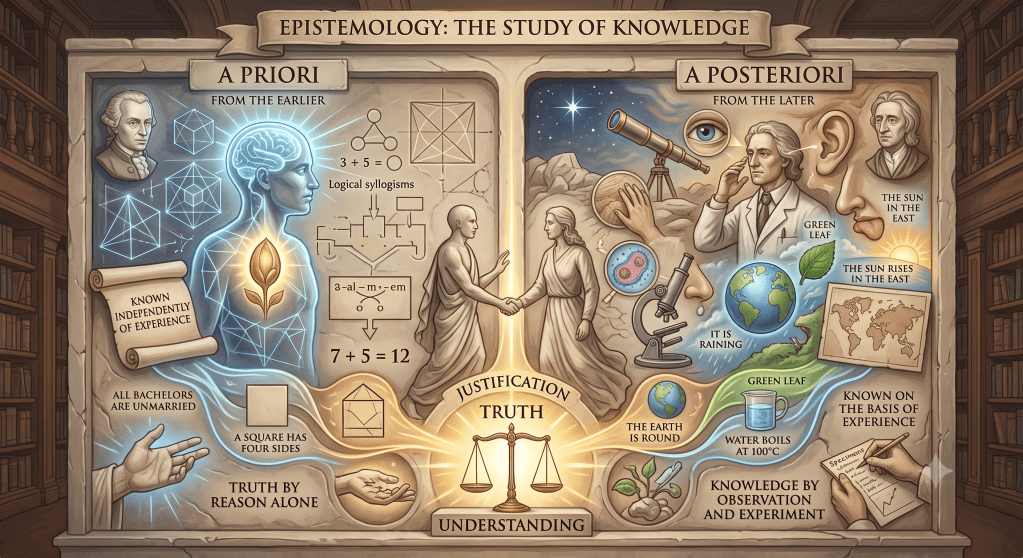
Few distinctions have shaped the theory of knowledge as decisively as the one between the a priori and the a posteriori. A priori knowledge is that which is gained through pure reason and logic, independent of sensory experience. Its classic exemplars are the truths of mathematics—that 2 + 2 = 4—and definitional or analytic statements such as “All bachelors are unmarried.” One need not survey the world’s bachelors to know that none is married; the predicate is already contained in the concept of the subject. A posteriori knowledge, by contrast, requires empirical observation, evidence, and sensory perception. That water boils at 100°C at sea level, or that “it is currently raining,” are things one can know only by looking, measuring, and checking. This divide—between what the mind can secure from within and what it must go out into the world to learn—is central to epistemology and touches every neighbouring discipline, from the philosophy of mathematics to the philosophy of science and religion.
The distinction has ancient roots but received its decisive modern shape in the early modern quarrel between the rationalists and the empiricists. The rationalists—pre-eminently René Descartes and Gottfried Wilhelm Leibniz—held that the intellect possesses ideas and principles that are not derived from experience and that genuine, necessary knowledge of reality can be attained by reason. Leibniz drew a sharp line between “truths of reason,” which are necessary and true in all possible worlds, and “truths of fact,” which are contingent. Against them stood the empiricists—John Locke and, most radically, David Hume—who insisted that the mind begins as a blank slate and that all its materials are ultimately traceable to sense experience. Hume divided all knowledge into “relations of ideas” (the domain of mathematics and logic, certain but empty of information about the world) and “matters of fact” (informative but never necessary), a bifurcation that anticipates the analytic–synthetic and a priori–a posteriori distinctions alike.
It was Immanuel Kant who reframed the entire debate. In the Critique of Pure Reason (1781/1787), Kant accepted with the empiricists that all a posteriori (empirical) judgments are synthetic, and accepted with the rationalists that a priori knowledge is genuine and independent of experience. But he denied that a priori truths must all be analytic. His revolutionary category was the synthetic a priori—judgments that are known independently of experience yet genuinely extend our knowledge rather than merely unpacking definitions. Mathematics, for Kant, was the paradigm: “7 + 5 = 12” is a priori and necessary, yet (he argued) the concept of 12 is not simply contained in the concepts of 7, 5, and addition. Geometry, arithmetic, and the principle that “every event has a cause” were, on his account, synthetic a priori truths that structure any possible experience. Kant took necessity and strict universality to be the marks of the a priori: whatever is known to be necessarily and universally true cannot have been learned from the always-particular, always-contingent testimony of the senses.
For nearly two centuries Kant’s near-identification of the necessary, the a priori, and the analytic held sway. It was decisively complicated by Saul Kripke in Naming and Necessity (1970). Kripke prised apart the metaphysical category of necessity from the epistemological category of the a priori, arguing that the two neither entail one another nor coincide in extension. He offered examples of the necessary a posteriori—truths like “water is H₂O” or “Hesperus is Phosphorus,” which are necessary (true in all possible worlds, given the identities involved) yet knowable only through empirical investigation—and, more startlingly, of the contingent a priori, illustrated by his famous standard-metre example: someone who fixes the reference of “one metre” by stipulating it as the length of a particular stick S can know a priori that S is one metre long, yet this truth is contingent, since S might have had a different length. Kripke’s separation of the modalities reshaped the contemporary discussion and showed that the a priori is a live, subtle, and far-from-settled notion rather than a relic of Kantian architecture.
II. The Contemporary Consensus: What Philosophers Actually Believe
If one wishes to know not merely how the debate developed but where it now stands among those who spend their lives on it, the best evidence is the 2020 PhilPapers Survey, conducted by David Bourget (Western University) and David Chalmers (New York University) and published as “Philosophers on Philosophy: The 2020 PhilPapers Survey” in Philosophers’ Imprint (vol. 23, no. 11, 2023). The survey put 100 questions to a target population of professional philosophers in the English-speaking world; 1,785 respondents took part, of whom 1,749 gave a usable answer to the question “A priori knowledge: yes or no?”
The result is a striking supermajority in favour of the a priori. On the main survey, 72.84% of respondents accept or lean toward “yes”—that humans do possess some a priori knowledge—while only 18.47% accept or lean toward “no,” and 9.03% return some “other” response (agnostic, undecided, the question is too unclear, or no fact of the matter). In other words, acceptance of the a priori outruns its rejection by nearly four to one. This places the a priori among a cluster of views commanding roughly 70% or more support, alongside non-skeptical realism about the external world, compatibilism about free will, and the analytic–synthetic distinction (itself endorsed by 62.48%). That the a priori belongs to this high-support cluster is corroborated by the survey’s correlation tables, which show acceptance of a priori knowledge tracking closely with scientific realism.
Moreover, support for the a priori is growing. The survey’s longitudinal analysis, comparing faculty at the ranked “comparable departments” surveyed in both years, shows acceptance of a priori knowledge rising from 71.11% in 2009 to 74.85% in 2020—a change of +3.74 points and one of the larger “swings” in the entire survey. Bourget and Chalmers explicitly identify a priori knowledge as one of the views toward which the discipline swung over the decade, and note the interesting wrinkle that this was an institutional swing (departments trending toward the a priori) even as the small subset of individuals who answered both surveys swung slightly the other way—a reminder that generational replacement, not individual conversion, drives much of the movement. The two survey numbers should not be conflated: the 72.84% is the 2020 main-survey figure for all respondents (which the survey warns should not be directly compared to 2009 because of differing populations), while the 71.11%→74.85% pair is the properly matched longitudinal comparison.
The upshot is unambiguous. The overwhelming consensus among contemporary philosophers is that human beings do possess a priori knowledge. Hardline empiricism—the view that all knowledge whatsoever is a posteriori—is, among professional epistemologists, a distinctly minority position. The intuition that some things (the truths of arithmetic, the validity of modus ponens, the impossibility of a round square) are known by reason rather than by observation has survived a century of assault and, if anything, strengthened.
III. The House Divided: Atheist and Secular Philosophers on the A Priori
It is sometimes assumed that scepticism about the a priori tracks religious scepticism—that the same naturalistic temper that inclines a philosopher toward atheism also inclines them toward a thoroughgoing empiricism in which mathematics and logic are merely very well-confirmed empirical generalizations. There is something to this. The PhilPapers data show that professional philosophers lean heavily secular: 66.95% of respondents accept or lean toward atheism, versus just 18.93% toward theism (the 2020 PhilPapers Survey, “God: atheism or theism?”, N = 1770), and metaphysical naturalism is the single most common meta-philosophical stance. Rejection of the a priori is plausibly somewhat more common among atheists precisely because atheism correlates with empiricism and naturalism, and because a fully naturalized epistemology, on some construals, has no obvious place for a faculty of rational insight that outruns the senses. But the correlation is loose, and the more interesting fact is that secular philosophy is itself deeply divided on the question. The debate over the a priori is not a proxy war between belief and unbelief; it is an argument that runs straight through the naturalist camp.
On one side stands what may be called the anti-a-priori camp, whose patron saint is Willard Van Orman Quine. In his epoch-making 1951 paper “Two Dogmas of Empiricism,” Quine attacked the very analytic–synthetic distinction on which much of the traditional case for the a priori rested, arguing that every attempt to define analyticity (“truth in virtue of meaning”) ultimately moves in a circle, presupposing notions—synonymy, necessity, definition—no clearer than the one it seeks to explain. Famously he concluded that “for all its a priori reasonableness, a boundary between analytic and synthetic statement simply has not been drawn. That there is such a distinction to be drawn at all is an unempirical dogma of empiricists, a metaphysical article of faith.” In place of the analytic/synthetic divide Quine offered confirmation holism: our beliefs face the “tribunal of experience” not one by one but as a corporate body, a “web of belief” in which no statement—not even a law of logic or arithmetic—is in principle immune to revision should recalcitrant experience press hard enough. On this picture, mathematical and logical truths are simply the most central, most protected strands of the web, treated as unrevisable only because giving them up would cost too much elsewhere. They are highly confirmed empirical generalizations, not deliverances of a special non-empirical faculty.
Quine’s most uncompromising contemporary heir is Michael Devitt, who makes the naturalist rejection of the a priori explicit and programmatic. Devitt takes from Quine the epistemological thesis that “there is only one way of knowing, the empirical way that is the basis of science,” and concludes flatly: “So I reject ‘a priori knowledge.’” His two central charges are that the notion “lacks motivation”—once we recognize the holistic, empirical character of the confirmation of even logic and mathematics, we no longer need a category of the a priori—and that it is “deeply obscure,” as the long history of failed attempts to explain how such knowledge is so much as possible attests. In papers such as “Naturalism and the A Priori” (1998) and “There is No A Priori” (2005), Devitt argues that epistemological naturalism, which he holds on independent grounds, simply leaves no room for knowledge justified independently of experience.
On the other side stands the defender camp, and it is crucial to note that its leading figures are themselves secular philosophers, not apologists for religion. Paul Boghossian, of New York University, has mounted one of the most influential contemporary defenses of the analytic explanation of the a priori. In papers including “Analyticity Reconsidered” and “Epistemic Analyticity: A Defense,” Boghossian argues that Quine’s naturalism, properly understood, should lead us to reject Quine’s own case against analyticity rather than to embrace it. He distinguishes epistemic analyticity (a sentence one is justified in believing merely by grasping its meaning) from metaphysical analyticity (a sentence true solely in virtue of meaning), defends the former even while conceding difficulties with the latter, and appeals to the notion of implicit definition—the way the axioms of logic or arithmetic can be understood as stipulations that fix the meanings of their key terms—to explain how a priori knowledge of logical and mathematical truths is possible.
David Chalmers, likewise a secular philosopher, offers the most systematic recent vindication of the a priori in Constructing the World (2012), based on his 2010 John Locke Lectures. Chalmers defends a “scrutability” thesis—that all truths about the world can be derived, by ideal a priori reasoning, from a compact base of fundamental truths—and uses this framework explicitly to rebut Quine’s arguments against the analytic and the a priori. Against Quine’s claim that every sentence is revisable and hence that no principled a priori/a posteriori line can be drawn, Chalmers distinguishes revision that involves conceptual change from revision that does not, preserving a principled distinction. Through his broadly Fregean, two-dimensional approach to meaning, Chalmers seeks to show that conceptual analysis and rational reflection genuinely yield knowledge.
The lesson is that the fate of the a priori does not ride on the theism–atheism divide. Quine, Devitt, Boghossian, and Chalmers are all, broadly speaking, working within a secular, naturalistically informed analytic tradition; they disagree profoundly nonetheless. And the discipline as a whole, as the survey shows, has sided decisively with the defenders. This matters for the argument that follows, because it means the recognition that reason yields real knowledge—that the mind is not a mere passive recorder of sense-data—is not a peculiarly religious commitment but a mainstream conclusion of contemporary secular philosophy.
IV. The Qur’an’s Integrated Epistemology: From the Tangible to the Intangible
Against this backdrop the epistemic posture of the Qur’an appears in sharp and instructive relief. The central thesis advanced here—developed at length by Zia H. Shah MD across the essays of thequran.love, “The Glorious Quran and Science”—is that the Qur’an does not recognize a sharp distinction between a priori and a posteriori knowledge. It does not partition truth into the two sealed compartments of pure reason and pure observation. Instead it weaves them together, characteristically arguing from the tangible to the intangible: it directs the reader’s gaze to the observable phenomena of nature—the empirical, the a posteriori—and then, by reasoned inference, leads the mind upward to conclusions about the unseen (al-ghayb): the existence of God, His unity, and the reality of the resurrection. Reason and observation are treated not as rivals but as two wings of a single flight.
The Qur’an names the phenomena of nature ayat—”signs”—the very same word it uses for its own verses, so that the book of nature and the book of scripture are presented as two texts to be read by the same reflective intelligence. And it relentlessly summons that intelligence into action. Its refrains are interrogative and hortatory: afala yatafakkarun (“do they not reflect?”), afala ta’qilun (“will they not use their reason?”), and its repeated closing signatures li-qawmin ya’qilun (“for a people who use reason”), li-qawmin yatafakkarun (“for a people who reflect”), and li-qawmin ya’lamun (“for a people who have knowledge”). The exemplary human beings of the Qur’an are the ulul-albab, the “people of understanding,” described in the celebrated passage of Surah Al Imran: “Indeed, in the creation of the heavens and the earth and the alternation of the night and the day are signs for those of understanding—who remember God while standing, sitting, and lying on their sides, and who reflect (yatafakkaruna) on the creation of the heavens and the earth, [saying], ‘Our Lord, You did not create this without purpose; exalted are You’” (Q 3:190–191). Here the movement is complete and paradigmatic: from observation of the cosmos (a posteriori), through disciplined reflection (the exercise of reason), to a metaphysical conclusion about purpose and a Creator (the intangible).
The catalogue of empirical signs the Qur’an invokes is vast, and it is precisely the ordinary, repeatable, observable furniture of the world: the creation of the heavens and the earth; the alternation of night and day; the ships that sail the sea by which people benefit; the rain God sends down from the sky, “reviving the earth after its death”; the bees inspired to build and to produce “a drink of varying colours in which there is healing” (Q 16:68–69); the birds “held poised in the midst of the sky—none holds them up but God” (Q 16:79); the stages of embryological development in the womb; the she-camel of Salih offered to the people of Thamud as a sign. Consider Q 2:164, which gathers many of these into a single sweeping tableau: “Indeed, in the creation of the heavens and the earth, and the alternation of the night and the day, and the ships which sail through the sea with that which benefits people, and what God has sent down from the sky of rain, giving life thereby to the earth after its lifelessness… and [His] directing of the winds and the clouds controlled between the sky and the earth are signs for a people who use reason.” The verse does not merely assert God’s existence; it lays out evidence and then appeals to reason (ya’qilun) to complete the inference.
Crucially, the Qur’an also argues on the plane of reason itself, deploying what are recognizably a priori considerations—dilemmas, disjunctions, and appeals to logical coherence. Three examples illustrate the point.
First, the terse rhetorical syllogism of Surah At-Tur: “Or were they created by nothing, or are they [their own] creators? Or did they create the heavens and the earth? Rather, they are not certain” (Q 52:35–36). This is an argument by exhaustive disjunction: either the disbelievers came from nothing, or they created themselves, or they created the cosmos—each alternative being rationally absurd—so a Creator must be affirmed. The premises are not empirical observations but conceptual impossibilities weighed by reason. Quran
Second, the argument from order against polytheism in Surah Al-Anbiya: “Had there been within the heavens and earth gods besides God, they both would have been ruined” (Q 21:22). This is an a priori argument from the observed unity and coherence of the cosmic order to the oneness of its ordering principle: a plurality of ultimate wills would issue in incoherence, yet the heavens and earth are not ruined; therefore there is one God. Quranic Arabic Corpus
Third, the argument for the resurrection in Surah Ya-Sin: to the sceptic who asks, “Who will give life to bones while they are disintegrated?”, the answer comes, “He will give them life who produced them the first time; and He is, of all creation, Knowing” (Q 36:78–79), sealed by the a fortiori conclusion, “Is not He who created the heavens and the earth able to create the likes of them?” (Q 36:81). The inference runs from the observed fact of a first creation to the rational possibility—indeed the greater ease—of a second. Empirical premise, rational inference, metaphysical conclusion: the two kinds of knowing are fused. Quran
Surah Yunus: From Tangible to Intangible
Shah’s reading of Surah Yunus (Q 10) crystallizes this method. The surah opens by directing attention to the observable order of the heavens: “It is He who made the sun a shining light and the moon a derived light and determined for it phases—that you may know the number of years and the account [of time]. God did not create this except in truth. He details the signs for a people who know” (Q 10:5). The precise, calculable regularity of the celestial clock—an empirical datum—is offered as a sign for “a people who know” (ya’lamun). The following verse extends the point: “Indeed, in the alternation of the night and the day and in what God has created in the heavens and the earth are signs for a people who fear God” (Q 10:6). Later the surah presses the great argument from providence and dependence: “Say, ‘Who provides for you from the heaven and the earth? Or who controls hearing and sight and who brings the living out of the dead and brings the dead out of the living and who arranges [every] matter?’ They will say, ‘God.’ So say, ‘Then will you not fear Him?’” (Q 10:31). The tangible experiences of provision, perception, and the cycle of life and death are marshalled as premises; the disbelievers themselves are made to supply the conclusion—”God”—and the verse then draws the intangible, moral consequence. The surah’s famous parable of worldly life makes the same move in reverse register: “The example of worldly life is but like rain which We have sent down from the sky… until, when the earth has taken on its adornment and is beautified and its people suppose that they have capability over it, there comes to it Our command by night or by day, and We make it as a harvest, as if it had not flourished the day before. Thus do We detail the signs for a people who give thought” (Q 10:24). A vivid, observable natural cycle becomes a meditation on the transience of the world and the certainty of divine judgment—tangible imagery yielding intangible truth, “for a people who give thought” (yatafakkarun).
Surah Ra’d: From Intangible to Tangible
The complementary movement—from the intangible to the tangible—Shah locates in Surah Ra’d, “The Thunder” (Q 13). The surah opens with a metaphysical claim and immediately grounds it in the physical: “God is He who raised the heavens without pillars that you can see; then He established Himself above the Throne. And He subjected the sun and the moon, each running [its course] for a specified term. He arranges [each] matter; He details the signs that you may, of the meeting with your Lord, be certain” (Q 13:2). As Shah observes—citing the reading of Sir Muhammad Zafrullah Khan, first foreign minister of Pakistan and a former President of the UN General Assembly, who wrote in Islam – Its Meaning for Modern Man that the Qur’an “reasons from the physical and tangible to the spiritual and intangible”—the invisible “pillars” that hold the heavens aloft are, in a modern idiom, the unseen force of gravity: God uses the observable architecture of the solar system as an argument for the reality of the unseen Afterlife (“that you may be certain of the meeting with your Lord”). The surah then names the thunder itself—”the thunder exalts [God] with praise” (Q 13:13)—and offers the celebrated parable of the flood: “He sends down rain from the sky, and valleys flow according to their capacity, and the torrent carries a rising foam… as for the foam, it vanishes as scum; but as for that which benefits the people, it remains on the earth. Thus does God present examples” (Q 13:17). An everyday hydrological observation—foam swept away, water sinking in to nourish—becomes an illustration of the difference between truth and falsehood. The surah closes on the intangible fruit of the whole method: “those who have believed and whose hearts are assured by the remembrance of God. Unquestionably, by the remembrance of God hearts are assured” (Q 13:28). Reasoning from the seen to the unseen terminates not in cold proof but in tranquillity of heart.
Resonance, Not Concordism
It is essential to frame these convergences carefully, and here Shah’s approach is deliberately distinct from the “scientific miracle” (i’jaz ‘ilmi) school associated with Maurice Bucaille and popularized by Zakir Naik. That concordist program treats the Qur’an as a coded almanac of modern scientific facts and reads back twenty-first-century embryology or cosmology into seventh-century verses as proof of divine authorship. Shah’s method is more modest and, arguably, more robust: he reads the Qur’an as offering an epistemic invitation—a summons to observe, to reason, and to infer—whose resonances with modern science are to be received as anticipations and harmonies, not as knock-down demonstrations. The point of Q 13:2 is not that the Qur’an “predicted” Newtonian gravity but that its method—arguing from the ordered, observable cosmos to an unseen ordering reality—is vindicated, rather than embarrassed, by the growth of scientific knowledge. This is the register in which the Qur’an’s epistemology should be compared with the philosophy of knowledge: as a congenial worldview, not a cipher.
That register finds natural allies among the philosopher-scientists who have reflected on why the world is intelligible at all. Eugene Wigner’s celebrated essay “The Unreasonable Effectiveness of Mathematics in the Natural Sciences” (Communications in Pure and Applied Mathematics, vol. 13, no. 1, February 1960) poses precisely the puzzle that sits at the seam of the a priori and the a posteriori: how is it that mathematics—a purely deductive, non-empirical, a priori pursuit—so uncannily and accurately describes the empirical, a posteriori world? Wigner closed the essay with the line: “The miracle of the appropriateness of the language of mathematics for the formulation of the laws of physics is a wonderful gift which we neither understand nor deserve.” Paul Davies, in The Mind of God, presses the same wonder: that the deep laws of nature are expressible in elegant mathematics “strongly suggests that there is more to our world than meets the eye.” John Polkinghorne wrote that “there is no a priori reason why beautiful equations should prove to be the clue to understanding nature,” seeing in this fit “a significant insight into the nature of reality.” Thomas Nagel—an atheist—argued in Mind and Cosmos (Oxford University Press, 2012, p. 17): “pure empiricism is not enough. The intelligibility of the world is no accident,” adding that mind is “doubly related to the natural order” in that nature gives rise to minds and is comprehensible to them. Roger Penrose’s mathematical Platonism and David Chalmers’ scrutability project both, in their different ways, insist that reason reaches real structure. None of these thinkers is offered here as a proof of the Qur’an’s claims. But each illuminates the same seam the Qur’an works: the marriage of a priori reason and a posteriori observation in a cosmos that answers to both. The effectiveness of a priori mathematics in the a posteriori sciences is, in Qur’anic idiom, itself an aya—a sign that the order within the mind and the order within the world share a common source. ThriftBooks + 2
Epilogue: Two Wings of a Single Flight
There is a quiet convergence at the heart of this essay. On the one hand, contemporary philosophy—after Quine’s assault, after Kripke’s refinements, after a century of naturalistic pressure—has arrived at a settled supermajority verdict: human beings do possess a priori knowledge. Reason is not merely the servant of the senses; it is a genuine source of truth. Nearly three-quarters of the world’s professional philosophers affirm this, and the proportion is rising, even among a discipline that leans overwhelmingly secular and naturalist. Hardline empiricism, the view that would collapse all knowing into observation, has been weighed and found wanting by those best positioned to judge.
On the other hand, the Qur’an—thirteen centuries before the PhilPapers Survey—never accepted the wall the philosophers have spent so long testing. It refused to divorce reason from observation or observation from reason. It reads the heavens and the earth as signs and reasons from them; it also reasons from the bare requirements of logic and coherence, from disjunction and dilemma and the impossibility of created things creating themselves. It argues from the tangible to the intangible in Surah Yunus and from the intangible to the tangible in Surah Ra’d, and in both directions the same reflective intelligence—the ulul-albab, the people of understanding—is doing the work. Where the modern debate has often treated the a priori and the a posteriori as competitors for the title of “the way we really know,” the Qur’an treats them as partners, two wings without which the bird of understanding cannot fly.
The philosophical vindication of the a priori and the Qur’anic integration of reason and observation are not the same claim, and neither proves the other. But they rhyme. Both testify that the mind is fitted to a world it did not make, that the truths of thought and the facts of experience meet in a coherence that calls for explanation. The Qur’an offers that explanation in the language of signs and their Author; Wigner and Davies and Nagel confess the mystery without always naming its resolution. For the reflective reader—the one the Qur’an keeps addressing—the invitation is not to choose between reason and observation, nor between philosophy and revelation, but to let each illuminate the other, and to follow the evidence of both wings toward the horizon they jointly disclose.



Leave a Reply