
Presented by Claude for Zia H Shah MD
Abstract
This essay examines a recurring pattern in the religious experience of humankind: the cry of the human being at the extremity of helplessness, the sense of rescue that follows, and — most consequentially — the transformed life that a rescued person may choose to live in gratitude. Taking as its anchor the Qur’anic passage Al-An’am 6:63–66, in which God asks who it is that “saves you from the dark depths of land and sea” when human beings “humbly and secretly call to Him,” the essay reads eight documented modern and historical lives against this scriptural template, framed by the paradigmatic Qur’anic narrative of Yunus (Jonah) praying in the darkness of the fish. The figures — drawn deliberately from multiple faith traditions — are Yusuf Islam (formerly Cat Stevens), the evolutionary biologist Jeffrey Schloss, the slave-ship captain turned abolitionist John Newton, the Olympian and airman Louis Zamperini, the mathematician Jeffrey Lang, Malcolm X, the Rwandan genocide survivor Immaculée Ilibagiza, and the scholar Muhammad Asad. The essay argues, in a non-polemical and interfaith-friendly register, that Q 6:63–64 supplies not merely a description of foxhole prayer but an ethical diagnosis of its aftermath: God warns of those who are rescued and then “still worship others beside Him,” while the lives surveyed here illustrate the harder and rarer path — the keeping of the vow of thankfulness (shukr). Convergences across traditions are presented as resonances rather than proofs.
I. The Anchor Verses
Say [Prophet], “Who is it that saves you from the dark depths of land and sea when you humbly and secretly call to Him [and say], ‘If He rescues us from this, We shall truly be thankful’?” Say, “God rescues you from this and every distress; yet still you worship others beside Him.” Say, “He has power to send punishment on you from above or from under your very feet, or to divide you into discordant factions and make some taste the violence of others.” See how We explain Our revelation in various ways, so that they may understand, yet your people still reject it even though it is the truth. Say, “I have not been put in charge of you.” — Al Quran 6:63–66 (Abdel Haleem translation)
These four verses turn on a single, universally recognizable human moment. Stripped of every comfort, at the edge of the “dark depths of land and sea” (zulumat al-barr wa’l-bahr), the human being calls out — tadarru’an wa khufyatan, “humbly and secretly” — and makes a bargain: If He rescues us from this, we shall truly be thankful. The classical commentators read the passage as a description of the innate monotheism that surfaces under duress. Ibn Kathir glosses the verses by observing that “Allah mentions how He favors His servants, saving them during times of need, in the darkness of land and at sea, such as when storms strike,” noting that in such moments people “call on Allah alone, without partners.” Al-Tabari and al-Qurtubi similarly treat the “darknesses” both literally — the perils of desert and ocean travel — and figuratively, as the darkness of anguish and terror from which only God is called upon. Alim
But the decisive turn of the passage is verse 64. God does rescue “from this and every distress” (min kulli karb) — and yet, the verse continues with a note of divine grief, “still you worship others beside Him.” The Qur’an here anticipates the very theme this essay pursues: the gap between rescue and gratitude. It is one thing to pray in the storm; it is another to keep the vow once the sea is calm. Ibn Kathir preserves a striking prophetic tradition on the sequel-verse 65: when “He has power to send punishment on you from above or from under your very feet” was revealed, the Prophet Muhammad sought refuge in God from the first two calamities, and God granted that His community would be spared them; but the third — “to divide you into discordant factions” — was not averted.
The Qur’an returns to this motif again and again, so that Q 6:63–66 reads less as an isolated argument than as one statement of a pervasive Qur’anic anthropology of crisis and prayer:
- Q 10:22–23: those aboard ship, caught in a storm and given up for lost, “call to God, sincere in their faith in Him,” promising to be thankful — and then, once delivered to land, “behave outrageously.”
- Q 17:67: “When you get into distress at sea, those you pray to besides Him desert you,” and only He is remembered.
- Q 29:65, Q 31:32: again the sea-storm as the theatre in which sincere, exclusive prayer is wrung from the human heart.
- Q 39:8, 39:49: humanity calls upon God in adversity, then forgets.
- Q 27:62: “Who answers the distressed (al-mudtarr) when they call upon Him and removes their suffering?”
- Q 2:186: “I answer the prayer of the supplicant when he calls on Me.”
- Q 40:60: “Call on Me and I will answer you.”
- Q 12:87: “Never despair of God’s mercy.”
- Q 94:5–6: “With hardship comes ease; truly, with hardship comes ease.”
And above all, the paradigmatic case:
- Q 21:87–88: “And [remember] Dhu’l-Nun (Jonah), when he went off in anger, thinking We had no power over him, but he cried out in the darkness, ‘There is no god but You, glory be to You! I have done wrong.’ We answered him and saved him from distress. This is how We save the faithful.”
The prophet Yunus, cast into the sea and swallowed by the great fish, prays from within what the Islamic tradition describes as three layers of darkness — the belly of the fish, the depths of the sea, and the night. His words — La ilaha illa anta, subhanaka, inni kuntu min al-zalimin — became, in a tradition recorded in Sunan al-Tirmidhi (no. 3505, graded sound) and Musnad Ahmad, the supplication that “no Muslim ever invokes for anything except that Allah answers him.” Yunus is the archetype of the anchor verses: the one who cries from the “dark depths of the sea,” is heard, is delivered, and — crucially — returns to his mission a changed man, going back to the people of Nineveh he had abandoned. His story is the connecting motif of everything that follows. Each life below is, in its own idiom, a variation on the prayer from the belly of the fish.
There is a striking biblical parallel that a pluralist reader will hear as a resonance across traditions. Psalm 107 sings of “they that go down to the sea in ships, that do business in great waters,” who are lifted to the heavens and plunged to the depths until “their soul is melted because of trouble,” and who then “cry unto the LORD in their trouble, and he bringeth them out of their distresses. He maketh the storm a calm.” The overlap with Q 6:63 — the sea, the terror, the cry, the deliverance, the summons to gratitude (“Oh that men would praise the LORD for his goodness”) — is remarkable. We present it not as proof of anything, but as evidence that the human cry de profundis, “out of the depths,” is one of the most widely attested experiences in the religious record of our species.
II. Yusuf Islam (Cat Stevens): The Wave off Malibu
No modern life illustrates the anchor verses more literally than that of the man born Steven Demetre Georgiou in London on 21 July 1948, who became the pop star Cat Stevens and then the Muslim educator and philanthropist Yusuf Islam.
By the early 1970s Cat Stevens was one of the most successful singer-songwriters in the world; his albums Tea for the Tillerman (1970) and Teaser and the Firecat (1971) were each certified triple platinum in the United States. Over the course of his career he has sold more than 100 million records and amassed more than two billion streams. Yet fame had been preceded by a brush with death that first turned him inward. In 1968–69, at the height of his early success, he contracted tuberculosis and was admitted, close to death, to the King Edward VII Hospital in Midhurst, West Sussex. He spent months recuperating and a year in convalescence. He later described the experience as decisive: “to go from the show business environment and find you are in hospital, getting injections day in and day out, and people around you are dying, it certainly changes your perspective. I got down to thinking about myself. It seemed almost as if I had my eyes shut.” During this period he took up meditation and vegetarianism, read widely in Buddhism, Zen, the I Ching, numerology and astrology, and wrote as many as forty songs.
The decisive event came in 1976. Swimming off the coast of Malibu, California, he was caught in the current and realized he could not fight his way back. In his own account: “I thought I could swim well, but I could not fight or beat the ocean. I had only seconds left. When I realized my vulnerability, what else could I do? My body was disappearing. I had only my soul left.” He cried out — in words that could stand as an epigraph to Q 6:63 — “Oh God! If you save me, I will work for you.” He recalled: “There was only one thing to do and that was to pray to the almighty to save me. And I did. I called out to God and he saved me. A little wave came from behind. It wasn’t big. It was just simply pushing me forward. The tide somehow had changed and I was able to get back to land. So I was saved.” He took it as a sign that “God was right there.” aol + 2
The convergence with the Qur’anic template is almost uncanny: the sea, the terror, the vow (“if He rescues us from this, we shall truly be thankful”), the deliverance by a wave. Shortly afterward, his brother David Gordon — who had converted to Judaism and had visited Jerusalem — brought him a copy of the Qur’an as a birthday gift. Stevens said on the BBC’s Desert Island Discs: “I would never have picked up the Qur’an myself as a free spirit; I was more aligned to my father’s Greek Orthodox beliefs.” He read it in secret, and was struck above all by its uncompromising monotheism. He formally embraced Islam at the New Regent’s Park Mosque in London on 23 December 1977, taking the name Yusuf Islam the following year — “Yusuf” (Joseph) because the Qur’anic story of a man “bought and sold in the market place” mirrored how he had come to feel within the music business.
What distinguishes Yusuf Islam from the ingrates of Q 6:64 is what he did next: he kept the vow. In 1979 he auctioned his guitars for charity and withdrew almost entirely from the music industry for some 25 years. He married Fauzia Mubarak Ali in 1979 and raised a family. He poured his royalties into education and relief — estimating in January 2007 that he was still earning approximately US$1.5 million a year from his Cat Stevens music, which he directed toward philanthropic and educational causes. In 1983 he founded the Islamia Primary School in north London, which in 1998 became the first Muslim school in Britain to receive state (“grant-maintained”) funding; he went on to found secondary schools and, in 1992, The Association of Muslim Schools (AMS-UK). In the late 1990s he and his wife established the humanitarian charity Small Kindness, whose name is taken from the Qur’an, to aid orphans and widows in the Balkans, Indonesia, Iraq and elsewhere. He helped found Muslim Aid. His later, gradual return to music — beginning with children’s albums and moving to the pop album An Other Cup (2006) and beyond — was itself framed as service, with proceeds directed to his charities. In 2014 he was inducted into the Rock and Roll Hall of Fame. His life is, in the terms of the anchor verses, the picture of the rescued one who “shall truly be thankful” and then remains so.
III. Jeffrey Schloss: The Prayer to a God “I Wasn’t Sure Was There”
The user’s second requested figure requires careful identification. The person meant is Dr. Jeffrey (Jeff) Schloss, the evolutionary biologist who for more than four decades held the T. B. Walker Chair of Natural and Behavioral Sciences at Westmont College in Santa Barbara, California, directed its Center for Faith, Ethics and Life Sciences, and served for fifteen years as Senior Scholar of the BioLogos Foundation. Schloss earned his BS in biology from Wheaton College and his PhD in ecology and evolutionary biology from Washington University in St. Louis; he co-edited, with the philosopher Michael Murray, The Believing Primate: Scientific, Philosophical, and Theological Reflections on the Origin of Religion (Oxford University Press). He has held fellowships and lectured at Oxford, Cambridge, Harvard, Notre Dame and elsewhere. (He should not be confused with unrelated persons of similar name.) To The Best Of Our Knowledge
Schloss’s documented answered-prayer narrative is of a quieter and more inward kind than a physical rescue at sea — and it is precisely for that reason a valuable counterpoint in this essay, illustrating that the “dark depths” of Q 6:63 include the depths of doubt as much as the depths of the ocean. His profession is, remarkably, the scientific study of the evolutionary origins of religion; and yet he insists that science “can’t explain everything about religion,” including his own experiences of what Rudolf Otto called the numinous. In an interview for public radio’s To The Best Of Our Knowledge (“An Evolutionary Biologist Searches for God,” aired 14 May 2017), Schloss recounted the pivotal moment of his own coming to faith — a prayer offered from genuine uncertainty:
“I was laying in my bed one night and decided to pray to a God who I wasn’t sure was there… And in that moment the most glorious, numinous, loving, overwhelming personal presence that I had ever experienced or imagined flooded my heart and filled the room.”
Here is the structure of the anchor verses transposed into the register of an intellectual’s crisis of meaning: the humble and secret call (khufyatan) to a God whose existence the caller cannot verify, and the sense of an answer. In a companion BioLogos testimony (“Finding Faith: An Evolutionary Biologist Shares His Story,” 2019), Schloss describes how his “journey to Christ” and his life were “forever changed by sharing a meal with a stranger,” and reflects on “what the love of God means to him.” The changed life that followed is his life’s work: rather than treating the evolutionary explicability of religious belief as a debunking of it, Schloss built a distinguished scholarly career arguing that a scientific account of the human religious impulse and a genuine relationship with God are not mutually exclusive — that a scientist can bring “a Christian perspective” into the secular academy. Upon his retirement, Westmont recorded that when Schloss graduated from Wheaton College he had “prayed for three things: to spend his life learning; to represent Christ in the world of ideas; and to make a difference in students’ lives as his professors had made in his,” and that “God graciously answered those prayers” across 44 years, four Teacher of the Year awards, and the mentorship of thousands of students. His is the transformed life of the mind: a scientist of religion who never let his science extinguish his prayer. BioLogosWestmont College
IV. John Newton: “The Lord Sent from on High and Delivered Me Out of the Deep Waters”
If any historical life is the perfect gloss on Q 6:63’s “dark depths of the sea,” it is that of John Newton (1725–1807), the slave-ship captain who wrote “Amazing Grace.” Newton is also a sobering case, because his transformation was slow and incomplete for many years — a reminder that the keeping of the vow is a process, not a single instant.
By his own account Newton, orphaned of his devout mother at six and sent to sea at eleven, became one of the most profane men his shipmates had ever encountered. He was pressed into the Royal Navy, flogged for desertion, and eventually so degraded that he was enslaved for a time by a slave trader’s consort in West Africa, “a servant of slaves in Africa,” as his self-composed epitaph would later put it. Rescued at his father’s behest by the merchant ship Greyhound, he was returning to England when, on the night of 10 March 1748 (Old Style; he kept 21 March as his anniversary), a violent storm nearly sank the vessel in the North Atlantic. Water poured through a breach in the hull; a crewman was swept overboard; Newton, working the pumps through the night, heard himself say, “If this will not do, the Lord have mercy on us.” The flippant words startled him: what mercy could such a sinner expect? He had, days earlier, been idly reading Thomas à Kempis’s The Imitation of Christ.
When the battered ship survived and limped to Ireland, Newton dated his spiritual awakening to that deliverance. He wrote of it as the day “the Lord sent from on high and delivered me out of the deep waters” — an almost verbatim echo of Psalm 107 and of the situation in Q 6:63. But — and this is the honest, sobering part of the record — Newton did not immediately abandon the slave trade. He continued as a slaver for several years, even captaining slave ships after his conversion, and only left the sea in 1754 after a seizure. His public repudiation of slavery came decades later: he published Thoughts upon the African Slave Trade in 1788, confessing that “it will always be a subject of humiliating reflection to me, that I was once an active instrument in a business at which my heart now shudders.” He became curate of Olney, wrote (with the poet William Cowper) the Olney Hymns — including “Amazing Grace” (1773) — and mentored the young parliamentarian William Wilberforce. Newton lived to see Parliament abolish the British slave trade in 1807, the year he died. His changed life took the better part of a lifetime to complete — which makes it, in its way, a truer and more humane illustration of Q 6:64’s warning than any instant conversion: the vow of gratitude must be renewed, and its full ethical implications lived out, long after the storm subsides. Acton
V. Louis Zamperini: The Raft, the Vow, and the Long Detour
Louis Zamperini (1917–2014) offers the most explicit “if you save me I will serve you” narrative in this collection — and, in its long-deferred fulfillment, the clearest dramatization of Q 6:64’s gap between rescue and gratitude.
A USC track star who ran the 5,000 metres at the 1936 Berlin Olympics, Zamperini became a US Army Air Forces bombardier in the Pacific. On 27 May 1943 his B-24, the “Green Hornet,” suffered mechanical failure and crashed into the ocean roughly 850 miles south of Oahu, killing eight of the eleven men aboard. Zamperini and pilot Russell “Phil” Phillips drifted on a life raft for 47 days — the third survivor, Francis “Mac” McNamara, died on day 33 — fending off sharks, catching albatross and rainwater, and surviving a strafing run by a Japanese bomber that left the raft riddled with bullet holes but the men untouched. Zamperini, by his own testimony not a religious man, prayed as never before. As his son Luke recounted the vow: “Lord, if you get me through this, if you bring me home alive, I will seek you and serve you the rest of my life.” Repeatedly, when the water ran out, he prayed for rain, and — as he told it — rain came.
Rescued after 47 days, the two men were captured by the Japanese Navy and Zamperini endured more than two years of brutal captivity, singled out for beatings by the guard Mutsuhiro “the Bird” Watanabe. He came home a hero but broken — an alcoholic consumed by nightmares and fantasies of revenge, his marriage collapsing. Here the anchor verses’ warning bites: Zamperini had been rescued from the deep and had “still” turned away from his vow. The turn came in 1949, when his wife persuaded him to attend a Los Angeles crusade led by the young evangelist Billy Graham. As Graham preached, Zamperini flashed back to the raft — “the moment when I prayed to God that if He spared my life, I’d dedicate it to service and prayer” — and realized, as he put it, that “I came back from the war alive, and I never even thought about those prayers. I never tried to keep one prayer.” That night he committed his life to Christ. He said the change was immediate: “I got off my knees and somehow I knew I was through getting drunk… I also knew that I forgave all my guards including the Bird,” and — he attested — his nightmares ceased. He spent the rest of his long life as a speaker on forgiveness, returned to Japan in 1950 to forgive his former captors face to face, and founded a boys’ camp. His story, told in Laura Hillenbrand’s Unbroken (2010) and Zamperini’s own Devil at My Heels, is the anchor verses in miniature — including the years of ingratitude between the vow and its keeping.
VI. Jeffrey Lang: The Atheist Conquered by the Book
Not every desperate prayer is a shout in a storm; some are the long, silent anguish of the intellect. The American mathematician Jeffrey Lang (b. 30 January 1954), a professor at the University of Kansas, embodies the crisis of doubt that Q 6:63’s “darknesses” also name.
Raised Roman Catholic in Bridgeport, Connecticut, Lang lost his faith in his teens over the problem of suffering — “If there is a God, and He is all merciful and all loving, then why is there suffering on this earth?” — and by eighteen was, in his words, “a full-fledged atheist,” and remained so for a decade through his doctoral studies. As a young mathematics lecturer at the University of San Francisco, he befriended Muslim students, one of whom eventually gave him a copy of the Qur’an. Lang began reading it with deep prejudice — and found himself, as a logician, unable to resist it. In his memoir Even Angels Ask: A Journey to Islam in America, he describes the disorienting intimacy of the encounter: “Painters can make the eyes of a portrait appear to be following you from one place to another, but which author can write a scripture that anticipates your daily vicissitudes?… Each night I would formulate questions and objections and somehow discover the answer the next day. It seemed that the author was reading my ideas and writing in the appropriate lines in time for my next reading. I have met myself in its pages.”
His conversion — the shahada declared at a mosque, followed by a first, halting attempt at the five daily prayers — brought a life reoriented around worship and reflection. Lang has said the Fajr (pre-dawn) prayer is “one of the most beautiful and moving rituals in Islam… It is as if you temporarily leave this world and communicate with the angels in singing God’s praises before dawn,” and, asked how a scripture in a language foreign to him could move him so, he answered, “Why is a baby comforted by his mother’s voice?” His changed life is expressed in three influential books — Struggling to Surrender (1994), Even Angels Ask (1997), and Losing My Religion: A Call for Help — that grapple candidly with faith, doubt and the struggles of Muslim life in America, and in decades of service as a bridge-builder and faculty advisor to Muslim students. Lang’s story enlarges the meaning of the anchor verses: the “distress” (karb) from which God rescues can be the distress of a mind that has lost, and desperately needs, an answer.
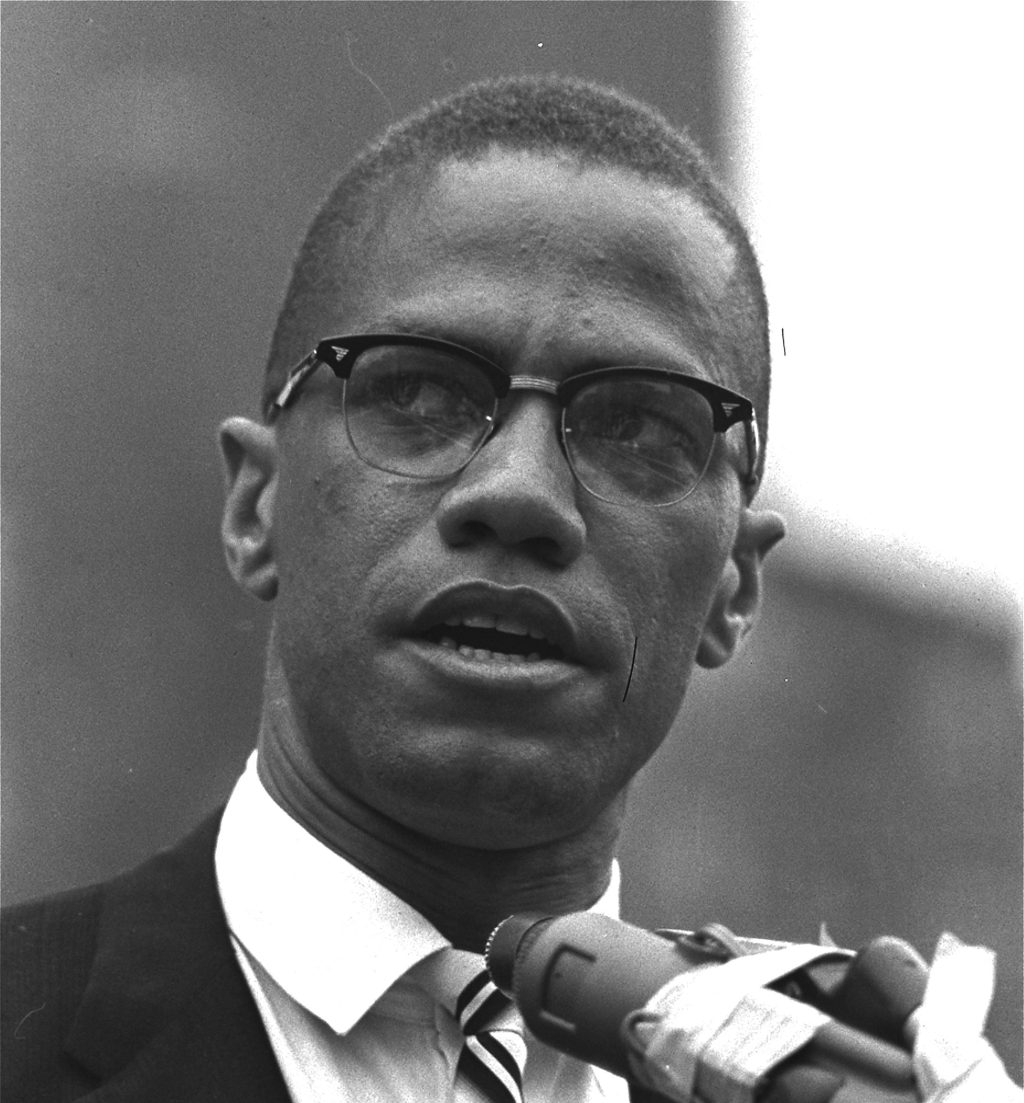
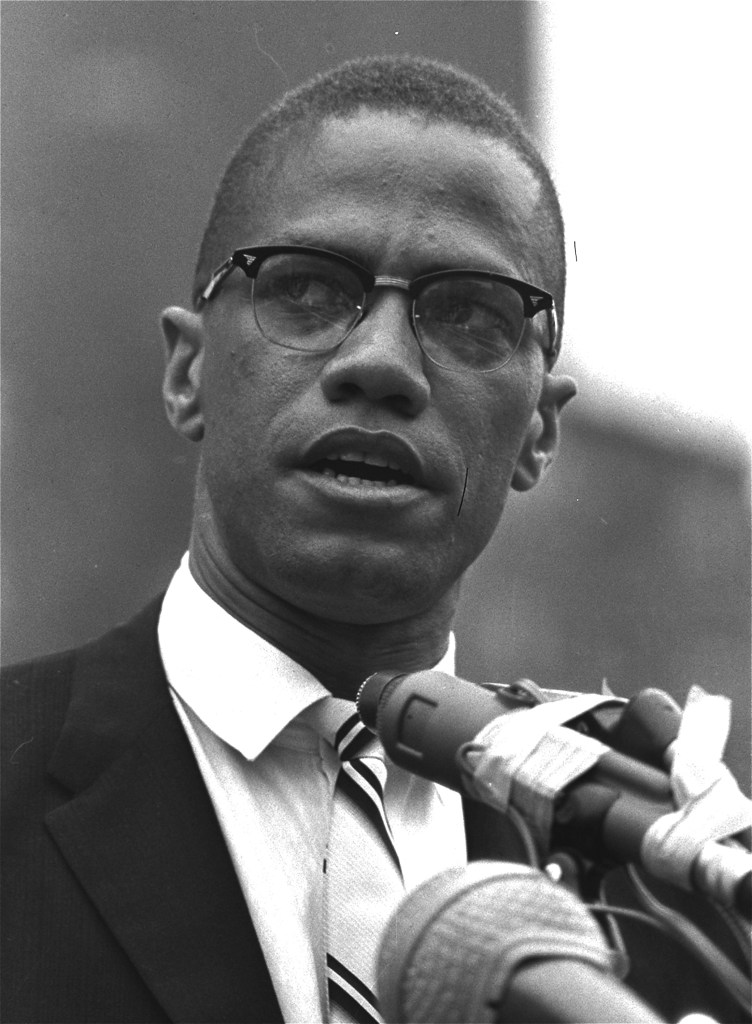
VII. Malcolm X: The Hardest Thing in the World
Malcolm X (1925–1965) locates the “dark depths” of Q 6:63 in a prison cell, and his account of learning to pray is one of the most searching in modern autobiography.
Born Malcolm Little, orphaned young and drawn into a life of hustling, drug-dealing and burglary, he was sentenced in 1946 to years in Massachusetts prisons. There, at what he called the lowest point of his life, his siblings introduced him by letter to the teachings of the Nation of Islam and urged him to pray. In The Autobiography of Malcolm X (told to Alex Haley), he describes the physical and spiritual agony of that first act of submission: “The hardest test I ever faced in my life was praying. You understand. My comprehending, my believing the teachings of Mr. Muhammad had only required my mind’s saying to me, ‘That’s right!’… But bending my knees to pray — that act — well, that took me a week.” He continues: “Picking a lock to rob someone’s house was the only way my knees had ever been bent before. I had to force myself to bend my knees. And waves of shame and embarrassment would force me back up. For evil to bend its knees, admitting its guilt, to implore the forgiveness of God, is the hardest thing in the world.”
Prayer became the hinge of one of the twentieth century’s most dramatic transformations. Malcolm taught himself to read by copying the dictionary, emerged from prison an autodidact and a formidable orator, and became the Nation of Islam’s most magnetic spokesman. His transformation did not end there: after his 1964 pilgrimage to Mecca — where, praying alongside Muslims of many nations and colors, he embraced Sunni Islam and took the name El-Hajj Malik El-Shabazz — he repudiated the racial separatism of his earlier years, a second conversion within the first. Manning Marable’s biography aptly subtitles his life “A Life of Reinvention.” Malcolm’s story testifies that the humble, secret call of Q 6:63 can be, for a proud man, the most difficult surrender of all — and the most life-altering. Daily Theology
VIII. Immaculée Ilibagiza: The Prayer in the Bathroom
Immaculée Ilibagiza (b. 1972) prayed her way through one of the darkest passages of the twentieth century, and emerged not with vengeance but with forgiveness — the very fruit that the anchor verses’ vow of gratitude implies.
A Tutsi university student home for Easter in April 1994, Ilibagiza was caught in the Rwandan genocide. Her father, a devout Catholic, pressed his rosary into her hands and sent her to the home of a Hutu pastor. There she and seven other women hid, silent, in a hidden bathroom measuring exactly 3 by 4 feet — twelve square feet — for 91 days, while machete-wielding killers searched the house repeatedly, once touching the door handle before turning away. Outside, nearly a million Rwandans, including her mother, father and two of her brothers, were murdered.
Ilibagiza has said she owes her survival to prayer. In her New York Times bestseller Left to Tell: Discovering God Amidst the Rwandan Holocaust (2006), she describes how, consumed by fear and hatred, she began to pray the rosary as a way “of drowning out the anger inside her, and the evil outside the house” — by her account praying 27 rosaries and 40 Divine Mercy chaplets every single day for three months. She recounts a specific answered prayer: through “fervent prayer” she was moved to beg the pastor to push a wardrobe in front of the bathroom door, a concealment that saved the women’s lives when the killers came. “I realized that my battle to survive this war would have to be fought inside of me,” she wrote. “I could rely only on God to help me fight.” She wrestled hardest with the Lord’s Prayer’s demand that she forgive those who “trespass against us,” at first skipping the line — until, she says, she heard an inner voice reminding her that the prayer “is not man-made.” Having entered the bathroom weighing 115 pounds, she emerged at 65 pounds to find her family slaughtered — and yet she later came face to face with the man who had killed her mother and brother and told him, “I forgive you.” Her transformed life has been given to a global ministry of faith and forgiveness, expressed in her books and in her work with orphans; her message, distilled, is “If I can forgive, anyone can.” Hers is the anchor verses in a locked room: the humble, secret call from the depths, the deliverance, and a gratitude that took the astonishing form of pardon. Duquesne UniversityDetroit Catholic
IX. Muhammad Asad: The Emptiness in the Subway
Muhammad Asad (1900–1992) — born Leopold Weiss, the grandson of an Orthodox rabbi in Lemberg (Lviv) — completes the interfaith arc of this essay: a Jewish intellectual whose crisis was not a storm but the spiritual emptiness of modern Europe, and whose “rescue” was a book.
A gifted young foreign correspondent for the Frankfurter Zeitung, Weiss traveled through the Arab world in the 1920s and found himself drawn to the God-consciousness he saw in Muslim life. The decisive moment, as he recounts in his classic memoir The Road to Mecca (1954), came on a Berlin subway (the U-Bahn) around September 1926. Studying the faces of his fellow passengers — prosperous, well-dressed, yet marked by a hidden anguish wholly at odds with their material comfort — he was struck by the sense of a civilization that had gained the world and lost its soul. Reaching home, he found an open copy of the Qur’an and his eyes fell on Surat al-Takathur (Q 102): “You are obsessed by greed for more and more, until you go down to your graves.” The verse, he wrote, rendered him speechless; the Qur’an trembled in his hands as he passed it to his wife Elsa: “Read this. Is it not an answer to what we saw in the subway?” He converted to Islam within days, taking the name Muhammad Asad (“Asad,” lion, echoing his given name Leo).
His changed life became one of the most consequential intellectual careers in modern Islam. Asad crossed the Arabian desert by camel, made the Hajj five times, befriended King Ibn Saud, and — at the urging of the poet-philosopher Muhammad Iqbal — helped articulate the intellectual foundations of the future state of Pakistan, later serving as Pakistan’s first envoy to the United Nations. He devoted seventeen years to The Message of the Qur’an (1980), an English translation and commentary ranked with those of Pickthall and Yusuf Ali, and remained throughout a self-described “religious bridge-builder,” emphasizing the shared heritage of Judaism, Christianity and Islam. The German diplomat and convert Murad Hofmann judged that “perhaps no other book except the Qur’an itself led to a greater number of conversions to Islam” than The Road to Mecca. Asad’s “distress” was the quiet desperation of a culture; his prayer was the honest question of a searching mind; and his gratitude was a lifetime of service to understanding between faiths.
X. Thematic Epilogue: Gratitude as the Test after Rescue
Read together, these eight lives — and behind them the towering classical instance of Augustine of Hippo, who in a Milanese garden, weeping and crying “How long, O Lord?”, heard a child’s voice sing tolle, lege (“take up and read”) and, opening Paul’s letter to the Romans, found his life remade — form a single extended commentary on Al-An’am 6:63–66.
The universality of the cry de profundis. From a drowning pop star off Malibu to an airman on a raft, from a slaver in an Atlantic gale to a woman in a Rwandan bathroom, from an atheist mathematician to a rabbi’s grandson on a Berlin train, the situations differ utterly, but the structure is identical, and it is exactly the structure Q 6:63 describes: the human being, stripped of every other resource, calls “humbly and secretly” upon God. The Qur’an presents this not as the property of one people but as a disclosure of what every human being is underneath — the fitra, the innate orientation toward the One, that surfaces when all idols fail. That the same pattern appears in Psalm 107 (“they that go down to the sea in ships… they cry unto the LORD in their trouble”) is, for a pluralist reader, a resonance worth pondering rather than a claim to be adjudicated. The cry from the depths is one of humanity’s most universal utterances.
Gratitude (shukr) as the real test. The genius of the anchor verses is that they do not end with the rescue. Verse 64 turns immediately to the aftermath — “God rescues you… yet still you worship others beside Him” — and Q 10:23 sharpens the point: once returned to dry land, people “behave outrageously.” The true drama of these lives is therefore not the moment of rescue but the decades afterward. Zamperini was rescued in 1943 and forgot his vow for six years. Newton was delivered in 1748 and remained a slaver for years more, taking the better part of a lifetime to live out his repentance. The Qur’anic anthropology is unsparingly realistic here: rescue is common; sustained gratitude is rare and costly. What unites the figures in this essay — and distinguishes them from the ingrates of Q 6:64 — is that each, sooner or later, kept the vow of thankfulness, and let it reorganize an entire life: schools and charities for Yusuf Islam, abolition for Newton, forgiveness for Zamperini and Ilibagiza, scholarship and bridge-building for Lang, Asad and Schloss, prophetic witness for Malcolm X.
The phenomenology of foxhole prayer — and why some transform while others forget. Sceptics rightly note that crisis reliably produces prayer; near-death experience researchers describe the flood of a “numinous, loving, overwhelming presence” as a recognizable phenomenon (Schloss’s own description). The Qur’an does not dispute the psychology; it presupposes it — that is the entire point of “when you humbly and secretly call to Him.” The interesting question is not whether desperate people pray, but why the experience remakes a Yusuf Islam or an Immaculée Ilibagiza while leaving others, in the words of Q 39:8, to “forget the One they had been praying to.” The lives here suggest an answer: transformation follows when the rescued person treats the deliverance as incurring a debt — when “if You save me I will work for You” is understood as a binding covenant rather than a panicked bargain to be discarded on shore.
Du’a as the marrow of worship. In the Islamic tradition, the Prophet Muhammad is reported to have said, “Supplication (du’a) is the essence of worship.” Q 2:186 — “I answer the prayer of the supplicant when he calls on Me” — and Q 40:60 — “Call on Me and I will answer you” — frame prayer not as a last resort but as the native language of the creature before its Creator. Q 27:62 asks, “Who answers the distressed (al-mudtarr) when they call upon Him?” The figures in this essay learned in extremity what the tradition teaches as a norm: that the human being is constitutively a supplicant, and that the cry from the depths is not a failure of self-reliance but the truest thing a person can do.
The darkness and the light. The connecting motif has been Yunus in the belly of the fish, praying in the layered darkness — La ilaha illa anta, subhanaka, inni kuntu min al-zalimin — and the Qur’an’s promise that follows: “This is how We save the faithful” (Q 21:88). Each life surveyed here descended into some darkness — of the sea, of prison, of genocide, of doubt, of a culture’s emptiness — and each, in its own tongue, cried the cry of Jonah and was, in its own way, cast back onto the shore. Q 12:87 supplies the pastoral summary that all of them, across their several traditions, came to embody: “Never despair of God’s mercy.” And Q 94:5–6 supplies the promise that their changed lives confirmed: “With hardship comes ease; truly, with hardship comes ease.”
The last of the anchor verses is a caution against triumphalism, and a fitting close for an essay written in a non-polemical, interfaith spirit. God instructs the Prophet: “I have not been put in charge of you” (Q 6:66). The stories gathered here are offered in exactly that register — not as proofs to compel, not as a ledger of one tradition’s victories over another, but as witnesses, laid side by side, to a single mercy that the Qur’an says answers the distressed whenever, and wherever, and in whatever language, they call.
A Note on Sources
This essay draws on the Abdel Haleem translation of the Qur’an for the anchor verses and classical tafsir (Ibn Kathir, al-Tabari, al-Qurtubi, al-Razi) for Q 6:63–66; on the hadith of Yunus’s supplication in Sunan al-Tirmidhi (3505) and Musnad Ahmad; and on primary and reputable secondary sources for each life: Yusuf Islam’s own interviews (BBC Desert Island Discs, The New York Times, The Sun, NPR) and the Yusuf Islam Foundation and Cat Stevens biographical record; the To The Best of Our Knowledge interview (14 May 2017) and BioLogos (“Finding Faith,” 2019) and Westmont College materials for Jeffrey Schloss; Newton’s Authentic Narrative and Thoughts upon the African Slave Trade with Britannica and museum sources; Laura Hillenbrand’s Unbroken and Zamperini’s Devil at My Heels; Jeffrey Lang’s Even Angels Ask and Struggling to Surrender; The Autobiography of Malcolm X; Immaculée Ilibagiza’s Left to Tell and interviews (National Catholic Register, The Catholic Sun); and Muhammad Asad’s The Road to Mecca. Convergences with Psalm 107 and Augustine’s Confessions are cited as interfaith resonances, not as proofs.



Leave a Reply