
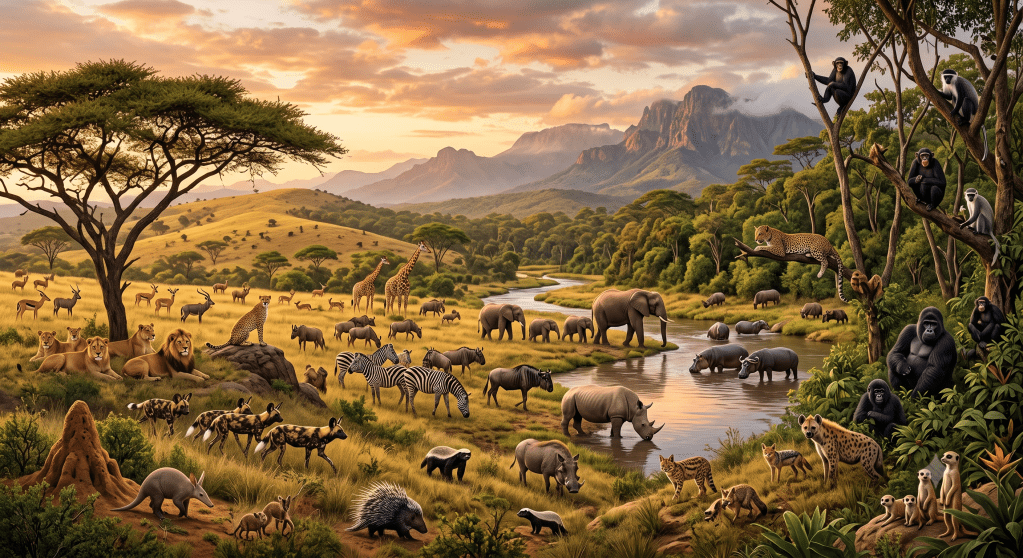
Presented by ChatGPT
Abstract
Quran 45:2–4 begins with revelation, then turns immediately to the visible world: the heavens, the earth, the human self, and the dispersed multitude of living creatures. In that sequence, the text does not treat nature as a distraction from scripture, but as one of scripture’s appointed theaters of meaning. Verse 45:4 is especially striking: “in your own creation, and whatever living beings He dispersed, are signs for people of sure faith,” while 45:2 anchors the whole contemplation in a Book sent down from Allah, “the Almighty, All-Wise.” The passage therefore invites a disciplined religious natural contemplation: seeing the living world as āyāt—signs—rather than as mute fact.
Modern zoology intensifies that invitation. Depending on the database and taxonomic scope, current global catalogues list roughly 1.4 to 1.8 million recognized animal species, while a widely cited biological estimate projected about 7.77 million animal species on Earth and concluded that about 86% of Earth’s species and 91% of ocean species still awaited description. In other words, even after centuries of classification, much of animal life remains hidden from us. That vastness does not weaken a theological reading of creation; it magnifies it. It suggests that the creative act of God is not exhausted by the familiar and the domesticated, but overflows in forms that human knowledge has barely begun to enumerate.
On this reading, evolution also becomes relevant, though indirectly. Quran 45:4 is not a textbook of phylogenomics, nor does it present a technical theory of descent with modification. But if the verse commands careful reflection on living beings, then truthful accounts of how animal forms arise, diversify, and are related to one another become part of that contemplative duty. Zoology catalogs the signs; evolutionary biology traces some of their historical pathways. Theology then asks what it means for these pathways to exist at all under the sovereignty of the One whom the Quran names al-Khāliq, al-Bāriʾ, al-Muṣawwir—the Creator, the Originator or Inventor, and the Shaper.
The Scriptural Horizon of the Passage
The passage unfolds with remarkable order. Verse 45:2 grounds the scene in revelation from “the Almighty, All-Wise.” Verse 45:3 points to the heavens and the earth as signs for believers. Verse 45:4 narrows the lens from the cosmic to the embodied—“your own creation” and the dispersed living creatures. Verse 45:5 then widens again to cycles and systems: night and day, rain, revivified earth, and winds. The movement is therefore from Book, to cosmos, to body and animals, to process and pattern. The world is not presented as chaos, but as intelligible order under divine wisdom.
The Arabic texture matters. The Quranic Arabic Corpus glosses yabuththu in 45:4 as “He disperses,” and dābbah as “moving creatures.” The verse therefore emphasizes not only life, but spread, plurality, inhabitation, and motion. Animals are not invoked as a static museum exhibit. They are dispersed across the earth as a living multitude. This makes zoology, biogeography, and ecology especially fitting companions for reflection on the verse: migration, radiation into habitats, and ecological difference are all part of the world that the verse calls a sign.
Classical commentary also notices the spiritual ascent built into 45:3–5. In Ma‘arif al-Qur’an, the signs in these verses are linked to three receptive states: belief, certainty, and reason. The point is not that faith replaces inquiry, but that deeper moral and intellectual receptivity allows the signs to become more legible. In that sense, zoology is not merely an inventory of specimens. It is one discipline through which faith can pass into yaqīn—a steadier certainty—when the abundance, coherence, and intelligibility of life are contemplated rightly.
This reading deepens further when paired with Quran 59:24, where God is named al-Khāliq, al-Bāriʾ, al-Muṣawwir—“the Creator, the Inventor, the Shaper.” In the same tafsir tradition, al-Muṣawwir is explained as the One who gives each creature its distinguishing form, with differences not only between species, but among individuals within a species. That is almost a theological gloss on morphology itself: zoological form is not an accidental leftover, but a field of divine signature.
Zoology as a Catalogue of Signs
The numerical scale of animal life is already spiritually arresting. The Catalogue of Life currently lists 1,812,571 animal species in its June 19, 2026 extended release, while the Encyclopedia of Life lists 1,402,683 animal species. The discrepancy itself is instructive: classification is dynamic, databases have different scopes, and human knowledge is still being assembled. What remains constant is the overwhelming magnitude of animal diversity. Even our official lists are still approximations of a living plenitude.
That plenitude is heavily invertebrate. The Encyclopedia of Life notes that about 95% of the 1.4 million known animal species are invertebrates, and that arthropods alone account for more than 1.2 million living species. EOL’s current taxon page for insects lists 954,979 named insect species, while entomological synthesis papers estimate that there may be about 5.5 million insect species globally. In other words, what most human beings treat as the background noise of creation—the crawling, winged, small, and overlooked—is actually the dominant register of animal multiplicity. A theology of creation that notices only charismatic vertebrates has barely begun to read the script of 45:4.
The same is true across other great branches of life. MolluscaBase describes molluscs as the second-largest animal phylum after arthropods and reports approximately 86,600 valid extant species. For birds, the newly unified AviList announced 11,131 species in 2025, while the IOC World Bird List v15.2—updated in April 2026—lists 11,227 bird species including extinct taxa. The Mammal Diversity Database v2.4, released in January 2026, records 6,758 living mammal species, and the Reptile Database reports more than 12,500 reptile species in 2026. AmphibiaWeb reports 9,079 amphibian species as of July 2026, and Eschmeyer’s Catalog of Fishes records 37,678 valid fish species. The sheer taxonomic spread across body plans, habitats, and lineages turns the phrase “whatever living beings He dispersed” into something much larger than common intuition can hold at once.
The user-supplied estimate of roughly 7.8 million animal species also has serious footing in the literature. Mora and colleagues estimated about 7.77 million animal species and argued that the majority remained undescribed. Later discussions have questioned aspects of total richness estimation, and marine-specific work has suggested that the unknown fraction in the oceans may in some cases be lower than the most dramatic early estimates. Still, the central theological point survives even the revisions: the field of created animal life radically exceeds the portion humans have named. Scientific humility is therefore not a threat to faith here; it is part of the reverence demanded by the verse.
This is also why the IUCN Red List and the Encyclopedia of Life are not merely technical resources but, in a sense, moral instruments for reading the signs responsibly. IUCN states that more than 172,600 species have been assessed and that more than 48,600 are threatened with extinction. To contemplate animals as āyāt is not only to admire them, but to recognize that extinction can erase signs before we have even learned to read them. Conservation, on this view, is not sentimentality; it is a form of fidelity to creation.
Evolution as the History of Shaped Abundance
If zoology gives us the breadth of creatures, evolution gives us much of their temporal depth. Contemporary animal phylogeny shows broad agreement on major deep relationships within the animal tree, including the monophyly of animals, Bilateria, Protostomia, Ecdysozoa, and Spiralia. Comparative genomics and phylogenomics have substantially clarified how diverse animal groups are related. This means that the multiplicity of species is not a heap of disconnected inventions; it is a branching history of kinship, divergence, loss, innovation, and adaptation.
For a theological commentary on 45:4, that branching pattern need not be felt as a diminishment of the Creator’s action. It can instead be read as a disclosure of divine generosity through ordered history. To say that creatures are related is not to say they are self-grounding. It is only to say that the Shaper often works through inheritance, variation, and development rather than through isolated acts that leave no natural continuity. In this sense, evolution does not rival al-Khāliq; it describes one layer of the created order through which the divine act becomes historically legible.
Evolutionary developmental biology strengthens this point. Review literature on deep homology argues that many anatomical novelties arise not from absolute biological discontinuity, but from the modification of pre-existing genetic regulatory circuits. De Robertis likewise emphasizes a shared developmental toolkit rooted in common ancestry, with ancient gene networks reused and re-patterned across animal phyla. A theological imagination can see here a profound resonance with the name al-Muṣawwir: not merely the production of forms, but the disciplined bestowal, variation, and recomposition of form across deep time.
Even Quran 71:14—“He truly created you in stages”—cannot simply be equated with modern evolutionary theory, but it does show that staged becoming is not alien to Quranic language about creation. Used carefully, that verse can support a theological sensibility in which process is not the opposite of creation. Developmental sequence, historical unfolding, and graduated becoming can all remain fully within the horizon of divine agency. The mistake would be to imagine that only the instantaneous is truly created. Abrahamic monotheism has generally affirmed not only that God brings things into being, but that God sustains and orders the world through time.
Philosophical Reflections on Mechanism, Meaning, and Miracle
A philosophically disciplined way to relate biology and theology is to distinguish levels of explanation without splitting reality into two separate worlds. Science asks about mechanisms, lineages, constraints, and causes within nature. Theology asks why there is a lawful and intelligible natural order at all, why living beings have being rather than non-being, and how created forms can signify their source. The Stanford Encyclopedia of Philosophy’s discussion of religion and science notes that these questions intersect most intensely around creation and divine action, while the entry on creation and conservation emphasizes that monotheistic traditions affirm both God’s bringing-into-being and God’s sustaining of beings over time.
That distinction is crucial for reading evolution theologically without collapsing into “God of the gaps” reasoning. If one seeks God only in what science has not yet explained, then every scientific advance seems to push God outward. But if God is instead confessed as the source of existence, order, lawfulness, and sustained intelligibility, then explanation within nature does not replace God; it reveals the depth of the created order. In that framework, an evolving biosphere can still be a theater of miracle in the theological sense: not because it violates nature, but because creaturely existence, intelligibility, and fecundity are already wondrous gifts.
Philosophically, biology also never fully escapes the language of ends and functions. The Stanford Encyclopedia’s entry on teleology in biology notes that teleological notions remain pervasive in fields such as genetics, medicine, and ethology because living systems are described in terms of what structures are for. Evolutionary theory explains how such functions arise historically, but it does not erase the remarkable fact that life is organized in ways that are intelligibly fitted to survival, reproduction, sensing, locomotion, and relation. For the believer, this does not force a crude design argument from every trait; rather, it heightens awareness that the world of animals is saturated with structured aptness.
Under the Quranic names of 59:24, one may say it this way. Al-Khāliq points to the donation of being itself. Al-Bāriʾ points to the bringing-forth and distinguishing of creatures into a real, ordered world. Al-Muṣawwir points to the bestowal of shape, difference, pattern, and individual identity. Zoology especially encounters the third name at every turn—feather architecture, insect segmentation, cephalopod eyes, mammalian dentition, reptilian scales, amphibian metamorphosis, fish hydrodynamics. Evolution then shows that these forms are neither random noise nor disjointed curiosities, but historically connected variations in a world of lawful creativity.
Abrahamic Resonances
The Quran’s invitation to learn from living creatures stands in continuity with broader Abrahamic scripture. Job 12:7–10 says, in effect, “ask the animals,” and they will teach that the life of every creature is in the hand of the Lord. Romans 1:20 teaches that divine power and nature can be perceived through what has been made. These texts do not erase the differences between Jewish, Christian, and Islamic theologies, but they converge on one major intuition: the created world is not spiritually opaque. Animal life can be pedagogical. It can teach.
From that Abrahamic angle, zoology becomes a school of reverence. The ant, whale, beetle, cuttlefish, vulture, gecko, lemur, caecilian, and coelacanth all rebut human parochialism. They announce that creation is far larger than human utility and far richer than human imagination. To study them well is therefore to practice humility. The scientist learns it by recognizing how much remains uncatalogued and how revisable classification still is. The theologian learns it by recognizing that the Creator’s wisdom exceeds the anthropocentric scale on which humans instinctively judge significance.
Thematic Epilogue
Quran 45:2–4 can thus be read as a sequence of deepening attentions: revelation names the Speaker; the cosmos broadens the stage; one’s own creation interiorizes the sign; the dispersed animal world multiplies it into near-infinity. In that light, all of zoology becomes an extended commentary on 45:4, and evolution becomes an indirect but powerful aid to that commentary by revealing kinship, deep time, developmental continuity, and the historical unfolding of form. None of this compels faith mechanically. But it does make unbelief look hurried, because the world of animals is too abundant, too patterned, too intelligible, and too unfinished in our knowledge to be spiritually trivial.
To stand before the animal kingdom with Quran 45:4 in mind is therefore to be taught three things at once. First, reality is more populous than our naming. Second, form is more meaningful than our habits of noticing. Third, history itself—developmental, ecological, evolutionary—may be read, by a people of faith and reason, as the unfolding of a creation whose source remains the One who creates, brings forth, and shapes. In that sense, every field guide, phylogenetic tree, museum drawer, field survey, Red List assessment, and taxonomic revision can become a small act of tafakkur: a disciplined return from creaturely multiplicity to the praise of al-Khāliq, al-Bāriʾ, al-Muṣawwir.
For references please go to the Microsoft Word file:



Leave a Reply