
Presented by ChatGPT
Abstract
Few questions lie deeper than the question of causation. When fire touches cotton, does fire itself possess a power that necessarily produces burning? When a photon reaches the surface of water, what makes that individual quantum event terminate as reflection rather than transmission? When a human being wills an action, how is that creaturely willing related to the sovereign will of God? Classical Islamic theology, modern physics, and the Qur’an approach these questions with very different vocabularies, yet Zia H. Shah, MD, has developed a sustained body of essays arguing that they can be brought into a philosophically illuminating conversation. His “Occasionalism” archive at The Glorious Quran and Science develops this thesis through articles on al-Ghazālī, divine providence, the “Inshallah universe,” Qur’an 57:1–6, the multiple interpretations of quantum mechanics, and the behavior of individual photons.
The argument is strongest when stated carefully. Quantum mechanics does not prove occasionalism, nor does present-day physics identify God as the hidden variable selecting quantum outcomes. What quantum theory does show is that the mechanistic picture inherited from classical physics is not the only possible picture of nature. In the standard probability-based formalism, a fully specified preparation generally yields probabilities for individual measurement outcomes rather than a prediction of which particular outcome will occur; the double-slit experiment makes this departure from classical intuition especially vivid. Feynman described the two-slit phenomenon as containing “the heart of quantum mechanics,” emphasizing that the theory calculates probabilities even when it does not predict the particular result of an individual event.
At an air-water interface there is, the light either reflects or refracts. Classical electromagnetism does predict how an incident beam divides statistically between reflected and transmitted light: Maxwell’s equations together with the Fresnel relations determine reflection and transmission amplitudes as functions of refractive indices, angle, and polarization. Shah himself acknowledges this, calculating reflected percentages before turning to the genuinely quantum question: given a single photon in an appropriate experiment, standard quantum mechanics predicts outcome probabilities but not, before measurement, which individual detection outcome will occur. Thus the scientifically defensible formulation is not “physics cannot tell whether a beam reflects or refracts,” but rather: physics can predict ensemble probabilities extremely accurately while ordinary quantum mechanics does not select in advance the unique result of each individual quantum trial. This distinction is crucial.
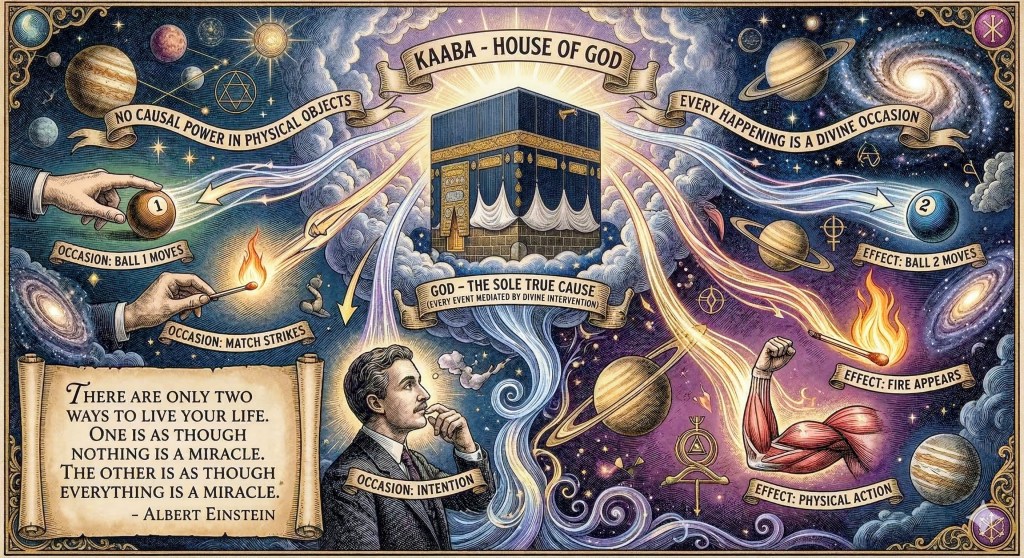
Al-Ghazālī’s famous critique of necessary causal connection supplies Shah’s metaphysical counterpart. In the seventeenth discussion of The Incoherence of the Philosophers, al-Ghazālī argues that what we ordinarily call cause and effect are not logically or metaphysically bound by an intrinsic necessity accessible to us. Fire and cotton can regularly occur together with burning without the conjunction itself constituting a self-sufficient necessity independent of God. Modern scholarship importantly qualifies the common textbook description of al-Ghazālī as an uncompromising occasionalist: Frank Griffel’s analysis notes that al-Ghazālī explicitly attacks necessary causal connection and leaves room, in one strand of the argument, for secondary or mediated causation. The radical occasionalist reading is therefore historically important but not the only scholarly reading of al-Ghazālī.
Shah’s distinct contribution is to place this Ghazālian problem inside a broad Qur’anic theology. The Qur’an repeatedly describes Allah as possessing unrestricted dominion, exhaustive knowledge, omnipotence, sustaining power, knowledge of the unseen, intimate knowledge of the human heart, and a will within which creaturely willing occurs. Shah consequently reads verses such as 57:1–6, 6:59, 31:16, 8:24, 76:30, 81:29, 67:30, 2:255, 35:41 and 55:29 as converging upon an ontology of radical creaturely dependence. His later synthesis explicitly groups 8:17, 2:255, 35:41, 30:25, 55:29, 6:59, 6:103, 18:23–24, 57:22 and 13:38–39 among the recurring Qur’anic texts relevant to this vision.
The resulting thesis can be stated in one sentence: quantum mechanics makes a mechanically self-sufficient universe less philosophically compulsory, while the Qur’an supplies a theology in which no event, object, mind, law, or causal sequence is independent of the knowledge, power, will and sustaining activity of Allah. That is a philosophical-theological synthesis, not an experimentally established result of physics. Indeed, one of Shah’s own later formulations wisely describes the relationship between Qur’anic theology and modern science as one of “resonance and anticipation,” rather than a concordist scientific proof.
The Quantum Mystery: From the Double Slit to a Single Photon at the Surface of Water
The double-slit experiment is an unusually good place to begin because it frustrates the ordinary distinction between “particle” and “wave.” Classical particles produce localized impacts and, when fired through two openings, their probabilities simply add. Classical waves spread through both openings and interfere: amplitudes combine, producing alternating regions of constructive and destructive interference. Quantum objects give us both features in the same experiment. Individual detection events occur as discrete localized “clicks,” yet after many events the distribution of those clicks forms an interference pattern governed by amplitudes. Feynman’s treatment makes precisely this contrast: quantum entities arrive in indivisible events, while their probability distribution obeys an interference rule.
The mathematical skeleton is beautifully compact. If an event can occur through two indistinguishable alternatives with complex amplitudes (\phi_1) and (\phi_2), quantum theory assigns
[ P = |\phi_1+\phi_2|^2, ]
rather than
[ P=P_1+P_2. ]
Because the first expression contains an interference term, the probability with both alternatives available is generally not the sum of the probabilities obtained by opening one alternative at a time. But if the experimental arrangement supplies which-path information—so that the alternatives become physically distinguishable—the interference term disappears and probabilities add in the classical-looking way.
This phenomenon is not merely a classroom fiction. Single-particle interference experiments have demonstrated that interference patterns emerge statistically from localized individual quantum detections. Such experiments are precisely why “wave-particle duality” should not be understood as a little classical particle literally changing costume into a classical wave. Quantum objects are described by a formalism more fundamental than either classical picture. Feynman therefore cautioned that electrons and photons behave, strictly speaking, like neither ordinary waves nor ordinary particles.
Copenhagen and complementarity
What is often called the Copenhagen interpretation is better regarded as a family of related ideas associated especially with Niels Bohr, Werner Heisenberg and the early quantum tradition, rather than a single universally codified doctrine. Bohr emphasized that quantum phenomena cannot simply be assigned simultaneously all the properties possessed by classical objects independently of their experimental context. Wave-like and particle-like descriptions are complementary: each becomes appropriate within particular arrangements, while no single classical picture exhausts the quantum phenomenon. His 1928 exposition explicitly tied quantum theory to limits on the unqualified application of classical concepts and to the statistical prediction of individual transitions.
On the usual textbook reading, the wave function evolves according to quantum dynamics and measurements yield outcomes probabilistically according to the Born rule. What is obtained in one trial cannot generally be predicted with certainty merely from the wave function when several outcomes have nonzero probability. This is the point of Feynman’s stark formulation: the formalism lets us calculate the odds, not generally the exact individual outcome.
That is the opening Shah finds philosophically significant. A Laplacian clockwork cosmos would ideally allow an intelligence with complete initial data to calculate every later event. Standard operational quantum mechanics does not present nature in that form. It offers highly exact probability distributions while leaving the unique occurrence in an individual trial outside the predictive reach of the ordinary formalism.
Everett and the many-worlds alternative
Hugh Everett’s 1957 “relative-state” formulation proposed a radically different response. Rather than inserting a special physical collapse into the dynamics, Everett sought to retain the universal quantum state and its unitary evolution. What later came to be called the Many-Worlds Interpretation develops this approach: the alternatives represented in the quantum state are not reduced by a fundamental collapse into one uniquely existing branch; instead, observers become correlated with different outcomes in effectively decohered branches.
This difference matters enormously for the theological argument. Copenhagen-style language makes it natural to speak about an objectively unpredictable individual outcome becoming actual. Everettian quantum mechanics instead tries to make the underlying universal dynamics deterministic, with apparent randomness understood from the standpoint of an observer located in one branch. Therefore quantum unpredictability by itself does not compel an indeterministic metaphysics, much less occasionalism. Shah’s own article on the plurality of quantum interpretations properly recognizes that quantum mechanics has generated radically different pictures of reality, including Copenhagen and Many-Worlds.
The deeper philosophical lesson is consequently not “quantum mechanics proves God chooses each outcome.” It is that successful physical equations do not automatically settle the ontology represented by those equations. Copenhagen, Everettian approaches, Bohmian mechanics and other interpretations offer very different accounts of what reality is like beneath or behind the shared empirical formalism. The existence of this interpretive plurality weakens the claim that the formal success of physics itself establishes a unique materialist metaphysics.
Objective-collapse theories must be distinguished here: unlike interpretations that preserve the standard unitary dynamics, they modify the theory and can in principle lead to experimentally different predictions. It is therefore too broad to say that every interpretation or alternative quantum theory makes exactly the same predictions. Decoherence, meanwhile, explains how environmental interaction suppresses observable interference between macroscopically distinct alternatives, but by itself does not uniquely choose among all philosophical interpretations of quantum mechanics.
The swimming-pool surface: what physics knows and what it does not
Shah’s photon example is especially instructive once it is sharpened. When ordinary light strikes water, some light is reflected and some is transmitted and refracted. Classical electromagnetic theory is exceptionally successful here. The Fresnel equations give reflection and transmission amplitudes; Snell’s law gives the propagation direction of the transmitted beam. Thus, the statement that “known physical laws do not decide whether the beam reflects or refracts” is not quite right. They predict both components.
Shah himself makes essentially this point before taking the next step. In his March 2025 essay, he calculates the reflected fraction for differently polarized light and says that science successfully predicts the percentages. He then asks a different question: what about an individual photon? For a quantum experiment in which a single photon encounters an optical interface or beam splitter and distinct reflected and transmitted outcomes are possible, quantum mechanics assigns amplitudes and therefore probabilities to the alternatives. Under the usual collapse-based account, however, the formalism does not give an additional fact that tells us in advance which particular photon will yield which particular detector click.
This permits a much more precise version of Shah’s proposed analogy:
[ \text{Physical law} \quad \longrightarrow \quad \text{probability distribution} ]
but, in standard indeterministic readings,
[ \text{physical law alone} \quad \not\longrightarrow \quad \text{advance prediction of the unique individual outcome}. ]
The scientifically warranted conclusion stops there. Physics does not license the further equation
[ \text{unpredicted quantum outcome} = \text{empirically demonstrated divine intervention}. ]
That second step is metaphysics and theology. Yet it is precisely at this boundary that Shah sees a conceptual opening for al-Ghazālī: nature can display strikingly stable lawlike regularity without the laws themselves functioning as a complete classical script specifying every particular event.
Al-Ghazālī, Causation, and Shah’s “Inshallah Universe”
Al-Ghazālī’s importance lies less in having anticipated quantum mechanics than in asking a prior philosophical question: what do we mean when we say that one created thing causes another?
In The Incoherence of the Philosophers, the celebrated example is fire and cotton. Observation shows a reliable conjunction: cotton exposed to fire under suitable circumstances burns. But does observation establish that fire possesses an autonomous metaphysical power by which burning must necessarily follow? Al-Ghazālī says that the necessary connection does not follow simply from the observed conjunction. Classical Ashʿarite occasionalism explains regularity by holding that God creates the successive states of the world according to a stable custom or habit, rather than created substances carrying independent causal powers sufficient unto themselves.
This should not be flattened into the claim that al-Ghazālī opposed science or denied regularity. His argument presupposes regularity—the entire notion of divine ʿāda, habit or customary order, depends upon it. The philosophical target is necessary and autonomous creaturely causation. Moreover, modern scholarship disputes how absolutely occasionalist al-Ghazālī himself was. Griffel notes that Discussion Seventeen allows more than one causal model: one is strongly occasionalist, while another permits mediated or secondary causes whose operation still depends on God. His principal polemical objective is the philosophers’ claim of necessary causal entailment, particularly insofar as that would constrain divine power and the possibility of miracles.
Shah adopts the stronger occasionalist strand. In his formulation, the cosmos is not a machine manufactured by God and then metaphysically left to run under powers delegated permanently to created things. Rather, it remains continuously dependent on Allah. Natural laws describe the astonishing regularity of divine governance; they do not constitute rival sovereign agents standing between Creator and creation. His 2026 “Omnipresent Sustainer” synthesis explicitly presents the universe as a continuously dependent order and uses modern metaphors such as frame-by-frame realization or simulation to illuminate—not literally identify—the classical theological idea of continuous divine sustaining.
The phrase “Inshallah universe” captures the same intuition at the level of creaturely agency. “I will do this tomorrow” must always be metaphysically qualified by “if Allah wills.” Qur’an 18:23–24 gives that qualification explicit scriptural form. Qur’an 76:30 and 81:29 then state the principle even more comprehensively: “you do not will unless Allah wills.” In Shah’s account, this need not abolish human responsibility. It describes dependent agency: human beings genuinely intend, choose and act, but their willing is never an independent island outside divine willing. His recurring triad of 8:24, 76:30 and 81:29 is central to this construction.
This produces a layered ontology:
At the creaturely level, fire burns cotton, people throw objects, photons interact with interfaces, clouds rain, water circulates, nervous systems generate measurable activity, and choices have consequences.
At the level of physical science, these processes are modeled through regularities, equations, fields, amplitudes, boundary conditions, biochemical interactions and probability distributions.
At the level of metaphysics, Shah denies that the success of those descriptions entails that created reality is ontologically self-sufficient.
At the level of Qur’anic theology, sovereignty, power, knowledge, preservation, command and ultimate efficacy belong to Allah.
The unusually vivid Qur’anic text for this layered agency is 8:17: “You did not throw when you threw, but Allah threw.” The verse simultaneously affirms an act at one level—“when you threw”—and attributes its decisive efficacy to Allah at another. Whatever its immediate historical context, Shah treats its grammar as a paradigm of creaturely action nested within divine action.
The Qur’an, however, never presents a technical theory called “occasionalism,” nor does it teach Ashʿarite atomism or discuss quantum wave functions. The more defensible claim is therefore that occasionalism is a philosophical construction intended to integrate a set of Qur’anic affirmations: Allah alone possesses unrestricted dominion; nothing lies outside His knowledge; creaturely willing lies within His willing; the world continues through His sustaining command; and created causes never become independent competitors with Him. Shah’s work is an extended attempt to show how coherently those affirmations fit together.
The Qur’anic Architecture: Sovereignty, Knowledge, Will, Presence, and Continuous Dependence
Shah’s occasionalist reading becomes more persuasive when the verses are read not as isolated proof-texts but as an interconnected theology of divine attributes.
Sovereignty and omnipotence
The first pillar is mulk—dominion. Qur’an 57:2, 3:189, 5:120 and 64:1 repeatedly join God’s ownership of heaven and earth with the declaration that He is ʿalā kulli shayʾin qadīr, powerful over all things. That combination matters. God is not portrayed as merely the strongest causal agent inside a shared cosmic system; the cosmos itself belongs to Him.
For occasionalism, omnipotence is not simply miraculous power occasionally exercised against otherwise autonomous natural causes. It is the deeper proposition that no created causal nexus can limit the Creator by possessing an independent necessity over which God has no authority. This is precisely why the Ghazālian debate about “necessary” connection mattered.
Omniscience down to the smallest event
The second pillar is comprehensive knowledge. Qur’an 6:59 is perhaps the most powerful text in Shah’s corpus: Allah possesses “the keys of the unseen”; He knows land and sea; not even a leaf falls without His knowledge; no grain hidden in the earth, no wet or dry thing, escapes the encompassing record. Qur’an 31:16 adds the mustard seed, even if concealed in a rock, heaven, or earth. Qur’an 3:29, 64:4, 67:13–14, 11:5 and 50:16 move inward from external nature to thoughts, whispers, concealed intentions and the contents of the human breast.
This is important to Shah’s quantum analogy. An individual quantum outcome may be unpredictable to us without being unknowable to God. Epistemic limitation on the part of physicists is not, in Qur’anic theology, an epistemic limitation on Allah. Thus quantum probability cannot be naively equated with divine uncertainty. The Qur’anic God is not waiting to discover what the photon “does.” In Shah’s theology, even events that physics represents probabilistically fall within exhaustive divine knowledge.
The unseen and the witnessed
The Qur’anic pair al-ghayb wa-l-shahāda—the unseen and the witnessed—widens this point into an ontology of knowledge. Qur’an 59:22, 32:6 and 13:9 call Allah the Knower of the unseen and witnessed; 62:8 declares that human beings return to that Knower; 72:26–27 stresses God’s knowledge of the unseen and His disclosure of it according to His own prerogative.
One should resist turning al-ghayb into a synonym for “hidden quantum variables.” The Qur’anic concept is far broader and theological. But Shah’s philosophical point remains legitimate at a more modest level: the Qur’an does not identify the empirically accessible layer of reality with the totality of reality. Therefore an epistemology confined to observable quantities cannot simply be converted into the metaphysical doctrine that nothing unobserved or transcendent exists.
The sustaining God: al-Qayyūm
Ayat al-Kursi, 2:255, names Allah al-Ḥayy al-Qayyūm: the Ever-Living, the One by whom all else stands. His preservation of heaven and earth does not weary Him. Qur’an 35:41 says that Allah holds the heavens and earth lest they cease or fall away; Qur’an 30:25 says the heaven and earth stand by His command; Qur’an 55:29 depicts all in the heavens and earth as dependent upon Him while He is continually “in a matter” or bringing matters about. These are among Shah’s most important verses for transforming creation from a one-time event in the remote past into an abiding relation of dependence.
This may be the strongest Qur’anic foundation for his occasionalist reading. Creation, on this view, does not mean merely that the universe had an initial cause billions of years ago. It means that created existence is never metaphysically self-grounding. To exist as creation is to remain dependent.
Divine will and dependent human willing
Qur’an 76:30 and 81:29 state with striking directness:
“You do not will unless Allah wills.”
Shah reads these together with Qur’an 18:23–24—“never say of something, ‘I will do that tomorrow,’ except [adding], ‘if Allah wills’”—and Qur’an 8:24, in which Allah “comes between a person and his heart.” Together these verses form his Qur’anic grammar of the Inshallah universe: creaturely projects are real, yet none acquires absolute independence from divine willing.
This is not fatalism in any simple sense. The Qur’an commands, prohibits, praises, blames and addresses human beings as morally responsible agents. Occasionalist theology therefore has to account for two claims simultaneously: Allah is ultimately sovereign, and humans genuinely act within the moral order. Classical Ashʿarism developed the language of kasb (“acquisition”) partly to negotiate this tension; Shah similarly prefers a model of contingent or dependent agency rather than human autonomy in the metaphysically absolute sense.
Providence in ordinary nature
Finally, verses such as 67:30 prevent occasionalism from being reduced to exotic quantum phenomena. The Qur’an asks: if your water disappeared underground, who could bring you flowing water? The theological point concerns everyday dependence. Water follows hydrological and geological regularities, yet the believer is taught to see those regularities themselves as gifts rather than as rival explanations that render divine providence redundant.
The same logic extends from groundwater to leaves, seeds, hearts, life, death, celestial order and human willing. Quantum mechanics is therefore not the foundation of Shah’s theology. At its most coherent, it is a modern illustration of a much older metaphysical thesis whose Qur’anic foundation is the radical dependence of all things upon Allah.
The Requested Qur’anic Dossier in Arabic
The following brings together the verses specified in the request. English comments give the thematic sense rather than reproducing a single published translation verbatim.
The opening of Sūrat al-Ḥadīd
Qur’an 57:1–6
سَبَّحَ لِلَّهِ مَا فِي السَّمَاوَاتِ وَالْأَرْضِ ۖ وَهُوَ الْعَزِيزُ الْحَكِيمُ ١
لَهُ مُلْكُ السَّمَاوَاتِ وَالْأَرْضِ ۖ يُحْيِي وَيُمِيتُ ۖ وَهُوَ عَلَىٰ كُلِّ شَيْءٍ قَدِيرٌ ٢
هُوَ الْأَوَّلُ وَالْآخِرُ وَالظَّاهِرُ وَالْبَاطِنُ ۖ وَهُوَ بِكُلِّ شَيْءٍ عَلِيمٌ ٣
هُوَ الَّذِي خَلَقَ السَّمَاوَاتِ وَالْأَرْضَ فِي سِتَّةِ أَيَّامٍ ثُمَّ اسْتَوَىٰ عَلَى الْعَرْشِ ۚ يَعْلَمُ مَا يَلِجُ فِي الْأَرْضِ وَمَا يَخْرُجُ مِنْهَا وَمَا يَنْزِلُ مِنَ السَّمَاءِ وَمَا يَعْرُجُ فِيهَا ۖ وَهُوَ مَعَكُمْ أَيْنَ مَا كُنْتُمْ ۚ وَاللَّهُ بِمَا تَعْمَلُونَ بَصِيرٌ ٤
لَهُ مُلْكُ السَّمَاوَاتِ وَالْأَرْضِ ۚ وَإِلَى اللَّهِ تُرْجَعُ الْأُمُورُ ٥
يُولِجُ اللَّيْلَ فِي النَّهَارِ وَيُولِجُ النَّهَارَ فِي اللَّيْلِ ۚ وَهُوَ عَلِيمٌ بِذَاتِ الصُّدُورِ ٦
These six verses constitute perhaps the most concentrated scriptural summary of Shah’s thesis: universal glorification; divine dominion; power over life and death; omnipotence; the First and Last, Outward and Inward; comprehensive knowledge; creation; intimate presence; the return of affairs to God; governance of cosmic processes; and knowledge of what lies inside the breasts. Shah explicitly treats 57:1–6 as an “ontological map” for divine sovereignty, omniscience, omnipresence and creaturely dependence.
The falling leaf and mustard seed
Qur’an 6:59
وَعِندَهُ مَفَاتِحُ الْغَيْبِ لَا يَعْلَمُهَا إِلَّا هُوَ ۚ وَيَعْلَمُ مَا فِي الْبَرِّ وَالْبَحْرِ ۚ وَمَا تَسْقُطُ مِنْ وَرَقَةٍ إِلَّا يَعْلَمُهَا وَلَا حَبَّةٍ فِي ظُلُمَاتِ الْأَرْضِ وَلَا رَطْبٍ وَلَا يَابِسٍ إِلَّا فِي كِتَابٍ مُّبِينٍ
The unseen, land and sea, every falling leaf, every hidden grain, every wet and dry thing all lie within divine knowledge. Shah repeatedly employs this verse because it joins cosmic scope to microscopic particularity.
Qur’an 31:16
يَا بُنَيَّ إِنَّهَا إِن تَكُ مِثْقَالَ حَبَّةٍ مِّنْ خَرْدَلٍ فَتَكُن فِي صَخْرَةٍ أَوْ فِي السَّمَاوَاتِ أَوْ فِي الْأَرْضِ يَأْتِ بِهَا اللَّهُ ۚ إِنَّ اللَّهَ لَطِيفٌ خَبِيرٌ
Even something as minute as a mustard seed, concealed in stone or anywhere in heaven and earth, is accessible to Allah. The concluding divine names—al-Laṭīf, the Subtle, and al-Khabīr, the All-Aware—are particularly resonant with Shah’s theology of events below ordinary human visibility.
The heart and divine willing
Qur’an 8:24
يَا أَيُّهَا الَّذِينَ آمَنُوا اسْتَجِيبُوا لِلَّهِ وَلِلرَّسُولِ إِذَا دَعَاكُمْ لِمَا يُحْيِيكُمْ ۖ وَاعْلَمُوا أَنَّ اللَّهَ يَحُولُ بَيْنَ الْمَرْءِ وَقَلْبِهِ وَأَنَّهُ إِلَيْهِ تُحْشَرُونَ
Allah “comes between the person and his heart,” an exceptionally strong statement of divine access to human interiority. Classical interpretations vary over the precise sense, so it should not be turned into a simplistic neurological proposition; Shah places it within a wider theology of divine nearness and the boundedness of human autonomy.
Qur’an 76:30
وَمَا تَشَاءُونَ إِلَّا أَن يَشَاءَ اللَّهُ ۚ إِنَّ اللَّهَ كَانَ عَلِيمًا حَكِيمًا
Qur’an 81:29
وَمَا تَشَاءُونَ إِلَّا أَن يَشَاءَ اللَّهُ رَبُّ الْعَالَمِينَ
“You do not will unless Allah wills.” These are among the clearest scriptural texts for Shah’s contention that human willing is real but metaphysically dependent.
Water and providential dependence
Qur’an 67:30
قُلْ أَرَأَيْتُمْ إِنْ أَصْبَحَ مَاؤُكُمْ غَوْرًا فَمَن يَأْتِيكُم بِمَاءٍ مَّعِينٍ
If accessible water were to disappear into the ground, who would restore flowing water? The verse locates dependence not in spectacular miracles but in an ordinary physical necessity of life.
Allah knows what is hidden within the heart
Qur’an 3:29
قُلْ إِن تُخْفُوا مَا فِي صُدُورِكُمْ أَوْ تُبْدُوهُ يَعْلَمْهُ اللَّهُ وَيَعْلَمُ مَا فِي السَّمَاوَاتِ وَمَا فِي الْأَرْضِ ۗ وَاللَّهُ عَلَىٰ كُلِّ شَيْءٍ قَدِيرٌ
The verse notably unites knowledge of concealed interior states with knowledge of heaven and earth and then with omnipotence.
Qur’an 64:4
يَعْلَمُ مَا فِي السَّمَاوَاتِ وَالْأَرْضِ وَيَعْلَمُ مَا تُسِرُّونَ وَمَا تُعْلِنُونَ ۚ وَاللَّهُ عَلِيمٌ بِذَاتِ الصُّدُورِ
Here the visible cosmos and hidden human interiority are encompassed by the same knowledge.
Qur’an 67:13–14
وَأَسِرُّوا قَوْلَكُمْ أَوِ اجْهَرُوا بِهِ ۖ إِنَّهُ عَلِيمٌ بِذَاتِ الصُّدُورِ ١٣
أَلَا يَعْلَمُ مَنْ خَلَقَ وَهُوَ اللَّطِيفُ الْخَبِيرُ ١٤
The theological logic of verse 14 is particularly significant: Should the One who created not know? Divine knowledge is related directly to divine creatorship.
Qur’an 11:5
أَلَا إِنَّهُمْ يَثْنُونَ صُدُورَهُمْ لِيَسْتَخْفُوا مِنْهُ ۚ أَلَا حِينَ يَسْتَغْشُونَ ثِيَابَهُمْ يَعْلَمُ مَا يُسِرُّونَ وَمَا يُعْلِنُونَ ۚ إِنَّهُ عَلِيمٌ بِذَاتِ الصُّدُورِ
No physical concealment creates an epistemic barrier to Allah; He knows both secrecy and declaration and what the breasts contain.
Qur’an 5:7
وَاذْكُرُوا نِعْمَةَ اللَّهِ عَلَيْكُمْ وَمِيثَاقَهُ الَّذِي وَاثَقَكُم بِهِ إِذْ قُلْتُمْ سَمِعْنَا وَأَطَعْنَا ۖ وَاتَّقُوا اللَّهَ ۚ إِنَّ اللَّهَ عَلِيمٌ بِذَاتِ الصُّدُورِ
The full verse concerns covenant, obedience and reverence, closing with the declaration that Allah knows the contents of the breasts.
Qur’an 50:16
وَلَقَدْ خَلَقْنَا الْإِنسَانَ وَنَعْلَمُ مَا تُوَسْوِسُ بِهِ نَفْسُهُ ۖ وَنَحْنُ أَقْرَبُ إِلَيْهِ مِنْ حَبْلِ الْوَرِيدِ
Creation, knowledge of the soul’s whisper, and extraordinary divine nearness are combined in one verse. Shah uses this among the verses supporting the concept of an ever-present Sustainer rather than a distant deistic Creator.
Creator and Knower of everything
Qur’an 6:101
بَدِيعُ السَّمَاوَاتِ وَالْأَرْضِ ۖ أَنَّىٰ يَكُونُ لَهُ وَلَدٌ وَلَمْ تَكُن لَّهُ صَاحِبَةٌ ۖ وَخَلَقَ كُلَّ شَيْءٍ ۖ وَهُوَ بِكُلِّ شَيْءٍ عَلِيمٌ
The verse joins origination, universal creation and universal knowledge.
Allah is powerful over all things
Qur’an 2:20
يَكَادُ الْبَرْقُ يَخْطَفُ أَبْصَارَهُمْ ۖ كُلَّمَا أَضَاءَ لَهُم مَّشَوْا فِيهِ وَإِذَا أَظْلَمَ عَلَيْهِمْ قَامُوا ۚ وَلَوْ شَاءَ اللَّهُ لَذَهَبَ بِسَمْعِهِمْ وَأَبْصَارِهِمْ ۚ إِنَّ اللَّهَ عَلَىٰ كُلِّ شَيْءٍ قَدِيرٌ
The immediate context is a parable involving lightning, but it closes with both divine willing and unrestricted power.
Qur’an 3:189
وَلِلَّهِ مُلْكُ السَّمَاوَاتِ وَالْأَرْضِ ۗ وَاللَّهُ عَلَىٰ كُلِّ شَيْءٍ قَدِيرٌ
Dominion and omnipotence are conjoined.
Qur’an 5:120
لِلَّهِ مُلْكُ السَّمَاوَاتِ وَالْأَرْضِ وَمَا فِيهِنَّ ۚ وَهُوَ عَلَىٰ كُلِّ شَيْءٍ قَدِيرٌ
Everything within heaven and earth belongs within the same divine sovereignty.
Qur’an 6:17
وَإِن يَمْسَسْكَ اللَّهُ بِضُرٍّ فَلَا كَاشِفَ لَهُ إِلَّا هُوَ ۖ وَإِن يَمْسَسْكَ بِخَيْرٍ فَهُوَ عَلَىٰ كُلِّ شَيْءٍ قَدِيرٌ
The verse presents benefit and harm within the horizon of divine sovereignty and power.
Qur’an 24:45
وَاللَّهُ خَلَقَ كُلَّ دَابَّةٍ مِّن مَّاءٍ ۖ فَمِنْهُم مَّن يَمْشِي عَلَىٰ بَطْنِهِ وَمِنْهُم مَّن يَمْشِي عَلَىٰ رِجْلَيْنِ وَمِنْهُم مَّن يَمْشِي عَلَىٰ أَرْبَعٍ ۚ يَخْلُقُ اللَّهُ مَا يَشَاءُ ۚ إِنَّ اللَّهَ عَلَىٰ كُلِّ شَيْءٍ قَدِيرٌ
Creation, divine willing and divine power appear together.
Qur’an 64:1
يُسَبِّحُ لِلَّهِ مَا فِي السَّمَاوَاتِ وَمَا فِي الْأَرْضِ ۖ لَهُ الْمُلْكُ وَلَهُ الْحَمْدُ ۖ وَهُوَ عَلَىٰ كُلِّ شَيْءٍ قَدِيرٌ
Again the conceptual sequence is cosmic glorification → divine dominion → praise → omnipotence.
Qur’an 57:2–3, already quoted above, belongs centrally in this same group: “His is the dominion of the heavens and the earth … and He is powerful over all things … and He knows all things.”
Knower of the unseen and the witnessed
Qur’an 59:22
هُوَ اللَّهُ الَّذِي لَا إِلَٰهَ إِلَّا هُوَ ۖ عَالِمُ الْغَيْبِ وَالشَّهَادَةِ ۖ هُوَ الرَّحْمَٰنُ الرَّحِيمُ
Knowledge of unseen and witnessed reality is here framed between divine unity and divine mercy.
Qur’an 32:6
ذَٰلِكَ عَالِمُ الْغَيْبِ وَالشَّهَادَةِ الْعَزِيزُ الرَّحِيمُ
The Knower of unseen and witnessed is simultaneously the Mighty and Merciful.
Qur’an 13:9
عَالِمُ الْغَيْبِ وَالشَّهَادَةِ الْكَبِيرُ الْمُتَعَالِ
The terse verse links exhaustive knowledge to divine greatness and transcendence.
Qur’an 62:8
قُلْ إِنَّ الْمَوْتَ الَّذِي تَفِرُّونَ مِنْهُ فَإِنَّهُ مُلَاقِيكُمْ ۖ ثُمَّ تُرَدُّونَ إِلَىٰ عَالِمِ الْغَيْبِ وَالشَّهَادَةِ فَيُنَبِّئُكُم بِمَا كُنتُمْ تَعْمَلُونَ
The doctrine becomes morally consequential: return to the Knower of unseen and witnessed entails disclosure of human action.
Qur’an 72:26–27
عَالِمُ الْغَيْبِ فَلَا يُظْهِرُ عَلَىٰ غَيْبِهِ أَحَدًا ٢٦
إِلَّا مَنِ ارْتَضَىٰ مِن رَّسُولٍ فَإِنَّهُ يَسْلُكُ مِن بَيْنِ يَدَيْهِ وَمِنْ خَلْفِهِ رَصَدًا ٢٧
God’s possession of knowledge of the unseen is not merely quantitative but sovereign: disclosure itself occurs according to divine choice.
Taken together, these verses yield an important point for the science-theology conversation. Quantum uncertainty describes limits and probabilities in our physical formalism; Qur’anic omniscience denies that reality is correspondingly uncertain to Allah. The two claims belong to different epistemic levels and need not conflict.
The Extended Qur’anic Corpus in Shah’s Earlier Occasionalism Articles
A particularly useful feature of Shah’s later synthesis is that it identifies a recurring verse-set extending beyond those in the original request: 8:17, 2:255, 35:41, 30:25, 55:29, 6:59, 6:103, 18:23–24, 57:22 and 13:38–39. His earlier photon essay also foregrounds 24:35, the celebrated Light Verse. These deserve inclusion because they reveal how his argument matured from a quantum-indeterminacy observation into a broader theology of sustaining, willing, knowing and acting.
The two-level agency of Qur’an 8:17
فَلَمْ تَقْتُلُوهُمْ وَلَٰكِنَّ اللَّهَ قَتَلَهُمْ ۚ وَمَا رَمَيْتَ إِذْ رَمَيْتَ وَلَٰكِنَّ اللَّهَ رَمَىٰ وَلِيُبْلِيَ الْمُؤْمِنِينَ مِنْهُ بَلَاءً حَسَنًا ۚ إِنَّ اللَّهَ سَمِيعٌ عَلِيمٌ
The phrase وَمَا رَمَيْتَ إِذْ رَمَيْتَ وَلَٰكِنَّ اللَّهَ رَمَىٰ—roughly, “you did not throw when you threw, but Allah threw”—is perhaps the most concise Qur’anic text for layered causation. Human action is neither simply erased nor treated as autonomous. One and the same event can be attributed to the human agent at one explanatory level and to Allah at the ultimate level.
That structure is arguably more sophisticated than the caricature of occasionalism according to which creatures “do nothing.” The verse itself says “when you threw.” Creaturely action exists, but final efficacy is not independent.
Ayat al-Kursi and the metaphysics of al-Qayyūm
Qur’an 2:255
اللَّهُ لَا إِلَٰهَ إِلَّا هُوَ الْحَيُّ الْقَيُّومُ ۚ لَا تَأْخُذُهُ سِنَةٌ وَلَا نَوْمٌ ۚ لَهُ مَا فِي السَّمَاوَاتِ وَمَا فِي الْأَرْضِ ۗ مَن ذَا الَّذِي يَشْفَعُ عِندَهُ إِلَّا بِإِذْنِهِ ۚ يَعْلَمُ مَا بَيْنَ أَيْدِيهِمْ وَمَا خَلْفَهُمْ ۖ وَلَا يُحِيطُونَ بِشَيْءٍ مِّنْ عِلْمِهِ إِلَّا بِمَا شَاءَ ۚ وَسِعَ كُرْسِيُّهُ السَّمَاوَاتِ وَالْأَرْضَ ۖ وَلَا يَئُودُهُ حِفْظُهُمَا ۚ وَهُوَ الْعَلِيُّ الْعَظِيمُ
This may be the theological center of Shah’s entire reconstruction. Allah is al-Qayyūm: not merely one who began the universe, but the One upon whom everything depends and who preserves heaven and earth without fatigue. Knowledge, permission, will, dominion and preservation appear in one verse.
God “holds” heaven and earth
Qur’an 35:41
إِنَّ اللَّهَ يُمْسِكُ السَّمَاوَاتِ وَالْأَرْضَ أَن تَزُولَا ۚ وَلَئِن زَالَتَا إِنْ أَمْسَكَهُمَا مِنْ أَحَدٍ مِّنْ بَعْدِهِ ۚ إِنَّهُ كَانَ حَلِيمًا غَفُورًا
Shah reads yumsiku—Allah “holds” or “keeps” the heavens and earth from ceasing—as sustaining language. It does not compete with gravitational or cosmological descriptions; it answers the metaphysical question of why the created order possesses and retains its existence and regularity at all.
Heaven and earth stand by His command
Qur’an 30:25
وَمِنْ آيَاتِهِ أَن تَقُومَ السَّمَاءُ وَالْأَرْضُ بِأَمْرِهِ ۚ ثُمَّ إِذَا دَعَاكُمْ دَعْوَةً مِّنَ الْأَرْضِ إِذَا أَنتُمْ تَخْرُجُونَ
The heaven and earth stand by His command. The verse therefore connects present cosmic order with divine command and future resurrection. Shah places it among his recurring occasionalist texts.
Continual divine activity
Qur’an 55:29
يَسْأَلُهُ مَن فِي السَّمَاوَاتِ وَالْأَرْضِ ۚ كُلَّ يَوْمٍ هُوَ فِي شَأْنٍ
Everything in heaven and earth turns in dependence toward God; “every day He is upon some affair.” Shah reads this as especially resistant to deism: God is not a retired architect whose causal contribution ended after creation.
The Creator beyond the range of sight
Qur’an 6:103
لَّا تُدْرِكُهُ الْأَبْصَارُ وَهُوَ يُدْرِكُ الْأَبْصَارَ ۖ وَهُوَ اللَّطِيفُ الْخَبِيرُ
Vision does not encompass Allah, while He encompasses vision. Once again the divine names al-Laṭīf and al-Khabīr—the Subtle and All-Aware—appear.
For Shah’s larger epistemology this supplies an important corrective: absence from empirical sight is not equivalent to absence from reality. Yet the verse should not be used as a direct prediction of any particular modern physical entity. Its subject is God, not microscopic particles.
The explicit Qur’anic basis of “Inshallah”
Qur’an 18:23–24
وَلَا تَقُولَنَّ لِشَيْءٍ إِنِّي فَاعِلٌ ذَٰلِكَ غَدًا ٢٣
إِلَّا أَن يَشَاءَ اللَّهُ ۚ وَاذْكُر رَّبَّكَ إِذَا نَسِيتَ وَقُلْ عَسَىٰ أَن يَهْدِيَنِ رَبِّي لِأَقْرَبَ مِنْ هَٰذَا رَشَدًا ٢٤
The everyday Muslim expression in shāʾ Allāh is therefore not merely social etiquette. In Shah’s interpretation it is compressed metaphysics: my future action is genuinely intended, but its realization is never metaphysically unconditional.
Event, record, and bringing into being
Qur’an 57:22
مَا أَصَابَ مِن مُّصِيبَةٍ فِي الْأَرْضِ وَلَا فِي أَنفُسِكُمْ إِلَّا فِي كِتَابٍ مِّن قَبْلِ أَن نَّبْرَأَهَا ۚ إِنَّ ذَٰلِكَ عَلَى اللَّهِ يَسِيرٌ
The verse places events occurring in the world and within persons in relation to a divine record prior to their being brought forth. This adds providence and decree to the other occasionalist themes of knowledge and sustaining power.
Permission, divine will, and Umm al-Kitāb
Qur’an 13:38–39
وَلَقَدْ أَرْسَلْنَا رُسُلًا مِّن قَبْلِكَ وَجَعَلْنَا لَهُمْ أَزْوَاجًا وَذُرِّيَّةً ۚ وَمَا كَانَ لِرَسُولٍ أَن يَأْتِيَ بِآيَةٍ إِلَّا بِإِذْنِ اللَّهِ ۗ لِكُلِّ أَجَلٍ كِتَابٌ ٣٨
يَمْحُو اللَّهُ مَا يَشَاءُ وَيُثْبِتُ ۖ وَعِندَهُ أُمُّ الْكِتَابِ ٣٩
The first verse denies autonomous prophetic control even over signs; the second asserts that Allah effaces and establishes according to His will, while with Him is the “Mother of the Book.” Shah includes these verses in his recurring providential corpus.
The Light Verse behind Shah’s photon meditation
Qur’an 24:35
اللَّهُ نُورُ السَّمَاوَاتِ وَالْأَرْضِ ۚ مَثَلُ نُورِهِ كَمِشْكَاةٍ فِيهَا مِصْبَاحٌ ۖ الْمِصْبَاحُ فِي زُجَاجَةٍ ۖ الزُّجَاجَةُ كَأَنَّهَا كَوْكَبٌ دُرِّيٌّ يُوقَدُ مِن شَجَرَةٍ مُّبَارَكَةٍ زَيْتُونَةٍ لَّا شَرْقِيَّةٍ وَلَا غَرْبِيَّةٍ يَكَادُ زَيْتُهَا يُضِيءُ وَلَوْ لَمْ تَمْسَسْهُ نَارٌ ۚ نُّورٌ عَلَىٰ نُورٍ ۗ يَهْدِي اللَّهُ لِنُورِهِ مَن يَشَاءُ ۚ وَيَضْرِبُ اللَّهُ الْأَمْثَالَ لِلنَّاسِ ۗ وَاللَّهُ بِكُلِّ شَيْءٍ عَلِيمٌ
Shah opens “Why Each Photon of Light is an Exhibit that Al Ghazali May Have the Last Laugh” with this verse and later suggests his discussion of quantum light as a possible scientific-philosophical meditation upon it. The verse itself is theological and metaphorical; it should not be reduced to a technical statement about photons. Still, its conjunction of light, divine guidance, willing and comprehensive knowledge explains why it serves as a fitting literary frame for his essay.
These extended verses reveal something important: Shah’s case does not ultimately stand or fall with quantum indeterminacy. Even if a future interpretation of quantum theory became universally accepted as deterministic, Qur’an 2:255, 35:41, 30:25, 55:29, 57:1–6 and the other texts would still support a theology of continuing ontological dependence. Quantum physics is one arena in which classical mechanistic intuitions become questionable; it is not the revealed foundation of the doctrine.
What Quantum Mechanics Can—and Cannot—Contribute to Qur’anic Occasionalism
The synthesis is most compelling when four distinct propositions are kept separate.
First, an empirical proposition: quantum theory successfully predicts statistical distributions while, under standard indeterministic readings, generally not predicting the unique result of each individual measurement. The double-slit experiment illustrates the amplitude structure behind those probabilities.
Second, an interpretive proposition: the equations alone have not produced universal agreement on what the underlying reality is. Bohr-style complementarity, Everettian relative-state approaches, Bohm-type theories, collapse theories and information-centered interpretations propose quite different ontologies. The Many-Worlds approach in particular demonstrates that quantum formalism cannot simply be equated with the proposition “fundamental reality is indeterministic.”
Third, a Ghazālian metaphysical proposition: observed regular conjunction does not by itself demonstrate a metaphysically necessary, autonomous causal power residing in created things. Natural regularity can be interpreted as the stable order through which divine wisdom acts. Scholarship requires the qualification that al-Ghazālī’s own final causal ontology is debated and may admit mediated secondary causes alongside the stronger occasionalist possibility.
Fourth, a Qur’anic theological proposition: all reality lies within the dominion, knowledge, power, sustaining action and will of Allah. Nothing in the Qur’anic verses surveyed above portrays nature as an independent ontological realm that acquires self-sufficient existence after creation.
Once those propositions are distinguished, the intellectual bridge becomes clearer.
Quantum physics does not establish:
[ \text{Allah directly chooses quantum outcome A rather than B} ]
as a scientific result.
It establishes, within standard operational formulations, something more limited:
[ \text{the physical state} \rightarrow {\text{possible outcomes with specified probabilities}}. ]
The theological interpreter may then ask whether the actual occurrence of one event rather than another can be situated within divine providence. That question is philosophically legitimate, but its answer comes from metaphysics and revelation rather than from the detector itself.
Likewise, we should not say that “scientists do not have a clue” why photons behave as they do without qualification. Quantum electrodynamics and optical theory provide extraordinarily precise calculations of interaction probabilities and amplitudes. What they do not necessarily provide, in an indeterministic interpretation, is a further deterministic variable specifying the unique individual result before it occurs. Shah’s own photon article contains both sides of this distinction: it first celebrates science’s ability to calculate reflection percentages, then emphasizes the inability to predict the particular fate of an individual photon.
Nor should the many-worlds interpretation be treated merely as an evasion. It represents a serious attempt to preserve universal deterministic unitary dynamics by eliminating fundamental collapse. Its theological significance is therefore ironic but valuable: the very existence of Everett’s alternative reinforces Shah’s broader philosophical observation that physics underdetermines metaphysics more than popular scientism often admits. Everett’s world and Copenhagen’s world are metaphysically very different ways of understanding the same core quantum formalism.
Yet Many-Worlds does not defeat the Qur’anic doctrine of dependence either. Even a deterministic universal wave function would leave unanswered the metaphysical questions: Why does that law exist? Why that quantum state? Why is there anything rather than nothing? Why does the mathematical structure possess physical actuality? Why does it persist? What grounds its causal and modal order? Occasionalism concerns ontological dependence, which is not identical to physical indeterminism.
Indeed, the deepest version of Shah’s thesis need not be “God lives in quantum gaps.” Such a thesis would be vulnerable to every future advance in physics. A much stronger formulation is:
Allah is not introduced where natural explanation fails; Allah is the ontological ground upon which natural explanation succeeds.
On this reading, deterministic phenomena are as dependent upon Allah as probabilistic ones. The orbit described perfectly by an equation, the chemical reaction whose yield is predictable, the biological process explained through molecular machinery, and the photon whose outcome is represented probabilistically are equally part of creation. The law is not an alternative to God because God and physical law do not occupy the same explanatory level.
This is also closer to the Qur’an surveyed here. Qur’an 35:41 does not say God sustains only unpredictable objects. Qur’an 6:59 does not restrict divine knowledge to events science cannot calculate. Qur’an 2:255 does not describe Allah as al-Qayyūm only at quantum measurements. Qur’an 57:4 does not say He is “with you” only where equations fail. Qur’an 55:29 does not restrict divine activity to exceptions from regularity.
This turns the accusation of a “God of the gaps” on its head. A gap theology says: “We cannot explain X, therefore God did X.” A Qur’anic ontology of sustaining says instead: “Whether we can explain X or not, X possesses no independent existence outside the reality continuously known, willed and sustained by its Creator.” Quantum indeterminacy may make that claim easier for a modern mechanistic imagination to contemplate, but it is not what logically establishes it.
Shah’s most mature writings appear increasingly aware of this demarcation. His later “Quantum Boundary” essays explicitly investigate what quantum mechanics can and cannot legitimately tell us about providence, consciousness and related theological questions, while his occasionalism corpus increasingly grounds the thesis in divine attributes and Qur’anic texts rather than quantum mystery alone.
The result is best described as Qur’anic occasionalism disciplined by scientific humility:
[ \text{Natural laws describe regularities} ]
without requiring
[ \text{Natural laws are self-subsistent causal beings}. ]
And:
[ \text{Quantum probabilities delimit human physical prediction} ]
without implying
[ \text{Quantum events are unknown to Allah}. ]
And:
[ \text{Human beings genuinely will and act} ]
without requiring
[ \text{Human willing is metaphysically independent of Allah}. ]
The Qur’anic verses gathered above repeatedly sustain precisely these distinctions.
Thematic Epilogue: The Falling Leaf, the Photon, and the Will of God
Consider three events.
A leaf detaches from a tree.
A photon encounters the surface of a pool.
A thought forms silently in a human heart.
To the physicist, these belong to different domains. The leaf is a macroscopic biological and mechanical system governed extraordinarily well by classical approximations. The photon requires quantum amplitudes. The thought involves a biological brain of staggering complexity. Science properly seeks the mechanisms, regularities and measurable structures relevant to each.
The Qur’an looks across these divisions and makes another kind of claim:
وَمَا تَسْقُطُ مِن وَرَقَةٍ إِلَّا يَعْلَمُهَا
“No leaf falls except that He knows it.” — Qur’an 6:59.
The verse does not provide an equation for the leaf’s trajectory. It makes a claim about the scope of divine knowledge.
When the subject turns from the leaf to the human interior, the claim becomes more intimate:
وَنَعْلَمُ مَا تُوَسْوِسُ بِهِ نَفْسُهُ
“We know what his soul whispers to him.” — Qur’an 50:16.
When it turns to volition:
وَمَا تَشَاءُونَ إِلَّا أَن يَشَاءَ اللَّهُ
“You do not will unless Allah wills.” — Qur’an 76:30; cf. 81:29.
When it turns to the cosmos itself:
إِنَّ اللَّهَ يُمْسِكُ السَّمَاوَاتِ وَالْأَرْضَ أَن تَزُولَا
Allah holds the heavens and the earth from passing away. — Qur’an 35:41.
And when the question becomes whether this sustaining activity is merely a distant act belonging to the origin of the universe:
كُلَّ يَوْمٍ هُوَ فِي شَأْنٍ
“Every day He is upon some affair.” — Qur’an 55:29.
These verses give Shah’s occasionalism its real center of gravity.
The ultimate image is therefore not a deity hiding inside the unexplained randomness of a detector. It is al-Ḥayy al-Qayyūm, the Ever-Living, the Sustainer of all: the God for whom deterministic and indeterministic processes alike are creation, for whom the visible and unseen are equally known, whose preservation of heaven and earth never wearies Him, and within whose willing creaturely willing finds its finite sphere.
Al-Ghazālī’s fire and cotton then acquire a new modern companion. At the surface of a swimming pool, classical optics tells us with extraordinary accuracy how much light will be reflected and transmitted; quantum theory supplies amplitudes and probabilities for individual quantum events; competing interpretations disagree about what ontology lies behind those probabilities. None of this is a scientific demonstration of occasionalism. But neither does it vindicate the old philosophical picture of the universe as a collection of self-sufficient objects pushing one another around through transparent, intrinsic necessities.
The double slit goes further. What arrives at the screen is one event at one location; what predicts the distribution is an amplitude structure associated with alternatives that cannot be treated like ordinary classical paths. Asking which slit the particle “really” traversed in the ordinary classical sense can cease to be a well-posed description when the experiment has not established which-path information. The quantum world thus disciplines the imagination. Nature is not obliged to conform to the mechanical pictures that human intuition finds comfortable.
That lesson would have interested al-Ghazālī. His deepest challenge was also directed against a premature promotion of a successful description into a metaphysical necessity. We see fire with cotton and then burning; we are tempted to transform habitual conjunction into an independent ontological necessity. Quantum theory presents a modern warning against a comparable move: success in predicting observable distributions does not automatically reveal the one philosophically compulsory picture of what reality ultimately is.
And this is where Zia H. Shah’s project is most fruitful. Its lasting thesis need not depend upon claiming that quantum mechanics has experimentally discovered Ghazālian occasionalism. The richer thesis is that modern physics has made the classical mechanistic imagination less absolute just as the Qur’an, for fourteen centuries, has refused to permit creation to become metaphysically absolute.
The Qur’anic universe is orderly—but its order is not a rival deity.
It contains causes—but no cause is independent of the Creator.
It contains human choices—but no will becomes an absolute will.
It contains hidden events—but nothing is hidden from Allah.
It contains stable heavens and earth—but their stability is itself dependent.
It contains laws—but the laws do not possess mulk, sovereignty.
It contains knowledge accessible to science—but the scientifically witnessed does not exhaust al-ghayb wa-l-shahāda, the unseen and the seen.
And it contains each individual event—from the falling leaf to the concealed mustard seed, from the movement of the heavens to the whisper of a soul—within the scope of the One described at the opening of Sūrat al-Ḥadīd:
هُوَ الْأَوَّلُ وَالْآخِرُ وَالظَّاهِرُ وَالْبَاطِنُ ۖ وَهُوَ بِكُلِّ شَيْءٍ عَلِيمٌ
“He is the First and the Last, the Manifest and the Hidden, and He knows all things.” — Qur’an 57:3.
That, more than quantum randomness by itself, is the heart of the occasionalist vision Shah finds in the Qur’an: creation at every scale is intelligible without ever becoming independent; lawful without becoming self-grounding; active without becoming autonomous; and contingent without falling outside the knowledge, wisdom, power and sustaining will of Allah.
For references, please go to the Microsoft Word file:



Leave a comment