
Presented by Claude for Zia H Shah MD
Abstract
This essay examines pantheism — the doctrine that God and the cosmos are identical — and offers a comprehensive refutation from the standpoint of Abrahamic monotheism (Judaism, Christianity, and Islam), with particular emphasis on the Islamic doctrine of Tawhid. It traces pantheism from the Stoics and Giordano Bruno through its most rigorous formulation in Baruch Spinoza’s Deus sive Natura, into German Idealism, and finally into the “cosmic religiosity” of Einstein, Hawking, Carl Sagan, and today’s naturalistic-pantheist movements. A dedicated section refutes panpsychism (Strawson, Goff, Chalmers, Tononi–Koch’s Integrated Information Theory, Whitehead) and shows that pantheism inherits panpsychism’s fatal “combination problem”: neither can extract unified consciousness or agency from an aggregate of unconscious parts. The essay then distinguishes pantheism sharply from the Sufi doctrine of Wahdat al-Wujud (Ibn Arabi), arguing that the latter is not pantheism but a form of acosmic panentheism anchored in Tawhid, while noting the countervailing doctrine of Wahdat al-Shuhud (Sirhindi), Shah Waliullah’s reconciliation, and the critiques of Ibn Taymiyyah. The theistic refutation proper draws on Maimonides, Aquinas, al-Ghazali, and Ibn Taymiyyah, and on contemporary cosmology (the Big Bang, the Borde–Guth–Vilenkin theorem) and fine-tuning. Following the framing of Zia H. Shah, MD, pantheism is treated charitably as a “way-station” on the road from atheism to theism — a genuine response to cosmic wonder that nonetheless refuses the final step to the personal, living God who creates, speaks, loves, and forgives. Qur’anic verses are quoted throughout in Arabic with translation.
I. Introduction: The Sandwich Between Atheism and Theism
Pantheism occupies a peculiar and revealing place in the geography of belief. It is, as the physician-writer Zia H. Shah, MD, has repeatedly argued on thequran.love, an intermediary stage — a station on the road that runs between agnosticism or atheism at one end and theism at the other. The pantheist, unlike the atheist, refuses to look at the ordered magnificence of the cosmos and pronounce it meaningless. He or she feels, with Einstein, “a rapturous amazement at the harmony of natural law,” and with Carl Sagan that “the cosmos is within us.” But the pantheist, unlike the theist, declines to take the final step: the recognition that this harmony points beyond itself to a personal Creator who wills, speaks, and can be addressed in prayer.
Shah’s own summary is characteristically blunt: “Dead and inert matter cannot be God. In one line Pantheism is replacing one small wooden or stone statue, with all of universe.” And further: “I believe that Pantheism, like Deism, is a station on road to agnosticism and atheism. When someone loses hope in Transcendent God or the religion they inherited… they invent Pantheism to make sense of our breath-taking universe.” This essay takes that framing seriously in both directions — treating pantheism as a serious and often noble intellectual response to wonder, worthy of charitable engagement, while nonetheless arguing that it collapses under scientific, philosophical, and theological scrutiny. thequran
The Qur’an itself describes the movement the pantheist leaves incomplete. In Surah Fussilat it promises:
سَنُرِيهِمْ ءَايَٰتِنَا فِى ٱلْءَافَاقِ وَفِىٓ أَنفُسِهِمْ حَتَّىٰ يَتَبَيَّنَ لَهُمْ أَنَّهُ ٱلْحَقُّ ۗ أَوَلَمْ يَكْفِ بِرَبِّكَ أَنَّهُۥ عَلَىٰ كُلِّ شَىْءٍ شَهِيدٌ
“We will show them Our signs in the horizons and within themselves until it becomes clear to them that it is the truth. But is it not sufficient concerning your Lord that He is, over all things, a Witness?” (Fussilat 41:53) Quranic Arabic Corpus
The signs “in the horizons and within themselves” are exactly what the pantheist reveres. What the verse insists upon is the further inference: that these signs are the signs of a Lord — a witnessing, personal reality — not merely brute facts about a self-existent nature.
II. What Pantheism Is: Definition, History, and Proponents
Definition
The word is modern. The Irish freethinker John Toland coined the adjective “pantheist” in 1705, on the title page of his pamphlet Socinianism Truly Stated… Recommended by a Pantheist to an Orthodox Friend; the noun “pantheism” itself is first attested around 1732. It is built from the Greek pan (all) and theos (God). As the Stanford Encyclopedia of Philosophy puts it, “the term ‘pantheism’ is a modern one, possibly first appearing in the writing of the Irish freethinker John Toland.” The Stanford Encyclopedia defines the doctrine at its most general “either (a) positively, as the view that God is identical with the cosmos (i.e., the view that there exists nothing which is outside of God), or (b) negatively, as the rejection of any view that considers God as distinct from the universe.” H. P. Owen’s classic formulation runs: “‘Pantheism’ … signifies the belief that every existing entity is, only one Being; and that all other forms of reality are either modes (or appearances) of it or identical with it.”
Crucially, the pantheist’s God is impersonal. As the Stanford Encyclopedia notes, pantheists “deny the existence of a ‘minded’ Being that possesses the characteristic properties of a ‘person,’ such as having intentional states, and the associated capacities like the ability to make decisions.” This is the decisive fault line between pantheism and Abrahamic theism, and it is where every refutation in this essay ultimately converges.
The Ancient and Early-Modern Roots
Pantheistic tendencies are ancient. The Stoics identified God with an immanent rational principle (logos) pervading and animating the cosmos as a kind of world-soul or cosmic fire. In the Renaissance, Giordano Bruno (1548–1600) fused Copernican cosmology with a vision of an infinite universe animated throughout by a divine world-soul; he was burned at the stake by the Roman Inquisition in Rome’s Campo de’ Fiori in February 1600, and later ages made him a symbol of the pantheist–naturalist confrontation with dogmatic theism.
Spinoza: The Philosopher of Deus sive Natura
The single most rigorous and influential statement of pantheism is Baruch (Benedict) Spinoza’s Ethics, completed in 1675, two years before his death. It remains, in the words of the Stanford Encyclopedia, “the book recognized as containing the most complete attempt at explaining and defending pantheism from a philosophical perspective.”
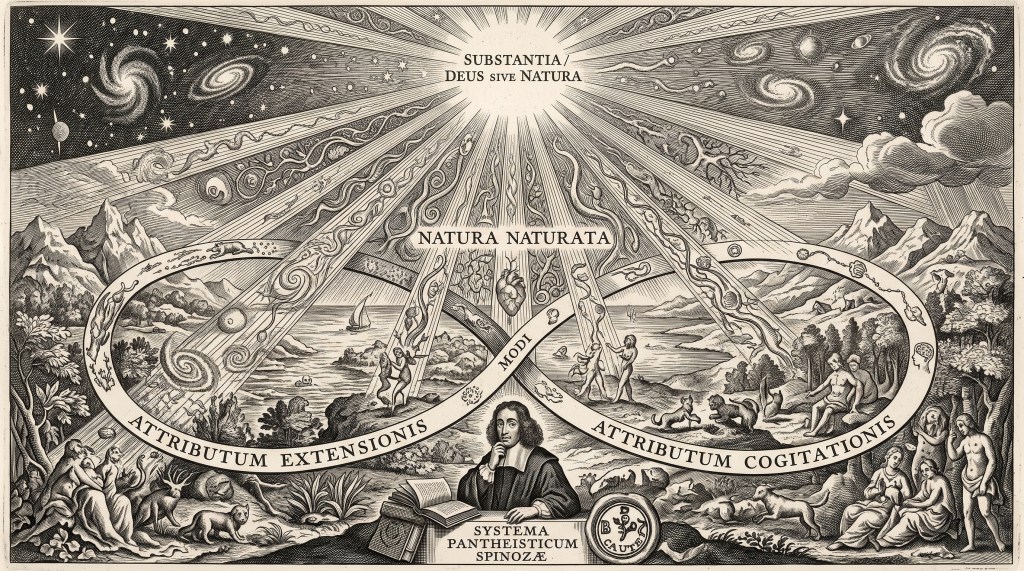
Spinoza’s system rests on substance monism: there exists only one substance, infinite and self-caused, which he calls indifferently “God” or “Nature” — Deus sive Natura. In the Latin (though not the original Dutch) edition of the Ethics, Part IV Preface, he writes: “That eternal and infinite being we call God, or Nature, acts from the same necessity from which he exists.” The argument for monism runs through the first fourteen propositions of Part I: every substance has at least one attribute; two substances cannot share an attribute; God has all possible attributes; therefore no substance other than God can exist (E1p14): “Except God, no substance can be or be conceived.” Stanford Encyclopedia of Philosophy + 2
This one substance has infinitely many attributes, of which humans know only two: thought and extension (mind and matter). Individual things — tables, trees, human beings — are not independent substances but modes, “affections of God,” particular ways in which the one substance is modified. As Spinoza puts it (E1p15): “Whatever is, is in God, and nothing can be or be conceived without God.” Stanford Encyclopedia of Philosophy
Spinoza distinguishes Natura naturans (“Nature naturing”) — Nature in its active, productive aspect, identified with God and the divine attributes — from Natura naturata (“Nature natured”) — the system of modes produced. The double use of “Natura” signals the ontological unity of God and the world. Internet Encyclopedia of Philosophy
The theological cost is total and deliberate. Spinoza’s God has no personhood, no intellect or will like a person’s, no purposes, and no freedom in the sense of choice. The universe follows from the divine nature “with a deterministic necessity,” exactly as the properties of a triangle follow from its definition. He mocks the notion of a God who acts for ends or responds to prayer as a projection of the human imagination. And his determinism is complete: what we call free will is merely our ignorance of the causes that determine us — “the infant believes that it is by free will that it seeks the breast.” As the Internet Encyclopedia of Philosophy observes, “even the atheist can, without too much difficulty, admit that God is nothing but Nature. Reductive pantheism and atheism maintain extensionally equivalent ontologies.” This is a point to which we shall return: Spinoza’s God, stripped of will and personhood, is functionally indistinguishable from the atheist’s Nature. Stanford Encyclopedia of Philosophy
For this and related views, the 23-year-old Spinoza was issued the harshest writ of herem (excommunication) ever pronounced by the Portuguese-Jewish community of Amsterdam, on 27 July 1656 — a document condemning his “abominable heresies and monstrous deeds,” ordering that he be “cast out from all the tribes of Israel” and his name “blotted out from under heaven.” It was never rescinded. We return below to what Judaism found so intolerable. Aeon
German Idealism, Romanticism, and the “Pantheism Controversy”
Spinoza’s God, long treated as scandalous, was rehabilitated in the late eighteenth century. The Pantheismusstreit (Pantheism Controversy) ignited by F. H. Jacobi’s revelation of Lessing’s Spinozism made Spinoza the presiding spirit of German Romanticism and Idealism. Hegel’s Absolute — Spirit (Geist) coming to self-consciousness through the historical unfolding of nature and mind — is often read as a dynamic, evolutionary pantheism (or panentheism). Goethe, Wordsworth (“a sense sublime of something far more deeply interfused”), Emerson, and the American Transcendentalists gave pantheism its enduring Romantic voice.
Einstein, Hawking, and Modern Cosmic Religiosity
In the twentieth century the pantheist impulse migrated into the sensibility of scientists. In a 27-word telegram of 24 April 1929, replying to Rabbi Herbert S. Goldstein of New York (who had wired, “Do you believe in God? Stop. Answer paid 50 words”) and reported in The New York Times the next day, Einstein wrote: “I believe in Spinoza’s God who reveals himself in the orderly harmony of what exists, not in a God who concerns himself with fates and actions of human beings.” He spoke of a “cosmic religious feeling” as “the strongest and noblest motive for scientific research,” and of “a rapturous amazement at the harmony of natural law,” while explicitly rejecting a personal God who hears prayer or judges conduct. Stephen Hawking urged humanity to “look up at the stars and not down at your feet,” to “wonder about what makes the universe exist,” yet concluded in The Grand Design that “because there is a law such as gravity, the universe can and will create itself from nothing.” As Zia Shah frames it in his essay “Wonder Without the Final Step,” Einstein “approached this threshold through an impersonal Spinozan religiosity, while Hawking remained within metaphysical naturalism. Their wonder was authentic; what they declined was the interpretive and existential conclusion.” thequran
Carl Sagan gave the sensibility its liturgy: “The cosmos is within us. We are made of star-stuff. We are a way for the universe to know itself,” and speculated that “a religion old or new, that stressed the magnificence of the universe as revealed by modern science, might be able to draw forth reserves of reverence and awe hardly tapped by the conventional faiths.” Contemporary heirs include Sam Harris’s meditative “spiritual naturalism,” Ursula Goodenough’s religious naturalism (her book The Sacred Depths of Nature seeks reverence without the supernatural), the philosopher Michael Levine (author of the major monograph Pantheism and of the Stanford Encyclopedia entry), and organized movements such as the World Pantheist Movement (founded 1999), whose credo affirms “Reverence, awe, wonder, and a feeling of belonging to Nature and the wider Universe.” thequran + 2
Richard Dawkins, no friend of theism, put the sharpest point on the matter in The God Delusion (2006, p. 40): “Pantheism is sexed-up atheism. Deism is watered-down theism.” This is not an insult the pantheist can easily shrug off, and it defines the central problem we now examine.
III. Refuting Panpsychism — and Extending the Refutation to Pantheism
Before refuting pantheism directly, it is illuminating to refute its philosophical cousin, panpsychism — the view that consciousness is a fundamental and ubiquitous feature of reality, present in some rudimentary form even in fundamental particles. The two doctrines share a common ambition: to get mind, consciousness, or divinity out of matter without paying the full metaphysical price of positing a transcendent mind. And they share a common failure. As Zia Shah puts the linkage precisely: “In the study of consciousness if you find panpsychism to be wrong then attributing consciousness to the whole of the universe is equally wrong. If an atom or a molecule is not conscious, then all 10 raised to the power 80, all of them put together, are not conscious.” thequran
The Panpsychist Program
Contemporary panpsychism has distinguished advocates. Galen Strawson argues that physicalism, taken seriously, entails panpsychism. Philip Goff, in Galileo’s Error: Foundations for a New Science of Consciousness (2019), defends panpsychism as the solution to the “hard problem” of consciousness — the problem of why physical processes are accompanied by subjective experience at all. Goff’s titular claim is that Galileo made an error in excluding the qualitative, experiential features of the world from the domain of science, and that consciousness must therefore be built into the fundamental furniture of reality. David Chalmers, who named the hard problem, treats panpsychism and “panprotopsychism” (the view that fundamental entities have proto-experiential properties) as serious contenders, often within a framework of Russellian monism (the idea that physics describes only the relational/structural properties of matter, leaving its intrinsic nature to be filled in by consciousness). The Integrated Information Theory (IIT) of Giulio Tononi and Christof Koch, which identifies consciousness with integrated information (Φ), is frequently read as a scientific cousin of panpsychism. And Alfred North Whitehead’s process philosophy attributes “experience” (in an attenuated sense) to all actual occasions. Wikipedia
The Standard Objections
1. The combination problem. This is the decisive objection, conceded even by sympathizers. If fundamental particles possess tiny fragments of consciousness, how do these combine to produce the unified, single subjective experience of a human being? As one reviewer of Goff writes, “How the different atoms of a living being suddenly link up their mini-conscious states and produce a unified whole, a self with agency that no longer depends on the specific substrate that produced it, is extraordinary.” Goff hopes the problem will be solved by future interdisciplinary science, but this is a promissory note, not a solution. Micro-subjects and macro-subjects are simply different subjects; there is no intelligible account of how many little experiencers sum into one big experiencer. Uncommon Descent
2. Lack of empirical evidence and unfalsifiability. There is no observational evidence whatever that electrons or quarks have experiences. As one critic notes, “all the evidence in hand strongly suggests that consciousness arises in conjunction with systems like ourselves when performing neurally instantiated, behavior-guiding cognitive functions.” Panpsychism makes no distinctive, testable predictions. IIT, its most scientific expression, was denounced in an open letter — “The Integrated Information Theory of Consciousness as Pseudoscience,” posted to PsyArXiv on 15 September 2023 by Fleming, Frith, Goodale, Lau, LeDoux and colleagues, with signatories including Daniel Dennett, Patricia Churchland, Joseph LeDoux and Bernard Baars — precisely because its predictions are not meaningfully testable with current tools and because it attributes consciousness to systems (like inactive grids of logic gates) that seem obviously non-conscious. Majestic EqualityClosertotruth
3. Failure to solve the hard problem. Panpsychism claims to dissolve the hard problem by making consciousness fundamental. But it merely relocates the mystery. As one critic tartly summarizes Goff’s dilemma: once you concede that the specific, unified consciousness of a human requires an explanation that mere micro-consciousness cannot supply, “you’ve got nothing: panpsychism adds diddly squat.” Why Evolution Is True
4. The problem of mental causation and explanatory vacuity. If the “experiential” properties of particles are causally inert — if physics is causally closed — then the posited proto-consciousness does no work, violating Ockham’s razor. If it is causally efficacious, it should show up in physics, and it does not.
5. Incoherence of proto-experience. The notion of an experience that is nobody’s experience — a “feeling” with no subject to feel it — is arguably incoherent. Experience is essentially for a subject; sub-personal “micro-experience” strains the concept past its breaking point.
Extending the Critique to Pantheism: Pantheism’s Own Combination Problem
Here is the crucial move. Pantheism faces a combination problem structurally identical to panpsychism’s — only larger. The panpsychist asks how tiny conscious parts combine into one human mind. The pantheist, if he wishes his God to be in any meaningful sense divine — conscious, purposive, an agent — must ask how the ~10⁸⁰ particles of the cosmos, individually unconscious, combine into a single, unified, cosmic consciousness with a unified will. If the parts are not conscious, the aggregate is not conscious. If the parts are conscious (panpsychism), the combination problem defeats the aggregation into one cosmic subject. Either way, the pantheist cannot get a conscious, agentive God out of the physical universe.
Spinoza, to his credit, saw this and bit the bullet: his God is not a unified conscious agent with purposes and will; “thought” is merely one of infinitely many attributes, and human minds are finite modes, not a cosmic super-mind. But this is precisely the problem. Pantheism confronts a dilemma:
- Horn 1 (impersonal God): If the pantheist God is not a unified conscious agent — Spinoza’s option — then it is not God in any religiously meaningful sense. It does nothing, wills nothing, knows nothing, loves no one, and cannot be prayed to. It is merely Nature relabeled “God.” Dawkins’s “sexed-up atheism” lands.
- Horn 2 (cosmic super-mind): If the pantheist insists the cosmos as a whole is a conscious agent, he inherits the combination problem and owes an account of how an impersonal, distributed physical totality possesses the unity of consciousness, the singular will, and the intentional agency that consciousness and agency require — with no more empirical evidence than the panpsychist can offer.
In both cases pantheism evacuates God of the very attributes that make God God. Both panpsychism and pantheism are attempts to conjure mind or divinity out of matter without positing a transcendent Mind that is not itself a product of matter — and both fail for the same reason. The theist’s alternative is not to build consciousness up from unconscious particles or to divinize the aggregate, but to recognize that mind and consciousness in the cosmos are the effects of a Creator who is Himself essentially conscious, personal, and prior to matter.
IV. Pantheism and Wahdat al-Wujud: A Necessary Distinction
Because the Sufi doctrine of Wahdat al-Wujud (“the Oneness/Unity of Being”) is so frequently — and, this essay argues, mistakenly — equated with pantheism, it demands separate treatment. The distinction matters enormously: a great deal of Islamic mysticism would fall under the same condemnation as Spinozism if the two were truly the same. They are not.
What Ibn Arabi Actually Taught
Wahdat al-Wujud is associated above all with the Andalusian mystic Muhyi al-Din Ibn Arabi (1165–1240), “the Great Sheikh,” and elaborated by his stepson and disciple Sadr al-Din al-Qunawi, and later figures such as Ibn Sab’in and the Persian poet Jami. (Ibn Arabi himself did not use the term Wahdat al-Wujud; it was applied later — indeed, as Ahmad Sirhindi noted, it was Ibn Arabi who “formulated the idea… analysed it and set down its syntax and grammar,” though the label came from his interpreters and critics.) Muhyiddin Ibn Arabi Society
The doctrine holds that there is only one true wujud (Being/Existence), and that wujud belongs exclusively to God. As William Chittick renders Ibn Arabi’s core teaching: “there is only Being, and all existence is nothing but the manifestation or outward radiance of that One Being. Hence ‘everything other than the One Being’ — that is, the whole cosmos in all its spatial and temporal extension — is nonexistent in itself, though it may be considered to exist through Being.” In Ibn Arabi’s own framing, wujud “is the unknowable and inaccessible ground of everything that exists. God alone is true wujud, while all things dwell in nonexistence.” GoodreadsBlogger
This is the decisive point that separates it from pantheism. Pantheism says God is the physical universe; the universe is fully real and divine. Wahdat al-Wujud says almost the opposite: the physical universe has no independent reality of its own — it “is” only insofar as, at every instant, it is sustained and manifested by the One who alone truly exists. Where pantheism divinizes and reifies the cosmos, Ibn Arabi de-realizes it, treating it as a shadow, a reflection, a tajalli (self-disclosure) of the divine names and attributes.
The Mirror and the Sunlight
Ibn Arabi’s favored images make the distinction vivid. The cosmos is like a face in a mirror: the reflected face is really there, “and yet it owns nothing of itself. Every trace of it is borrowed, and it disappears the moment the real face turns away.” Creation stands before its Source in just that borrowed way — real, but with a wholly derivative, dependent reality. The related sunlight image (also central to Chabad, below) holds that creatures perceive their own existence as real much as we see the sun’s rays as things in themselves, when in truth the rays own nothing apart from the sun. Sufi Philosophy
Critically, Ibn Arabi combines two moments that pantheism cannot: tanzih (God’s incomparability and transcendence) and tashbih (God’s similarity/immanence). As Chittick emphasizes, a proper understanding of God for Ibn Arabi requires balancing both: “To the extent that He is unknowable, He is incomparable; and to the extent that He ‘discloses [Himself] as every form in the external and internal worlds,’ He is similar.” Pantheism collapses everything into tashbih (pure immanence/identity) and loses tanzih entirely. This is why scholars — from Toshihiko Izutsu (Sufism and Taoism) to Seyyed Hossein Nasr to Fethullah Gülen — insist that Ibn Arabi is not a pantheist. The concept of barzakh (isthmus) — a boundary that simultaneously separates and connects two realities — is, as one commentator notes, “the mechanism that prevents the framework from collapsing into pantheism.” WordPressSufi Philosophy
Panentheism or Acosmism, Not Pantheism
Where, then, does Wahdat al-Wujud belong on the map? Most careful scholars classify it as a form of panentheism (“all-in-God”: the world is in God and utterly dependent on Him, but God infinitely exceeds the world) or as an acosmic theism (in which only God has true being and the cosmos is, in itself, a kind of nothing). The Stanford Encyclopedia distinguishes panentheism from pantheism precisely: “while pantheism emphasizes God’s identity with the world, panentheism maintains the identity and significance of the non-divine” and “considers God and the world to be inter-related with the world being in God and God being in the world.” Ibn Arabi’s system, properly read, remains anchored in Tawhid: true existence (wujud) belongs exclusively to God, and creation is a mirror-manifestation (tajalli) of the divine names — the world “is real, but its reality is a gift, held in being at every instant by the One who alone exists in and through Himself.” stanford + 2
The Critics: Ibn Taymiyyah and the Charge of Heresy
Yet the debate over whether Wahdat al-Wujud slides into heresy is real and ongoing. The great Hanbali jurist Ibn Taymiyyah (1263–1328) leveled the most sustained attack, condemning Ibn Arabi’s doctrine as tantamount to ittihad (union with God) and hulul (indwelling/incarnation of God in creation) — both forms of unbelief (kufr) in his judgment. Ibn Taymiyyah understood Wahdat al-Wujud as “the equating of God with nature” — in modern terms, pantheism — and held that “those who adhere to Wahdat al-Wujud say that existence is one, and [what] wajib al-wujud [the Necessary Being, God] has is the same as [the being] a creature has.” He judged that treating God’s existence as united with the existence of His creatures is disbelief and shirk. DOAJDOAJ
Modern scholarship offers an important qualification: as one analysis notes, “Ibn Taymiyyah’s criticism emerged because he only saw aspects of tashabbuh (equation of God with his creatures)… and did not see aspects of tanzih (purification of God from the likeness of his creatures)… These two aspects are combined into one in the teachings of Ibn ‘Arabi.” In other words, Ibn Taymiyyah refuted a pantheistic reading of Ibn Arabi — a reading that many of Ibn Arabi’s own defenders (such as ‘Abd al-Ghani al-Nabulusi in his Al-Wujud al-Haqq) reject as a misreading. There is also a genuine danger the critics rightly flag: a determinist/Jabari reading in which, if the creature’s act is God’s act, moral accountability (taklif) dissolves — the same collapse of moral responsibility we shall see afflicts Spinoza. ResearchGate + 2
Wahdat al-Shuhud and Shah Waliullah’s Reconciliation
Partly in response to these dangers, the Indian Naqshbandi reformer Shaykh Ahmad Sirhindi (1564–1624), known as Mujaddid Alf-i Thani (“Renewer of the Second Millennium”), advanced the contrasting doctrine of Wahdat al-Shuhud (“Unity of Witnessing”). Sirhindi argued that the sense of oneness with God experienced by the mystic is a subjective state of perception — the seeker becomes so absorbed in the love and remembrance of God that all else vanishes from consciousness — rather than an objective ontological identity. God created the universe from non-being, and it is emphatically not the Being of God; God and His attributes (Dhat and Sifat) are not identical with creation. For Sirhindi, “mystical experiences that suggest unity with God are subjective perceptions rather than objective realities,” and “the final stage is servitude and the final truth is difference.” This preserves the Creator–creature distinction with maximum clarity, and became the defining metaphysics of the Naqshbandi-Mujaddidi order. Pakistan Observer + 4
In the eighteenth century, the polymath Shah Waliullah of Delhi (1703–1762) made the first great attempt to reconcile the two doctrines, arguing that they describe the same reality from different vantage points — that the apparent conflict is largely verbal, a matter of the station from which the mystic speaks. He leaned toward the clearer Creator–creature distinction of Wahdat al-Shuhud while accommodating the insights of Wahdat al-Wujud as a recognition of God’s overwhelming presence and sustaining power in the world. mehbooba
The upshot for our purposes: Wahdat al-Wujud, at its most defensible, is a panentheist mysticism inside Tawhid, categorically distinct from Spinozist pantheism — but the tradition’s own internal critics (Sirhindi, Ibn Taymiyyah) recognized the pantheistic misreading as a live danger and built firewalls against it. Islam thus contains both the resource and the antidote.
V. The Theistic Refutation (I): Jewish Sources
The Shema and Creation ex nihilo
At the root of the Jewish rejection of pantheism stands the Shema:
שְׁמַע יִשְׂרָאֵל יְהוָה אֱלֹהֵינוּ יְהוָה אֶחָד “Hear, O Israel: the LORD our God, the LORD is one.” (Deuteronomy 6:4)
The God of Israel is the Creator who stands over against His creation. Genesis opens: “In the beginning God created the heavens and the earth” (בְּרֵאשִׁית בָּרָא אֱלֹהִים אֵת הַשָּׁמַיִם וְאֵת הָאָרֶץ, Genesis 1:1). Creation ex nihilo — the world called into being from nothing by a free divine act — is incompatible with any doctrine that makes the world a mode, part, or emanation of God’s own substance. Isaiah’s God explicitly asserts the infinite gap between Himself and His creatures:
“For my thoughts are not your thoughts, neither are your ways my ways, saith the LORD. For as the heavens are higher than the earth, so are my ways higher than your ways, and my thoughts than your thoughts.” (Isaiah 55:8–9)
Solomon, dedicating the Temple, gives classical expression to divine transcendence: “But will God indeed dwell on the earth? Behold, the heaven and heaven of heavens cannot contain thee; how much less this house that I have builded?” (1 Kings 8:27) — a text irreconcilable with the pantheist identification of God with the spatial cosmos.
Maimonides and Negative Theology
The towering medieval refutation of any doctrine that assimilates God to the world is Moses Maimonides’ (1135–1204) Guide of the Perplexed. Maimonides insists so radically on divine transcendence that he denies we can predicate any positive attribute of God’s essence; we can say only what God is not. When we apply to God terms we use of creatures — even “exists” — we speak equivocally: God “shares no common trait with anything outside Him at all, for the term ‘existence’ is only applied to Him as well as to creatures by way of homonymy” (Guide I.52). This via negativa is the exact antithesis of pantheism, which makes God maximally continuous with the world. For Maimonides, the more one negates, the closer one draws to the truth of a God who is utterly beyond the created order — a God who is emphatically not identical with the nature He created. Blogger
The Herem Against Spinoza
It was against this background that the Amsterdam Portuguese-Jewish community pronounced its unprecedented herem on Spinoza in 1656. Whatever the mix of doctrinal and political motives, the mature philosophy that soon followed makes the theological offense plain: a God who is identical with Nature, who has no will, no providence, no chosenness, no Torah given in freedom, and who neither commands nor forgives, is simply not the God of Israel. Spinoza’s God cannot be the party to a covenant.
Hasidic Acosmism: Why It Is Not Pantheism
A fascinating case is the “acosmism” of Chabad Hasidism, articulated by Rabbi Shneur Zalman of Liadi (the Alter Rebbe) in the Tanya, drawing on the Lurianic Kabbalah’s doctrine of tzimtzum (the divine “contraction” that makes room for creation). Chabad takes with radical seriousness the verse ein od milvado — “there is none besides Him” (Deuteronomy 4:35) — teaching that from God’s perspective the world has no independent existence at all; only tzimtzum, understood as a concealment rather than a literal withdrawal, screens creatures from perceiving that everything is, in truth, “G-dliness.”
Superficially this can sound pantheistic, and the Vilna Gaon and other Mitnagdim worried it verged on the heresy of Spinoza. But Chabad’s own theologians draw the sharp distinction, and it maps precisely onto our earlier analysis of Ibn Arabi. As Chabad.org explains: “Everything that exists is sustained by G-d and has no true reality without Him… yet not all that exists is G-dly.” The system is best classified, exactly like Wahdat al-Wujud, as acosmism or panentheism, not pantheism: as one summary puts it, “Pantheism: God is identical with the physical (finite) universe. Panentheism: The physical universe is entirely contained within the infinite God, and nullified beside It… Acosmism: There is no [independent] physical universe, it is all God-stuff.” Scholars following Elliot Wolfson distinguish “Spinoza’s pantheism that represents a secularization of the divine” from “Chabad’s divinization of nature.” The key difference from Spinoza: Chabad’s God is a personal, willing Creator who commands the mitzvot and to whom one relates through Torah and prayer. The world is nullified before God, not identified with God. Chabad.org + 2
The Jewish pattern is thus consistent: the traditions can affirm the most intense divine immanence (ein od milvado), but always inside a framework where God is a transcendent, personal, willing Creator — never the impersonal substance of Spinoza.
VI. The Theistic Refutation (II): Christian Sources
Aquinas: God as Ipsum Esse Subsistens
The classical Christian metaphysics of creation, in Thomas Aquinas, is built precisely to exclude pantheism. Aquinas draws a real distinction between essence and existence in all creatures: in any created thing, what it is (essence) is distinct from that it is (existence). One can know completely what a phoenix is without knowing whether any phoenix exists. In God alone there is no such composition: God’s essence is His existence. God is ipsum esse subsistens — “subsistent existence itself,” the pure act of being.
This single doctrine accomplishes two things at once, as Thomist commentators emphasize: it makes God “at once most transcendent, and infinitely so, from creatures, and… most immanently active in his creation.” Because creatures have existence (received, participated, contingent) while God is existence (underived, necessary), God is not one being among beings, not the “whole” of which creatures are “parts,” and emphatically not to be located, as pantheism locates Him, on a continuum of being with the world. Aquinas’s God creates ex nihilo and sustains all things in being at every moment, yet remains ontologically distinct from them. This is the metaphysical refutation of pantheism in its most rigorous form: the pantheist confuses the God who is Being with the creatures that merely have it. Aquinasonline
Coupled with this is the doctrine of divine simplicity — God is not composed of parts, matter and form, or genus and difference — which again rules out identifying God with the manifestly composite, changing, divisible cosmos.
The Fourth Lateran Council: The Ever-Greater Dissimilarity
In 1215 the Fourth Lateran Council enshrined the formula that has governed Catholic thought about God-talk ever since: “Between Creator and creature there can be noted no similarity so great that a greater dissimilarity cannot be seen between them” (inter creatorem et creaturam non potest tanta similitudo notari, quin inter eos maior sit dissimilitudo notanda). This principle — the heart of the analogia entis — is the precise inverse of the pantheist instinct. Where pantheism presses toward “the pure similarity of identity,” the Council insists that every likeness between God and world is overwhelmed by an ever-greater unlikeness. Whatever immanence theology affirms, transcendence always exceeds it. Papal Encyclicals + 2
Chesterton and C. S. Lewis
The modern Christian critique of pantheism found its most memorable voices in G. K. Chesterton and C. S. Lewis. Lewis, in Miracles, diagnosed pantheism as “the permanent natural bent of the human mind… the attitude into which the human mind automatically falls when left to itself,” resisted only by “Platonism and Judaism, and Christianity.” He distinguished the pantheist picture — the universe “almost is God, so that if it did not exist He would not exist either” — from the Christian: “God invented and made the universe — like a man making a picture or composing a tune. A painter is not a picture.” Basicincome + 2
Lewis pressed two devastating objections. First, the moral objection: because pantheism makes God equally present in all things, it must make God “equally present in what we call evil and what we call good and therefore indifferent to both.” A God beyond good and evil is a God who “does not care about right and wrong” — to Lewis, morally intolerable and self-refuting (for if our moral intuitions reflect nothing real, why trust any intuition?). Second, the existential objection, in one of his most quoted passages: BasicincomeThequran
“The Pantheist’s God does nothing, demands nothing. He is there if you wish for Him, like a book on a shelf. He will not pursue you. There is no danger that at any time heaven and earth should flee away at His glance.” Leadingchurch.com
Here the whole difference is captured: the pantheist’s God is passive, safe, and ultimately useless; the living God is an agent who acts, demands, pursues, and can be encountered. Chesterton concurred, quipping that pantheism, in pretending to put God everywhere, in fact leaves Him nowhere in particular, dissolving the personal God into an impersonal everything.
Acts 17:28 Read Non-Pantheistically
Christian theism must reckon with Paul’s citation, at the Areopagus, of the Greek (Stoic-tinged) poets: “In him we live, and move, and have our being” (Acts 17:28), and with “in him all things hold together” (Colossians 1:17). These are texts of intense immanence, but the theistic reading is panentheist-participatory, not pantheist: creatures live and move in God as effects continually sustained by their transcendent cause — exactly Aquinas’s point that God is most immanent because He is ipsum esse subsistens — not as parts or modes of the divine substance. Paul’s very sermon insists on a God who “made the world and all things therein,” who “is Lord of heaven and earth” and “dwelleth not in temples made with hands,” and who “commandeth all men every where to repent” — a Creator, Judge, and personal agent, not a Stoic world-soul.
VII. The Theistic Refutation (III): Islamic Sources — The Primary Focus
Islam mounts perhaps the most systematic and uncompromising resistance to pantheism, because its entire theology is organized around Tawhid — the absolute oneness, uniqueness, and transcendence of God — and around a God who is supremely personal: who creates by will, speaks, reveals, sends prophets, commands, judges, and resurrects.
The Qur’anic Doctrine of Divine Incomparability
The foundational text is Surah al-Ikhlas, the Qur’an’s most concentrated statement of Tawhid:
قُلْ هُوَ ٱللَّهُ أَحَدٌ ٱللَّهُ ٱلصَّمَدُ لَمْ يَلِدْ وَلَمْ يُولَدْ وَلَمْ يَكُن لَّهُۥ كُفُوًا أَحَدٌۢ “Say, ‘He is Allah, [who is] One, Allah, the Eternal Refuge. He neither begets nor is born, nor is there to Him any equivalent.’” (Al-Ikhlas 112:1–4) Wikipedia
The term al-Samad — the Eternal, Self-Sufficient upon whom all depend while He depends on none — is the direct negation of the pantheist picture of a God who is nothing but the interdependent web of nature. Even more decisive against every form of divine–creature assimilation is the verse that Islamic theology treats as the charter of tanzih (incomparability):
فَاطِرُ ٱلسَّمَٰوَٰتِ وَٱلْأَرْضِ … لَيْسَ كَمِثْلِهِۦ شَىْءٌ ۖ وَهُوَ ٱلسَّمِيعُ ٱلْبَصِيرُ “[He is] Creator of the heavens and the earth… There is nothing like unto Him, and He is the Hearing, the Seeing.” (Al-Shura 42:11) Quran
Note the two halves in a single breath: God is utterly incomparable (“nothing like Him” — against pantheism’s identification), yet supremely personal (“the Hearing, the Seeing” — against the impersonal Absolute). Pantheism can accommodate neither clause. The Qur’an’s God is neither the cosmos nor a blind principle within it.
The same balance recurs in the great “attribute verses.” Ayat al-Kursi proclaims God the living, self-subsisting Sustainer of all that is:
ٱللَّهُ لَآ إِلَٰهَ إِلَّا هُوَ ٱلْحَىُّ ٱلْقَيُّومُ “Allah — there is no deity except Him, the Ever-Living, the Sustainer of [all] existence.” (Al-Baqarah 2:255) Quran
And the closing verses of Surah al-Hashr pour out the divine names — al-Khaliq (the Creator), al-Bari’ (the Maker), al-Musawwir (the Fashioner) — that presuppose an agent who deliberately designs, an idea alien to Spinoza’s necessitated substance (Al-Hashr 59:22–24). Divine transcendence beyond all perception is unambiguous:
لَّا تُدْرِكُهُ ٱلْأَبْصَٰرُ وَهُوَ يُدْرِكُ ٱلْأَبْصَٰرَ ۖ وَهُوَ ٱللَّطِيفُ ٱلْخَبِيرُ “Vision perceives Him not, but He perceives [all] vision; and He is the Subtle, the Acquainted.” (Al-An’am 6:103) My Islam
Immanence Without Identity: The Qur’anic “Nearness” Verses
Crucially — and here Islam parallels the sophisticated immanence of Chabad and Ibn Arabi — the Qur’an affirms an intense divine nearness that is never identity. God is:
هُوَ ٱلْأَوَّلُ وَٱلْءَاخِرُ وَٱلظَّٰهِرُ وَٱلْبَاطِنُ ۖ وَهُوَ بِكُلِّ شَىْءٍ عَلِيمٌ “He is the First and the Last, the Ascendant and the Intimate, and He is, of all things, Knowing.” (Al-Hadid 57:3) Quran O
وَهُوَ مَعَكُمْ أَيْنَ مَا كُنتُمْ “…and He is with you wherever you are…” (Al-Hadid 57:4) My Islam
وَنَحْنُ أَقْرَبُ إِلَيْهِ مِنْ حَبْلِ ٱلْوَرِيدِ “…and We are closer to him than [his] jugular vein.” (Qaf 50:16) My Islam
وَإِذَا سَأَلَكَ عِبَادِى عَنِّى فَإِنِّى قَرِيبٌ ۖ أُجِيبُ دَعْوَةَ ٱلدَّاعِ إِذَا دَعَانِ “And when My servants ask you concerning Me — indeed I am near. I respond to the invocation of the supplicant when he calls upon Me.” (Al-Baqarah 2:186) Al-Islam
This last verse is the theistic refutation of pantheism in a single sentence: God’s nearness is the nearness of a personal Thou who answers prayer — precisely the capacity Spinoza’s and Einstein’s God cannot possess. The “light verse” likewise affirms God as the metaphysical source of all illumination without collapsing into the light of the cosmos:
ٱللَّهُ نُورُ ٱلسَّمَٰوَٰتِ وَٱلْأَرْضِ “Allah is the Light of the heavens and the earth…” (Al-Nur 24:35)
The Radical Contingency of Creation
Against the pantheist’s eternal, self-existent Nature, the Qur’an insists on the utter dependence of everything other than God:
يَٰٓأَيُّهَا ٱلنَّاسُ أَنتُمُ ٱلْفُقَرَآءُ إِلَى ٱللَّهِ ۖ وَٱللَّهُ هُوَ ٱلْغَنِىُّ ٱلْحَمِيدُ “O mankind, you are those in need of Allah, while Allah is the Free of need, the Praiseworthy.” (Al-Fatir 35:15)
كُلُّ مَنْ عَلَيْهَا فَانٍ وَيَبْقَىٰ وَجْهُ رَبِّكَ ذُو ٱلْجَلَٰلِ وَٱلْإِكْرَامِ “Everyone upon it [the earth] will perish, and there will remain the Face of your Lord, Owner of Majesty and Honor.” (Al-Rahman 55:26–27) Anjumanesakina
كُلُّ شَىْءٍ هَالِكٌ إِلَّا وَجْهَهُۥ “Everything will be destroyed except His Face.” (Al-Qasas 28:88) Quran O
A universe every part of which is fani (perishing) and faqir (utterly needy) cannot be God, who is al-Ghani (self-sufficient) and al-Baqi (abiding). Pantheism divinizes the perishable; the Qur’an declares only the imperishable Face divine. And God’s continuous creative activity — against Spinoza’s static, eternally necessitated substance — is affirmed:
كُلَّ يَوْمٍ هُوَ فِى شَأْنٍ “…every day He is bringing about a matter.” (Al-Rahman 55:29)
The Qur’an also grounds the cosmological and design arguments in nature itself: that “the heavens and the earth were a joined entity, and then We separated them” (أَوَلَمْ يَرَ ٱلَّذِينَ كَفَرُوٓا۟ أَنَّ ٱلسَّمَٰوَٰتِ وَٱلْأَرْضَ كَانَتَا رَتْقًا فَفَتَقْنَٰهُمَا, Al-Anbiya 21:30), and that “the heaven We constructed with strength, and indeed, We are [its] expander” (وَٱلسَّمَآءَ بَنَيْنَٰهَا بِأَيْي۟دٍ وَإِنَّا لَمُوسِعُونَ, Al-Dhariyat 51:47) — verses many modern commentators read alongside the expanding universe of contemporary cosmology. Islam AwakenedQuran O
Against Incarnation and Indwelling: Hulul and Ittihad
Islam’s rejection of pantheism is of a piece with its rejection of incarnation. The Qur’an sharply condemns any doctrine that lodges God in a creature:
لَقَدْ كَفَرَ ٱلَّذِينَ قَالُوٓا۟ إِنَّ ٱللَّهَ ثَالِثُ ثَلَٰثَةٍ ۘ وَمَا مِنْ إِلَٰهٍ إِلَّآ إِلَٰهٌ وَٰحِدٌ “They have certainly disbelieved who say, ‘Allah is the third of three.’ And there is no god except one God.” (Al-Ma’idah 5:73; cf. 5:17, 5:72)
If it is kufr to say God became incarnate in one man, it is a fortiori incompatible with Tawhid to say God is incarnate in — or identical with — the whole material universe. This is the ground of Ibn Taymiyyah’s critique of hulul (indwelling) and ittihad (union), examined above.
Al-Ghazali, the Kalam Cosmological Argument, and Divine Will
Abu Hamid al-Ghazali (1058–1111), in Tahafut al-Falasifa (The Incoherence of the Philosophers), refuted the Aristotelian–Avicennan doctrine of an eternal world precisely because it undermined divine freedom and creation. Al-Ghazali defended huduth (the temporal origination of the world) and the kalam cosmological argument: whatever begins to exist has a cause; the universe began to exist; therefore the universe has a cause. Against the philosophers’ necessary emanation — in which the world flows from God automatically, without deliberation (a view close in structure to Spinoza’s necessitarianism) — al-Ghazali insisted on “a robust divine will that can choose between alternatives,” a God who “freely creates the world in time by an eternal will,” who knows particulars, and who acts. This is the antithesis of the pantheist God who does nothing and chooses nothing. Al-Ghazali’s occasionalism further makes God the direct, continuous sustainer of every event — an immanence far more intimate than pantheism’s, but grounded in a personal agent’s will rather than in impersonal identity. Philopedia + 2
The Core Philosophical Refutations
We may now gather the decisive arguments, weighted toward the concerns of a scientifically literate readership:
1. Pantheism cannot ground morality. If all is God, then evil is God too. As Lewis saw, a God identical with everything is indifferent to the distinction between good and evil — indeed is both the cancer and the cure, the torturer and the tortured. Pantheism cannot supply moral obligation, because obligation requires a lawgiver who is other than and authoritative over the moral agent. The Qur’anic God commands, and thereby grounds taklif (moral accountability); the pantheist substance commands nothing.
2. Pantheism cannot answer the contingency question. Leibniz’s question — “Why is there something rather than nothing?” — cannot be answered by pointing to the very something whose existence is in question. To say “the universe exists necessarily and is God” is to assert, not to explain, and it is now in deep tension with cosmology (below). Theism answers: contingent being is grounded in a Necessary Being distinct from it — al-Qayyum, ipsum esse subsistens.
3. Pantheism conflicts with the beginning of the universe. Spinoza’s God/Nature is eternal and necessary. But contemporary cosmology indicates the universe began. The standard Big Bang model, and more generally the Borde–Guth–Vilenkin (BGV) theorem — Arvind Borde, Alan Guth, and Alexander Vilenkin, “Inflationary Spacetimes Are Incomplete in Past Directions,” Physical Review Letters 90, 151301 (15 April 2003) — establish that any universe which has on average been expanding throughout its history “must be incomplete in null and timelike past directions”; that is, it cannot be infinite in the past but must have a past spacetime boundary. A cosmos with a beginning is not a necessary, self-existent, eternal substance — it is a contingent effect that calls for a cause beyond itself. (One must note the honest caveats: BGV is a theorem about classical spacetime that may be modified in a full quantum-gravity regime, and Guth personally suspects the universe may have no beginning. But the theorem’s plain implication — that the observable expanding cosmos is past-incomplete — sits very awkwardly with Spinozist eternalism.) WallScienceandculture
4. Fine-tuning points to an intentional agent, not an impersonal substance. The extraordinary precision of the universe’s initial conditions and physical constants — Roger Penrose’s estimate of the initial low-entropy state as a precision of one part in 10 raised to the 10^123, the most staggering example — is naturally read as the signature of intention. An impersonal substance that acts “from the necessity of its nature” (Spinoza) has no capacity to select life-permitting parameters from the vastly more probable life-prohibiting ones. Purpose implies a purposer; a chooser, not a substance.
5. The argument from consciousness (developed in §III): mind cannot be built from, or aggregated out of, mindless matter. The existence of consciousness points to a fundamental Mind that is its source — the personal God — not to conscious particles or a conscious cosmos-aggregate.
6. A God without will cannot be religious. This is the existential heart of the matter, and it is where Zia Shah’s “final step” becomes decisive. A God who cannot will cannot reveal (no scripture, no prophecy); cannot love (love is a personal act); cannot forgive (forgiveness is a decision of a will); cannot answer prayer (Q 2:186). Spinoza was consistent: one cannot love such a God back in any reciprocal sense, and it certainly cannot love you. The Abrahamic God is al-Wadud, the Loving.
7. Spinoza’s determinism destroys moral responsibility. If every human act follows with geometric necessity from the divine nature, then praise and blame, guilt and merit, repentance and reward are illusions. The same Jabari collapse that Ibn Taymiyyah and Sirhindi feared in a pantheistic misreading of Wahdat al-Wujud afflicts Spinozism at its foundation. A moral universe requires free agents answerable to a personal Judge — which is exactly the anthropology and theology of the Qur’an.
VIII. What Theists Can Learn from the Pantheists
Following Zia Shah’s charitable framing, refutation is not the whole story. The pantheist is right about a great deal, and the theist impoverishes his own faith if he does not notice.
The pantheist is right that the universe is suffused with an order, beauty, and grandeur that demand a response of reverence and awe — and the Qur’an agrees, commanding again and again the contemplation of the ayat (signs) in the horizons and in the self. The pantheist is right that a merely deistic, absentee God — one who winds the clock and departs — is religiously inadequate; God is nearer than the jugular vein. The pantheist is right to reject a crudely anthropomorphic idol, and Maimonides, Ibn Arabi, and the whole via negativa tradition share that refusal. The pantheist’s error is not the reverence; it is the terminus. He stops at the creation and declines to follow the sign to the One who is signified — mistaking the mirror for the Face. As Shah puts it, cosmic awe requires a “final step” to the personal God, and the tragedy of Einstein and Hawking is that they came to the very threshold of the ulu al-albab (people of understanding) — those who, in Q 3:190–191, contemplate the heavens and the earth and then turn in prayer: “Our Lord, You did not create this in vain.”





Leave a Reply