

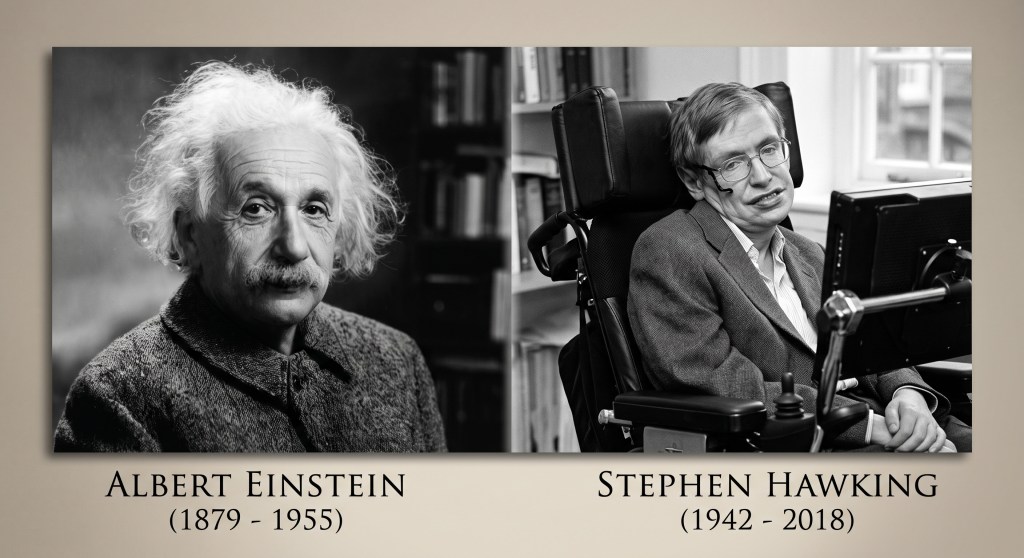
Presented by ChatGPT by Zia H Shah MD
Abstract
Albert Einstein and Stephen Hawking repeatedly described the universe in the language of mystery, beauty, harmony, intelligibility, amazement, romance, and wonder. Einstein called the mysterious the source of science and spoke of a “cosmic religious feeling,” yet rejected—or remained agnostic about—a personal God who hears prayer, judges human conduct, and acts providentially. Hawking urged humanity to look upward at the stars and wonder why the universe exists, yet ultimately declared that the laws of nature made a Creator unnecessary.
This essay presents a source-checked collection of their principal statements about the awe awakened by nature. “All quotations” must be understood practically: no finite survey can capture every interview, letter, lecture, documentary, and variant wording, but the collection below gathers the substantially relevant and reasonably traceable statements while distinguishing primary sources from recollections and popular adaptations.
Qur’an 3:189–191 describes a further movement beyond observation and emotion: from divine sovereignty, through disciplined contemplation of nature, to remembrance, recognition of purpose, prayer, and moral accountability. From a Qur’anic perspective, Einstein approached this threshold through an impersonal Spinozan religiosity, while Hawking remained within metaphysical naturalism. Their wonder was authentic; what they declined was the interpretive and existential conclusion expressed by the ulū al-albāb: “Our Lord, You have not created all this without purpose.”
I. Einstein’s vocabulary of mystery, beauty, harmony, and awe
Einstein’s relevant statements form a remarkably consistent constellation. He did not regard science as emotionally neutral. Scientific discovery began, for him, in astonishment before an intelligible reality that immeasurably exceeded the human mind.
A source-checked collection
| Theme | Einstein’s words | Source and status |
|---|---|---|
| The mysterious | “The most beautiful experience we can have is the mysterious.” | Einstein’s essay “The World as I See It,” reproduced by the American Institute of Physics. |
| Wonder as intellectual life | Whoever “can no longer wonder, no longer marvel, is as good as dead.” | Same primary essay; the two excerpts together capture Einstein’s identification of wonder with intellectual and spiritual vitality. |
| Cosmic religious feeling | “The cosmic religious feeling is the strongest and noblest motive for scientific research.” | “Religion and Science,” first published in 1930; accessible in this transcription of the essay. |
| Scientific rapture | The scientist experiences “a rapturous amazement at the harmony of natural law.” | Einstein’s discussion of the religiousness of science, documented by the American Institute of Physics’ Physics Today. |
| Intelligibility as miracle | “The eternal mystery of the world is its comprehensibility.” | “Physics and Reality,” 1936; text reproduced by the American Academy of Arts and Sciences. |
| The miracle of understanding | “The fact that it is comprehensible is a miracle.” | Same essay. Einstein was astonished not merely that order exists, but that the human mind can discover it. |
| Humility before rational order | “My religiosity consists in a humble admiration of the infinitely superior spirit…” | Letter to M. Schayer, August 1, 1927; archive citation and context are summarized here. |
| Science disclosing a superior spirit | A spirit is “manifest in the laws of the Universe—a spirit vastly superior to that of man.” | Einstein’s 1936 response to the schoolgirl Phyllis Wright; reproduced with context here. |
| Nature’s intellectual gift | “Joy in looking and comprehending is nature’s most beautiful gift.” | Essay for Leo Baeck, 1953; source information is given here. |
| Humble admiration | “We have to admire in humility the beautiful harmony of the structure of the world.” | Einstein’s correspondence with Guy H. Raner, documented by the Freedom From Religion Foundation. |
| The child in the library | “We see the universe marvelously arranged and obeying certain laws but only dimly understand these laws.” | George Sylvester Viereck’s 1929 interview with Einstein, excerpted with attribution here. |
| The freedom of the Creator | “What really interests me is whether God had any choice in the creation of the world.” | Recollection by Einstein’s assistant Ernst Straus, discussed in the AIP essay “Einstein’s Third Paradise”. |
| God’s “thoughts” | Einstein reportedly wanted to know how God created the world—God’s “thoughts,” with physical details being secondary. | Recollected by Esther Salaman and therefore less direct than a published Einstein text; bibliographic history is given here. |
Quotations requiring caution
Several statements attributed to Einstein online are paraphrases, composites, or weakly sourced. These should not be placed on the same level as his published essays and authenticated letters:
- “Look deep into nature, and then you will understand everything better” is widely attributed to him, but its documentary history is uncertain.
- “Coincidence is God’s way of remaining anonymous” has no secure Einstein source.
- “I want to know God’s thoughts; the rest are details” is traceable to a recollected conversation, not an extant Einstein manuscript.
- The “little child in a vast library” analogy comes from an interview report. It is important and consistent with Einstein’s outlook, but it is not equivalent in evidentiary status to his own published essay.
The authentic corpus is already powerful without embellishment: mystery, radiant beauty, rational harmony, comprehensibility, humility, wonder, and a superior intelligence all belong to Einstein’s habitual vocabulary.
II. What Einstein actually believed about God
Calling Einstein simply a pantheist is understandable but incomplete. He explicitly associated himself with “Spinoza’s God,” meaning divinity disclosed in the lawful harmony of reality rather than a personal being concerned with individual conduct. His famous 1929 reply declared belief in the God revealed through cosmic harmony, “not in a God” concerned with human fortunes and actions. The historical exchange is preserved by the Jewish Telegraphic Agency.
Yet Einstein sometimes hesitated to call himself a pantheist. He also said that the question was too vast for a simple yes or no and that he could more appropriately be called an agnostic. His most accurate description may therefore be:
a deeply religious nonbeliever whose religiosity was Spinozan, impersonal, deterministic, and centered upon cosmic intelligibility.
Einstein rejected atheistic dogmatism, but he also rejected the Abrahamic conception of a God who possesses will, responds to prayer, commands moral accountability, and establishes an afterlife. His 1954 letter to Eric Gutkind was especially severe toward traditional religious language; Christie’s describes him there as a “deeply religious non-believer” and reproduces his rejection of conventional God-language. See Christie’s account of the “God Letter”.
Thus Einstein did not fail to feel religious awe. He consciously restricted what that awe was permitted to mean.
III. Hawking’s vocabulary of cosmic beauty, curiosity, and wonder
Hawking’s public language was frequently as poetic as Einstein’s, even when his metaphysics was more explicitly atheistic.
A source-checked collection
| Theme | Hawking’s words | Source and status |
|---|---|---|
| Universes without observers | Other possible universes might be beautiful yet contain “no one able to wonder at that beauty.” | A Brief History of Time, with page attribution here. |
| Cosmic beauty | Hawking called ours “our vast and beautiful universe.” | His Oxford Union speech, preserved by the Stephen Hawking Estate. |
| Looking upward | “Look up at the stars and not down at your feet.” | Same speech; also reproduced on the Hawking Estate biography. |
| Existential wonder | “Wonder about what makes the universe exist. Be curious.” | Same official speech. |
| Human comprehension | Understanding the universe’s governing laws is “a great triumph.” | Oxford Union speech. |
| Cosmic smallness and intellectual greatness | “But we can understand the Universe. That makes us something very special.” | Hawking’s 1988 Der Spiegel interview; contextualized here. |
| Science as passion | “Science is not only a disciple of reason, but…one of romance and passion.” | Hawking’s interview with Parade, reported contemporaneously by Space.com. |
| Cosmic surprise | “The universe does not behave according to our pre-conceived ideas. It continues to surprise us.” | Hawking Estate lecture, “Does God Play Dice?”. |
| The beginning of time | Hawking called the universe’s finite past “the most remarkable discovery of modern cosmology.” | Hawking Estate lecture, “The Beginning of Time”. |
| Fine-tuning | “At first sight, it seems remarkable that the universe is so finely tuned.” | Hawking Estate lecture, “Life in the Universe”. |
| Imagination | “Imagination remains our most powerful attribute.” | Hawking Estate TED speech, discussing how imagination allows the mind to cross the universe. |
| The mystery behind equations | “What is it that breathes fire into the equations…?” | A Brief History of Time; bibliographic context from Oxford Reference. |
| Ultimate comprehension | A complete theory would disclose, metaphorically, “the mind of God.” | The conclusion of A Brief History of Time; context explained here. |
| His life’s quest | “My goal is simple. It is complete understanding of the universe…” | Reported in John Boslough’s Stephen Hawking’s Universe; bibliographic details here. |
| Three cosmic ingredients | Despite its complexity, a universe can be described through matter, energy, and space. | Developed in Brief Answers to the Big Questions; the relevant text is excerpted here. |
| Creative imperfection | “Without imperfection, neither you nor I would exist.” | From Into the Universe with Stephen Hawking (2010); source identification here. |
| The glory of discovery | “It has been a glorious time to be alive” and to study theoretical physics. | Quoted by the University of Cambridge. |
Hawking therefore cannot reasonably be portrayed as emotionally blind to nature. He experienced scientific inquiry as wonder, excitement, romance, passion, beauty, and astonishment.
IV. What Hawking meant—and did not mean—by “God”
Hawking’s “mind of God” was metaphorical. In his later explanations, it meant complete knowledge of the laws of nature, not encounter with a conscious Creator. His trajectory culminated in explicit atheism.
He argued that one cannot prove God’s nonexistence, but that physics makes God unnecessary. In The Grand Design, Hawking and Leonard Mlodinow claimed that because laws such as gravity exist, spontaneous cosmic creation becomes possible. Hawking summarized the position in an ABC News interview.
That assertion, however, contains philosophy as well as physics. A law of nature describes or governs a class of physical possibilities; whether a law can cause its own instantiation, explain its own existence, or transform absolute nonbeing into being is a metaphysical question. “Nothing” in quantum cosmology generally means a highly structured physical or mathematical state—not the absolute absence of space, time, fields, laws, possibilities, and causal powers.
Physics may explain how one physical state develops from another. It does not, by physics alone, decide:
- why there is a lawful reality at all;
- why mathematical structures correspond to physical existence;
- why the laws have their particular form;
- why a comprehensible universe exists;
- why conscious observers capable of truth and wonder appear within it;
- or whether the entire order is dependent upon a transcendent source.
These are precisely the sorts of issues treated by cosmological and fine-tuning arguments in contemporary philosophy. They remain vigorously debated rather than scientifically abolished. See the Stanford Encyclopedia’s treatment of the cosmological argument and its discussion of teleological and fine-tuning arguments.
V. Qur’an 3:189–191
The Arabic text
Āl ʿImrān 3:189
وَلِلَّهِ مُلْكُ السَّمَاوَاتِ وَالْأَرْضِ ۗ وَاللَّهُ عَلَىٰ كُلِّ شَيْءٍ قَدِيرٌ
Āl ʿImrān 3:190
إِنَّ فِي خَلْقِ السَّمَاوَاتِ وَالْأَرْضِ وَاخْتِلَافِ اللَّيْلِ وَالنَّهَارِ لَآيَاتٍ لِّأُولِي الْأَلْبَابِ
Āl ʿImrān 3:191
الَّذِينَ يَذْكُرُونَ اللَّهَ قِيَامًا وَقُعُودًا وَعَلَىٰ جُنُوبِهِمْ وَيَتَفَكَّرُونَ فِي خَلْقِ السَّمَاوَاتِ وَالْأَرْضِ رَبَّنَا مَا خَلَقْتَ هَٰذَا بَاطِلًا سُبْحَانَكَ فَقِنَا عَذَابَ النَّارِ
Five English translations
The following complete renderings are drawn from public-domain editions, allowing their full wording to be presented.
1. Marmaduke Pickthall
3:189: “Unto Allah belongeth the Sovereignty of the heavens and the earth. Allah is Able to do all things.”
3:190: “Lo! In the creation of the heavens and the earth and (in) the difference of night and day are tokens (of His Sovereignty) for men of understanding,”
3:191: “Such as remember Allah, standing, sitting, and reclining, and consider the creation of the heavens and the earth, (and say): Our Lord! Thou createdst not this in vain. Glory be to Thee! Preserve us from the doom of Fire.”
2. Abdullah Yusuf Ali
3:189: “To Allah belongeth the dominion of the heavens and the earth; and Allah hath power over all things.”
3:190: “Behold! in the creation of the heavens and the earth, and the alternation of night and day,—there are indeed Signs for men of understanding,—”
3:191: “Men who celebrate the praises of Allah, standing, sitting, and lying down on their sides, and contemplate the (wonders of) creation in the heavens and the earth, (With the thought): ‘Our Lord! not for naught Hast Thou created (all) this! Glory to Thee! Give us salvation from the penalty of the Fire.’”
3. Muhammad Habib Shakir
3:189: “And Allah’s is the kingdom of the heavens and the earth, and Allah has power over all things.”
3:190: “Most surely in the creation of the heavens and the earth and the alternation of the night and the day there are signs for men who understand.”
3:191: “Those who remember Allah standing and sitting and lying on their sides and reflect on the creation of the heavens and the earth: Our Lord! Thou hast not created this in vain! Glory be to Thee; save us then from the chastisement of the fire.”
These first three translations are reproduced in the public-domain Project Gutenberg parallel edition.
4. J. M. Rodwell
3:189: “For the Kingdom of the Heavens and the Earth is God’s, and God hath power over all things.”
3:190: “Verily, in the creation of the Heavens and of the Earth, and in the succession of the night and of the day, are signs for men of understanding heart;”
3:191: “Who standing, and sitting, and reclining, bear God in mind, and muse on the creation of the Heavens and of the Earth. ‘O our Lord!’ say they, ‘thou hast not created this in vain. No. Glory be to Thee! Keep us, then, from the torment of the fire.’”
From Rodwell’s public-domain Project Gutenberg edition.
5. George Sale
3:189: “And unto GOD belongeth the kingdom of heaven and earth: GOD is almighty.”
3:190–191: “Now in the creation of heaven and earth, and the vicissitude of night and day, are signs unto those who are endued with understanding; who remember GOD standing, and sitting, and lying on their sides; and meditate on the creation of heaven and earth, saying, O LORD, thou hast not created this in vain; far be it from thee: therefore deliver us from the torment of hell fire.”
From Sale’s public-domain Project Gutenberg edition.
A particularly lucid modern rendering is M. A. S. Abdel Haleem’s treatment of bāṭilan: “You have not created all this without purpose.” See Abdel Haleem’s translation of 3:191.
VI. The Qur’anic architecture: sovereignty, signs, remembrance, and purpose
These verses are not merely three independent religious observations. Their sequence presents a carefully ordered epistemology.
1. Verse 189: the metaphysical foundation
“To God belongs the sovereignty of the heavens and the earth.”
The passage does not begin with an isolated appeal to beauty. It begins with ontology: the cosmos is not self-owning, self-grounding, or metaphysically ultimate. Its existence, powers, possibilities, and regularities belong to God.
The final clause—God has power over all things—establishes divine agency. The source of cosmic order is not merely an impersonal equation. It is the will and power of the sovereign Creator.
This is precisely where the Qur’anic worldview departs from Spinozan pantheism. God is disclosed through creation but is not identical with creation. The laws of nature are manifestations of divine wisdom and governance; they are not themselves God.
2. Verse 190: nature as a field of signs
The Qur’an then turns to observable reality:
- the creation of the heavens;
- the creation of the earth;
- the alternation of darkness and light;
- regularity within change;
- order across immense differences of scale.
These are called āyāt—signs, the same word used for the verses of revelation. Nature is therefore not divine, but semiotic: it points beyond itself.
A sign is neither a coercive demonstration nor an arbitrary symbol. Smoke may signify fire; handwriting may signify mind; regular, mathematically comprehensible order may signify intelligence. A sign must be read through a broader rational framework.
3. Verse 191: contemplation becomes relationship
The people of understanding do two inseparable things:
- yadhkurūna Allāh—they remember God;
- yatafakkarūna—they reflect deeply upon creation.
The Qur’an joins dhikr and fikr: remembrance and reasoning, worship and investigation, the heart’s orientation and the mind’s analysis. Scientific observation without remembrance can remain metaphysically truncated; remembrance without reflection may become unexamined habit.
The Prophet Muhammad’s own practice embodied this unity. Ibn ʿAbbās reported that when the Prophet awoke for night prayer, he recited the concluding verses of Āl ʿImrān and then prayed. The report is preserved in Ṣaḥīḥ al-Bukhārī and Ṣaḥīḥ Muslim; see Ṣaḥīḥ Muslim 763.
4. The conclusion: mā khalaqta hādhā bāṭilan
The thoughtful believer does not merely exclaim, “How beautiful!” The conclusion is:
“Our Lord, You have not created this without purpose.”
Bāṭil includes what is futile, false, empty, vain, groundless, or without enduring purpose. The order of nature is interpreted teleologically: creation has truth, intention, and moral direction.
The next words are equally important:
“Glory be to You; protect us from the punishment of the Fire.”
Cosmology has become ethics and eschatology. If the universe is created purposefully, human consciousness is not an accidental spectator. Knowledge brings responsibility; life is accountable; actions possess enduring significance.
VII. Ulū al-albāb: more than intellectual brilliance
The singular lubb means the kernel, core, or innermost essence of something. Ulū al-albāb may therefore be rendered “possessors of core understanding.”
The expression does not simply mean people with high intelligence. A brilliant mathematician may possess enormous computational ability while refusing questions of purpose. A philosopher may reason subtly while remaining governed by pride, resentment, or an unquestioned metaphysical assumption.
The Qur’anic lubb is reason purified of its husks:
- inherited prejudice;
- intellectual arrogance;
- emotional resentment;
- unexamined materialism;
- tribal allegiance;
- wishful thinking;
- and the fragmentation of fact from value.
As emphasized in Zia H. Shah’s studies of the Qur’anic expression, ulū al-albāb integrate empirical observation, revelation, moral discernment, remembrance, humility, and action. The sixteen Qur’anic occurrences portray holistic wisdom rather than detached cleverness. See “Sixteen Verses Mentioning Ulū al-Albāb” and its companion comprehensive study.
Modern psychology makes a related but more limited observation: awe can diminish the sense of an isolated self and increase prosocial concern. Yet awe occurs among religious and nonreligious people alike. It changes perspective but does not dictate one metaphysical interpretation. See the study “Awe, the Small Self, and Prosocial Behavior” and research showing that wondering awe occurs among religious and nonreligious people.
The Qur’an therefore does not merely praise the emotion of awe. It praises the rightly oriented intellect that interprets the experience.
VIII. Why cosmic wonder does not automatically produce belief
Wonder is evidentially suggestive, but it is not logically self-interpreting. The same night sky may be perceived as:
- the handiwork of a personal Creator;
- the manifestation of an impersonal divine reality;
- an unexplained brute fact;
- the outcome of a multiverse;
- or simply a beautiful physical phenomenon requiring no further metaphysical conclusion.
Several barriers can prevent—or rationally delay—the movement from awe to personal theism.
1. Methodological naturalism becomes metaphysical naturalism
Science properly seeks natural mechanisms. That method has been extraordinarily successful. The error occurs when a rule for scientific investigation is converted into a complete ontology:
Science examines physical causes; therefore only physical causes exist.
The conclusion does not follow. A metal detector’s inability to detect consciousness does not show that consciousness is unreal. Likewise, a physical equation’s silence about divine purpose does not disprove purpose.
Hawking often moved from the scientific adequacy of a physical model to the metaphysical unnecessaryness of God. But explanatory usefulness within physics and ultimate ontological sufficiency are different claims.
2. The fear of a “God of the gaps”
Many scientists rightly reject arguments that insert God wherever current science lacks an explanation. As science advances, such gaps shrink.
Qur’anic natural theology is not fundamentally a gap argument. It does not say, “We do not know how night and day alternate; therefore God did it.” It says that the known process—the rotation of Earth, gravitational formation, stellar energy, atmospheric optics, and the mathematical laws governing them—is itself a sign.
God is not proposed as a substitute for mechanism but as the ground of:
- the existence of mechanisms;
- the rationality of laws;
- the applicability of mathematics;
- the universe’s contingency;
- and its intelligibility to consciousness.
3. Beauty underdetermines personality
Beauty may point toward order, but order alone does not establish every attribute of the Abrahamic God. Einstein could accept harmony and intelligence while denying providence, revelation, judgment, and prayer.
The movement to a personal God normally involves a cumulative case:
- contingency suggests a necessary ground;
- intelligibility suggests rational source;
- fine-tuning suggests purposive selection;
- consciousness suggests that mind is not alien to ultimate reality;
- moral experience suggests objective value;
- revelation supplies historical and linguistic claims;
- prayer and religious experience supply personal encounter.
Cosmic beauty is an entry point, not the entire argument.
4. The problem of suffering
A beautiful cosmos is also a dangerous cosmos. Stars explode; organisms prey upon one another; children suffer; earthquakes and diseases kill indiscriminately. A person may sincerely wonder how an omnipotent and compassionate personal God can govern such a world.
Einstein’s resistance to a rewarding and punishing deity was tied partly to his determinism. Hawking’s own physical suffering did not make him sentimental about providence or immortality.
The Qur’anic answer is not that suffering is unreal. It places earthly life within moral testing, creaturely freedom, regular natural law, spiritual development, divine justice, and resurrection. Whether that answer persuades a person depends partly upon whether the Afterlife is already regarded as a serious possibility.
5. Divine hiddenness
Some people reason that if a personal and loving God existed, His existence would be more obvious. Cosmic order may suggest transcendence, yet God does not appear as one more observable object.
The Qur’anic response is that God’s signs are abundant without being coercive. They permit responsible recognition while leaving room for freedom, character, humility, and moral choice. God is not hidden through absence of evidence but transcendent beyond sensory capture.
6. Rejection of anthropomorphic religion
Einstein often rejected a personal God because such language appeared to him to magnify human personality onto the cosmos. If “personal” means a large invisible human being with emotional volatility, his criticism is justified.
Classical monotheism, however, does not teach that God is a magnified organism. Divine knowledge, will, mercy, and address are affirmed without bodily limitation. The Qur’an simultaneously declares divine personality and transcendence:
“There is nothing whatever like Him” (42:11).
Rejecting anthropomorphism need not entail rejecting a knowing, willing, communicating Creator.
7. Determinism and the denial of accountability
Einstein’s Spinozan determinism made divine judgment appear incoherent: if every human act is necessitated, how can people be morally responsible?
Qur’an 3:191 reaches the opposite conclusion. The purposive universe culminates in accountability. The final prayer for protection from the Fire presupposes morally significant agency.
Thus one important barrier between Einstein’s cosmic religion and Qur’anic theism was not cosmology but anthropology: his denial of libertarian freedom.
8. Epistemic standards and prior commitments
People assign evidence different weights. If someone begins with a high prior probability for naturalism, fine-tuning may be interpreted through a multiverse. If someone begins with theism, the same evidence may appear naturally expected under divine wisdom.
This does not mean evidence is irrelevant. It means that worldview formation is cumulative. Theism and atheism are large explanatory frameworks, not conclusions extracted mechanically from one photograph of a galaxy.
9. Religion’s historical failures
Dogmatism, sectarian conflict, coercion, clerical abuse, and hostility toward science can make personal religion seem intellectually or morally suspect. A scientist may reject not God, but the distorted God presented by religious institutions.
The Qur’anic remedy is not anti-intellectual submission. It calls precisely for ulū al-albāb: people who test claims, contemplate evidence, recognize moral truth, and refuse to confuse inherited authority with revelation.
IX. Einstein and Hawking at different points on the Qur’anic path
The three Qur’anic verses permit a revealing comparison.
| Qur’anic movement | Einstein | Hawking |
|---|---|---|
| Recognition of cosmic order | Profoundly affirmed | Profoundly affirmed |
| Wonder and mystery | Central to science and religiosity | Central to curiosity and scientific passion |
| Human ability to understand nature | Regarded as miraculous | Regarded as a great human triumph |
| Universe as a sign of transcendent intelligence | Frequently suggested | Ultimately rejected as unnecessary |
| Personal Creator | Rejected or left agnostic | Explicitly denied |
| Providence and prayer | Rejected | Rejected |
| Objective cosmic purpose | Replaced by impersonal harmony | Generally replaced by humanly constructed meaning |
| Moral accountability and Afterlife | Rejected | Rejected |
| Qur’anic conclusion, “Our Lord” | Not taken | Not taken |
Einstein traveled farther toward religious interpretation. His universe disclosed a “superior spirit,” a rationality beyond human reason, and something worthy of humble reverence. Yet he stopped before divine will, address, providence, and accountability.
Hawking preserved wonder but placed it within a self-contained naturalistic framework. He continued to ask why the universe exists but increasingly treated the laws of physics as sufficient, even though the existence and efficacy of those laws remained unexplained.
From the standpoint of Qur’an 3:189–191, both men mastered tafakkur—reflection—but did not unite it with dhikr—remembrance of the personal God. They saw the signs, admired their beauty, and pursued their mathematical grammar, but did not accept the full existential interpretation:
“Our Lord, You have not created all this without purpose.”
That is the “final step” developed in Zia H. Shah’s framing of Einstein, Hawking, and Qur’an 3:189–191.
X. Is the final step merely a “leap of faith”?
The phrase “leap of faith” can be misleading if it suggests belief without evidence. The Qur’anic movement is better described as a rational-existential inference.
It contains at least four elements:
- Observation: A structured, dynamic, mathematically ordered cosmos exists.
- Reflection: Its existence, regularity, intelligibility, and life-permitting character call for explanation.
- Metaphysical judgment: The cosmos is interpreted as dependent upon sovereign intelligence and power.
- Existential response: The observer addresses the source as “Our Lord,” recognizes purpose, and accepts accountability.
The final movement is more than deduction because personal trust is always more than deduction. Knowing that another mind exists does not yet constitute friendship; knowing that a moral duty exists does not yet constitute obedience. Similarly, philosophical belief that a Creator probably exists is not identical with worship.
Yet this does not make faith irrational. It means that the evidence must be personally appropriated. The Qur’an’s ulū al-albāb do not abandon reason. They allow reason, moral consciousness, humility, and remembrance to converge.
Thematic Epilogue: from looking upward to saying “Our Lord”
Einstein stood before the universe like a child in an immense library. He recognized order, felt humility, and suspected a rationality immeasurably greater than the human mind. Hawking urged humanity to lift its gaze from its feet, look toward the stars, and wonder what makes the universe exist. Both understood that science begins not only in calculation but in astonishment.
Their testimony therefore remains valuable. The believer need not diminish their intellectual greatness because they did not share the believer’s conclusion. Their wonder is itself evidence that the universe is not experienced merely as an inventory of particles. It confronts consciousness as mystery, beauty, order, and invitation.
But the Qur’an asks the observer to complete the arc. It begins with the sovereignty of God, directs the intellect toward the heavens and the earth, joins continuous remembrance with disciplined contemplation, and transforms cosmic wonder into recognition:
“Our Lord, You have not created all this without purpose.”
The difference is not between those who look at nature and those who refuse to look. Einstein, Hawking, and the ulū al-albāb all look—intensely and intelligently. The difference lies in how the sight is interpreted.
Einstein heard in nature the harmony of an impersonal divinity. Hawking heard the self-sufficiency of physical law. The Qur’anic believer hears an address: the laws are signs, beauty is disclosure, intelligibility is invitation, consciousness is responsibility, and existence is purposeful.
The heavens awaken wonder. The lubb—the purified core of understanding—carries wonder through humility into recognition, and recognition into prayer.



Leave a Reply