
Epigraph
“The sun and the moon [move] by precise calculation.” (Quran 55:5)
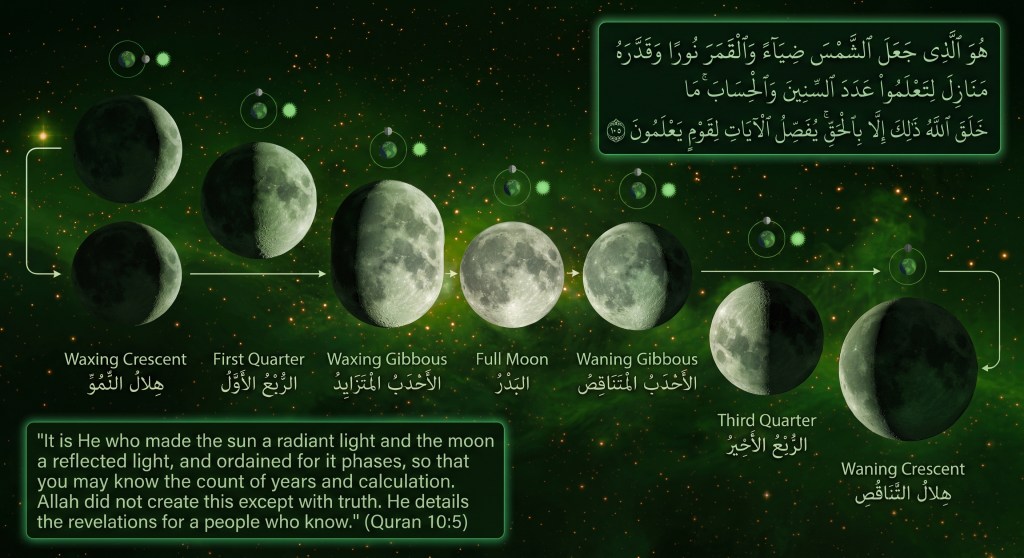
“He made the sun a radiant light and the moon a light, and determined for it phases – that you may know the number of years and the reckoning (hisāb).” (Quran 10:5)
“We have made the night and the day as two signs… that you may seek bounty from your Lord and know the number of years and the account (hisāb).” (Quran 17:12)
Presented by ChatGPT for Zia H Shah MD
Abstract
Three Qur’anic passages connect the most visible rhythms of the sky with calculation, chronology, livelihood, knowledge, and divine purpose. Qur’an 55:5 declares, with lapidary economy, that “the sun and the moon” operate bi-ḥusbān—by reckoning, calculation, or measured determination. Qur’an 10:5 distinguishes the sun’s radiant brilliance from the moon’s light and identifies the moon’s ordered stations as a means of knowing years and calculating time. Qur’an 17:12 presents night and day as signs whose alternation enables economic activity as well as chronological reckoning. Read in their literary settings, these verses unite cosmic order with moral order: the calculability of nature is mercy, a condition of language, agriculture, worship, navigation, science, and civilization; human beings are consequently obliged to measure justly and use knowledge responsibly.
Historically, Muslim societies made the un-intercalated lunar Hijri calendar central to ritual life, while also employing solar and regnal systems for agriculture, taxation, administration, and astronomy. The same civilization produced decisive work in algebra, algorithms, trigonometry, astronomical tables, instrumentation, observational astronomy, geodesy, and calendar science. Its scholars translated and criticized earlier knowledge, added original discoveries, and transmitted a transformed inheritance to Latin Europe. The later relocation of scientific leadership toward Europe was gradual and multi-causal—not a single “torch-passing”—and it does not diminish the cumulative, trans-civilizational character of knowledge.
The Gregorian calendar illustrates that cumulative process. Promulgated by Pope Gregory XIII in 1582 through Inter gravissimas, it corrected the Julian drift that had displaced the ecclesiastical equinox used in the computation of Easter. Its underlying reform proposal came principally from the Italian physician and astronomer Aloysius Lilius; Christopher Clavius helped evaluate, explain, and defend it. Today most Muslims, like most of humanity, use a solar civil calendar alongside the lunar religious calendar. That practical plurality accords with Qur’an 13:17: froth passes away, while what benefits people remains. The verse is not an automatic law of historical survival, but it supplies an epistemic ethic—test claims, preserve benefit, and discard vanity.
Scientifically, modern astronomy explains the sun’s self-luminous radiance, the moon’s reflected light, phases as changing viewing geometry, orbital regularities, and the unavoidable mismatch among day, synodic month, and tropical year. These discoveries do not “prove” revelation, but they amplify the verses’ central affirmation: the cosmos is ordered enough to be investigated and calculated. Philosophically, the passages invite humility about the conventional elements of every calendar and wonder at the natural regularities on which conventions depend. Theologically, they call Muslims to be permanent seekers of every beneficial kind of knowledge, resisting both scientistic reduction and religious dogmatism.
Read further in Microsoft Word file:




Leave a Reply