

Presented by Gemini for Zia H Shah MD
Audio teaser: The Saudi Turkey Pakistan Nuclear Alliance
Abstract
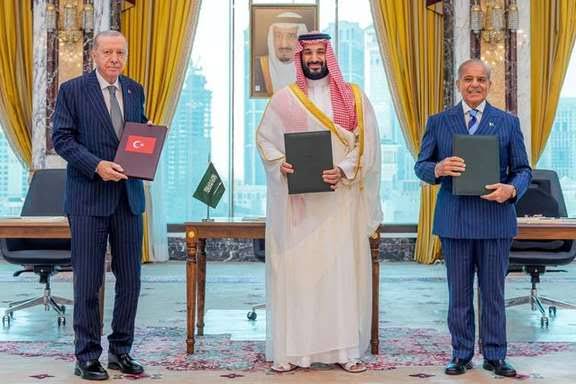
On August 7, 2026, the leadership of Saudi Arabia, Turkey, and Pakistan gathered at the Makkah Al-Mukarramah Summit for Joint Defence to sign the Mecca Joint Defense Agreement (MJDA), establishing a landmark trilateral collective security framework. Stipulating that an armed attack against any single signatory will be treated as an attack against all three, the pact introduces a mutual defense commitment analogous to NATO’s Article 5 into the security architecture of the Middle East and South Asia. Accelerated by the multi-front conflict involving the United States, Israel, and Iran that escalated on February 28, 2026, the agreement reflects a strategic shift by regional powers to hedge against the perceived unreliability of traditional external security guarantees.
By merging Saudi financial capital, Turkey’s advanced defense-industrial infrastructure and NATO-standard military forces, and Pakistan’s battle-hardened manpower and nuclear deterrence posture, the MJDA creates a self-reliant security axis. This report evaluates the political motivations, military capabilities, and geo-economic initiatives—such as revived trans-Eurasian rail corridors—that underpin the agreement. Furthermore, the analysis explores the theological and philosophical grounding of the treaty through an exegesis of Surah At-Tin (Qur’an 95:3), examining how the divine invocation of Makkah as a “secure city” (hadhal baladil amin) informs contemporary Islamic concepts of sanctuary, collective deterrence, and sovereign autonomy. Finally, actionable policy recommendations are outlined to guide the signatory states in institutionalizing this pact for their domestic stability and the broader security of the global Muslim community (Ummah).
Genesis and Structural Mechanics of the Agreement
The formal execution of the Mecca Joint Defense Agreement on August 7, 2026, by Saudi Crown Prince Mohammed bin Salman, Turkish President Recep Tayyip Erdogan, and Pakistani Prime Minister Shehbaz Sharif represents the integration of two previously distinct bilateral security vectors into a unified trilateral arrangement. The immediate catalyst for this strategic alignment was the security environment created by the outbreak of direct conflict between the United States, Israel, and Iran on February 28, 2026. Over the subsequent eighteen months, Saudi Arabia absorbed repeated ballistic missile and swarm drone strikes launched by Iranian forces and allied non-state actors operating from Yemen and Iraq. The inability of Western security guarantees to reliably prevent or intercept these strikes in real time accelerated Riyadh’s desire to establish an alternative regional security hedge.
The treaty was not established ex nihilo; rather, it consolidated mature bilateral defense ties. Riyadh and Islamabad had previously laid a formal foundation through the Strategic Mutual Defence Agreement signed at Al-Yamamah Palace in September 2025, which institutionalized long-standing military exchanges, technical assistance, and security cooperation. Simultaneously, Turkey and Pakistan maintained a robust defense partnership characterized by joint naval vessel construction, pilot training programs, and defense technology exchanges. This was complemented by Saudi Arabia’s strategic procurement from Ankara, highlighted by a record-setting 2023 agreement to acquire Turkish unmanned aerial vehicles (UAVs) and advanced defense technologies. The Mecca Summit merged these established operational tracks into a single multilateral defense framework.
Technically framed by Turkish Foreign Minister Hakan Fidan as equivalent to NATO’s Article 5 collective defense clause, the MJDA commits all three nations to mutual aid in the event of external armed aggression. To operationalize this commitment, the agreement establishes a permanent General Secretariat based in Saudi Arabia and a Ministerial Committee tasked with coordinating joint defense planning, intelligence sharing, and capability harmonization. Legally anchored in Article 51 of the United Nations Charter, which affirms the inherent right of individual and collective self-defense, the pact presents itself as a purely defensive instrument designed to stabilize the wider region.
Political Implications and Regional Rebalancing
The political architecture of the MJDA signifies a realignment in the geopolitical landscape of the Middle East and South Asia. For Saudi Arabia, entering into a collective security pact with two prominent non-Arab Muslim powers indicates a shift in its grand strategy. While Riyadh maintains its foundational security ties with Washington, the treaty reflects an explicit recognition that seeking an exclusive, binding Article 5-style security guarantee from the United States Congress is politically unfeasible under current conditions. Rather than fully breaking with Western security architectures, Saudi Arabia is diversifying its strategic portfolio, positioning itself as the central financial and diplomatic coordinator of a regional security network.
For Turkey, the agreement consolidates President Erdogan’s long-standing effort to project Turkish defense capabilities and influence across the Islamic world, building upon existing security arrangements in Qatar, Syria, and Libya. By linking its defense industry with Saudi capital and Pakistani strategic weight, Turkey enhances its status as an indispensable regional power while establishing a robust counterweight to Israeli military assertiveness in the Eastern Mediterranean and Levant.
For Pakistan, joining the pact enhances its international diplomatic standing and secures its primary sources of hydrocarbon imports and financial assistance. Furthermore, it allows Islamabad to project strategic influence into the Gulf—a region home to millions of Pakistani expatriates—while demonstrating its utility as a global security provider.
| State | Primary Strategic Motivations | Strategic Asset Contributed | Broader Geopolitical Objective |
|---|---|---|---|
| Saudi Arabia | Hedging against U.S. unreliability; deterring Iranian missile/drone threats. | Substantial financial capital; modern air bases; advanced Western interceptors. | Diversify security providers; anchor regional stability; lead Middle Eastern defense realignment. |
| Turkey | Expanding defense export markets; projecting power; counterbalancing Israeli freedom of action. | NATO’s second-largest standing army; advanced defense-industrial base (UAVs, air defense). | Assert multipolar leadership; integrate Islamic defense markets; secure strategic depth. |
| Pakistan | Elevating global prestige; securing hydrocarbon imports and economic support. | Operational military manpower (8,000+ deployed troops); strategic nuclear deterrent (~170 warheads). | Deepen Middle Eastern footprint; establish strategic counterweights; enhance national prestige. |
A notable political dynamic surrounding the Mecca Summit was the absence of Egypt. Despite participating in initial quadrilateral foreign-ministry discussions during the March 2026 Riyadh Summit, Cairo opted not to sign the final agreement. Cairo’s hesitation stems from three primary factors: first, its ongoing, delicate diplomatic normalization with Turkey following a decade of rupture over political Islam and Libyan intervention; second, its formal security commitments under the Camp David Accords with Israel, which a mutual defense pact with anti-Iranian and anti-Israeli undertones could complicate; and third, an expeditionary doctrine that prioritizes immediate border security over Gulf security deployments. Analysts suggest Cairo is adopting a wait-and-see approach to observe the pact’s operational commitments before committing.
The diplomatic reaction across the international system was swift and polarized:
- Iran: Iranian officials publicly criticized the pact, with Ebrahim Rezaei of the Iranian Parliament’s National Security Commission dismissing it as a “paper agreement” that would fail to provide genuine security for Saudi Arabia, comparing it to previous reliance on American protection.
- Israel: Security analysts and political leaders in Tel Aviv viewed the emerging Sunni military axis with deep concern, perceiving the combination of Turkish NATO-standard forces and Pakistani strategic capabilities as a potential limit on Israeli military operations. Consequently, Israeli leaders accelerated attempts to construct a counter-balancing “Hexagon” alliance involving Greece, Cyprus, and India.
- India: New Delhi responded with caution, closely monitoring the treaty’s implications for Pakistan’s strategic posture. While Indian media circulated reports of emergency defense talks with Israel, India’s Ministry of External Affairs officially clarified that no new bilateral pact was being signed, though it confirmed it was watching the trilateral development closely.
- United States: Washington maintained a posture of quiet observation. Official silence suggests American strategists recognize the MJDA aligns with broader U.S. goals of regional burden-sharing, allowing Washington to transition from an explicit security guarantor to an overarching security integrator in the Middle East.
Military Architecture, Capability Synergy, and Deterrence Dynamics
The operational credibility of the Mecca Joint Defense Agreement relies on the functional synergy of the three signatories’ military capabilities. Rather than creating duplicate command structures, the alliance integrates complementary military strengths across land, air, sea, and technological domains.
Saudi Arabia contributes vast capital resources, world-class military infrastructure, and an advanced, modern air force. Turkey brings NATO’s second-largest standing military force, extensive combat experience in expeditionary operations, and a rapidly expanding defense-industrial sector capable of producing indigenous drones, armored vehicles, missile systems, and naval vessels. Pakistan provides a battle-hardened military force, experienced command personnel, and a strategic nuclear arsenal estimated at 170 warheads.
       +---------------------------------------------------------------------------------+
       |                    MECCA JOINT DEFENSE AGREEMENT ARCHITECTURE                  |
       +---------------------------------------------------------------------------------+
                                                |
       +----------------------------------------+----------------------------------------+
       |                                        |                                        |
       v                                        v                                        v
+-----------------------------+  +-----------------------------+  +-----------------------------+
|        SAUDI ARABIA         |  |           TURKEY            |  |          PAKISTAN           |
| - Financial Capital & R&D   |  | - Advanced Defense Industry |  | - Expeditionary Manpower    |
| - Modern Airbases & Radar   |  | - NATO-Standard Military    |  | - 8,000+ Deployed Troops    |
| - Western Interceptor Fleet |  | - Counter-UAV & Missiles    |  | - Strategic Nuclear Arsenal |
+-----------------------------+  +-----------------------------+  +-----------------------------+
       |                                        |                                        |
       +----------------------------------------+----------------------------------------+
                                                |
                                                v
       +---------------------------------------------------------------------------------+
       |                       INTEGRATED OPERATIONAL OUTPUTS                            |
       |  - Layered Peninsula Air Defense (Sensors + Interceptors + Combat Crew)        |
       |  - Strategic Ambiguity & Extended Deterrence                                    |
       |  - Joint Command Secretariat & Interoperability Standards                       |
       +---------------------------------------------------------------------------------+
In functional terms, the alliance builds upon significant force deployments already active within the Arabian Peninsula. Pakistan has deployed approximately 8,000 military personnel to Saudi Arabia, alongside fighter squadrons, unmanned platforms, and specialized air defense units tasked with safeguarding critical Saudi infrastructure. The MJDA provides the overarching legal mechanism to integrate these assets with Turkish electronic warfare, sensor arrays, and low-altitude counter-drone systems. This creates an integrated, multi-layered air defense bubble capable of mitigating swarm drone attacks and ballistic missile threats across Gulf airspace.
A critical element of the alliance’s deterrence model is Pakistan’s nuclear status. Official statements from Saudi Arabia explicitly state that the MJDA contains no formal nuclear component and is not linked to an arms race, aiming instead to develop sustainable self-reliant defense capabilities. Similarly, Pakistani defense analysts maintain that Islamabad’s nuclear doctrine remains oriented toward South Asian security dynamics.
However, by establishing a legally binding collective defense pact where an attack on Saudi Arabia is treated as an attack on Pakistan, the treaty introduces a powerful element of strategic ambiguity. Adversaries contemplating major aggression against Gulf infrastructure must account for the presence of a nuclear-armed power within the alliance’s operational matrix, effectively enhancing deterrence without requiring a formal nuclear sharing agreement.
Geo-Economic Integration and Eurasian Transit Corridors
An important insight derived from the Mecca Accords is that the pact functions as both a collective defense arrangement and an instrument for geo-economic integration. The three signatory nations recognize that military alliances require hard infrastructure, trade connectivity, and energy linkages to maintain long-term cohesion. Consequently, the treaty serves as the security anchor for ambitious trans-Eurasian rail and trade corridors designed to alter regional trade flows.
Primary among these infrastructure initiatives is the planned revival of the historic Hejaz Railway. Negotiated between Saudi Arabia and Turkey, this project seeks to establish an overland rail corridor linking the Persian Gulf to Europe through Jordan, Syria, and Turkey. Crucially, this route bypasses Israel, the United Arab Emirates, and Greece—three nations that formed the core of the competing India-Middle East-Europe Economic Corridor (IMEC).
| Infrastructure Project | Primary Signatories & Partners | Geographic Route | Geopolitical & Strategic Impact |
|---|---|---|---|
| Hejaz Railway Revival | Saudi Arabia, Turkey, Jordan, Syria. | Persian Gulf → Levant → Turkey → Europe. | Bypasses Israel, UAE, and Greece; establishes a direct overland trade route connecting Gulf energy to European markets. |
| Islamabad-Tehran-Istanbul (ITI) Railway | Pakistan, Turkey, Iran. | South Asia → Iranian Plateau → Anatolia → Europe. | Connects South Asian industrial centers directly to Turkish supply chains; reduces reliance on maritime choke points. |
| Lapis Lazuli Southern Extension | Pakistan, Turkey, Central Asian Republics. | Central Asia → Afghanistan → Pakistan → Arabian Sea. | Links landlocked Central Asian energy and mineral markets to Pakistani ports and broader Gulf supply lines. |
Concurrently, Turkey and Pakistan are accelerating efforts to expand the Islamabad-Tehran-Istanbul (ITI) rail line and extend the Lapis Lazuli Corridor southward into Pakistan. By linking South Asia and Central Asia to Turkish logistics hubs, these transit projects establish an integrated economic belt protected by the military umbrella of the MJDA. If fully realized, these alternative networks will reduce the signatories’ vulnerability to maritime blockades and divert commercial transit value away from competing regional hubs.
Theological and Philosophical Foundations: Commentary on Qur’an 95:3
The decision to sign the Mecca Joint Defense Agreement within the holy city of Makkah during the Makkah Al-Mukarramah Summit for Joint Defence was a deliberate theological act designed to align modern statecraft with foundational Islamic principles. A nuanced understanding of the agreement requires examining its thematic and philosophical convergence with Qur’anic exegesis (tafsir), specifically regarding divine sanctuary, civic peace, and collective responsibility.
Exegesis of Hadhal Baladil Amin (Qur’an 95:3)
In Surah At-Tin (Chapter 95, Verses 1–4), the Divine text opens with a sequence of sacred oaths:
“By the fig and the olive, and by Mount Sinai, and by this secure city [Makkah]—We have certainly created man in the best posture.”
[cite: 7, 8, 14]
Classical scholars of exegesis, including Al-Tabari and Ibn Kathir, explain that these oaths symbolize the geographic epiphanies of prophetic history:
- The Fig and the Olive (At-Tin wal-Zaytun): Refers to the lands of the Levant and Palestine, the site of the prophetic missions of Ibrahim (Abraham) and Isa (Jesus).
- Mount Sinai (Tur Sinin): Represents the sacred mountain where Allah revealed the Law directly to Musa (Moses).
- This Secure City (Hadhal Baladil Amin): Explicitly designates Makkah Al-Mukarramah, the birthplace of the Prophet Muhammad and the site of the final revelation.
Linguistically, the term Amin derives from the root a-m-n, denoting safety, security, trust, and liberation from fear. Makkah is characterized not merely as an urban settlement, but as an inviolable sanctuary (Haram) where violence is sanctified against, human life is safeguarded, and sanctuary is guaranteed to all who enter. The Qur’anic structure establishes that physical and societal security (Amn) is the indispensable prerequisite for humanity to fulfill its noble origin and spiritual potential (Ahsan Taqweem).
Translating Sacred Sanctuary into Modern Collective Deterrence
The theological thesis underlying the MJDA is the translation of the classical concept of Amn (sanctuary) into an operational model of collective security. By invoking the sacred status of Makkah as the signing site of a mutual defense treaty, the leaders of Saudi Arabia, Turkey, and Pakistan grounded a modern political pact in the normative framework of the Quran.
Historically, the inviolability of Makkah provided a space where inter-tribal warfare was suspended, allowing trade, pilgrimage, and diplomatic dialogue to flourish. In the contemporary geopolitical era—marked by missile proliferation, foreign intervention, and regional instability—the agreement asserts that maintaining Hadhal Baladil Amin requires structural self-reliance. Security cannot be outsourced to external non-Muslim powers whose strategic commitments fluctuate; rather, it must be generated through internal unity (Ittehad) and mutual protection among sovereign Muslim nations.
Furthermore, the pact offers a model for transcending historical ethnic and sectarian divisions within the global Islamic community (Ummah). By uniting an Arab monarchy, a Turkic constitutional republic, and a South Asian federal republic under a single defense covenant signed in Makkah, the treaty demonstrates that strategic solidarity can bridge regional, linguistic, and doctrinal differences.
Strategic Roadmap for Long-Term Growth and Ummah Benefit
To ensure the Mecca Joint Defense Agreement evolves beyond a symbolic declaration into an enduring security architecture, the signatory governments and their civil societies must pursue a structured strategy for institutionalization.
Institutional Defense Integration
The Ministerial Committee and General Secretariat established in Saudi Arabia must prioritize creating a permanent Combined Military Command. This institution should be staffed by officers from all three nations and tasked with formulating joint defense doctrines, conducting real-time threat assessments, and managing integrated air defense networks.
To ensure operational readiness, the signatories should institute annual trilateral military exercises—conceptually titled Balad Amin (Secure City)—testing joint rapid-response capabilities across maritime, air, and cyber domains. Furthermore, defense communications, command-and-control software, and operational procedures must be standardized to facilitate seamless coordination during crisis scenarios.
Defense-Industrial and Technological Synergy
The alliance must leverage Saudi capital to establish co-development defense funds in Ankara and Rawalpindi. Priority should be given to joint research and production of autonomous systems, air defense interceptors, quantum-encrypted communications, and electronic warfare capabilities.
By pooling industrial resources, the three states can reduce their shared dependence on Western and Eastern defense suppliers, creating a self-sustaining defense-industrial base.
Diplomatic Engagement and Conflict Resolution
The signatories must strictly maintain the MJDA’s character as a defensive agreement. To prevent the alliance from escalating regional tensions or being perceived as an aggressive sectarian bloc, the General Secretariat should open diplomatic hotlines with neighboring states, including Iran, Egypt, and GCC members.
Furthermore, as emphasized by Turkish and Pakistani officials, the agreement should remain open to the accession of other Muslim-majority nations—such as Malaysia, Indonesia, Jordan, and Qatar—that adhere to its defensive parameters, establishing a broader platform for collective stability.
Socio-Economic and Civic Integration
To ensure the alliance benefits the broader populations of the three states and the global Ummah, defense cooperation must be paired with economic and civic initiatives. Governments should expedite the Hejaz and ITI rail corridors, streamline cross-border trade tariffs, and establish preferential trade agreements.
At the civil society level, universities across Saudi Arabia, Turkey, and Pakistan should launch joint scholarship programs in strategic studies, engineering, and Islamic philosophy. Fostering academic, cultural, and commercial exchanges will build a durable foundation of public support for the alliance, ensuring its longevity across political transitions.
Thematic Epilogue
The Mecca Joint Defense Agreement of August 7, 2026, represents a significant turning point in the modern political history of the Muslim world. Born out of regional war and the declining reliability of external security guarantees, the pact establishes a self-reliant security structure anchored by three prominent Muslim-majority powers. By combining Saudi financial capital, Turkish industrial and military capacity, and Pakistani strategic deterrence, the alliance constructs a multi-nodal architecture capable of shaping the geo-economic and security landscape of Eurasia.
Yet, the ultimate significance of the Mecca Accords extends beyond traditional realpolitik. By sealing this covenant in the holy city of Makkah, the signatories explicitly linked their security policies to the Qur’anic concept of Hadhal Baladil Amin—affirming that peace, human dignity, and societal flourishing are rooted in physical sanctuary and collective defense. If guided by diplomatic wisdom, institutional discipline, and a commitment to broad regional stability, the alliance has the potential to fulfill its founding mandate: transforming an ancient divine promise of sanctuary into an enduring architecture of peace for the signatory nations and the global community at large.







Leave a Reply