
Written and collected by Zia H Shah MD, Chief Editor of the Muslim Times
Introduction: The Ḥajj (major pilgrimage to Mecca) holds a central place in Sunni Islam as the fifth pillar of faith, combining physical journey with profound spiritual meaning. All Sunni traditions – across diverse legal schools (madhāhib) and theological orientations – regard Hajj as an obligation for those able, rooted in the Qur’anic command: “Pilgrimage to the House is a duty owed to God by people who are able to undertake it.” Its significance is threefold: legal (as a farḍ duty once in a lifetime), spiritual (as a means of purification and closeness to God), and eschatological (as a foreshadowing of the Day of Judgment). This article presents Sunni theological understandings of Hajj – drawing on classical and modern Sunni scholarship – and compares them with Twelver Shiʿa and Ismāʿīlī Shiʿa perspectives in terms of ritual practice, legal rulings, and symbolic interpretation. Relevant Qur’anic verses (in M.A.S. Abdel Haleem’s translation) are cited to ground each theological claim.
Hajj as a Pillar of Islam in Sunni Thought
In Sunni theology, Hajj is unanimously recognized as a fundamental act of worship prescribed by God. Along with the declaration of faith (shahāda), prayer, almsgiving, and fasting, it completes the five pillars underpinning Muslim practice fiqh.islamonline.net. The Qur’an situates Hajj in the Abrahamic legacy: “The first House [of worship] to be established for people was the one at Mecca… a blessed place; a source of guidance for all people… Pilgrimage to the House is a duty owed to God by people who are able to undertake it.” Sunni authorities interpret this as a binding obligation on every adult Muslim who is physically and financially capable (istiṭāʿa), to be performed at least once in a lifetime. Deliberate neglect of this duty is strongly condemned – classical exegetes note that the verse warns “those who reject this” duty that “God has no need of anyone,” implying spiritual ruin for one who denies or abandons Hajj.
Sunni legal scholars (fuqahā’) across all four schools – Hanafi, Shafiʿi, Maliki, and Hanbali – concur on Hajj’s obligatory status and basic integrals, while differing in some juristic details. All schools require entering a state of consecration (iḥrām) at designated points (mīqāt), performing the core rites at specified times during Dhū al-Ḥijja, and maintaining certain prohibitions during Hajj. Minor differences exist in the classification of rites as arkān (essential pillars) or wājibāt (necessary duties) and the penalties for omissions. For example, the schools vary on whether the saʿy (running between Ṣafā and Marwah) is an essential pillar or a mandatory duty that can be expiated if missedi. Despite such technical nuances, all Sunni madhāhib share a common framework for Hajj that emulates the Prophet Muhammad’s Farewell Pilgrimage. Each school emphasizes that Hajj, when correctly performed, earns immense reward – a famous hadith states that an accepted Hajj has no reward except Paradise, and one who completes Hajj free of sin “returns as pure as the day his mother bore him” (i.e. completely forgiven) fiqh.islamonline.net. This emphasis on spiritual reward underscores that Hajj is not merely a ritual obligation but a transformative journey of the soul in Sunni belief.
Spiritual and Eschatological Significance of Hajj in Sunni Theology
Beyond its legal status, Hajj carries profound spiritual significance in Sunni theology, often described as a journey of repentance, self-purification, and renewal of one’s relationship with God. The Qur’an reminds pilgrims to maintain the highest moral conduct during Hajj: “There should be no indecent speech, misbehavior, or quarrelling for anyone undertaking the pilgrimage – whatever good you do, God is well aware of it. Provide well for yourselves: the best provision is to be mindful of God.” Sunni scholars interpret this verse (Qur’an 2:197) as indicating that the true adornment of a pilgrim is not fine clothes or wealth brought to Mecca, but taqwā (God- consciousness). The state of iḥrām (simple white garments and prohibition of vanity or sexual activity) is intended to instill humility, patience, and a focus on dhikr (remembrance of God) en.al-shia.org fiqh.islamonline.net. Indeed, as one modern scholar notes, the white shroud-like garb and austere conduct signify “inward purity… humility, and [are] a reminder of death when the deceased is shrouded in similar clothes. So it is as if pilgrims were preparing to meet Allah.” fiqh.islamonline.net.
Eschatologically, Sunni theology often portrays Hajj as a rehearsal for the Day of Judgment. The gathering of multitudes on the plain of ʿArafāt – all clad identically in white, begging God’s mercy under the open sky – is a powerful image of the resurrection when humanity will stand equal before God fiqh.islamonline.net. Many scholars draw this parallel: Imām al-Ghazālī (d. 1111), for instance, writes that the pilgrim’s donning of iḥrām and standing at ʿArafāt should evoke the bared humility of souls awaiting judgment, instilling awareness of one’s final return to God (a theme echoed by later scholars)en.al-shia.orgen.al-shia.org. The Prophet Muhammad’s Farewell Sermon itself, delivered on ʿArafāt, stressed human equality and accountability, foreshadowing the Qur’anic message: “O mankind! We created you from a male and a female, and made you into races and tribes so that you should recognize one another. In God’s eyes, the most honored of you are the ones most mindful of Him: God is all knowing, all aware.”ia600501.us.archive.org. Sunni commentators often quote this verse (Qur’an 49:13) when discussing Hajj, as the pilgrimage vividly manifests this ideal: kings and commoners, rich and poor, of every race worship side by side, with nothing to distinguish them but their piety. The wuqūf (standing) at ʿArafāt is thus seen as the culmination of Hajj’s spiritual journey, where pilgrims are urged to repent sincerely and pray for salvation – an earnest preview of the gathering on the Last Dayfiqh.islamonline.netfiqh.islamonline.net. There is a well-known hadith in Sunni collections that “Hajj wipes out whatever sins came before it” (if done properly), reinforcing the notion that a faithful pilgrimage prepares one for the ultimate meeting with God, as a soul cleansed of past transgressions.
Interpretations Across Sunni Schools of Law and Theology
Sunni Islam is often described as encompassing multiple schools of jurisprudence (madhāhib) and theological thought (especially Ashʿarī, Māturīdī, and Atharī/Ahl al-Ḥadīth). When it comes to Hajj, however, these diverse strands converge on core principles, with differences arising more in legal detail than in theological meaning. All Sunni schools affirm that Hajj was established by God through Prophet Ibrāhīm (Abraham) and perfected by Prophet Muhammad ﷺ, carrying profound meaning for the believer’s faith.
Perspectives of the Four Sunni Law Schools (Madhāhib)
Each of the four canonical Sunni law schools – Hanafi, Maliki, Shafi‘i, and Hanbali – has an extensive jurisprudence of Hajj (fiqh al-ḥajj). They agree on the fundamental sequence of rites: entering iḥrām at the mīqāt with the talbiyah chant, performing ṭawāf (circumambulation of the Kaʿbah) and saʿy, standing at ʿArafāt on the 9th of Dhū al-Ḥijja, collecting pebbles and stoning the Jamarāt at Mina, offering an animal sacrifice, and concluding with the farewell ṭawāf. All consider Wuquf at ʿArafāt the “greatest pillar” of Hajj – as the Prophet said, “Hajj is ʿArafah” – such that missing it invalidates the pilgrimage. Likewise, all require the ṭawāf al-ifāḍah (circling the Kaʿbah after leaving Mina) before ending iḥrāmia600501.us.archive.orgia600501.us.archive.org.
Differences lie in finer points. For example, the Hanafis classify certain rites like ramī al-jamarāt (stoning the pillars symbolizing Satan) as wājib rather than farḍ, meaning that omission requires a compensatory sacrifice but does not invalidate the Hajjia600501.us.archive.org. Shafi‘is and Hanbalis tend to count saʿy and stoning as obligatory pillars that cannot be omitted. Maliki jurists uniquely emphasize the niyyah (intention) and performance of rites in prescribed order, and consider delaying the ṭawāf al-ifāḍah beyond Dhū al-Ḥijja as a serious issue requiring expiation. Despite such variations, these schools uniformly stress adhering to the Prophet’s Sunnah in the rites, often citing his injunction: “Take your rituals from me.” All four schools also allow the three permitted modes of Hajj – tamattu‘ (combining an ʿumrah with Hajj in one trip, with a break in iḥrām), qirān (joining ʿumrah and Hajj in a single continuous state of iḥrām), and ifrād (Hajj alone) – though with different preferences. Twelver Shiʿa jurisprudence, for comparison, generally requires Hajj al-tamattu‘ for pilgrims coming from outside Meccashiastudies.comshiastudies.com, aligning in practice with Sunni tamattuʿ but making it obligatory.
Importantly, all Sunni schools anchor their Hajj rulings in Qur’an and Hadith. Qur’anic verses such as “Complete the major and minor pilgrimage for the sake of God”ia600501.us.archive.org and detailed Prophetic reports of the Farewell Hajj form the basis of legal consensus. For instance, they cite Qur’an 2:196–2:203 for injunctions on completing rites and maintaining pietyia600501.us.archive.orgia600501.us.archive.org, and Qur’an 5:97 which calls the Kaʿbah and the sacred months “a support for people”ia600501.us.archive.org. Thus, while the Sunni madhāhib differ on secondary issues (e.g. whether a particular violation during Hajj incurs a sacrifice or just repentance), they uniformly view the Hajj as a divinely mandated system of rites aimed at commemorating the monotheistic legacy of Abraham and Muhammad and at refining the believer’s obedience and devotion.
Approaches of Ashʿarī, Māturīdī, and Atharī Theologies
Within Sunni kalām (theology), the major schools – Ashʿarism and Māturīdism (the theological frameworks for the majority of Sunni scholars historically) and Atharism (also known as the Salafi or scripturalist approach) – have no fundamental disagreement on the doctrine of Hajj. As a pillar of Islam attested by unequivocal texts (naṣṣ), Hajj’s obligation and spiritual merit are accepted by all. Nonetheless, their approaches can differ subtly in emphasis:
- Ashʿarī and Māturīdī theologians, who often employ rational exposition, tend to highlight the wisdom (ḥikmah) behind Hajj’s rites. They affirm that acts of worship have benefits for the soul and society, even if the full wisdom may be beyond human reason. For example, an Ashʿarī scholar like al-Ghazālī delved into the inner meanings of Hajj in Iḥyāʾ ʿUlūm al-Dīn, seeing in each ritual a metaphor for spiritual stages – the Kaʿbah symbolizing the Divine Presence, the physical journey symbolizing the soul’s journey to God, etc.en.al-shia.orgen.al-shia.org. Māturīdī scholars similarly accept symbolic interpretations insofar as they do not contradict the literal performance. Both schools agree that Hajj must be performed outwardly as ordained, while encouraging reflection on its ethical and spiritual lessons (unity, sacrifice, detachment from dunya).
- Atharī (Traditionalist/Salafi) theologians focus on strict adherence to the Prophetic example, sometimes cautioning against over-allegorization of rituals. They stress that the primary purpose of Hajj is obedience to God’s command, as an act of worship established in the Qur’an and Sunnah, whether or not one perceives its full rationale. A well-known report often quoted in Salafi circles is of the Caliph ʿUmar kissing the Black Stone and saying, “I know that you are only a stone and can neither harm nor benefit; if the Prophet had not kissed you, I would not kiss you”islamqa.info. This exemplifies the Atharī ethos: the ritual is done in submission to God and imitation of the Prophet, not because the stone itself has power. Atharī scholars like Ibn Taymiyyah and Ibn ʿUthaymīn do acknowledge wisdom in the rites – for instance, Ibn ʿUthaymīn wrote that “circumambulation, saʿy, and stoning were only ordained to establish the remembrance of Allah”islamqa.info, linking every physical act to a spiritual remembrance – but they resist any notion that the outer rites can be bypassed in favor of an inner meaning. In Atharī creed, performing Hajj with ikhlāṣ (sincerity) and according to the Sunnah is itself an exercise in faith and submission, even when one does not rationally grasp every aspectislamqa.info.
In summary, Sunni theological schools are united on Hajj’s status and core significance. Any differences lie in hermeneutical approach: the Ashʿarī and Māturīdī tradition allows for more theological reflection on symbolism (often overlapping with Sufi mystical interpretations), whereas the Atharī-Salafi approach emphasizes literal implementation and cautions believers to stay within the bounds of revealed texts when ascribing meanings to rituals. Nonetheless, even Atharī scholars often celebrate the evident spiritual themes of Hajj – tawḥīd (affirming the oneness of God), tauba (repentance), dhikr, and the unity of Muslims – as long as these are grounded in Quranic or Prophetic referencesislamqa.infoislamqa.info.
Symbolism of the Hajj Rites in Sunni Theology
Sunni scholars through the ages have written about the symbolic and spiritual meanings of the Hajj rituals. While jurists describe how to perform each rite, theologians and mystics often explore why these acts matter to the soul. Many of these interpretations are shared across Sunni and Shiʿa thought, given the common origin of the rites, though emphasis can vary. Below, we discuss key elements of Hajj and their meaning as understood in Sunni theology, supported by Qur’anic verses and Hadith (with Abdel Haleem’s English translations of the Qur’an):
Iḥrām: Consecration and Equality
The very first step of Hajj – entering the state of iḥrām – is rich with meaning. Iḥrām requires the pilgrim to don two seamless white cloths (for men; women wear modest dress), symbolizing renunciation of worldly status and desires. All markers of social distinction are shed: no colorful garments, no perfumes, no jewelry. In this uniform, almost monastic state, all pilgrims become equal before God. Sunni writers frequently liken the iḥrām garb to the shroud (kafan) in which Muslims are buriedfiqh.islamonline.net. As Dr. Yahya al-Yahya observes, “The whiteness and cleanness of the pilgrims’ clothes is a sign of inward purity… a reminder of death when the deceased is shrouded in similar clothes. So it is as if pilgrims were preparing to meet Allah.”fiqh.islamonline.net. Qur’an 22:23 alludes to the pure garments of Paradise; by wearing simple white in Hajj the believers seek a preview of that purity.
Moreover, the restrictions of iḥrām (no hunting, no cutting hair or nails, no marital relations or vulgar speech) train the soul in discipline and humilityen.al-shia.org. As one Shiʿa source beautifully put it (and Sunnis would agree), “The ritual of Ihram entirely removes man from material ostentations, external distinctions, extravagant clothing and ornaments… It distances him from the material world and engrosses him in a world of light, purity and spirituality.”en.al-shia.org. In Sunni tradition, pilgrims often recite upon entering iḥrām: “Labbayk Allāhumma labbayk…” (“Here I am, O Allah, at Your service…”), a cry of total submission. This talbiyah chant explicitly proclaims God’s oneness: “Here I am – You have no partner – here I am. Indeed, all praise, favor, and sovereignty belong to You – You have no partner.”fiqh.islamonline.net. Thus from the outset, Hajj affirms tawḥīd (Divine Unity) and the renunciation of shirk (idolatry). The simple clothes and words remind pilgrims that they come to God as pure servants, discarding worldly pride. In the words of Qur’an 22:32, “Those who honor God’s rites show the piety of their hearts.”ia600501.us.archive.orgia600501.us.archive.org – wearing iḥrām and observing its discipline is a way of honoring the sacred rites and cultivating piety.
Ṭawāf and Tawḥīd: Circling the One God’s House
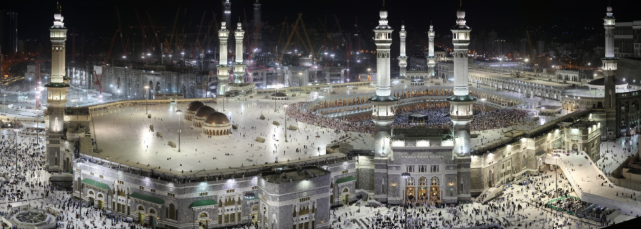
Pilgrims performing ṭawāf around the Kaʿbah in Mecca during Hajj. The act of circling the Kaʿbah seven times symbolizes centering one’s life around the One God (tawḥīd), in imitation of the angels circling God’s Throneislamqa.infoia600501.us.archive.org. The Kaʿbah – built by Prophet Abraham – is called in the Qur’an “the Ancient House” and was purified for monotheistic worshipia600501.us.archive.org.
The ṭawāf – circumambulating the Kaʿbah seven times – is among the most iconic rites of Hajj. In Sunni theology, this continuous circling is laden with symbolism affirming tawḥīd (the oneness of God) and the believer’s submission. The Qur’an recounts that Abraham was commanded: “Purify My House for those who circle around it, those who stand to pray…”ia600501.us.archive.org, indicating that ṭawāf is an act of devotion as ancient as Abraham himself. By walking around the Kaʿbah, pilgrims physically orient themselves around Allah – the Kaʿbah is not an idol (God forbid), but a sanctified focal point for worship of the unseen God. Just as Muslims face the Kaʿbah in daily prayers to unite their direction, in Hajj they encircle it to show that God is the center of their lives. Some theologians compare ṭawāf to the motion of the planets around the sun or electrons around a nucleus – a natural expression of revolving around a central force of attraction. In Islamic terms, that center is the One God.
A Prophetic hadith explicitly states: “Circumambulation of the House, the saʿy between al-Ṣafā and al-Marwah, and the stoning of the Jamarāt have only been ordained to establish the remembrance of Allah.”islamqa.info. Sunni scholars like Ibn ʿUthaymīn cite this to emphasize that ṭawāf is essentially dhikr in motionislamqa.info. As the pilgrim walks, he or she utters supplications, praises of God, and especially the talbiyah or takbīr. Even the physical gestures – like kissing or touching the Black Stone at the Kaʿbah’s corner – are understood in terms of reverence to God. The second Caliph ʿUmar’s statement (noted above) underscores that Muslims kiss the Black Stone only because the Prophet did, as an act of obedience to Godislamqa.info. There is no inherent power in the stone; it is revered as a symbol of God’s covenant with His servants. Some reports say the Black Stone will bear witness on the Day of Judgment for those who honored it rightlyislamqa.info, an example of Hajj’s eschatological thread.
Sunni mystics added further layers of meaning: circling seven times might represent the seven heavens or the perfection of worship; never turning one’s back fully to the Kaʿbah signifies constant orientation to God. Al-Ghazālī teaches that as pilgrims circle the Kaʿbah, they should remember the angels circling the Divine Throne (al-ʿArsh) in heaven, and realize they join in a cosmic worship that affirms lā ilāha illā Allāh (there is no deity but God)fiqh.islamonline.net. In sum, ṭawāf in Sunni theology is the embodied affirmation of tawḥīd: the pilgrim’s heart and body gravitate around the One Lord, seeking His mercy.
Saʿy (Ṣafā and Marwah): Perseverance and Trust in God
The saʿy, running or walking briskly between the two small hills of al-Ṣafā and al-Marwah next to the Kaʿbah, commemorates Hagar’s desperate search for water for her infant Ishmael. This rite is directly sanctioned in the Qur’an: “Safa and Marwa are among the rites of God, so there is no sin on whoever performs the Hajj or ʿUmrah to walk between them” (Qur’an 2:158, not quoted in full) – a verse which legitimized the practice in Islam after the pre-Islamic Arabs had introduced idols thereia600501.us.archive.org. By calling Ṣafā and Marwah shaʿāʾir Allāh (symbols or rites appointed by God), the Qur’an makes the saʿy an integral, divinely meaningful part of Hajj.
Sunni exegetes and storytellers highlight Hagar’s faith and perseverance as the soul of this ritual. Alone in the desert, she ran back and forth seven times between the hills searching for help, until God sent the Angel Gabriel to uncover the Zamzam well. Pilgrims reenact this not as an empty tribute, but to internalize Hagar’s virtues: patience, hope, and reliance on God in times of distress. As one scholar writes, saʿy teaches that **“relief and divine provision come after sincere effort and trust”*. Pilgrims may reflect that in their own lives, they often run between “valleys” of hardship, and it is ultimately God who provides sustenance (just as Zamzam sprang forth)en.al-shia.orgen.al-shia.org.
A modern commentary by Shaykh Ash-Shinqīṭī (a Sunni scholar) states that the wisdom behind saʿy is explained by these authentic accounts of Hagar – illustrating how God tests His servants then rewards trust and effort richlyislamqa.infoislamqa.info. The running also symbolizes urgency in worship – one should hasten to serve God. Interestingly, pilgrims initially ascend Ṣafā and Marwah, reciting the verse “Indeed, Ṣafā and Marwah are among the symbols of Allah…” and glorifying God. This recitation (from Qur’an 2:158) at the very spot of its revelation blurs the line between past and present, making pilgrims feel as if they are characters in the sacred history. Many report that the physical exertion of saʿy, especially under the Arabian sun, drives home lessons of endurance and the sweetness of finding relief (when Zamzam water is then drunk).
In sum, saʿy in Sunni thought represents the human striving (saʿy literally means effort) and God’s responding grace. It balances the purely devotional acts with a dramatic, historical narrative of a mother’s love and a believer’s trust. The endpoint – the Zamzam well – remains available for pilgrims to drink, a tangible symbol of God’s mercy that rewarded Hagar. Sunni traditions hold the water of Zamzam to be blessed and curative, recalling a hadith, “Zamzam water is for whatever intention it is drunk”. Thus, the pilgrim performing saʿy experiences the arc of trial to relief, embodying the principle that “Allah will surely bring ease after difficulty” (cf. Qur’an 94:5-6, paraphrased).
Wuqūf at ʿArafāt: Forgiveness and the Day of Judgement
The standing at ʿArafāt (wuqūf) on the 9th of Dhū al-Ḥijja is often regarded as the spiritual climax of the Hajj. From noon to sunset on that day, pilgrims gather in the plain of ʿArafāt (just outside Mecca) in constant supplication, repentance, and pleading for God’s mercy. The Prophet’s statement, “Ḥajj is ʿArafāt,”fiqh.islamonline.net underscores that without this standing, Hajj is not fulfilled.
Sunni theology imbues this rite with dual significance: deep spiritual cleansing and eschatological foreshadowing. It is taught that on the Day of ʿArafah, God’s forgiveness overflows. A hadith in Saḥīḥ Muslim states that on no day does Allah free more people from Hellfire than on the Day of ʿArafah – a narration that Sunni preachers often quote to inspire earnest repentance on that afternoon. Pilgrims, having shed their worldly identifiers, stand humbled and vulnerable, reciting the talbiyah or Qur’anic duʿā’s. Many invoke the famous supplication: “Our Lord, we have wronged ourselves; if You do not forgive us and have mercy upon us, we will be among the lost” (cf. Qur’an 7:23). This collective act of seeking forgiveness is so central that even Muslims not on Hajj observe the Day of ʿArafah by fasting and extra prayer, in solidarity with the pilgrims.
Eschatologically, the scene at ʿArafāt is a microcosm of Mahshar, the gathering of souls on Judgment Day. Sunni scholars frequently draw parallels: just as people assemble on ʿArafah awaiting mercy, so shall humanity assemble awaiting God’s judgment. The heat and thirst of the day recall the Quranic imagery of the Day of Reckoning’s hardship, and the way pilgrims turn to God alone for mercy prefigures how none but God can save on Judgment Day. Some descriptions even liken the pilgrims’ white clothes to the burial shrouds in which they will be resurrectedfiqh.islamonline.net. The noted scholar Ibn Hajar (Shafiʿi jurist) wrote that ʿArafāt’s great lesson is one of tawba (repentance) and ikhlāṣ (sincere devotion), which prepares the soul for ultimate accountabilityislamqa.infoislamqa.info.
Additionally, ʿArafāt is where the Prophet Muhammad ﷺ delivered his Farewell Sermon, reinforcing core Islamic values (the oneness of God, equality of humans, rights and ethics). Sunni thought celebrates this as the moment when Islam’s message was finalized – indeed, Qur’an 5:3 (“Today I have perfected your religion for you”) was, according to hadith, revealed during the ʿArafāt gathering of the Farewell Hajj. Thus ʿArafāt carries the memory of Islam’s completion, adding to its sanctity.
In practice, pilgrims at ʿArafāt spend hours in dua (prayer), Quran recitation, and often emotional tears. Many describe it as the most poignant spiritual experience of their lives. Islamic literature – Sunni and Shiʿa alike – is rich with moving supplications for the Day of ʿArafah. For example, Twelver Shiʿa pilgrims recite Imam Husayn’s Duʿā ʿArafah, a long, heartfelt prayer of gnosis and repentanceshiastudies.com, while Sunnis often read the Prophet’s own prayers or spontaneous personal supplications. The ethos is the same: standing on ʿArafāt is standing before God, anticipating the individual’s standing before Him on Qiyāmah (the Resurrection). As one contemporary blog aptly put it, “This standing at Arafat is a profound reminder of the Day of Judgment, where every soul will stand before Allah seeking His mercy and pardon.”feelingblessed.org (Though not a classical source, this sentiment reflects widespread understanding.)
By sunset, an immense spiritual catharsis occurs: pilgrims feel hope that their sins are forgiven and their prayers answered, as they depart ʿArafāt for the next rite (Muzdalifah) amidst chants of “Allāhu Akbar”. Sunni tradition holds that leaving ʿArafāt cleansed is like a rebirth – which again echoes the idea of emerging sinless for the final journey to the Hereafter. Little wonder that the Prophet said “Ḥajj mabroor (a Hajj properly completed and accepted) has no reward except Paradise.”fiqh.islamonline.net The mabrūr Hajj, in Sunni view, is one where the pilgrim’s sins were washed at ʿArafāt and the remainder of rites were done in piety.
Stoning of the Jamarāt: Rejecting Evil
On the days of Eid al-Adha (10th of Dhū al-Ḥijja and the two subsequent days, known as Tashrīq), pilgrims perform ramī al-jamarāt: the stoning of three pillars (formerly tall stone markers, now large wall-like structures) in Mina. This ritual emulates Prophet Abraham, who – according to Islamic tradition – was tempted by Satan at these three spots while he hastened to fulfill God’s command to sacrifice his son. Abraham pelted Satan with stones to drive him away. Pilgrims likewise throw pebbles (seven at each pillar each day) to symbolize their rejection of evil and temptation.
Sunni explanations of ramī emphasize its role as a symbolic reenactment of the believer’s struggle against Satan (al-shayṭān) and sinful promptings. It is a very physical and cathartic ritual – pilgrims cast pebbles with force, and many report imagining the stones hitting the personification of their own sins or the Devil. As one jurist noted, it is an externalization of an internal struggle: “the real target of the stones is the devil within ourselves.” Although some might question how throwing pebbles benefits one spiritually, Atharī scholars like Ibn Hajar answer that the primary reason is pure obedience (since God ordained it), but the observable wisdom is to demonstrate loyalty to God by symbolically “humiliating” His enemy, Iblīsislamqa.infoislamqa.info.
The Qur’anic basis comes indirectly: after the stoning, verse 2:203 says “Remember God during the appointed days”fiqh.islamonline.net, which are understood as the days of stoning and takbīr in Mina. Also, Qur’an 22:38, immediately after describing Hajj rites, says “God will defend the believers; God does not love the unfaithful, ungrateful”ia600501.us.archive.org, hinting at the idea that believers take a stand against disbelief and ingratitude (embodied by Satan) during Hajj.
In practical terms, Sunni authorities remind pilgrims that ramī is an act of worship, not an act of anger. One should do it solemnly, saying “Bismillāh, Allāhu Akbar” with each throw. A hadith recounts that the Prophet did the stoning while proclaiming God’s greatness and without hurling oversized rocks or acting violently – teaching moderation and intention. As with ṭawāf, the Atharī stance is that ramī is done solely because the Prophet did so, “even if the wisdom behind it is not known”islamqa.info. Yet nearly all commentators agree on the evident symbolism: it is a ritualistic rejection of evil. The jamarāt (stone pillars) are often colloquially called “shayṭān” by pilgrims (“stoning the devil”), underscoring the understood meaning.
Modern reflections sometimes connect this ritual to casting away one’s bad habits. In sermons, Sunni imams urge pilgrims to think of each pebble as breaking a particular sin or egoistic trait within them – arrogance, greed, backbiting, etc. By completing the stoning over three days, the pilgrim signifies a continuing commitment to defeat Satan’s whisperings even after leaving Mecca. The geographical setting of Mina, where tens of thousands simultaneously fling stones in a united affront to evil, also reinforces Muslim solidarity against wrongdoing.
Finally, stoning the jamarāt immediately precedes and coincides with the acts of sacrifice (qurbān) and ʿĪd prayers, tying together the themes of surrender and gratitude. It is worth noting that Twelver Shiʿa perform the same stoning ritual with the same significance, and Ismāʿīlīs too see it as repudiating the nafs al-ammārah (the soul that inclines to evil). Thus, across Islamic schools, the consensus is that ramī dramatizes the moral of the Abrahamic test: shun Satan, obey Allah.
Sacrifice (Qurbānī/Uḍḥiyah): Devotion and Gratitude
The rite of animal sacrifice during Hajj – usually a sheep, goat, or share in a cow/camel slaughtered at Mina – commemorates Prophet Abraham’s supreme act of obedience when he was willing to sacrifice his son for God, and God ransomed the boy with a ram (Qur’an 37:102-107). In Hajj, pilgrims performing tamattuʿ or qirān are required to offer a sacrifice (those doing ifrād may do so optionally). The Festival of Sacrifice (Eid al-Adha) on the 10th of Dhū al-Ḥijja is observed by all Muslims worldwide with similar sacrifices, mirroring the pilgrims.
Sunni theology views this qurbānī as an expression of submission (islām in the literal sense) and thankfulness to God. It symbolizes giving up something precious for the sake of Allah. The Qur’an clarifies the inner significance of the sacrifice in a powerful verse often quoted by scholars in this context: “It is neither their meat nor their blood that reaches God, but your piety (taqwā) that reaches Him”ia600501.us.archive.orgia600501.us.archive.org. This verse (22:37) is critical – it reminds believers that God does not need the flesh or blood of animals (refuting any pagan notions of feeding God), rather He desires the spirit of devotion and obedience behind the act. Thus, the outward sacrifice is a vehicle for an inward sacrifice of one’s ego and attachment. The same passage also says, “Thus We have subjected them (animals) to you so that you may be thankful”ia600501.us.archive.org. The ability to sacrifice an animal for food and ritual is itself a blessing from God to be grateful for. Pilgrims indeed distribute the meat to the poor of Mecca and consume some themselves, in line with Qur’an 22:28 “eat from them and feed the miserable and poor”islamqa.info. Sunni jurists mention that one-third of the meat is sunnah to give in charity – highlighting the social aspect of sharing God’s bounties, which fosters gratitude and care for others.
Sacrifice also ties together the themes of Abraham’s legacy and the unity of Muslims. All pilgrims, regardless of background, perform the same act on Eid day, as do millions of other Muslims back home – a global synchronization of worship. Sunni thought emphasizes Abraham’s role as millat ibrahīm (the creed of Abraham) which the Qur’an urges Muslims to followia600501.us.archive.orgia600501.us.archive.org. By reenacting Abraham’s sacrifice, the ummah reaffirms its continuity with that pure monotheistic line. The takbīrāt (chanting “Allāhu Akbar”) that accompany the slaughter recall that when Abraham proved his willingness, God sent a ram, and ever since believers proclaim His greatness and mercy at this moment.
On a personal level, many Sunni spiritual teachers interpret the sacrifice as a call to slaughter one’s inner vices. Just as the pilgrim offers the animal’s life, he or she should be prepared to part with sinful habits and devote their own life to God’s service. The willingness to spend money on the animal and give away its meat also combats greed and selfishness. In effect, the nafs (lower self) is what truly must be “sacrificed” symbolically.
Interestingly, in Ismāʿīlī thought (discussed later), a more metaphorical approach sometimes overtook the literal – but Sunnis insist on the continuation of the physical sacrifice alongside its symbolism. This stems from the Prophet Muhammad’s practice during his Hajj, where he sacrificed camels and distributed the meat, demonstrating the importance of the communal and charitable dimensions.
Finally, after the stoning and sacrifice, pilgrims exit iḥrām by shaving their heads (or trimming hair). This final act – the ḥalq – is another minor sacrifice: giving up one’s hair in humility. The Prophet prayed for mercy thrice for those who shave their head in Hajj, showing the merit of fully yielding one’s vanity. Shaving the head marks the pilgrim’s rebirth into a state of purity as Hajj concludes.
In summary, the sacrifice in Hajj epitomizes the spirit of Islam – complete submission to God’s will, gratitude for His mercy, and generosity toward His creation. The Qur’an encapsulates this by saying “Pray to your Lord and sacrifice [to Him]” (108:2), a command manifestly fulfilled by the Hajj rites.
Unity, Diversity, and Transformation in the Hajj Experience
One of the most celebrated aspects of Hajj in Sunni discourse is the way it embodies the unity of the Ummah and transcends distinctions of race, nationality, and class. Every year, Hajj brings Muslims from “every distant land” as the Qur’an foretoldia600501.us.archive.org. “Proclaim the Pilgrimage to all people,” God ordered Abraham, “They will come to you on foot and on every kind of swift mount, emerging from every deep mountain pass”ia600501.us.archive.org. This universal call is a cornerstone of Islamic teaching that the ummah (global community of believers) is one.
Sunni scholars and observers often remark that Hajj is the great equalizer of mankind. In the words of one, “Hajj is a symbol of unity, because it makes all people the same in their deeds, rituals, direction of prayer, and even clothing. None are better than others, be they kings or servants, rich or poor. All are the same.”fiqh.islamonline.netfiqh.islamonline.net. During Hajj, Muslims literally stand shoulder to shoulder regardless of social status. The experience of sharing tents in Mina, crowding together in prayer, and helping one another in the rites fosters a powerful sense of brotherhood and sisterhood. The Prophet’s Farewell Sermon at ʿArafāt declared, “O people, your Lord is One and your father (Adam) is one. An Arab has no superiority over a non-Arab, nor a non-Arab over an Arab; nor a white over a black, nor a black over a white – except by piety.”fiqh.islamonline.netfiqh.islamonline.net. This message, preserved in Sunni tradition (Musnad Aḥmad, etc.), is vividly realized during Hajj. Modern commentators frequently cite how Hajj dissolves racial prejudice – Malcolm X’s famous letter from Mecca in 1964 is often quoted, where he was astonished to worship alongside “blue-eyed blonds and black-skinned Africans” all united in faithicit-digital.orgaboutislam.net. Such testimonials reinforce the Sunni view that Hajj is a microcosm of an ideal Islamic society: diverse yet unified, all members equal before God’s law.
At the same time, Hajj showcases the diversity within Islam. Pilgrims bring myriad cultures – different languages, dress styles (outside of iḥrām), and traditions – to Mecca, yet all harmonize in the singular purpose of worship. This has historically facilitated exchange of knowledge and customs. Sunni historians note that Hajj was a vehicle for the diffusion of ideas and hadith compilations across the Muslim world. The unity of ritual allowed people of far-flung regions to recognize their common ground. For instance, a Malay, a Turk, a Fulani, and a Persian could pray together despite not speaking the same tongue, because Islamic practice bound them. Thus, Hajj affirms both unity in essentials and appreciation of diversity in non-essentials – a balance Sunni thinkers often highlight as a strength of the ummah.
Spiritually, the transformative power of Hajj is a recurring theme. A classical view holds that a successful Hajj should leave the believer deeply changed – closer to God, purged of sin, and with a heart softened toward others. Imām al-Ghazālī in his “Mysteries of Hajj” writes that every stage of Hajj should correspond to an inner progress: by the end, the pilgrim has traversed from heedlessness to remembrance, from sin to repentance, from division to unity of purpose. In modern times, scholars like Muhammad Asad and others have spoken of Hajj as a “spiritual re-birth” – the pilgrim returns home as ḥājj (a honorific title) and is expected to live a life more committed to faith. The community also often celebrates returnees, reinforcing that they are now exemplars of piety.
One key topic Sunni scholars address is whether the effects of Hajj endure. They caution that while Hajj cleanses one of past sins (if accepted), it is incumbent on the pilgrim to maintain that purity. Practical advice is given: avoid returning to bad habits; let the humility and patience learned in Hajj guide interactions at home. Some even say the accepted Hajj (al-ḥajj al-mabrūr) is known by the positive change in a person’s character afterwards. If someone comes back from Hajj and immediately resumes unethical behavior, it’s a sign the spiritual lessons were not absorbed. Therefore, imams use the occasion of Hajj to exhort all Muslims (not just pilgrims) to seek an inner Hajj – a genuine transformation of the heart.
To sum up, in Sunni theology and spirituality, Hajj is seen as a unifying pilgrimage that knits the Muslim ummah together and a transformative journey that purifies and elevates the individual soul. It demonstrates the Qur’anic idea that all believers are brothers (49:10) and that “the noblest in God’s sight is the most righteous”ia600501.us.archive.org, not the wealthiest or of highest lineage. In an era of global fragmentation, many Sunni leaders point to Hajj as a timely lesson in unity and equality under Godfiqh.islamonline.netfiqh.islamonline.net. The annual influx of millions to the holy sites, all performing the same rites, remains one of the most potent symbols of Islam’s enduring unity-in-diversity.
Classical and Contemporary Sunni Reflections on Hajj
Throughout Islamic history, Sunni scholars – from jurists and theologians to Sufi mystics – have reflected on Hajj’s meanings. Classical views often come from scholars who performed Hajj and then wrote treatises about its lessons. For example, the 12th-century scholar Al-Ghazālī (an Ashʿarī theologian and Sufi) dedicated a chapter of his magnum opus Iḥyāʾ ʿUlūm al-Dīn to “Secrets of the Pilgrimage.” In it, he urges pilgrims to go beyond the outward actions and seek the inner truth of each rite. He writes that the Kaʿbah is the earthly symbol of God’s presence, so circling it is akin to “circling in love around the Beloved.” He also compares the caravans of Hajj to the journey to the Afterlife, and the standing at ʿArafāt to standing before Allah on Judgment Day – thus, the pilgrim should fear and hope accordinglyen.al-shia.orgen.al-shia.org. Al-Ghazālī’s influence made such contemplative approaches mainstream in Sunni thought. Following him, many khawāṭir (spiritual meditations) on Hajj were composed, and Sufi poets like Rumi used Hajj imagery to convey mystical truths (e.g. Rumi said the real Kaʿbah is the heart of the saint, as an allegory – a view we see even Ismāʿīlī writers quotingask.ismailignosis.comask.ismailignosis.com, although Sufis still physically perform Hajj).
Another classical scholar, Ibn al-Qayyim (d. 1350, a Hanbali-Atharī scholar and mystic), wrote eloquently about Hajj in his poem al-Nūniyya and prose works. He described the tears and prayers of ʿArafāt as evoking the mercy of God like nothing else, and marveled at how people of every stripe repeat the talbiyah in unison. Even the typically legalistic scholars like Ibn ʿAbd al-Barr (Maliki) or al-Nawawī (Shafiʿi) included in their manuals moral exhortations for pilgrims – advising kindness, avoiding annoyance of others (since the crowds can test patience), and remembering the poor.
On the contemporary side, Sunni voices continue to interpret Hajj for modern contexts. With easier travel, more Muslims perform Hajj now than ever, so global awareness of it has grown. Modern scholars often emphasize the social and political lessons of Hajj: unity, equality, consultation (as pilgrims must cooperate), and even peacemaking. For instance, the late Grand Mufti of Saudi Arabia, Shaykh Ibn Bāz, wrote that the solidarity shown in Hajj indicates how Muslims “could overcome their differences if they rally around Quran and Sunnah as they do around the Kaʿbah”. Similarly, thinkers like Muhammad Iqbal (philosopher-poet) saw in Hajj an antidote to racism and nationalism, as it “breaks the idols” of tribe and nation by making everyone wear the same attire and perform the same acts in one language (the talbiyah). Some modernists also reflect on logistical marvels – that Islam envisioned a gathering of humanity long before “globalization” was a term, showing the faith’s inherently international outlook.
There are also modern sociological studies of Hajj experiences, noting, for example, how Hajj can foster a lasting sense of Muslim identity and brotherhood. One famous case is Malcolm X (though not a Sunni scholar, his experience is widely cited in Sunni circles) who wrote that Hajj was key in his transformation from racial separatism to a more universal human outlookwhyislam.orgaboutislam.net. This is presented as evidence of Hajj’s almost miraculous ability to change hearts and perspectives in line with Islamic ideals.
On the devotional front, contemporary imams like Shaykh Abd al-Qadir al-Jilani (20th century, not to be confused with the medieval saint) or Maulana Maududi have published Hajj guides that interweave rulings with meanings. They stress that a Muslim should save up and go for Hajj as not just a duty but an opportunity to “refresh one’s faith at the source” – praying in the Kaʿbah’s vicinity, visiting the Prophet’s tomb in Madinah (a recommended, though not officially required, ziyārah after Hajj)shiastudies.com, and meeting devout people from around the world.
In summary, classical Sunni scholars provided a rich legacy of Hajj reflections focusing on personal purification and symbolic understanding, while modern scholars reinforce those aspects and additionally highlight Hajj’s power to unify and reform the Muslim community in contemporary times. Both classical and modern perspectives converge on seeing Hajj as one of the greatest blessings of Islam: a ritual that is simultaneously physical and spiritual, individual and collective, historical and ever-renewing.
Comparative Perspectives: Sunni and Shiʿa Views on Hajj
The institution of Hajj is shared by all denominations of Islam, but there are nuanced differences in emphasis and interpretation between Sunni and Shiʿa (especially Twelver and Ismāʿīlī) traditions. It is important to note that in terms of ritual practice, Sunni and Twelver Shiʿa Hajj are nearly identical: Shiʿa pilgrims perform the same tawaf, saʿy, standing at ʿArafāt, stoning, etc., albeit with minor jurisprudential variations. The points of divergence lie more in legal rulings, supplementary practices, and theological symbolism.
Twelver Shiʿa Perspectives on Hajj
Twelver Shiʿism (Ithnā ʿAshariyyah), the faith of the majority in Iran and large communities in Iraq, Lebanon, etc., holds Hajj in very high esteem as one of the ten furūʿ al-dīn (branches of religion). Like Sunnis, Twelvers regard Hajj as obligatory for those able, once in a lifetime, and echo the Quranic warning that rejection of Hajj is tantamount to impietyshiastudies.comshiastudies.com. A saying attributed to Imam Jaʿfar al-Ṣādiq even states that one who neglects Hajj with ability “has died a Jew or Christian” (a hyperbolic way to stress its necessity). Thus, at the level of law (fiqh), Twelver manuals of Hajj (such as those by al-Ṭūsi or al-Khomeini) align broadly with Sunni manuals, with a few differences:
- Hajj Tamattu‘ Emphasis: Shiʿa fiqh requires pilgrims from outside Mecca to perform Hajj al-tamattuʿ (Umrah followed by Hajj in the same season)shiastudies.com. This is actually something Sunnis also recommend (the Prophet encouraged tamattuʿ for those without sacrificial animals), but Sunnis allow choice between tamattuʿ, ifrād, and qirān. Twelvers make tamattuʿ virtually mandatory for non-residents of Mecca, viewing it as the specific form taught by the Imams.
- Combining Prayers: During Hajj, Twelver Shiʿa, consistent with their general practice, combine certain prayers (e.g. Zuhr and ʿAsr at ʿArafāt in one time, Maghrib with ʿIshāʾ at Muzdalifah). Sunnis shorten prayers during Hajj travel but typically pray at separate times (though the Prophet combined at Arafat too, which Sunnis do as a special case). These differences are minor and managed without issue during the Hajj.
- Ziyārat al-Nabī and Ahl al-Bayt: Shiʿa place particular importance on visiting the Prophet’s tomb in Madinah after Hajj and also the graves of the Imams (such as the Baqīʿ cemetery). One hadith they quote: “Whoever performs Hajj without visiting me has shunned me”shiastudies.com, and Fatimah al-Zahrā is cited saying “Hajj is a strengthening of the religion”shiastudies.com. Sunni tradition also encourages visiting the Prophet’s mosque (out of love, not as part of Hajj’s rites), but Shiʿa sources consider it almost an expected part of the journey. Additionally, Shiʿa pilgrims may incorporate duʿā’s taught by their Imams (like the Duʿā ʿArafah of Imam Ḥusayn) during the ritesshiastudies.com, adding a distinctly Shiʿi devotional flavor though it doesn’t change the outward ritual.
- Leadership and Wilāya: Twelver theology teaches that for any deed to be fully accepted, one must have proper wilāya (allegiance to the rightful Imams). Some Shiʿa narrations indicate that “Hajj is not complete without recognizing the Imam of your time.” Sunnis do not have this concept of tying Hajj to acknowledgment of Imam ʿAlī or the Ahl al-Bayt’s authority. In practice, this belief doesn’t alter the performance of Hajj, but it means Shiʿa pilgrims consider love of the Prophet’s family as spiritually integral to the Hajj’s merit. During the Talbiyah, some Twelver texts even recommend adding praise on Muhammad and his progeny (while Sunnis stick to the Prophet’s formulation). However, mainstream Shiʿa do not alter the Talbiyah in mandatory ways that would set them apart visibly.
In terms of symbolism, Twelver interpretations of Hajj are very close to Sunni ones (common origin), with a few distinctive emphases:
- Memory of Karbala: The Shiʿa perform Hajj just as devoutly, but their hearts also carry the tragedies of the Prophet’s family. For example, on ʿArafāt day, Shiʿa pilgrims recall Imam Ḥusayn’s own Hajj that he left early to head toward Karbala. Some devout Shiʿa may even depart Mecca after Hajj to visit Karbala for ʿĀshūrā’. While not a Hajj requirement, it shows how their devotional life links the two pilgrimages (Hajj and Karbala visitation).
- Imam as Guide: Shiʿa literature often recounts how the Imams performed Hajj. These stories serve as role models; e.g., Imam Zayn al-ʿĀbidīn made Hajj repeatedly and gave sermons explaining its rites. Shiʿa theology thus incorporates the Imams’ perspectives, which tend to reinforce the spiritual themes. A quote from Imam al-Bāqir: “Hajj and ʿUmrah are two bazaars of the Hereafter – whoever enters them sincerely returns forgiven and enriched by virtues.”duas.org – Sunnis could concur, but it’s expressed via an Imam’s authority.
Despite these differences, Twelver scholars and Sunni scholars often emphasize common ground: both affirm Hajj’s Abrahamic origin, both revere Mecca and the Kaʿbah deeply (the Kaʿbah is central to both Sunni and Shiʿi piety), and both hold that Hajj symbolizes tawḥīd and Muslim unity. In recent times, efforts have been made to avoid sectarian issues during Hajj – for instance, Iran and Saudi Arabia have agreements on accommodating Shiʿa prayer times or talbiyah practices so that all can perform worship without conflictcfr.org.
One notable comparison: Ayatollah Khomeini, a Twelver leader, once gave a speech calling Hajj a venue for Muslim political unity, even urging pilgrims to chant against injustice (which led to some tensions in the 1980s). This political view of Hajj as protest was not shared by Sunni authorities, who prefer keeping Hajj apolitical or only spiritually “political” (i.e., unity). So contemporary geopolitics can shape emphasis: Shiʿa might underline Hajj as a show of strength of the oppressed, Sunnis as unity of the ummah, but these are subjective accents rather than doctrinal differences about Hajj itself.
In short, Sunni and Twelver Shiʿa views on Hajj are largely congruent in ritual and spiritual ethos. Differences are nuanced: Twelvers integrate their Imamology into their experience (without altering rites), and have specific legal stipulations like tamattuʿ. Both communities hold Hajj to be of supreme importance and see it as a time of unity, forgiveness, and renewal.
Ismāʿīlī Shiʿa and Esoteric Interpretations of Hajj
The Ismāʿīlī Shiʿa present a more marked contrast in certain interpretations of Hajj, especially historically. Ismāʿīlīs consist of sub-groups (e.g., Nizārī Ismāʿīlīs led by the Aga Khan, and Mustaʿlī Ismāʿīlīs like the Bohra community). Their views on Hajj have evolved, but classical Ismāʿīlī texts often give esoteric (bāṭinī) interpretations that go beyond (and sometimes even substitute) the exoteric practice.
In Ismāʿīlī thought, every outward ritual (ẓāhir) has an inner meaning (bāṭin) and a hidden reality (ḥaqīqa). Regarding Hajj, some Ismāʿīlī philosophers argued that the true Kaʿbah is not the stone structure in Mecca, but the spiritual “House of God” which is the Imām of the timeask.ismailignosis.comask.ismailignosis.com. They note that the Qur’an calls the Kaʿbah Bayt Allāh (House of God) and the Prophet’s family Ahl al-Bayt (People of the House). They connect verses such as “Proclaim the Hajj among mankind: they will come to you (Prophet Abraham)”ask.ismailignosis.comask.ismailignosis.com – pointing out “to you” (in Qur’an 22:27) grammatically refers to Abraham as an individual – and reason that pilgrimage was originally both to the physical house and the living guide (prophet or imam)ask.ismailignosis.comask.ismailignosis.com.
One modern Ismāʿīlī publication explains: “The physical Ka‘bah…possesses no true meaning without its esoteric counterpart for whose sake the Ka‘bah itself is established. The Imam of the Time is the esoteric House of God and the Living Ka‘bah. The Imam himself is the inner meaning (bāṭin) of the physical Ka‘bah.”ask.ismailignosis.comask.ismailignosis.com. They support this with a saying attributed to Imam Jaʿfar al-Ṣādiq: “We (the Imams) are the Kaʿbah of God…and we are the Qiblah of God. We are the Sacred Sanctuary (ḥaram) of God.”ask.ismailignosis.com. While Twelver Shiʿa respect the Imams immensely, they do not normally go so far as to call them the “Kaʿbah of God” in a literal sense. This highlights a unique Ismāʿīlī angle: an allegorical transposition of Hajj’s focus from place to person.
In practice, historically, some Ismāʿīlī communities (especially the Nizārīs during certain periods) did not prioritize the physical Hajj. The medieval Qarmatians (an extreme Ismāʿīlī sect) even raided Mecca and carried off the Black Stone in 930 CE, an act deplored by all other Muslims, indicating their rejection of the conventional Hajj. They reportedly said the true Hajj was allegiance to their messianic leader. Mainstream Ismāʿīlīs later distanced from such actions, but the theology remained that while Hajj is valid, its inner purpose is fulfilled by recognizing and venerating the Imam. In modern times, Nizārī Ismāʿīlīs under the Aga Khan often focus on devotional gatherings locally (Jamaʿat-khanas) and the guidance of the Imam, with Hajj being not as central in community practice (many Nizārīs never undertake Hajj, sometimes due to geography or other emphases). Mustaʿlī Ismāʿīlīs (e.g., Bohras), on the other hand, generally do perform Hajj and adhere to outward Sunni-like practice under their Dāʿī’s guidance, but still treasure the esoteric meanings.
The Ismāʿīlī esoteric interpretation does not outright negate the ritual – rather, it recontextualizes it. For example, Ismāʿīlī teachings often describe stages of the physical Hajj as corresponding to spiritual progress toward the Imam/Godismailignosis.com. One Ismāʿīlī writer (al-Mu’ayyad fi’l-Dīn al-Shīrāzī) poetically said: “Come, I will show you that which is truly the House of God, not what you imagine to be the House of God. Is a House of stone more sacred than the chosen guide [Muhammad] who established the House?”ismailignosis.comismailignosis.com. This poem suggests the Prophet (and by extension the Imam) is more sacred than the brick-and-mortar Kaʿbah. For Sunnis and Twelver Shiʿa, such a comparison would be unusual – the Kaʿbah’s sanctity is not normally pitted against love of the Prophet, since both are honored.
Sunni responses: Sunni scholars historically criticized any devaluation of the physical Hajj as a grave misguidance. They point to Qur’an 3:97 which makes Hajj an unequivocal dutyia600501.us.archive.org, and to the Prophet’s practice and the early Imams (Ali, etc.) who all performed Hajj physically. They would view the Ismāʿīlī stance as an overreach of allegory – allowable to see spiritual lessons in Hajj, but not to replace it with an Imam-centric devotion. Indeed, many Sufis (sought inner meanings) still firmly insist on doing Hajj, indicating that one can have ẓāhir and bāṭin together. Sunnis also cite the verse, “Whoever honors the symbols of God – indeed that arises from piety of the heart” (22:32)ia600501.us.archive.orgia600501.us.archive.org, implying that external rites are themselves an expression of internal piety, not separable.
In modern inter-sect contexts, Ismāʿīlī authorities typically affirm that they respect Hajj and do not prohibit followers from it. The Aga Khan IV, for example, has performed Umrah (minor pilgrimage) and encourages ethical conduct aligned with Hajj’s values. But it remains true that the center of gravity in Ismāʿīlī devotion is the living Imam more than any ritual or holy city. Whereas for Sunnis, Mecca and the Hajj rites are non-negotiable focal points commanded by God for all Muslims, for Nizārī Ismāʿīlīs the living Imam’s guidance might take precedence if, hypothetically, circumstances made Hajj impractical. (The Mustaʿlī Bohras differ here, as their Dai actively leads groups to Hajj when possible, showing a range within Ismāʿīlism.)
Symbolic Comparison: Interestingly, some Ismāʿīlī interpretations echo Sunni Sufi ones. The idea that the heart of the saint is the real Kaʿbah was mentioned by Rumi (Sunni Sufi) and also appears in Ismāʿīlī texts citing Rumi himselfask.ismailignosis.comask.ismailignosis.com. Sunni Sufis would still go to the stone Kaʿbah, but use that idea to stress respect for God’s friends. Ismāʿīlīs use it to bolster the primacy of the Imam (seen as the quintessence of sainthood). Another overlap: both might call Hajj a journey of the soul to God, but Sunnis mean through the physical journey, Ismāʿīlīs might mean instead of it.
In conclusion, Sunni vs. Shiʿa Hajj differences are subtle in Twelver practice and more pronounced in Ismāʿīlī esotericism. Sunnis focus on the literal performance enriched by inner devotion; Twelvers do the same with an added emphasis on Imam-centric duʿā and doctrinal allegiance; Ismāʿīlīs provide layered meanings that can sometimes overshadow the literal rite. Despite these differences, all concur that Hajj (literal or spiritual) symbolizes obedience to the One God, the legacy of Abraham, and the aspirational unity of mankind in worship. The legal and ritual commonalities between Sunnis and Twelver Shiʿa at Hajj far outweigh differences – indeed, on the ground in Mecca, often one cannot distinguish a Shiʿa vs. Sunni pilgrim except perhaps by the phrasing of certain supplications. The theological nuances become more apparent in scholarly discourse: for Sunnis, Hajj is primarily about the relationship between God and the individual (with the Prophet’s model as the guide), whereas for Shiʿa it also strongly involves the individual’s relationship to the Prophet’s family as intercessors or exemplars. For Ismāʿīlīs, the vertical symbolism (toward God) is reinterpreted with a hierarchical symbolism (the Imam as gate to God).
Ultimately, Hajj remains a shared institution that both Sunnis and Shiʿa revere. It is one of the most powerful unifying practices in Islam, where doctrinal differences often fade in the face of the overwhelming spiritual experience of standing on ʿArafāt or circling the Kaʿbah. Each tradition brings its richness to understanding the pilgrimage, and a comparative look, as given above, shows the tapestry of Islamic thought woven around this ancient rite.
Conclusion
In Sunni theology, the Hajj is far more than a physical journey – it is a profound spiritual odyssey, a legal duty, and a foretaste of the afterlife wrapped into one. We have seen how the major Sunni schools of law prescribe the rites with meticulous care, ensuring the pilgrim fulfills the Quranic command to “Complete the pilgrimage for the sake of God.” We have also explored how Sunni theological traditions – Ashʿarī, Māturīdī, Atharī – while differing in approach, uniformly uphold Hajj’s spiritual aims: affirming tawḥīd, inculcating piety and humility, and preparing the soul for its meeting with the Almighty. The Qur’anic verses sprinkled through this discussion (3:97, 2:197, 22:27-37, etc.) ground these themes: from the declaration of Hajj as an obligation, to the injunction to avoid disputes and stock up on taqwā during Hajj, to the vivid description of pilgrims coming from far and being asked to “celebrate God’s name on known days” and then sacrifice and feed the poor.
We delved into the rich symbolism of Hajj’s rituals as understood in Sunni thought. Every step – iḥrām, ṭawāf, saʿy, ʿArafāt, stoning, sacrifice – carries layers of meaning: the stripping of identity to become a humble servant of Allah; the circling of the Kaʿbah to center life on divine unity; the running of saʿy to illustrate perseverance and God’s providence; the standing at ʿArafāt to plead for mercy as on Judgment Day; the pelting of Jamarāt to cast away evil; the sacrifice to manifest obedience and charity. These interpretations were not arbitrarily invented – they are drawn from the Qur’an, Hadith, and reflections of the Prophet’s Companions and later scholars. For instance, the understanding that “neither the meat nor blood reaches God, but your piety does” directly comes from Qur’an 22:37, guiding Sunni and Shiʿa alike to see the essence beyond the form.
Comparatively, we observed that Sunni and Twelver Shiʿa perspectives on Hajj are closely aligned, with shared rituals and spiritual vocabulary, differing only in some juristic details and additional Shiʿa emphasis on the Imams’ role. Both traditions celebrate Hajj’s power to unite the ummah and transform the believer – a unity evidenced by the fact that a Sunni and a Shiʿi can stand side by side at ʿArafāt uttering the same talbiyah and Quranic pleas. The Twelver addition of Imam-specific prayers or concepts of walāyah adds a layer for Shiʿa devotees but does not fundamentally alter the Hajj’s meaning as a devotion to the One God and a reenactment of Abraham’s legacy.
The Ismāʿīlī Shiʿa interpretation provided a thought-provoking foil: by elevating the spiritual meaning (the Imam as ḥajj al-bāṭin), it reminds us that even within Islam, rituals can be viewed through markedly different lenses. Yet, interestingly, many of the esoteric insights of the Ismāʿīlīs find echoes in Sunni Sufi writings – the difference being Sunnis insist on coupling inner meaning with outer observance, whereas Ismāʿīlīs at times privileged the inner over the outer. In the grand tapestry of Islamic theology, Sunni scholars assert that the full spectrum of Hajj – body and soul, law and mysticism – must be embraced. The outer rites without inner devotion would be empty motions, and inner feelings without outer compliance would be disobedience; true Hajj requires both. As Qur’an 22:32 suggests, honoring the rituals (shaʿāʾir) externally is itself a sign of internal piety.
Finally, from both classical and modern perspectives, Hajj emerges as a journey of unity, humility, and spiritual rebirth. It is a living testament to the Islamic ideal of tawḥīd: uniting hearts in worship of the One God. The sights and sounds of Hajj – the global multitude chanting labbayk, the circling around the Kaʿbah, the endless rows in prayer – all imprint on the pilgrim the reality of belonging to something far greater than oneself, the ummah of Muhammad, which in turn is carrying forth the millennia-old prayer of Abraham. When the pilgrim returns home, the real work of Hajj begins: to keep that sense of unity and piety alive, to be, as the Qur’an says, “among those whose hearts fill with awe whenever God is mentioned” and who have been cleansed by the journey.
In sum, Sunni theology views the Hajj as a microcosm of the Islamic faith itself – encompassing surrender (islām) to God’s command, deep faith (īmān) in seeking forgiveness and unseen reward, and beautification of character (iḥsān) through acts of devotion and sacrifice. It is a ritual that binds the community and heals the soul. As the Qur’an beautifully stated the purpose of the pilgrimage: “That they may witness benefits for themselves and celebrate God’s name…” – benefits both worldly and otherworldly. Sunni scholars, echoing this verse, affirm that whoever undertakes Hajj with understanding will indeed witness immense benefits: personal moral growth, solidarity with Muslims, and above all, the pleasure of their Lord. And Allah knows best.
Sources:
- The Qur’an (translation by M.A.S. Abdel Haleem)
- IslamOnline Fatwa, “Fruits of Hajj” (Dr. Yahya al-Yahya’s points on Hajj’s aims) fiqh.islamonline.net
- Al-Shia.org, “The Secret and Philosophy of Hajj” (Twelver Shiʿa perspective on ethical dimensions) en.al-shia.orgen.al-shia.org
- Islam Q&A, “Wisdoms of Actions of Hajj” (Ibn ʿUthaymīn and others on ritual wisdom) islamqa.infoislamqa.info
- Ismaili Gnosis, “Esoteric Hajj: From the Physical Ka‘bah to the Living Imam” (Ismāʿīlī perspective) ask.ismailignosis.com
- Shia Studies.com, “Philosophy of Hajj” (quotations from Imam ʿAlī and Fatimah on Hajj) shiastudies.com
- IslamAwakened and Quran.com for specific Quranic verses in Abdel Haleem translationi, etc.
- Classical references as cited in secondary sources: e.g., Fath al-Bārī of Ibn Hajar al-ʿAsqalānī islamqa.info, and Ghazālī’s Iḥyāʾ as summarized in various analyses en.al-shia.org.




Leave a Reply