
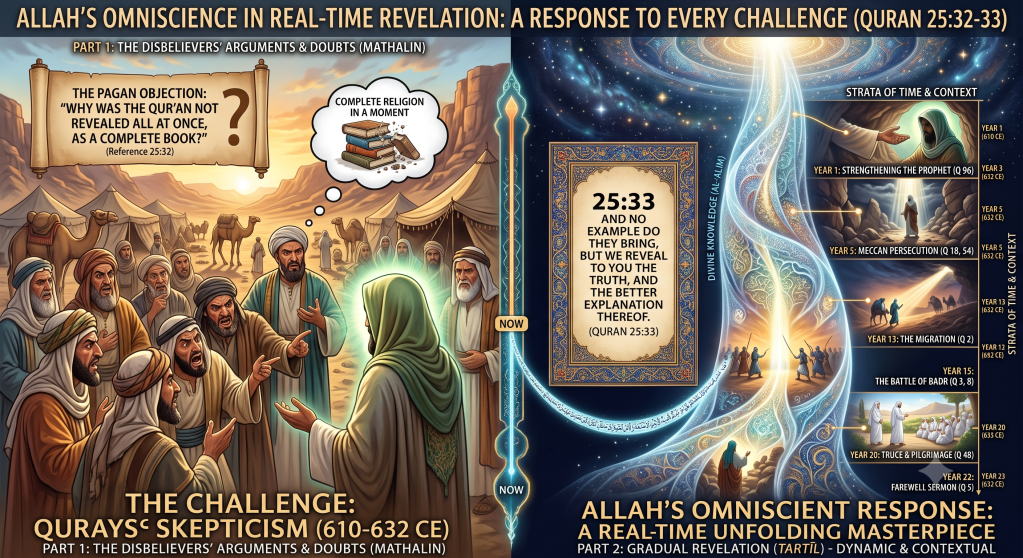
Presented by ChatGPT for Zia H Shah MD
Abstract
Qur’an 25:32–33 presents gradual revelation not as a deficiency but as one of the signs of the Qur’an’s living, providential character. The revelation did not descend as an inert volume detached from human experience. It entered history over approximately twenty-three years, strengthening the Prophet’s heart, forming a community, answering questions, correcting false assumptions, resolving disputes, and confronting objections as they arose. The passage therefore makes a remarkable claim: no analogy, criticism, argument, or intellectual challenge brought against the Prophet would be allowed to overturn the truth entrusted to him; God would provide al-ḥaqq—the truth—and aḥsana tafsīrā—the finest, clearest, and most adequate explanation.
This promise is intimately connected with the opening of Sūrah al-Furqān. Verses 1–2 identify the source of revelation as the universal Sovereign who created and measured everything; verses 4–5 record allegations that the Prophet fabricated the Qur’an with human assistance or copied ancient tales; and verse 6 answers that it was revealed by “the One who knows what is hidden in the heavens and the earth.” Verses 32–33 then show how that divine knowledge operates within time. From the human perspective the answers arrive “in real time,” but from the theological perspective God does not discover the answers when questions arise: eternal knowledge is disclosed at the appropriate historical moment.
The question concerning the rūḥ in 17:85 is an especially powerful illustration. The Qur’an neither invents an obsolete physical mechanism nor confuses neural function with the ultimate mystery of subjective existence. It establishes the rūḥ within God’s creative command and reminds humanity of the limits of its knowledge. Fourteen centuries later, neuroscience has made immense progress in identifying neural correlates of consciousness, yet no consensus explains why physical processing should produce subjective experience. The Qur’anic answer remains philosophically alive—not because it substitutes revelation for scientific investigation, but because it correctly locates the boundary between empirical description and ultimate ontology.
The central verses
Qur’an 25:32–33
وَقَالَ الَّذِينَ كَفَرُوا لَوْلَا نُزِّلَ عَلَيْهِ الْقُرْآنُ جُمْلَةً وَاحِدَةً ۚ كَذَٰلِكَ لِنُثَبِّتَ بِهِ فُؤَادَكَ ۖ وَرَتَّلْنَاهُ تَرْتِيلًا
وَلَا يَأْتُونَكَ بِمَثَلٍ إِلَّا جِئْنَاكَ بِالْحَقِّ وَأَحْسَنَ تَفْسِيرًا
A close translation reads:
“Those who disbelieve say, ‘Why was the Qur’an not sent down to him all at once?’ We have revealed it in this manner so that We may strengthen your heart with it, and We have arranged and recited it in a measured progression. They cannot bring you any argument without Our bringing you the truth and the finest explanation.”
The word mathal can mean an example, comparison, analogy, parable, proposed case, or apparently plausible argument. Here it encompasses the objections and counterexamples advanced to undermine the Prophet and his message. Al-Ṭabarī explains that whenever the opponents produced an argument, God supplied the truth by which their claim was invalidated, together with a clearer exposition. Ibn Kathīr similarly interprets mathal as arguments and doubts brought against the revelation, answered with something truer, clearer, and more eloquent. Al-Ṭabarī on 25:33, Ibn Kathīr on 25:32–33.
The opening of Sūrah al-Furqān
The first six verses provide the theological premises for the promise made in verses 32–33.
تَبَارَكَ الَّذِي نَزَّلَ الْفُرْقَانَ عَلَىٰ عَبْدِهِ لِيَكُونَ لِلْعَالَمِينَ نَذِيرًا
Blessed and exalted is He who sent down the Criterion upon His servant, so that he might warn all peoples.
الَّذِي لَهُ مُلْكُ السَّمَاوَاتِ وَالْأَرْضِ وَلَمْ يَتَّخِذْ وَلَدًا وَلَمْ يَكُن لَّهُ شَرِيكٌ فِي الْمُلْكِ وَخَلَقَ كُلَّ شَيْءٍ فَقَدَّرَهُ تَقْدِيرًا
He possesses the sovereignty of the heavens and earth. He has taken no son, has no partner in His sovereignty, and has created everything and determined it with precise measure.
وَاتَّخَذُوا مِن دُونِهِ آلِهَةً لَّا يَخْلُقُونَ شَيْئًا وَهُمْ يُخْلَقُونَ وَلَا يَمْلِكُونَ لِأَنفُسِهِمْ ضَرًّا وَلَا نَفْعًا وَلَا يَمْلِكُونَ مَوْتًا وَلَا حَيَاةً وَلَا نُشُورًا
Yet they have taken gods besides Him that create nothing and are themselves created; they control neither harm nor benefit for themselves, nor do they possess power over death, life, or resurrection.
وَقَالَ الَّذِينَ كَفَرُوا إِنْ هَٰذَا إِلَّا إِفْكٌ افْتَرَاهُ وَأَعَانَهُ عَلَيْهِ قَوْمٌ آخَرُونَ ۖ فَقَدْ جَاءُوا ظُلْمًا وَزُورًا
The disbelievers say, “This is only a falsehood he has fabricated, with the help of other people.” They have thereby committed injustice and spoken falsely.
وَقَالُوا أَسَاطِيرُ الْأَوَّلِينَ اكْتَتَبَهَا فَهِيَ تُمْلَىٰ عَلَيْهِ بُكْرَةً وَأَصِيلًا
They also say, “Ancient tales that he has had written down, which are dictated to him morning and evening.”
قُلْ أَنزَلَهُ الَّذِي يَعْلَمُ السِّرَّ فِي السَّمَاوَاتِ وَالْأَرْضِ ۚ إِنَّهُ كَانَ غَفُورًا رَّحِيمًا
Say, “It was sent down by the One who knows what is hidden in the heavens and the earth. He is ever forgiving and merciful.”
The architecture is deliberate:
| Opening claim | Objection | Answer developed in 25:32–33 |
|---|---|---|
| God sent down the Furqān, the Criterion | The Prophet fabricated it | Its source is the Knower of every hidden reality |
| God created and measured everything | The message is borrowed folklore | The One who orders reality also orders revelation |
| The warning is for all peoples | A human messenger cannot possess universal knowledge | His knowledge is received, not independently possessed |
| Others allegedly helped compose it | New challenges could expose its human origin | Every challenge receives truth and superior explanation |
| The Qur’an was supposedly dictated morning and evening | Why was it not delivered as one complete book? | Gradual disclosure is intentional, pedagogical, and providential |
Verse 1 calls the revelation al-Furqān, identifying its epistemic function: it distinguishes truth from falsehood. Verse 32 calls it al-Qur’ān, identifying its oral and performative form: it is recited, heard, remembered, and lived. Verse 33 speaks of tafsīr, identifying its explanatory power. It is simultaneously criterion, recitation, and clarification.
The ordering of creation and the ordering of revelation
A striking rhetorical correspondence joins verses 2 and 32:
وَخَلَقَ كُلَّ شَيْءٍ فَقَدَّرَهُ تَقْدِيرًا
“He created everything and determined it with precise determination.”
And:
وَرَتَّلْنَاهُ تَرْتِيلًا
“We arranged and recited it in measured progression.”
Both statements end with emphatic verbal nouns: taqdīrā and tartīlā. The God who measures being also measures meaning. The One who gives creation its proportion, sequence, relations, and laws gives revelation its order, timing, cadence, and rhetorical placement.
The Qur’an’s chronology is therefore not literary disorder. Its gradual descent is analogous—not identical—to providence in nature and history. A seed does not become a tree in one instant; a child is educated in stages; a moral community is formed through experience; and a question becomes teachable when it is actually encountered. Revelation came at the moment when its words could become memory, action, law, consolation, and communal identity.
The objection becomes its own refutation
The critics asked: If the Qur’an is divine, why did it not descend as a completed volume?
The answer is itself a demonstration of the wisdom of gradual revelation. Their new objection becomes the occasion for a new disclosure. The revelation answers why revelation is being given through answers.
There is a profound self-referential quality here. Verse 32 does not merely describe progressive revelation; it performs it. An objection arises in history, and a revelation arrives that:
- identifies the objection,
- exposes its unstated assumption,
- corrects that assumption,
- consoles the Prophet,
- educates the believers, and
- preserves the exchange for future generations.
The assumption behind the criticism was that a divine book must resemble a completed manuscript handed down all at once. The Qur’an rejects that premise. Divine communication need not imitate human publishing. It may instead accompany a messenger and a community through the unfolding drama of life.
“So that We may strengthen your heart”
The first purpose stated is not polemical victory but the strengthening of the Prophet’s heart.
لِنُثَبِّتَ بِهِ فُؤَادَكَ
The Qur’an was revealed amid ridicule, accusations, boycott, bereavement, persecution, migration, warfare, moral crises, and the enormous burden of forming a new community. Fresh revelation renewed the Prophet’s assurance that he had not been abandoned. It interpreted events before discouragement could define them.
The use of fu’ād, the heart as the center of deep perception and emotional consciousness, is important. Revelation addresses the whole human being. A logically sound proposition may still leave a suffering person without courage. The Qur’an combines argument with consolation, truth with presence, and doctrine with spiritual reinforcement.
Gradual revelation also strengthened the heart through repetition and recognition. Again and again, events unfolded in accordance with the moral patterns already disclosed: arrogance blinded, patience ripened, persecution failed to extinguish truth, and apparent weakness became spiritual strength. Revelation interpreted history while the Prophet was living it.
A claim of divine knowledge within historical time
Verse 33 is breathtaking in its openness:
“They cannot bring you any argument without Our bringing you the truth and the finest explanation.”
A merely human author would normally avoid such an unlimited public exposure. A scholar can answer within a discipline; a philosopher may defend a system under controlled assumptions; a ruler can silence critics; and an editor can revise a manuscript before publication. The Prophet, however, publicly recited revelations before friendly and hostile audiences without possessing a private research institution capable of preparing responses to every unexpected challenge.
From the standpoint of faith, this is omniscience expressed within history. Yet “real-time omniscience” needs theological precision. God does not wait for an objection, acquire new information, and then devise an answer. The questions are new to the human participants, not to God. Eternal knowledge is disclosed within temporal sequence at precisely the moment providence appoints.
Thus the Qur’an presents two levels simultaneously:
- Human history is genuinely unfolding through questions, decisions, and consequences.
- Divine knowledge comprehends the whole without surprise, confusion, or revision.
Gradual revelation is temporal in delivery but not provisional in its divine source.
What kind of mastery is being claimed?
The passage should not be reduced to the claim that the Qur’an contains every mathematical formula, medical detail, or future scientific discovery. Its claim is more foundational: no valid objection can overthrow its account of God, creation, revelation, moral responsibility, or humanity’s final destiny.
Its mastery operates at several levels.
Historical mastery
The Qur’an retrieves earlier prophetic histories and transforms them into arguments about perennial human behavior. Pharaoh is not presented merely as an Egyptian monarch but as the recurring political psychology of absolutism. The people of Noah, ʿĀd, Thamūd, Abraham, Lot, Moses, Mary, and Jesus become witnesses to patterns of revelation, pride, persecution, repentance, and judgment.
History becomes morally intelligible rather than merely chronological.
Philosophical mastery
The Qur’an addresses the central questions of existence:
- Why is there something rather than nothing?
- Is the universe self-explanatory?
- Can dependent beings constitute their own ultimate explanation?
- Is consciousness exhausted by material description?
- Are moral truths objective?
- Are human beings free and accountable?
- Does death end personal existence?
- Can the first creation rationally ground belief in resurrection?
It does not always answer in the vocabulary later used by Aristotle, Ibn Sīnā, al-Ghazālī, Kant, or contemporary analytic philosophy. It frequently goes beneath technical vocabulary to the assumptions on which entire philosophical systems depend.
Logical mastery
Many Qur’anic answers correct malformed questions. The critics reasoned:
- A messenger must be an angel.
- A prophet should possess treasure and gardens.
- A divine book must descend as one completed physical object.
- Human resurrection is impossible because bodies decay.
- Ancestral practice is evidence of truth.
- Material prosperity proves divine approval.
The Qur’an exposes the non sequitur in each inference. A messenger’s humanity makes him imitable; gradual revelation serves moral formation; the first creation makes recreation intelligible; inherited belief is not self-validating; and wealth is neither proof of virtue nor protection from accountability.
Rhetorical mastery
The Qur’an does not merely state correct conclusions. It selects the form most suited to the human condition: question, parable, oath, narrative, analogy, warning, consolation, legal ruling, cosmic sign, or concise aphorism. Aḥsana tafsīrā is not only a correct answer but the most illuminating placement and expression of that answer.
The question concerning the rūḥ
Qur’an 17:85
وَيَسْأَلُونَكَ عَنِ الرُّوحِ ۖ قُلِ الرُّوحُ مِنْ أَمْرِ رَبِّي وَمَا أُوتِيتُمْ مِنَ الْعِلْمِ إِلَّا قَلِيلًا
“They ask you about the Spirit. Say, ‘The Spirit belongs to the command and domain of my Lord, and you have been given only a little knowledge.’”
A report from Ibn Masʿūd preserved in Ṣaḥīḥ al-Bukhārī describes Jews asking the Prophet about the rūḥ. He remained silent rather than improvising, and then recited the revealed answer. Classical reports differ regarding the first immediate occasion of the verse, but the report powerfully illustrates the prophetic posture: he does not pretend to possess knowledge independently of revelation. Ṣaḥīḥ al-Bukhārī 4520.
Is rūḥ identical with consciousness?
The terms should not be treated as exact synonyms. Rūḥ has a wider Qur’anic range and can signify spirit, life-giving divine command, revelation, or—in other passages—Gabriel. Consciousness, in modern philosophy and neuroscience, usually refers to subjective experience: what it feels like to see color, suffer pain, remember, choose, or be aware of oneself.
Nevertheless, the question of the rūḥ overlaps profoundly with the problem of consciousness because both concern the interior reality that makes a living human being more than an externally described object.
Three dimensions of the answer
The answer in 17:85 accomplishes at least three things.
First, it affirms that the rūḥ is real. Human inwardness is not dismissed as an illusion or verbal confusion.
Second, it places the rūḥ within God’s amr—His command, governance, or creative domain. This does not mean that the human spirit is a fragment of God. Islamic theology maintains the Creator–creation distinction. The rūḥ is dependent upon God, brought into being and sustained by His command.
Third, it establishes epistemic humility. Human beings possess knowledge, but only a limited portion of reality is accessible to them. The verse does not say that research is futile. “You have been given only a little knowledge” recognizes genuine knowledge while denying its exhaustiveness.
Why the answer remains philosophically powerful
The verse does not offer a primitive anatomy of the soul that later science could falsify. It does not locate consciousness in the heart, blood, breath, pineal gland, electrical current, or any other temporary theoretical model. Instead, it answers at the level of ontology and epistemology:
- the phenomenon is real;
- it belongs to created reality under divine command;
- and its ultimate nature exceeds ordinary human mastery.
Modern neuroscience has identified extensive relationships between conscious states and brain activity. Brain injury, anesthesia, sleep, stimulation, and neurodegeneration demonstrate that our earthly conscious life is profoundly dependent on the brain. But correlation, dependence, and neural mechanism do not by themselves settle why there is subjective experience at all.
Contemporary consciousness research continues to contain multiple competing and sometimes incompatible theories. A major 2025 adversarial study directly tested Global Neuronal Workspace Theory and Integrated Information Theory, finding significant challenges for central predictions of both rather than a final resolution. Cogitate Consortium, Nature. Other researchers likewise observe that consensus among grand theories of consciousness remains elusive. Overgaard, Fazekas, and Wiese, Nature Reviews Psychology.
This does not scientifically prove a particular theology of the soul. It does, however, show that the Qur’an’s declaration of limited knowledge has not been rendered naïve by scientific progress. We know immensely more about the brain than seventh-century humanity knew, yet the explanatory gap between third-person neural activity and first-person experience remains.
The verse’s greatness lies partly in refusing a false performance of omniscience. The finest explanation is sometimes not an elaborate mechanism but a precise statement of what the questioner can and cannot presently know.
The historical environment and the human-authorship hypothesis
It is tempting to describe seventh-century Arabia simply as a land without literacy, books, scriptural contact, or intellectual culture. Historical accuracy requires greater nuance.
Arabia possessed inscriptions, poets, merchants, Jewish and Christian communities, and oral circulation of biblical and post-biblical traditions. The Qur’an itself presupposes an audience acquainted with at least some Abrahamic ideas. Arabia was not sealed off from Late Antiquity.
At the same time, there is no compelling evidence of a complete written Arabic Bible circulating in the Prophet’s Meccan environment before Islam. Sidney Griffith’s research argues that scriptural materials circulated orally among Arabic-speaking Jews and Christians, while surviving Arabic biblical translations belong principally to the Islamic period. Overview of Griffith’s The Bible in Arabic. Scholars therefore distinguish oral knowledge of biblical traditions from possession of a complete Arabic Bible or an accessible Arabic theological library.
Consequently, the strongest Islamic argument does not depend on portraying Arabia as intellectually empty. It is more careful and more impressive:
- The Prophet did not emerge from a documented scholarly institution.
- No identifiable library, curriculum, translation project, or group of specialist authors has been shown to account for the Qur’an.
- The revelation was delivered publicly and progressively rather than composed privately and repeatedly revised.
- It addressed changing political, ethical, legal, historical, and theological situations while maintaining a recognizable theological center.
- The accusations of secret collaborators were made by the Qur’an’s earliest opponents, but those opponents did not produce the alleged teachers or documentary sources capable of explaining the whole phenomenon.
Human-source theories may appeal to oral traditions, collective memory, or the wider Late Antique environment. Such factors can explain certain vocabulary and shared narratives, but intellectual environment is not the same as authorship. Influence does not by itself explain transformation, coherence, rhetoric, theological correction, or the Qur’an’s sustained ability to interpret events as they unfolded.
The argument for revelation is therefore cumulative and abductive: which explanation best accounts for the total phenomenon?
Not every question is answered on the questioner’s terms
Verse 33 does not promise to gratify every demand. The Qur’an distinguishes between sincere inquiry and evasive interrogation. Some questions are answered directly; others have their assumptions corrected; still others are refused because the demanded spectacle would not cure the underlying moral resistance.
The Qur’an answers questions about:
- the new moons and the measurement of time,
- lawful expenditure,
- warfare and sacred months,
- intoxicants and gambling,
- orphans,
- menstruation,
- lawful food,
- the spoils of war,
- the Hour,
- the mountains,
- Dhū al-Qarnayn,
- and the rūḥ.
But the quality of the answer is determined by truth, not by the questioner’s appetite. “The finest explanation” may provide a law, tell a story, expose a contradiction, redirect attention, or mark the limits of human knowledge.
This is another sign of mastery. An insecure claimant attempts to answer everything in excessive detail. The Qur’an sometimes answers with a single sentence because a concise answer can reveal that the original question was misconceived.
A theological reading of the Qur’anic challenge
Within Islamic theology, 25:32–33 rests on four divine attributes already proclaimed at the beginning of the sūrah.
Omniscience
God “knows what is hidden in the heavens and the earth.” Every objection, its psychological motive, its valid element, and its hidden fallacy are already encompassed by divine knowledge.
Wisdom
The answer is not merely correct but appropriately timed. Divine wisdom governs not only what is revealed but when, how, and in response to which human situation.
Providence
Revelation accompanies the Prophet. He is not abandoned to defend the message using his unaided resources. The divine promise joins intellectual guidance with personal support: “so that We may strengthen your heart.”
Mercy
Verse 6 concludes not with an assertion of intellectual domination but with forgiveness and mercy. The purpose of answering objections is not to humiliate opponents. It is to remove obstacles to recognition and open the possibility of repentance. Even those who accuse the Prophet of fraud are reminded that the One who knows their hidden motives is still forgiving and merciful.
The Qur’an as an inexhaustible criterion
The historical period of progressive revelation ended with the Prophet, but the function described in verse 33 continues. New philosophical vocabularies arise, scientific paradigms change, political systems develop, and moral controversies assume unfamiliar forms. The Qur’an does not receive new verses in response. Rather, its completed principles continue to generate insight when human beings bring new questions to it.
This continuing adequacy should not be confused with the infallibility of every commentator. The Qur’an is divine; tafsīr is human. Muslims may force temporary scientific theories into verses, confuse cultural customs with revelation, or offer poor answers to serious objections. Verse 33 is not a guarantee that every Muslim argument will be the “best explanation.” It is a summons to return repeatedly to the text, its language, its total worldview, and the unity of truth.
The confidence of the verse is therefore joined to an obligation: believers must not answer criticism with slogans, evasions, or intellectual hostility. If the Qur’an brings truth and the finest explanation, its interpreters should seek accuracy, intellectual charity, evidence, and moral dignity.
Thematic Epilogue: The Criterion descending into life
Sūrah al-Furqān begins above history—with the transcendent Sovereign who owns the heavens and earth, creates everything, and measures each thing with precision. It then descends into the noisy marketplace of history, where human beings accuse, ridicule, question, compare, and demand. The movement from verses 1–6 to verses 32–33 is therefore a movement from divine omniscience to divine speech within time.
The One who measures creation in verse 2 measures revelation in verse 32. The One who knows every hidden reality in verse 6 supplies the truth and finest explanation in verse 33. The opening declares the source; the later verses display the method.
The Qur’an’s grandeur lies not merely in possessing answers but in knowing the proper measure of an answer. It gives law where law is needed, narrative where history must awaken conscience, argument where reasoning has gone astray, consolation where the prophetic heart is wounded, and silence before mysteries that human categories cannot contain.
The question of the rūḥ is emblematic. Humanity asks for mastery over the very principle by which it asks questions. The Qur’an answers neither with mythology nor with premature mechanism. It affirms reality, locates it within the divine command, and teaches humility: human knowledge is real but small before the totality of existence. Fourteen centuries of investigation have greatly enlarged that “little,” yet consciousness remains a frontier on which empirical brilliance and metaphysical perplexity continue to meet.
Thus 25:32–33 is not merely a recollection of ancient debate. It is a declaration about the nature of revelation itself. The Qur’an enters history without becoming a prisoner of its century. It speaks to particular questions without exhausting its meaning in their immediate circumstances. It strengthens one prophetic heart while addressing the consciences of all humanity. And it presents itself as al-Furqān: the enduring Criterion by which arguments are tested, assumptions uncovered, falsehood separated from truth, and the finite human mind directed toward the All-Knowing source of reality.




Leave a comment