
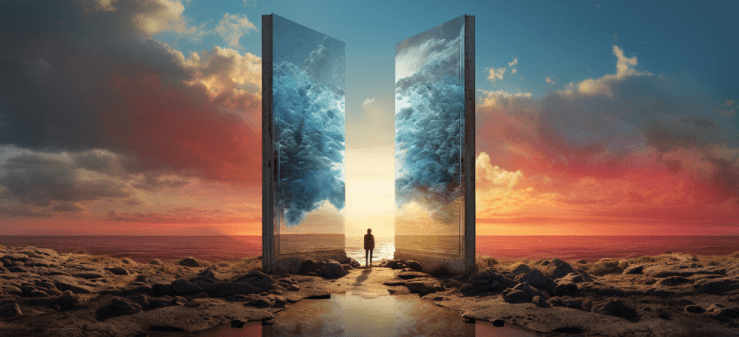
For those in search of truth rather than pride
Abstract
The Glorious Quran does not present the afterlife as a remote speculation or a mere inherited doctrine. It presents it as a living, intimate, and unavoidable truth, written into our very existence, our consciousness, our helplessness at death, and our return to Allah. The combined reading of Quran 2:28, 17:85, and 56:83–87 forms a majestic Quranic challenge to human pride. We were once lifeless, and Allah gave us life. We ask about the ruh, but Allah tells us that the ruh is from the command of our Lord and that we have been given only a little knowledge. Then, at the deathbed, when the soul reaches the throat and the watchers stand helplessly nearby, Allah asks humanity: if you are truly independent of divine authority and future judgment, then bring the soul back, if you are truthful.
This Quranic challenge remains unanswered. Modern neuroscience has made remarkable discoveries about the brain, perception, sleep, anesthesia, memory, coma, and behavior. Yet it remains very far from explaining the conscious self. It has not solved the mystery of first-person experience. It has not shown how matter becomes awareness. It has not produced a complete theory of consciousness. It has not reliably detected consciousness in all patients who outwardly appear unresponsive. It has not preserved an individual human self on another platform. It has not called back the departing soul at death.
For devout believers in the Quran, this is exactly as revelation teaches. The ruh is from the command of Allah, not from the command of man. Human knowledge is real, useful, and honorable when it bows before its Creator, but it is little. The Quranic challenge is therefore not merely an intellectual argument; it is a summons to humility, gratitude, repentance, and certainty. The One who gave us life the first time is fully able to give it again. The first creation is proof enough for the second creation. The soul’s departure is a reminder. The grave is not the end. The resurrection is the promise of Allah, and Allah never fails in His promise.
The Quranic Text
Quran 2:28
Arabic
كَيْفَ تَكْفُرُونَ بِٱللَّهِ وَكُنتُمْ أَمْوَٰتًا فَأَحْيَاكُمْ ۖ ثُمَّ يُمِيتُكُمْ ثُمَّ يُحْيِيكُمْ ثُمَّ إِلَيْهِ تُرْجَعُونَ
Six English translations
Pickthall: “How disbelieve ye in Allah when ye were dead and He gave life to you! Then He will give you death, then life again, and then unto Him ye will return.”
Yusuf Ali: “How can ye reject the faith in Allah?- seeing that ye were without life, and He gave you life; then will He cause you to die, and will again bring you to life; and again to Him will ye return.”
Shakir: “How do you deny Allah and you were dead and He gave you life? Again He will cause you to die and again bring you to life, then you shall be brought back to Him.”
Muhammad Sarwar: “How dare you deny the existence of God Who gave you life when you initially had no life. He will cause you to die and bring you to life again. Then you will return to His Presence.”
Mohsin Khan: “How can you disbelieve in Allah? Seeing that you were dead and He gave you life. Then He will give you death, then again will bring you to life (on the Day of Resurrection) and then unto Him you will return.”
Arberry: “How do you disbelieve in God, seeing you were dead and He gave you life, then He shall make you dead, then He shall give you life, then unto Him you shall be returned?”
This verse speaks to the human being with both tenderness and awe. It does not begin with abstract metaphysics. It begins with the forgotten miracle of our own existence. We were not. Then Allah brought us into being. We were lifeless, and He gave us life. Before we could think, He created the mind. Before we could love, He created the heart. Before we could ask questions, He gave us the consciousness by which questions become possible.
The Quran asks: how can you deny Allah after this?
The first creation is the sign. The second creation is the promise. Death is not a defeat of divine power; it is one stage in a sequence already declared by the Lord of the worlds: lifelessness, life, death, life again, and return to Him. The believer reads this verse and sees that resurrection is not strange. What is truly strange is that a creature who was once nothing should deny the One who made him something.
Quran 17:85
Arabic
وَيَسْـَٔلُونَكَ عَنِ ٱلرُّوحِ ۖ قُلِ ٱلرُّوحُ مِنْ أَمْرِ رَبِّى وَمَآ أُوتِيتُم مِّنَ ٱلْعِلْمِ إِلَّا قَلِيلًا
Six English translations
Pickthall: “They are asking thee concerning the Spirit. Say: The Spirit is by command of my Lord, and of knowledge ye have been vouchsafed but little.”
Yusuf Ali: “They ask thee concerning the Spirit (of inspiration). Say: ‘The Spirit (cometh) by command of my Lord: of knowledge it is only a little that is communicated to you, (O men!)’”
Shakir: “And they ask you about the soul. Say: The soul is one of the commands of my Lord, and you are not given aught of knowledge but a little.”
Muhammad Sarwar: “They ask you about the Spirit. Say, ‘The Spirit comes by the command of my Lord. You have been given very little knowledge.’”
Mohsin Khan: “And they ask you (O Muhammad SAW) concerning the Ruh (the Spirit); Say: ‘The Ruh (the Spirit): it is one of the things, the knowledge of which is only with my Lord. And of knowledge, you (mankind) have been given only a little.’”
Arberry: “They will question thee concerning the Spirit. Say: ‘The Spirit is of the bidding of my Lord. You have been given of knowledge nothing except a little.’”
Here the Quran opens a window into one of the deepest mysteries of existence: the ruh. We know that we are conscious. We know that we see, hear, remember, suffer, hope, love, pray, and fear. We know the inner light of awareness more directly than we know the stars, the oceans, or even our own bodies. Yet when asked about the ruh, Allah commands His Messenger to say: the ruh is from the command of my Lord, and you have been given only a little knowledge.
This verse is a mercy, because it saves us from arrogance. It does not forbid study. It does not condemn medicine. It does not ask believers to reject neuroscience. Rather, it places all human knowledge under the sovereignty of Allah. We may study neurons, synapses, sleep, anesthesia, brain injury, and perception. We may discover correlations between brain states and conscious states. We may learn how memory, language, and attention are affected by the brain. But the ruh itself is not ours to possess. It is not a manufactured object. It is not a machine part. It is not reducible to a diagram. It is from the command of Allah.
The believer therefore sees modern consciousness studies not as a threat to faith but as a confirmation of the Quranic warning: human knowledge is little. The deeper science goes, the more astonishing the mystery becomes. The more precisely the brain is mapped, the more urgent the question remains: who lit the lamp of awareness within matter? Who made the self? Who gave the “I” by which every scientific fact is known?
The Quran answers: the Lord.
Quran 56:83
Arabic
فَلَوْلَآ إِذَا بَلَغَتِ ٱلْحُلْقُومَ
Six English translations
Pickthall: “Why, then, when (the soul) cometh up to the throat (of the dying)”
Yusuf Ali: “Then why do ye not (intervene) when (the soul of the dying man) reaches the throat,-”
Shakir: “Why is it not then that when it (soul) comes up to the throat,”
Muhammad Sarwar: “Why can you not help a soul dying”
Mohsin Khan: “Then why do you not (intervene) when (the soul of a dying person) reaches the throat?”
Arberry: “Why, but when the soul leaps to the throat of the dying”
The Quran now brings the argument from the beginning of life to the end of life. It takes us to the deathbed. Every human being must one day arrive there. Kings and beggars, physicians and patients, saints and sinners, skeptics and believers—all must face the hour when the soul reaches the throat.
At that moment, wealth becomes silent. Status becomes useless. The body that once moved freely lies still. The tongue that argued, commanded, boasted, and laughed can no longer speak. The eyes may remain open, but the world is slipping away. The soul is departing by the decree of Allah.
This is not merely a biological event. It is a spiritual unveiling. The Quran places us beside the dying person so that we may learn before we ourselves are laid down.
Quran 56:84
Arabic
وَأَنتُمْ حِينَئِذٍ تَنظُرُونَ
Six English translations
Pickthall: “And ye are at that moment looking”
Yusuf Ali: “And ye the while (sit) looking on,-”
Shakir: “And you at that time look on–”
Muhammad Sarwar: “right before your very eyes?”
Mohsin Khan: “And you at the moment are looking on,”
Arberry: “and that hour you are watching”
The watchers are present. Family members may be weeping. Physicians may be working. Machines may be measuring. Hands may be held. Prayers may be whispered. Yet the watchers cannot command the soul.
The Quran’s phrase is devastating in its simplicity: “and you are at that moment looking.” You see, but you do not control. You witness, but you do not possess. You love the dying person, but you cannot hold the soul in the body. You may know the pulse, the oxygen level, the scan, and the lab values, but you do not own the mystery of life.
This is where human pride breaks. At the deathbed, every ideology becomes small. The Quran asks us to look honestly: if life were merely ours, if consciousness were merely a human possession, if the soul were under our command, why do we stand helpless when it departs?
Quran 56:85
Arabic
وَنَحْنُ أَقْرَبُ إِلَيْهِ مِنكُمْ وَلَـٰكِن لَّا تُبْصِرُونَ
Six English translations
Pickthall: “And We are nearer unto him than ye are, but ye see not -”
Yusuf Ali: “But We are nearer to him than ye, and yet see not,-”
Shakir: “And We are nearer to it than you, but you do not see–”
Muhammad Sarwar: “We are closer to him than you, but you cannot see.”
Mohsin Khan: “But We (i.e. Our angels who take the soul) are nearer to him than you, but you see not,”
Arberry: “(And We are nigher him than you, but you do not see Us)”
This verse brings comfort and trembling together. Allah is nearer to the dying person than the watchers are, but they do not see. The unseen is not absent. Divine nearness is not negated by human blindness. The room may appear to contain only bodies, machines, and grieving relatives, but the Quran tells us that another reality is present: the command of Allah, the nearness of Allah, the angels of Allah, and the transition of the soul from this world to the next.
For the believer, this verse transforms the deathbed. It is not a scene of abandonment. It is a scene of divine nearness. The dying person is not slipping into nothingness. He or she is moving from the visible world into the unseen realm of Allah’s decree.
The watchers do not see, but Allah sees. The watchers cannot hold, but Allah commands. The watchers do not know the full reality, but Allah knows.
Quran 56:86
Arabic
فَلَوْلَآ إِن كُنتُمْ غَيْرَ مَدِينِينَ
Six English translations
Pickthall: “Why then, if ye are not in bondage (unto Us),”
Yusuf Ali: “Then why do ye not,- If you are exempt from (future) account,-”
Shakir: “Then why is it not– if you are not held under authority–”
Muhammad Sarwar: “If you are true to your claim that there is no Day of Judgment,”
Mohsin Khan: “Then why do you not, if you are exempt from the reckoning and recompense (punishment, etc.)”
Arberry: “why, if you are not at Our disposal,”
Here the Quran confronts the claim of independence. If human beings are not under divine authority, if there is no reckoning, if there is no Day of Judgment, if life belongs only to matter and death ends everything, then let humanity prove its independence at the very moment when independence matters most.
This is the Quranic challenge. It is not shouted from a distance. It is spoken at the edge of the grave. It is addressed to human arrogance at the moment when human power is most exposed.
Quran 56:87
Arabic
تَرْجِعُونَهَآ إِن كُنتُمْ صَـٰدِقِينَ
Six English translations
Pickthall: “Do ye not force it back, if ye are truthful?”
Yusuf Ali: “Call back the soul, if ye are true (in the claim of independence)?”
Shakir: “That you send it (not) back– if you are truthful?”
Muhammad Sarwar: “why can you not bring it (the soul) back (to life)?”
Mohsin Khan: “Bring back the soul (to its body), if you are truthful?”
Arberry: “do you not bring back his soul, if you speak truly?”
This is among the most powerful challenges in the Quran: bring it back, if you are truthful.
Bring back the soul.
Not merely the heartbeat. Not merely the blood pressure. Not merely oxygenation. Not merely electrical activity. Not merely cellular function. Bring back the conscious self. Bring back the person who loved, remembered, worshiped, hoped, sinned, repented, and knew himself or herself as “I.”
This challenge remains unanswered. No science has returned the departing soul by command. No technology has seized the ruh. No theory has mastered the mystery of the conscious self. No machine has become sovereign over life and death.
The believer hears this verse and says: Subhan Allah. Glory be to Allah, Lord of life and death. We belong to Him. We return to Him. He created us the first time, and He will raise us the second time.
The Combined Quranic Challenge
When these verses are read together, they form a single luminous argument.
First, Quran 2:28 reminds us of our origin. We were lifeless, and Allah gave us life. The first creation has already happened. Therefore, resurrection is not impossible. It is the second act of the same divine power.
Second, Quran 17:85 reminds us of our limitation. The ruh is from the command of Allah, and human knowledge concerning it is little. Therefore, no human being should pretend to have mastered the essence of consciousness.
Third, Quran 56:83–87 brings us to the deathbed. When the soul reaches the throat and the watchers stand helplessly nearby, Allah challenges humanity to bring it back if they are truthful in denying divine authority and future reckoning.
The combined argument is not cold or abstract. It speaks to every person:
You did not create yourself.
You do not fully understand your own consciousness.
You cannot command your soul at death.
Therefore, humble yourself before the One who gave you life.
Trust the One who promises to give life again.
The Quranic challenge is thus a call to faith through self-knowledge. The human being is invited to look within and see a sign of Allah. Consciousness itself becomes a mirror. The soul becomes a witness. Death becomes a sermon. Resurrection becomes not an absurdity but the fulfillment of the first miracle of life.
Present Neuroscience Is Far from Meeting the Challenge
Modern neuroscience has studied the brain with astonishing skill. It has mapped neural pathways, studied memory, investigated attention, explored anesthesia, examined coma, and developed theories of consciousness. These achievements deserve gratitude, because all true knowledge is ultimately a gift from Allah.
But neuroscience has not met the Quranic challenge.
It has not explained why there is subjective experience at all. It can describe neural activity, but description is not the same as explaining why there is an inner life. It can measure brain signals, but measurement is not the same as creating the conscious self. It can identify correlations, but correlation is not command.
Contemporary consciousness science itself acknowledges the difficulty. Recent reviews continue to describe consciousness as one of the great scientific challenges of our age. The privacy of first-person experience, the limits of objective data, the lack of a complete theory, and the absence of universally reliable tests all show that the field is far from final mastery.
The 2025 Nature adversarial collaboration between leading theories of consciousness illustrates this limitation. Two major theories—Integrated Information Theory and Global Neuronal Workspace Theory—were tested using modern methods, including fMRI, MEG, and intracranial EEG. The findings supported some predictions but also substantially challenged central claims of both theories. In other words, even the best current theories remain incomplete.
Clinical medicine reveals the same humility. Some patients who appear outwardly unresponsive may still possess covert consciousness. They may be “there” inwardly, while unable to signal outwardly. This means that even detecting consciousness in living patients can remain uncertain. If science cannot always tell whether consciousness is present in a silent body, how can it claim mastery over the soul at death?
Brain emulation is even farther away. Current research has not fully recorded even an organism’s brain at the level required for complete causal reproduction of consciousness, let alone the human brain with its approximately 86 billion neurons. And even if a future machine could imitate speech, memories, or personality patterns, the Quranic question would still remain: has the individual conscious self truly been preserved, or has only a copy-like imitation been produced?
The Quranic challenge is not to build a chatbot. It is not to simulate personality. It is not to restart a heart under reversible medical conditions. It is to bring back the soul when it departs, if human beings are truthful in their claim of independence from Allah.
Present neuroscience is very far from this. In the conviction of devout believers in the Quran, it shall never meet this challenge in the ultimate sense, because the ruh is not a human possession. It is from the command of the Lord.
The Difference Between Bodily Function and Conscious Selfhood
Human beings have gained impressive knowledge of many bodily functions. We understand digestion in the stomach and intestines in great detail. We understand acid secretion, enzymes, absorption, hormones, and motility. We understand kidney function with remarkable precision: filtration, reabsorption, secretion, electrolyte balance, and waste removal. We can build cars, airplanes, laptops, phones, and complex machines.
But consciousness is not understood in that way.
A laptop can be assembled from parts. A car can be engineered from blueprints. Digestion can be described through chemistry and physiology. Kidney function can be modeled through filtration and transport mechanisms. These systems are complex, but they are not mysteries in the same way consciousness is.
Consciousness is the light by which all systems are known. It is the first-person reality of being someone. It is the “I” that experiences pain, joy, memory, love, worship, fear, guilt, repentance, and hope. The human being does not merely process information. The human being knows that he knows. He suffers. He longs. He prays. He stands before Allah inwardly even before he stands before Him outwardly on the Day of Judgment.
Until science can explain consciousness with the same complete mastery with which it explains digestion or kidney function—and until it can instantiate a specific individual human consciousness on another platform and return the departing soul at death—it has not answered the Quranic challenge.
For believers, that day will not come. Human beings may learn more about the brain, but they will not become lords of the ruh. They may build more powerful machines, but they will not become creators of souls. They may extend life by Allah’s permission, but they will not abolish death. They may observe the dying, but they will not command the return.
Allah says, “Bring it back, if you are truthful.” And humanity remains silent before the command of Allah.
Zia H Shah MD’s Consciousness Corpus
The consciousness collection at The Glorious Quran and Science deepens this Quranic argument by presenting consciousness as one of the clearest inward signs of Allah. Across many essays and reflections, Zia H Shah MD has emphasized that consciousness is not a trivial byproduct of matter but a profound sign pointing toward the Creator.
In his writings, consciousness is treated as the most intimate miracle. We can doubt many things, but we cannot doubt that we are aware. Awareness is the stage on which all knowledge appears. Every scientific theory, every philosophical argument, every denial, every prayer, every act of love, and every moral decision appears within consciousness. Therefore, consciousness is not a marginal puzzle. It is central to the human encounter with Allah.
One recurring theme in Shah’s work is that consciousness remains resistant to reduction. The brain can be mapped. Neural correlates can be discovered. But the inward reality of experience—the felt nature of pain, the redness of red, the sweetness of love, the ache of grief, the awe of prayer, the tremor of repentance—cannot be exhausted by third-person description. This resonates deeply with Quran 17:85: “The ruh is from the command of my Lord, and you have been given only a little knowledge.”
Another theme in Shah’s writings is that consciousness points toward a prior Mind. If the universe contains conscious beings, then consciousness should not be dismissed as an accidental spark in a meaningless cosmos. Rather, the conscious human self can be read as a sign of the supreme Conscious Creator. The finite mind points toward the infinite Mind. The created self points toward the Creator. The inward light of awareness points toward the One who is An-Nur, the Light of the heavens and the earth.
Shah’s reflections on sleep, death, anesthesia, and resurrection also enrich this argument. Sleep is a small daily sign. Each night consciousness is veiled; each morning it is restored by Allah’s mercy. Anesthesia gives another sign: awareness can disappear from worldly access and then return. Death is the greater departure, and resurrection is the greater awakening. The Quran trains the believer to see these rhythms not as accidents, but as signs.
Thus the Quranic challenge is strengthened by Shah’s consciousness corpus. Quran 2:28 gives the argument from first creation to second creation. Quran 17:85 gives the divine boundary of the ruh. Quran 56:83–87 gives the deathbed challenge. Shah’s writings help frame consciousness itself as an inward sign leading the sincere seeker back to Allah.
The Devotional Meaning of the Challenge
The Quranic challenge is not given so that we may merely win arguments. It is given so that hearts may awaken.
The question is not only, “Can science explain consciousness?” The deeper question is: “Will the conscious human being recognize his Lord?”
The question is not only, “Can medicine delay death?” The deeper question is: “Have I prepared for the moment when my soul reaches my throat?”
The question is not only, “Can technology imitate thought?” The deeper question is: “Have I used my own mind in gratitude to the One who gave it?”
The Quran does not humiliate human knowledge; it purifies it. It teaches knowledge to bow. It teaches the scientist to be humble, the philosopher to be reverent, the physician to remember Allah at the bedside, and the believer to see every breath as a trust.
When we read Quran 56:83–87, we should not only think of others dying. We should think of ourselves. One day my soul will reach the throat. One day others may stand around me looking. One day my body will no longer obey me. One day my possessions will remain behind. One day my record will come forward. One day I will know with certainty what I now believe by revelation.
At that moment, only Allah will matter.
Therefore, the Quranic challenge should lead to worship. It should lead to prayer before the final helplessness. It should lead to repentance before the soul reaches the throat. It should lead to gratitude for the first creation and certainty in the second creation.
Thematic Epilogue
The Quran places before us three mirrors.
The first mirror is our origin: we were lifeless, and Allah gave us life.
The second mirror is our consciousness: we possess an inward light that we did not create and cannot fully explain.
The third mirror is our death: the soul reaches the throat while human beings watch, unable to bring it back.
In these three mirrors, the believer sees the same truth: Allah is the Lord of life, the Lord of the soul, the Lord of death, and the Lord of resurrection.
Modern neuroscience may continue to study the brain, and whatever truth it discovers is part of Allah’s creation. But it remains very far from the Quranic challenge. It has not explained the conscious self. It has not mastered the ruh. It has not transferred the individual soul. It has not returned the departing self at death. And in the conviction of devout believers, it never will, because the ruh belongs to the command of Allah.
The Quranic challenge therefore stands like a mountain before human arrogance:
You were dead, and Allah gave you life.
He will cause you to die.
Then He will give you life again.
Then to Him you will return.
You ask about the ruh, but you have been given only a little knowledge.
When the soul reaches the throat, and you stand watching, Allah is nearer than you are, though you do not see.
If you deny the reckoning, then bring it back, if you are truthful.
But humanity cannot bring it back.
So let the heart submit before the final hour. Let the mind bow before the One who gave it light. Let the tongue say, before it is silenced: La ilaha illa Allah. There is no god but Allah.
The afterlife is not a myth added to life from outside. It is the completion of life’s deepest truth. The One who created us from nothing will raise us from death. The One who gave consciousness in the womb will restore consciousness in the resurrection. The One who knows the secret of the ruh will gather every soul for judgment.
The first creation is the proof.
The soul is the sign.
Death is the warning.
Resurrection is the promise.
And the promise of Allah is true.


Leave a Reply