
Presented by ChatGPT for Zia H Shah MD
Abstract
To men and women formed by Torah, and especially to those who have devoted years to the beit midrash, yeshiva, and kollel: Islam approaches you not as a people without revelation, but as a community whose patriarchs and prophets the Qur’an repeatedly honors. The Qur’an commands Muslims to affirm what was revealed to Abraham, Ishmael, Isaac, Jacob, Moses, Jesus, and the other prophets, declaring, in its own formulation, that believers should not accept one authentic messenger of God while repudiating another. Its invitation to Jews and Christians begins with what it calls a kalimatin sawāʾ—a “common word” or equitable ground: worship of the one God without partners.
This essay therefore offers something more modest, and intellectually more serious, than religious pressure: an invitation to encounter Islam and the Qur’an at first hand. It explains how Islam locates Muhammad within the Abrahamic prophetic succession; how the Qur’an itself appeals to the Torah and Gospel when making that claim; where Muslim readings of earlier scripture are genuinely disputed by Jewish and Christian interpreters; and why a Torah scholar, even while remaining critical, may find the Qur’an unusually recognizable as a Semitic, monotheistic, law-conscious scripture. The Qur’an itself says that theological discussion with the People of the Book should ordinarily be conducted “in the best manner” and grounds that courtesy in a remarkable proposition: “our God and your God is One.”
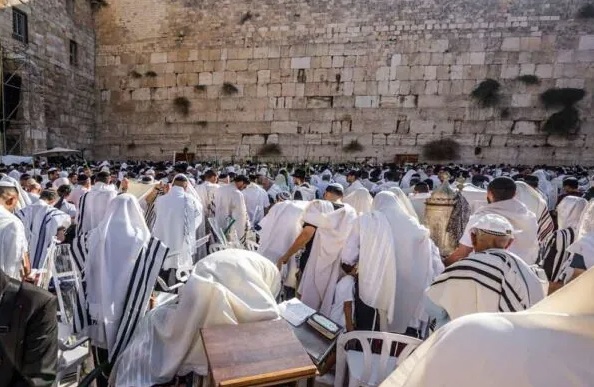
The scale of the potential scholarly encounter is extraordinary. The Israel Democracy Institute’s 2025 statistical yearbook reports that 169,366 Haredi men were enrolled in yeshivot and kollelim in 2023, an 83% rise from 2013; the figure is therefore a 2023 enrollment figure appearing in the 2025 yearbook, rather than a 2025 headcount. The Institute for Jewish Policy Research estimated in 2022 that about 2.1 million Haredi Jews lived worldwide, with Israel and the United States together accounting for about 92%; it estimated about 75,000 in the United Kingdom, 30,000 in Canada, and 12,000 in France.
The invitation proposed here does not promise wealth, employment, health, or automatic salvation in exchange for reading another religion’s scripture. Such promises would trivialize both Torah study and the Qur’an. What Islam can honestly place before a serious student is a theological claim to investigate: that the God of Abraham and Moses continued to address humanity; that Muhammad belongs to that prophetic history; and that sincere faith, righteousness, intellectual honesty, and accountability before God matter eternally. Qur’an 2:62 itself speaks of divine reward in connection with faith in God, the Last Day, and righteous action rather than material inducement.
The catastrophe endured by civilians in Gaza gives such an encounter additional moral urgency. As of September 9, 2026, an OCHA snapshot, attributing the figures to Gaza’s Ministry of Health, listed 73,669 reported Palestinian fatalities and 174,652 reported injuries; OCHA explicitly cautions that figures not independently verified by the UN are attributed to their originating authorities. The same document records more than 1,200 reported Israeli fatalities from October 7, 2023 and its immediate aftermath, with 1,162 identified fatalities including at least 33 children. Scriptural conversation worthy of Abraham cannot make one child’s death morally invisible because another child belongs to one’s own people.
Abraham, Israel’s Prophets, and the One God
The most natural doorway from Torah into the Qur’an is not Muhammad. It is Abraham.
Genesis presents Abraham as one chosen to teach his household “the way of GOD” by doing what is just and right. The Qur’an likewise makes Abraham—Ibrāhīm—a paradigmatic servant of the one God. Its argument in Qur’an 3:65–68 is chronological: Torah and Gospel appeared after Abraham, and therefore later communal labels cannot exhaust the identity of the patriarch who preceded both Sinai and Christianity. It characterizes him as an upright monotheist surrendered to God and makes following Abraham’s monotheism central to its own religious self-understanding.
That does not mean Judaism and Islam understand Abraham identically. Judaism knows Abraham through Torah, covenant, circumcision, Isaac, Jacob, and Israel; Islam incorporates those elements into a wider prophetic genealogy that also gives Ishmael a major role. What matters for genuine dialogue is not to conceal that difference but to recognize the striking common premise beneath it: Abraham’s God is one, transcendent, creator, judge, source of moral obligation, and the proper object of worship.
Here the Qur’an sounds particularly close to Jewish ears. Its invitation in 3:64 is neither an invitation to a pantheon nor to the divinization of Muhammad. It says, in substance: let the People of Scripture and Muslims meet upon the worship of God alone, associating nothing with Him and refusing to make creatures into divine lords. Zia H. Shah makes this the centerpiece of his recent writing on Judaism and Islam, describing tawḥīd and Jewish achdut Hashem as a theological point of exceptional closeness and describing Halakha and Sharia as two traditions in which revealed law penetrates ordinary life. That “twin faiths” formulation is Shah’s interpretive thesis, not a neutral scholarly classification, but it identifies a real subject worthy of comparative study.
The Qur’an goes still further in the way Muslims are instructed to speak about Israel’s prophets. Qur’an 2:136 tells them to affirm revelation given to Abraham, Ishmael, Isaac, Jacob and the tribes, to Moses and Jesus, and to the prophets from their Lord, adding that they are not to make a repudiating distinction among God’s genuine messengers. The theological principle is important: Islam does not ask a Muslim to become pious by despising Moses. Belief in Moses is part of Muslim belief.
Moses in particular occupies an immense place in the Qur’anic imagination. Shah’s comparative essay emphasizes how the Qur’an repeatedly retells Moses’ confrontation with Pharaoh, Israel’s deliverance, Sinai, law, rebellion, repentance, and dependence upon God, and treats Moses as a major paradigm of prophetic leadership. The stories are not identical to their Torah counterparts, and a rabbinic reader will immediately notice both convergences and differences. That is precisely why comparative reading is worthwhile.
A Muslim invitation to a Jew therefore ought not begin, “Forget Moses.” It should begin:
Bring Moses with you. Bring Abraham, Isaac, Jacob, Joseph, Aaron, David, Solomon, Jonah, Zechariah, and the entire discipline of studying sacred language. Then ask what kind of book the Qur’an becomes when it is read by someone who already knows what covenant, law, prophecy, repentance, exile, mercy, judgment, and the One God mean.
That is a question of study, not an instruction to abandon one’s conscience.
Muhammad and the Qur’an’s Claim of Prophetic Continuity
The Qur’an does not present Muhammad as the founder of an unrelated deity or as a divine being. Its self-presentation is that of a later revelation calling humanity back to the God already known through Abrahamic prophecy. Qur’an 29:46 tells Muslims to tell Jews and Christians that they believe in what was revealed to themselves and what was revealed to the People of the Book, because “our God and your God is One.”
That claim has several layers.
First is continuity of God: Muhammad’s God is claimed to be the God of Abraham rather than a new Arabian deity. Second is continuity of prophecy: Muhammad is placed after a sequence that includes Israelite prophets and Jesus. Third is continuity with scripture coupled with correction: the Qur’an repeatedly portrays itself as confirming divine truths given earlier while also adjudicating later disagreements. These are Islamic theological claims, of course; a Jewish reader is entitled to test rather than presuppose them.
Most strikingly, the Qur’an itself appeals to Jewish and Christian tradition as evidence. Qur’an 7:157 describes followers of the “unlettered Prophet” as finding his description in the Torah and Gospel in their possession. Qur’an 61:6 places on the lips of Jesus the statement that he confirms the Torah before him and announces a messenger to follow him called Aḥmad, a name linguistically related to Muḥammad. These are therefore not inventions of modern Muslim apologetics; the Qur’an itself explicitly places Muhammad’s prophetic claim in conversation with the Jewish and Christian scriptural worlds.
Muslim exegetes and polemicists subsequently searched earlier scriptures for passages they believed could illuminate those Qur’anic claims. Deuteronomy’s promise of a future prophet “like Moses,” for example, became part of Jewish-Muslim and later Christian-Muslim argument. The history of Jewish-Muslim polemics includes extensive contestation over biblical interpretation, textual authority, and prophecy; academic treatments emphasize precisely that these were arguments between communities, not agreed readings shared by Judaism and Islam.
That distinction is essential. A responsible Muslim argument should not tell a learned Jew that “your rabbis secretly know Deuteronomy predicts Muhammad,” nor tell a Christian that the meaning of a disputed text is beyond debate. Muslim interpretation may see corroboration; Jewish and Christian traditions generally read their scriptures through different canonical and exegetical frameworks. The honest question is therefore comparative:
Does Muhammad, considered as a historical prophetic claimant and judged by the theological criteria of monotheism, moral law, worship, revelation, and prophetic vocation, exhibit enough continuity with Abraham and Moses that his claim deserves serious examination?
The Qur’an itself proposes a method for examining it that is surprisingly congenial to textual scholarship: read, reason, compare, reflect, and look at the moral fruit of the teaching. In 29:46 it simultaneously makes a truth claim and places an ethical boundary on argument: dispute with the People of the Book in the best manner.
This combination matters. A claim about Muhammad does not become stronger by caricaturing Judaism.
Nor does Muhammad replace God. The Qur’an’s “common word” deliberately directs worship away from human beings and toward God alone. For a Jewish reader for whom uncompromising divine unity is non-negotiable, that is arguably the first proposition about Islam to examine.
An Invitation to the Beit Midrash Mind
There is a special reason to address students of yeshivot and kollelim—not because they are an easier population to persuade, but because they possess intellectual habits uniquely suited to serious comparative scripture.
According to the Israel Democracy Institute, Haredi post-secondary religious education distinguishes yeshiva study from kollel, the latter being a full-time advanced Torah framework principally for married men. The Institute recorded 169,366 yeshiva and kollel students in 2023, following an 83% increase over the preceding decade. Globally, JPR’s demographic work found a large and rapidly growing Haredi population concentrated overwhelmingly in Israel and the United States, with substantial communities in Britain, Canada, France, and elsewhere.
To someone who has spent thousands of hours over a daf, a serious Qur’anic encounter need not begin with a tract. It can begin with a text and a chavruta-style question.
Read Genesis alongside the Qur’anic Abraham narratives. Read Exodus beside the Qur’anic Moses cycle. Compare Shema-centered Jewish monotheism with Qur’anic tawḥīd. Compare mitzvah and halakhic intentionality with Qur’anic command and Islamic fiqh. Compare teshuvah with tawbah; tzedakah with ṣadaqah; fasting with ṣawm; ritual purity with ṭahārah; blessing before ordinary acts with Islamic dhikr and invocation. Some analogies will illuminate; others will break down. The intellectually interesting thing is precisely to discover where.
Shah’s “Twin Faiths” essay makes much of this structural resemblance: law governing food, prayer, bodily practice, commerce and family life; iconoclastic monotheism; ritual washing; sacred calendars; fasting; charity; and a religious ideal in which the divine command accompanies mundane life. His article also stresses the medieval Jewish-Muslim intellectual encounter, particularly Jewish thinkers writing in Arabic or Judeo-Arabic and engaging the philosophical world of Islam. Because Shah’s site is an explicitly Muslim interpretive project, its historical assertions should be checked against independent scholarship rather than treated as final authorities; even so, the topics he highlights are serious fields of historical inquiry. The site itself describes Shah as an Upstate New York physician and chief editor of The Muslim Times and says he has written more than 500 pieces on Islam, Christianity, secularism, and religion and science.
What, then, might a Torah scholar gain?
Not a guaranteed salary. Not a promise that Qur’an study will cure disease, solve family difficulties, or produce financial success. Sacred study deserves better than such inducements.
The worldly fruits are more defensible and potentially richer: the ability to understand the religious grammar of Muslim neighbors; direct access to a civilization that interacted for centuries with Jewish philosophy and scholarship; a new comparative lens on monotheism, law, prophecy, prayer, ethics, Arabic and Hebrew as cognate Semitic languages, and the ways revelation is interpreted across generations.
And on the matter of the afterlife, intellectual humility is especially necessary. The Qur’an certainly speaks in the language of eternal accountability and reward. Qur’an 2:62 says that believers, Jews, Christians, and Sabians who truly believe in God and the Last Day and do good have their reward with their Lord. Muslim exegetical traditions have debated how this and other salvation passages relate to Muhammad’s mission; Shah himself emphasizes the broader history of interpretive pluralism within Islamic commentary. It would therefore be presumptuous for an interfaith invitation to assign paradise or damnation to individual readers as though the inviter possessed God’s judgment.
A more faithful invitation is:
You who have trained yourselves not to skim a sacred page: grant the Qur’an the dignity of being read before it is judged. Read it in translation; where possible, place the Arabic beside Hebrew; consult classical and modern Muslim commentary; raise every objection that integrity demands; and distinguish what the Qur’an actually says from what politics, polemic, or hearsay says about it.
You do not honor Torah by fearing a book. And Muslims do not honor the Qur’an by asking another community to read it without questions.
There is a particularly suggestive principle in Qur’an 29:46: “what has been revealed to us and what was revealed to you” are mentioned in one breath, followed by “our God and your God is One.” A Torah scholar need not agree with that assertion in advance. But it is a proposition sufficiently important to deserve study.
Gaza and the Sanctity of Innocent Life
No contemporary invitation from Muslims to Jews can speak honestly about fraternity while treating Gaza as an abstraction. Nor can it appeal to Palestinian suffering by erasing the Israelis murdered on October 7, 2023. Scriptural morality fails whenever compassion becomes tribal.
The magnitude of Palestinian suffering is enormous. OCHA’s September 9, 2026 impact snapshot listed 73,669 reported Palestinian fatalities and 174,652 reported injuries in Gaza, attributing those figures to the Gaza Ministry of Health. Of 71,444 fatalities identified by the end of 2025, the source’s breakdown included 21,283 children and 10,983 women. OCHA expressly notes that casualty figures not yet independently verified by the UN are attributed to the authorities supplying them.
The suffering did not simply vanish with the ceasefire agreement announced in October 2025. OCHA’s September 18, 2026 situation report said civilians in Gaza continued to face life-threatening conditions amid extensive destruction, continuing strikes, shortages and restrictions. On September 16 a war-damaged residential building in Gaza City collapsed, reportedly killing 21 people, including 12 children; OCHA also cited Palestinian Civil Defence estimates that more than 8,000 people remained missing beneath rubble.
The same moral seriousness must encompass Israeli civilians. OCHA’s September 9 snapshot recorded more than 1,200 reported Israeli fatalities from October 7 and its immediate aftermath, including 1,162 identified fatalities and at least 33 children. The murder, kidnapping, terrorization, or deliberate targeting of civilians does not become righteous because the victims have a different nationality or religion.
For an Abrahamic religious conversation, this is not a political footnote. Genesis associates Abraham’s vocation with justice and righteousness. The Qur’an associates authentic religion with moral accountability and repeatedly places righteousness alongside belief. The shared question after Gaza is therefore more searching than “Which community can win the argument?”
It is:
What does belief in the God of Abraham demand when the life before us belongs to somebody else’s child?
A Muslim speaking to a Jew should not say, “You are responsible for Gaza because you are Jewish.” That would be both morally wrong and a form of collective blame. A Jew speaking to a Muslim should not identify every Palestinian with Hamas or every Muslim with terrorism. A Palestinian child is not Hamas. An Israeli child is not the Israeli cabinet. A synagogue is not a government ministry. A mosque is not an armed faction.
The Qur’an provides a useful discipline here even in theological disagreement: argue with the People of the Book “in the best manner” and remember the oneness of the God before whom both parties claim to stand. If that command means anything in 2026, it means that grief should enlarge moral vision rather than contract it.
There is also a special role for religious scholars. Torah and Qur’an are dangerous when they become reservoirs of quotations with which to acquit one’s own camp and condemn the other. They become morally serious when the reader permits revelation to judge himself. The real interfaith test is consequently not whether Jews can be induced to repeat Muslim slogans, or Muslims Jewish ones. It is whether both can stand before God without treating innocent blood as a statistic that matters only when it supports a political narrative.
A shared lament might therefore say:
God of Abraham, God who knows every mother and every child: let no Palestinian infant be reduced to collateral arithmetic; let no murdered Israeli be forgotten because acknowledgment complicates our argument. Break the habit by which we mourn selectively. Teach the descendants of Abraham that no victory purchased by the moral invisibility of children can be a complete victory.
That prayer does not resolve borders, security arrangements, settlements, armed groups, state power, refugee claims, sovereignty, or competing historical narratives. It does something more elementary: it refuses to let political disagreement abolish the human person.
Zia H. Shah’s Qur’anic Vision: Revelation, Reason, and the “Two Books”
The website the user highlighted, The Glorious Quran and Science, is a large and evolving collection rather than a single systematic book. Its “About” page describes it as Qur’anic commentary and a collection of articles mainly by Zia H. Shah, a physician in Upstate New York and chief editor of The Muslim Times, with more than 500 articles credited to him on Islam, Christianity, secularism, and religion and science. It would therefore be misleading to claim that one essay could incorporate literally everything he has written. What can be synthesized are the recurrent themes most relevant to Jewish-Muslim encounter.
Judaism and Islam as neighboring structures
Shah’s most direct thesis for this discussion appears in his January 2026 essay on Judaism and Islam as “twin faiths.” He emphasizes strict monotheism—tawḥīd and achdut Hashem—and what he calls their “nomocentric” structure: both traditions understand divine law as extending beyond formal worship into food, family, commerce, bodily discipline, charity and everyday conduct.
One need not accept the “twin” metaphor without qualification. There are profound differences concerning covenant, Israel, Muhammad, the Qur’an, the status of Torah, Jesus, supersession, religious law, eschatology and communal authority. But Shah is pointing toward a fruitful comparative hypothesis: Judaism may feel structurally nearer to Islam than many readers expect when comparison begins with God, law and embodied practice rather than simply with historical conflict. That is Shah’s interpretive argument, and it is a promising question for serious study.
The “common word”
In his February 2026 treatment of Qur’an 3:64–68, Shah makes the Qur’anic appeal to a “common word” the organizing principle of Abrahamic dialogue. He reads the passage as an invitation first to the shared sovereignty of the one God and then to debate the meaning of Abraham without pretending that later religious identities existed in Abraham’s own lifetime. The Qur’anic text itself supports the basic outline: worship God alone, associate nothing with Him, and recognize Abraham as preceding Torah and Gospel.
For a Jewish reader, this is perhaps Shah’s strongest point of entry. The initial Muslim question need not be, “Will you accept every proposition of Islamic theology this afternoon?” It can be: What follows if we begin together with the radical uniqueness of God?
Nature as another field of divine signs
A second major strand of Shah’s project is what he calls harmony between revelation and the study of nature. His 2026 synthesis describes his outlook as welcoming modern cosmology, fine-tuning discussions, evolutionary science, and neuroscience into Qur’anic reflection while warning against crude “scientific miracle” apologetics in which every modern discovery is retrospectively forced into a verse.
That caution is valuable. Science cannot honestly be used as a collection of proof-texts for whichever scripture one already accepts. Scientific conclusions remain open to empirical revision, whereas theological claims operate in a different register. Shah’s more interesting proposition is philosophical: that nature and revelation can be approached as two bodies of evidence about a single reality rather than as enemies. His site’s current catalogue reflects sustained attention to cosmology, fine-tuning, evolution, consciousness, biology, mathematics, time and the philosophy of divine purpose.
That offers another bridge to a Torah scholar. A religious person does not cease asking empirical questions because he believes in a Creator. Nor should a scientist cease distinguishing data from theological interpretation. The conversation becomes richer when both disciplines retain their integrity.
Interpretation rather than slogan
Shah has also explicitly written about interpretive pluralism in Qur’anic history, observing that Muslim commentators have approached the text through linguistic, legal, theological, mystical, philosophical and, more recently, scientific lenses. For a student accustomed to Mishnah, Gemara, Rashi, Tosafot, Rambam and successive layers of commentary, that fact is especially relevant.
The Qur’an is not equivalent to Talmud, and tafsīr is not the same institution as rabbinic commentary. Yet there is a recognizable scholarly phenomenon on both sides: a foundational text generates centuries of disciplined interpretation, disagreement, reconciliation and renewed application. Shah’s own scientific hermeneutic is one contemporary example, not the sole Islamic reading.
That is another reason an encounter with Islam should not consist merely of isolated verses copied from the internet. A yeshiva-trained reader would rightly object if someone reduced Judaism to ten translated sentences detached from rabbinic interpretation. The Qur’an deserves the corresponding courtesy: text, language, context, commentary and competing readings.
Epilogue: From the House of Study to a Common Word
Imagine—not a conversion rally, not a political debate, not an attempt to make Jews cease being recognizably Jewish—but two tables in a house of study.
At one table lies the Torah.
At the other lies the Qur’an.
The student begins with Abraham.
He discovers that the second book does not mock Abraham but claims him; does not dismiss Isaac or Jacob; does not order Muslims to disbelieve Moses; and does not permit Muhammad to become an object of worship. Instead it says that believers are to affirm Abraham, Ishmael, Isaac, Jacob, Moses and the prophets, and it summons the People of Scripture to a common word: God alone.
He then reaches the disputed point. The Qur’an says Muhammad belongs to that same succession and even claims that signs of his mission are connected with Torah and Gospel. The Jewish student is not required to pretend that Judaism already agrees. He opens the texts. He asks what Muslims mean. He asks what Jewish exegetes mean. He distinguishes a Qur’anic claim from a historical demonstration. He challenges weak arguments and takes strong ones seriously.
That is genuine study.
Then the voices of Gaza intrude upon the room: tens of thousands of reported Palestinian dead, thousands still missing, children among them; and behind the beginning of the catastrophe, Israeli families shattered by murder and kidnapping on October 7. The question of revelation suddenly ceases to be merely antiquarian. Abraham’s God, if He is truly God, must also be God when the dead child speaks Arabic, Hebrew, or no words at all.
Perhaps that is where the deepest invitation should begin.
Not:
“Join my people against yours.”
But:
“Come, let us discover what obedience to the One God requires of both of us.”
To the yeshiva student who has learned patience before a difficult page: bring that patience to the Qur’an.
To the kollel scholar accustomed to pursuing an argument until midnight: examine Muhammad’s claim with the same refusal of superficiality.
To the Muslim who offers the Qur’an: first learn enough Torah and Jewish history to speak without caricature.
To both: refuse the cheap pleasure of making the other ridiculous.
Zia H. Shah’s most productive recurring intuition is that Judaism and Islam possess enough theological and legal resemblance to make serious encounter possible without pretending their differences are small; his “common word” emphasis places that encounter under the sovereignty of the one God, while his Qur’an-and-science writings argue that faith need not fear disciplined investigation. Those themes are best treated not as proofs that end inquiry, but as reasons to begin it.
And the Qur’an itself gives perhaps the most fitting rule for the meeting: when speaking with the People of the Book, speak in the best manner and remember, even amid disagreement, the claim at the heart of the conversation—“our God and your God is One.”
For the person who believes revelation is possible, there can hardly be a more consequential question than whether God has spoken. For the person who has spent his life studying Torah, there can hardly be a more intellectually honorable response to another scripture claiming the God of Abraham and Moses than to read it carefully enough to know what he is accepting or rejecting.
The invitation, then, is not to credulity.
It is to study.
Not to material promises.
It is to truth.
Not to forget the covenantal history that formed you.
It is to ask whether the God whom Abraham sought may confront the human being beyond the boundaries within which he first learned God’s name.
And after Gaza, the study has one final test: whether more knowledge of God makes us more capable of recognizing His image-bearing, morally inviolable human creatures across the line of tribe, nation and inherited grievance.
Open the texts. Ask the difficult questions. Let neither fear nor hatred do the reading for you.



Leave a Reply