
Epigraph
أَلَمْ تَرَ أَنَّ اللَّهَ سَخَّرَ لَكُم مَّا فِي الْأَرْضِ وَالْفُلْكَ تَجْرِي فِي الْبَحْرِ بِأَمْرِهِ وَيُمْسِكُ السَّمَاءَ أَن تَقَعَ عَلَى الْأَرْضِ إِلَّا بِإِذْنِهِ ۗ إِنَّ اللَّهَ بِالنَّاسِ لَرَءُوفٌ رَّحِيمٌ
Al Quran 22:65
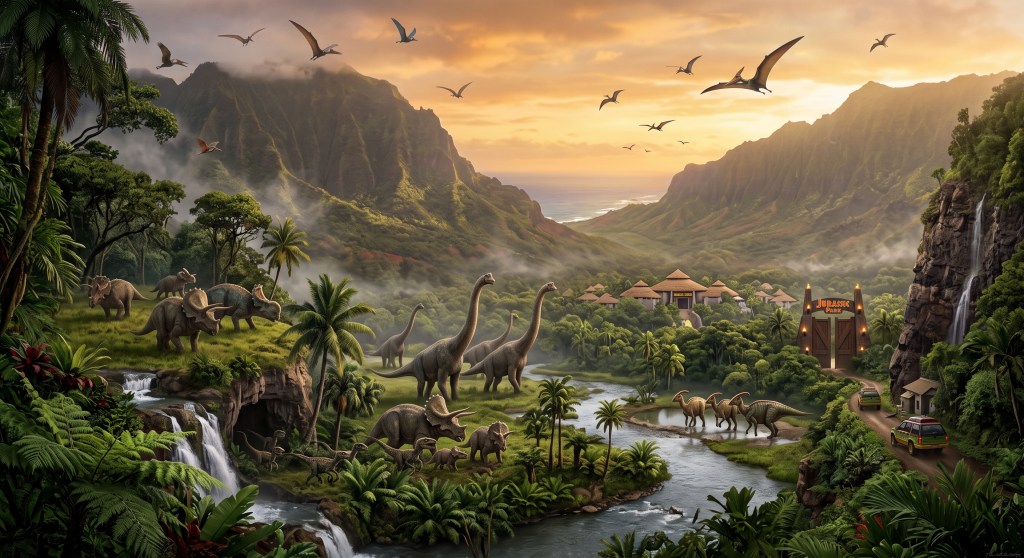
Presented by Claude for Zia H Shah MD
Abstract
This commentary examines Qur’an 22:65 (Sūrat al-Ḥajj), which declares that God “holds back the sky from falling upon the earth except by His permission” and closes with the affirmation that “Indeed Allah, to mankind, is Kind (Raʾūf) and Merciful (Raḥīm).” Reading the verse through classical exegesis (al-Ṭabarī, al-Qurṭubī, al-Rāzī, al-Zamakhshari, al-Bayḍāwī, Ibn Kathīr, Ibn ʿĀshūr), contemporary tafsīr (Yusuf Ali, Maududi, Sayyid Qutb, Muhammad Asad), and modern planetary science, it argues that the verse’s imagery of a protected sky acquires new depth in light of what we now know about Earth’s defenses against cosmic bombardment: atmospheric ablation, the magnetosphere, the Moon, and the ambiguous but real gravitational role of Jupiter and orbital dynamics. The verse’s crucial qualifier — “except by His permission” (illā bi-idhnihi) — is read as reframing the Chicxulub impact of ~66 million years ago, which ended the age of non-avian dinosaurs and cleared ecological space for the mammalian and ultimately primate radiation. The commentary develops a theology of “dual providence”: God’s ongoing mercy in shielding earthly life from the sky’s “fall,” and the singular, permitted “fall” that itself proved providential for the emergence of humanity — a reading that makes the verse’s closing names, Raʾūf and Raḥīm, addressed specifically “to mankind” (bi-l-nās), exquisitely fitting. Throughout, the aim is illumination rather than concordism: the science adds a horizon of meaning to the verse, not proof that the verse “predicted” the science.
The Arabic Text of Qur’an 22:65
أَلَمْ تَرَ أَنَّ ٱللَّهَ سَخَّرَ لَكُم مَّا فِى ٱلْأَرْضِ وَٱلْفُلْكَ تَجْرِى فِى ٱلْبَحْرِ بِأَمْرِهِۦ وَيُمْسِكُ ٱلسَّمَآءَ أَن تَقَعَ عَلَى ٱلْأَرْضِ إِلَّا بِإِذْنِهِۦٓ ۗ إِنَّ ٱللَّهَ بِٱلنَّاسِ لَرَءُوفٌ رَّحِيمٌ
Transliteration: Alam tara annal-lāha sakhkhara lakum mā fī l-arḍi wa-l-fulka tajrī fī l-baḥri bi-amrih; wa yumsiku s-samāʾa an taqaʿa ʿalā l-arḍi illā bi-idhnih; inna l-lāha bi-n-nāsi la-Raʾūfun Raḥīm.
Six English Translations
- Sahih International: “Do you not see that Allah has subjected to you whatever is on the earth and the ships which run through the sea by His command? And He restrains the sky from falling upon the earth, unless by His permission. Indeed Allah, to the people, is Kind and Merciful.” myislam
- Yusuf Ali: “Seest thou not that Allah has made subject to you (men) all that is on the earth, and the ships that sail through the sea by His Command? He withholds the sky (rain) from failing on the earth except by His leave: for Allah is Most Kind and Most Merciful to man.” Islam Awakenedmyislam
- Pickthall: “Hast thou not seen how Allah hath made all that is in the earth subservient unto you? And the ship runneth upon the sea by His command, and He holdeth back the heaven from falling on the earth unless by His leave. Lo! Allah is, for mankind, Full of Pity, Merciful.” Islam Awakenedmyislam
- Muhammad Asad: “Art thou not aware that it is God who has made subservient to you all that is on earth, and the ships that sail through the sea at His behest — and [that it is He who] holds the celestial bodies [in their orbits], so that they may not fall upon the earth save by His leave? Verily, God is most compassionate towards men, a dispenser of grace.”
- Abdel Haleem: “[Prophet], do you not see that God has subjected everything on the earth to you, and the ships that sail the sea at His command? He keeps the heavens from falling down on the earth except by His leave: God is most compassionate and most merciful to mankind.”
- Dr. Mustafa Khattab (The Clear Quran): “Do you not see that Allah has subjected to you whatever is in the earth as well as the ships ˹that˺ sail through the sea by His command? He keeps the sky from falling down on the earth except by His permission. Surely Allah is Ever Gracious and Most Merciful to humanity.” Quora
Commentary of the Classical Exegetes
The classical commentators approach 22:65 as one of a chain of divine “signs” (āyāt) enumerated in Sūrat al-Ḥajj 22:63–66: the sending of rain that revives dead earth, the subjugation (taskhīr) of all that is on the earth and the ships upon the sea, the holding of the sky, and the giving of life and death. The verse thus sits within a rhetoric of gratitude: God recounts His blessings so that man may recognize the Giver.
Al-Ṭabarī (d. 923), in Jāmiʿ al-Bayān, glosses the phrase directly: God “holds the sky by His power (bi-qudratihi) lest it fall upon the earth, except by His permission.” He treats the verse as a proof-text elsewhere for the meaning of “protected” (maḥfūẓ) in 21:32 — the sky is safeguarded by God so that it neither collapses nor dissipates. Quran
Al-Qurṭubī (d. 1273), the Andalusian Mālikī and Ashʿarī, records the grammatical debate over an taqaʿa (“that it fall”): the Basran grammarians read it as karāhiyata an taqaʿa (“out of aversion that it should fall”), while the Kufans read li-allā taqaʿa (“so that it does not fall”). Most strikingly, al-Qurṭubī offers a distinctly Ashʿarite, occasionalist gloss on how God holds the heaven: “wa imsākuhu lahā khalqu al-sukūni fīhā ḥālan baʿda ḥāl” — “His holding it is His creating stillness within it, state after state.” The sky’s immobility is not an inert property but a continuously re-created condition. On “except by His permission,” al-Qurṭubī reads a permitted actual fall: “except by God’s permission for it to fall — so it would fall by His permission, that is, by His will.” And the closing names, he says, describe God as kind and merciful to mankind “in these things which He has subjected for them.” Quran + 5
Fakhr al-Dīn al-Rāzī (d. 1210), in his Mafātīḥ al-Ghayb (al-Tafsīr al-Kabīr), situates the verse within a cluster of proofs of divine power and grace. He reasons that the preceding blessings are “not complete except by this one”: since the heaven (the dwelling of the angels) must be solid and heavy, and whatever is heavy must by nature fall unless a preventer prevents it, the sky’s suspension is itself a standing miracle of divine restraint — “an argument built upon what appears to common perception.” Al-Rāzī likewise carries the Basran/Kufan grammatical readings, glossing that God held the sky “lest it fall and the blessings He bestowed be nullified.” AlhesnAlhesn
Al-Zamakhsharī (d. 1144), in al-Kashshāf, supplies the rhetorical and grammatical framing on which later exegetes drew — reading an taqaʿa as karāhata or makhāfata an taqaʿa (“for fear that it fall”) and attending to the eloquence (balāgha) of the closing divine names. Al-Bayḍāwī (d. c. 1319), whose Anwār al-Tanzīl is an abridgment of al-Kashshāf (for grammar) and al-Rāzī (for theology), mirrors this line: yumsiku = He restrains/prevents; an taqaʿa = lest it fall; illā bi-idhnihi = except by His will.
Ibn Kathīr (d. 1373) gives the most homiletically vivid reading, and the one most directly relevant to our theme. Commenting on “He withholds the heaven from falling on the earth except by His leave,” he writes: “If He willed, He could give the sky permission to fall on the earth, and whoever is in it would be killed, but by His kindness, mercy and power (bi-luṭfihi wa raḥmatihi wa qudratihi), He withholds the heaven from falling on the earth, except by His leave.” On the closing clause, “Indeed Allah, to mankind, is Kind and Merciful,” Ibn Kathīr adds the arresting nuance that this mercy is extended to human beings “even though they do wrong (maʿa ẓulmihim),” cross-referencing 13:6 (“your Lord is full of forgiveness for mankind in spite of their wrongdoing”). The possibility of the sky’s fall is thus real and ever-present; its restraint is a continuous act of mercy toward a creation that has not earned it. Islam-QA +2 + 2
Ibn ʿĀshūr (d. 1973), in al-Taḥrīr wa-l-Tanwīr, offers the richest philological and theological treatment. He notes that imsāk (holding) primarily means “binding firmly,” the opposite of “casting down,” and here carries the connotation of prevention (manʿ) — the same verb used in 35:41 of God holding the heavens and earth “lest they cease.” He explains the coupling of “holding the sky” with the subjugation of earth and sea: the immense celestial bodies would by their very magnitude crush earthly things “were it not for the laws and systems (sunan wa-nuẓum) God ordained, preventing them from overpowering one another,” citing 36:40 (“neither may the sun overtake the moon…”). This is a striking natural-law reading rather than a picture of physical pillars. Ibn ʿĀshūr lists three admissible senses of “the sky” (al-samāʾ): (1) everything above the earth — all celestial worlds, whose “falling” would be a cosmic collapse, so that the verse is a grace of preserving human life; (2) rain (a known Arabic sense of al-samāʾ), so that God apportions rainfall lest continuous downpour harm people; and (3) everything the sky contains — meteors, hail, thunderbolts, falling stars — which God restrains from striking the earth except by His leave. He judges the third “the most comprehensive and concise, hence most fitting to the Qur’an’s inimitability (iʿjāz).” Great Tafsirs + 6
Crucially, Ibn ʿĀshūr confronts the exegetical difficulty of “except by His permission.” Some had resolved it by saying it means “except on the Day of Resurrection, when God will permit the sky to fall.” He rejects this, observing that the traditions do not report the sky’s falling on the Last Day, only its splitting and cleaving (tashaqquq, infiṭār). He therefore prefers to read illā bi-idhnihi as an iḥtirās — a rhetorical guarding qualification that fuses blessing (imtinān) with warning (takhwīf): God restrains celestial things in all their states, except for a fall attended by His permission, so that human beings remain both grateful and in awe. On idhn (“permission”), he notes that its literal sense is a command, “borrowed here to mean God’s will and creative act (mashīʾa wa-takwīn).” And on the closing names, Ibn ʿĀshūr distinguishes them precisely: Raʾūf (an intensive form) denotes the averting of harm, while Raḥīm denotes the bringing of benefit to the needy; their pairing conveys both what is distinctive to each and what they share. The clause functions as the rationale (taʿlīl) for the whole enumeration of blessings — “because in all of it there is compassion (raʾfa) toward mankind by facilitating their benefits, which entails warding off harm from them.” greattafsirs + 4
Commentary of Contemporary Exegetes and Thinkers
Abdullah Yusuf Ali (d. 1953), in his famous notes, observes that the word samāʾ (“sky/heaven”) can mean the canopy of heaven, something lofty, or a roof, and that the verse conveys how “the Good in God’s world is guarded and protected” — a theme he links to the imagery of the heavens as beauty and power. His parenthetical “(rain)” reflects one classical option (al-samāʾ as rain), though the broader sense of the celestial canopy is also in view. Guidance of Allah
Sayyid Abul Aʿlā Maududi (d. 1979), in Tafhīm al-Qurʾān, glosses “heaven” as signifying “the whole celestial sphere, every part of which is held in its proper place solely by the Will and Power of God.” He reads the verse as an argument from cosmic order: the universe does not sustain itself; its stability is a continuous expression of divine governance, so that man ought to recognize his utter dependence. Islamic Studies
Sayyid Quṭb (d. 1966), in Fī Ẓilāl al-Qurʾān (“In the Shade of the Qur’an”), reads the passage as an invitation to contemplate the seamless web of divine care that surrounds human life — the subjugated earth, the sailing ships, the suspended sky — all held in a delicate order that testifies to a purposeful, merciful Hand. The believer, moving through a cosmos “in the shade” of God’s names, sees in the ordinary stability of the heavens a standing sign of grace.
Muhammad Asad (d. 1992), in The Message of the Qurʾan, renders the phrase as God holding “the celestial bodies [in their orbits], so that they may not fall upon the earth save by His leave.” Asad’s note connects the verse to the modern understanding of gravitation and orbital mechanics: what keeps the heavenly bodies from crashing into one another and onto the earth is the finely balanced system of forces that God has established. This is representative of a broad school of modern scientifically-minded commentators (including writers such as Zia H. Shah, whose essays on The Glorious Quran and Science explicitly read 22:65 alongside atmospheric and astronomical science) who caution against claiming the verse “predicted” gravity, while affirming that it is fittingly read in light of what we now know.
The Philosophical Horizon: Occasionalism, Secondary Causes, and Divine Sustenance
Al-Qurṭubī’s gloss — that God’s “holding” of the sky is His “creating stillness within it, state after state” — opens directly onto one of the central debates of Islamic theology (kalām): how exactly does God uphold the cosmos? The dominant Ashʿarī position, systematized by Abū al-Ḥasan al-Ashʿarī (d. 936) and given its most famous defense by al-Ghazālī (d. 1111) in the Tahāfut al-Falāsifa, is occasionalism: created things possess no independent causal power; what we call “laws of nature” are the dependable ʿāda (habit) or sunna of God, who re-creates the accidents of the world at every instant. On this view, the sky does not “stay up” by an inertial property it owns; it is held, moment by moment, by the direct creative act of God. Remove that sustaining will for an instant, and it lapses. As the Stanford Encyclopedia of Philosophy summarizes al-Ashʿarī’s thought, “God rearranges the atoms that make up this world anew at every instant,” so that the world “is in a constant state of recreation by God.”
The Māturīdī school, following Abū Manṣūr al-Māturīdī (d. 944), affirms with the Ashʿarīs that God is the ultimate cause of all things and that nothing occurs without His will, but tends to grant the reality of the created natural order more explanatory weight: God has endowed things with genuine properties through which effects customarily occur, yet those properties have “no efficacy independent of His sustaining power” — secondary causes as instruments, not autonomous agents. Even Fakhr al-Dīn al-Rāzī, straddling theology and philosophy, developed a nuanced account in which natural regularities are real but wholly dependent. Modern scholarship (e.g., Frank Griffel) has argued that al-Ghazālī himself may have left room for genuine secondary causality operating entirely within God’s sustaining act.
This debate matters for reading 22:65 because the qualifier illā bi-idhnihi — “except by His permission” — is precisely the hinge between primary and secondary causation. The divine idhn, as Ibn ʿĀshūr noted, is God’s creative will (mashīʾa wa-takwīn). Whether the sky’s remaining aloft is a continuous divine re-creation (occasionalism) or the operation of God-given natural forces (secondary causation), in either case the outcome is one and the same: nothing in the heavens — neither their stability nor their occasional “fall” — occurs outside the compass of divine permission. The verse is theologically ecumenical: it affirms total dependence without dictating a single metaphysics of causation. It is worth adding that “energy is conserved” and “Allah sustains creation” are not rival answers but operate at different explanatory levels; an occasionalist can embrace conservation laws wholeheartedly, since mathematical regularity simply describes the dependable pattern of divine action. When a meteor is incinerated in the upper atmosphere, or when, once in tens of millions of years, a mountain-sized asteroid is permitted to strike, both the shielding and the striking fall under the same idhn.
The Theology of the Divine Names Raʾūf and Raḥīm
The verse closes with two of the ninety-nine names, and their pairing is not accidental. Both derive from roots of mercy, yet the tradition distinguishes them. Al-Ghazālī observes that al-Raʾūf is “the One who has pity (on others), and pity is the intensification of mercy,” so that it “has the same meaning as raḥīm though in an intensified form.” Scholars refine the distinction: al-Raḥīm (from raḥma) is the mercy that responds to need and confers benefit — including, on one classical reading, the special mercy reserved for believers — while al-Raʾūf (from raʾfa) is the compassion so far-reaching that, as one traditional formulation puts it, “his mercy extends before the calamity hits, and involves him taking care of you and warning you so that a calamity does not hit.” Ibn ʿĀshūr’s formulation is the sharpest: Raʾūf is the averting of harm; Raḥīm is the bringing of benefit.
Read against the meaning of the verse, the two names map onto the two faces of divine providence with remarkable precision. Al-Raʾūf — the One who wards off harm before it arrives — corresponds to the ongoing shielding of the earth from the “fall” of the sky. Al-Raḥīm — the One who brings benefit to the needy — corresponds to the fruit that even a permitted catastrophe can yield. And the address is specific: “to mankind (bi-l-nās).” The verse does not say God is kind to the dinosaurs, or to all life indiscriminately; it names human beings as the beneficiaries of this cosmic care — a detail that will prove theologically luminous when we turn to the one great impact that Earth’s history did suffer.
Special Section: Meteors, Impacts, and the Providence of a Permitted Fall
The Science of the Shielded Sky
Modern astronomy has revealed that Earth is not a passive target in an empty sky but a protected world within a “cosmic shooting gallery,” defended by a layered array of mechanisms.
The atmosphere. Earth’s atmosphere is its first and most constant shield. According to NASA Science (“Meteors and Meteorites: Facts”), “about 48.5 tons (44,000 kilograms) of meteoritic material falls on Earth each day” — the overwhelming majority of it vaporized by ablation, the friction-driven incineration of incoming meteoroids traveling at speeds up to 72 km/s. (Estimates of the total daily influx of interplanetary dust and meteoroids range more broadly, from a few tonnes to a few hundred tonnes, per the modeling literature — but the qualitative fact is unmistakable.) Objects smaller than about 25 meters typically burn up or explode in the air rather than reaching the surface. The Chelyabinsk meteoroid of February 2013 — some 17–20 meters across, weighing an estimated 10,000–13,000 tons, entering at roughly 19 km/s — never touched the ground; it disintegrated in an airburst about 30 km up, its explosion the atmosphere’s “rescue” of the surface below. The sky is falling in small pieces all the time, and we are almost entirely spared its arrival. thequranNspirement
The magnetosphere. Generated by the churning of Earth’s molten iron core, the magnetosphere deflects the solar wind — the roughly one billion tons of charged particles the Sun ejects each second — and shields the atmosphere from being stripped away. The contrast with Mars, which lost its global magnetic field early and with it most of its atmosphere and surface water, is the textbook demonstration: an ESA study during a 2008 planetary alignment found the rate of Martian oxygen loss to the solar wind increasing at ten times the rate of the increase measured at Earth. Without the magnetosphere, Earth’s air and oceans would, over geological time, have been sputtered into space, leaving it lifeless. Science Times
Jupiter — shield, or something more ambiguous. The popular image of Jupiter as the solar system’s “cosmic vacuum cleaner” has real support: in 1994, Jupiter’s gravity tore apart Comet Shoemaker–Levy 9 and swallowed its fragments, a vivid demonstration of the giant planet absorbing an impactor that might otherwise have wandered inward. But the picture is more nuanced than the “shield” cliché suggests. Simulations by Jonathan Horner and Barrie Jones found that Jupiter “almost gives with one hand and takes away with the other”: while it does eject many long-period comets from the solar system, it also deflects asteroids and short-period comets onto Earth-crossing paths. Their surprising conclusion was that removing Jupiter entirely would leave Earth’s cometary impact rate roughly unchanged, while a planet of intermediate (Saturn-like) mass in Jupiter’s place would actually increase impacts. The honest scientific verdict, as the Planetary Society summarizes, is that Jupiter’s role is “not clear-cut” — it “may or may not be our ally in planetary defense.” This ambiguity is worth stating plainly rather than overselling; it does not diminish the larger point that the configuration of the solar system, whatever the net sign of Jupiter’s contribution, is one in which complex life has had the long stretches of relative calm it needed. thequran
The Moon and orbital dynamics. The Moon’s heavily cratered face is a record of impacts it absorbed, and it acts as a modest secondary buffer. More significantly, the broad architecture of the solar system — the sweeping-up of debris during the early bombardment, the Kirkwood gaps cleared by orbital resonance with Jupiter, the Yarkovsky effect subtly nudging asteroids off Earth-crossing paths, and the sheer emptiness of interplanetary space — conspires to make large impacts rare. Per Encyclopedia Britannica’s summary of the impact hazard, an impact by a 1-km object (the smallest thought capable of global catastrophe) is estimated to occur on average about once every 100,000 years; a 100-meter regional-devastation event about once per millennium; a Chelyabinsk-scale (17-meter) event about once per century.
Human planetary defense. For the first time in the history of life, one species has begun to take a conscious hand in this defense. NASA’s Planetary Defense Coordination Office and the congressionally mandated NEO surveys track tens of thousands of near-Earth objects, and in September 2022 the DART mission deliberately struck the ~160-meter asteroid moonlet Dimorphos. The impact shortened Dimorphos’s orbital period around its parent asteroid Didymos: the initial result reported in Nature (Thomas et al., 2023) was a change of −33 ± 1 minutes, and follow-up analysis (Naidu et al., Planetary Science Journal) settled the figure at 33 minutes and 15 seconds shorter — the first demonstration that humanity can measurably deflect an incoming body. There is a theological resonance worth noting here: the creature that the verse names as the special object of divine kindness has itself become, in a small way, an agent of the sky’s holding-back.
Related Qur’anic Verses
The Qur’an returns repeatedly to the motif of a protected, God-sustained sky. 21:32 calls the heaven “a well-secured canopy (saqfan maḥfūẓan)” — the very verse al-Ṭabarī explains by reference to 22:65. 2:22 and 40:64 describe the heaven as a “canopy” or “safe canopy” (bināʾ) built above humankind. 35:41 declares that “God holds (yumsiku) the heavens and the earth, lest they cease; and were they to cease, none could hold them after Him” — the same verb yumsiku, the same theology of continuous sustenance, closed there with the names al-Ḥalīm (Forbearing) and al-Ghafūr (Forgiving). And a cluster of verses — 15:16–18, 37:6–10, 67:5, 72:8–9 — speaks of the lower heaven adorned with lamps and guarded by “piercing flames” and “shooting stars” (shuhub), imagery the tradition read symbolically (the good in God’s world protected against every assault of evil) and which resonates, for the modern reader, with the literal spectacle of meteors burning in the upper air. The 2017 essay “Meteors: Establish the truth of the Holy Quran” on The Glorious Quran and Science notes that the Qur’an mentions “all that is between the heaven and the earth” more than a dozen times — a phrase it reads as encompassing the meteors, comets, and interstellar matter that populate the space our planet traverses. IslamWebQuranic Arabic Corpus
The One Permitted Fall: Chicxulub and the K–Pg Extinction
If the sky is held back “except by His permission,” then the theologically pointed question becomes: what happened when the sky did fall? The most consequential answer in Earth’s history is written in a layer of iridium-rich clay found across the globe and in a buried crater beneath the Yucatán.
Approximately 66 million years ago — dated with remarkable precision to 66.043 ± 0.043 million years ago — an asteroid, a carbonaceous chondrite estimated at 10–15 kilometers (6.2–9.3 miles) in diameter, struck the shallow sea off the northern Yucatán Peninsula, excavating the Chicxulub crater, roughly 180–200 km across. The energy released has been estimated at the equivalent of billions of atomic bombs; peer-reviewed assessments of the impactor’s kinetic energy range from roughly 1.3 × 10²⁴ to 5.8 × 10²⁵ joules. The impact ignited global wildfires, triggered mega-tsunamis, and — most lethally — lofted vast quantities of dust, soot, and sulfur into the stratosphere, blocking sunlight, collapsing photosynthesis, and plunging the planet into an “impact winter.” The result was the Cretaceous–Paleogene (K–Pg) mass extinction, which eliminated about 76% of species — including all the non-avian dinosaurs, the pterosaurs, the ammonites, the rudists, and most marine reptiles. The theory, first proposed by Luis and Walter Alvarez and colleagues in 1980 and confirmed by the crater’s discovery, rests on the global iridium anomaly, shocked quartz, and tektites. nih + 2
Two features of this event make it uncannily specific — a “worst-case scenario” in almost every controllable variable. First, its location. The Yucatán target rock was an anomalously sulfate-rich shallow sea, laden with the mineral gypsum; the vaporization of these sulfur-bearing evaporites is what generated the sun-blocking sulfate aerosols that drove the global cooling. Research (published in PNAS by a Syracuse-led team) linking the K–Pg boundary’s stratospheric sulfur to this gypsum-rich site underscores that the impact’s lethality was magnified by where it happened. (Notably, a 2024 study in Nature Communications by Katarina Rodiouchkina and colleagues empirically estimated the sulfur release at 67 ± 39 gigatons — about fivefold lower than earlier numerical estimates — suggesting a milder, though still catastrophic, impact winter; the science here is actively refining itself.) Second, its trajectory. Three-dimensional simulations by Professor Gareth Collins and colleagues at Imperial College London (Collins et al., “A steeply-inclined trajectory for the Chicxulub impact,” Nature Communications, 2020; DOI: 10.1038/s41467-020-15269-x) concluded that the asteroid “struck at a steep angle, perhaps 60 degrees above the horizon, and approached its target from the north-east.” As Collins put it, “we know that this was among the worst-case scenarios for the lethality on impact,” because that angle ejected the maximum quantity of climate-altering gas and debris into the upper atmosphere. Had it struck at a shallower or more head-on angle, or been a few kilometers smaller (the 10-km Popigai and Manicouagan impactors did not cause mass extinctions), the outcome would likely have been far less severe. Naturearxiv
The Theology of Dual Providence
Here the verse’s qualifier — illā bi-idhnihi — becomes the fulcrum of the whole commentary. The classical exegetes disputed whether “except by His permission” pointed to the Day of Judgment or to a permitted partial fall. Al-Qurṭubī, al-Ṭabarī, and Ibn Kathīr read it as a real, permitted possibility: were God to grant leave, the sky would fall. Ibn ʿĀshūr, rejecting the Judgment-Day reading on the ground that the traditions speak of the sky’s splitting rather than its falling, read the phrase as a rhetorical guard fusing blessing with warning. Either way, the grammar preserves a startling truth: the sky’s not falling is the default mercy, but a fall “by His permission” is not excluded — it is folded into the divine will. Islam-QA
The Chicxulub impact is the paradigm case of such a permitted fall, and its aftermath discloses a providence with two faces. On one hand, the impact was an unimaginable catastrophe — the closing of an entire chapter of life. On the other, it was the opening of the chapter that leads to us. In the Cretaceous world, mammals were mostly small, nocturnal creatures living in the ecological shadow of the dinosaurs. The extinction of the dominant reptiles removed that ceiling. As Halliday, Upchurch, and Goswami (University College London) found in Proceedings of the Royal Society B (2016), “rates of morphological evolution in the 5 Myr interval immediately after the K–Pg mass extinction are three times higher than background rates during the Cretaceous,” as mammalian lineages radiated into the vacated ecological niches — the beginning of the “Age of Mammals.” (The precise tempo is debated: molecular-clock studies favor a “Long Fuse” model in which the placental orders originated somewhat before the boundary, and one genomic analysis in PNAS argues the radiation was “uninterrupted” by the extinction; but the paleontological consensus is that the K–Pg event was a decisive catalyst for the diversification that followed.) Among the lineages that flourished were the earliest stem primates — the plesiadapiforms and purgatoriids of the earliest Paleocene — the deep root of the branch that would, tens of millions of years later, issue in humankind. Nature
This is the sense in which the verse’s closing names are exquisitely fitting. God is al-Raʾūf — the One who averts harm — in the ceaseless, ongoing mercy by which the atmosphere burns the daily rain of meteors, the magnetosphere holds the air in place, and the great impactors are, age after age, kept at bay. And God is al-Raḥīm — the One who brings benefit — in that the single most destructive “fall” the earth ever suffered was itself, in the long view, the instrument that cleared the way for the mammalian and primate radiation, and so for the very species the verse addresses. The address “to mankind (bi-l-nās)” is the hinge: the dual providence is calibrated, in the verse’s own words, to human beings. The sky held back is mercy to us; the one sky that fell was, providentially, also mercy to us.
This must be said carefully and without triumphalism. The claim is not that the Qur’an “predicted” the Chicxulub impact, nor that the science proves the theology. It is, rather, that the verse offers a frame — the sky held back as mercy, the permitted fall as hidden mercy — into which the scientific narrative fits with a fittingness that invites reflection (tadabbur). Contingency and improbability in cosmic history — the precise angle of an asteroid, the sulfur content of a Cretaceous seabed, the emptying of a niche — are, in the Qur’anic idiom, āyāt: signs to be read, not proofs to be brandished.
Philosophical Reflections: Natural Evil, Teleology, and Contingency
The Chicxulub story reframes one of the oldest problems in the philosophy of religion: the problem of natural evil, of catastrophe and suffering built into the fabric of the world. The verse’s theology suggests a response that is neither a denial of the catastrophe nor a facile optimism, but a reframing through providence: the same event can be, at one timescale, an unmitigated disaster, and at another, the necessary condition of a greater good. This is not to say that every catastrophe is thereby “explained” or justified — the mystery of suffering remains — but that the category of the permitted fall, the idhn, holds open the possibility that destruction and creation are not always opposites in the divine economy.
There is a genuine teleological dimension here, but it must be handled with philosophical care. Evolutionary biology does not build in a goal, and the post-K–Pg radiation was not “aimed” at humanity in any mechanism the science can identify. The theological claim operates at a different level: that the whole contingent history — laws, initial conditions, the improbable concatenation of impact and aftermath — is embraced within a divine intention, working through secondary causes rather than around them. This is exactly the space that idhn opens: divine permission as the mode by which providence is enacted through natural law, not in violation of it. The occasionalist and the secondary-causationist can agree on the reading: whether the asteroid’s path was continuously re-created by God or the outworking of God-given gravitational forces, its arrival “by His permission” was the enactment of a purpose that natural description alone cannot exhaust.
Finally, the anthropic and fine-tuning discussions that surround Earth’s habitability — the strength and longevity of the magnetosphere, the composition and depth of the atmosphere, the stabilizing Moon, the stable near-circular orbit, and (with all due caution) the gravitational architecture of the outer solar system — belong in this same register. They are not, taken singly, knock-down demonstrations of design; each is contested and probabilistically slippery. But cumulatively they describe a world statistically hospitable to the long, unhurried flourishing that complex and conscious life requires. The Qur’an’s response to such contemplation is not to end the argument but to redirect the gaze: “Do you not see…?” (a-lam tara). The verse begins with an invitation to look, and ends with a name — Raʾūf, Raḥīm — that tells the looker what, in the end, they are seeing.


Leave a Reply