
Epigraph
“The sun and the moon [move] by precise calculation.” (Quran 55:5)
“He made the sun a radiant light and the moon a light, and determined for it phases – that you may know the number of years and the reckoning (hisāb).” (Quran 10:5)
“We have made the night and the day as two signs… that you may seek bounty from your Lord and know the number of years and the account (hisāb).” (Quran 17:12)
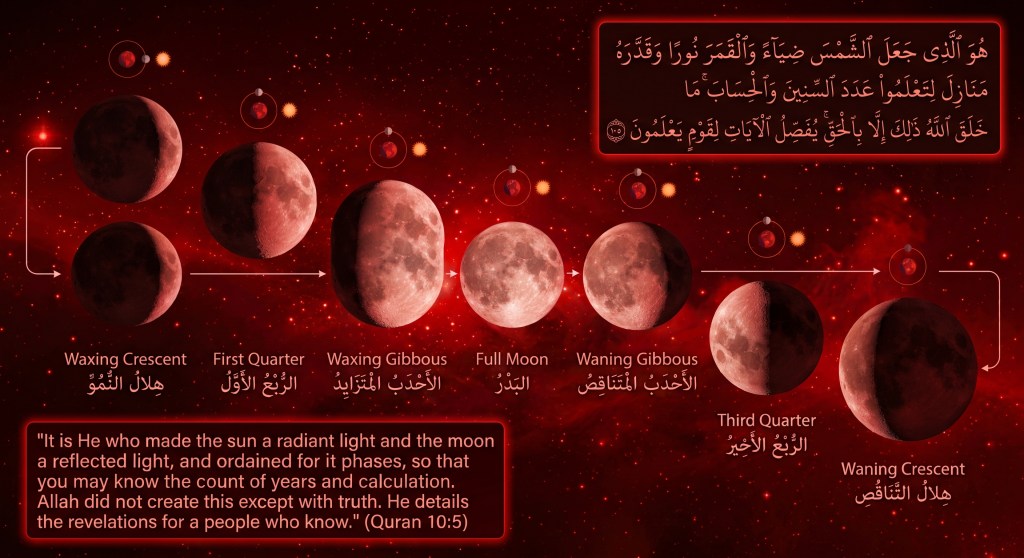
Presented by Gemini for Zia H Shah MD
Audio teaser: How Celestial Math Built Our Calendar:
Abstract
The measurement of time stands as one of humanity’s most profound intellectual triumphs, bridging the seemingly insurmountable gap between abstract celestial mechanics and the pragmatic organization of terrestrial civilizational life. This comprehensive report offers an exhaustive scientific, historical, philosophical, and theological commentary on the Quranic presentation of timekeeping, specifically analyzing verses 55:5, 10:5, and 17:12. By establishing the textual and philological foundation of these verses, the analysis identifies a profound resonance between ancient scriptural declarations and modern astrophysical realities, particularly regarding the nature of solar luminosity and lunar reflectance. Following the mandate of the original inquiry, the historical analysis begins with the establishment of the lunar calendar in early Islamic societies and details the monumental contributions of Muslim scholars to mathematics and astronomy during the Golden Age. However, historical philosophy necessitates recognizing that no single civilization holds a monopoly on knowledge; as humanity evolved, the geographical and cultural “Mecca of knowledge” migrated from Baghdad and the Muslim world to Renaissance Europe. The report subsequently traces the comprehensive evolution of the solar calendar from its Paleolithic origins through to Babylonian, Egyptian, and Julian iterations, culminating in the Gregorian reform of 1582. Authorized by Pope Gregory XIII and engineered by the brilliant minds of Aloysius Lilius and Christopher Clavius, the Gregorian calendar resolved critical astronomical inaccuracies. Applying the operative theological principle of Quran 13:17—that whatever benefits humanity is sustained on Earth—this report argues against fundamentalist exclusivity that artificially bifurcates knowledge into “Islamic” and “secular” domains. It concludes with a thematic epilogue highlighting the ongoing resonance between Quranic cosmology and the fine-tuning of the universe, while advocating for a philosophical paradigm that champions the relentless, dogmatism-free pursuit of universal knowledge.
Introduction: The Intersection of Cosmos and Consciousness
From the earliest dawns of human consciousness, the rhythmic, highly predictable cycles of the heavens have served as the primary canvas upon which humanity organized its existence. The rising and setting of the sun, the waxing and waning of the moon, and the shifting constellations were not merely background phenomena; they were the very mechanisms of survival, dictating the planting of crops, the anticipation of annual floods, and the observance of sacred rituals. The architecture of timekeeping is inherently both a scientific endeavor and a theological meditation. Recognizing patterns in the sky inherently prompts inquiries into the nature of the Orderer of those patterns.
In Islamic theology, the cosmos is not a chaotic expanse but a meticulously calibrated system designed for human legibility and utility. The Quran repeatedly draws the reader’s attention to the precision of the celestial bodies, presenting them as signs (āyāt) of divine providence and as highly pragmatic tools for human organization. However, the interpretation and application of these celestial signs have evolved dramatically over millennia. The transition from strictly lunar timekeeping to refined mathematical solar calendars reflects not just a refinement in astrometry, but an evolution in human civilization’s complex administrative needs. This evolution highlights a fundamental philosophical truth: the pursuit of accurate knowledge is a cumulative, inter-civilizational enterprise that transcends single cultures or religious epochs.
Textual Foundation: The Quranic Framework of Time, Light, and Reckoning
To deeply understand the theological and scientific synthesis of Islamic timekeeping, one must first examine the foundational texts. The Quran explicitly links the mechanics of the sun and the moon to the human capacity for mathematics, calculation, and historical reckoning. The following sections provide the Arabic text alongside six widely recognized English translations to capture the nuances of classical Arabic lexicography.
Quran 55:5 – The Precision of Celestial Mechanics
The verse located in Surah Ar-Rahman explicitly links the celestial bodies to mathematical precision, establishing a universe governed by inviolable laws rather than capricious divine whims.
Arabic Text: الشَّمْسُ وَالْقَمَرُ بِحُسْبَانٍ
| Translator | English Translation |
| Sahih International | The sun and the moon [move] by precise calculation. |
| Yusuf Ali | The sun and the moon follow courses (exactly) computed. |
| Pickthall | The sun and the moon are made punctual. |
| Shakir | The sun and the moon follow a reckoning. |
| Arberry | The sun and the moon to a reckoning. |
| Muhsin Khan | The sun and the moon run on their fixed courses (exactly) calculated with measured out stages for each. |
The term ḥusbān (حُسْبَان), derived from the root ḥ-s-b, denotes a precise mathematical calculation, accounting, or exact trajectory. The theological implication here is immense: it posits a universe that is highly deterministic in its physics.
Quran 10:5 – The Ordainment of Light and Reckoning
This verse from Surah Yunus distinguishes the varying physical properties of the sun and moon, subsequently explaining the teleological purpose behind their orbital phases.
Arabic Text: هُوَ الَّذِي جَعَلَ الشَّمْسَ ضِيَاءً وَالْقَمَرَ نُورًا وَقَدَّرَهُ مَنَازِلَ لِتَعْلَمُوا عَدَدَ السِّنِينَ وَالْحِسَابَ ۚ مَا خَلَقَ اللَّهُ ذَٰلِكَ إِلَّا بِالْحَقِّ ۚ يُفَصِّلُ الْآيَاتِ لِقَوْمٍ يَعْلَمُونَ
| Translator | English Translation |
| Sahih International | It is He who made the sun a radiant light and the moon a derived light and determined for it phases – that you may know the number of years and account [of time]. |
| Yusuf Ali | It is He Who made the sun to be a shining glory and the moon to be a light (of beauty), and measured out stages for her; that ye might know the number of years and the count (of time). |
| Pickthall | He it is Who appointed the sun a splendour and the moon a light, and measured for her stages, that ye might know the number of the years, and the reckoning. |
| Shakir | He it is Who made the sun a shining brightness and the moon a light, and ordained for it mansions that you might know the computation of years and the reckoning. |
| Arberry | It is He who made the sun a radiance, and the moon a light, and determined it by stations, that you might know the number of the years and the reckoning. |
| Muhsin Khan | It is He Who made the sun a shining thing and the moon as a light and measured out its (their) stages, that you might know the number of years and the reckoning. |
Quran 17:12 – The Duality of Day and Night for Human Utility
In Surah Al-Isra, the Quran shifts focus from the celestial bodies themselves to the resulting phenomena of day and night on Earth, emphasizing their direct socioeconomic and historical utility for humanity.
Arabic Text: وَجَعَلْنَا اللَّيْلَ وَالنَّهَارَ آيَتَيْنِ ۖ فَمَحَوْنَا آيَةَ اللَّيْلِ وَجَعَلْنَا آيَةَ النَّهَارِ مُبْصِرَةً لِّتَبْتَغُوا فَضْلًا مِّن رَّبِّكُمْ وَلِتَعْلَمُوا عَدَدَ السِّنِينَ وَالْحِسَابَ ۚ وَكُلَّ شَيْءٍ فَصَّلْنَاهُ تَفْصِيلًا
| Translator | English Translation |
| Sahih International | And We have made the night and day as two signs, and We erased the sign of the night and made the sign of the day visible that you may seek bounty from your Lord and may know the number of years and the account [of time]. |
| Yusuf Ali | We have made the Night and the Day as two (of Our) Signs: the Sign of the Night have We obscured, while the Sign of the Day We have made to enlighten you; that ye may seek bounty from your Lord, and that ye may know the number and count of the years. |
| Pickthall | And We appoint the night and the day two portents. Then We make dark the portent of the night, and We make the portent of the day sight-giving, that ye may seek bounty from your Lord, and that ye may know the computation of the years, and the reckoning. |
| Shakir | And We have made the night and the day two signs, then We have made the sign of the night to pass away and We have made the sign of the day manifest, so that you may seek grace from your Lord, and that you might know the numbering of years and the reckoning. |
| Arberry | We have made the night and the day two signs; then We have blotted out the sign of the night, and made the sign of the day to see, and that you may seek bounty from your Lord, and that you may know the number of the years, and the reckoning. |
| Muhsin Khan | And We have appointed the night and the day as two Ayat (signs). Then, We have made dark the sign of the night while We have made the sign of day illuminating, that you may seek bounty from your Lord, and that you may know the number of the years and the reckoning. |
Philological and Scientific Commentary: The Astrophysics of the Text
The verses cited above offer a multi-layered ontological view of the universe, blending precise physical descriptions with profound teleological purpose. The depth of these verses becomes remarkably apparent when classical Arabic philology is analyzed through the lens of modern astrophysics.
The Duality of Celestial Illumination: Ḍiyāʾ and Nūr
In Quran 10:5, a highly specific terminological distinction is made regarding the nature of the light emanating from the sun and the moon. The sun is described as ḍiyāʾ (ضِيَاءً), while the moon is described as nūr (نُورًا). Classical Arabic lexicographers, long before the advent of the telescope, distinguished these two terms in a manner that astoundingly anticipates modern astronomical understanding. Ḍiyāʾ refers to a self-subsisting, radiant light that emits from a localized source by its own inherent power, almost exclusively accompanied by the generation of thermal energy. It implies a source of active combustion or radiance. Conversely, nūr is a broad, generic term for light, often denoting a secondary, cool, or reflected illumination that lacks inherent combustion or localized generation.
From a scientific standpoint, this linguistic nuance perfectly mirrors the astrophysical reality of stellar nucleosynthesis versus planetary albedo. The sun is a main-sequence star. In its core, intense gravitational pressure and heat facilitate nuclear fusion, converting hydrogen isotopes into helium, thereby generating vast amounts of electromagnetic radiation (radiant heat and visible light) across the spectrum. It is a primary emitter. The moon, conversely, is a rocky, natural satellite that produces absolutely no visible light of its own. Its luminosity is entirely dependent on the albedo effect—the reflection of the sun’s electromagnetic radiation off the silicon-rich lunar regolith.
| Celestial Body | Quranic Terminology | Linguistic Definition | Modern Astrophysical Reality |
| The Sun | Ḍiyāʾ (ضِيَاءً) | Primary, radiant, heat-generating light source. | Main-sequence star; emits energy via core nuclear fusion. |
| The Moon | Nūr (نُورًا) | Secondary, derived, or non-combustive illumination. | Rocky satellite; emits no light, relies entirely on albedo (reflection). |
The linguistic precision of assigning ḍiyāʾ to the sun and nūr to the moon signifies a cosmological order where bodies act in mathematically predictable roles as either generators or reflectors of energy.
The Concept of Ḥusbān and Ḥisāb: The Mathematics of Existence
Quran 55:5 states that the sun and the moon move by ḥusbān (بِحُسْبَانٍ), a term rooted in the concept of precise calculation. Similarly, 10:5 and 17:12 emphasize that the phases of these bodies exist so humanity may know the “number of years and the reckoning” (ʿadada al-sinīna wal-ḥisāb).
Theological interpretations suggest that the universe operates on a deterministic, mathematical calculus ordained by the Creator. Because the cosmos obeys inviolable physical laws—such as gravity, orbital mechanics, angular momentum, and Kepler’s laws of planetary motion—humanity is empowered to extrapolate ḥisāb (the reckoning of time). If the universe were erratic or subject to random alterations in physical constants, science, agriculture, and civilization would be entirely impossible. The dependability of the celestial clockmaker is what grants humanity the cognitive ability to structure complex society, seek economic bounty (as noted in 17:12, “seek bounty from your Lord”), and meticulously catalog historical epochs.
History Part I: The Lunar Calendar in Muslim Societies and the Explosion of Science
In fulfilling the historical mandate of this analysis, we must begin with the sociological and religious establishment of the lunar calendar in the early Muslim community, and how the requirements of faith catalyzed an unprecedented explosion in mathematical and astronomical sciences.
The Establishment of the Purely Lunar Calendar
Prior to the advent of Islam, the various tribes of the Arabian Peninsula utilized a lunisolar calendar, heavily relying on the practice of nasīʾ (intercalation), which involved arbitrarily adding a thirteenth month to align the lunar year with the solar seasons. In the 7th century, however, Quranic revelation (Surah At-Tawbah 9:36–37) explicitly abolished the practice of nasīʾ, strictly prohibiting the alteration of the twelve-month lunar cycle. This established the Hijri calendar as a purely lunar system.
The rationale behind a strictly lunar calendar for religious observance is deeply egalitarian. A twelve-month lunar year is approximately 354 days long, falling short of the solar year by about 11 days. Consequently, the Islamic months migrate backward through the solar seasons over a 33-year cycle. This ensures that the physical hardships of religious obligations—most notably the daytime fasting during the month of Ramadan—are shared equally by all Muslims across the globe throughout their lifetimes. A Muslim in the Northern Hemisphere will experience long, hot summer fasts during a particular decade, while enjoying short, cool winter fasts a decade and a half later, preventing permanent geographical disparity in religious exertion.
Muslim Contributions to Mathematics and Astronomy
While the civil and religious calendar of the Islamic empire became strictly lunar, this did not stifle the scientific pursuit of solar and cosmic understanding. On the contrary, the specific religious obligations of Islam necessitated the development of highly advanced mathematical astronomy. Muslims were required to determine the exact direction of Mecca (the Qibla) from anywhere in the expanding empire to perform their daily prayers. Furthermore, the timing of the five daily prayers is governed entirely by the shifting angle of the sun, requiring precise solar tracking. Finally, accurately predicting the visibility of the new crescent moon (hilāl) to mark the beginning of months like Ramadan demanded complex orbital mechanics that superseded basic visual observation.
During the Islamic Golden Age (spanning roughly the 8th to 14th centuries), scholars operating in state-sponsored institutions like the House of Wisdom (Bayt al-Hikmah) in Baghdad, as well as observatories in Damascus, Maragha, and Andalusia, became the absolute vanguard of global astronomy. Recognizing that the celestial sphere could not be mapped using flat geometry, Muslim mathematicians effectively birthed modern spherical trigonometry.
Luminaries of this era made contributions that permanently altered the trajectory of human knowledge:
- Al-Khwarizmi formalized algebra and introduced Hindu-Arabic numerals to the wider world, providing the foundational mathematical syntax required for advanced celestial mechanics.
- Al-Battani (Albategnius) meticulously recalculated the length of the solar year with astonishing precision, identifying slight inaccuracies in earlier Greek and Ptolemaic models, and producing highly accurate astronomical tables (Zij).
- Al-Biruni utilized advanced trigonometry to calculate the radius of the Earth with an error margin of less than 1%, a feat unmatched for centuries.
- Ibn al-Shatir developed non-Ptolemaic astronomical models that later mirrored the mathematical techniques utilized by Copernicus.
The Philosophical Shift: The Migration of the “Mecca of Knowledge”
A fundamental principle of historical philosophy—and an observable reality of human sociology—is that no single civilization, religion, or ethnic group holds a perpetual monopoly on knowledge. Humanity evolved. The intense intellectual ferment that characterized Baghdad, Cordoba, and Samarkand eventually faced internal and external pressures. Political instability, devastating events like the Mongol sack of Baghdad in 1258, and creeping internal theological dogmatism that slowly began to deprioritize the natural sciences, gradually diminished the output of the Middle Eastern scientific centers.
Simultaneously, through the translation movements in places like Toledo and Sicily, the immense corpus of Arabic scientific literature was transmitted into Latin. The “Mecca of knowledge” is not a fixed geographic coordinate; it is a fluid mantle that rests wherever rigorous, unfettered inquiry is supported by societal infrastructure. This epicenter of intellectual pursuit began to migrate geographically and culturally—moving decisively from the Muslim world to the universities, patronage networks, and observatories of Renaissance Europe. This shift underscores the universal nature of the scientific enterprise. Knowledge belongs to humanity at large, not to the specific demographic that momentarily discovers it.
History Part II: The Broad Evolution of the Solar Calendar
To contextualize the monumental European contributions to timekeeping that followed the Islamic Golden Age, one must understand the parallel evolution of the solar calendar, tracing its roots from prehistory. Humanity’s transition from moon cycles to precise solar years is a chronicle of agricultural necessity and continuous refinement.
Paleolithic and Mesolithic Origins
Long before the advent of written language, prehistoric humans relied exclusively on the moon. The moon’s phases provide a highly visible, universally accessible ~29.5-day cycle. The etymology of the word “month” itself is inextricably linked to the word “moon,” serving as a linguistic fossil of humanity’s earliest timekeeping methods. Archaeological discoveries confirm that early hunter-gatherers tracked these lunar cycles. Notably, at a Mesolithic site in Warren Field, Scotland, dating to approximately 8000 BC, archaeologists uncovered a series of meticulously aligned pits that corresponded to the phases of the moon across twelve months, uniquely calibrated to reset at the winter solstice.
The Mesopotamian Metonic Cycle
As humanity transitioned to agrarian civilizations in the Fertile Crescent, the inherent mismatch between the lunar and solar cycles became a crisis. Because a purely lunar calendar drifts 11 days a year, an agricultural society utilizing it would soon find its planting months occurring in the dead of winter. To resolve this, Mesopotamian astronomer-priests developed lunisolar calendars, initially utilizing ad hoc intercalation to add a 13th month when the seasons drifted. By the late 6th century BCE, Babylonian mathematics discovered the Metonic cycle: a highly precise observation that 19 solar years are almost exactly equal to 235 lunar months. By inserting 7 intercalary months over a fixed 19-year period, they stabilized the average calendar year to 365.24 days.
The Egyptian Solar Breakthrough and the Julian Reform
The most revolutionary shift occurred in Ancient Egypt around 2800 BC. Managing an empire dependent on the annual flooding of the Nile required solar predictability, leading Egyptian administrators to completely decouple their civil administration from the lunar cycle. They engineered a 365-day solar calendar (12 months of 30 days, plus 5 extra days), anchored to the heliacal rising of Sirius. Because it lacked a leap year, it drifted slowly, creating a 1,460-year “Sothic cycle”.
When Julius Caesar reformed the Roman calendar in 46 BC, he utilized Egyptian astronomical expertise (specifically Sosigenes of Alexandria). Seeking to correct the Egyptian quarter-day error, the Julian calendar introduced a leap day every four years, setting the average year at exactly 365.25 days.
History Part III: The Gregorian Calendar Reform
For over sixteen centuries, the Julian calendar dominated the Western world and Christian timekeeping. However, its mathematical foundation contained a subtle, yet ultimately highly disruptive, flaw.
The Mathematical Flaw and the Easter Crisis
The true tropical year—the exact time it takes for the Earth to return to the vernal (spring) equinox—is approximately 365.2422 days, which is roughly 11 minutes and 14 seconds shorter than the Julian assumption of 365.25 days. While 11 minutes per year appears trivial to a single human generation, over centuries, this error compounded dramatically, amounting to an uncorrected drift of about one full day every 128 years.
By the 16th century, the calendar had drifted by an alarming 10 days relative to the actual solar equinox. This presented a massive theological and administrative crisis for the Catholic Church. The First Council of Nicaea, held in 325 AD, had established a formula for calculating the date of Easter: it must be celebrated on the first Sunday after the first full moon occurring on or after the vernal equinox, traditionally pegged to March 21. Because of the Julian drift, the actual astronomical vernal equinox was occurring around March 11, pushing the holiest celebration of the Christian calendar progressively further out of alignment with its intended seasonal setting.
The Papal Bull Inter gravissimas and the True Creators
The Council of Trent (1545–1563) officially recognized this crisis and authorized the Papacy to scientifically reform the calendar. After decades of intense research, international consultation, and vigorous debate among the finest mathematical minds of the era, Pope Gregory XIII finally enacted the sweeping reform. On February 24, 1582, the Pope issued the papal bull Inter gravissimas (“Among the most serious…”), officially establishing what is universally known today as the Gregorian calendar.
However, historical accuracy demands noting that while the calendar is named after the Pope who commissioned and authorized it, the underlying mathematical architecture was strictly the product of advanced secular-scientific rigor. The true creators of the reform were two brilliant men: Aloysius Lilius (Luigi Lilio), an Italian physician and astronomer who authored the original structural proposal, and Christopher Clavius, a formidable German Jesuit mathematician and astronomer who expanded, modified, rigorously tested, and defended Lilius’s algorithm.
Lilius and Clavius accurately identified that the structural flaw of the Julian system was an overabundance of leap years. Their solution was a highly elegant mathematical correction designed to closely approximate the true tropical year. They decreed that centurial years (years ending in “00”) would no longer automatically be leap years, unless they were evenly divisible by 400.
| Calendar System | Leap Year Rule | Average Year Length | Variance from True Solar Year | Time to Drift One Day |
| Julian Calendar | Every 4 years without exception. | 365.25 days | ~11 minutes too long | ~128 years |
| Gregorian Calendar | Every 4 years, EXCEPT century years not divisible by 400. | 365.2425 days | ~26 seconds too long | ~3,300 years |
Therefore, under the Lilius-Clavius model, the years 1700, 1800, and 1900 were standard common years, whereas the year 2000 was a leap year. This brilliant adjustment eliminated three leap days every 400 years, pushing the average calendar year to 365.2425 days—a figure so precise that it will take over three millennia for the calendar to drift by a single day.
Furthermore, to fix the liturgical calculations, Lilius proposed, and Clavius meticulously implemented, an original and highly practical mathematical scheme utilizing “epacts” to track the age of the ecclesiastical moon, thereby resolving long-standing astronomical obstacles to computing the precise date of Easter irrespective of raw observational data.
Implementation and the “Lost Ten Days”
To realign the calendar with the seasons as they existed during the Council of Nicaea in 325 AD, the accumulated 10-day error of the Julian calendar had to be forcefully excised from human timekeeping. Pope Gregory decreed that 10 days must simply vanish. October 1582 was selected for the transition because it contained the fewest important conflicting religious feasts. Thus, in countries that adopted the reform, the population went to sleep on Thursday, October 4, and woke up the next morning on Friday, October 15.
This historical anomaly resulted in unique paradoxes. The prominent Spanish mystic and Catholic reformer Saint Teresa of Avila died during the night of the transition, meaning her official date of death is recorded variably in history as either October 4 or October 15, 1582.
The geopolitical implementation of the Gregorian calendar was fraught with intense religious sectarianism. Catholic-aligned nations like Italy, Spain, Portugal, and Poland adopted the decree immediately. However, Protestant Europe, deeply suspicious of papal authority following the Reformation, fiercely resisted. The German astronomer Johannes Kepler famously encapsulated the geopolitical stubbornness of the era, remarking that Protestants would rather “disagree with the sun than agree with the pope.” England and its colonial empire did not adopt the Gregorian calendar until 1752 (requiring the elimination of 11 days by that point), while other nations, such as Russia and Greece, delayed their adoption until the 20th century. In Ireland, the calendar reform even became a point of conflict, with Catholic lords operating on the Gregorian system while the English authorities in Dublin adhered to the Julian, creating temporary, highly localized time discrepancies.
Ultimately, however, the overwhelming scientific utility of the Gregorian calendar transcended all political and religious sectarian lines. Today, it stands as the standard global civil calendar, utilized seamlessly by nations of all faiths, ideologies, and geographic locales.
The Operative Principle of Quran 13:17: The Supremacy of Universal Utility
The universal, global adoption of the Gregorian calendar by secular, Christian, Hindu, Buddhist, and Muslim societies alike brings into sharp focus a profound philosophical principle articulated explicitly in the Quran.
Surah Ar-Ra’d (13:17) establishes a definitive epistemological and sociological benchmark for what endures in human civilization:
“He sends down rain from the sky, and the valleys flow according to their measure… Thus Allah sets forth truth and falsehood. Then as for the foam, it passes away as scum upon the banks, and as for what benefits mankind, it remains in the earth. Thus Allah sets forth the examples.”.
This theological principle—that whatever is of pragmatic use and genuine service to humanity (mā yanfaʿu al-nāsa) is sustained and preserved by the divine will on our planet—is deeply operative in the history of science, technology, and societal organization.
Certain fundamentalist or puritanical ideologies within the modern era have occasionally attempted to fixate entirely on the lunar calendar, labeling it exclusively and righteously as “Islamic,” while actively rejecting solar timekeeping as a foreign, secular, or Western intrusion. Such dogmatic, reactionary perspectives ignore both historical reality and the explicit Quranic mandate. While the strictly lunar calendar continues to be vitally and undeniably important for preserving the rhythm of Islamic religious events (such as determining the fasting month of Ramadan, the timings of the two Eids, and the Hajj pilgrimage), humanity at large has evolved its civil frameworks.
The two billion Muslims globally, representing all theological shades, cultural backgrounds, and geographic distributions, utilize the solar Gregorian calendar every single day. They use it for managing global commerce, organizing complex educational semesters, conducting precision agriculture, synchronizing international aviation, and managing civic administration. They do so not out of a betrayal of their faith, nor out of subjugation to the West, but in direct accordance with the principle of Quran 13:17. The Gregorian calendar is a masterwork of astronomical science, engineered over millennia to keep civil society harmoniously synced with the Earth’s orbit and seasons. It profoundly “benefits mankind,” and therefore, it remains firmly established on the earth.
Knowledge is an accretive, compounding process. The astronomical models of the ancient Greeks and Egyptians were corrected and refined by the Arabs in Baghdad, whose mathematical texts were subsequently translated into Latin in Spain, and then refined further by European minds like Clavius, leading eventually to Newtonian physics and modern astrophysics. Attempting to claim sole ownership of this process is historically illiterate. The scientific enterprise is a shared human heritage.
Thematic Epilogue: Resonance and the Pursuit of Knowledge
The deep intertwining of divine scripture and the historical evolution of timekeeping yields two primary thematic conclusions that serve as a robust roadmap for contemporary Islamic philosophy and broader human sociology.
Theme I: The Resonance Between the Quran and Cosmic Science
The textual declarations of the Quran—specifically the verses 55:5, 10:5, and 17:12—are in profound, undeniable resonance with modern scientific discovery and our increasing secular knowledge regarding the solar system and cosmology. The universe is not an accident born of chaos, but an entity characterized by breathtaking mathematical fine-tuning. The fact that the sun acts as a primary nuclear furnace radiating life-giving energy (ḍiyāʾ), while the moon acts as an inert, stabilizing reflector (nūr), and that both operate in exact, mathematically calculable orbits (ḥusbān), constitutes the foundational requirement for biological survival on Earth.
Without the precise orbital distance of the Earth from the Sun, our oceans would boil or freeze. Without the stabilizing gravitational influence of the Moon, the Earth’s axial tilt would wobble chaotically, destroying the climatic stability that allows agriculture and civilization to flourish. The Quranic assertion that these celestial mechanics were established so that humanity may “know the number of the years and the reckoning” operates as a profound theological acknowledgment of the Anthropic Principle—the scientific observation that the universe’s fundamental physical parameters are meticulously calibrated to allow for conscious, observing life. The relentless advancement of secular astronomy does not negate or threaten the Quranic worldview; rather, it methodically unpacks and verifies the mechanical details of the ḥisāb (calculation) that the scripture exalts.
Theme II: The Mandate to be Constant Seekers of Universal Knowledge
The long, complex history of the calendar teaches a vital sociological lesson: the strict partitioning of knowledge along religious, national, or ethnic lines is an illusion, and a dangerous one. The early solar calendar was birthed in the pagan civilization of Egypt. The advanced mathematical models of the stars were polished in the bustling, cosmopolitan centers of Islamic Baghdad and Andalusia. The highly precise calendar the entire world relies upon today was structurally designed by a Catholic physician, finalized by a Jesuit priest, and promulgated by a Pope in 1582.
Therefore, as conscientious human beings and as good Muslims, the ultimate mandate derived from this history is to remain constant seekers of all kinds of knowledge. The physical universe is the unwritten word of the Creator, requiring study and deciphering, just as the scripture is the written word requiring exegesis. Attempting to exclude external knowledge—such as resisting the utility of a solar calendar merely because it was finalized outside the traditional Islamic sphere—represents a highly regressive, black-and-white philosophy that ultimately strangles human societal development.
Dogmatism and exclusion build artificial walls that inevitably collapse under the weight of utility, whereas open scientific inquiry and pragmatism build bridges that elevate civilizations. By fully embracing the mandate of Quran 13:17—willingly accepting, integrating, and utilizing whatever genuinely benefits humanity, regardless of its geographic or cultural origin—society aligns itself intimately with the divine intent. The sun and the moon traverse the cosmos by precise calculation, completely indifferent to the ideological borders and theological disputes drawn by mankind below; it is humanity’s task to look upward, learn humbly from that celestial precision, and march forward together in the shared, universal light of discovery.




Leave a Reply