
Presented by Gemini for Zia H Shah MD
Audio teaser: Alien life in a Quranic divorce guide
Abstract
The intersection of classical Qur’anic exegesis, modern exotheology, and contemporary astrophysics provides a profoundly expansive framework for understanding the nature of Divine Providence. This comprehensive report delivers an exhaustive scientific, philosophical, and theological analysis of the concluding verse of Surah At-Talaq (Qur’an 65:12), highlighting its unambiguous accommodation of extraterrestrial life and cosmic pluralism. By juxtaposing the microcosmic human crisis of marital dissolution detailed in the opening verses of the chapter with the macrocosmic revelation of planetary multiplicity in its conclusion, a highly nuanced philosophical narrative emerges. The report integrates contemporary cosmological findings—specifically the astronomical breakthrough revealing that the observable universe contains an estimated two trillion galaxies—with classical Islamic jurisprudence and the profound traditions of early exegetes, most notably Abdullah Ibn Abbas. Through a rigorous linguistic, morphological, and thematic examination of Qur’an 65:12, supplemented by cross-referential analyses of verses 42:29, 30:17-18, and 10:65-66, the analysis demonstrates that the Qur’an constructs a coherent matrix anticipating biological and rational extraterrestrial life. Synthesizing these textual proofs with the extensive exotheological writings of Zia H. Shah MD, the report establishes a cohesive theological paradigm. The ultimate pedagogical goal of this cosmic disclosure is spiritual reassurance: the infinite Creator who sustains biological, moral, and spiritual life across trillions of galaxies, utilizing mathematical precision and boundless grace, is more than capable of providing sanctuary, justice, and sustenance to a lone believer navigating the trauma of a dissolving household.
1. The Microcosm of Human Trials: The Contextual Landscape of Surah At-Talaq
To fully comprehend the cosmic magnitude of Surah At-Talaq’s concluding verse, an exhaustive examination of the intensely intimate, domestic context of the chapter’s preceding verses is required. Surah At-Talaq, translated as “The Divorce,” is primarily a deeply pragmatic, legal, and psychological chapter. The first eleven verses meticulously outline the protocols for marital dissolution, emphasizing compassion, the protection of women’s rights during the waiting period (‘iddah), financial obligations, and the absolute necessity of ethical conduct during a period typically characterized by emotional volatility, interpersonal conflict, and profound psychological distress.
At its core, a divorce represents the collapse of a universe—the death of a shared domestic world. The psychological trauma associated with the fragmentation of a home often induces a state of profound existential anxiety regarding future sustenance, societal standing, and emotional survival. Anticipating this human vulnerability, the Qur’an repeatedly interjects these complex legal statutes with profound spiritual reassurances, anchoring the believer’s transient crisis to the eternal stability of Divine Providence. The concept of Sakinah (tranquility), which is often lost during the dissolution of a marriage, is systematically rebuilt through reliance on the Divine.
The underlying thesis of the chapter’s early verses is the inviolability of God’s support for the conscious believer who adheres to ethical boundaries even when aggrieved. This is explicitly articulated in the promises woven through the legal text: “And whoever fears Allah – He will make for him a way out. And will provide for him from where he does not expect. And whoever relies upon Allah – then He is sufficient for him. Indeed, Allah will accomplish His purpose. Allah has already set for everything a [decreed] extent” (Qur’an 65:2-3). These verses cultivate a psychological resilience built upon the recognition of an all-encompassing Divine governance. The believer is instructed that providence is not limited by human economic structures or societal safety nets.
The transition from this domestic minutiae to the awe-inspiring cosmic architecture in verse 12 is neither abrupt nor disconnected; it is a deliberate, highly sophisticated pedagogical escalation. The Qur’an systematically shifts the believer’s gaze from the shattered threshold of their earthly home to the outermost perimeters of the cosmos. By doing so, the text scales the concept of providence. The theological deduction presented to the reader is unequivocal: if the Divine architecture is capable of flawlessly managing the immense, unquantifiable complexities of the cosmos, then the socio-economic and emotional needs of a single believer undergoing a divorce are effortlessly within the purview of His infinite grace. The architecture of faith demands that the believer view their personal crisis through the lens of universal governance.
2. The Macrocosmic Revelation: Linguistic and Exegetical Analysis of Qur’an 65:12
The culmination of this theological reassurance is found in the final verse of the chapter, widely regarded by modern scholars as one of the most fundamental Qur’anic statements concerning exotheology and cosmic pluralism.
Arabic Text:
اللَّهُ الَّذِي خَلَقَ سَبْعَ سَمَاوَاتٍ وَمِنَ الْأَرْضِ مِثْلَهُنَّ يَتَنَزَّلُ الْأَمْرُ بَيْنَهُنَّ لِتَعْلَمُوا أَنَّ اللَّهَ عَلَىٰ كُلِّ شَيْءٍ قَدِيرٌ وَأَنَّ اللَّهَ قَدْ أَحَاطَ بِكُلِّ شَيْءٍ عِلْمًا
English Translation:
“Allah is the One Who created seven heavens, and likewise for the earth. The [divine] command descends between them so you may know that Allah is Most Capable of everything and that Allah certainly encompasses all things in [His] knowledge.”
[cite: 5, 6]
2.1 Morphological and Semantic Nuances
The verse constructs a majestic cosmological framework through several precise Arabic lexical choices, each carrying profound implications for the existence of extraterrestrial life. The phrase Sab’a Samawat (seven heavens) introduces the concept of cosmic multiplicity. While classical commentators sometimes viewed this literally as seven distinct atmospheric, planetary, or celestial layers, modern linguistic and cosmological interpretations note that the number “seven” in ancient Arabic parlance frequently denotes plurality, vastness, or an uncountable multitude. It signifies the sheer, layered immensity of the universe, aligning with the modern understanding of galactic superclusters and cosmic web structures.
The exotheological pivot of the verse resides in the phrase wa minal-ardhi mithlahunna (and of the earth, the like of them). The word mithlahunna operates as a feminine plural pronoun translating to “similar to them” or “the like thereof.” Structurally and grammatically, this pronoun binds the plurality of the earths to the plurality of the heavens. It asserts that just as the celestial realm is vast, layered, and multiple, the terrestrial realm—meaning habitable, earth-like planets capable of sustaining life—is equally plural. The deliberate use of feminine verbs and pronouns when describing these sister planets aligns remarkably with contemporary astronomical nomenclature, which routinely categorizes highly similar exoplanets as “Sister Earths” or “Sister Planets”. This linguistic mirror reflects a universe where our Earth is not a solitary anomaly, but part of a vast genus of life-bearing worlds.
Furthermore, the verse utilizes the phrase yatanazzalu al-amru baynahunna (the command descends between them). The continuous present tense of the verb yatanazzalu indicates a perpetual, unceasing flow of divine administration and interaction. In Qur’anic theology, the amr (command) possesses a dual nature. It encompasses both the physical laws of nature—such as gravity, electromagnetism, thermodynamics, and biological evolution—and the moral or spiritual revelations sent to conscious beings. The continuous descent of this command across these myriad earths confirms that the universe is not a barren, mechanical void left to its own devices. Instead, it is a dynamic, actively governed theater of existence teeming with purposeful, sustained life that requires ongoing physical and spiritual administration.
2.2 The Pedagogical Purpose of Cosmic Disclosure
The verse explicitly states the rationale behind this cosmic disclosure using the phrase li-ta’lamu (“so that you may know”). The revelation of extraterrestrial worlds and multiple heavens is not presented merely as abstract astronomical trivia; it is a highly targeted theological instrument designed to expand human consciousness regarding two specific divine attributes. The first is infinite omnipotence, articulated as the reality that Allah is Most Capable of everything (‘ala kulli shay’in qadir). The second is infinite omniscience, established by the declaration that Allah encompasses all things in His knowledge (qad ahata bikulli shay’in ‘ilma).
For the believer standing in the ruins of a collapsed marriage, struggling with the fear of abandonment, social alienation, or destitution, this verse serves as a profound psychological anchor. It demands a radical shift in perspective. The text suggests that the God who continually dispatches His sustaining command across countless exoplanets, managing the biological, social, and spiritual evolution of extraterrestrial civilizations across the cosmos, has not overlooked the micro-tragedies of human existence. His providence is infinitely scalable; it governs the macro-structures of deep space and simultaneously records the falling of a leaf or the breaking of a human heart. By understanding the governance of the cosmos, the believer achieves certainty in the governance of their own life.
3. The Scale of Providence: Two Trillion Galaxies and Modern Astrophysics
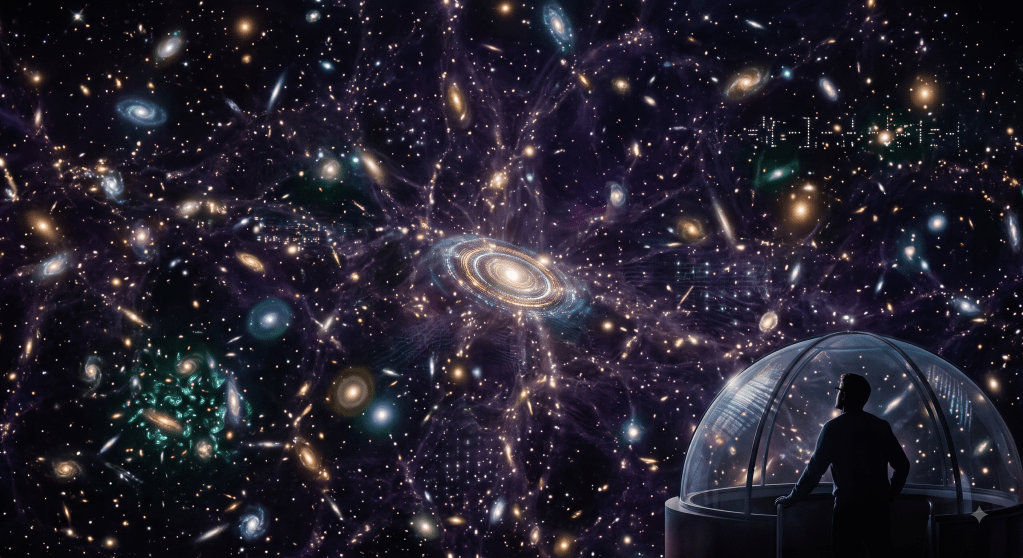
To fully appreciate the weight of the phrase “seven heavens” and the corresponding “like of them” regarding the earths in verse 65:12, one must quantify the cosmos using the lens of modern astrophysics. The theological magnitude of infinite providence is inextricably linked to the physical magnitude of the universe. For decades, astronomical consensus, based heavily on the landmark Hubble Deep Field images captured in the mid-1990s, estimated the observable universe to contain between 100 billion and 200 billion galaxies. This figure alone was staggering, suggesting an unfathomable number of star systems, yet it represented only a fraction of the actual cosmic architecture.
A watershed moment in cosmology occurred with a 2016 study led by Professor Christopher Conselice at the University of Nottingham, which fundamentally disrupted this consensus and expanded the inventory of the universe tenfold. This discovery provides the empirical scale necessary to comprehend the exotheological claims of Surah At-Talaq.
3.1 The Nottingham Methodology and the Faint Galaxy Paradigm
Conselice’s team synthesized deep-space survey data from NASA’s Hubble Space Telescope with other observatories to construct an exhaustive 3-D map of the universe. Recognizing the inherent limitations of current optical instrumentation, the team developed highly sophisticated mathematical models to infer the presence of galaxies that are currently too faint or too distant to be directly observed by contemporary technology.
The application of these mathematical models revealed a stark and humbling reality: approximately 90 percent of the galaxies in the observable universe are too faint and too far away to be seen with present-day telescopes. By calculating the density of galaxies throughout the universe’s 13.8-billion-year history, the researchers demonstrated that the early universe was incredibly crowded with small, faint galaxies. Many of these early celestial structures were similar in mass to the satellite galaxies currently orbiting the Milky Way. Over billions of years, these smaller systems merged to form the massive galaxies observed today, a process that validates both the “top-down” and “bottom-up” models of galactic evolution and structure formation.
This research also provided a compelling resolution to Olbers’ paradox, a cosmological problem formulated in the 1800s asking why the night sky is dark if the universe contains an infinity of stars. The team concluded that there is such an abundance of galaxies that, in principle, every patch in the sky contains part of a galaxy, but their light remains invisible to the human eye due to cosmic redshift, the dynamic expansion of the universe, and the absorption of light by intergalactic dust and gas.
3.2 Cosmological Implications for Extraterrestrial Life
The conclusion of this deep-sky census placed the universe’s minimum galactic population at roughly 2 trillion (2 × 10¹²) galaxies. The implications of this data for the interpretation of Qur’an 65:12 are profound.
| Cosmological Metric | Previous Consensus (Pre-2016) | Revised Consensus (Conselice et al., 2016) |
| Estimated Galactic Population | 100 – 200 Billion Galaxies | 2 Trillion Galaxies |
| Observation Status | Primarily visible/detectable spectrum | 90% unobservable; mathematically inferred |
| Primary Evolutionary Model | Static density estimations | Dynamic merger-driven reduction over 13.8B years |
| Implication for Olbers’ Paradox | Unresolved conceptually | Solved: Every patch of sky contains a galaxy, though light is shifted/absorbed |
When calculating the probability of extraterrestrial life, this tenfold increase in galactic population alters the Drake Equation exponentially. If our single Milky Way galaxy contains an estimated 100 to 400 billion stars, and current exoplanetary data suggests that most stars host planetary systems within their respective habitable zones, the mathematical probability of earth-like planets within a 2-trillion-galaxy universe approaches absolute certainty.
When the Qur’an states wa minal-ardhi mithlahunna (and of the earth, the like of them), it speaks directly to this staggering astronomical reality. The two trillion galaxies serve as the physical manifestation of the Sab’a Samawat (the plural heavens). The billions of exoplanets nestled within the habitable zones of their respective stars are the mithlahunna (the earths similar to our own). The sheer scale of this biological and cosmological theater acts as the ultimate testament to the infinite Providence that governs both the macro-structures of deep space and the micro-complexities of human socio-legal affairs. If the Divine command (amr) is capable of coordinating the merger of galaxies over 13.8 billion years and sustaining the biospheres of trillions of worlds, the provision of alimony, emotional peace, and future sustenance for a divorced believer is an effortless manifestation of that same divine capability.
4. Classical Islamic Exotheology: The Legacy of Ibn Abbas
The interpretation of Qur’an 65:12 as a definitive proof of inhabited extraterrestrial worlds is not a modern revisionist attempt to harmonize religion with post-Hubble science. It has deep, highly authenticated roots in classical Islamic epistemology, championed by none other than Abdullah Ibn Abbas, the cousin of the Prophet Muhammad and the foundational patriarch of Qur’anic exegesis (Tafsir).
Historical transmissions indicate that Ibn Abbas possessed an extraordinarily expansive view of cosmic pluralism (ta’addud al-‘awalim), one that anticipated the existence of parallel biological and spiritual civilizations long before the invention of the optical telescope.
4.1 The Tradition of Multiple Adams and Parallel Prophets
When questioned by his contemporaries about the meaning of the phrase “and of the earth, the like of them” (65:12), Ibn Abbas delivered a commentary that fundamentally challenged the geocentric worldview of his era. He stated unequivocally:
“Seven earths: In every earth is a prophet like your Prophet, an Adam like your Adam, a Noah like your Noah, an Abraham like your Abraham and a Jesus like your Jesus.”
[cite: 15, 16, 17]
This tradition is not an obscure, apocryphal anomaly; it is rigorously documented and evaluated in classical compilations. It was recorded by Ibn Jarir al-Tabari, authenticated by Al-Hakim in his Mustadrak, and cited by Al-Bayhaqi in Shu’ab al-Iman and Kitab al-Asma wa l-Sifat, as well as by Jalaluddin Al-Suyuti in Al-Durr Al-Manthur. Furthermore, Ibn Hajar al-Asqalani, recognized as one of the most stringent and authoritative scholars of hadith methodology, affirmed the authenticity of its chain of transmission (isnad), cementing its validity within mainstream Islamic scholasticism.
4.2 Theological Deductions from Classical Exegesis
Ibn Abbas’s exposition requires careful philosophical and theological unpacking. He was not suggesting a literal multiverse of cloned historical figures endlessly repeating the exact same historical events. Rather, he was employing the highest archetypes of human spiritual development (Adam, Noah, Abraham, Jesus, Muhammad) to convey a profound exotheological reality regarding the nature of extraterrestrial civilizations.
First, the mention of “an Adam like your Adam” signifies parallel biological origins. It implies that God initiated biological and conscious life on other planets through respective progenitors, tailored to the specific environmental and evolutionary conditions of those worlds. Just as humanity represents a unique creation on Earth, these extraterrestrial beings represent unique, purposeful creations on their respective planets.
Second, the presence of parallel “Prophets” indicates universal moral accountability. It suggests that these extraterrestrial beings possess free will, rationality, and moral agency. The descent of the divine command (yatanazzalu al-amru) mentioned in 65:12 includes the dispatching of moral law and spiritual guidance to these distant civilizations. The continuous interaction of the Divine with these worlds confirms that revelation is not an Earth-exclusive phenomenon.
Third, the tradition highlights the continuity of divine pedagogy. Just as human history was shepherded by a succession of reformers and messengers guiding civilizations from primitive morality to advanced ethical frameworks, extraterrestrial histories undergo similar processes of spiritual maturation, guided by beings selected from among their own kind.
It is reported that Ibn Abbas would often hesitate to share the full depth of this interpretation with the uneducated masses. His pupil Mujahid reported Ibn Abbas saying, “If I were to interpret this verse rightly, you would turn disbelievers. Your denial would tantamount to disbelief”. He feared that the immense paradigm shift would shatter their localized, geocentric understanding of God. Today, aided by the empirical knowledge of two trillion galaxies, modern believers are epistemologically equipped to absorb what Ibn Abbas understood fourteen centuries ago: humanity does not possess a monopoly on God’s grace, and the universe is a vast sanctuary of conscious worship.
5. The Qur’anic Matrix for Extraterrestrial Life: Cross-Referential Analysis
The profound implications of Surah At-Talaq 65:12 do not exist in a vacuum. The Qur’an constructs a highly coherent, cross-referential matrix that repeatedly hints at extraterrestrial life in no uncertain terms. By examining complementary verses, the exotheological mandate becomes irrefutable, painting a picture of a universe teeming with biological entities and rational worshippers.
5.1 The Biological Inhabitants of the Cosmos: Qur’an 42:29
Perhaps the most biologically explicit verse concerning extraterrestrial life is found in Surah Ash-Shura, which confirms the dispersion of physical organisms throughout the universe.
Arabic Text:
وَمِنْ آيَاتِهِ خَلْقُ السَّمَاوَاتِ وَالْأَرْضِ وَمَا بَثَّ فِيهِمَا مِن دَابَّةٍ ۚ وَهُوَ عَلَىٰ جَمْعِهِمْ إِذَا يَشَاءُ قَدِيرٌ
English Translation:
“And among His Signs is the creation of the heavens and the earth, and the living creatures that He has scattered through them: and He has power to gather them together when He wills.”
[cite: 7, 11, 20, 21]
The linguistic precision of this verse is paramount to understanding its exotheological claims. The Arabic word Daabbah (دَابَّةٍ) is derived from the root daba, which means to crawl, move slowly, or walk. In Qur’anic lexicon, Daabbah strictly refers to corporeal, biological, moving creatures requiring physical sustenance, typically created from water. It is definitively not used to describe ethereal entities such as angels, who are created from light, or jinn, who are created from smokeless fire.
The verse explicitly states that God has scattered or dispersed (baththa) these biological entities feehima (in both of them), meaning they exist throughout both the Earth and the heavens (the wider cosmos). This definitively shatters the geocentric illusion of biological exclusivity. Furthermore, the verse concludes with an eschatological or perhaps physically prophetic promise: wa huwa ‘ala jam’ihim idha yashaa’u qadeer (and He has the power to gather them together when He wills). Whether this “gathering” denotes a cosmic day of resurrection where all planetary civilizations are brought together for final judgment, or alludes to the future possibility of physical interstellar contact between humanity and extraterrestrial civilizations, the underlying premise remains absolute: the universe is teeming with biological life.
5.2 The Symphony of Cosmic Praise: Qur’an 30:17-18
The presence of sentient life capable of rational thought, temporal awareness, and spiritual communion across the cosmos is further established in Surah Ar-Rum:
Arabic Text:
فَسُبْحَانَ اللَّهِ حِينَ تُمْسُونَ وَحِينَ تُصْبِحُونَ – وَلَهُ الْحَمْدُ فِي السَّمَاوَاتِ وَالْأَرْضِ وَعَشِيًّا وَحِينَ تُظْهِرُونَ
English Translation:
“So glorify Allah in the evening and in the morning—all praise is for Him in the heavens and the earth—as well as in the afternoon, and at noon.”
[cite: 23, 24]
Praise (Al-Hamd) requires a conscious agent capable of recognizing grace, articulating gratitude, and demonstrating spiritual submission. While all physical matter submits to God’s natural laws implicitly, the specific injunction of temporal glorification (morning, evening, afternoon, noon) suggests the presence of conscious beings governed by the physical cycles of their respective planetary rotations. Time, as experienced through mornings and evenings, is a planetary phenomenon dependent on a celestial body rotating on its axis relative to a host star. Therefore, the declaration that praise belongs to Him “in the heavens and the earth” across these specific temporal markers indicates that the heavens are not silent vacuums. They echo with the conscious doxology of innumerable extraterrestrial communities recognizing their Creator according to the day-night cycles of their own worlds.
5.3 The Sentience of the Heavens: Qur’an 10:65-66
Surah Yunus corroborates the presence of rational beings beyond Earth through a subtle yet definitive grammatical rule regarding the possession of the heavens. In verse 65, the Prophet is comforted against the grief caused by detractors, establishing that all honor belongs to God, who is Hearing and Knowing. This seamlessly transitions into verse 66, which establishes the cosmic scope of His dominion.
Arabic Text:
وَلَا يَحْزُنكَ قَوْلُهُمْ ۘ إِنَّ الْعِزَّةَ لِلَّهِ جَمِيعًا ۚ هُوَ السَّمِيعُ الْعَلِيمُ – أَلَا إِنَّ لِلَّهِ مَن فِي السَّمَاوَاتِ وَمَن فِي الْأَرْضِ ۗ وَمَا يَتَّبِعُ الَّذِينَ يَدْعُونَ مِن دُونِ اللَّهِ شُرَكَاءَ ۚ إِن يَتَّبِعُونَ إِلَّا الظَّنَّ وَإِنْ هُمْ إِلَّا يَخْرُصُونَ
English Translation:
“And let not their speech grieve you. Indeed, honor belongs to Allah entirely. He is the Hearing, the Knowing. Unquestionably, to Allah belongs whoever is in the heavens and whoever is on the earth. And those who invoke other than Allah do not [actually] follow [His] ‘partners.’ They follow not except assumption, and they are not but falsifying.”
[cite: 25]
In Arabic grammar, the relative pronoun ma (مَا) is utilized for inanimate objects or non-rational beings (what/that which), whereas the pronoun man (مَن) is reserved exclusively for rational, sentient, and conscious beings capable of intellect and moral choice (who/whoever). By stating that to Allah belongs man (whoever) is in the heavens, the Qur’an categorically asserts that the cosmos is inhabited by intelligent entities possessing cognition, volition, and self-awareness. The use of the pronoun man strips away any possibility that the verse is merely referring to stars, asteroids, or non-sentient cosmic dust. It is a definitive acknowledgment of a populated universe.
6. Synthesizing Exotheology and Providence: The Insights of Zia H Shah MD
The extensive writings of Zia H Shah MD act as a critical modern bridge, seamlessly uniting the intricate cosmological data of the 21st century with the profound theological architecture of the Qur’an. His collective works establish a robust paradigm of Islamic Exotheology that elevates the discourse from mere scientific harmonization to profound spiritual and psychological reflection.
In essays such as From the Threshold of a Home to the Edge of the Cosmos: A Thematic Tafsir of Surah At-Talaq and The Earths Like Unto the Heavens, Shah explores the psychological juxtaposition inherent in the text. The unparalleled brilliance of Surah At-Talaq lies in its dramatic, sudden shift in focal length. The Qur’an begins by managing the micro-dynamics of a collapsing human household—dictating the ethics of alimony, child-rearing during separation, and emotional boundaries designed to protect women during a period of acute vulnerability. It directly addresses the terrified individual who feels their personal universe has permanently shattered. Then, without warning, verse 65:12 pulls the metaphysical camera back billions of light-years, revealing an infinite tapestry of orbital planes, alien civilizations, and two trillion galaxies, all sustained by the continuous descent of the Divine Command (yatanazzalu al-amru).
Shah’s analyses articulate that this jarring juxtaposition is the ultimate antidote to human despair. The central thesis of Tawakkul (trust in God) is predicated entirely on understanding the absolute capability of the Trustee. If the believer recognizes that God seamlessly administers the complex biological evolution, the moral legislation, and the physical sustenance of intelligent beings residing in galaxies millions of light-years away, the believer’s personal crisis is immediately contextualized. The Infinite Providence that fuels the stars, regulates the gravitational dynamics of superclusters, and feeds extraterrestrial biospheres is the exact same Providence that promises to find “a way out” for the divorced mother or the disenfranchised spouse.
Furthermore, Shah highlights how modern astrophysics validates the Qur’anic insistence on cosmic pluralism. The revelation of the faint galaxies by Conselice’s team mathematically mandates the existence of extraterrestrial habitats, effectively actualizing Ibn Abbas’s vision of multiple Adams and multiple earths. Through themes explored in his articles like The Architecture of Faith and Not Wearied by Their Creation, Shah posits that God is not the localized tribal deity of a solitary rocky planet; He is the Lord of the Worlds (Rabb al-‘Aalameen). His command radiates through the multidimensional architecture of space, establishing moral and physical order across the staggering expanse of two trillion galaxies. When the believer realizes that the loss of Sakinah (tranquility) in their marriage can be restored by the Lord of two trillion galaxies, their despair is replaced by an awe-inspired reliance.
7. Thematic Epilogue: The Infinite Canopy of Grace
The universe is characterized not by its emptiness, but by its overwhelming, unfathomable abundance. When humanity peers through the deep-field lenses of modern space telescopes, it does not see a void; it witnesses an ocean of light, a canvas populated by at least two trillion galaxies, each hosting billions of stars and countless terrestrial worlds. This is the physical realization of the Sab’a Samawat, the countless heavens spoken of in the climax of Surah At-Talaq.
The Qur’an’s exotheological vision—articulated through the plural earths of 65:12, the biological creatures (Daabbah) of 42:29, the sentient praise bound by time in 30:17-18, and the rational beings (man) of 10:66—presents a cosmos that is intensely alive. The universe is a community of communities, bound together by the continuous descent of the Divine Command, functioning under a unified moral and physical law.
Yet, the ultimate miracle of Qur’anic pedagogy is its refusal to let this cosmic immensity diminish the value of the individual human soul. Surah At-Talaq bridges the infinite and the intimate. It leverages the existence of extraterrestrial life and the staggering scale of the universe not to make the human feel insignificant, but to comfort the brokenhearted. It whispers a profound theological truth: the God who orchestrates the orbital mechanics of two trillion galaxies, who disperses biological life across the cosmos, and who sends His guiding command to civilizations unseen, is the exact same God who listens to the silent weeping of a believer in the depths of the night.
To believe in the extraterrestrial implications of Surah At-Talaq is not merely to acknowledge a scientific probability confirmed by modern astrophysics; it is to submit to the absolute limitlessness of Divine Providence. The believer is invited to look up at the night sky, fully aware that behind the veil of the dark, billions of other earths rotate, teeming with life, sustained by the very same Mercy that will provide for them tomorrow morning. In the face of crisis, divorce, or earthly loss, the populated cosmos stands as an unconquerable monument to the Qur’anic promise: “And whoever relies upon Allah – then He is sufficient for him.”




Leave a Reply