
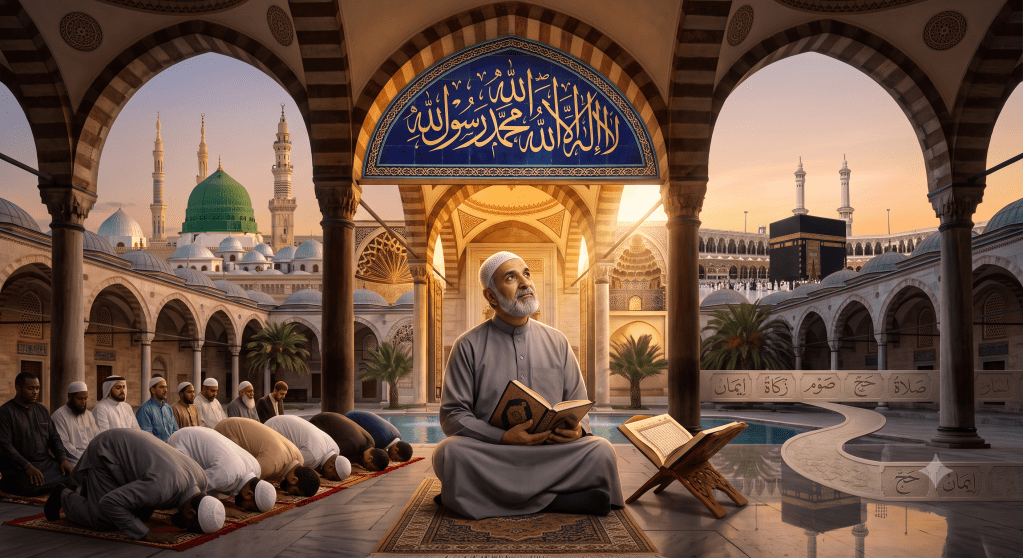
Presented by ChatGPT for Zia H Shah MD
Abstract
Islamic faith is not presented in the Qur’an as a collection of abstract propositions detached from life. It is a comprehensive orientation of the intellect, heart, conscience, worship, and conduct toward God. Qur’an 2:1–5 begins with receptivity to revelation, belief in the unseen, prayer, generosity, continuity of divine guidance, certainty in the Hereafter, and the promise of true flourishing. Qur’an 2:177 then transforms creed into righteousness: belief in God, the Last Day, angels, revelation, and prophets must express itself through generosity, liberation, prayer, charity, fidelity, and perseverance. Qur’an 2:285 presents the Prophet Muhammad, may peace be upon him, and his followers as one believing community united in submission to all God’s messengers. Qur’an 4:136 commands believers to deepen and preserve their faith, warning that the interconnected articles of belief cannot be selectively dismantled.
These passages are illuminated by the Hadith of Gabriel, which organizes religion into īmān—faith; islām—obedient practice; and iḥsān—spiritual excellence. Qur’an 3:7 supplies a hermeneutical safeguard: foundational beliefs should be grounded in the clear, governing verses rather than speculative exploitation of ambiguous language. Qur’an 8:22 simultaneously repudiates unthinking religiosity by condemning the deliberate refusal to hear, speak, and reason about truth. Finally, the declaration of Qur’an 5:3—revealed at ʿArafāt during the Prophet’s Farewell Pilgrimage—announces the perfection of the religion, the completion of divine favor, and God’s approval of Islam as the enduring way of surrender. Taken together, these texts portray Islam as revealed truth rationally contemplated, inwardly believed, ritually embodied, morally demonstrated, socially compassionate, and spiritually beautified.
A note on the six translations
To provide six complete renderings without reproducing lengthy copyrighted contemporary editions, the comparisons below employ:
- A contemporary rendering prepared for this article
- Marmaduke Pickthall
- Maulana Muhammad Ali
- George Sale
- John Medows Rodwell
- Edward Henry Palmer
The five historical translations are in the public domain; their spelling and punctuation have occasionally been regularized. The Arabic text may be verified at Quran.com, while historical English editions are available through the Internet Sacred Text Archive and the Muhammad Ali translation archive.
I. Qur’an 2:1–5: The opening portrait of the faithful
Arabic text
الٓمٓ ١
ذَٰلِكَ ٱلْكِتَـٰبُ لَا رَيْبَ ۛ فِيهِ ۛ هُدًى لِّلْمُتَّقِينَ ٢
ٱلَّذِينَ يُؤْمِنُونَ بِٱلْغَيْبِ وَيُقِيمُونَ ٱلصَّلَوٰةَ وَمِمَّا رَزَقْنَـٰهُمْ يُنفِقُونَ ٣
وَٱلَّذِينَ يُؤْمِنُونَ بِمَآ أُنزِلَ إِلَيْكَ وَمَآ أُنزِلَ مِن قَبْلِكَ وَبِٱلْـَٔاخِرَةِ هُمْ يُوقِنُونَ ٤
أُو۟لَـٰٓئِكَ عَلَىٰ هُدًى مِّن رَّبِّهِمْ ۖ وَأُو۟لَـٰٓئِكَ هُمُ ٱلْمُفْلِحُونَ ٥
Six translations
1. Contemporary rendering
Alif, Lām, Mīm. This is the Book in which there is no doubt—a guidance for those who remain conscious of God: those who believe in the unseen, establish prayer, and spend from what We have provided them; those who believe in what has been revealed to you and what was revealed before you, and who possess certainty concerning the Hereafter. These are upon guidance from their Lord, and these are the ones who truly flourish.
2. Pickthall
Alif. Lam. Mim. This is the Scripture whereof there is no doubt, a guidance unto those who ward off evil; who believe in the Unseen, and establish worship, and spend of that We have bestowed upon them; and who believe in that which is revealed unto thee and that which was revealed before thee, and are certain of the Hereafter. These depend on guidance from their Lord. These are the successful.
3. Maulana Muhammad Ali
I, Allah, am the Best Knower. This Book, there is no doubt in it, is a guide to those who keep their duty, who believe in the Unseen and keep up prayer and spend out of what We have given them, and who believe in that which has been revealed to thee and that which was revealed before thee, and of the Hereafter they are sure. These are on a right course from their Lord, and these it is that are successful.
4. George Sale
A. L. M. There is no doubt in this book; it is a direction to the pious, who believe in the mysteries of faith, who observe the appointed times of prayer, and distribute alms out of what We have bestowed on them; and who believe in that revelation which hath been sent down unto thee, and that which hath been sent down unto the prophets before thee, and have firm assurance of the life to come. These are directed by their Lord, and they shall prosper.
5. Rodwell
Elif. Lam. Mim. No doubt is there about this Book: it is a guidance to the God-fearing, who believe in the unseen, who observe prayer, and out of what We have bestowed on them expend; and who believe in what hath been sent down to thee and in what hath been sent down before thee, and full faith have they in the life to come. These are guided by their Lord; and with these it shall be well.
6. Palmer
Alif Lam Mim. That is the Book! There is no doubt therein; a guide to the pious, who believe in the unseen, and are steadfast in prayer, and of what We have given them expend in alms; who believe in what is revealed to thee and what was revealed before thee, and of the Hereafter they are sure. These are in guidance from their Lord, and these are the prosperous.
Commentary: faith begins in humility
The mysterious letters—Alif, Lām, Mīm—stand at the threshold of the Qur’an like a reminder that revelation is intelligible without being reducible to the limits of human comprehension. Muslims have proposed many interpretations, but the classical tradition generally resisted dogmatic certainty about their precise meaning. The Book begins, therefore, by humbling the interpreter: reason must be exercised vigorously, but it is not omniscient.
Immediately afterward comes the Qur’an’s foundational claim: this is a Book free of intrinsic doubt and a source of guidance. Yet guidance is received by the muttaqīn—those who possess taqwā, a vigilant awareness of God that produces moral caution and spiritual responsiveness. The verses do not describe them merely as people who assent to doctrines. Their faith possesses five visible features:
- openness to realities beyond unaided sensory perception;
- regular communion with God through prayer;
- generosity from what God has entrusted to them;
- acceptance of the continuity of revelation;
- moral certainty concerning judgment and the Hereafter.
Faith in the unseen is not a command to believe every unverifiable claim. Al-ghayb refers to realities inaccessible to ordinary perception but disclosed by trustworthy revelation: God, angels, resurrection, judgment, and the world to come. The unseen is beyond unaided observation, not contrary to reason.
Prayer then translates metaphysical faith into embodied remembrance. Spending translates gratitude into social responsibility. Belief in earlier revelation prevents the Muslim from imagining that God first became concerned with humanity in seventh-century Arabia. Certainty in the Hereafter places every action within an eternal moral horizon.
The result is falāḥ. The term means more than momentary success: it suggests flourishing, enduring attainment, and the realization of life’s proper purpose.
II. Qur’an 2:177: The Qur’an’s comprehensive definition of righteousness
Arabic text
لَّيْسَ ٱلْبِرَّ أَن تُوَلُّوا۟ وُجُوهَكُمْ قِبَلَ ٱلْمَشْرِقِ وَٱلْمَغْرِبِ وَلَـٰكِنَّ ٱلْبِرَّ مَنْ ءَامَنَ بِٱللَّهِ وَٱلْيَوْمِ ٱلْـَٔاخِرِ وَٱلْمَلَـٰٓئِكَةِ وَٱلْكِتَـٰبِ وَٱلنَّبِيِّـۧنَ وَءَاتَى ٱلْمَالَ عَلَىٰ حُبِّهِۦ ذَوِى ٱلْقُرْبَىٰ وَٱلْيَتَـٰمَىٰ وَٱلْمَسَـٰكِينَ وَٱبْنَ ٱلسَّبِيلِ وَٱلسَّآئِلِينَ وَفِى ٱلرِّقَابِ وَأَقَامَ ٱلصَّلَوٰةَ وَءَاتَى ٱلزَّكَوٰةَ وَٱلْمُوفُونَ بِعَهْدِهِمْ إِذَا عَـٰهَدُوا۟ ۖ وَٱلصَّـٰبِرِينَ فِى ٱلْبَأْسَآءِ وَٱلضَّرَّآءِ وَحِينَ ٱلْبَأْسِ ۗ أُو۟لَـٰٓئِكَ ٱلَّذِينَ صَدَقُوا۟ ۖ وَأُو۟لَـٰٓئِكَ هُمُ ٱلْمُتَّقُونَ ١٧٧
Six translations
1. Contemporary rendering
Righteousness does not consist merely in turning your faces toward the east or west. Rather, truly righteous is the one who believes in God, the Last Day, the angels, the Scripture, and the prophets; who, despite loving wealth, gives it to relatives, orphans, the needy, stranded travellers, those who ask, and for the liberation of people in bondage; who establishes prayer and gives the prescribed charity; who fulfils commitments once made; and who remains steadfast through poverty, suffering, and times of conflict. These are the people who have proved truthful, and these are the God-conscious.
2. Pickthall
It is not righteousness that ye turn your faces to the East and the West; but righteous is he who believeth in Allah and the Last Day and the angels and the Scripture and the prophets; and giveth wealth, for love of Him, to kinsfolk and to orphans and the needy and the wayfarer and to those who ask, and to set slaves free; and observeth proper worship and payeth the poor-due. And those who keep their treaty when they make one, and the patient in tribulation and adversity and time of stress. Such are they who are sincere. Such are the Allah-fearing.
3. Maulana Muhammad Ali
It is not righteousness that you turn your faces towards the East and the West, but righteous is the one who believes in Allah, and the Last Day, and the angels and the Book and the prophets, and gives away wealth out of love for Him to the near of kin and the orphans and the needy and the wayfarer and to those who ask and to set slaves free, and keeps up prayer and pays the poor-rate; and the performers of their promise when they make a promise, and the patient in distress and affliction and in the time of conflict. These are they who are truthful; and these are they who keep their duty.
4. George Sale
It is not righteousness that ye turn your faces in prayer towards the east and the west, but righteousness is of him who believeth in God and the last day, and the angels, and the scriptures, and the prophets; who giveth money for God’s sake unto his kindred, and unto orphans, and the needy, and the stranger, and those who ask, and for redemption of captives; who is constant at prayer, and giveth alms; and of those who perform their covenant when they have covenanted, and who behave themselves patiently in adversity, and hardships, and in time of violence. These are they who are true, and these are they who fear God.
5. Rodwell
There is no piety in turning your faces toward the east or the west, but he is pious who believeth in God, and the last day, and the angels, and the Scriptures, and the prophets; who for the love of God disburseth his wealth to his kindred, and to the orphan, and the needy, and the wayfarer, and those who ask, and for the freeing of captives; who observeth prayer and payeth the legal alms, and who are faithful to their engagements, and patient under ills and hardships and in time of trouble. These are they who are just, and these are they who fear the Lord.
6. Palmer
Righteousness is not that ye turn your faces towards the east or the west; but righteous is he who believes in God and the last day and the angels and the Book and the prophets, and gives wealth for love of Him to kindred and orphans and the poor and the son of the road and beggars and for freeing captives; and is steadfast in prayer and gives alms; and those who fulfil their covenant when they covenant; and the patient in adversity and affliction and at the time of violence—these are they who are true, and these are those who fear.
Creed becomes character
Qur’an 2:177 is sometimes called Āyat al-Birr, the verse of comprehensive righteousness. It does not abolish ritual orientation: the Qur’an itself prescribed the qiblah. Instead, it denies that ritual direction, communal identity, or ceremonial conformity by itself constitutes righteousness.
The verse moves through four inseparable dimensions.
1. The doctrinal foundation
It names belief in:
- God;
- the Last Day;
- angels;
- divine revelation;
- the prophets.
Belief in God grounds ultimate reality and moral obligation. Belief in the Last Day grounds accountability. Angels represent God’s unseen administration and the transmission of revelation. Scripture grounds knowledge of God’s will. Prophets embody and communicate that guidance in history.
2. Compassionate expenditure
The verse speaks of giving wealth while loving it—whether “out of love for God” or “despite one’s love for wealth,” both meanings converging in sacrificial generosity. Righteous giving reaches relatives, orphans, the poor, travellers cut off from their resources, petitioners, and people in bondage.
The reference to freeing “necks” made emancipation an act of worship. Its moral trajectory opposes the ownership and degradation of human beings and extends naturally to liberation from trafficking, coercive labor, crushing debt, captivity, and oppressive structures.
3. Worship and social obligation
The Qur’an distinguishes voluntary generosity from zakāt. A believer gives from love and also fulfills the community’s structured economic obligation. Prayer orders the person before God; charity helps reorder society according to mercy and justice.
4. Integrity and fortitude
Faithfulness to promises protects trust, while patience is required in:
- al-baʾsāʾ—poverty or severe material hardship;
- al-ḍarrāʾ—personal suffering, illness, or affliction;
- ḥīn al-baʾs—moments of danger and conflict.
The conclusion is striking: “These are the ones who have proved truthful.” Truthfulness is not merely verbal accuracy. It is correspondence between confession and life.
III. Qur’an 2:285: The Prophet and the believers form one community of faith
Arabic text
ءَامَنَ ٱلرَّسُولُ بِمَآ أُنزِلَ إِلَيْهِ مِن رَّبِّهِۦ وَٱلْمُؤْمِنُونَ ۚ كُلٌّ ءَامَنَ بِٱللَّهِ وَمَلَـٰٓئِكَتِهِۦ وَكُتُبِهِۦ وَرُسُلِهِۦ لَا نُفَرِّقُ بَيْنَ أَحَدٍ مِّن رُّسُلِهِۦ ۚ وَقَالُوا۟ سَمِعْنَا وَأَطَعْنَا ۖ غُفْرَانَكَ رَبَّنَا وَإِلَيْكَ ٱلْمَصِيرُ ٢٨٥
Six translations
1. Contemporary rendering
The Messenger believes in what has been revealed to him from his Lord, as do the believers. Each believes in God, His angels, His Scriptures, and His messengers: “We make no rejecting distinction between any of His messengers.” And they say, “We hear and we obey. We seek Your forgiveness, our Lord, and to You is the final return.”
2. Pickthall
The messenger believeth in that which hath been revealed unto him from his Lord, and so do believers. Each one believeth in Allah and His angels and His Scriptures and His messengers—We make no distinction between any of His messengers—and they say: We hear, and we obey. Grant us Thy forgiveness, our Lord. Unto Thee is the journeying.
3. Maulana Muhammad Ali
The Messenger believes in what has been revealed to him from his Lord, and so do the believers. They all believe in Allah and His angels and His Books and His messengers. We make no difference between any of His messengers. And they say: We hear and obey; our Lord, Thy forgiveness do we crave, and to Thee is the eventual course.
4. George Sale
The Apostle believeth in that which hath been sent down unto him from his Lord, and the faithful also. Every one of them believeth in God, and His angels, and His Scriptures, and His Apostles: We make no distinction at all between His Apostles. And they say, We have heard, and do obey: we implore Thy mercy, O Lord, for unto Thee must we return.
5. Rodwell
The Apostle believeth in that which hath been sent down from his Lord, as do the faithful also. Each one believeth in God, and His angels, and His Books, and His Apostles: we make no distinction between any of His Apostles. And they say, “We have heard and we obey. Thy mercy, Lord! for unto Thee must we return.”
6. Palmer
The Apostle believes in what is sent down to him from his Lord, and the believers do so too. Each believes in God, and His angels, and His Books, and His apostles. We make no distinction between any of His apostles; and they say, “We hear and obey. Thy pardon, O our Lord! and unto Thee our journey is.”
“We hear and we obey”
The Messenger is not pictured as standing outside faith and merely demanding it from others. He is himself the foremost believer in the revelation entrusted to him. Prophet and community are united by the same orientation toward God.
“We make no distinction” does not mean that every prophet possessed an identical historical mission or rank. It means that believers may not accept some genuine messengers while repudiating others. All belonged to one divinely initiated history of guidance.
The passage culminates in three movements:
- reception—“we hear”;
- obedience—“we obey”;
- humility—“we seek Your forgiveness.”
Obedience is therefore not self-congratulation. Even after hearing and obeying, believers remain conscious of weakness and dependence upon divine forgiveness.
IV. Qur’an 4:136: “O believers, believe”
Arabic text
يَـٰٓأَيُّهَا ٱلَّذِينَ ءَامَنُوٓا۟ ءَامِنُوا۟ بِٱللَّهِ وَرَسُولِهِۦ وَٱلْكِتَـٰبِ ٱلَّذِى نَزَّلَ عَلَىٰ رَسُولِهِۦ وَٱلْكِتَـٰبِ ٱلَّذِىٓ أَنزَلَ مِن قَبْلُ ۚ وَمَن يَكْفُرْ بِٱللَّهِ وَمَلَـٰٓئِكَتِهِۦ وَكُتُبِهِۦ وَرُسُلِهِۦ وَٱلْيَوْمِ ٱلْـَٔاخِرِ فَقَدْ ضَلَّ ضَلَـٰلًۢا بَعِيدًا ١٣٦
Six translations
1. Contemporary rendering
O you who believe, deepen and remain firm in your belief in God, His Messenger, the Book He has sent down upon His Messenger, and the Scripture He sent down before. Whoever rejects God, His angels, His Scriptures, His messengers, and the Last Day has wandered immeasurably far astray.
2. Pickthall
O ye who believe! Believe in Allah and His messenger and the Scripture which He hath revealed unto His messenger, and the Scripture which He revealed aforetime. Whoso disbelieveth in Allah and His angels and His Scriptures and His messengers and the Last Day, he verily hath wandered far astray.
3. Maulana Muhammad Ali
O you who believe, believe in Allah and His Messenger and the Book which He has revealed to His Messenger and the Book which He revealed before. And whoever disbelieves in Allah and His angels and His Books and His messengers and the Last Day, he indeed strays far away.
4. George Sale
O true believers, believe in God and His Apostle, and the book which He hath caused to descend unto His Apostle, and the book which He hath formerly sent down. And whosoever believeth not in God, and His angels, and His Scriptures, and His Apostles, and the last day, he surely erreth in a wide mistake.
5. Rodwell
O ye who believe! Believe in God and His Apostle, and the Book which He hath sent down to His Apostle, and the Book which He hath sent down aforetime. Whoever believeth not on God and His angels and His Books and His Apostles and in the last day, he verily hath erred with a wide error.
6. Palmer
O ye who believe! Believe in God and His Apostle and the Book which He has sent down to His Apostle, and the Book which He sent down before; for whoso disbelieves in God and His angels and His Books and His apostles and the last day has erred a wide error.
Faith is a continuing vocation
Why command people who already believe to believe?
Classical and contemporary commentators have understood the imperative in complementary ways:
- remain steadfast in faith;
- make outward profession inwardly sincere;
- deepen inherited or preliminary belief into conscious conviction;
- accept the complete structure of revelation without selective rejection;
- renew faith through obedience.
Faith is not a possession locked away after a single declaration. It can be strengthened by knowledge, remembrance, prayer, moral action, repentance, and spiritual experience. It can also be weakened by neglect, pride, cruelty, or self-deception.
The verse also shows that the articles of faith form an integrated worldview. Remove God, and revelation loses its ultimate source. Remove angels, and the Qur’anic account of revelation is fractured. Remove Scripture, and religious knowledge becomes unanchored. Remove the prophets, and revelation loses its human recipients and exemplars. Remove the Last Day, and history is deprived of final moral resolution.
V. Qur’an 5:3: The perfection of religion
Arabic text
ٱلْيَوْمَ أَكْمَلْتُ لَكُمْ دِينَكُمْ وَأَتْمَمْتُ عَلَيْكُمْ نِعْمَتِى وَرَضِيتُ لَكُمُ ٱلْإِسْلَـٰمَ دِينًا
Six translations
1. Contemporary rendering
Today I have perfected your religion for you, completed My favor upon you, and approved Islam—self-surrender to God—as your religion and way of life.
2. Pickthall
This day have I perfected your religion for you and completed My favour unto you, and have chosen for you as religion al-Islam.
3. Maulana Muhammad Ali
This day have I perfected for you your religion and completed My favour to you and chosen for you Islam as a religion.
4. George Sale
This day have I perfected your religion for you, and have completed My mercy upon you; and I have chosen Islam to be your religion.
5. Rodwell
This day have I perfected your religion for you, and have filled up the measure of My favours upon you; and it is My pleasure that Islam be your religion.
6. Palmer
This day have I perfected for you your religion and fulfilled My grace upon you, and am pleased with Islam for you as a religion.
When and where was it revealed?
The strongest Sunni report concerning the setting comes from ʿUmar ibn al-Khaṭṭāb. A Jewish man told him that, had such a verse been revealed to the Jews, they would have regarded its day as a festival. ʿUmar replied that the Muslims knew precisely when and where it was revealed: the Prophet Muhammad, may peace be upon him, was standing at ʿArafāt on a Friday. The report appears in Ṣaḥīḥ al-Bukhārī 45 and in parallel narrations in Ṣaḥīḥ Muslim 3017a–c.
This was the Day of ʿArafah—the ninth of Dhu al-Ḥijjah—in 10 AH, during the Prophet’s Farewell Pilgrimage. Al-Wāḥidī’s classical Asbāb al-Nuzūl further reports that it was revealed on Friday after the afternoon prayer while the Prophet was at ʿArafāt, mounted upon his camel al-ʿAḍbāʾ. Al-Wāḥidī’s report preserves the historical memory of the verse as the solemn culmination of the Prophet’s public mission.
Classical commentary on “I have perfected your religion”
Several related meanings appear in classical exegesis.
1. Completion of the essential structure of faith and law
Al-Jalālayn interprets perfection as the completion of the religion’s rulings and obligations. In this understanding, the basic structure of Islamic belief, worship, lawful and unlawful conduct, communal life, and moral responsibility had been authoritatively established.
This does not necessarily mean that no Qur’anic words were revealed afterward. The chronology of the final verses was debated. The claim is theological rather than merely chronological: the religion had reached the completeness God intended for the community.
2. Completion of the favor of guidance
Ibn Kathīr calls this one of God’s greatest favors to the Muslim community. The religion no longer awaited another dispensation or another prophet to repair an incomplete message. God had selected Islam as the community’s divinely approved path. Ibn Kathīr’s commentary connects the perfected religion with the finality and universality of the Prophet’s mission.
3. The public vindication of Islam
Perfection also had a historical dimension. The Prophet who had once been persecuted in Mecca now stood at ʿArafāt surrounded by a believing community performing the Abrahamic pilgrimage purified of idolatrous rites. Hostile powers had lost hope of extinguishing the religion. Divine favor was “completed” not merely as a manuscript of regulations but as a living community capable of worshipping God openly.
4. Completeness of principles, not the termination of thought
A perfected religion does not eliminate interpretation, jurisprudence, intellectual inquiry, or moral deliberation. Perfection means that the normative foundations are complete. New technologies, economies, medical interventions, political circumstances, and scientific discoveries can create unprecedented questions, but the Qur’an’s principles—justice, mercy, sanctity of life, fidelity, consultation, prevention of harm, compassion, accountability, and human dignity—continue to guide responsible reasoning.
Perfection therefore excludes both additions presented as new revelation and the claim that Islam must remain frozen in the social details of one historical century. A complete revelation can contain enduring principles capable of wise application in changing circumstances.
VI. Qur’an 3:7: Clear foundations and ambiguous expressions
Arabic text
هُوَ ٱلَّذِىٓ أَنزَلَ عَلَيْكَ ٱلْكِتَـٰبَ مِنْهُ ءَايَـٰتٌ مُّحْكَمَـٰتٌ هُنَّ أُمُّ ٱلْكِتَـٰبِ وَأُخَرُ مُتَشَـٰبِهَـٰتٌ ۖ فَأَمَّا ٱلَّذِينَ فِى قُلُوبِهِمْ زَيْغٌ فَيَتَّبِعُونَ مَا تَشَـٰبَهَ مِنْهُ ٱبْتِغَآءَ ٱلْفِتْنَةِ وَٱبْتِغَآءَ تَأْوِيلِهِۦ ۗ وَمَا يَعْلَمُ تَأْوِيلَهُۥٓ إِلَّا ٱللَّهُ ۗ وَٱلرَّٰسِخُونَ فِى ٱلْعِلْمِ يَقُولُونَ ءَامَنَّا بِهِۦ كُلٌّ مِّنْ عِندِ رَبِّنَا ۗ وَمَا يَذَّكَّرُ إِلَّآ أُو۟لُوا۟ ٱلْأَلْبَـٰبِ ٧
Six translations
1. Contemporary rendering
He is the One who has sent down the Book to you. Some of its verses are clear and determinative—they are the foundation of the Book—while others are open to more than one resemblance or interpretation. Those whose hearts incline toward deviation pursue the ambiguous parts, seeking discord and seeking to impose an interpretation upon them. No one knows their ultimate interpretation except God. Those firmly grounded in knowledge say, “We believe in it; all of it is from our Lord.” Yet none take heed except people of deep understanding.
2. Pickthall
He it is Who hath revealed unto thee the Scripture wherein are clear revelations—they are the substance of the Book—and others which are allegorical. But those in whose hearts is doubt pursue that which is allegorical, seeking to cause dissension by seeking to explain it. None knoweth its explanation save Allah. And those who are of sound instruction say: We believe therein; the whole is from our Lord; but only men of understanding really heed.
3. Maulana Muhammad Ali
He it is Who has revealed the Book to thee; some of its verses are decisive—they are the basis of the Book—and others are allegorical. Then those in whose hearts is perversity follow the part of it which is allegorical, seeking to mislead and seeking to give it their own interpretation. And none knows its interpretation save Allah, and those firmly rooted in knowledge. They say: We believe in it; it is all from our Lord. And none are mindful except men of understanding.
4. George Sale
It is He who hath sent down unto thee the book, wherein are some verses clear to be understood; they are the foundation of the book; and others are parabolical. But they whose hearts are perverse will follow that which is parabolical therein, out of love of schism, and a desire of the interpretation thereof; yet none knoweth the interpretation thereof except God. But they who are well grounded in knowledge say, We believe therein; the whole is from our Lord; and none will consider except the prudent.
5. Rodwell
He it is who hath sent down to thee the Book. Some of its signs are of themselves perspicuous; these are the basis of the Book—and others are figurative. But they whose hearts are given to err follow its figures, craving discord and craving an interpretation; yet none knoweth its interpretation but God. And the stable in knowledge say, “We believe in it: it is all from our Lord.” But none will bear this in mind save men endued with understanding.
6. Palmer
He it is who has revealed to thee the Book, of which there are some verses that are decisive—they are the mother of the Book—and others ambiguous. But as for those in whose hearts is perversity, they follow what is ambiguous, craving sedition and craving their own interpretation of it; but none knows the interpretation of it except God. Those who are well grounded in knowledge say, “We believe in it; it is all from our Lord”; but none will remember save those who possess minds.
The hermeneutics of responsible belief
Qur’an 3:7 provides a vital rule for Islamic theology: the muḥkamāt—clear and governing verses—constitute the “mother” or foundation of the Book. Ambiguous, symbolic, compressed, or multivalent passages must be read through those foundations, not used to overthrow them.
Classical scholars debated the punctuation of the sentence concerning interpretation. One reading pauses after “except God,” meaning that ultimate realities are known fully by God alone. Another connects “those firmly grounded in knowledge,” allowing that qualified scholars possess a measure of interpretation. The two readings need not be mutually destructive: scholars may understand linguistic and contextual meanings while God alone possesses exhaustive knowledge of the realities described.
For fundamental belief, the practical rule is clear:
- theology should begin with the Qur’an’s repeated, unambiguous teachings;
- isolated metaphors should not overrule clear moral principles;
- speculative doctrines should not be treated as equal to the Qur’an’s explicit foundations;
- ambiguity should produce humility, not sectarian aggression.
Ibn Kathīr summarizes the method by saying that those who refer ambiguous verses back to the clear verses acquire guidance, whereas reversing that relationship produces error. His discussion of 3:7 identifies the clear verses as the Book’s governing basis.
VII. Qur’an 8:22: Faith requires the responsible use of reason
Arabic text
إِنَّ شَرَّ ٱلدَّوَآبِّ عِندَ ٱللَّهِ ٱلصُّمُّ ٱلْبُكْمُ ٱلَّذِينَ لَا يَعْقِلُونَ ٢٢
Six translations
1. Contemporary rendering
Surely the worst of living creatures in God’s sight are those who deliberately make themselves deaf and mute toward truth and refuse to use their reason.
2. Pickthall
Lo! the worst of beasts in Allah’s sight are the deaf, the dumb, who have no sense.
3. Maulana Muhammad Ali
Surely the worst of beasts in Allah’s sight are the deaf, the dumb, who understand not.
4. George Sale
The worst sort of beasts in the sight of God are the deaf and the dumb, who understand not.
5. Rodwell
The vilest beasts in God’s sight are the deaf, the dumb, who understand not.
6. Palmer
Verily, the worst of beasts in God’s sight are the deaf, the dumb, who have no sense.
A condemnation of willful unreason, not disability
The verse is not disparaging people with hearing or speech disabilities. Its language is moral and metaphorical. It describes people who possess the capacity to receive, communicate, and reason about truth but deliberately shut down those capacities.
The surrounding passage commands believers to listen and respond to God and His Messenger. Al-Jalālayn therefore explains the “deaf” as deaf to truth and the “dumb” as unwilling to acknowledge it. Classical commentary on 8:22 consistently treats the description as spiritual rather than physiological.
The concluding expression—alladhīna lā yaʿqilūn, “those who do not use reason”—is decisive. The verb is active. The fault is not that they lack a rational faculty, but that they refuse to employ it honestly.
Thus the Qur’anic doctrine of faith is neither fideism nor intellectual pride. Human reason cannot independently discover every detail of the unseen, but it can:
- recognize signs of divine wisdom;
- distinguish coherence from contradiction;
- evaluate prophetic credibility;
- expose idolatry and superstition;
- understand revelation’s language and purposes;
- recognize the moral beauty of justice and compassion;
- prevent exploitation of ambiguous texts.
Reason does not replace revelation, and revelation does not disable reason. Revelation guides reason toward realities and purposes it could not securely attain by itself.
VIII. The Hadith of Gabriel: Islam, faith, and spiritual excellence
Abū Hurayrah narrated that Gabriel came to the Prophet Muhammad, may peace be upon him, in the presence of his companions and asked about faith, Islam, spiritual excellence, and the Hour.
The Prophet defined faith as belief in God, His angels, meeting Him, His messengers, and resurrection. He defined Islam as worshipping God alone, establishing prayer, paying obligatory charity, and fasting Ramadan. He defined iḥsān as worshipping God as though one sees Him, while knowing that although one does not see Him, He sees the worshipper.
After Gabriel departed, the Prophet explained:
“That was Gabriel. He came to teach the people their religion.”
This narration is Ṣaḥīḥ al-Bukhārī 50, Book 2, Hadith 43. Its Arabic wording and the reference supplied in the question correspond to the received text.
The longer narration from ʿUmar in Ṣaḥīḥ Muslim 8a includes the testimony of faith, pilgrimage for those able to undertake it, and belief in divine decree—its good and its apparently adverse manifestations.
Three dimensions of one religion
The hadith does not establish three competing versions of religion. It describes three concentric dimensions.
Islam: embodied surrender
Islām concerns visible submission:
- worshipping God without partners;
- bearing witness to the divine unity and Muhammad’s messengership;
- prayer;
- zakāt;
- fasting;
- pilgrimage when able.
These practices train the body, regulate time, discipline desire, redistribute wealth, and unite the community.
Īmān: the inward worldview
Īmān concerns belief in:
- God;
- angels;
- divine books;
- messengers;
- the Last Day;
- divine decree.
These beliefs answer the deepest questions of existence: What is ultimate reality? Why are we here? How is guidance communicated? Is history morally meaningful? Does death have the final word? Can suffering exist within divine providence?
Iḥsān: the beauty of divine awareness
Iḥsān transforms correct action into beautiful worship. A person may perform prayer outwardly while remaining distracted, vain, or harsh. Iḥsān brings the consciousness of God into worship and conduct.
To worship as though one sees God does not mean claiming a physical vision. It means worship so vivid with awareness, love, reverence, and sincerity that the unseen becomes morally present. The second half safeguards this aspiration: even when the worshipper cannot sustain such awareness, God always sees the worshipper.
Iḥsān therefore extends beyond ritual. One who knows that God sees cannot comfortably maintain a division between piety in the mosque and injustice in business, family life, medicine, scholarship, or politics.
IX. An unconventional, more detailed, synthesis of the fundamental beliefs
Taken together, the requested Qur’anic passages and the Hadith of Gabriel yield the following architecture.
1. Belief in the one God
God is the source of revelation, guidance, provision, moral obligation, forgiveness, and final return. Islamic monotheism is not merely the numerical assertion that God is one. It is the recognition that nothing created shares His independent divinity, ultimate sovereignty, or right to worship.
To believe in God is to trust that reality is grounded in eternal knowledge, wisdom, justice, mercy, power, and purpose.
2. Belief in the unseen
Reality exceeds the limits of immediate sense perception. This is hardly foreign to intellectual life: even ordinary reasoning constantly moves from observable effects to realities not directly observed. Qur’anic faith, however, is not indiscriminate credulity. It is confidence in realities disclosed by God through authenticated revelation.
3. Belief in angels
Angels represent a created order wholly obedient to God. Gabriel’s appearance in the hadith joins doctrine with event: the angel through whom revelation came also publicly taught the structure of religion.
Belief in angels affirms that the cosmos is not spiritually empty and that divine revelation is not reducible to the Prophet’s private imagination.
4. Belief in revelation and Scripture
Qur’an 2:4, 2:177, 2:285, and 4:136 repeatedly join belief in the present revelation with belief in earlier revelation. Islam sees the Qur’an as confirming the divine origin of previous scriptures while serving as the final criterion for the Muslim community.
Scripture provides more than information. It summons, warns, consoles, reforms, and judges.
5. Belief in all God’s prophets
The prophetic tradition is one in origin and moral purpose. Noah, Abraham, Moses, Jesus, Muhammad, and the many named and unnamed messengers called humanity to worship God and live responsibly before Him.
“We make no distinction” forbids the sectarian act of believing in one genuine messenger by repudiating another. The Qur’an nevertheless recognizes different missions, revelations, communities, and degrees of prophetic distinction.
6. Belief in resurrection, judgment, and meeting God
The Hereafter makes moral reality complete. In earthly history, victims often die without vindication and oppressors without adequate accountability. Resurrection means that neither goodness nor evil disappears into nothingness.
Belief in judgment is therefore not peripheral. It generates responsibility, patience, hope, and urgency. “To You is the final return” is both promise and warning.
7. Belief in divine decree and providence
The Muslim narration of the Hadith of Gabriel expressly includes belief in divine decree, its good and its adverse manifestations. This affirms that creation does not escape God’s knowledge and sovereignty.
It should not be turned into fatalism. The Qur’an constantly addresses human beings as morally responsible agents who must reason, choose, repent, obey, give, and persevere. Divine knowledge does not render human deliberation meaningless; it places finite freedom within a universe sustained by God.
X. What the Qur’an does not permit us to separate
The Qur’anic presentation overturns several false divisions.
Faith versus works
Qur’an 2:177 joins creed, worship, social generosity, emancipation, honesty, and endurance in one description of righteousness. Works without truthful faith may lack their ultimate orientation, but professed faith without moral fruit is exposed as incomplete or insincere.
Ritual versus ethics
The verse does not reject the qiblah, prayer, or zakāt. It rejects reducing religion to ritual identity while neglecting compassion and justice.
Revelation versus reason
Revelation discloses what unaided reason cannot fully know; reason recognizes, interprets, and applies revelation. Qur’an 8:22 condemns the deliberate suspension of understanding.
Inner spirituality versus public responsibility
Iḥsān deepens public morality because a person who knows that God sees cannot honestly confine religion to private devotional experience.
The Qur’an versus earlier prophets
Belief in the Qur’an requires honoring the genuine revelations and messengers that preceded it. Islam presents itself as the completion of Abrahamic monotheism, not a deity’s abandonment of all previous concern for humanity.
Certainty versus humility
The believer may be certain of the Qur’an’s divine origin while remaining humble about personal interpretation. Qur’an 3:7 distinguishes revelation’s truth from the interpreter’s fallibility.
XI. The completed religion and the continuing task
When Qur’an 5:3 announced the perfection of religion, it did not announce the perfection of every Muslim, ruler, jurist, commentator, culture, or institution. The revelation is complete; human understanding remains corrigible. Islam is divinely approved; Muslim conduct must still be measured against it.
This distinction is essential. Otherwise, every inherited custom can be mistaken for revelation and every historical interpretation treated as infallible. Qur’an 3:7 demands that interpretations be returned to the clear foundations of the Book. Qur’an 8:22 requires the exercise of reason. Qur’an 2:177 tests theology by its moral fruit. The Hadith of Gabriel asks whether outward Islam has matured into inward faith and spiritual excellence.
The completion of revelation therefore increases rather than removes responsibility. Muslims cannot plead that guidance was unavailable. The task is to understand, embody, and beautifully communicate what has already been given.
Thematic epilogue: From the unseen to the beautiful
The opening of al-Baqarah begins with the unseen and ends with flourishing. Between those poles lies the entire drama of faith. The unseen God addresses visible human beings through revelation. Belief becomes prayer; prayer becomes generosity; generosity becomes liberation; conviction becomes fidelity; suffering becomes steadfastness; knowledge becomes humility; obedience becomes iḥsān.
At ʿArafāt, near the end of the Prophet’s earthly mission, the religion was declared complete. Yet its perfection was not the completion of a cold inventory. It was the completion of a way: a way of seeing the universe as a meaningful creation, history as a theater of moral responsibility, revelation as mercy, prophets as one human fraternity, wealth as trust, suffering as a test, death as passage, judgment as justice, and God as the final destination.
The Qur’an’s fundamental beliefs are therefore not stones placed beside one another. They are living members of a single spiritual body. Belief in God gives revelation its source. Revelation makes the prophets intelligible. The prophets teach worship. Worship produces God-consciousness. God-consciousness demands compassion. Compassion proves truthfulness. The Last Day completes justice. Iḥsān suffuses the whole with beauty.
The believer says, with the Messenger and the faithful:
سَمِعْنَا وَأَطَعْنَا ۖ غُفْرَانَكَ رَبَّنَا وَإِلَيْكَ ٱلْمَصِيرُ
“We hear and we obey. We seek Your forgiveness, our Lord, and to You is the final return.”
That confession contains the rhythm of Islam: revelation heard, truth believed, duty performed, weakness confessed, forgiveness sought, and the whole journey entrusted to God.




Leave a Reply