
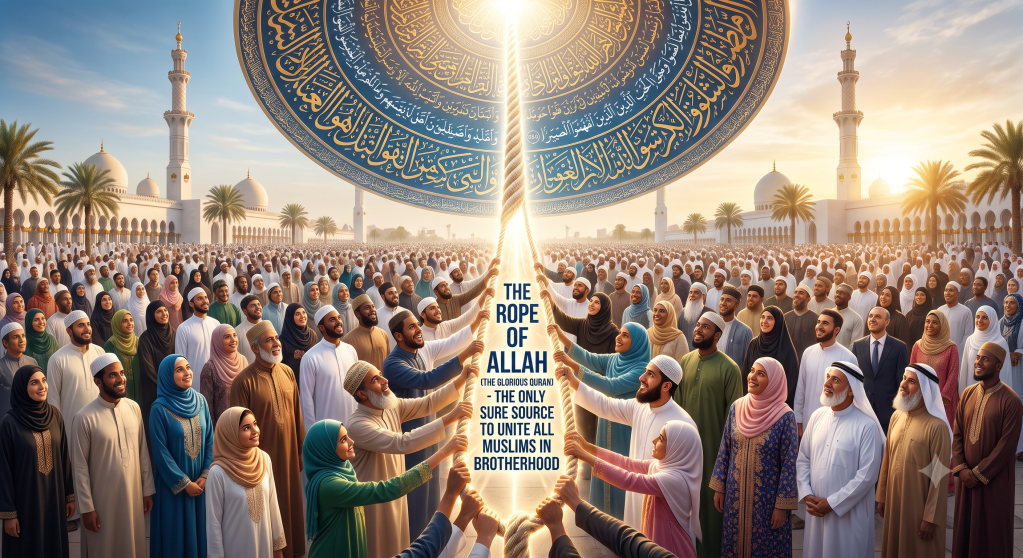
Presented by ChatGPT for Zia H Shah MD
Abstract
Qur’an 3:103 offers one of the most powerful foundations for Muslim unity:
“Hold fast, all together, to the Rope of Allah, and do not become divided.”
Classical exegetes explained the “Rope of Allah” as the Qur’an, Allah’s covenant, Islam, obedience to God, or the divinely guided community. These interpretations are complementary rather than contradictory: the Qur’an is the preserved textual embodiment of Allah’s covenant, the authoritative exposition of Islam, and the common source through which obedience to God is defined. Yet when the verse is applied to a Muslim world divided into competing schools and sects, the Qur’an must occupy a unique and indispensable position. Every major Muslim community recognizes the same Arabic Qur’an as revealed scripture, whereas they do not share every hadith collection, theological authority, juristic methodology, imam, caliph, or ecclesiastical structure.
Consequently, the only practicable interpretation capable of bringing all Muslims into a common brotherhood is to regard the Qur’an itself as the universally accessible Rope of Allah. Muslims should begin with its explicit teachings and their vast shared inheritance, allowing agreement to establish fellowship before disputed interpretations are discussed with learning, humility, and charity. Unity cannot mean absorption into one existing sect, because leadership by a specifically Sunni, Shi‘a, Ahmadi, Ibadi, Salafi, Sufi, or other sectarian authority would require other Muslims to surrender convictions fundamental to their own traditions. Qur’anic unity is therefore neither compulsory uniformity nor doctrinal indifference. It is a covenantal brotherhood centered on revelation: one Qur’an, one God, one Prophet, one qiblah, and a shared moral responsibility. Such unity realizes the Prophet Muhammad’s vision of the believers as a single living body in which the suffering of one member is felt by all.
The Verse
وَٱعْتَصِمُوا۟ بِحَبْلِ ٱللَّهِ جَمِيعًۭا وَلَا تَفَرَّقُوا۟ ۚ وَٱذْكُرُوا۟ نِعْمَتَ ٱللَّهِ عَلَيْكُمْ إِذْ كُنتُمْ أَعْدَآءًۭ فَأَلَّفَ بَيْنَ قُلُوبِكُمْ فَأَصْبَحْتُم بِنِعْمَتِهِۦٓ إِخْوَٰنًۭا وَكُنتُمْ عَلَىٰ شَفَا حُفْرَةٍۢ مِّنَ ٱلنَّارِ فَأَنقَذَكُم مِّنْهَا ۗ كَذَٰلِكَ يُبَيِّنُ ٱللَّهُ لَكُمْ ءَايَـٰتِهِۦ لَعَلَّكُمْ تَهْتَدُونَ
“And hold firmly together to the Rope of Allah and do not be divided. Remember Allah’s favor upon you when you were enemies, then He united your hearts, so you—by His grace—became brothers. And you were at the brink of a fiery pit and He saved you from it. This is how Allah makes His revelations clear to you, so that you may be rightly guided.” (Qur’an 3:103)
The verse contains five interconnected movements:
- Hold firmly to Allah’s Rope.
- Hold it collectively—jamīʿan, all together.
- Refuse destructive fragmentation.
- Remember that brotherhood is a divine favor.
- Recognize that revelation is the means of continuing guidance.
The sequence matters. The Qur’an does not merely command people to unite. Every sect, party, nation, and political movement calls for unity on its own terms. The verse first identifies the axis around which Muslims are to unite: not tribe, dynasty, race, nationality, personality, or institution, but the Rope belonging to Allah.
The Language of Rescue
The verb iʿtaṣimū comes from the root ʿ-ṣ-m, conveying protection, preservation, and seeking security against danger. The same root appears in the idea of being guarded from falling or being protected from harm. Holding the Rope is therefore not a decorative symbol of religious identity. It is an act of rescue.
The word ḥabl means a rope, cord, cable, bond, or means of connection. A rope may serve several purposes simultaneously:
- It connects what is separated.
- It provides something firm to grasp.
- It rescues a person from a pit.
- It permits ascent from a lower condition.
- Its separate strands gain strength when woven together.
The metaphor fits the remainder of the verse perfectly. Humanity stands “on the brink of a pit of Fire,” and revelation is the divinely extended means of rescue. It binds the believer vertically to God and horizontally to fellow believers.
The expression jamīʿan is grammatically and spiritually decisive. It does not merely mean that each Muslim should privately grasp the Rope. It means that they must grasp it together. The divine command is simultaneously personal and communal: no believer is excused from holding the Rope, but neither may any believer claim exclusive ownership of it.
The Historical Setting: From Enemies to Brothers
Classical commentators connect the verse especially with the tribes of Aws and Khazraj in Medina. Before Islam, they had suffered generations of hostility and warfare. Their grievances had accumulated into inherited identities: each generation received not merely its tribal name but the memories, wounds, and suspicions of its ancestors.
According to reports used by the exegetes, an attempt was once made to revive memories of their pre-Islamic battles. Old poetry was recited, passions rose, and members of the two tribes nearly returned to armed confrontation. The Prophet reminded them of Allah, Islam, and the brotherhood established through revelation. They recognized the temptation, wept, embraced, and abandoned the quarrel.
Thus, “when you were enemies, He united your hearts” is not sentimental language. It describes the transformation of an actual society. Islam did not merely negotiate a temporary ceasefire between Aws and Khazraj. It gave them a higher identity that relativized their inherited divisions. They remained aware of their tribal backgrounds, but those backgrounds could no longer be allowed to overrule their common submission to God.
This distinction is critical for the contemporary Muslim world. Unity does not require the disappearance of every historical, cultural, intellectual, or juridical identity. It requires that none of these subordinate identities be permitted to overturn the primary brotherhood created by faith.
What Is the “Rope of Allah”? The Classical Interpretations
Al-Ṭabarī
Al-Ṭabarī preserves several early interpretations. Mujāhid and ʿAṭāʾ explained the Rope as Allah’s covenant; Ibn Zayd identified it as Islam; while reports from Ibn Masʿūd, al-Suddī, al-Ḍaḥḥāk, and Qatādah explicitly identify it as the Qur’an. Qatādah calls the Qur’an the strong Rope that God commanded believers to grasp. Ibn Masʿūd is reported as saying:
“Hold fast to the Rope of Allah, for the Rope of Allah is the Book of Allah.”
These reports show that identifying the Rope with the Qur’an is not a late modern attempt to minimize the Islamic tradition. It is among the earliest recorded explanations of the verse. (Tafsīr al-Ṭabarī on 3:103)
The interpretations “Qur’an,” “covenant,” “Islam,” and “obedience” are not mutually exclusive. The Qur’an contains the covenant, defines submission, commands obedience, and provides the revealed grammar of the Muslim community.
Al-Rāzī
Fakhr al-Dīn al-Rāzī notices the wisdom of the verse’s order. Unity by itself is not necessarily virtuous: people may unite around injustice, prejudice, conquest, or falsehood. The verse therefore identifies the correct principle of union before prohibiting division. Muslims must unite by holding what comes from Allah.
This insight dismantles the assumption that numerical consolidation is automatically Qur’anic unity. A community may become politically centralized while remaining spiritually alienated from the divine Rope. Conversely, Muslims may lack a single political structure yet still manifest profound religious brotherhood through shared worship, mutual mercy, and adherence to the Qur’an.
Al-Qurṭubī
Al-Qurṭubī treats iʿtiṣām as seeking protection and explains the prohibition as forbidding division in religion, fragmentation through competing desires, and the mutual estrangement of believers. His commentary associates unity with the Qur’an and the divinely guided community, not with partisan loyalty. “Do not divide,” he explains, means that believers must not imitate earlier communities whose religion fractured through contending desires and sectarian antagonism. (Al-Qurṭubī on 3:103)
This is an important qualification. The Qur’an does not condemn every difference of opinion. Classical Muslim civilization accommodated multiple legal schools, interpretive methods, philosophical tendencies, and spiritual disciplines. What the verse condemns is tafarriq: a divisiveness that tears the moral and spiritual body of the community apart.
Ibn Kathīr
Ibn Kathīr records both “Allah’s covenant” and “the Qur’an” as explanations of the Rope. He cites the description of the Qur’an as Allah’s “strong Rope” and “straight path.” He then emphasizes that Allah commands communal unity and forbids fragmentation. (Ibn Kathīr on 3:103)
Again, the relationship between covenant and Book is organic: the Qur’an is not merely a manuscript containing information about the covenant. It is the continually recited form of that covenant. Every recitation renews the believer’s encounter with God’s address.
Al-Jalālayn and the Wider Classical Tradition
Al-Jalālayn glosses the Rope as Allah’s religion or covenant and relates the brotherhood in the verse to the transformation of Aws and Khazraj. Other early authorities speak of devotion to Allah, obedience, Islam, or the community. Ibn ʿAṭiyyah wisely observes that these explanations are close to one another.
They are best understood as concentric meanings:
- The Rope’s textual manifestation is the Qur’an.
- Its theological content is Allah’s covenant.
- Its comprehensive religious expression is Islam.
- Its human response is faith and obedience.
- Its social fruit is a united community.
The mistake would be to detach these meanings from one another. “Community” without revelation may become authoritarian collectivism. “Islam” defined exclusively by one later sect may become an instrument of exclusion. “Obedience” without a common criterion may mean submission to rival human authorities. The Qur’an anchors and evaluates every wider application.
The Qur’an as the Sure Common Ground
For relations among all Muslims, the Qur’an possesses a status no secondary authority can duplicate. Muslims disagree over the number, authenticity, and interpretation of particular hadiths. They follow different schools of jurisprudence, theological systems, lines of religious authority, and accounts of early Islamic history. Yet Sunni, Shi‘a, Ibadi, Ahmadi and other self-identifying Muslim communities recite essentially the same Arabic Qur’an.
This does not mean that the Sunnah is unimportant. The Qur’an itself presents the Prophet as teacher, exemplar, judge, and interpreter. Rather, it means that when Muslims belonging to different traditions seek a common starting point, the shared Qur’an must come before the disputed use of secondary sources. The Sunnah can then be studied through the Qur’an’s ethical and theological framework, with disagreements about particular reports discussed honestly.
Muḥammad ʿAbduh and Rashīd Riḍā make the identification unusually explicit in Tafsīr al-Manār: “The Rope of Allah is the Qur’an,” supported by early reports describing the Book of Allah as a rope extended from heaven to earth. (Tafsīr al-Manār on 3:103)
Abul A‘la Maududi explains Allah’s Rope as the divine way of life that preserves the believer’s relationship with God while binding believers into a community. Once Muslims loosen their grasp of this Rope and place subsidiary allegiances at the center, they divide into ever smaller factions. (Maududi on 3:103)
Maʿārif al-Qur’an makes the contemporary logic especially clear. Every party calls for unity around its own program; others, possessing their own programs, naturally resist. Lasting unity therefore requires a principle not invented by one human faction and imposed upon the rest. For Muslims, that common divine criterion is the preserved Qur’an. (Maʿārif al-Qur’an on 3:103)
In Shi‘a exegesis, ʿAllāmah Ṭabāṭabāʾ likewise treats the verse’s brotherhood as the real social fruit of divine unity. The reconciliation of hearts is itself the favor of God; brotherhood is not a polite fiction superimposed upon continuing hostility. (Al-Mīzān on 3:102–110)
The convergence is important. Though traditions differ about the full implications of authority, they can meet at the Qur’an before debating their differences.
Agreement Before Disagreement
A Qur’an-centered approach to Muslim unity should proceed in expanding circles.
First: affirm what is universally shared
Muslims affirm:
- The oneness and sovereignty of Allah.
- The prophethood of Muhammad.
- The divine revelation of the Qur’an.
- Prayer, charity, fasting, remembrance, and moral accountability.
- The resurrection and judgment.
- The sanctity of human life.
- Justice, compassion, honesty, patience, forgiveness, and service.
- The spiritual brotherhood of believers.
- Responsibility toward the poor, orphaned, displaced, oppressed, and vulnerable.
These are not a thin minimum. They constitute an immense theological, devotional, moral, and civilizational inheritance.
Second: allow the shared Qur’an to interpret itself
Relevant verses should be gathered and read together. Qur’an 3:103 must be read alongside:
- “The believers are but brothers, so make peace between your brothers” (49:10).
- “Obey Allah and His Messenger, and do not dispute, lest you lose courage and your strength depart” (8:46).
- “As for those who divided their religion and became sects, you have nothing to do with them” (6:159).
- “Establish the religion and do not become divided therein” (42:13).
- “Cooperate in righteousness and reverence, and do not cooperate in sin and aggression” (5:2).
- “If you disagree over anything, refer it to Allah and the Messenger” (4:59).
The Qur’an itself therefore distinguishes principled discussion from destructive disputation. Disagreement is anticipated; hostility is not authorized.
Third: discuss differences without making fellowship conditional upon victory
After common teachings have been established, Muslims can examine disputed questions concerning succession, hadith, jurisprudence, theology, religious experience, and institutional authority. Each side may present its evidence. But discussion should not begin with an ultimatum: “Accept our entire historical system before we recognize you as a brother.”
Brotherhood must provide the moral setting for disagreement. Otherwise, debate becomes warfare conducted with texts.
Unity Is Not Sectarian Absorption
The demand that all Muslims unite under one existing sectarian leadership contains a logical contradiction. A specifically sectarian leader derives authority from premises not shared by other sects. To submit fully to that leader would ordinarily require outsiders to accept the sect’s account of doctrine, history, law, and succession—in effect, to cease being what they presently are.
That is not unity among sects; it is conversion into one sect.
A Sunni cannot become united under a specifically Twelver doctrine of the Imamate without abandoning essential Sunni convictions. A Twelver Shi‘a cannot accept a specifically Sunni theory of caliphal legitimacy without revising foundational Shi‘a beliefs. Similar difficulties arise wherever a Sufi order, Salafi movement, Ahmadi caliphate, Ibadi imamate, political party, dynasty, or national state is presented as the universal axis of the ummah.
This does not mean that religious leadership is unnecessary. It means that sect-specific leadership cannot, merely by asserting itself, become the common Rope of Allah. Internal leadership may guide particular communities. Broader Muslim cooperation, however, must be organized around principles accessible to all: the Qur’an, consultation, justice, accountability, freedom of conscience, mutual security, and service to humanity.
A universal Muslim council, for example, could include different traditions without declaring one sect’s entire theology binding upon the others. Its authority would be consultative and covenantal rather than sectarian. It could defend mosques and sacred sites, coordinate humanitarian aid, oppose persecution, encourage scholarship, and mediate disputes while leaving doctrinal questions to persuasion rather than coercion.
Unity Does Not Mean Uniformity
A body is one precisely because its organs are not identical. An eye is not a hand, and a heart is not a lung. Their differences serve life when they remain integrated; they become pathological when one attacks another or refuses to serve the whole.
Likewise, Muslim unity need not abolish every school of law, cultural tradition, devotional practice, or intellectual perspective. The Qur’an’s prohibition is not “do not differ in any judgment.” It is “do not become divided.” The distinction is between ikhtilāf, which may be an honest difference of understanding, and tafarriq, the conversion of difference into hostile camps.
Legitimate diversity becomes sectarianism when:
- A school claims exclusive possession of Islam.
- Historical grievances become permanent moral permission for hatred.
- Other Muslims’ lives, mosques, and dignity are treated as expendable.
- Sectarian authorities are placed beyond scrutiny.
- Salvation is distributed by party membership.
- Common Qur’anic obligations are neglected in favor of polemical victory.
Conversely, unity becomes empty rhetoric when it suppresses sincere questions, conceals injustice, or demands silence from the oppressed. Qur’anic brotherhood is truthful as well as compassionate.
The Prophetic Vision: The Ummah as One Body
The Prophet Muhammad said:
“The likeness of the believers in their mutual love, mercy, and compassion is that of one body: when one limb suffers, the whole body responds with sleeplessness and fever.”
The report is transmitted in both Ṣaḥīḥ al-Bukhārī 6011 and Ṣaḥīḥ Muslim 2586. (Ṣaḥīḥ Muslim 2586a; Ṣaḥīḥ al-Bukhārī 6011)
The Prophet chose three relational words: mutual love, mutual mercy, and mutual sympathy. The body is therefore not united merely because its members bear the same label. Its unity is demonstrated through shared sensation and responsive care.
If a Muslim community is massacred, displaced, starved, persecuted, or deprived of education, the rest of the ummah cannot remain emotionally anesthetized. The true measure of unity is not the frequency with which Muslims speak of the ummah but whether the pain of distant believers interrupts their comfort.
The hadith also corrects triumphalist models of leadership. The head does not prove that the body belongs to it by destroying the limbs. Authority exists to coordinate care for the organism. When leadership deepens hatred, excuses cruelty, or treats some Muslims as disposable, it betrays the bodily metaphor.
Another authentic report states that Allah is pleased when believers worship Him alone, “hold fast to the Rope of Allah and do not become divided,” and sincerely counsel those entrusted with authority. (Ṣaḥīḥ Muslim 1715a) Worship, unity, and accountable leadership thus belong together.
“He United Your Hearts”
The verse does not say merely that Allah aligned the interests of Aws and Khazraj. It says:
فَأَلَّفَ بَيْنَ قُلُوبِكُمْ
“He joined your hearts together.”
Political alliances can be negotiated, but hearts cannot be permanently joined by calculation alone. Earlier in the same surah, believers are warned against influences that would make them turn back after receiving faith. Later verses prohibit imitating communities that divided after clear proofs came to them. The unity of hearts therefore requires spiritual work:
- humility before revelation;
- repentance from arrogance;
- restraint of the tongue;
- refusal to caricature opponents;
- willingness to hear evidence;
- forgiveness of inherited injuries;
- justice even toward those one dislikes;
- prayer for fellow Muslims rather than merely against them.
The Qur’an is the common Rope, but merely owning or reciting it will not produce unity if hearts approach it seeking ammunition against others. The Book unites when believers permit it to judge their own prejudices.
“You Were on the Brink of a Pit of Fire”
Classical commentators understand the pit both historically and eschatologically. Tribal warfare had brought the Arabs near social destruction, while unbelief and hatred placed them near the Fire of the Hereafter. Islam rescued them from both.
The same double warning applies today. Sectarianism produces worldly hells before the final judgment: bombed mosques, displaced families, intellectual stagnation, authoritarian exploitation, and generations educated to hate fellow Muslims. Every faction imagines that only the other side is standing at the brink. The verse addresses all collectively.
Significantly, Allah says, “He saved you from it.” No tribe saved itself. No school may boast that its own brilliance produced brotherhood. Unity is a grace requiring gratitude; once appropriated as a sectarian achievement, it begins to disappear.
A Practical Qur’anic Charter of Muslim Brotherhood
A contemporary application of 3:103 could rest on the following commitments:
- The Qur’an is the supreme shared scripture and the first common reference in inter-Muslim dialogue.
- Every person who sincerely professes the Islamic testimony of faith is presumptively treated as a Muslim; excommunication is never a casual political or polemical instrument.
- Mosques, lives, property, families, and dignity are inviolable regardless of sectarian identity.
- Shared Qur’anic beliefs and moral duties are taught before inherited polemics.
- Historical and theological disputes may be discussed, but without coercion, mockery, incitement, or dehumanization.
- No sectarian leader is presented as the necessary universal leader of all Muslims merely on the authority of that sect’s contested premises.
- Common institutions operate through consultation, transparency, and fair representation.
- Muslims cooperate in education, health care, poverty relief, peacemaking, environmental stewardship, and the defense of religious freedom.
- The suffering of any Muslim community is treated as a wound to the whole body, without making compassion dependent upon sect, ethnicity, nationality, or political usefulness.
- Unity is never used to suppress justice; reconciliation must include truth, restitution, and protection against renewed wrongdoing.
This is not a program for theological relativism. It is a disciplined order of priorities: common revelation first, shared duties second, respectful investigation of differences third.
The Central Conclusion
Exegetically, “the Rope of Allah” possesses a rich field of mutually reinforcing meanings: the Qur’an, Allah’s covenant, Islam, obedience, and the divinely guided community. But for the concrete task of uniting Muslims belonging to rival traditions, the Qur’an must be recognized as the foundational and universally shared form of that Rope.
The Qur’an is not the property of any sect. No historical faction authored it, and none may stand between it and the rest of the ummah. Every Muslim approaches it as a servant, learner, and moral respondent. Its centrality therefore creates a shared forum without requiring prior surrender to the complete doctrines of another community.
Muslims can begin where the Qur’an is clear and where their commentaries converge. They can worship together where worship is shared, serve together where suffering calls, defend one another where dignity is threatened, and study together where knowledge is sought. Thereafter, they may discuss differences patiently, recognizing that intellectual disagreement does not nullify the brotherhood God established.
Thematic Epilogue: One Rope, Many Hands, One Living Body
The image of the Rope and the image of the body illuminate one another.
The Rope descends from above; the body grows through relationships below. The Rope supplies transcendence, revelation, and direction. The body supplies sympathy, interdependence, and service. Without the Rope, the body has no sure divine orientation. Without the body, attachment to the Rope can become an individual slogan without social mercy.
The Qur’an does not ask Muslims to pretend that their disagreements do not exist. It asks them to ensure that disagreement never becomes a substitute for revelation or an excuse for hatred. It does not command every Muslim to enter one sectarian house. It summons every sectarian house into a larger courtyard belonging to Allah, where the Qur’an is recited, the one God is worshipped, Muhammad is honored as His Messenger, and every believer’s dignity is protected.
A rope can be grasped by many hands without becoming the possession of any one hand. Indeed, its purpose is defeated when one group tries to cut away the hands of others. Likewise, a body remains alive not by making every organ identical, but by allowing every organ to recognize the life it shares with the whole.
The future unity of Muslims will therefore not arise from the victory of one sect over all others. It will arise when Muslims refuse to confuse unity with domination; when they place the Qur’an above inherited factional pride; when they begin dialogue with shared truths rather than disputed conclusions; and when the suffering of any Muslim causes moral wakefulness and fever throughout the entire ummah.
Then “Hold fast, all together, to the Rope of Allah” will cease to be merely a verse recited at conferences and become a lived covenant. Muslims will remain capable of disagreement, yet incapable of indifference to one another. Many hands will grasp one Rope, and many members will awaken as one body.





Leave a Reply