
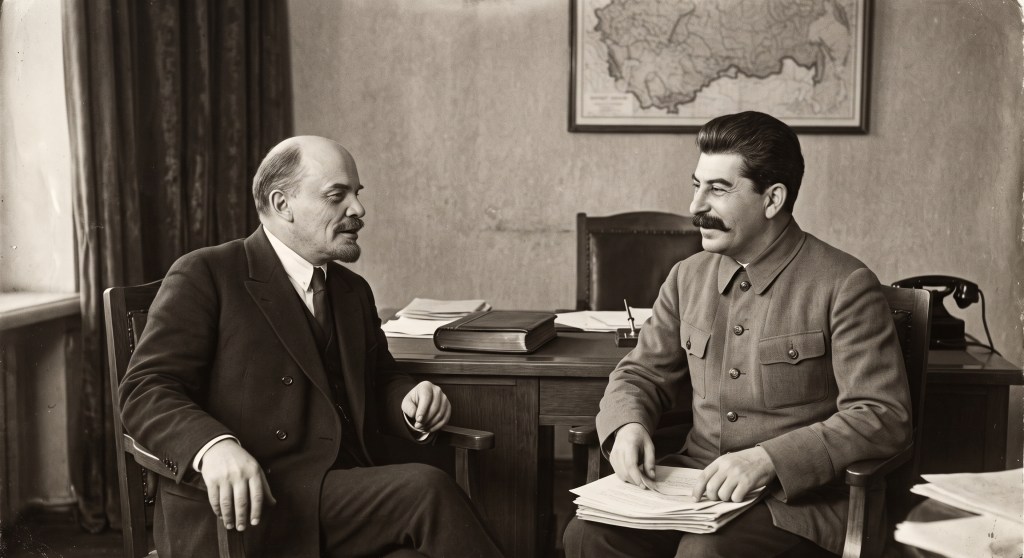
Presented by ChatGPT for Zia H Shah MD
Abstract
Joseph Stalin, born Ioseb Jughashvili in Georgia in 1878, rose from a church education and a revolutionary underground to become the dominant ruler of the Soviet Union. His government expanded heavy industry, education, and Soviet military power, helped defeat Nazi Germany, and established a superpower. It also imposed agricultural collectivization, devastating famines, mass executions, forced labor, ethnic deportations, and a system in which fear penetrated public and private life. This biography traces the relationship between his personal development, Marxist convictions, political skill, and responsibility for state violence. Particular attention is given to his years at the Tiflis Theological Seminary, his subsequent atheism and persecution of religious institutions, the disputed accounting of deaths attributable to his rule, and his daughter Svetlana Alliluyeva’s description of his final illness. The evidence establishes responsibility for millions of deaths, while requiring distinctions between documented killings, deaths under coercive conditions, famine mortality, and wartime casualties. His death in March 1953 left a powerful state but also a society burdened by bereavement, silence, and institutionalized mistrust.
1 Childhood in imperial Georgia
Stalin was born in Gori, a Georgian town within the Russian Empire, on 18 December 1878 according to the Gregorian calendar, corresponding to 6 December in the Julian calendar then used in Russia. His regime later celebrated 21 December 1879 as his birthday. The discrepancy is a small but revealing example of the distance between the historical person and his official image. His Georgian name, Ioseb Besarionis dze Jughashvili, became the Russified Iosif Vissarionovich Dzhugashvili; “Joseph Stalin” was the form familiar internationally. [1, 2]
His father, Besarion, was a shoemaker. His mother, Ekaterine Geladze, usually called Keke, worked to support the family and was determined to secure her son an education. Family life was troubled by his father’s drinking and periods of violence and separation. Yet an account that makes Stalin’s entire later career the inevitable product of an abusive childhood explains too much with too little evidence. His circumstances changed over time, and his mother’s commitment created opportunities unavailable to many children around him. [3]
Smallpox left facial scars, and a damaged or impaired left arm remained a lifelong physical limitation. He nevertheless became an able pupil at the Gori church school, which he attended from 1888. Georgian was his first language; education in Russian gave him access to the wider imperial world. He acquired a strong memory, an interest in literature, and experience of religious singing. The future dictator was neither an uneducated peasant who accidentally obtained power nor a fully formed tyrant in childhood. He was an ambitious provincial student whose developing abilities could have taken several directions. [2–4]
Georgia’s position mattered. The young Jughashvili encountered the tension between local language and culture and the authority of a Russian imperial state. Religious education offered advancement while also exposing students to the discipline and cultural hierarchy of that state. His later revolutionary identity emerged within this setting, where national resentment, social inequality, and radical ideas overlapped.
2 The seminarian who became a revolutionary
In 1894, aged fifteen, Jughashvili entered the Tiflis Theological Seminary on a scholarship. Tiflis is modern Tbilisi. The institution trained clergy within the Russian Orthodox ecclesiastical order then imposed in Georgia. He was a seminarian preparing for a possible priestly vocation; he was never ordained. His mother hoped that this education would give him a respected and secure life. [3, 4]
The curriculum included scripture, theology, church history, liturgy, classical languages, literature, and other academic subjects. His earlier academic distinction is well attested, and he initially performed strongly at the seminary. The claim that he remained uniformly the highest-ranking student throughout his years there needs qualification: surviving accounts describe changes in his performance and increasing disciplinary difficulties. Theological literacy and later hostility to religion are both part of his biography. One does not cancel the other. [4, 5]
The school’s controlled routines, restrictions on reading, surveillance, and Russian-language environment helped foster resentment among some students. Jughashvili read forbidden literature and entered socialist circles. His intellectual transformation was gradual: Georgian literary and national interests preceded and accompanied his absorption in Marxism. It is safer to describe engagement with Marxist literature and local revolutionaries than to imagine one reading of Marx or Lenin instantly converting a devout student into the future Soviet ruler.
Stalin supplied his own retrospective explanation in a 1931 interview with the German writer Emil Ludwig. He associated his revolutionary development with underground Marxist groups and rebellion against the seminary’s oppressive discipline. This is valuable testimony about how he wished to explain himself, but it is also a successful dictator’s reconstruction of his youth. It cannot independently settle the chronology of his loss of faith or every circumstance of his departure. [6]
He ceased attending in the spring of 1899 and did not take the examinations needed to complete his course. Accounts variously emphasize withdrawal, failure to appear for examinations, financial difficulty, or revolutionary activity. April is often given for his effective departure, while May appears in accounts of his formal removal. Soviet official biography later presented him as expelled for Marxist propaganda. These descriptions need not refer to precisely the same administrative event. The secure conclusion is that he left in 1899 without qualifying and increasingly committed himself to revolutionary work. A categorical claim that one disputed explanation is certainly the “real reason” goes beyond the evidence. [4, 5, 7]
His seminary years suggest a significant historical possibility: institutions that prohibit inquiry can intensify rebellion against their authority. They do not demonstrate that theological education causes tyranny. Most seminarians did not become dictators, and Stalin’s subsequent choices were shaped by decades of political struggle, institutional opportunity, and personal ambition.
3 Underground politics and the making of Stalin
At the turn of the century, Jughashvili became an organizer among workers in the Caucasus. He circulated illegal literature, helped organize strikes, and acquired experience of clandestine networks. He joined the Russian Social Democratic movement and sided with Lenin’s Bolshevik faction after the party split in 1903. Arrests, imprisonment, exile, and escapes punctuated his early career. His last substantial pre-revolutionary exile, in remote Siberia, lasted until the collapse of tsarism in 1917. [1, 8]
Revolutionary financing could include robbery and other violence. Stalin was associated with the Bolshevik network involved in the 1907 Tiflis bank robbery, carried out by militants including Kamo. The extent of his operational role is disputed; he should not automatically be portrayed as personally leading every action later attached to his legend. What is clear is his acceptance of an underground political culture in which violence could be justified as service to the revolution.
He used several aliases, notably “Koba,” drawn from a Georgian literary character. Around 1912–1913 he adopted “Stalin,” suggesting a man of steel. Lenin brought him into the Bolshevik Central Committee in 1912. His essay on Marxism and the national question, published in 1913, helped establish a reputation extending beyond local organizational work. The pseudonym eventually displaced the Georgian family name as the designation of a political identity. [1, 8]
The familiar portrait of Stalin as merely a dull bureaucrat is misleading. His strengths differed from Trotsky’s public brilliance, but they included persistence, an excellent memory for people and disputes, organizational skill, and an ability to present political arguments in accessible language. These attributes became dangerous when joined to a willingness to treat rivals as enemies whose destruction could be morally justified.
4 Revolution civil war and the foundations of dictatorship
Following the February Revolution of 1917, Stalin returned to Petrograd and worked on the Bolshevik newspaper Pravda. His initial position toward the Provisional Government was less radical than Lenin’s subsequent demand for a new revolutionary break. Once Lenin returned, Stalin supported the party’s course toward the seizure of power. He participated in the Bolshevik leadership in October, although later propaganda greatly inflated his personal role. [1, 8]
In Lenin’s government he became people’s commissar for nationalities. During the civil war he served on important political and military assignments, including at Tsaritsyn, later renamed Stalingrad. He distrusted former imperial officers serving the Red Army and clashed with Trotsky over military authority. Civil war normalized coercion, emergency administration, confiscation, and the classification of opponents as enemies of the revolution.
Stalin inherited an increasingly authoritarian political structure. The Bolsheviks had already eliminated competing centers of power, developed the political police, suppressed opposition, and curtailed organized dissent within their own party. This history does not make every subsequent Stalinist crime inevitable. It explains how a leader could acquire instruments of violence without having to construct them from nothing. The question was increasingly who would control the party-state and how far that control would extend. [9]
In April 1922 Stalin became general secretary of the Communist Party. The office gave him influence over appointments, organizational information, and access to the leadership. Patronage could produce loyalty, but it also let him shape which officials would participate in future decisions. His ascent depended on accumulating practical advantages inside institutions that formally proclaimed collective leadership.
Lenin’s final writings expressed alarm. In his December 1922 notes and January 1923 addition, commonly called his testament, he warned about Stalin’s concentration of authority and proposed considering his removal as general secretary. Lenin also criticized other leaders; the document was not a simple endorsement of Trotsky as successor. After Lenin’s death in January 1924, Stalin’s allies helped prevent the warning from destroying his career. [10]
5 Defeating rivals and concentrating power
Stalin did not inherit supreme power in a single act. He first cooperated with Grigory Zinoviev and Lev Kamenev against Trotsky, then with Nikolai Bukharin and others against the former allies, and eventually turned against Bukharin. Disputes concerned genuine questions of economic development, revolution abroad, and relations with the peasantry. Stalin nevertheless combined doctrinal argument with control over personnel, disciplinary procedures, and shifting coalitions. [8, 11]
His advocacy of “socialism in one country” promised that the Soviet Union could construct socialism without waiting for successful revolutions elsewhere. It appealed to a party exhausted by upheaval and seeking a workable national project. His positions on economic policy changed as alliances and circumstances changed. He could denounce opponents for excessive radicalism and later pursue measures more coercive than those he had previously rejected.
By the end of the 1920s Stalin was the predominant leader. Trotsky was expelled from the Soviet Union in 1929 and assassinated in Mexico in 1940 by an agent of the Soviet security apparatus. Zinoviev, Kamenev, and Bukharin would be executed after show trials. Political defeat increasingly became a preliminary stage of physical destruction. [8, 11]
The cult of personality strengthened alongside this concentration of power. Portraits, celebrations, textbooks, films, and official histories represented Stalin as Lenin’s uniquely faithful successor and the source of the country’s achievements. The cult also changed the behavior of officials: demonstrating enthusiasm became safer than displaying independent judgment. A system ostensibly dedicated to collective emancipation made the ruler’s approval central to individual survival.
6 Industrial transformation collectivization and famine
From 1928 onward, the Five-Year Plans accelerated heavy industrial development. New factories, power stations, mines, and industrial cities expanded Soviet productive capacity. Education and technical training created avenues of advancement for many people. The Soviet Union acquired an industrial base that later mattered enormously in the struggle against Nazi Germany. These developments belong in a serious biography, but their existence does not prove that Stalin’s particular methods were necessary or that their human costs were justified. [8, 9]
Forced collectivization transformed rural life. Peasant households lost control over land, livestock, production, and much of their harvest. The campaign against “kulaks,” supposedly prosperous exploitative peasants, used an elastic category that could include families whose offense was resistance or local unpopularity. Confiscation, deportation, violence, and punitive procurement shattered communities. The state treated the countryside as a source of resources for its wider project while denying rural people an effective political voice.
The famine of the early 1930s affected Ukraine, Kazakhstan, parts of Russia, and other regions. Harvest conditions and agricultural disruption mattered, but state policy was central: unrealistic demands, confiscation, restrictions on movement, and the punishment of alleged resistance turned shortages into catastrophe and obstructed escape. Historians debate the relative importance and intention of particular measures. That debate does not erase the leadership’s knowledge of suffering or its responsibility for choices that sustained it. [12, 13]
In Ukraine, the Holodomor killed millions. Research presented by Harvard’s MAPA project estimates approximately 3.9 million excess deaths in 1932–1934. This is distinct from an additional estimated deficit of 600,000 births; births that did not occur must not be described as people killed. The Ukrainian catastrophe is widely understood as genocide, including by historians who emphasize the connection between starvation and attacks on Ukrainian national life. Other scholars dispute aspects of intent or the application of that classification while accepting the immense, policy-driven mortality. [13, 14]
Kazakhstan’s experience requires separate attention. Collectivization and pressure to abandon pastoral ways of life devastated livestock economies. Sarah Cameron’s research places the death toll above 1.5 million people, roughly a quarter of the republic’s population, including more than a third of ethnic Kazakhs. This was not merely a peripheral version of the Ukrainian tragedy: its mechanisms included the assault on a mobile pastoral society and the destruction of its means of subsistence. [15]
The political meaning of these famines extends beyond failed economic management. A state that criminalizes unwelcome information can persist in disastrous policies because both officials and victims have reason to conceal the truth. Stalin’s power deprived society of peaceful means to compel a change of course.
7 The Great Terror and the Gulag
The assassination of Leningrad party leader Sergei Kirov in December 1934 became a pretext for expanding repression. Stalin’s personal responsibility for arranging the assassination remains unproven; his exploitation of it is clear. The subsequent show trials represented veteran Bolsheviks as conspirators working for hostile powers. Confessions extracted under coercion supplied theatrical confirmation of allegations whose political purpose was the destruction of opposition. [9, 11]
The most intensive mass killing occurred in 1937–1938. The NKVD, headed for much of this period by Nikolai Yezhov, conducted mass operations against supposed former kulaks, criminals, national minorities, and other designated enemies. Local officials participated, sometimes pushing for enlarged quotas, but the campaign depended on authorization and direction from the center. Stalin was not an uninformed observer of a police force operating beyond his knowledge. The regime’s violence was administered through orders, lists, categories, and approvals. [16, 17]
Approximately 682,000 executions are documented for those two years. The more precise figure commonly cited in archival scholarship is 681,692. Its apparent precision should not be mistaken for a count of every death caused by the terror: deaths in detention and other categories require separate treatment. The victims also extended far beyond famous party leaders. Workers, peasants, clergy, professionals, and members of targeted ethnic groups constituted much of the human loss. [16–18]
The Gulag was an extensive system of forced-labor camps and colonies. Prisoners worked in mining, forestry, construction, and other punishing environments. Hunger, disease, exposure, overwork, violence, and inadequate care killed enormous numbers. Many prisoners survived and were eventually released; this fact corrects an inaccurate picture of automatic extermination without mitigating the institution’s brutality. Counting admissions or sentences as deaths is a serious statistical mistake. [18, 19]
Repression damaged people beyond the direct victim. A spouse could be arrested, children displaced, and surviving relatives pressured to renounce the condemned. Knowing someone who disappeared could become dangerous knowledge. Informing on others might arise from conviction, opportunism, personal grievance, or an attempt at self-preservation. These mechanisms helped turn a ruler’s campaigns into pervasive social relationships of fear.
8 Stalin and the Second World War
On 23 August 1939 the Soviet Union and Nazi Germany concluded the Molotov–Ribbentrop Pact. Secret arrangements divided parts of Eastern Europe into spheres of influence. Germany invaded Poland on 1 September; Soviet forces entered from the east on 17 September. Stalin’s government subsequently annexed territories and attacked Finland. The pact bought time and territory for the USSR while facilitating Hitler’s attack on Poland and exposing populations to Soviet occupation and repression. [20]
In spring 1940 the Soviet security police murdered roughly 22,000 Polish officers, prisoners, and members of the intelligentsia in the operation commonly called the Katyn massacre. Archival documents establish Stalin’s approval. For decades the Soviet government blamed Nazi Germany. The crime therefore involved both the destruction of human beings and a sustained assault on their families’ ability to establish the truth. [21]
Hitler invaded the Soviet Union on 22 June 1941. Stalin’s misreading of German intentions, restrictions on military preparedness, and the earlier destruction of experienced officers contributed to the scale of the initial disaster. Responsibility for the invasion and the Nazi war of annihilation rests with Hitler’s regime. Stalin’s serious failures do not transfer that primary responsibility to the country that was invaded. [20, 22]
Stalin remained the central Soviet war leader. He chaired the State Defense Committee, assumed supreme military command, and helped coordinate the mobilization of industry and manpower. Over time he became more willing to work through experienced commanders. Soviet resistance at Moscow, the victory at Stalingrad, the battle of Kursk, and subsequent offensives turned the war. Victory depended on soldiers and civilians from across the USSR, industrial evacuation, military learning, and Allied assistance. It cannot adequately be explained as the accomplishment of one man. [22, 23]
The Soviet contribution to defeating Nazism was decisive. The Red Army also liberated survivors of Nazi camps. At the same time, Stalin’s forces brought a new structure of domination to much of Eastern Europe, and Soviet personnel committed grave abuses, including sexual violence against civilians. Liberation from Nazism and freedom from dictatorship were different historical experiences. [20, 22]
The war did not suspend Stalinist collective punishment. Chechens, Ingush, Crimean Tatars, Volga Germans, and other communities were subjected to deportation, with entire populations treated as suspect. Families died in transit and exile. Such measures replaced individual evidence with inherited or collective guilt. Victory enlarged Stalin’s prestige without removing the violence built into his government. [36]
Stalin also negotiated the emerging international order. At Tehran in 1943, Yalta in February 1945, and Potsdam that summer, he bargained with the Western Allies over military strategy, Germany, Poland, and the balance of power. He promised Soviet entry into the war against Japan, which followed in August 1945. Agreements over postwar Europe were shaped by both diplomacy and the location of occupying armies. His determination to secure Soviet predominance clashed with Western expectations of political freedom in countries under Soviet influence. [37]
9 His atheism and the persecution of religion
Stalin’s adult political outlook was atheistic and materialist. His former theological training does not establish a hidden continuation of Orthodox belief. Nor does acquaintance with biblical language prove religious conviction: a person can retain the vocabulary and habits of an education after rejecting its teachings. His public arguments and state policies provide firmer evidence than stories of secret devotion.
In his 1938 exposition of dialectical and historical materialism, Stalin presented matter as fundamental and consciousness as arising from material processes. Historical development was to be understood through social production and class relations. Within this framework, religion was treated as a human and social phenomenon rather than revelation from a transcendent source. This was an asserted philosophical worldview, not an experimental demonstration that all religious claims had been disproved. [24]
His political commitment was explicit. Answering an American labor delegation in 1927, he declared: “The Party cannot be neutral towards religion.” He defended anti-religious propaganda as part of the struggle against religious prejudice and the influence of clergy. Although he also invoked formal freedom of conscience, his account placed the party in active opposition to religion. The tension between legal professions and coercive practice was substantial. [25]
Under Stalin, religious persecution included the closure and destruction of places of worship, confiscation of property, restrictions on religious teaching, harassment of believers, and the imprisonment or execution of religious personnel. Orthodox Christians were major targets, but Muslims, Jews, Catholics, Protestants, Buddhists, and others also suffered. Campaigns associated with militant atheism sought to replace inherited belief with the state’s approved interpretation of society. Religious organizations were vulnerable both because of their beliefs and because they could sustain loyalties outside the party. [9]
The distinction between secular government and coercive state atheism is essential. A government can remain institutionally separate from religion while protecting believers and nonbelievers equally. Stalin’s system went much further: it attempted to regulate the permissible sources of meaning, association, and public authority. Freedom of conscience was subordinated to the political project.
The wartime accommodation with the Church
The German invasion encouraged a tactical change. Religious patriotism could support national resistance, and the regime had reasons to improve its standing with foreign allies. On 4 September 1943 Stalin met senior Orthodox hierarchs. He permitted the election of a patriarch and a limited restoration of institutional church life. A contemporary American diplomatic report records this development. [26]
The accommodation was significant, but it did not establish religious equality or demonstrate Stalin’s return to Christian faith. A controlled church could be useful to an atheist ruler. The episode shows his flexibility in choosing instruments of power and the resilience of religious attachment despite years of repression. It also warns against treating the regime’s religious policy as an unchanging line of identical measures throughout his rule.
What his atheism can and cannot explain
Atheism was not incidental to Stalinism. Hostility to religion supplied a language of justification for particular campaigns and helped define clergy and independent religious communities as obstacles. An adequate account must acknowledge that ideological connection rather than explain persecution entirely as a personal quarrel with priests.
Yet atheism alone does not explain the Gulag, collectivization, or the Great Terror. Other relevant causes include revolutionary class ideology, party monopoly, imperial and security ambitions, incentives within the bureaucracy, and Stalin’s personal decisions. Nonbelief does not logically entail dictatorship, and many atheists defend human rights and freedom of conscience. Similarly, religious profession does not guarantee that a ruler will honor those rights. Historical explanation becomes weaker when it substitutes guilt by association for specific causal evidence.
From a theological standpoint, Stalin’s career can be read as a warning about the elevation of a finite ruler and his political project into an ultimate authority. That is an interpretation, not a substitute for archival history. The deeper moral question concerns whether human beings retain claims on our conscience when a state declares that their destruction serves a supposedly higher future. Stalin’s system repeatedly answered that question in favor of the state.
10 The private man and his family
Stalin married Ekaterine “Kato” Svanidze in 1906. Their son Yakov was born in 1907; Kato died that year. In 1919 he married Nadezhda Alliluyeva, with whom he had Vasily and Svetlana. Nadezhda died by suicide in November 1932. The precise combination of personal distress, marital conflict, and political disillusionment behind her death cannot be reconstructed with certainty. It should not be reduced to one dramatic explanation. [3, 27]
Yakov, a Red Army officer, fell into German captivity and died at Sachsenhausen in 1943. Vasily’s later life was marked by alcoholism and instability. Svetlana grew up with privileges unavailable to ordinary Soviet children but also with secrecy, bereavement, and the disappearance of relatives. Stalin’s authority could reach into her attachments: her relationship with the filmmaker Aleksei Kapler was followed by Kapler’s arrest. [3, 27]
Private tenderness and public cruelty are not mutually exclusive. A dictator’s affection for a child does not disprove his responsibility for mass violence, just as cruelty toward relatives does not independently explain an entire political system. Stalin’s family matters because it reveals the reach of political power into intimate life. People close to the ruler could be both beneficiaries of privilege and victims of the mechanisms he commanded.
He read extensively, followed literature and cinema, and intervened in cultural affairs. Intellectual curiosity did not produce intellectual tolerance. Artists and scholars depended on decisions that could turn approval into persecution. His support for ideological interference in science, including the ascendancy of Trofim Lysenko in biology, further illustrates how claims to scientific authority could coexist with the suppression of open inquiry. The consequences arose when political loyalty became a test of truth. [28, 38, 39]
11 The postwar superpower and the final campaigns
By 1945 the Soviet Union had achieved enormous military prestige and extended its power across Eastern Europe. Communist governments consolidated authority under Soviet influence. The confrontation with the Western powers hardened into the Cold War. The Berlin blockade of 1948–1949 failed to expel the Western Allies, while the first Soviet atomic test in 1949 ended the American nuclear monopoly. Stalin had helped create a state capable of projecting power far beyond its borders. [1, 23]
At home, peace brought neither general freedom nor an end to deprivation. The famine of 1946–1947 emerged from war damage and drought but was intensified by policy choices concerning procurement, distribution, and reserves. Michael Ellman’s study estimates between 1.0 and 1.5 million excess deaths and argues that different priorities could have prevented or substantially reduced the catastrophe. [29]
Stalin also supported Kim Il Sung’s decision to invade South Korea in June 1950. Soviet approval, weapons, and training were important to the outbreak of a war that inflicted enormous losses. This establishes responsibility extending beyond Soviet domestic repression, although allocating every death in a multinational war to one leader would obscure the roles and decisions of other participants. [30]
The late Stalin years included renewed attacks on alleged foreign influence, the persecution of Jewish cultural figures, and increasingly antisemitic campaigns. The fabricated Doctors’ Plot, publicly announced in January 1953, accused physicians, many of them Jewish, of murderous conspiracy. Arrests and coercion followed. Stalin died before the campaign’s possible next stage could become clear. Claims that a fully settled plan for deporting all Soviet Jews has been conclusively proved should be treated cautiously. [2, 3]
His last years displayed a familiar pattern: insecurity was answered by suspicion, suspicion by investigation, and investigation by pressure to discover conspiracies. The structure rewarded confirmation of the ruler’s fears. It also made loyal service no guarantee of safety.
12 How many deaths did Stalin cause
The most defensible short answer is that Stalin and his regime caused millions of deaths; an influential post-archival synthesis by Timothy Snyder gives approximately six million deliberate killings and about nine million when foreseeable deaths from hunger, deportation, and confinement are included. Other reconstructions produce higher totals, particularly when using higher famine estimates or broader categories. Nine million is therefore a named historian’s accounting, not a universally settled final number. [18]
Why the figures differ
There are several different questions concealed within “How many did he kill?” One concerns executions ordered or carried out by the state. Another concerns people who died because the state imprisoned, deported, or starved them. A third concerns excess mortality under policies that officials knew were disastrous. A fourth includes military deaths arising from war, aggression, or strategic failure. These questions overlap, but they are not interchangeable.
Records may count sentences rather than completed executions, admissions rather than unique prisoners, or deaths inside camps while missing those occurring shortly after release. Demographic calculations depend on estimates of expected mortality, migration, and population registration. Archives improved knowledge profoundly after the Soviet collapse, but they did not make all categories complete or eliminate methodological disagreement. [17, 19, 31]
The following figures show scale and scope. They must not be added mechanically: some rows are subsets of others, and different studies use different periods and definitions.
| Category | Approximate deaths or estimate | What the figure means |
| Great Terror of 1937–1938 | About 682,000 | Documented executions; a subset of the wider execution total. [16, 17] |
| Wider Soviet execution record for 1921–1953 | About 800,000 recorded | A frequently cited archival series. It begins before Stalin’s supremacy and is not a complete count of all lethal repression. [31] |
| Gulag deaths during the Stalin era | Roughly 1.5–1.7 million in commonly cited archival-based estimates | Coverage and treatment of deaths outside recorded custody affect the total. Broader reconstructions are higher. [19, 31] |
| Deportation and special settlements | Hundreds of thousands | Deaths in forced resettlement and exile; wider penal-system estimates may already include some of these victims. [18, 31] |
| Soviet famine of the early 1930s | Estimates differ substantially; the MAPA demographic summary reports 8.7 million for 1932–1934 across the USSR | Includes about 3.9 million in Ukraine; regional totals are not additional deaths to add again. [13] |
| Postwar famine | About 1.0–1.5 million | Ellman’s estimate for the 1946–1947 famine crisis and its mortality consequences. [29] |
The famine estimate is especially consequential. Older influential accounts used lower all-Union totals than the 8.7 million reported in the MAPA demographic summary. It would be inconsistent to insert a higher famine estimate into Snyder’s accounting while leaving every other element untouched and still call the result “Snyder’s estimate.” A new total requires reconciling populations, dates, categories, and overlap. [13, 18]
Responsibility does not require a personal execution order for every victim
Stalin bears direct responsibility for authorized executions and major repressive campaigns. He also bears responsibility for creating and maintaining conditions in which foreseeable deaths occurred on a vast scale. Deliberately shooting a prisoner and knowingly maintaining lethal conditions in a deportation settlement are different acts, but both can ground grave moral responsibility.
The existence of local initiative does not exonerate the center. Conversely, making Stalin the only actor can conceal the participation of party leaders, police officers, administrators, and others. Responsibility can be shared without becoming diluted. His special responsibility followed from his power to initiate, enlarge, restrain, or terminate policies and from his central role in removing constraints on their implementation.
Why the Soviet war dead cannot simply be added
The Soviet Union lost approximately 26–27 million people during the Second World War. These deaths included military casualties and civilians killed by occupation, starvation, bombardment, and Nazi genocide. They are not all “people killed by Stalin.” His decisions contributed to military disaster and included atrocities, but Nazi Germany initiated the invasion and pursued a murderous occupation. Assigning the entire Soviet war toll to Stalin would be historically indefensible. [20, 22]
Likewise, victims in Poland and other occupied territories require careful attention to whether a chosen total already includes them. Deaths in the Korean War raise a further issue of shared causal responsibility. An honest account can discuss these additional spheres of culpability without pretending that a single arithmetic operation resolves them.
Claims of twenty million or more appear frequently in older literature and popular discussion. They should be attributed and their definitions explained rather than repeated as an uncontested archival finding. Rejecting an inflated or incompatible total does not rehabilitate Stalin. The documented and well-supported losses are already sufficient to place his rule among history’s greatest human catastrophes.
13 His final illness and Svetlana’s testimony
On the night of 28 February–1 March 1953, Stalin entertained senior colleagues at his dacha near Moscow. He subsequently suffered a devastating stroke and was found incapacitated on 1 March. Medical care was delayed for many hours amid uncertainty and fear about entering his quarters and taking responsibility. The exact sequence depends partly on later recollections, which must be compared critically. [2, 32]
The reported clinical picture included impaired consciousness, inability to speak, and right-sided paralysis, consistent with a major left-sided cerebral hemorrhage. His condition deteriorated over the following days. He died on 5 March 1953, aged seventy-four; the officially recorded time was 9:50 p.m. His hypertension and vascular disease provide a plausible medical background. Poisoning theories exist, but they remain unproved; a medical reassessment published in 2023 argues against the proposed warfarin mechanism. [2, 32]
What his daughter described
Svetlana Alliluyeva’s Twenty Letters to a Friend, written in 1963 and published in 1967, begins with the intimate experience of her father’s dying. She described physical deterioration, increasingly difficult breathing, and the distress of watching him. Her brief judgment was: “The death agony was horrible.” She recalled a final opening of his eyes and a look she experienced as frightening and angry. [33, 34]
She also described his suddenly raising his left hand, “as though he were pointing to something above and bringing down a curse on us all.” The gesture was ambiguous even in her telling. Her account records what she saw and how it felt to her; it does not supply a spoken declaration that he had seen God, the devil, or an afterlife. Later retellings sometimes convert this uncertainty into a supernatural certainty that the testimony cannot establish. [33]
Svetlana interpreted her father’s suffering in religious and moral terms. That interpretation belongs to her struggle to understand a man she loved and whose crimes she increasingly confronted. A reader can take her distress seriously without treating the course of a terminal neurological illness as a reliable measure of divine judgment. People of exemplary character can die painfully, and violent rulers can die quietly. Neither medicine nor historical method can infer a person’s ultimate spiritual destiny from a last movement or facial expression.
The limits of retrospective testimony also matter. She wrote a decade after the event, with knowledge of the subsequent revelations about her father and with her own evolving religious commitments. This does not invalidate the account. It means that physical observation, remembered emotion, and later interpretation should be distinguished. Her memoir is especially valuable as evidence of the daughter’s experience; it is not a complete medical chart or an unmediated view into Stalin’s final thoughts.
There is, nevertheless, a powerful political irony in his last illness. A ruler who had made initiative dangerous depended, when helpless, on people afraid of taking it. The Doctors’ Plot had intensified suspicion of physicians. One cannot prove that prompt treatment would have saved him, given the severity of the stroke and the medicine then available. But the hesitation surrounding his care exposes the human consequences of the atmosphere he had created.
14 Stalin after his death
Stalin’s death produced public mourning, political uncertainty, and, among some survivors of repression, private relief. His embalmed body was placed alongside Lenin’s. His successors soon began dismantling parts of the terror system while competing for power; Lavrenty Beria was arrested and executed in 1953. The dictatorship had presented Stalin as indispensable, yet the state continued without him.
In February 1956 Nikita Khrushchev’s secret speech to the Twentieth Party Congress denounced aspects of the personality cult and repression. The speech was selective, especially attentive to crimes against party members, and did not fully confront famine, the institutional foundations of dictatorship, or the participation of the surviving leadership. Even so, it broke a major official taboo. In 1961 Stalin’s body was removed from Lenin’s mausoleum and buried near the Kremlin wall. [1, 35]
His legacy cannot be evaluated simply by balancing industrial output against deaths, as though material achievements could reimburse murdered people. It requires acknowledging Soviet transformation and victory while examining who paid the costs and whether they had any power to refuse. It also requires resisting a leader-centered account that appropriates the achievements of millions for one ruler while assigning every failure to subordinates.
Stalin’s biography demonstrates how an individual can shape a system and also depend on it. His actions mattered profoundly. So did the absence of independent law, accountable institutions, free inquiry, and protected dissent. A society becomes especially vulnerable when those who report disaster are punished while those who announce success are rewarded.
References and source notes
The numbered references identify sources for the factual claims and disputed questions above. Official Soviet publications are used as evidence of the regime’s statements, not as neutral accounts. Online excerpts and summaries do not substitute for consultation of the full scholarly books. The memoir quotations are short excerpts reproduced in later accounts; wording can vary between translations and editions.
[1] Wichmann, Manfred. “Josef W. Stalin 1878/79–1953.” Deutsches Historisches Museum, LeMO, updated 20 January 2016. Chronology. Source
[2] Turner, Matthew D. “Tyrant’s End: Did Joseph Stalin Die From Warfarin Poisoning?” Cureus 15, no. 3 (2023): e36265. Used for the reported illness and evaluation of poisoning, not as the sole authority for political history. Source
[3] Knight, Amy. “Stalin: His Daughter & His Crimes.” The New York Review of Books, 19 November 2015. Review of biographies by Oleg Khlevniuk and Rosemary Sullivan. Source
[4] Boer, Roland. “Stalin as a Theological Student.” Political Theology Network, 12 November 2014. A sympathetic interpretive account; its categorical explanations of departure require comparison with other biographies. Source
[5] Boer, Roland. “Sergei and the ‘Divinely Appointed’ Stalin: Theology and Ecclesiology in Church-State Relations in the Soviet Union in the Lead-up to the Cold War.” Social Sciences 7, no. 4 (2018): 67. Source
[6] Stalin, J. V. “Talk With the German Author Emil Ludwig.” Interview, 13 December 1931; published in Bolshevik, 30 April 1932. Works, vol. 13, pp. 106–125. Source
[7] Marx–Engels–Lenin Institute. Joseph Stalin: A Short Biography, 1947, chapter 1. An official, propagandistic source for the claim of expulsion for Marxist activity. Source
[8] PBS, Red Files. “Biography: Joseph Stalin.” 1999. A broad introduction, used with corrections and qualifications from later scholarship. Source
[9] Library of Congress. “Internal Workings of the Soviet Union.” Revelations from the Russian Archives. Sections on repression, economic policy, and anti-religious campaigns. Source
[10] Lenin, V. I. “Letter to the Congress,” December 1922, with addition of 4 January 1923. Source
[11] Khlevniuk, Oleg V. Master of the House: Stalin and His Inner Circle. Yale University Press, 2009. Publisher’s description of the study of the Politburo and concentration of power. Source
[12] Davies, R. W., and Stephen G. Wheatcroft. The Years of Hunger: Soviet Agriculture, 1931–1933. Palgrave Macmillan, 2004; revised edition, 2009. Foundational study of agriculture and famine. Source
[13] Harvard Ukrainian Research Institute, MAPA Digital Atlas of Ukraine. “Demographic Research.” Summary of research by the Ptoukha Institute and collaborating demographers. Reports 3.9 million excess deaths in Ukraine and 8.7 million across the USSR for 1932–1934. Source
[14] Harvard Ukrainian Research Institute. “Newly Mapped Data Leads to New Insights.” 2018. Source
[15] Cameron, Sarah. The Hungry Steppe: Famine, Violence, and the Making of Soviet Kazakhstan. Cornell University Press, 2018. See the publisher’s interview, “The Hidden History of the Kazakh Famine.” Source
[16] Goldman, Wendy Z. Terror and Democracy in the Age of Stalin: The Social Dynamics of Repression. Cambridge University Press, 2007. Publisher’s excerpt discusses the archival execution count. Source
[17] Getty, J. Arch, Gábor T. Rittersporn, and Viktor N. Zemskov. “Victims of the Soviet Penal System in the Pre-war Years: A First Approach on the Basis of Archival Evidence.” American Historical Review 98, no. 4 (1993): 1017–1049. Source
[18] Snyder, Timothy. “Hitler vs. Stalin: Who Killed More?” The New York Review of Books, 10 March 2011. The approximate six-million and nine-million totals are Snyder’s definitions and synthesis, not a universal consensus. Source
[19] Alexopoulos, Golfo. Illness and Inhumanity in Stalin’s Gulag. Yale University Press, 2017. Publisher’s overview; relevant to illness, release practices, and the limitations of recorded mortality. Source
[20] United States Holocaust Memorial Museum. “The Soviet Union and the Eastern Front.” Holocaust Encyclopedia. Source
[21] Fischer, Benjamin B. “The Katyn Controversy: Stalin’s Killing Field.” Studies in Intelligence 43, no. 3 (1999). Source
[22] Australian War Memorial. “The Nazi-Soviet War, 1941–1945.” 2021. Source
[23] United States Department of State, Office of the Historian. “The United States and the Soviet Union During the Second World War.” Source
[24] Stalin, J. V. “Dialectical and Historical Materialism.” September 1938. Source
[25] Stalin, J. V. “Questions & Answers to American Trade Unionists.” Interview of September 1927, question XI. Published in Pravda, 15 September 1927, and by Workers Library Publishers. Source
[26] United States Department of State. Foreign Relations of the United States, 1943, vol. III, document 708. Report from Moscow, 7 September 1943, on Stalin’s meeting with Orthodox hierarchs. Source
[27] Radio Free Europe/Radio Liberty. “Stalin: The Early Years.” 2013. Biographical photograph captions concerning his early life and family. Source
[28] Khlevniuk, Oleg V. Stalin: New Biography of a Dictator. Translated by Nora Seligman Favorov. Yale University Press, 2015. General biographical reference and further reading. Source
[29] Ellman, Michael. “The 1947 Soviet Famine and the Entitlement Approach to Famines.” Cambridge Journal of Economics 24, no. 5 (2000): 603–630. Source
[30] Wilson Center. “Preparing for War: Soviet-North Korean Relations, 1947–1950.” 2020. Archival research on Soviet support and Stalin’s approval. Source
[31] “Excess mortality under Joseph Stalin.” Wikipedia. Used only as a guide to commonly cited archival categories and their underlying scholarship; the numerical discussion is qualified through the specialist sources above. Source
[32] Faria, Miguel A., Jr. “Stalin’s Mysterious Death.” Surgical Neurology International 2 (2011): 161. Its assassination hypothesis is contested and should be read alongside Turner’s 2023 reassessment. Source
[33] Alliluyeva, Svetlana. Twenty Letters to a Friend. Translated by Priscilla Johnson McMillan. Harper & Row, 1967, opening letter, especially pp. 16–17 in the original American edition. The brief passages are reproduced in medical and biographical accounts, including references 2, 32, and 34. Source
[34] Thompson, Nicholas. “My Friend, Stalin’s Daughter.” The New Yorker, 31 March 2014 issue. Source
[35] Khrushchev, Nikita. Speech to the Twentieth Congress of the Communist Party of the Soviet Union, 25 February 1956. English text reproduced by the University of Notre Dame. Source
[36] Werth, Nicolas. “Mass Crimes under Stalin 1930–1953.” Sciences Po, Mass Violence and Resistance Research Network, 14 March 2008. Used for the mechanisms of repression and deportation; some of its numerical estimates differ from the archival series cited in the mortality table. Source
[37] United States Department of State, Office of the Historian. “The Yalta Conference, 1945.” See also its accounts of Tehran and Potsdam. Source
[38] Roberts, Geoffrey. “Stalin and His Books: The Librarian’s Tale.” Yale University Press London, 2022. Source
[39] “Lysenkoism Against Genetics: The Meeting of the Lenin All-Union Academy of Agricultural Sciences of August 1948, Its Background, Causes, and Aftermath.” Genetics (2019). Source
Thematic epilogue
The limits of power and the claims of the individual
Stalin began as a child whose mother hoped that education would lead him to the service of God. He ended as a ruler whose state had tried to subordinate religious faith, historical memory, and public truth to political authority. Between the seminary and the Kremlin lay choices, institutions, struggles, and opportunities. None relieves him of responsibility for what he commanded or knowingly sustained.
His life challenges the assumption that intelligence, learning, and a grand social purpose necessarily protect against cruelty. An educated ruler can use ideas to rationalize violence. A movement promising liberation can develop institutions that destroy the people it claims to serve. A state can acquire factories, armies, and nuclear weapons while leaving its citizens unable to speak honestly about hunger or the disappearance of a neighbor.
For a religious reader, this history invites reflection on accountability beyond earthly power and on the danger of treating a human project as an absolute good. For a secular reader, it can reinforce the need for enforceable rights, evidence, and institutions that permit correction. These approaches need not agree about ultimate reality to recognize that no government should be allowed to make the person disappear into a category.
Svetlana’s remembered scene at the deathbed brings Stalin back within the ordinary limits of human life. His final gesture cannot resolve the questions of faith that his biography raises. It does, however, leave a dying man where propaganda had placed an almost superhuman ruler. His power ended; the consequences for his victims and their descendants did not.
The most fitting response to his life is therefore to restore attention to those whom his rule made anonymous. Every defensible mortality estimate represents individual people, relationships, and futures. Historical precision honors them. So does the refusal to let achievement excuse atrocity, ideological loyalty suppress evidence, or admiration for power outweigh the claims of a single human being.
For references, please go to the Microsoft Word file:




Leave a comment