
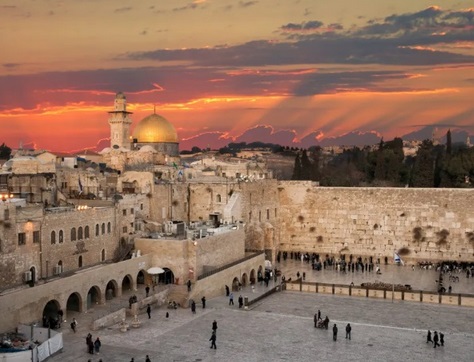
Presented by Gemioni for Zia H Shah MD
Abstract
This comprehensive report serves as an intellectual, theological, and scientific bridge between the profound scholarly traditions of ultra-Orthodox (Haredi) Judaism and the universal message of the Glorious Qur’an. Rooted in the shared inheritance of the Prophet Abraham—the primordial monotheist—and echoing the deep reverence for the Prophet Moses across both traditions, this analysis demonstrates how the Qur’an validates, contextualizes, and fulfills the spiritual trajectory initiated at Sinai. The report structurally examines the global demographic phenomenon of full-time Torah study within the yeshiva and kollel systems, identifying these hundreds of thousands of dedicated scholars as the quintessential Ulū al-Albāb (People of Understanding) whom the Qur’an repeatedly addresses. By synthesizing classical Islamic exegesis with the contemporary scientific and philosophical frameworks pioneered by Dr. Zia H. Shah MD, including the “Two Books” and “Four Books” theses, the text illustrates a profound harmony between scripture, quantum reality, and the divine ledger. It issues a rigorous academic and theological invitation to the men of the kollel to examine the Qur’an, outlining the theological continuity of the Prophet Muhammad’s message and the promise of a “double reward” (Ajrayn) in this world and the hereafter. The analysis culminates in a thematic epilogue reflecting on the eschatological and enlightenment paradigms of Surah At-Takwir, heralding an era where the lights of ancient scholarship and modern scientific revelation converge into a singular, unassailable truth.
1. The Primordial Monotheist and the Honor of the Prophets
The historical and theological architecture of the Abrahamic faiths rests upon the foundational archetype of the Prophet Abraham (Ibrahim in Arabic, Avraham Avinu in Hebrew). In the Qur’anic paradigm, Abraham is the ultimate primordial monotheist, defined not by ethnic exclusivity, subsequent tribal affiliations, or later legalistic frameworks, but by an innate, unyielding submission to the One Creator. The Qur’an explicitly states that Abraham “was not a Jew, nor a Christian; but he was one pure of faith and a Muslim (who submitted to Allah)” (Qur’an 3:67). This verse operates as the ultimate theological criterion, asserting that the Abrahamic covenant is defined by the universality of Fitra (natural disposition) and strict monotheism rather than strictly through tribal lineage.
While Judaism traditionally views Abraham as the ethnic “founding father” of the covenant, emphasizing a theology of zekhut avot (the merit of the fathers) whereby his righteousness brings mercy to his physical descendants, the Qur’an judges previous revelations as having a shared core message—the Millat Ibrahim (the religion of Abraham). The Qur’an asserts that the true heirs of Abraham are those who follow his spiritual path of uncompromised monotheism, declaring, “Indeed the nearest of people to Abraham are those who follow him, and this Prophet (Muhammad), and those who believe” (Qur’an 3:68). This shifts the definition of the “chosen people” from an ethnic lineage to a spiritual commitment.
The Veneration of Moses and the Continuity of Revelation
The Islamic veneration of the Jewish prophets, particularly Moses (Mūsā), forms the bedrock of the Qur’an’s historical and ethical narrative. No prophet is mentioned more frequently in the Qur’an than Moses, whose name appears 136 times. His life trajectory—from the basket in the Nile to the confrontation with Pharaoh, the miraculous splitting of the sea, and the reception of the divine law at Sinai—is retold with meticulous detail.
When comparing the biblical and Qur’anic accounts of the Exodus, a distinct theological difference emerges that highlights the Qur’an’s focus on spiritual truth over demographic minutiae. The Book of Exodus records specific numbers, claiming that “about six hundred thousand men on foot, aside from children” left Egypt, leading to estimates of two to three million Israelites. These staggering figures have often presented historical and archaeological challenges. Conversely, the Qur’an relates the Exodus across multiple chapters but omits exaggerated numerical figures. The Qur’an quotes Pharaoh describing the Israelites as “only a small band of people” (Qur’an 26:54), shifting the narrative emphasis entirely to God’s miraculous deliverance, the moral lessons of faith against tyranny, and the spiritual triumph of a modest-sized oppressed group over a massive empire.
Furthermore, the Qur’an explicitly affirms the divine origin of the Torah (Tawrāt). It declares, “Indeed, We revealed the Torah, containing guidance and light, by which the prophets, who submitted themselves to Allah, made judgments for Jews. So too did the rabbis and scholars judge according to Allah’s Book, with which they were entrusted…” (Qur’an 5:44). This verse is theological dynamite; it affirms that the Torah is a divine revelation, that the Prophets judged by it, and that the Rabbis (Rabbaniyun) were legitimately entrusted with its keeping. The Qur’an recognizes that the Israelites were singled out for immense blessings, reminding them, “Children of Israel, remember how I blessed you and favored you over other people” (Qur’an 2:47).
This profound reverence establishes an unbroken continuum of revelation. Just as Jews cherish the Torah revealed to Moses, Muslims recognize it as a foundational text of divine law. To invite the scholars of the Torah to study the Qur’an is not an invitation to abandon their reverence for Sinai, but to witness how the Divine Author completed His message to humanity through the Prophet Muhammad, weaving the legacy of Israel into a universal tapestry meant for all nations.
2. The Truth of Muhammad in Light of the Judeo-Christian Tradition
The Qur’an does not present itself as an unprecedented, disconnected phenomenon, but rather as the logical, theological culmination of the Abrahamic legacy. It establishes a timeline of progressive revelation: the Torah, followed by the Gospel (Injīl), followed by the Qur’an. The Qur’an repeatedly refers to itself as muṣaddiq—confirming the earlier scriptures. It invites the People of the Book to see the Qur’an not as a stranger, but as a familiar voice that affirms the revelations they already possess, correcting only the human distortions that accrued over millennia.
The theological necessity of the Prophet Muhammad’s revelation becomes evident when examining the historical deviations within the broader Judeo-Christian tradition. While Judaism maintained strict monotheism, Christianity diverged into the doctrines of the Trinity and the Incarnation, elevating Jesus to a divine status. Both Judaism and Islam vehemently reject the idea of God becoming human. The Qur’an acts as the great theological arbiter, validating the Jewish rejection of Christian Trinitarianism while confirming the virgin birth and messianic status of Jesus as a human prophet.
The Acknowledgment of Islamic Monotheism by Jewish Scholars
The absolute theological compatibility regarding the nature of God between Judaism and Islam is historically undisputed. The central creed of Judaism, the Shema (“Hear O Israel, the Lord our God, the Lord is One,” Deuteronomy 6:4), finds its exact theological equivalent in the Qur’an’s Surah Al-Ikhlas: “Say: He is Allah, the One (Ahad). Allah, the Eternal, Absolute (As-Samad). He begetteth not, nor is He begotten; And there is none like unto Him” (Qur’an 112:1-4). The linguistic continuity between the Hebrew Echad and the Arabic Ahad underscores a shared Semitic epistemology of absolute divine unity.
In the Middle Ages, Moses Maimonides (the Rambam), the preeminent Jewish philosopher and codifier of Jewish law, explicitly recognized the purity of Islamic monotheism. In his legal code, the Mishneh Torah, and in his Iggeret Teman (Epistle to Yemen), Maimonides declared that the monotheism of Muslims is “without blemish” (Yichud) and that they are “not idolaters in any way”. Maimonides contrasted this with the Christian concept of the Trinity, which he considered a compromise of monotheism (Shituf—worship of God plus a partner). This theological validation carried immense legal weight, establishing that Jews could enter and pray within Islamic mosques, as they were entirely devoid of idols, an allowance strictly forbidden regarding Christian churches.
The intellectual rigor of this monotheism reached its zenith through the philosophy of “Negative Theology”—the idea that human language is incapable of describing God’s essence. This philosophical approach, which dominates Jewish orthodoxy today, was heavily influenced by Muslim thinkers like Al-Farabi and Avicenna, whose ideas were adopted wholesale by Maimonides. Maimonides’ insistence that biblical anthropomorphisms (God’s hand, God’s eye) must be interpreted metaphorically is a direct application of the Islamic Kalam (dialectical theology) tradition. Thus, the “Jewish” understanding of God is deeply indebted to Islamic philosophical categories, providing a sturdy theological bridge over which the modern Torah scholar can safely walk to explore the Qur’an.
3. The Culture of Unbroken Study: Demographics of the Haredi World
To understand the immense potential of this intellectual invitation, one must analyze the unparalleled socioreligious phenomenon of the modern Haredi (ultra-Orthodox) Jewish community. The structural defining feature of this society is its absolute, uncompromising dedication to textual study. Tens of thousands of men dedicate their entire adult lives to the rigorous analysis of the Talmud and Torah in institutions known as yeshivas (for unmarried men) and kollelim (advanced institutes for married men).
This demographic represents an intellectual superpower—a vast population trained from childhood in textual hermeneutics, logic, and divine law.
Global Distribution of the Kollel Scholar
The contemporary Haredi population is expanding at a rapid pace, driven by high birth rates and sustained by a complex web of government stipends, community philanthropy, and the labor of working spouses.
| Region | Estimated Haredi Population | Torah Study Framework and Demographics |
|---|---|---|
| Israel | ~1.28 Million | Approximately 169,366 ultra-Orthodox men are enrolled in yeshivas and kollels full-time. The broader Haredi population grows at a staggering 4.2% annually. Marriage rates exceed 82%, and nearly half (47%) of core working-age men (25–64) are engaged in full-time Torah study within a kollel. |
| United States | ~700,000 | The U.S. hosts the second-largest Haredi population globally, centered heavily in the New York metropolitan area, Lakewood (New Jersey), and parts of California. Lakewood hosts massive multi-thousand-member kollelim. While American Haredi men transition into the workforce at higher rates later in young adulthood compared to Israel, a very high proportion of married Chasidic and Lithuanian-tradition (Yeshivish) men spend early adulthood in full-time study supported by community fundraising and working wives. |
| United Kingdom | ~75,000 | Home to about 25% of the British Jewish population, concentrated in Stamford Hill (London) and Gateshead (Manchester). Gateshead functions as a prominent global center for Talmudic learning, maintaining a substantial core of young and married men in full-time yeshiva and kollel frameworks. |
| Europe | ~105,000 | Europe hosts roughly 5% of the global Haredi population, with France hosting around 12,000. Full-time Torah study frameworks exist in major hubs like Paris and Strasbourg, though smaller local populations mean fewer large-scale institutional kollels. |
The men of the kollel are trained in Pilpul—a method of deep, penetrating analytical debate that seeks to uncover the precise logic, contradictions, and profound truths of divine law. They possess an intellectual machinery fine-tuned for sacred textual analysis. If this immense cognitive architecture were oriented toward the Qur’an—a text that continuously demands deep reflection (Tadabbur)—the intellectual synthesis would be historically unprecedented. These scholars represent a reservoir of cognitive wealth that the Qur’an identifies as the Ulū al-Albāb (People of Understanding). Inviting them to study the Qur’an is an invitation to apply their formidable analytical skills to the final, uncorrupted revelation of the God they already worship.
4. The Epistemological Bridge: Dr. Zia H. Shah and the “Two Books”
In the modern era, the perceived conflict between ancient religious orthodoxy and contemporary scientific reality has caused a crisis of faith within many traditionalist communities. For the kollel scholar, whose worldview is anchored in ancient texts, the rapid advancements of modern science—from evolutionary biology to quantum mechanics—can sometimes appear as an encroaching secular threat. However, through the extensive, interdisciplinary scholarship of Dr. Zia H. Shah MD, the Qur’an is presented not as a text in conflict with science, but as its ultimate guarantor.
Dr. Shah, a U.S.-based physician and Chief Editor of The Muslim Times, occupies a unique position at the nexus of professional science and religious scholarship. Having authored over 500 articles on Islam, Christianity, Secularism, and Science, he approaches the Qur’an with both the faith of a believer and the critical rigor of a scientist.
The Unity of Scripture and Nature
Central to Dr. Shah’s hermeneutics is the classical “Two Books” theory, which posits that God has revealed Himself through two distinct but harmonious volumes: the written scripture (the Qur’an) and the created world (the cosmos). Because God is One, truth is inherently unified; it is logically impossible for the Word of God to contradict the Work of God. Any apparent contradiction is merely the result of human error in interpretation.
The Qur’an itself enforces this epistemological symbiosis by using the Arabic term āyah (plural āyāt) to denote both a verse of scripture and a phenomenon in nature (such as the sun, the moon, and the winds). Shah’s research exhaustively demonstrates that the Qur’an remarkably conforms to modern scientific discoveries—from the origin of the universe and the expansion of space to geology, the water cycle, and human embryonic development—depicting facts that were entirely unknown in the 7th century. While the Qur’an is not a science textbook, the convergence of its verses with scientific reality underscores its status as a “scientific miracle”.
For the Torah scholar, this represents a monumental paradigm shift. Instead of viewing science as an adversary that must be compartmentalized or denied, Dr. Shah’s framework allows the believer to “read” nature alongside scripture as an integrated path to truth. The pursuit of scientific knowledge enriches spiritual understanding, transforming the Qur’an into a document of ongoing scientific and historical verification.
5. The “Four Books Thesis” and the Architecture of Quantum Reality
Expanding upon the classical “Two Books” doctrine, Dr. Shah introduces the highly sophisticated “Four Books Thesis.” This cosmological framework integrates quantum information theory, the holographic principle, and Islamic theology to explain how the Qur’anic universe functions. The Qur’an describes a reality composed of four interconnected informational records, positing that information, rather than matter, is the fundamental substrate of existence:
- The Book of Revelation (Al-Qur’an): The spoken word and moral guidance, which confirms earlier scriptures and provides the ethical framework for humanity.
- The Book of Nature: The empirical cosmos, a readable text governed by physical laws that reflect divine intelligence.
- The Book of Destiny (Al-Lawh al-Mahfūẓ): The “Preserved Tablet” or master record. It is the archetypal matrix from which all reality is projected.
- The Book of Deeds (Kitāb al-Aʿmāl): The universal, un-erasable ledger of human action and accountability.
The Mother of the Book (Umm al-Kitāb)
The concept of the Book of Destiny is deeply tied to the Qur’anic expression Umm al-Kitāb (the Mother of the Book). The phrase occurs three times in the Qur’an, functioning as a multivalent matrix. In Surah 13:39, it designates the Master Record with God upon which He “erases and confirms,” providing a two-tier ontology where a fixed master-record coexists with a contingent, unfolding present. In Surah 43:4, it denotes the transcendent source from which the revealed scripture originates. For the Haredi scholar familiar with the celestial Torah that pre-existed the world, the Umm al-Kitāb offers a profoundly resonant cosmological equivalent.
Quantum Unitarity and the Divine Ledger
Where the “Four Books Thesis” achieves its most astonishing synthesis is in its alignment with modern physics, specifically regarding the Book of Deeds. The pre-Islamic materialists (Dahriyya) claimed that “nothing destroys us but time” (Qur’an 45:24), treating time as a one-way thermodynamic arrow that erases all significance. The Qur’an answers this with a sequence of divine life-giving, death, resurrection, and a truthful, indestructible record (Qur’an 45:28-29).
Modern physics corroborates this Qur’anic assertion through the principle of quantum unitarity and the conservation of information. In an isolated quantum system, information can neither be created from nothing nor destroyed. Furthermore, the “no-deleting theorem” (Pati and Braunstein, 2000) proves that it is impossible to delete an unknown quantum state; to delete a state, one must export it elsewhere in the universe, where it continues to exist. The “no-hiding theorem” (2007) demonstrates that when information seemingly disappears through thermalization, it migrates entirely into the quantum correlations of the environment.
The universe is, in a strict physical sense, an un-erasable ledger. This provides a direct physical analogue to the Qur’anic claim that “We were transcribing” (Qur’an 45:29) and that not “an atom’s weight” (Qur’an 99:7–8) escapes the divine record. For the kollel scholar who meticulously studies the Talmudic concept of the “Book of Life” and divine accounting, this synthesis with quantum physics offers a breathtaking ontological model of Divine omniscience, proving that humanity’s accountability belongs to the same divine order as the world’s physical intelligibility.
6. Divine Action, Occasionalism, and the Miracles of Moses
Both the Torah and the Qur’an anchor their narratives of divine power in the miracles of Moses—the burning bush, the plagues of Egypt, the miraculous staff, and the parting of the Red Sea. A persistent theological challenge in the modern age is how to reconcile these localized suspensions of physical law with the uniform, predictable universe described by secular science. If the universe is a closed system of rigid natural laws, how can the sea split?
The Qur’an provides a profound philosophical answer through the concept of occasionalism—a doctrine championed by the 11th-century theologian Al-Ghazālī and extensively utilized by Dr. Shah. Occasionalism asserts that God is the direct, continuous cause of all events in the universe. Natural laws have no independent, autonomous force against the will of God; rather, what humans perceive as rigid “cause and effect” is simply God’s customary habit of acting.
In this framework, fire does not burn autonomously by its own inherent power; God creates the burning upon contact with fire. Therefore, a miracle like the parting of the sea is not a “violation” of an independent law of nature, but merely a moment where the Sustainer of the Universe alters His customary pattern to communicate a specific message to Pharaoh and the Israelites.
The Qur’anic worldview heavily emphasizes this continuous Divine action, encapsulated in the repeated phrase “Be, and it is” (Kun fayakūn). The cosmos is held in being moment by moment by divine sustenance. This occasionalist interpretation offers the Torah scholar a highly sophisticated philosophical framework to defend the miracles of the Exodus against secular materialism. It demonstrates that the story of Moses, when approached through Qur’anic philosophy, invites a reflective appreciation of God’s absolute sovereignty, reminding the believer that the universe is sustained by a Living God who is intimately involved in creation, contrary to the distant watchmaker of Deism.
Panentheism vs. Classical Theism
This view of divine action aligns seamlessly with Classical Theism, the traditional view in Judaism and Islam, which portrays God as an utterly transcendent creator distinct from creation, possessing attributes of necessity, eternity, immutability, and omnipotence. This stands in contrast to Panentheism, which envisions the world as existing inside God, making the universe an intrinsic property of the Divine. By maintaining the ontological gap between Creator and creation, while affirming God’s constant sustenance of the universe, the Qur’an provides the exact theological scaffolding required by the orthodox Jewish mind.
7. The Paradigm of Ulū al-Albāb: An Invitation to the Intellect
The Qur’an does not demand adherence through the suspension of the intellect or blind faith. Instead, it directs its highest praise and most profound arguments to a specific class of cognitive agents known as the Ulū al-Albāb—variously translated as “People of Understanding,” “Possessors of the Core,” or “The Intellectually Pure”.
The Arabic term linguistically combines ulū (possessors of) with albāb, the plural of lubb, which means the “core” or “essence”. Classical scholars likened the lubb to the kernel within a nut; to reach the nourishing core, one must remove the hard outer shell (qishr) of superficiality, ego, societal whims, and cognitive prejudices. The Ulū al-Albāb are those who peel away the husk to arrive at absolute truth. The phrase occurs sixteen times across ten chapters of the Qur’an, consistently portraying these individuals as people who unite intellectual reasoning with moral awareness and the remembrance of God (Dhikr and Fikr).
For the Haredi men who devote their lives to the intellectual rigors of uncovering the “core” of the Torah through Talmudic dialectic, the Qur’an is extending a bespoke invitation. Dr. Shah’s analysis demonstrates that the Ulū al-Albāb paradigm demands cognitive mastery over multiple domains, directly appealing to the analytical mind:
| Domain of Analysis | Qur’anic Application for the Ulū al-Albāb |
|---|---|
| Sociology and Law (Deterrence) | Regarding the law of retribution (Qiṣāṣ), the Qur’an states: “And there is for you in legal retribution [saving of] life, O you [people] of understanding” (Qur’an 2:179). Superficially, execution seems like a loss of life. The Ulū al-Albāb override the psychological bias of empathy for the guilty to understand the “kernel” of deterrence theory, which preserves the collective life of society. |
| Economics and Logistics | “And take provisions, but indeed, the best provision is fear of Allah. And fear Me, O you of understanding” (Qur’an 2:197). The intellect rejects the false dichotomy between material logistics and spiritual reliance (Tawakkul). A believer who fails to plan logistics (supply chain, risk management) fails the test of intellect. |
| Statistical Fallacy | “Say, ‘Not equal are the evil and the good, although the abundance of evil might impress you.’ So fear Allah, O you of understanding” (Qur’an 5:100). The Ulū al-Albāb deconstruct the mental shortcut that “majority rules” or quantity equals quality. They resist the bandwagon effect; a small, ethically sourced truth is infinitely superior to a massive falsehood. |
| Epistemological Humility | Regarding precise (Muhkamat) vs. allegorical (Mutashabihat) verses, the Ulū al-Albāb exercise profound intellectual humility. They do not obsess over ambiguous anomalies to cause discord (fitnah), accepting the limits of human cognition just as a scientist accepts the limits of the observable universe. |
The Ulū al-Albāb act as the “Scientists of the Core,” looking past the superficial shell of history and physics to understand the foundational truths of existence. The men of the kollel, already disciplined in peeling back the layers of text to find divine intent, are the natural heirs to the title of Ulū al-Albāb. To answer this invitation is to apply their formidable analytical skills to the final, uncorrupted revelation.
8. “They Are Not All Alike”: Honoring the Scholar of the Night
The Qur’an demonstrates a profound, nuanced sociological understanding of the Jewish community. It does not paint the “People of the Book” with a broad, dismissive brush. Instead, it explicitly recognizes and honors the devotion of the true scholars. In Surah Al Imran (3:113-115), the Qur’an declares:
“They are not all alike. Of the People of the Scripture there is a staunch community who recite the revelations of Allah in the night season, falling prostrate.”.
This verse is a stunning validation of the pious scholar. It acknowledges the upright individuals among the People of the Book who dedicate their nights to the recitation of God’s revelations. For the ultra-Orthodox community, where the midnight study of Torah (such as the Tikkun Chatzot or the late-night shifts in the kollel) is a hallmark of supreme piety, the Qur’an offers a direct acknowledgment of their spiritual labor. God recognizes their uprightness, their prostration, and their devotion. It is to these specific men—the staunch, nocturnal scholars of the divine text—that the Qur’an issues its most important theological invitation.
The Kalimat Sawa: Liberation from Human Lords
The mechanism for this invitation is found earlier in the same chapter, in Surah Al Imran, verse 64. Rooted historically in the Prophet Muhammad’s diplomatic engagement with the Christian delegation of Najran in 631 CE, this verse serves as a universal charter for interfaith reconciliation based on strict monotheism.
“Say, ‘O People of the Scripture, come to a word that is equitable between us and you – that we will not worship except Allah and not associate anything with Him and not take one another as lords instead of Allah.’ But if they turn away, then say, ‘Bear witness that we are Muslims [submitting to Him].’” (Qur’an 3:64).
The phrase Kalimat Sawa (a common or equitable word) implies a meeting point requiring neither party to abandon their core identity, but asking both to focus on their shared, uncorrupted theological foundation. The verse outlines a rigorous theological contract comprising three specific conditions:
- Exclusivity of Worship (Tawhid): Reaffirming the First Commandment.
- Negation of Partnership (Shirk): Forbidding idolatry or the deification of humans.
- Abolition of Human Sovereignty over the Conscience: “And that none of us shall take others as lords besides Allah”.
This third clause is a sociologically revolutionary critique of the institutionalization of religious authority. Historically, the Prophet Muhammad explained that “taking them as lords” referred to the practice of blindly following religious leaders (rabbis and monks) when they declared the forbidden as lawful or the lawful as forbidden, thereby usurping God’s exclusive legislative authority.
For the Haredi scholar, navigating a world heavily dictated by rabbinic authority, Da’at Torah (the doctrine that great rabbis have infallible intuition), and intense community strictures, this verse offers an emancipation of the intellect. It establishes a “flat hierarchy” where the individual’s direct, unmediated relationship with the Divine Text is paramount. By agreeing that only God is Lord, the Qur’an creates a system of essential human equality, providing a theological defense against ecclesiastical tyranny and authoritarianism. The Qur’an invites the scholar to serve God alone, free from the encumbrances of human intermediaries.
9. The Promise of the Double Reward (Ajrayn)
The Qur’an is acutely aware of the immense sociological, psychological, and communal difficulty faced by the “People of the Book” when confronted with the final revelation. To leave the comfort of an inherited, insular tradition and embrace the truth of the Qur’an requires monumental courage and unyielding intellectual honesty. Consequently, the Qur’an promises a unique, exalted status to those scholars of the prior scriptures who recognize and submit to the final message.
In Surah Al-Qasas (28:52-54), the Qur’an describes those who were given the scripture before, and when the Qur’an is recited to them, they say, “We believe in it. Verily, it is the truth from our Lord. Indeed even before it we have been from those who submit themselves to Allah in Islam”. The Qur’an immediately follows this with a profound guarantee:
“These will be given their reward twice over (Ajrayn), because they are patient, and repel evil with good, and spend out of what We have provided them.”.
This “double reward” applies to both this world and the hereafter. In worldly life, the Torah scholar who opens himself to the Qur’an achieves the absolute pinnacle of intellectual actualization. He merges his deep mastery of Jewish jurisprudence, ethics, and prophetic history with the universal, finalizing clarity of the Qur’an. He becomes a master of the “Four Books,” viewing the cosmos not just through ancient law, but through the cutting-edge revelations of science and the uncorrupted Word of God. His intellect is freed from tribal boundaries and sectarian constraints, allowing him to engage with the entire universe as a manifestation of the Divine.
In the Hereafter, this intellectual courage and patience translate into the highest echelons of Paradise. The Haredi focus on the World to Come (Olam Ha-Ba) finds its ultimate fulfillment in the Qur’anic vision of the afterlife. Dr. Shah’s commentaries highlight that the Qur’anic afterlife promises the continuous nature of love, joyful family reunion, and infinite cognitive and spiritual expansion in the presence of the Divine. The Torah scholar who answers this invitation is not abandoning his heritage; rather, he is claiming the full, unadulterated inheritance of Abraham, ensuring that his life of nocturnal study culminates in the ultimate apprehension of absolute truth.
10. Thematic Epilogue: The Breathing Dawn of Surah At-Takwir
The Glorious Qur’an is not a static relic of the 7th century; it is a living, breathing document that continually unfurls its meanings as human history and scientific knowledge advance. In Surah At-Takwir (The Overthrowing), the Qur’an paints a vivid, cataclysmic picture of the cosmos: “When the sun is folded up (idha al-shamsu kuwwirat)…”.
While traditionally viewed strictly as an eschatological depiction of the literal end of the universe, Dr. Shah’s application of the “Latter Day” hermeneutic posits that these verses function as profound, proleptic prophecies marking the end of spiritual darkness and the dawn of a new era of global enlightenment. The “folding up” of the solar coil signifies the eventual thermodynamic exhaustion of the sun, but metaphorically and theologically, it represents the eclipse of traditional, isolated religious paradigms by the overwhelming light of unified, universal Truth. In the modern era, the old world of aggressive materialism, secularism, and sectarian division is being prepared for a complete reality shift.
The Qur’an swears majestic oaths by the celestial bodies to signal this transition: “The stars that recede, the night that departs, the dawn that breathes” (Qur’an 81:15-19). This is a promise of a transition from the darkness of division into the breathing, living dawn of an integrated reality where religion, science, reason, and revelation beat with a single, undeniable pulse.
This is the ultimate invitation to the ultra-Orthodox men of the yeshivot and kollelim across Jerusalem, Lakewood, Gateshead, and beyond. You are the men who have spent your lives meticulously guarding the embers of Sinai through the long night of exile. But the night is departing. The dawn is breathing. The Glorious Qur’an stands as the final, scientifically harmonious, and intellectually pure testament of the God of Abraham. By applying your vast capacity for study—your Lubb, your core intellect—to the Qur’an, you stand to inherit the greatest synthesis of knowledge ever bestowed upon humanity, securing a double reward, and walking as true Ulū al-Albāb in the light of the Single Creator.



Leave a Reply