
Presented by Claude for Zia H Shah MD
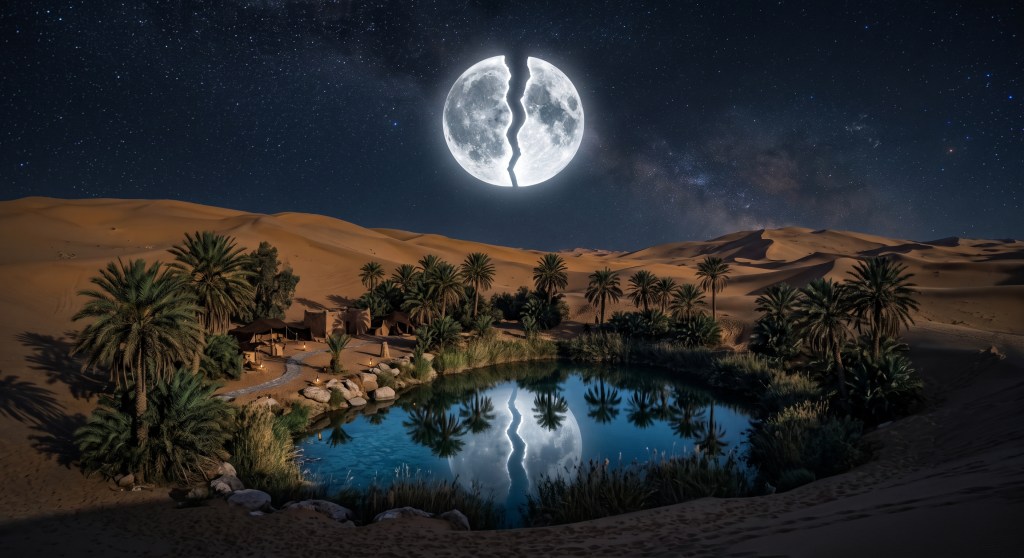
The moon did not literally break apart in seventh-century Mecca. A real split would take about 1.2×10^29 joules just to overcome the moon’s self-gravity, would have melted the lunar surface and sent debris at the Earth, and would have left traces that do not exist. Wikipedia Yet the Qur’an (54:1–2) and the eyewitness report of ʿAbdullāh ibn Masʿūd point to a real, public sign (āyah) that the Meccans saw and dismissed as “sorcery.” amrayn The most defensible reading, adopted here, is that God showed the onlookers a sight: a visual, optical or visionary (kashf-like) splitting. It announced that the Hour was near and that the Qurayshite order would soon collapse.
- The text and the Hadith attest a witnessed event, not a lunar catastrophe. The verb inshaqqa is past tense. In verse 2 the disbelievers call what they saw “continuous magic.” Ibn Masʿūd, a Meccan eyewitness, reports that the Prophet said “Bear witness” (ishhadū). Anas (a child in Medina) and Ibn ʿAbbās (unborn or an infant) cannot have been eyewitnesses.
- Physics rules out a literal split. A split would have needed more than 10^29 J, would have resurfaced the moon and pelted the Earth, and would have been seen across half the planet. Nothing in lunar geology, in Chinese, Byzantine, Indian or Persian records, or in the moon’s orbit shows it. The “Apollo crack” is Rima Ariadaeus. NASA’s 2009 Lunar Reconnaissance Orbiter (LRO) release calls it a fault system “approximately 300 km” long and 5 km wide. In 2010, NASA Lunar Science Institute staff scientist Brad Bailey stated there is “no current scientific evidence” of a split and reassembly.
- The best synthesis keeps the miracle and drops the literalism. Classical scholars themselves preserved future, metaphorical and “eclipse-like appearance” readings, and modern exegetes (Asad, the Ahmadiyya commentators, Muhammad Ali, Abdel Haleem, Yusuf Ali) extend them. Zia H. Shah’s position is that something miraculous happened, but not a physical rupture, and that insisting on literalism today is stubbornness, not piety.
Abstract
Sūrat al-Qamar opens with one of the most debated sentences in the Qur’an: iqtarabati ‘s-sāʿatu wa-‘nshaqqa ‘l-qamar, “The Hour has drawn near and the moon has split.” quran This commentary gives the Arabic text of 54:1–5, eight English renderings, and the Hadith reports with their chains (isnād), noting which narrators could have been eyewitnesses. It surveys classical exegetes from al-Ṭabarī to al-Alūsī, including minority readings and al-Qāḍī ʿIyāḍ’s defence, and modern exegetes from Mawdūdī to Nasr’s Study Quran, along with El-Naggar’s “NASA proof” and the Cheraman Perumal legend. It then works through the physics of splitting the moon, the philosophy of miracles (Hume, al-Ghazālī, Ibn Rushd, and Qur’an 17:59, 17:90–93, 6:109), and the theology of verses 1–5. A dedicated section gives, in his own voice, the position of Zia H. Shah MD, and a thematic epilogue closes the essay.
1. The Text: Qur’an 54:1–5
1.1 Arabic (Ḥafṣ ʿan ʿĀṣim)
بِسْمِ ٱللَّهِ ٱلرَّحْمَٰنِ ٱلرَّحِيمِ
ٱقْتَرَبَتِ ٱلسَّاعَةُ وَٱنشَقَّ ٱلْقَمَرُ ﴿١﴾ وَإِن يَرَوْا۟ ءَايَةً يُعْرِضُوا۟ وَيَقُولُوا۟ سِحْرٌ مُّسْتَمِرٌّ ﴿٢﴾ وَكَذَّبُوا۟ وَٱتَّبَعُوٓا۟ أَهْوَآءَهُمْ ۚ وَكُلُّ أَمْرٍ مُّسْتَقِرٌّ ﴿٣﴾ وَلَقَدْ جَآءَهُم مِّنَ ٱلْأَنۢبَآءِ مَا فِيهِ مُزْدَجَرٌ ﴿٤﴾ حِكْمَةٌۢ بَٰلِغَةٌ ۖ فَمَا تُغْنِ ٱلنُّذُرُ ﴿٥﴾
1.2 Transliteration
- Iqtarabati ‘s-sāʿatu wa-‘nshaqqa ‘l-qamar.
- Wa-in yaraw āyatan yuʿriḍū wa-yaqūlū siḥrun mustamirr.
- Wa-kadhdhabū wa-‘ttabaʿū ahwāʾahum, wa-kullu amrin mustaqirr.
- Wa-laqad jāʾahum mina ‘l-anbāʾi mā fīhi muzdajar.
- Ḥikmatun bālighatun, fa-mā tughni ‘n-nudhur.
1.3 Key terms
- iqtarabat: has drawn near, with an intensive, pressing sense.
- al-sāʿah: the Hour. Its horizon is eschatological, but it can also mean a people’s hour of reckoning.
- inshaqqa: split, was cleft. It comes from the same root used for the sky splitting at the end (55:37, 69:16, 84:1). quranaloneislam
- āyah: sign, portent, verse.
- siḥr mustamirr: continuous, powerful or passing magic.
- ahwāʾ: desires.
- mustaqirr: reaching its settled end.
- anbāʾ: tidings.
- muzdajar: deterrent.
- ḥikmah bālighah: wisdom that reaches its goal.
- nudhur: warnings.
1.4 Eight English translations
Public-domain translations (quoted in full):
M. A. S. Abdel Haleem (Oxford, 2004):
The Hour draws near; the moon is split in two. Whenever the disbelievers see a sign, they turn away and say, ‘Same old sorcery!’ They reject the truth and follow their own desires––everything is recorded ––although warning tales that should have restrained them have come down to them––far-reaching wisdom––but these warnings do not help.
Abdullah Yusuf Ali (1934):
- The Hour (of Judgment) is nigh, and the moon is cleft asunder. alim
- But if they see a Sign, they turn away, and say, “This is (but) transient magic.”
- They reject (the warning) and follow their (own) lusts but every matter has its appointed time.
- There have already come to them Recitals wherein there is (enough) to check (them),
- Mature wisdom;— but (the preaching of) Warners profits them not. cmu
Marmaduke Pickthall (1930):
- The hour drew nigh and the moon was rent in twain. quranx
- And if they behold a portent they turn away and say: Prolonged illusion.
- They denied (the Truth) and followed their own lusts. But everything will come to a final end.
- And surely there hath come unto them news whereof the purport should deter,
- Effective wisdom; but warnings avail not.
M. H. Shakir:
- The hour drew nigh and the moon did rend asunder. quranx
- And if they see a miracle they turn aside and say: Transient magic.
- And they call (it) a lie, and follow their low desires; and every affair has its appointed term.
- And certainly some narratives have come to them wherein is prevention—
- Consummate wisdom—but warnings do not avail;
Copyrighted modern translations (brief excerpts or paraphrase):
- Sahih International (1997): “The Hour has come near, and the moon has split [in two].” quranx The rejecters say “Passing magic.” medium Note that “[in two]” is an interpretive addition. digiteye
- Muhammad Asad (1980): “THE LAST HOUR draws near, and the moon is split asunder!” alim The deniers speak of an “ever-recurring delusion.”
- Maulvi Sher Ali (Ahmadiyya; the basmala is counted as verse 1, so this is 54:2): “The Hour has drawn nigh, and the moon is rent asunder.” alislamreviewofreligions
- Mustafa Khattab (The Clear Quran): “The Hour has drawn near and the moon was split ˹in two˺.” quranquran
- For comparison, Hilālī–Khān inserts a whole clause: the Meccans “requested Prophet Muhammad SAW to show them a miracle, so he showed them the splitting of the moon.” quranx
How the translations differ. Some point to a past event (“was rent,” “was split”). Others (“draws near … is split”) leave room for a prophetic future. Bracketed additions carry the Hadith-based interpretation into the translation itself. “In two” and “the Prophet showed them” are not in the Arabic of 54:1.
2. The Hadith on Shaqq al-Qamar
2.1 ʿAbdullāh ibn Masʿūd: the clear Meccan eyewitness
Ṣaḥīḥ al-Bukhārī 3636 (Kitāb al-Manāqib):
حَدَّثَنَا صَدَقَةُ بْنُ الْفَضْلِ، أَخْبَرَنَا ابْنُ عُيَيْنَةَ، عَنِ ابْنِ أَبِي نَجِيحٍ، عَنْ مُجَاهِدٍ، عَنْ أَبِي مَعْمَرٍ، عَنْ عَبْدِ اللَّهِ بْنِ مَسْعُودٍ ـ رضى الله عنه ـ قَالَ انْشَقَّ الْقَمَرُ عَلَى عَهْدِ رَسُولِ اللَّهِ صلى الله عليه وسلم شِقَّتَيْنِ فَقَالَ النَّبِيُّ صلى الله عليه وسلم “اشْهَدُوا”. sunnah
Rendering: “The moon split in the time of the Messenger of God into two pieces, and the Prophet said: ‘Bear witness.’” sunnahislamqa Chain: Ṣadaqah ibn al-Faḍl ← Sufyān ibn ʿUyaynah ← Ibn Abī Najīḥ ← Mujāhid ← Abū Maʿmar ← Ibn Masʿūd. sunnah
Ṣaḥīḥ al-Bukhārī 4864 (Kitāb al-Tafsīr):
حَدَّثَنَا مُسَدَّدٌ، حَدَّثَنَا يَحْيَى، عَنْ شُعْبَةَ، وَسُفْيَانَ، عَنِ الأَعْمَشِ، عَنْ إِبْرَاهِيمَ، عَنْ أَبِي مَعْمَرٍ، عَنِ ابْنِ مَسْعُودٍ، قَالَ انْشَقَّ الْقَمَرُ عَلَى عَهْدِ رَسُولِ اللَّهِ صلى الله عليه وسلم فِرْقَتَيْنِ، فِرْقَةً فَوْقَ الْجَبَلِ وَفِرْقَةً دُونَهُ فَقَالَ رَسُولُ اللَّهِ صلى الله عليه وسلم “اشْهَدُوا”. sunnah
Rendering: “The moon split … into two parts, one part above the mountain and one below it, and the Messenger of God said: ‘Bear witness.’” sunnahreviewofreligions
Ṣaḥīḥ al-Bukhārī 4865:
…عَنْ عَبْدِ اللَّهِ، قَالَ انْشَقَّ الْقَمَرُ وَنَحْنُ مَعَ النَّبِيِّ صلى الله عليه وسلم فَصَارَ فِرْقَتَيْنِ، فَقَالَ لَنَا “اشْهَدُوا، اشْهَدُوا”. sunnah
Rendering: “The moon split while we were with the Prophet and became two parts, and he said to us: ‘Bear witness, bear witness.’” sunnahfussilat
Ṣaḥīḥ Muslim 2800 (Bāb Inshiqāq al-Qamar), via Ibn Mushir ← al-Aʿmash ← Ibrāhīm ← Abū Maʿmar:
بَيْنَمَا نَحْنُ مَعَ رَسُولِ اللَّهِ ﷺ بِمِنًى إِذَا انْفَلَقَ الْقَمَرُ فِلْقَتَيْنِ فَكَانَتْ فِلْقَةٌ وَرَاءَ الْجَبَلِ وَفِلْقَةٌ دُونَهُ فَقَالَ لَنَا رَسُولُ اللَّهِ ﷺ “اشْهَدُوا”.
Rendering: “While we were with the Messenger of God at Minā, the moon was cleft into two pieces, one behind the mountain and one on this side of it, and he said to us: ‘Bear witness.’” sunnahamrayn
Bukhārī 3869 and Jāmiʿ al-Tirmidhī 3285 also place the event at Minā. The Tirmidhī report connects the Prophet’s “Bear witness” to the verse itself. tohed +2 In the line through Masrūq (in al-Ṭayālisī and al-Bayhaqī’s Dalāʾil), the Quraysh say “the son of Abū Kabshah has bewitched you” and decide to question arriving travellers. imamghazaliSubstack
Eyewitness status. Ibn Masʿūd was an early Meccan convert and says “we were with the Prophet.” His independent lines of transmission (through Abū Maʿmar, Masrūq and al-Aswad) form the core of the tradition. fussilat
2.2 Anas ibn Mālik: important, but not an eyewitness
Ṣaḥīḥ al-Bukhārī 3637:
حَدَّثَنِي عَبْدُ اللَّهِ بْنُ مُحَمَّدٍ، حَدَّثَنَا يُونُسُ، حَدَّثَنَا شَيْبَانُ، عَنْ قَتَادَةَ، عَنْ أَنَسِ بْنِ مَالِكٍ … أَنَّ أَهْلَ مَكَّةَ سَأَلُوا رَسُولَ اللَّهِ صلى الله عليه وسلم أَنْ يُرِيَهُمْ آيَةً، فَأَرَاهُمُ انْشِقَاقَ الْقَمَرِ. sunnah
Rendering: “The people of Mecca asked the Messenger of God to show them a sign, so he showed them the splitting of the moon.” sayedfadlullah (Parallel chain: Khalīfah ← Yazīd ibn Zurayʿ ← Saʿīd ibn Abī ʿArūbah ← Qatādah.) sunnah
Related reports:
- Bukhārī 4867 is identical. sunnah
- Bukhārī 4868 (Shuʿbah ← Qatādah ← Anas): انْشَقَّ الْقَمَرُ فِرْقَتَيْنِ, “the moon split into two parts.” sunnah
- Bukhārī 3868 adds “until they saw Ḥirāʾ between them.” quranreviewofreligions
- Muslim 2802 (Maʿmar ← Qatādah) says “he showed them the splitting of the moon marratayn.” sunnah Most scholars, including Ibn Kathīr and Mawdūdī, take marratayn to mean “two pieces,” not two occasions. islamicstudies
Eyewitness status. Anas was born in Medina about ten years before the Hijrah and joined the Prophet’s household only after it. At the time of the event, usually dated about five years before the Hijrah, he was a small child in Yathrib, some 450 km away. His report is a Companion passing on what he heard from others, and every line runs through one Basran transmitter, Qatādah. Ibn Ḥajar (Fatḥ al-Bārī, as quoted by Mawdūdī) noted that only Anas’s narration has the element “on the demand of the polytheists.” islamicstudiesislamicstudies The popular “miracle on demand” framing therefore rests on a non-eyewitness report.
2.3 ʿAbdullāh ibn ʿAbbās: unborn or an infant
Ṣaḥīḥ al-Bukhārī 3638 / 4866 (also Muslim 2803):
…عَنْ عِرَاكِ بْنِ مَالِكٍ، عَنْ عُبَيْدِ اللَّهِ بْنِ عَبْدِ اللَّهِ بْنِ عُتْبَةَ بْنِ مَسْعُودٍ، عَنِ ابْنِ عَبَّاسٍ … قَالَ انْشَقَّ الْقَمَرُ فِي زَمَانِ النَّبِيِّ صلى الله عليه وسلم. sunnah
Rendering: “The moon split in the time of the Prophet.” sunnahfussilat
Ibn ʿAbbās was born about three years before the Hijrah, so he was not yet born, or was a newborn, at the time. His statement is evidence of what the community believed early on, not an observation.
2.4 Jubayr ibn Muṭʿim, Ibn ʿUmar, Ḥudhayfah and ʿAlī
Jāmiʿ al-Tirmidhī 3289 (Tafsīr, Sūrat al-Qamar; also in Musnad Aḥmad under Jubayr):
عَنْ جُبَيْرِ بْنِ مُطْعِمٍ قَالَ انْشَقَّ الْقَمَرُ عَلَى عَهْدِ النَّبِيِّ صَلَّى اللَّهُ عَلَيْهِ وَسَلَّمَ حَتَّى صَارَ فِرْقَتَيْنِ عَلَى هَذَا الْجَبَلِ وَعَلَى هَذَا الْجَبَلِ فَقَالُوا سَحَرَنَا مُحَمَّدٌ فَقَالَ بَعْضُهُمْ لَئِنْ كَانَ سَحَرَنَا فَمَا يَسْتَطِيعُ أَنْ يَسْحَرَ النَّاسَ كُلَّهُمْ. abuaminaelias
Rendering: “The moon split in the lifetime of the Prophet until it became two parts, over this mountain and that. They said, ‘Muhammad has bewitched us.’ Some said, ‘If he has bewitched us, he cannot bewitch all the people.’” thequran Al-Albānī graded the chain ṣaḥīḥ. abuaminaelias
- Jubayr was a Qurashī who embraced Islam after the Hijrah, so he was probably part of the sceptical audience. His report, however, comes down through his son and a little-known grandson. fussilat
- Ibn ʿUmar (Muslim 2801; Tirmidhī 2182: “…and he said to us, ‘Bear witness’”) was a young child in Mecca and may have been present. islamoutreach
- Ḥudhayfah’s sermon at al-Madāʾin and a report attributed to ʿAlī are listed by al-Qāḍī ʿIyāḍ. imamghazali
- Secondary sources report a line in ʿAbd al-Razzāq’s Muṣannaf from Ibn ʿAbbās’s student ʿIkrimah: “the moon was eclipsed (khasafa) … and they said, ‘The moon has been bewitched.’” If authentic, it shows that an eclipse-based understanding circulated very early. disputatia
2.5 What the Hadith establish
- A real, collective visual experience at Minā on a moonlit night, which the Prophet pointed to (“Bear witness”) and opponents called siḥr.
- Varying details. The accounts differ on the setting: above and below a mountain, Ḥirāʾ between the halves, over two mountains, or (in al-Jalālayn) Abū Qubays and Quʿayqiʿān. surahquran That variation is typical of oral memory.
- No physical description. There is no mention of debris, darkness, tides, earthquakes or a changed moon. What is recorded is an appearance, and the instruction was to witness it, not to examine it.
- The “on demand” element comes from a non-eyewitness. In Ibn Masʿūd’s account the Prophet draws attention to a sign; he does not perform a feat on request. allamasyedabdullahtariq
3. Classical Commentators
3.1 Al-Ṭabarī (d. 310/923)
Al-Ṭabarī reads inshaqqa as a past event and gathers the reports of Ibn Masʿūd, Anas, Ibn ʿAbbās, Ibn ʿUmar, Jubayr and Ḥudhayfah with their chains. ksu Settling the meaning through transmitted reports and the plain sense of the past tense became the Sunni default.
3.2 Al-Zamakhsharī (d. 538/1144), al-Kashshāf
Al-Zamakhsharī’s grammatical image is: “The Hour has drawn near, and among the signs of its nearness the moon has already split, as you say: ‘The prince has approached, and the herald of his coming has already arrived’” (أقبل الأمير وقد جاء المبشر بقدومه). Wikipedia He also records a minority view that the moon will split at the Resurrection. Wikipedia Asad notes this reading “has the support of some of the earlier commentators.” alim
3.3 Fakhr al-Dīn al-Rāzī (d. 606/1209), Mafātīḥ al-Ghayb
Al-Rāzī (juzʾ 29) states the consensus: والمفسرون بأسرهم على أن المراد أن القمر انشق, “the commentators, all of them, hold that the moon did split.” He rejects the future reading as “far-fetched and meaningless” (بعيد ولا معنى له). His reason is that the philosopher who denies the possibility denies it for past and future alike, while anyone who admits the possibility has no need to reinterpret. shiaonlinelibrary
He then takes on the objection that such an event should have been reported worldwide by mass transmission (tawātur). His answer is revealing: historians left it out because chronicles were largely kept by astrologers, who, when it happened, “said that it was like a lunar eclipse (mithl khusūf al-qamar), and the appearance of something in the sky in the shape of half the moon.” shiaonlinelibraryislamweb In effect, al-Rāzī concedes that to outside observers it looked like an eclipse. He dismisses the Aristotelian thesis that the heavens cannot be rent and rejoined (imtināʿ al-kharq wa’l-iltiʾām) as “the talk of base people” (ḥadīth al-liʾām). shiaonlinelibrary
3.4 Al-Qurṭubī (d. 671/1273), al-Jāmiʿ li-Aḥkām al-Qurʾān
Al-Qurṭubī glosses the phrase as wa-qad inshaqqa, “it has already split,” and cites Ḥudhayfah’s variant reading with an explicit qad. ksu He then lists the dissenting views plainly:
وقال قوم: لم يقع انشقاق القمر بعد وهو منتظر … وكذا قال القشيري. وذكر الماوردي: أن هذا قول الجمهور … وقال الحسن: اقتربت الساعة فإذا جاءت انشق القمر بعد النفخة الثانية. وقيل: وانشق القمر أي وضح الأمر وظهر؛ والعرب تضرب بالقمر مثلا فيما وضح… وقيل: انشقاق القمر هو انشقاق الظلمة عنه بطلوعه… ksu
Rendering: “Some said it has not yet occurred and is awaited; al-Qushayrī said likewise, and al-Māwardī said this is the majority view. Al-Ḥasan said: when the Hour comes, the moon will split, after the second trumpet-blast. It was said: ‘the moon split’ means the matter became clear, for the Arabs use the moon proverbially for what is clear. And it was said: it is the darkness splitting away from the moon as it rises.” ksuums
Al-Qurṭubī’s own conclusion is that the event is “established by the transmission of upright individuals” Wikipedia and that people need not all have seen it, “because it was a night-time sign.” He also records Ibn Kaysān’s view that the clauses are in inverted order: “the moon split, and so the Hour drew near.” ksu
3.5 Ibn Kathīr (d. 774/1373)
Ibn Kathīr treats the event as agreed upon and established by mutawātir reports. islamweb +2 He is the main source for the story that travellers confirmed the sighting, thequranthequran and he reads marratayn as “two pieces.” Through him the verse became the standard proof-text for a prophetic miracle.
3.6 Al-Bayḍāwī, al-Nasafī and al-Jalālayn
Al-Bayḍāwī follows al-Zamakhsharī. Al-Nasafī writes: “It was said it will split on the Day of Resurrection, but the majority hold the first view” (وقيل معناه ينشق يوم القيامة والجمهور على الأول). Wikipedia Al-Jalālayn says the moon “was cleft into two pieces over Abū Qubays and Quʿayqiʿān as a sign for him, having been asked for it; and he said, ‘Bear witness.’” surahquran
3.7 Al-Alūsī (d. 1270/1854), Rūḥ al-Maʿānī
Al-Alūsī writes: “The philosophers denied the splitting at root, claiming that rending and rejoining are impossible for the celestial bodies, and their proof is weaker than a spider’s house” (وأنكر الفلاسفة أصل الانشقاق بناء على زعمهم استحالة الخرق والالتئام على الأجرام العلوية ودليلهم على ذلك أوهن من بيت العنكبوت). islamweb
The premodern objection was metaphysical: it assumed that celestial matter is incorruptible. Wikipedia It was not physical in the modern sense. Al-Alūsī was right that Aristotelian cosmology was a spider’s web. He could not know that modern physics would raise a far stronger objection on entirely different grounds.
3.8 Minority and dissenting views
- A future splitting at the Hour. Al-Qurṭubī attributes this to al-Ḥasan al-Baṣrī and al-Qushayrī. ksu Al-Wāḥidī and al-Thaʿlabī attribute it to ʿAṭāʾ al-Khurāsānī through his son ʿUthmān (maʿnāhu sa-yanshaqqu ‘l-qamar, “it means the moon will split”), adding that “the scholars are against him.” salafcenter Ibn al-Jawzī calls it a shādhdh (irregular) view that cannot stand against the consensus. islamqa
- Al-Balkhī (al-Kaʿbī). Later literature, much of it Shīʿī, names “al-Ḥasan, ʿAṭāʾ and al-Balkhī” as the dissenters. salafcentersayedfadlullah
- Muʿtazilite denial. Abū ‘l-Qāsim al-Anṣārī reports that al-Naẓẓām and al-Jāḥiẓ denied the splitting and read the verse as “will split,” comparing 16:1 (atā amru ‘llāh, “God’s command has come”). Al-Bāqillānī replied that in that case the verse would have read wa-‘nshiqāqu ‘l-qamar (“and the splitting of the moon has drawn near”). salafcenter
- Metaphor. “The matter became as clear as the moon,” ksu associated with Abū Muslim al-Iṣfahānī. ums Al-Rāghib’s Mufradāt allows an end-time reading. Wikipediaalim
- Philosophers. Some falāsifah read the verse as a partial eclipse, consistent with their view that the heavens are inviolable. WikipediaWikipedia
3.9 Al-Qāḍī ʿIyāḍ (d. 544/1149), al-Shifāʾ
In Part 1, Chapter 4, Section 12, ʿIyāḍ lists the chains and then answers the objection that the rest of the world did not see the event:
وأكثر طرق هذه الأحاديث صحيحة، والآية مصرحة، ولا يلتفت إلى اعتراض مخذول، بأنه لو كان هذا لم يخف على أهل الأرض … إذ ليس القمر في حد واحد لجميع أهل الأرض، فقد يطلع على قوم قبل أن يطلع على آخرين … أو يحول بين قوم وبينه سحاب أو جبال، ولهذا نجد الكسوفات في بعض البلاد دون بعض، وفي بعضها جزئية، وفي بعضها كلية… islamweb
Rendering: “Most chains are sound and the verse is explicit. No attention is paid to the objection that it could not have been hidden from the people of the earth … for the moon is not in the same position for all people: it rises on some before others … or clouds or mountains intervene. That is why eclipses are seen in some lands and not others, partial in some and total in others.” islamwebWikipedia
The argument undercuts itself. By comparing the event to an eclipse, ʿIyāḍ, like al-Rāzī, concedes that it behaved like a local optical appearance. An eclipse varies with the observer’s location because it is a matter of light and line of sight. A physically sundered moon would be sundered for everyone who could see it, and from Mecca at night that audience would have stretched from the Atlantic to India.
4. Contemporary Commentators
4.1 Mawdūdī, Tafhīm al-Qurʾān
Mawdūdī argues that a future reading makes the passage “disjointed”: islamicstudies “If the moon had not actually split at the time … it would be absurd to say on the basis of this that the Hour of Resurrection had approached.” He describes the scene: “It was the 14th night of the lunar month; the moon had just risen when it suddenly split islamicstudies … Then after a moment or so they rejoined.” islamicstudies He draws the inference: “when the Moon can split, the earth can also split.” islamicstudies He also holds that the incident “happened only once.” islamicstudiesislamicstudies
His own logic works against a physical reading. A physical split that rejoined “after a moment” is exactly the kind of event that would have devastated the Earth too (§5). Mawdūdī is right about the grammar and context but underestimates the physics.
4.2 Sayyid Quṭb, Fī Ẓilāl al-Qurʾān
Quṭb accepts the reports, but his interest is rhetorical: the opening is a shattering cosmic scene, and the real tragedy is the hearts that stay closed. He consistently ranks the Qur’an itself above any sensory miracle. Mehmet Salmazzem’s survey counts him among modern exegetes who depart from the purely proof-text approach. philpapers
4.3 Iṣlāḥī and Ghāmidī
The Farāhī–Iṣlāḥī school reads Sūrat al-Qamar as itmām al-ḥujjah: the completion of proof against the Quraysh before their reckoning. “The Hour” therefore has a near historical horizon, the defeat at Badr (compare 54:45), as well as an eschatological one. Ghāmidī affirms that the splitting happened and counts it among the signs of the Hour already fulfilled. al-idah He stresses its function as an āyah, not its mechanics.
4.4 The Ahmadiyya exegetes
- Mirza Ghulam Ahmad defended the reality of the sign against Arya Samaj critics in Surmah-e-Chashm-e-Ārya (Rūḥānī Khazāʾin, vol. 2, pp. 108–116). reviewofreligions
- Mirza Bashir Ahmad (Seerat Khatam-un-Nabiyyin) writes: “the established belief is that the moon did not actually split into two pieces; rather, it appeared to spectators as if it had been rent asunder, by the power of God … the eyes of the spectators were overpowered by a supernatural power.” reviewofreligions
- He argues that the Hadith wording “alludes to this actuality.” reviewofreligions
- He cites al-Ghazālī and Shāh Walīullāh (via Shiblī Nuʿmānī) as holding that “this was merely a supernatural influence.” reviewofreligions
- He interprets the sign through dream symbolism, where the moon signifies sovereignty: Ṣafiyyah dreamt of a moon falling into her lap, and ʿĀʾishah of three moons falling into her chamber. The sign was therefore “an insinuation that now their rule was about to end.” reviewofreligions
- He dates it to about 9 Nabawī. reviewofreligions
- Muhammad Zafrulla Khan (Muhammad: Seal of the Prophets) writes: “it appeared to those who were present that the moon had been split.” He glosses the Hour as “[of the ruin of Arab power].” alislam
- Mirza Bashiruddin Mahmud Ahmad (Tafsīr-e-Kabīr), the basis of the Five-Volume English Commentary, belongs to the same line. Wikipedia The Friday sermon of 23 May 2003 summarises it: “the moon was symbolic of the land of Arab … the regime in power would be destroyed … as if, the ‘moon did rent asunder’ and Islam was triumphant.” alislam
- Mirza Tahir Ahmad (Revelation, Rationality, Knowledge and Truth, 1998) states the governing principle: “Any divide between revelation and rationality, religion and logic has to be irrational.” alislam
- Maulana Muhammad Ali (Lahore Ahmadiyya): “The Moon … was a symbol of the power of the Arabs. Its ‘splitting apart’ indicated the overthrow of the power of the Quraish.” alahmadiyya He accepts the reports as mashhūr and notes that some commentators refer the verse to the Last Day. alahmadiyya
4.5 Ghulām Aḥmad Parwez
Parwez, the rationalist Qur’anist, interpreted passages involving the supernatural without recourse to it. Wikipedia He read the verse politically, as the collapse of the old Arabian order before the Qur’anic revolution. Because he did not treat most Hadith as binding, the Minā reports did not settle the question for him.
4.6 Muhammad Asad
Asad sees “no reason to doubt the subjective veracity” of the reports, but suggests “what actually happened was an unusual kind of partial lunar eclipse, which produced an equally unusual optical illusion.” He finds al-Rāghib’s end-time reading “particularly convincing in view of the juxtaposition … of the moon’s ‘splitting asunder’ and the approach of the Last Hour.” alim
4.7 Abdel Haleem, Yusuf Ali and Nasr
- Abdel Haleem: “it clearly refers to the end of the world.” Wikipedia
- Yusuf Ali keeps three readings open: the moon appeared cleft in the Prophet’s time; it will split at the Judgment (compare 75:8–9); and the metaphor “clear as the moon.” WikipediaWikipedia
- The Study Quran (Nasr et al., 2015) says the Prophet pointed and the moon “appeared to separate into two halves, one on either side of nearby Mt. Hirā’ … and the line of separation disappeared.” thequranthequran It notes that al-Rāghib, al-Māwardī and al-Zamakhsharī allow a future reading. Wikipedia Its key verb is “appeared.”
4.8 The “NASA proof”: El-Naggar and the Ariadaeus rille
The Egyptian geologist Zaghloul El-Naggar (1933–2025) claimed, in a 2004 book and in lectures including one at a British university, that NASA had proven the moon was split and rejoined. The claim spread online from 2007. digiteye +2 His source was secondhand: the British Muslim David Musa Pidcock said he had seen a 1978 James Burke television programme in which unnamed scientists allegedly made the claim. wordpresssiasat
The “evidence” is an Apollo photograph of Rima Ariadaeus, a linear rille. NASA’s LRO release “Rima Ariadaeus, a Linear Rille” (28 September 2009) states that “experts agree that Rima Ariadaeus, which extends for approximately 300 km, is a fault system exhibiting a well-developed graben typical of normal fault systems on Earth.” It has been known through telescopes for over 200 years and does not circle the moon. Astronomer Paul Groot (Radboud University) told AFP Fact Check that it “does not encircle the entire lunar surface” and may relate to the impact that formed the nearby Tycho crater. Brad Bailey, NASA Lunar Science Institute staff scientist, answered the question on 21 June 2010 on the Institute’s Q&A page (“Evidence of the moon having been split in two”): “My recommendation is to not believe everything you read on the internet. Peer-reviewed papers are the only scientifically valid sources of information out there. No current scientific evidence reports that the Moon was split into two (or more) parts and then reassembled at any point in the past.”
4.9 Cheraman Perumal and “world records”
The legend says the Chera king Cheraman Perumal saw the moon split, travelled to Arabia and became Muslim. Historian Sebastian R. Prange (Monsoon Islam, Cambridge, 2018) shows that Malabar Muslims composed the story in the 12th–14th centuries to strengthen their community’s standing, and that it is historically fictitious. In some versions the king sees the split in a dream, Wikipedia which fits a visionary reading better than a physical one. Wikipedia No record of a divided moon exists in the Tang court astronomy (from 618), which logged eclipses and “guest stars,” or in Byzantine, Sasanian or Indian sources.
5. Scientific Section: What Would It Take to Split the Moon?
5.1 Binding energy
With M ≈ 7.35×10^22 kg and R ≈ 1.737×10^6 m, the Moon’s gravitational binding energy (for a uniform sphere, U = 3GM²/5R) is about 1.24×10^29 J. fandom +2 That is about 300,000 times the Chicxulub impact (about 4×10^23 J), a thousand times the Caloris Basin impact on Mercury (about 1.3×10^26 J), and roughly five minutes of the Sun’s entire output. universetoday
5.2 A visible split within minutes
For two hemispheres to separate by one lunar diameter (about 3,500 km) within a minute, each would need to move at about 29 km/s. That is a kinetic energy of ½Mv² ≈ 3×10^31 J, about 250 times the binding energy, and the same again would be needed to bring the halves back. If even the binding energy alone were dissipated on re-collision, it would amount to about 1.7 MJ per kilogram, roughly what is needed to heat rock to melting and melt it. The full kinetic energy would be far more than enough.
A moon split and “sealed” would therefore be globally molten and resurfaced. Its 4-billion-year-old cratered highlands would be erased, and the Apollo samples, dated to 3–4.5 billion years, would record a 7th-century reset. They record nothing of the kind.
5.3 Debris, tides and the Roche limit
Ejecta at several km/s would reach Earth within days. One percent of the lunar mass striking at about 11 km/s would deliver about 4×10^28 J, around 100,000 Chicxulubs, enough to vaporise oceans. Unequal fragments on eccentric orbits would produce erratic tides. Fragments passing within the Roche limit (about 18,000 km) would be torn into rings. universetoday The Moon itself orbits more than twenty times farther out than that limit, which is why only an enormous external input of energy could split it.
5.4 Orbits and the long record of the sky
Lunar laser ranging, using the reflector arrays left by Apollo 11, 14 and 15, “has accurately shown that the distance between the two increases by 1.5 inches (3.8 centimeters) a year” (NASA JPL, “The Apollo Experiment That Keeps on Giving,” July 2019). Historical eclipse records from 720 BC to AD 1600 were used by Stephenson, Morrison and Hohenkerk (“Measurement of the Earth’s rotation: 720 BC to AD 2015,” Proc. R. Soc. A 472, 2016) to reconstruct Earth’s rotation. They found that the length of day “increases at an average rate of +1.8 ms per century,” slightly below the +2.3 ms per century that tidal friction alone would predict. The difference is explained by slow, non-tidal geophysical effects, not by any discontinuity. The reconstruction does not test the 7th century directly, but a smooth record of this kind leaves no room for a lunar catastrophe.
5.5 A night seen by half the world
When the Moon was up over Minā, it was also up over Africa, Europe, Persia, India and much of Central Asia. Clouds and differences in time zone cannot explain complete silence about a physical event of this size. Al-Rāzī’s claim that astrologers “took it for an eclipse” effectively admits that distant observers saw nothing more than an eclipse would show.
5.6 Lunar geology
Rilles are sinuous (collapsed lava channels such as Hadley Rille, visited by Apollo 15), arcuate, or linear (grabens such as Ariadaeus). They are local and do not form a belt. wikiislam A reassembled moon would show a global suture, a young melt sheet and a reset crater count. No lunar orbiter (LRO, SELENE/Kaguya, Chandrayaan, Chang’e) has found any of these.
5.7 What survives scientifically
What survives is a perceptual event, and there are several candidates:
- an unusual partial eclipse (Asad); alim
- refraction near the horizon, since a full moon rising behind mountains through layered air can look doubled or sliced (the “Etruscan vase” and Novaya Zemlya-type distortions);
- theologically, a kashf, a vision shown to a group.
Science cannot confirm a vision, but it has no quarrel with one.
6. Philosophical Section: Miracles, Laws and Testimony
6.1 Hume
Hume (“Of Miracles,” 1748) defined a miracle as “a transgression of a law of nature by a particular volition of the Deity.” He argued that testimony can never outweigh the “firm and unalterable experience” behind a law of nature. zahrainstitute Critics reply that this assumes the conclusion. Wikipedia For 54:1, though, Hume’s challenge falls mainly on the physical reading. Ibn Masʿūd’s testimony that he saw two halves is not improbable in Hume’s sense. The claim that the Moon’s substance was sundered is.
6.2 Al-Ghazālī and Ibn Rushd
Al-Ghazālī (Tahāfut al-Falāsifah, Discussion 17) denied any necessary causal connection: God creates burning when fire meets cotton, according to His habit (ʿādah, sunnat Allāh), and a miracle is God choosing a different habit. thequranthequran Ibn Rushd (Tahāfut al-Tahāfut) replied that denying causes destroys knowledge itself. He treated miracles as beyond philosophical analysis and advised against attacking literal readings in public. euppublishingmuslimphilosophy
Occasionalism permits a physical split. But God would then also have to erase the melt, reset the crater record and adjust the eclipse archives. That would be a miracle built to leave no evidence, which sits badly with a sign meant to be witnessed.
Zia Shah’s writing on thequran.love offers a way through:
- In “Faith: Occasionalism, and the Living Message of Moses’s Miracles” (December 2025) he writes: “The laws of physics are simply God’s customary practice (sunnatullah), which He maintains for our benefit and can suspend at will.” thequran A God who keeps the cosmos reliable for our benefit has reason to show a sign to perception rather than wreck the order the sign points to.
- In “The Mystery of Gravity and the Quranic Verses about It” (December 2024) he writes: “The Quranic understanding of miracles is within the laws of nature and not in their violation.” thequran
- In “What Laws of Physics Did Allah Use for the Miracle of ZamZam Spring in Mecca” (2022) he argues that God builds His purposes “in the blue print of this universe.” thequran
- His essays on al-Ghazālī’s occasionalism (March and May 2025) and “How God Interacts With the Universe” (January 2025) describe a God who acts through the lawful order, often at the level of perception, probability and meaning. thequran
6.3 Āyāt: signs, not stunts
The Qur’an uses āyah for rain, seeds, night and day, and its own verses alike. Wikipedia It is notably reserved about miracles on demand:
- 17:59: “Nothing prevents Us from sending signs except that the ancients denied them … We send signs only to frighten (takhwīfan).”
- 17:90–93: The Quraysh demand springs, gardens, a house of gold, and an ascent to heaven with a readable book. Wikipedia The reply: “Glory to my Lord! Am I anything but a human messenger?”
- 6:109: “Signs are with God alone. What will make you realise that even if it came, they would not believe?”
Wensinck and Gril take these verses to mean that the Qur’an disclaims miracles for Muhammad. Wikipedia That goes too far, since 54:2 speaks of a sign that was seen. But these verses do show that the Qur’anic idea of a sign is epistemic and moral, not spectacular. A sign that shattered the moon would compel belief, and 6:158 warns that belief compelled in that way no longer benefits the soul.
6.4 Siḥrun mustamirr: how people explain signs away
The Meccans do not deny that they saw something. They deny what it meant. A charge of siḥr (compare 7:116, where the magicians “bewitched the eyes of the people”) fits a visual, perceptual event best: people call something magic when it was shown to their eyes. Jubayr’s report puts it exactly: “If he has bewitched us, he cannot bewitch all the people.” abuaminaelias The critics asked travellers. According to the tradition, the travellers confirmed the sighting, and the critics still turned away. imamghazalithequran Evidence does not move a stance fixed by hawā.
6.5 The ethics of testimony
Hadith criticism, applied carefully, gives a nuanced result. The core report (the moon was seen split at Minā, and the Prophet said “Bear witness”) rests on a multiply attested eyewitness together with the Qur’an itself. The embellishments (on demand, Ḥirāʾ between the halves, “twice,” the travellers) come through non-eyewitnesses or later lines. A believer can accept the core as testimony to an experience without being bound to a dramatised physical process that the eyewitness never described.
7. Theological Section: The Hour, Desire, Deterrence and Wisdom
7.1 “The Hour has drawn near”
The Prophet said, “I and the Hour have been sent like these two,” holding two fingers together. With the last prophet, humanity entered the final age. Ibn Masʿūd’s report in al-Bukhārī that “five things have passed: the smoke, the moon, the Romans, the grasp (al-baṭshah) and the inescapable (al-lizām)” sunnah shows that the first generation read the moon’s sign as already fulfilled and linked it to the defeat of the Quraysh at Badr (54:45: “the host will be routed”).
Two horizons are present together. One is cosmic: the moon eclipsed and joined to the sun (75:8–9), the sky split open (55:37, 84:1). ums The other is historical: the reckoning of a people. The moon, keeper of the Arabs’ calendar and in dream interpretation the emblem of their rule, suits both. alislam +2
7.2 Verses 2–3: hawā and mustaqirr
“They denied and followed their desires.” In the Qur’an hawā is the opposite of hudā, guidance: it is the self’s inclination made into a god (25:43, 45:23). Denial here is a choice grounded in desire, not intellectual doubt. The consolation follows: kullu amrin mustaqirr, every matter reaches its settled end. Rejecting a sign does not change what it means.
7.3 Verses 4–5: anbāʾ, muzdajar, ḥikmah bālighah, nudhur
The anbāʾ are the histories that follow: Noah, ʿĀd, Thamūd, Lot and Pharaoh. huggingfacealahmadiyya Each ends with fa-kayfa kāna ʿadhābī wa-nudhur, “how then were My punishment and My warnings?” The refrain wa-laqad yassarnā ‘l-qurʾāna li’dh-dhikr fa-hal min muddakir (“We have made the Qur’an easy to remember; is there anyone who will take heed?”) recurs four times (54:17, 22, 32, 40). alislamthequran
This is the structural key to the sūrah. After a momentary sign in the sky, fifty verses are devoted to the lasting sign, the Qur’an. The moon’s sign flashed and was explained away. The ḥikmah bālighah remains and reaches every generation. Verse 5 closes soberly: fa-mā tughni ‘n-nudhur, warnings do not help someone who refuses to look. The lesson of 54:1–5 is not “God can break the moon.” It is that a sign fulfils its purpose only in a person willing to receive it.
8. The View of Zia H Shah MD
The position of the author, Zia H. Shah MD, in his own voice.
I am a physician, trained in internal medicine, pulmonary and sleep medicine. In my work every diagnosis must fit the whole body of evidence. I read iqtarabati ‘s-sāʿatu wa-‘nshaqqa ‘l-qamar the same way. I take the text with complete seriousness, and the created order with complete seriousness, because both come from the same God.
First, the moon could not have been literally broken in two. A physical split, even for a moment, would not have been a quiet wonder over the hills of Minā. It would have been a catastrophe for the Earth. Overcoming the Moon’s self-gravity takes on the order of 10^29 joules, and making the halves visibly separate and rejoin takes far more. That energy does not vanish. It would have melted the Moon, hurled debris at our planet, disturbed the tides and the orbit, and been seen from Spain to China. As I wrote in my introduction to Sūrat al-Qamar on The Glorious Quran and Science (thequran.love, 2017): “We do believe in this miracle, but based on the modern astronomical knowledge think that it did not literally happen, as that would have led to catastrophic destruction on the planet earth, including Makkah and Madinah. So, we think it must have been some sort of optical phenomenon the details of which we don’t know, at least not at present.” thequran I hold that view today with greater conviction.
Second, I am equally sure that something miraculous did happen. The Qur’an speaks of the event in the past tense to an audience that was present. If nothing extraordinary had occurred, the Meccan opponents, eager to discredit the Prophet, would have seized on the verse as an obvious falsehood. So would many of the believers, who were not credulous people. They would have found a serious fault in the Qur’an, and the Qur’an invites exactly that test (4:82). thequran The opponents did not say “nothing happened.” They said siḥrun mustamirr. That is the reaction of people who saw something they could not explain and did not want to accept.
Third, verse 2 is an argument. It tells us that the critics who called the event magic were wrong: it was a real āyah. It also shows a pattern that holds across the centuries. Those committed to denial do not benefit from clear signs, however clear. “If they see a sign, they turn away.” That was true of the Quraysh and of Pharaoh’s court, and it is true of the modern sceptic. It is also true of believers who will not look at the signs God has written into the cosmos.
Fourth, I do not blame the commentators of old. Al-Ṭabarī, al-Rāzī, al-Qurṭubī, Ibn Kathīr and al-Alūsī worked within the cosmology of their time. They were right to insist, against Aristotelian dogma, that God is not bound by Greek metaphysics. But they knew nothing of gravitational binding energy, orbital mechanics, the Roche limit, impact physics or the radiometric ages of lunar rock. They could not have known what the literal claim would cost. Even so, the best of them, al-Rāzī and al-Qāḍī ʿIyāḍ, reached for the analogy of an eclipse, an appearance that depends on the observer. That is close to where I stand.
Fifth, today the situation is different. A contemporary commentator who has the Apollo samples, lunar laser ranging and the physics of impacts before him, and still insists that the Moon’s substance was torn apart and sealed again, is not defending the Qur’an. He is defending a human interpretation of it against the book of nature, which is also God’s. That insistence is stubbornness, and it shows a fundamentalist inclination that confuses loyalty to a reading with loyalty to revelation. It gives critics of Islam an easy target, and it teaches young Muslims that faith requires them to distrust their telescopes. The Qur’an asks us to let the fundamental verses govern the allegorical ones (3:7). thequran A fundamental truth is that God created the heavens and the earth bi’l-ḥaqq, with truth and order, as I discuss in “God’s Creation through Law and Mathematics.” thequran A reading that requires Him to hide a planetary catastrophe from His own creation does not respect that.
My conclusion. On a moonlit night at Minā, God showed the Prophet’s audience a sign in the moon. It may have been an optical or atmospheric phenomenon, an eclipse-like appearance, or a vision (kashf) impressed on the eyes of those present, as Mirza Bashir Ahmad, and before him, it is reported, al-Ghazālī and Shāh Walīullāh, held. reviewofreligions The Prophet said “Bear witness,” and it was witnessed. Its message was that the Hour had drawn near: the reckoning of the Qurayshite order, and ultimately the end of every worldly order. That message came true at Badr and at the conquest of Mecca. The miracle was real; the literal fracture was not. The God who keeps the Moon in its orbit “for our benefit” did not need to break His own order in order to speak to us through it.
9. Thematic Epilogue: The Moon and the Eye That Refuses
Sūrat al-Qamar begins with the moon and ends with the God-fearing “in a seat of truth, in the presence of a Sovereign, Omnipotent” (54:55). Between the two, one question is asked four times: fa-hal min muddakir? “Is there anyone who will take heed?”
The moon has always been a teacher. It keeps the Muslim calendar. It waxes and wanes, a lesson in time and mortality (36:39: “until it returns like an old date-stalk”). It will be eclipsed and joined to the sun at the end (75:8–9). On one night at Minā it became a sign pointing beyond itself: to the end of an order that thought itself permanent, and beyond that to the end of every order.
The real split in these five verses is not in the moon but among the people looking at it. One group says ishhadū, “we bear witness.” The other says siḥrun mustamirr, “the same old trick.” The sky above them is the same. What differs is hawā, the heart’s prior commitment that decides in advance what the eyes are allowed to mean.
That split runs through our own time. There are sceptics who dismiss every sign as illusion, and there are literalists who will not let the heavens correct their reading of a single verb. Both, in their different ways, turn away. The way of the ulū ‘l-albāb (3:190–191) is to hold both books together, the revealed and the created, trusting that kullu amrin mustaqirr and that their one Author cannot contradict Himself.
The moon still hangs whole over Minā, faithful to its orbit, and that too is an āyah. It was “split” for a moment so that, whole, it could go on teaching: the Hour is near, the signs are clear, and a wisdom that reaches its goal (ḥikmatun bālighah) waits for anyone who will take heed.
Fa-hal min muddakir?




Leave a comment