
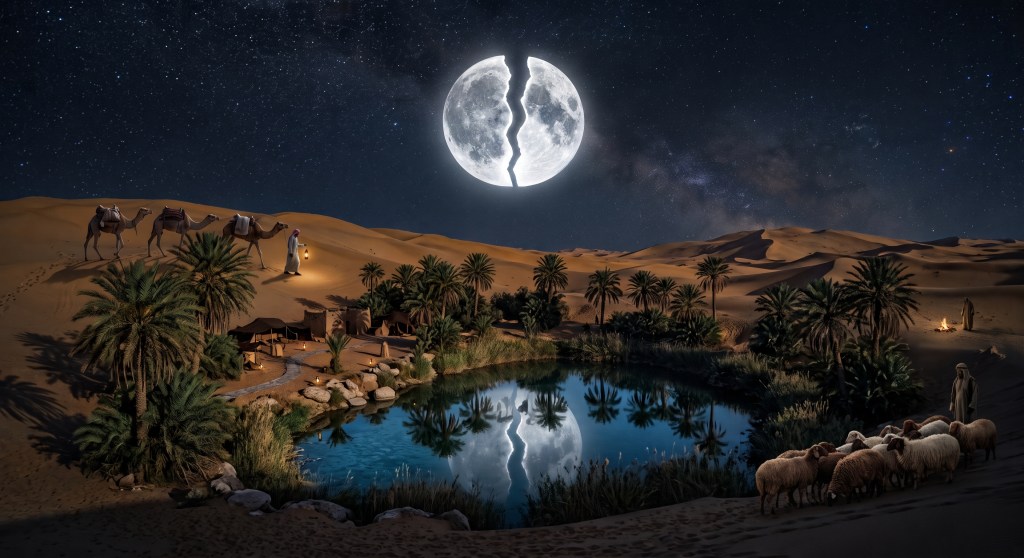
Presented by Gemini for Zia H Shah MD
Audio teaser: The Impossible Physics of Splitting the Moon
Abstract
The opening passage of Surah Al-Qamar (Quran 54:1-5) represents one of the most rigorously debated cosmic and historical events within Islamic textual tradition. Describing the approach of the Final Hour and the splitting of the moon, the text has generated over a millennium of exegetical discourse. Classical commentators overwhelmingly relied upon mass-transmitted Hadith literature to assert a physical, astronomical bifurcation of the lunar body during the Meccan period of the Prophet Muhammad’s ministry. However, the advent of modern astrophysics, specifically the rigorous understanding of gravitational binding energy, orbital mechanics, and the Roche limit, poses an insurmountable challenge to a literal interpretation of this event. This comprehensive report provides an exhaustive scientific, philosophical, and theological commentary on these five verses. It juxtaposes classical exegesis with the contemporary rationalist shifts spearheaded by figures like Sir Syed Ahmad Khan and Muhammad Asad, while exploring the philosophical frameworks of causality championed by Al-Ghazali. A dedicated synthesis of the perspective articulated by Zia H Shah MD serves as the interpretive focal point of this analysis. This perspective argues that while a profound miraculous event undoubtedly occurred to confound the critics of the time, a literal splitting of the moon is a cosmological impossibility that would have annihilated the terrestrial biosphere. By distinguishing the innocent ignorance of ancient commentators from the stubborn fundamentalism of modern literalists, this report situates the passage within the broader thematic structure of Surah Al-Qamar, emphasizing the Quranic imperative of taking heed (dhikr) over rigid, scientifically disastrous literalism.
I. Textual Foundations: The Arabic Text and Translations
An exhaustive analysis of Quran 54:1-5 must begin with the primary Arabic text, which establishes the rhythmic cadence and the semantic roots that have driven centuries of theological discourse. The passage captures a moment of cosmic disruption juxtaposed against the stubborn psychological disposition of the Meccan polytheists.
The Arabic Text (Quran 54:1-5)
اقْتَرَبَتِ السَّاعَةُ وَانْشَقَّ الْقَمَرُ (1) وَإِنْ يَرَوْا آيَةً يُعْرِضُوا وَيَقُولُوا سِحْرٌ مُسْتَمِرٌّ (2) وَكَذَّبُوا وَاتَّبَعُوا أَهْوَاءَهُمْ وَكُلُّ أَمْرٍ مُسْتَقِرٌّ (3) وَلَقَدْ جَاءَهُمْ مِنَ الْأَنْبَاءِ مَا فِيهِ مُزْدَجَرٌ (4) حِكْمَةٌ بَالِغَةٌ فَمَا تُغْنِ النُّذُرُ (5)
Comparative Translations
To capture the nuances of the Arabic terminology—particularly the verbs iqtaraba (has drawn near) and inshaqqa (is cleft/split)—it is essential to examine how prominent translators have rendered the text. The variations in translating the Arabic past tense highlight the ongoing debate over whether the text describes a completed historical event or a guaranteed eschatological certainty.
| Translator | Translation of Quran 54:1-5 |
|---|---|
| M.A.S. Abdel Haleem | 1. The Hour draws near; the moon is split in two. 2. Whenever the disbelievers see a sign, they turn away and say, ‘Same old sorcery!’ 3. They reject the truth and follow their own desires––everything is recorded–– 4. although warning tales that should have restrained them have come down to them–– 5. far-reaching wisdom––but these warnings do not help. |
| Sahih International | 1. The Hour has come near, and the moon has split [in two]. 2. And if they see a miracle, they turn away and say, “Passing magic.” 3. And they denied and followed their inclinations. But for every matter is a [time of] settlement. 4. And there has already come to them of information that in which there is deterrence. 5. Extensive wisdom – but warning does not avail [them]. |
| Abdullah Yusuf Ali | 1. The Hour (of Judgment) is nigh, and the moon is cleft asunder. 2. But if they see a Sign, they turn away, and say, “This is (but) transient magic.” 3. They reject (the warning) and follow their (own) lusts but every matter has its appointed time. 4. There have already come to them Recitals wherein there is (enough) to check (them). 5. Mature wisdom; – but (the preaching of) Warners profits them not. |
| Marmaduke Pickthall | 1. The hour drew nigh and the moon was rent in twain. 2. And if they behold a portent they turn away and say: Prolonged illusion. 3. They denied (the Truth) and followed their own lusts. Yet everything will come to a decision. 4. And surely there hath come unto them news whereof the purport should deter. 5. Effective wisdom; but warnings avail not. |
| Muhammad Asad | 1. The Hour is nigh, and the moon is split. 2. But if they see a sign, they turn away, and say: “This is evident magic.” 3. And they rejected the truth and followed their own desires. But every matter has its appointed time. 4. And there has already come to them of information that in which there is deterrence. 5. Far-reaching wisdom, but warnings do not help. |
| A. J. Arberry | 1. The Hour has drawn nigh: the moon is split. 2. Yet if they see a sign they turn away, and they say ‘A continuous sorcery!’ 3. They have cried lies, and followed their caprices; but every matter is settled. 4. And there have come to them such tidings as contain a deterrent. 5. A Wisdom far-reaching; yet warnings do not avail. |
A primary observation from this array of translations is the rendering of the verbs. Arabic frequently uses the perfect tense for both completed past actions and future events of absolute certainty, a concept known as the prophetic past. Abdel Haleem translates the verbs in a manner that bridges the past and present continuous (“draws near”, “is split”), capturing the immediacy of the sign while reflecting the grammatical reality of the Arabic. The response of the deniers in verse 2—calling the event “continuous sorcery” (siḥrun mustamir)—anchors the passage in a localized, observable reaction to a visual phenomenon. The Meccan polytheists were presented with a profound sign, yet their psychological disposition, rooted in their “own desires,” led them to dismiss the supernatural as mere illusion.
II. The Hadith Corpus: Testimonies of the Lunar Event
The classical orthodox understanding that the moon literally split in the sky during the Meccan period is deeply rooted in the Hadith literature. The reports regarding the splitting of the moon are classified as Mutawatir (mass-transmitted) by traditional scholars, meaning they were narrated by multiple independent chains of transmission from various companions, making them foundational to classical Islamic historiography.
To fully understand the classical insistence on a physical event, it is necessary to examine the primary texts from the most authoritative Sunni collections, Sahih al-Bukhari and Sahih Muslim. The narratives consistently detail the geographical context of Mecca and Mina, the visual parallax of the mountain, and the immediate reaction of the Quraysh.
| Source & Reference | Full Text of the Narration |
|---|---|
| Sahih al-Bukhari 4864 | Narrated Ibn Masud: “During the lifetime of Allah’s Messenger (ﷺ) the moon was split into two parts; one part remained over the mountain, and the other part went beyond the mountain. On that, Allah’s Messenger (ﷺ) said, ‘Witness this miracle.’” |
| Sahih al-Bukhari 4865 | Narrated `Abdullah: “The moon was cleft asunder while we were in the company of the Prophet, and it became two parts. The Prophet (ﷺ) said, ‘Witness, witness (this miracle).’” |
| Sahih al-Bukhari 4866 | Narrated Ibn `Abbas: “The moon was cleft asunder during the lifetime of the Prophet.” |
| Sahih al-Bukhari 4867 | Narrated Anas: “The people of Mecca asked the Prophet (ﷺ) to show them a sign (miracle). So he showed them (the miracle) of the cleaving of the moon.” |
| Sahih al-Bukhari 4868 | Narrated Anas: “The moon was cleft asunder into two parts.” |
| Sahih al-Bukhari 3638 | Narrated Ibn `Abbas: “The moon was split into two parts during the lifetime of the Prophet.” |
| Sahih al-Bukhari 3868 | Narrated Anas bin Malik: “The people of Mecca asked Allah’s Apostle to show them a miracle. So he showed them the moon split in two halves between which they saw the Hira’ mountain.” |
| Sahih al-Bukhari 3869 | Narrated `Abdullah: “The moon was split (into two pieces) while we were with the Prophet in Mina. He said, ‘Be witnesses.’ Then a Piece of the moon went towards the mountain.” |
| Sahih Muslim 2800b | This hadith has been transmitted on the authority of Abdullah b. Mas’ud (who said): “We were along with Allah’s Messenger (ﷺ) at Mina, that moon was split up into two. One of its parts was behind the mountain and the other one was on this side of the mountain. Allah’s Messenger (may peace be upon him) said to us: Bear witness to this.” |
| Sahih Muslim 2802a,b | Anas reported that “the people of Mecca demanded from Allah’s Messenger (ﷺ) that he should show them (some) signs (miracles) and he showed twice the splitting of the moon.” |
| Jami’ at-Tirmidhi 3288 | Narrated Ibn ‘Umar: “The moon was split during the time of the Messenger of Allah (SAW). So the Messenger of Allah (SAW) said: ‘Bear witness.’” |
The specificity of these reports forms the bedrock of the classical orthodox belief in a physical, astronomical manipulation. The companions detail their physical location at Mina, explicitly noting the visual of the mountain (Mount Hira or Mount Abu Qubais) positioned between the two lunar halves, and record the immediate reaction of the Meccan polytheists labeling the event as “magic”.
In modern apologetics, scholars attempting to defend the literal physical splitting against the lack of global historical records argue that the whole world does not witness night at the same time, that moon sighting varies geographically, and that local weather phenomena (clouds, fog, dust) could obscure the view for neighboring civilizations. Furthermore, they argue that ancient populations were largely asleep during the night, minimizing the potential pool of witnesses outside the immediate Meccan vicinity. While these arguments address the lack of human eyewitness testimony, they entirely fail to address the insurmountable cosmological and planetary physics involved in dismantling a celestial body.
III. Classical Exegesis (Tafsir): The Theology of Omnipotence
Classical commentators (Mufassirun) approached Quran 54:1-5 through the lens of literal, historical reality. For scholars operating prior to the Scientific Revolution, the omnipotence of God (Qudrah) rendered the physical disruption of celestial bodies entirely plausible and theologically necessary.
Ibn Kathir (d. 1373 CE) explicitly cites the widespread transmission of the Hadiths to validate the physical splitting. He argues that the Quraysh demanded a definitive miracle, the Prophet pointed to the moon, and it was cleanly cleaved, leaving no debris. Similarly, Fakhr al-Din al-Razi (d. 1209 CE) in his Tafsir al-Kabir and Al-Qurtubi affirmed the event as a literal historical reality that served to vindicate the prophetic claim.
These classical theologians viewed the cosmos not as an autonomous, self-sustaining machine governed by inviolable physical laws, but as a contingent creation subject to the immediate, overriding will of the Creator. In this pre-modern paradigm, if the deniers of Mecca called the event “transient magic,” it was precisely because a profound physical anomaly had occurred before their eyes—one they could not explain through standard empirical frameworks, thus necessitating their psychological retreat into accusations of sorcery.
IV. Contemporary Exegesis: Rationalism and Eschatology
As Islamic thought encountered post-Enlightenment rationality and the empirical realities of modern astrophysics, several prominent Muslim intellectuals sought alternative hermeneutical approaches to the passage, attempting to reconcile textual reverence with cosmic mechanics.
The Eschatological Reading
Thinkers such as Muhammad Asad highlighted the grammatical phenomenon in the Quran where the past tense is utilized to describe future eschatological events. Asad argued that the phrase “the moon is split” (inshaqqa al-qamar) refers to the apocalyptic cosmic cataclysm that will precede the Day of Resurrection. In his highly influential The Message of the Qur’an, Asad writes that the splitting of the moon is not something that has already happened, but is a sign of Judgment Day, as clearly indicated in the text pairing it with the approach of the Hour. In his view, the subsequent verse regarding the disbelievers calling it “magic” refers to their general posture toward all divine signs and prophetic warnings, rather than a localized historical event.
The Rationalist Reading
In the late 19th century, figures like Sir Syed Ahmad Khan adopted a strictly rationalist perspective (Ilm al-Kalam), heavily influenced by a desire to reconcile the Quran with natural philosophy. In his Tafsir al-Quran wa Huwa al-Huda wa al-Furqan, Sir Syed often interpreted purported physical miracles allegorically or psychologically. He argued that the laws of nature are the “work of God” and the Quran is the “word of God,” and it is philosophically impossible for the two to contradict. Consequently, he viewed the splitting of the moon not as an astronomical disruption, but potentially as a visual illusion, a natural lunar eclipse misunderstood by the observers, or a purely eschatological metaphor.
V. Scientific Cosmology: The Physical Impossibility of a Literal Split
The insistence by certain traditionalist factions on a literal, physical splitting of the moon requires a rigorous examination against the established principles of modern astrophysics. When subjected to the laws of gravitation, kinetic energy, and orbital mechanics, the classical interpretation of a physically bifurcated lunar body becomes fundamentally untenable without assuming the complete suspension of the universe’s operational physics and the subsequent erasure of catastrophic terrestrial damage.
Gravitational Binding Energy and Planetary Annihilation
To physically split the moon and separate its halves, an energy threshold exceeding the moon’s gravitational binding energy must be introduced into the system. Gravitational binding energy (U) is the minimum energy required to disassemble a uniform sphere to infinity and is calculated using the formula:
U=5R3GM2
Where:
- G is the gravitational constant (6.674×10⁻¹¹ m3kg−1s−2)
- M is the mass of the moon (7.342×10²² kg)
- R is the lunar radius (1.737×10⁶ m)
The calculated binding energy of the moon is approximately 1.2×1029 Joules.
To contextualize this astronomical magnitude of energy, one must look at the most powerful forces known to humanity. The most powerful nuclear weapon ever detonated on Earth, the Tsar Bomba, released roughly 2.4×10¹⁷ Joules. Therefore, to physically cleave the moon would require an energy input equivalent to approximately 500 billion of the largest nuclear devices ever constructed detonating simultaneously within the lunar core.
| Cosmic and Terrestrial Energy Comparisons | Energy Yield (Joules) |
|---|---|
| Gravitational Binding Energy of the Moon | 1.2×1029 J[cite: 33, 35] |
| Solar Energy Output (per year) | 1.2×1034 J |
| Chicxulub Asteroid Impact (Dinosaur Extinction) | 4.2×10²³ J |
| 2004 Indian Ocean Earthquake (Magnitude 9.2) | 1.0×10²² J |
| Tsar Bomba (Largest Nuclear Detonation) | 2.4×10¹⁷ J |
If such an immense amount of energy were introduced into the Earth-Moon system to violently separate the lunar halves (as depicted in classical descriptions where one half was seen behind a mountain and the other in front), the resulting thermal radiation, kinetic debris, and shockwaves would be apocalyptic. The conservation of energy dictates that this excess energy cannot simply vanish; it must radiate outward. Even a marginal fraction of this energy striking the Earth would flash-boil the oceans, vaporize the atmosphere, and melt the terrestrial crust into an ocean of magma, resulting in the total and immediate extinction of the biosphere.
The Roche Limit and Orbital Disruption
Furthermore, the physical separation and subsequent reassembly of the moon invoke the devastating dynamics of the Roche limit. The Roche limit defines the critical distance within which a celestial body, held together only by its own gravity, will disintegrate due to a second body’s tidal forces. The formula for estimating the fluid Roche limit is:
d≈2.456Rp(ρsρp)1/3
For a fluid moon orbiting the Earth, the Roche limit is calculated at approximately 18,489 kilometers from the Earth’s center. The moon currently rests at a safe distance of 384,400 kilometers.
If the moon were cleaved and its mass distribution altered, or if massive parts of it were brought close enough to Earth to create the dramatic visual parallax described in the Hadiths (appearing on either side of a local mountain), it would inevitably cross the Roche limit. Inside this limit, the tidal forces exerted by Earth would exceed the moon’s self-gravity, causing it to undergo spaghettification. The moon would be pulverized into a planetary ring system, and Earth would be subjected to a catastrophic, unrelenting bombardment of lunar debris.
Additionally, tidal forces scale with the inverse cube of the distance. Bringing massive lunar fragments 20 times closer to Earth to satisfy the visual parameters of the classical interpretation would result in tidal forces 8,000 times stronger than present. This gravitational violence would trigger unimaginable tectonic upheaval, super-earthquakes, and continent-drowning tsunamis that would reshape the planet’s surface.
The total absence of any historical, geological, or astronomical record of global cataclysms, mass extinctions, or debris impacts in 7th-century Arabia—or globally—provides insurmountable empirical evidence that the moon was not physically destroyed and reassembled.
VI. Philosophical Theology: Causality, Occasionalism, and the Cosmos
The tension between the scientific impossibility of the event and the theological necessity of validating the sacred text is a profound philosophical challenge. Historically, Islamic philosophy navigated the boundary between divine omnipotence and physical law through the rigorous debate over causality.
Al-Ghazali, Occasionalism, and Sunnatullah
The great theologian Abu Hamid Al-Ghazali (d. 1111 CE) championed the Ash’arite doctrine of Occasionalism, a metaphysical framework that fundamentally restructures the understanding of natural law. According to Al-Ghazali, the universe possesses no inherent, autonomous causal power. The entities within creation have no independent efficacy; rather, God is the sole Agent in every event. When fire burns cotton, it is not the inherent nature of the fire to burn; rather, God creates the burning at the exact moment the fire touches the cotton.
In this framework, what scientists term “laws of nature” are merely Sunnatullah—the customary habits of God. God sustains the universe moment by moment, recreating it in a predictable pattern to allow for human rational inquiry, existence, and the planting of crops. Because God is completely unbound by prior causal chains, He can effortlessly break His “habit”. Thus, for Al-Ghazali, a miracle (such as the splitting of the moon) is not a violation of nature, but simply God choosing to actualize a different possibility for a brief moment outside of His usual custom.
Fascinatingly, modern commentators have noted that this philosophical stance bears an uncanny resemblance to aspects of quantum mechanics, where events are probabilistic rather than strictly deterministic, and particles can seemingly transcend spatial limitations through entanglement.
Ibn Rushd and the Defense of Secondary Causes
While Occasionalism philosophically protects the absolute omnipotence of God and theoretically allows for any physical anomaly, it met fierce resistance from Aristotelian philosophers like Ibn Rushd (Averroes, d. 1198 CE). Ibn Rushd pushed back against Al-Ghazali’s complete denial of secondary causes, arguing that God establishes an ordered universe governed by profound wisdom, and that denying inherent causality undermines the rational study of God’s creation, rendering the universe unintelligible.
Today, physics and cosmology reveal a universe bound by an “unreasonable effectiveness of mathematics”—a pre-established harmony that points directly to a Designer. The Quran itself confirms this mathematical precision: “The sun and the moon move by precise calculation” (Quran 55:5). Proposing a massive, literal rupture of these mechanics without the corresponding planetary consequences introduces a severe theological contradiction. It posits a God who relies on immense physical deception—suppressing the thermal, gravitational, and kinetic realities of a torn celestial body to make it appear as though nothing changed on Earth.
VII. The Perspective of Zia H Shah MD
To navigate this highly complex intersection of revelation, classical tradition, and astrophysical reality, Zia H Shah MD articulates a synthesis that is both scientifically rigorous and deeply reverent of the Quranic text. This perspective, heavily featured on the platform thequran.love, seeks to resolve apparent conflicts in the Quran by rising above human inconsistencies and letting fundamental, universally defensible truths guide the interpretation of allegorical or miraculous passages.
From his scientific perspective as a medical doctor and rationalist, Zia H Shah MD clearly states that the breaking of the moon could not have been a literal, physical cleavage. As demonstrated by the cosmological data, the physical fracturing of a body with a gravitational binding energy of 1.2×1029 Joules would undeniably necessitate the total destruction of the Earth. A literal split would have showered the Earth in an apocalyptic rain of debris, boiled the atmosphere, and erased all life. Because human history continued uninterrupted, the split could not have been a physical fracture of the lunar rock.
However, Zia H Shah MD emphatically believes that a miraculous event did happen. The Quran is absolute in its integrity; if nothing anomalous had occurred in the Meccan sky, the Quran would not have mentioned it. More critically, the sophisticated and hostile nonbelievers of the time—as well as skeptical believers—would have instantly found a serious fault in the Quran. They would have exposed the Prophet by stating that no such event ever occurred, crushing the nascent Islamic movement in its infancy.
Instead, verse 2 specifically argues that the critics witnessed the event but dismissed it: “And if they see a miracle, they turn away and say, ‘Passing magic.’” (54:2). This verse is the ultimate proof that a visual, awe-inspiring phenomenon manifested. The critics were definitely wrong in calling the event magic, but their reaction perfectly illustrates a fundamental psychological tendency of stubborn critics: they refuse to benefit from or believe in clear signs, opting instead to label the divine as mere sorcery or mass illusion. The miracle was a localized manipulation of light, space, or human perception—an optical or atmospheric reality authored by the Divine—designed to serve as a profound sign of the Hour, without violating the gravitational integrity of the solar system.
Furthermore, Zia H Shah MD argues that the commentators of old who suggested a literal, physical splitting did so innocently; they simply did not know what humanity knows today of modern cosmology, orbital mechanics, and the catastrophic scientific consequences of such a physical split. They operated faithfully within the knowledge horizon of their era. However, if contemporary commentators, armed with modern astrophysics, stubbornly insist on a literal splitting of the moon’s mass, they are demonstrating fundamentalist inclinations. Such obstinacy ignores the Quranic injunction to apply reason and reflects a refusal to let the “fundamental define the allegorical” (Quran 3:7). True Quranic understanding embraces the harmony between God’s work (nature) and God’s word (scripture). To cling to a scientifically disastrous interpretation is to do a disservice to the intellectual majesty of the Quran.
VIII. Literary and Structural Analysis of Surah Al-Qamar
Understanding verses 1-5 requires zooming out to appreciate the architectural brilliance of Surah Al-Qamar as a whole. The Surah is highly percussive, compact, and characterized by rapid, rhythmic warnings and a haunting refrain that demands profound intellectual and spiritual engagement.
The Mechanics of Dhikr (Remembrance)
A central structural pillar of the Surah is the concept of Dhikr. Four times throughout the chapter (verses 17, 22, 32, and 40), the Quran proclaims:
“And We have certainly made the Qur’an easy for remembrance, so is there any who will remember?” (Wa-laqad yassarnā al-Qurʾāna li-l-dhikri fa-hal min muddakir).
Linguists and exegetes note that the Arabic word dhikr operates on multiple planes: it means to memorize, to understand, to take heed, and to derive moral lessons. The word muddakir (derived from the root dh-k-r) specifically refers to one who actively internalizes the admonition.
By opening the Surah with the cosmic sign of the moon’s splitting, the Quran establishes an atmosphere of intense awe and impending eschatological accountability. The visual miracle in the sky (the splitting of the moon) is immediately juxtaposed with the linguistic miracle in the ear (the Quran itself, which has been made “easy for remembrance”). The deniers in Mecca rejected the visual sign as “magic,” just as they repeatedly rejected the linguistic sign as poetry or sorcery.
The Historical Warning
Following the opening five verses, the Surah transitions into a relentless sequence of historical case studies—the people of Noah, ‘Ad, Thamud, Lot, and Pharaoh. Each narrative follows a precise cyclical structure: a Prophet delivers a warning (nudhur), the people arrogantly deny it, a specific divine punishment (‘adhāb) eradicates them, and the narrative concludes with the refrain regarding the Quran’s ease of remembrance.
For example, the people of ‘Ad are destroyed by a “screaming wind” that plucks them up like uprooted palm trunks, and the people of Thamud are obliterated by a single devastating “shriek”. The opening verses about the moon establish the existential stakes: the Hour is drawing near, and the universe itself is subject to disruption by the Creator. The historical accounts serve as localized proof of this ultimate cosmic vulnerability. The physical world offers no immunity against the divine decree.
IX. Thematic Epilogue
The opening verses of Surah Al-Qamar stand at the fascinating nexus of classical reverence, philosophical inquiry, and modern empirical science. To read them today is to engage in a profound exercise of Dhikr—an active, deeply reflective remembering that harmonizes the intellect and the soul.
The traditional view of a physically bifurcated moon served its theological purpose in antiquity, powerfully asserting the absolute sovereignty of God over a static sky. Yet, as humanity’s cosmic horizon has expanded, revealing a universe of staggering mathematical precision, delicate gravitational balances, and unimaginable energies, exegesis must necessarily evolve. God’s majesty is not diminished by the inviolability of astrophysics; rather, it is magnified by it. The laws of nature are the poetry of the Divine, establishing an arena where human reason can flourish.
As Zia H Shah MD posits, acknowledging that the moon did not literally fracture does not strip the Quran of its miraculous nature. Instead, it elevates our understanding of how God interacts with human perception, offering signs that stun the senses without annihilating the very Earth we stand upon. The miracle of the moon was a profound divine intervention, an undeniable testament witnessed by the skeptics of Mecca, proving that the reality we take for granted can be instantly suspended by its Author.
Ultimately, Surah Al-Qamar demands that humanity move beyond mechanical disputes over how the moon split, and focus entirely on why the sign was given. The Hour is near. The universe is contingent. And the final, enduring miracle is not written in the transient canvas of the night sky, but in the pages of a Book made easy for remembrance—if only there is someone willing to remember.





Leave a comment