
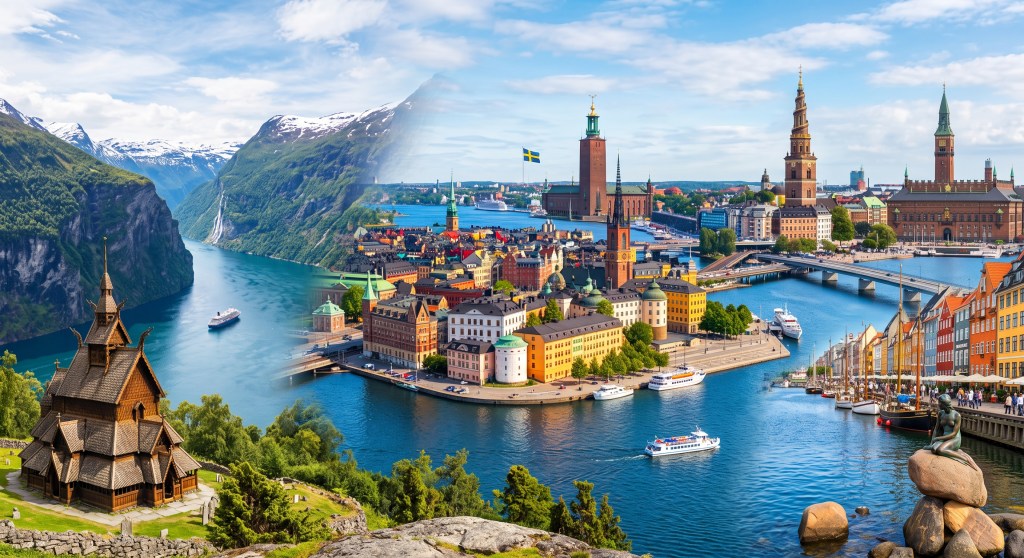
An essay in the spirit of invitation — warm, respectful, and without compulsion By Claude for Zia H. Shah, MD
Abstract
This essay is a warm invitation, addressed to the peoples of Norway, Denmark, and Sweden, to consider a further step in a spiritual journey their ancestors began more than a thousand years ago. Its thesis is simple and, I hope, gently argued: that the Trinitarian monotheism of Christianity — which drew Scandinavia out of the polytheism of the Old Norse religion — was a genuine, valuable, and civilization-shaping step toward the worship of the One God, and that the pure, undivided monotheism (Tawhid) of Islam is the natural completion of that same journey. I argue this not as a stranger, but as a fellow traveler on the Abrahamic road, drawing on the Quran’s own principle that “there is no compulsion in religion” quran (Quran 2:256). I trace three movements: the Norse past and the first great transition to Christianity; the surprising and beautiful history of contact between the Viking world and the Muslim world; and the modern moment — in which conversions to Islam, Muslim migration, and peaceful coexistence within one of the world’s most secular and free societies have quietly reopened that ancient road. Christianity is honored throughout as the faith that prepared Scandinavia’s spiritual soil. Islam is presented not as its rival but as its fulfillment: one God, indivisible, Al-Rahman (the Gracious) and Al-Rahim (the Merciful), the God of Abraham, of Jesus, and of all humankind.
I. The World of the Allfather: Scandinavia Before the One God
To speak honestly to a people, one must begin with honor for their past. Long before church bells rang over the fjords, the peoples of Scandinavia lived within a rich and coherent religious world — what scholars call Old Norse religion, and what its own practitioners simply called sidr, “the custom.”
It was a polytheistic world, alive with divine presence. Its gods were divided into two great families: the Æsir, gods of war and cosmic order, and the Vanir, gods of fertility and nature. At the head stood Odin, the Allfather — god of wisdom, war, poetry, and death, who was said to have sacrificed an eye at the well of Mímir to drink of wisdom, and to have hung himself upon the world-tree to win the secret of the runes. Beside him stood Thor, the hammer-wielding god of thunder and protection, the most beloved of the gods among ordinary farmers and seafarers, whose hammer Mjölnir was worn as a pendant across the Norse world.
The cosmos itself was imagined as a vast tree, Yggdrasil, whose branches and roots bound together nine realms — Asgard of the gods, Midgard of humankind, Jötunheim of the giants, and others. Fate was woven at the roots of that tree by the Norns. Religious life was practical and communal: blót, the ritual sacrifice offered at homes, in sacred groves, and at the estates of chieftains; seiðr, the practice of divination and magic; and a pervasive sense that destiny was fixed and courage was the highest virtue. This was not a shallow faith. It gave meaning, structure, and dignity to life for centuries, and its echoes survive today in the modern revival of Ásatrú, whose Icelandic fellowship, the Ásatrúarfélagið, was founded in 1972 and officially recognized by the Icelandic state in 1973 — and which is now among the fastest-growing spiritual movements in the Nordic world.
I recount all this with respect, not condescension. Every people begins somewhere, and the human heart, wherever it beats, reaches toward the transcendent. The Quran itself teaches that God has sent guides to every nation (Quran 35:24). The Norse reverence for the sacred, for oath and honor, for the mystery woven into nature — these were the first stirrings of a soul that would one day seek the One.
II. The First Great Journey: From Many Gods to One
Then came a turning. Beginning in the 8th century and unfolding over some three hundred years, the peoples of Scandinavia made one of the most consequential journeys in their history: they moved from the worship of many gods to the worship of One. This was the Christianization of Scandinavia.
It came not by a single sword-stroke but through many channels — trade, the centralizing ambitions of kings, contact with Christian Europe during the very age of Viking expansion, and the conversion of rulers. The earliest efforts came in the 830s, when the missionary Ansgar built churches at Birka and Hedeby. The decisive conversions of kings, however, came between roughly 960 and 1020. Denmark led the way: around 965, King Harald Bluetooth declared his kingdom Christian and raised the larger of the two Jelling Stones, which bears the oldest Scandinavian image of Christ and commemorates the king who, in the stone’s own words, “made the Danes Christian.” In Norway, Olaf Tryggvason set conversion in motion around 995; in Sweden, Olof Skötkonung accepted baptism around the year 1000.
Let us be honest about what this transition asked of the Norse. As one historical account of the period frankly notes, the old indigenous traditions that “had provided security and structure were challenged by ideas that were unfamiliar, such as original sin, the Incarnation, and the Trinity.” It was not easy. Faith was, for a time, so provisional that a king like Harald could be baptized for political advantage while his son Sweyn Forkbeard rebelled and restored the old ways; old customs lingered in private for generations. And yet the direction of travel was unmistakable and, I would argue, providential: away from the many and toward the One. The doctrine of one God, creator of heaven and earth, took root in Nordic soil and bore a thousand years of fruit — cathedrals and universities, hospitals and hymns, an ethic of charity and human dignity that shapes Scandinavia to this day.
Here I wish to be very clear, for this is the heart of my invitation. I honor Christianity. I honor it as the faith that carried the Nordic peoples across the great divide between polytheism and monotheism. The God whom Harald Bluetooth’s Danes learned to worship is the same One God whom Muslims worship. The reverence for Jesus, the love of the Gospel’s mercy, the insistence that there is a Creator to whom all are accountable — these are precious and true. In my own writings I have called this the shared inheritance of the “Abrahamic legacy,” and I have devoted essays such as “The Common Word: A Historical and Theological Analysis of Quran 3:64–68 and the Abrahamic Legacy” thequran and “The Divine Invitation: A Comprehensive Commentary on Quran 3:64 and the Paradigm of Abrahamic Fellowship” thequran to exactly this fellowship. Christianity is not the enemy of Islam. In the Quran’s own framing, it is kin.
And yet — and I say this as gently as I can — the journey from the many to the One was not, in Christianity, fully completed. The doctrine of the Trinity, formalized in the creeds of the fourth century, holds together three divine persons in one Godhead. To Muslim eyes, and I believe to the plain reading of Jesus’s own witness, this is a monotheism still carrying within it a shadow of plurality — a limited monotheism, magnificent in intent but not yet pure. The final step remained.
III. An Ancient Bridge: When the Norse Met the Muslim World
Before I describe that final step, let me tell you something you may find surprising and beautiful: the road between Scandinavia and the world of Islam is not new. It is more than a thousand years old.
The Vikings were not only raiders; they were among the greatest traders and travelers of their age. And the geography of their journeys mapped out the world they touched. The Danes sailed mostly west — to England, where they carved out the Danelaw, and to Normandy. The Norwegians sailed west and north — to Scotland, Ireland, Iceland, and the Faroe and Shetland Islands. And the Swedes turned east — down the great rivers of the Baltic into the lands of the Rus, across to the Black Sea and the Caspian, to the very edges of the Islamic Caliphates. It was the Swedes-as-Rus who gave their name to Russia, and who traded furs and amber for the silver of Baghdad and Samarkand.
The archaeological evidence of this contact is staggering. According to a 2023 study by the French scholar and archaeologist Manar Hammad, reported by Medievalists.net, “Scandinavian museums possess almost 500,000 dirhams, more than any other place in the world” — Islamic silver coins buried in hoards across Sweden, Gotland, Denmark, and Norway between roughly 770 and 1050. Gotland alone accounts for more than 350 recorded dirham hoards. These coins bore Arabic inscriptions, many of them religious: the name of God, verses of the Quran, the profession of divine oneness. When a Norse trader weighed his hack-silver on the scales, he was, without knowing it, handling the words of Tawhid.
And there is a still more intimate artifact. In a ninth-century woman’s grave at the Viking trading town of Birka, near Stockholm, archaeologists found a silver ring set with colored glass, engraved in Arabic Kufic script with a single phrase: il-la-lah — “for Allah,” or “to Allah.” Modern analysis by the Stockholm University biophysicist Sebastian Wärmländer and colleagues, published in the journal Scanning in 2015, found the ring to be “a high quality (94.5 percent) non-gilded silver alloy, set with a stone of colored soda-lime glass,” still bearing the file marks from its casting — so that “the ring has rarely been worn, and likely passed from the silversmith to the woman buried at Birka with few owners in between.” It is, the researchers note, “the only ring with an Arabic inscription found at a Scandinavian archaeological site.” The name of God, in Arabic, resting on the hand of a Viking woman in the earth of Sweden for eleven hundred years.
Nor was the contact only material. In the year 921–922, the Arab Muslim diplomat Ahmad ibn Fadlan traveled from Baghdad to the Volga, where he met a band of Norse traders he called the Rus. His Risala records his encounter with wonder and candor: “I have never seen more perfect physical specimens, tall as date palms, blond and ruddy.” He watched their customs, their commerce, and their funerals, and left one of the earliest and most vivid eyewitness accounts of the Norse ever written — set down by a Muslim hand.
I offer this history not as a curiosity but as a parable. The connection between your ancestors and the world of the One God is not a foreign imposition of the modern age. It is a thread woven into your own soil, your own graves, your own coins. The ring in the Birka grave was, perhaps, a whisper across eleven centuries — an invitation carried in silver, waiting to be read.
IV. The Case for the Pure Oneness of God
Let me now speak of the final step: the pure monotheism, the Tawhid, at the heart of Islam. I do so in the spirit of reason and reverence, for the Quran appeals not to coercion but to reflection.
The central claim of Islam is breathtakingly simple: God is One — not one in three, nor three in one, but One, indivisible, without partner, without offspring, without equal. “Say, He is Allah, the One; Allah, the Eternal, Absolute; He begets not, nor is He begotten; and there is none comparable unto Him” al-islam (Quran 112). This chapter, al-Ikhlas — “The Purity” — is said in the Prophetic tradition to weigh a third of the entire Quran, so central is its message.
Why should this matter to a thoughtful Scandinavian, heir to Christianity and citizen of a scientific age? Because the oneness of God is not merely a doctrine to be accepted; it is a truth that the very structure of the universe proclaims. This is an argument I have developed at length in essays such as “The Singularity of Creation: A Scientific, Philosophical, and Theological Refutation of Trinitarian Plurality Through the Lens of Quranic Monism and Cosmic Unity,” thequran and in my “Research Dossier: One Creator, Unified Creation — Q 21:22, Q 31:10–11, Q 13:16.” The Quran itself makes the argument: “Had there been in the heavens and the earth other gods besides Allah, then surely both would have gone to ruin” reviewofreligions (Quran 21:22). The cosmos is a single, coherent, law-governed whole. Its physics is unified; its constants are consistent from one edge of the observable universe to the other; its mathematics is one. Such radical unity of creation points, the Quran insists, to the radical unity of the Creator. One order bespeaks one Author.
And what of Jesus, peace be upon him? Here I must speak with the greatest tenderness, for I know how beloved he is. Islam does not diminish Jesus — it honors him profoundly. He is al-Masih, the Messiah; he is the Word that God conveyed to Mary and a spirit from Him; quranreflect he is born of a virgin by God’s command; he is a mighty prophet and messenger. What Islam declines to do is to make him God. And here, remarkably, Islam finds itself joined by the conclusions of modern critical scholarship. As I have noted in drawing upon the work of the New Testament scholar Bart Ehrman — in an essay bearing his own words as its title, “‘I am Firmly Convinced That Jesus Never Claimed To Be God’” — the historical Jesus, in Ehrman’s phrase, “didn’t call himself God and didn’t consider himself God”; he preached the Kingdom of God, not his own divinity. The Quran gives us his own voice: “The Messiah, Jesus, son of Mary, was no more than a messenger of Allah… So believe in Allah and His messengers, and do not say ‘Three.’ Desist — it is better for you. Allah is only One God” surahquran (Quran 4:171).
This is not a subtraction from Christianity. It is, I would argue, a restoration of it — a return to the pure monotheism that Jesus himself, a Jewish prophet of Galilee who proclaimed “Hear, O Israel, the Lord our God, the Lord is One,” would have recognized as his own.
And the God thus made One is not remote or cold. The Quran opens every chapter but one with the invocation Bismillah al-Rahman al-Rahim — “In the name of God, the Gracious, the Merciful.” Of the ninety-nine Beautiful Names of God, these two — Al-Rahman and Al-Rahim — are the most emphasized. Al-Rahman is the boundless grace inherent in God’s very being, poured out upon all creation before any deserving; Al-Rahim is the tender, responsive mercy that answers those who turn toward Him. alim In my essay “The One and the Ninety-Nine: How the Names of Allah Interpret One Another,” thequran I have tried to show how the divine names form a single, luminous web, each illuminating the others, so that the One God is known not as a bare mathematical unity but as a living fullness of mercy, knowledge, power, and beauty. To worship the One is not to worship less. It is to worship the whole of the Real, undivided.
This same One God is the God of Abraham — the patriarch who, as I have written in “The Primordial Paradigm: Abraham as the Universal Archetype of Monotheism and Quranic Role Model,” looked upon the setting star, the setting moon, the setting sun, and refused to love things that fade, turning instead to the One who does not set (Quran 6:74–79). Abraham is the shared father of Jews, Christians, and Muslims. To follow the pure monotheism of Islam is, in a real sense, to come home to Abraham’s own creed.
V. The Pioneers: Scandinavians Who Have Walked the Road
This is no longer an abstract proposal. In our own time, a growing number of Norwegians, Danes, and Swedes have quietly walked precisely this road — from the secular or Christian world of their birth to the pure monotheism of Islam. They are not, for the most part, the product of pressure or crisis. They are, characteristically, individuals who arrived through personal intellectual exploration, reading and reflection, in one of the most secular societies on earth. Let me honor a few of them.
Ivan Aguéli (1869–1917), the Swedish painter and mystic, born John Gustaf Agelii in the small town of Sala, converted to Islam and took the name Shaykh ‘Abd al-Hadi al-‘Aqili. A gifted post-impressionist whose works hang in Sweden’s national museums, he became a pioneer in introducing Islamic esotericism and Sufism to Europe, and it was Aguéli who initiated the French thinker René Guénon into the Shadhiliyya Sufi order. He presented Sufism to the West, in the words of one scholarly study of his thought, “as a spiritual philosophy that dealt with the liberation of man from materialism and selfishness.”
Mohammed Knut Bernström (1919–2009), a distinguished Swedish diplomat who served as ambassador to Spain, Morocco, and other nations, converted to Islam in 1986 after retiring from the foreign service. He devoted his later years to producing Koranens budskap (1998), which became the most respected Swedish translation of the Quran, rendered with literary care and accompanied by the commentary of Muhammad Asad.
Tage Lindbom (1909–2001), once the leading theoretician and archivist of the Swedish Social Democratic Party — a central architect of Sweden’s labor movement — turned in his later life to traditionalist Sufism and became, as scholars have noted, “the grand old man” of Swedish conservative thought, authoring the first esoteric commentary on the Quran in Swedish. His close associate Kurt Almqvist (1912–2001), the poet and scholar, likewise became a Swedish Sufi and a leading voice of the Traditionalist School — “something so unusual as a Swedish Sufi,” as one Swedish source put it.
More recent journeys show the same pattern reaching into ordinary life. Leif Skjetne, who served as a Lutheran clergyman for nearly four decades, embraced Islam at the age of seventy-five. Helena Benaouda (Hummasten), who came to Islam through people in her neighborhood after moving to Sweden, went on to chair the Muslim Council of Sweden from 2004 to 2014 and became the nation’s most high-profile convert. Ronja Andersson, a young Swedish football goalkeeper, publicly announced her conversion in 2018, calling it “the best decision I’ve taken in my life.” And figures such as the imam Åke Daniel Eneborg in Stockholm reflect how converts have become teachers and leaders within Scandinavian Islam itself.
The statistics tell the quiet story. In Norway, researchers estimate that the number of ethnic Norwegian converts to Islam rose from around 500 at the end of the 1990s to around 3,000 in recent years. Crucially, the character of conversion has changed. As Kari Vogt, religious historian at the University of Oslo’s Department of Culture Studies and Oriental Languages, observed in the newspaper Verdens Gang, whereas Norwegian women once converted chiefly through marriage to Muslim men, “this trend has now changed drastically. Now, women are choosing Islam after reading and researching about Islam.” This is conversion by conviction — the free movement of a free mind. Women, notably, make up a majority of these converts, drawn often by what they describe as Islam’s clarity, dignity, and moral structure.
VI. Coexistence in the Secular North
Some may ask: why speak of religion at all in Scandinavia, the very heartland of modern secularity? Norway, Denmark, and Sweden are consistently ranked among the least religious and most contented societies on earth. The sociologist Phil Zuckerman famously described them, in the title of his 2008 book, as a “society without God.” Church membership remains substantial on paper — according to Statistics Norway, 61.7% of Norwegians still belonged to the Church of Norway in 2024, down from 72.7% in 2015 — but active belief is thin, with only about 3% attending church on a typical Sunday.
I see in this secularity not an obstacle but an opportunity, and above all a gift to be honored. For Scandinavian secularism is built upon something precious: freedom of conscience, religious liberty, and a deep cultural commitment to reason, tolerance, and the dignity of the individual. These are values Islam shares and celebrates. The Quran’s own foundational principle governing faith is “there is no compulsion in religion” (Quran 2:256). Faith that is coerced is worthless; only faith freely chosen has meaning. A free and secular society is precisely the soil in which honest religious seeking can flourish, unforced and unafraid.
And Islam is no longer a stranger in these lands. Muslims have come — first as labor migrants from the 1960s and 1970s (the first Pakistani workers arrived in Oslo in 1967), then as refugees and asylum seekers from the 1980s onward, and now as generations born and raised as Scandinavians. Norway is home to roughly 182,000 Muslims (about 3.4% of the population as of 2020); Sweden to an estimated 600,000 to 800,000 people of Muslim background; Denmark to some 256,000 to 300,000. Mosques have risen — Oslo became the first Scandinavian capital with a purpose-built mosque in 1995 — and Muslim communities have woven themselves into the fabric of Nordic life.
This coexistence has not been without friction; I will not pretend otherwise. There have been tensions, prejudice, mosque arson attacks, and painful incidents on all sides, and there are those who would exploit religion for hatred or violence — a betrayal of faith itself, whoever commits it. Dawah, rightly understood, has nothing to do with coercion; every act of forcing conscience is a violation of the Quran’s own command. But the deeper story is one of quiet, growing, peaceful neighborliness: of interfaith dialogue such as the long-running Contact Group between the Church of Norway and the Islamic Council of Norway, which has fostered Christian–Muslim engagement for more than two decades; of Muslims and Christians and secular humanists sharing schools, workplaces, and cities. It was, movingly, often through simple human kindness — a Muslim refugee cared for, a neighbor’s example — that several of the converts I have named first encountered Islam. This is dawah as it should be: not argument imposed, but character witnessed.
VII. The Invitation
And so I come to the invitation itself — offered, in keeping with everything above, freely and without the slightest compulsion.
To the peoples of Norway, Denmark, and Sweden: your ancestors once made a magnificent journey. They left behind the many gods of Asgard and turned toward the One God, Creator of heaven and earth. It was a journey of a thousand years, and it made you who you are. It was a true journey and a good one, and the Christianity that carried you across it deserves your gratitude and mine.
I invite you, gently, to consider that the journey has one further step — the shortest and yet the most profound. From the One-in-Three to the One. From a monotheism that still carries a shadow of plurality to the pure, clear, undivided oneness of God: Tawhid. It is the same God — the God of Abraham, the God whom Jesus worshipped and served, the God whose name lay in Arabic silver in a Viking woman’s grave. Islam does not ask you to abandon the best of what you are. It asks you to complete it: to keep your reverence for Jesus while restoring him to his true and honored place as prophet; to keep your love of mercy while knowing its Source as Al-Rahman, Al-Rahim; to keep your commitment to reason while following it to its conclusion in the One.
Just as the Swedes once rowed east and found, at the end of the great rivers, the silver of a civilization built on the words of God’s oneness — so too, today, the road east remains open. Not a road of raiding, but of reading; not of conquest, but of conviction; not of the sword, but of the free and searching heart.
There is no compulsion in religion. There is only the invitation — and the One who waits, Gracious and Merciful, at the end of the road.
Epilogue: The Ring in the Earth
Consider once more that silver ring, lifted from the earth of Birka after eleven hundred years, bearing in Arabic the single word: for Allah.
It came to a Norse woman by paths we cannot fully trace — down rivers, across steppes, through the hands of traders who did not share her language and merchants who did not share her gods. She wore it, or kept it, or was given it; and when she died it went with her into the ground, and there it waited, while eleven centuries of history rolled over it. It waited through the fall of the old gods and the raising of the Jelling Stone. It waited through the age of cathedrals and the age of doubt. It waited through the coming of the migrants and the building of the mosques. And then, in our own time, it was lifted again into the light, and its one word was read at last.
I like to think that ring was always an invitation — a message in silver, sent across the centuries from the world of the One God to the world of the North, saying only: the One is here; the One is waiting; the road is open.
The Allfather sought wisdom and gave an eye for it at the well. The Norse honored the seekers, those who would sacrifice for truth. I ask nothing so costly. I ask only that you read the word on the ring — and consider, with the freedom that is your birthright and your glory, whether the journey your ancestors began might have, waiting quietly at its end, the pure and gracious Oneness of God.
Wherever you are on the road, may the Gracious, the Merciful, guide your steps. Peace be upon you — salam.
Further Reading
Readers who wish to explore these themes more deeply are warmly invited to the following collections of essays by the author at The Glorious Quran and Science (thequran.love):
- Christianity: https://thequran.love/category/christianity/
- Monotheism: https://thequran.love/category/monotheism/
- Abrahamic Faiths: https://thequran.love/category/abrahamic-faiths/
- Attributes of God: https://thequran.love/category/attributes-of-god/




Leave a Reply