
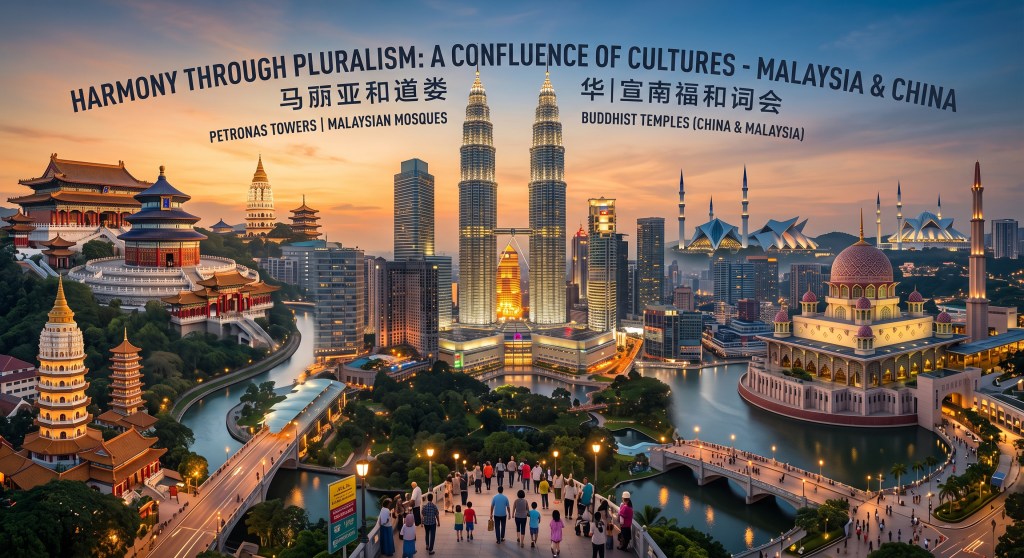
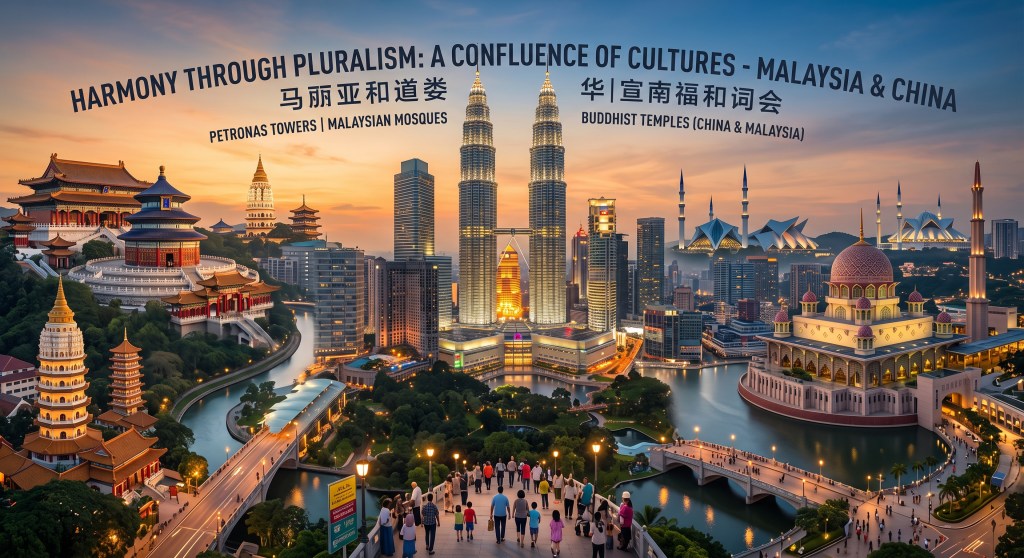
Presented by Gemini for Zia H Shah MD
Audio teaser: Chinese billionaires find harmony in Malaysia
Abstract
The global migration of high-net-worth capital is increasingly directed toward Southeast Asia, with Malaysia emerging as a primary beneficiary of Chinese wealth. Driven by compelling comparative valuations against regional hubs like Singapore, the restructuring of the Malaysia My Second Home (MM2H) program, and robust domestic economic indicators, Chinese billionaires and affluent families are aggressively acquiring Malaysian real estate, particularly in Kuala Lumpur, Penang, and Malacca. However, this demographic and economic shift extends far beyond transactional asset acquisition. It represents a profound civilizational encounter between the secular, syncretic cultural heritage of the Chinese diaspora and the Islamic foundational ethos of Malaysia. By examining this convergence through the exhaustive pluralistic frameworks articulated by Dr. Zia H. Shah MD—which seamlessly harmonize Islamic theology with the tenets of Buddhism, Confucianism, and Taoism—this report illustrates how Islam functions as a comprehensive, universal “way of life” (deen) rather than a rigid political construct. Through the historical precedents of the Han Kitab and Emperor Hongwu’s Hundred-Word Eulogy, alongside contemporary models of religious tolerance, Malaysia is positioned not merely as a haven for capital preservation, but as a “Living University” where the deepest philosophical traditions of the East and the Abrahamic world achieve a harmonious synthesis.
1. The Macro-Economic Realignment: Chinese Wealth Migrating Southward
The epicenter of global wealth creation has decisively shifted eastward, fundamentally altering the geopolitical and economic landscape of the Asia-Pacific region. According to the Hurun Global Rich List published in March 2026, the People’s Republic of China has reclaimed the title of the world’s billionaire capital, boasting 1,110 billionaires and surpassing the United States, which recorded 1,000. This extraordinary wealth generation has been largely driven by the technological hardware sectors, artificial intelligence, electric vehicles, and the globalization of Chinese industrial supply chains.
| Global Ranking | Country | Number of Billionaires (Hurun 2026) | Primary Wealth Drivers |
|---|---|---|---|
| 1 | China | 1,110 | AI, Industrial Products, Semiconductors, Green Energy |
| 2 | United States | 1,000 | Software, Finance, Media, Technology |
| 3 | India | 308 | Telecommunications, Retail, Pharmaceuticals |
| 4 | Germany | 212 | Retail, Automotive, Industrial Manufacturing |
As this demographic of ultra-high-net-worth individuals (UHNWIs) and their families seek secondary bases for corporate operations, asset preservation, and lifestyle upgrades, Malaysia has emerged as a premier destination. This migration is driven by a highly attractive valuation matrix relative to neighboring Singapore. While Singapore has historically served as the default financial harbor for Asian wealth, its escalating living costs, exorbitant property taxes for foreign buyers, and saturated market have prompted Chinese investors to seek more capital-efficient alternatives. Malaysia offers a compelling counterbalance: a robust GDP growth rate that hit 5.2% in 2025, a territorial tax system that generally exempts foreign-sourced income, and mature infrastructure capable of supporting international corporate expansions. The strategic positioning of Malaysia allows the Chinese elite to maintain proximity to their primary operations while enjoying a significantly reduced cost of living and a high quality of life.
The MM2H Catalyst and Taxation Dynamics
The restructuring of the Malaysia My Second Home (MM2H) residency program in 2024 established a formalized, tiered pathway that perfectly aligns with the capital deployment strategies of affluent Chinese nationals. By moving away from restrictive offshore income requirements and pivoting to a capital-test model built on fixed bank deposits paired with mandatory real estate acquisitions, the Malaysian government successfully catalyzed an influx of foreign direct investment.
Between mid-2024 and early 2026, the MM2H program received 14,535 applications, generating approximately RM3.87 billion in economic contributions through participation fees, fixed deposits, and property transactions. Chinese nationals absolutely dominate this demographic, accounting for 53.7% (6,704 applicants) of all accumulated applications by March 2026, vastly outpacing the combined totals of Taiwan, Hong Kong, Singapore, and Western nations.
| MM2H Tier (2026 Framework) | Fixed Deposit Requirement (USD) | Minimum Property Purchase | Visa Validity |
|---|---|---|---|
| Platinum | $1,000,000 | RM 2,000,000 | 20 years (Renewable, allows business/work) |
| Gold | $500,000 | RM 1,000,000 | 15 years (Renewable) |
| Silver | $150,000 | RM 600,000 | 5 years (Renewable) |
| SEZ / SFZ | $65,000 (Age 21-49) | RM 500,000 (Designated zones) | 10 years (Renewable) |
The appeal of the MM2H program is heavily bolstered by Malaysia’s territorial tax system. Participants benefit from zero taxation on foreign-sourced income, zero capital gains tax for individuals on most asset categories (excepting specific real estate disposals), and the absence of an inheritance tax. While a flat 8% stamp duty was introduced for foreign residential property buyers starting January 1, 2026, the overall entry and holding costs remain a fraction of those encountered in mainland China, Hong Kong, or Singapore. Furthermore, the dominance of Chinese applicants is smoothed by geographic proximity, affordable world-class healthcare, high-quality international education, and the widespread use of Mandarin within Malaysia’s Chinese community, which severely reduces cultural friction during relocation.
2. Real Estate Paradigms: Kuala Lumpur, Penang, and Malacca
The influx of Chinese MM2H participants has provided a vital counterbalance to a Malaysian domestic property market characterized by high overhangs and affordability constraints. By mandating property purchases for all new MM2H federal tiers and enforcing a 10-year holding period, the state has locked in long-term foreign capital. The capital deployment is highly strategic, focusing on specific urban nodes that offer distinct economic and lifestyle advantages.
Kuala Lumpur remains the primary target for the Chinese elite seeking stable rental yields—historically hovering between 4.5% and 6%—and cosmopolitan infrastructure. The requirement for foreigners to purchase properties valued at a minimum of RM1,000,000 naturally directs capital toward high-end condominiums in the Kuala Lumpur City Centre (KLCC), Mont Kiara, and Bukit Bintang. These properties serve dual purposes: acting as prestigious secondary residences for relocating families and as corporate footholds for Chinese enterprises expanding into the ASEAN market. The capital city’s maturity and liquidity make it the safest harbor for large-scale wealth preservation.
Penang has always held an enduring appeal for the Chinese diaspora. Culturally, its demographics heavily mirror Chinese ancestral traditions, creating an immediate sense of linguistic and culinary familiarity. Economically, Penang is a vital node in the global semiconductor and technology supply chain, drawing executives from China’s booming industrial sectors. Real estate acquisitions in Penang are clustered around seafront properties and tech-adjacent developments. This demand remains robust despite the island’s stringent foreign purchase threshold, which requires a minimum investment of RM3,000,000 for landed homes, though mainland Penang offers strata opportunities from RM500,000.
Malacca (Melaka) offers a unique synthesis of historical resonance and future potential. As a vital historical node on the ancient Maritime Silk Road and deeply connected to the legacy of Admiral Zheng He, Malacca holds profound cultural significance for Chinese investors. Furthermore, with foreign strata purchases permissible from RM500,000, it presents a highly accessible entry point for mid-tier affluent buyers looking for heritage-rich environments and tourism-driven yields. Similarly, the southern state of Johor is capturing massive attention due to the Johor-Singapore Special Economic Zone (SEZ), where specialized MM2H pathways allow for RM500,000 property entries in designated areas like Forest City, capturing the spillover of wealth from neighboring Singapore.
3. Malaysia as a Demographic and Cultural Bridge
The physical migration of Chinese families and capital into Malaysia triggers a vital sociological interaction. As envisioned by Dr. Zia H. Shah MD, Malaysia in 2025/2026 functions as a multicultural nexus of approximately 36 million people. The demographic reality features a dominant Muslim majority, comprising roughly 63.5% of the population, coexisting alongside a substantial ethnic Chinese minority that makes up 22% to 23% of the citizenry. The Chinese demographic in Malaysia predominantly practices Buddhism (approximately 75.9%), frequently synchronized with Taoist and Confucian folk traditions, alongside a notable Christian minority.
This demographic reality positions Malaysia as the world’s premier “Living University” for civilizational dialogue. It serves as the geographical and cultural bridge between the Islamic world, comprising 2 billion people, and the Chinese and Eastern Buddhist world, comprising 1.4 billion people. In this environment, Chinese expatriates and MM2H residents do not enter a cultural vacuum. They enter a society rich in ethical seriousness, where mosques and Buddhist temples share neighborhoods, and where everyday tolerance is a lived reality rather than an abstract political theory. Dr. Shah conceptualizes this dynamic by referencing the classical Song-era Chinese painting, “Three Laughs at Tiger Brook”, which depicts a Confucian scholar, a Taoist, and a Buddhist monk laughing together, symbolizing the harmony of China’s “Three Teachings.” He proposes adding Islam as a “Fourth Dimension” to this historical model, expanding it into a wider global dialogue of civilizations where diverse communities learn from one another in a state of mutual respect.
For the newly arriving Chinese elite, who largely hail from a society shaped by a strong modern current of secularism and state-sanctioned atheism layered over traditional syncretic beliefs, the encounter with Malaysia’s Islamic ethos requires a nuanced translation. The success of this integration depends on presenting Islam not as a geopolitical identity or a rigid political system, but as a universal deen—a comprehensive way of life that harmonizes effortlessly with the deepest philosophical truths of their own ancestral heritage.
4. Islam as a Comprehensive Way of Life: Moving Beyond the Political
A critical barrier to cross-cultural understanding for Chinese expatriates is the media-driven conflation of Islam with political authoritarianism, systemic conflict, or rigid dogmatism. Dr. Zia H. Shah effectively deconstructs this caricature, arguing that Islam, at its core, means peace through surrender to the Divine. It is an ontological orientation of the heart, a balanced lifestyle (wasatiyyah), and a profound ethical framework that guides the entire spectrum of human existence.
For the modern Chinese demographic—many of whom are experiencing the spiritual void that accompanies hyper-materialism and extreme capitalistic pressures—Islam offers a compelling alternative. This modern disillusionment is starkly evidenced by the youth Tang Ping (“Lying Flat”) movement in China, a grassroots rejection of crushing societal expectations. Islam provides an antidote to this existential fatigue by offering a life centered on spiritual purpose and clear ethical guidance. The Islamic worldview posits that humanity possesses an innate, intuitive inclination toward the Divine, known as the fitra. This concept suggests that recognizing a higher moral purpose requires no irrational leaps of faith, no complex ecclesiastical hierarchies, and no intermediaries, but rather a return to one’s natural disposition.
Furthermore, Islam operates as a “middle nation” (ummatan wasatan), promoting an equitable balance between extremes. The Islamic principles of zuhd (detachment) and qana’ah (contentment) do not condemn wealth, commerce, or prosperity. Indeed, historical figures like the Chinese Muslim Admiral Zheng He were masters of global commerce. Instead, these principles subordinate material wealth to a higher ethical purpose. This represents the exact equilibrium sought by Chinese elites attempting to balance immense corporate success with internal peace. By realigning life toward a higher moral purpose, the deen of Islam provides a framework where one can enjoy worldly blessings while remaining profoundly conscious of ethical obligations to the broader community.
5. The Lampshade and the Light: The Abrahamic Covenant of Coexistence
To facilitate this cross-cultural integration, it is essential to utilize the framework of religious pluralism. Dr. Shah posits that the sages of China and the prophets of the Near East drank from the “same well of Truth, even if they named that well differently.” In his synthesis, all faith traditions contain inherent wisdom; they are but different lampshades illuminating a single, universal Light. This perspective is deeply rooted in a rigorous textual and hermeneutical analysis of the Quran, which provides a tripartite structural framework for interfaith coexistence and actively rejects dogmatic exclusivity.
The foundation of this coexistence rests on the Ontological Pillar found in Quran 21:92. This verse defines the spiritual unity of the believer’s community across history, declaring humanity as a single Ummah under one Lord. By placing figures like Moses, Jesus, and Abraham in a continuous narrative flow, the scripture dissolves the barriers of race, time, and sectarian geography. It ensures that human diversity—differences in tongues and colors—is understood as an intentional part of the Divine plan rather than a reason for conflict. Building upon this is the Intellectual Pillar found in Quran 3:64, which invites people of other traditions to a “Common Word.” This methodology prioritizes shared ethical and theological commitments over dogmatic disputation, effectively creating a safe harbor for interfaith dialogue and mutual respect. Finally, the Sociological Pillar found in Quran 5:5 legislates the practical mechanics of trust and intimacy. It permits deep social integration through the sharing of food and the bonds of marriage with the “Other,” weaving diverse groups into the intimate fabric of the community rather than advocating for mere passive tolerance.
Furthermore, Dr. Shah’s exegesis of Quran 2:111-113 explicitly dismantles the concept of religious monopolies on salvation. The scripture condemns the self-righteous assertions that Paradise is reserved strictly for a single sect, demanding that those who make such claims produce their proof. Instead, it establishes a universal, inclusive criterion: whoever sincerely submits their whole self to God and is a doer of good (muhsin) shall have their reward. This expansive theology allows newly arriving Chinese residents to engage with Islamic culture not as a threat to their secular or syncretic identity, but as a universally welcoming spiritual home that measures individuals solely by their righteousness and compassion.
6. The Islamic-Confucian Nexus: Ethics, Filial Piety, and Ritual
The demographic arriving in Malaysia via the MM2H program is deeply rooted in Confucian ethics, which govern their social interactions, familial obligations, and corporate governance architectures. Far from being alien to Islam, Confucianism exhibits a remarkable structural resonance with Quranic teachings. The integration of these philosophies is not a modern invention; it was mastered centuries ago by the Huiru (Confucian Muslims) during the Ming and Qing dynasties in China.
Scholars of the Han Kitab tradition, most notably Wang Daiyu and Liu Zhi, accomplished something extraordinary in Islamic intellectual history: they articulated Islamic theology and metaphysics using the exact vocabulary of Neo-Confucianism. Liu Zhi, in his magnum opus Tianfang Xingli (“Nature and Principle in Islam”) and the Tianfang Dianli (“Ritual Law of Islam”), mapped Islamic concepts onto Chinese frameworks with absolute precision. He equated the Confucian concept of li (ritual propriety and social order) with the Islamic sharia (Divine Law), demonstrating that both are comprehensive systems designed to align human behavior with cosmic truth. Furthermore, he aligned the “Muhammadan Reality” (al-Haqiqa al-Muhammadiyya) with the Neo-Confucian Taiji (the Supreme Ultimate), bridging the metaphysical gap between the two civilizations by showing how Absolute Unity differentiates into multiplicity.
Dr. Shah extends this classical lineage into the contemporary era by highlighting direct ethical parallels between the two traditions. The Golden Rule, expressed in the Confucian principle of reciprocity (shu), is perfectly mirrored in the Prophet Muhammad’s teaching that none truly believes until he loves for his brother what he loves for himself. Filial piety (xiao), the paramount virtue in Confucianism, is similarly a central command in Islam. The Quran repeatedly pairs the worship of God with absolute kindness to parents, establishing familial respect as a sacred, rather than merely societal, obligation. Furthermore, the Confucian ideal of governance by virtue and the profound love of learning are echoed in the Quranic injunctions toward justice, excellence, and the relentless pursuit of knowledge. For the modern Chinese investor, understanding that their deeply held ethical structures are not only respected but actively championed within Islamic theology dramatically lowers the psychological barriers to integration in Malaysia.
7. The Taoist Resonance: The Formless Way and the Absolute Real
While Confucianism provides the ethical architecture for Chinese society, Taoism supplies its cosmological subtlety, its reverence for nature, and its metaphysical depth. Lao Tzu, the enigmatic sage of the Axial Age and author of the Tao Te Ching, articulated a philosophy of harmony with the natural Way (Tao) that deeply influences the Chinese psyche, particularly in its skepticism toward rigid human bureaucracies.
Dr. Shah explores the daring speculative theology that Lao Tzu might have been one of the 124,000 unnamed prophets (Anbiyya) sent by the Divine to guide the nations of antiquity. While orthodox Islam maintains strict theological boundaries regarding the nature of God—rejecting the impersonal, amoral nature of the Tao (which treats the myriad things like sacrificial straw dogs) in favor of a Personal, naming, and merciful Creator—the conceptual bridges between the two traditions are profound.
The Daoist insistence that the ultimate reality cannot be captured by ordinary language (“The Tao that can be told is not the eternal Tao”) resonates deeply with the Islamic doctrine of Tawhid, which insists on God’s absolute incomparability and transcendence above human conceptualization and naming. Dr. Shah harmonizes the metaphysics of the two traditions by aligning the Tao with Al-Haqq (The Real), and mapping the dualistic energies of Yin and Yang onto the Divine Islamic attributes of Jalal (Majesty/Rigor) and Jamal (Beauty/Mercy).
Furthermore, the Taoist doctrine of Wu Wei (non-action or effortless action) and the cultivation of Te (inner virtue) find striking parallels in Islamic spiritual disciplines. The apocryphal maxim “Watch your thoughts” serves as a conceptual bridge linking Taoist internal cultivation with the Islamic discipline of Niyyah (intention) and Zuhd (asceticism and detachment from worldly status). Both traditions harbor a deep suspicion of ego-driven domination and emphasize profound humility before a reality larger than the self, viewing true power as something derived from spiritual alignment rather than self-assertive material force.
8. The Eightfold Path and the Straight Path of Submission
The majority of the Chinese diaspora in Malaysia identify as Buddhist, practicing a syncretic blend of Mahayana Buddhism with local folk traditions. To bridge this gap, it is crucial to recognize that both Buddhism and Islam offer comprehensive spiritual methodologies designed to transcend human suffering and illusion through rigorous discipline. Dr. Shah meticulously maps the Buddha’s Noble Eightfold Path to Islam’s Sirāt al-Mustaqīm (the Straight Path of Submission), demonstrating that both paths demand moral purity, mindful awareness, and focused effort.
The convergence begins with Right View (Sammā-diṭṭhi), the Buddhist requirement to see reality as it truly is, understanding the impermanent nature of existence to end delusion. In Islam, this parallels Tawhid, the clear vision of Divine Oneness and the ultimate purpose of life, where guided insight arises by recognizing God’s signs in the cosmos. Right Intention (Sammā-saṅkappa), which focuses the mind on goodwill and harmlessness, is perfectly mirrored in the Islamic concept of Niyyah, where the heart’s intentions are the core of all actions, and purity of motive (ikhlāṣ) is paramount.
Behavioral ethics align seamlessly. Right Speech (Sammā-vācā) and Right Action (Sammā-kammanta) in Buddhism—mandating abstention from falsehood, theft, and harm—correspond to the Islamic mandates to speak with integrity (qawli maʿrūf), protect life and property, and enjoin good while forbidding evil. Right Livelihood (Sammā-ājīva), earning a living without exploiting others or dealing in harmful trades, is a central tenet of Islamic sharia regarding lawful (halal) earnings and the prohibition of usury and deceit.
The inner spiritual disciplines share equal resonance. Right Effort (Sammā-vāyāma), the diligent striving to foster wholesome qualities, is mirrored in the Islamic concept of Jihad al-Nafs (the spiritual struggle against the lower self) and the cultivation of perseverance (ṣabr) through trials. Right Mindfulness (Sammā-sati), the constant, non-reactive awareness taught by the Buddha, parallels the Islamic state of God-consciousness (taqwa) and continuous remembrance (dhikr). Finally, Right Concentration (Sammā-samādhi), the deep meditative absorption (jhāna) of Buddhism, finds its equivalent in khushūʿ—the profound quietude, humility, and inward focus required during the five daily Islamic prayers (salah), which withdraws the worshiper from worldly distractions. By highlighting these structural symmetries, Islam is not presented to the Chinese Buddhist as a negation of their heritage, but as a sister-path of profound ethical discipline leading to ultimate peace.
9. The Informational Architecture of Reality: The Four Books of God
A uniquely modern intersection between Chinese demographics and Islamic thought occurs in the realm of empirical science and rationality. The Chinese elite driving the Hurun wealth statistics are largely grounded in technological, engineering, and scientific backgrounds, operating within a highly rationalist and secular paradigm. To engage this demographic intellectually, Dr. Shah introduces the “Four Books of God” thesis, a cosmological framework that brilliantly marries empirical science with spiritual metaphysics.
Rejecting the antiquated “conflict model” of science and religion, this framework posits that a single Divine Author reveals truth across four interconnected informational records. The first is the Book of Revelation, the scriptural text of the Quran itself. The second is the Book of Nature, the empirical cosmos governed by the laws of physics and biology. The third is the Book of Destiny, referred to as Al-Lawh al-Mahfūẓ (The Preserved Tablet) or Umm al-Kitab (The Mother of the Book), which serves as the underlying informational architecture or master-matrix of reality. This concept elegantly parallels modern theoretical frameworks in quantum information theory and the holographic principle. The fourth is the Book of Deeds, the moral and ethical ledger of human actions.
Under this unifying framework, scientific inquiry is not viewed as an alternative to religion, but as an act of supreme devotion—a meticulous reading of the Book of Nature. The Quran’s perfect internal consistency across theology, ethics, history, and observations of the natural world reflects a unified reality designed by an All-Knowing Author. By integrating Al-Ghazali’s theories of occasionalism with modern physics, Dr. Shah presents a universe where the physical and the spiritual are seamlessly enmeshed. For Chinese technologists relocating to Malaysia, this offers a highly sophisticated, rationalist entry point into Islamic metaphysics. It provides a unifying theory that honors their scientific acumen and empirical training while reintroducing a profound sense of the sacred into their understanding of the cosmos.
10. Historical Precedents: The Ming Synthesis and the Hundred-Word Eulogy
The modern convergence of Chinese capital and Malaysian Islamic culture is not without a powerful historical precedent. It is, in many ways, the rekindling of a profound Sino-Islamic synthesis that reached its zenith during the Ming Dynasty under Emperor Hongwu (Zhu Yuanzhang, r. 1368–1398). Emperor Hongwu, a former Buddhist novice who expelled the Mongols and restored Han Chinese rule, was a master of political pragmatism and statecraft. Recognizing the loyalty, military prowess, and ethical fortitude of his Muslim subjects—many of whom served as key generals in his anti-Yuan campaigns—he initiated policies of deliberate accommodation. He funded the construction and restoration of mosques across the empire, including the famous Jingjue Mosque in Nanjing, and issued imperial decrees actively protecting Muslim communities, thereby formally integrating them into the fabric of Chinese society.
The most enduring legacy of this era is the Hundred-Word Eulogy (Baizizan), a 100-character poem written in classical Chinese that officially praised the Prophet Muhammad and the religion of Islam. Regardless of ongoing academic debates regarding whether Hongwu penned the poem personally or commissioned it via Muslim advisors at court, it carried the absolute weight of an imperial decree and served as a cornerstone of Hui Muslim identity.
The text of the poem demonstrates a shockingly sophisticated grasp of Islamic theology, proving that deep civilizational dialogue was active at the highest levels of the Chinese state. The poem references the universe beginning with the “heavenly tablet” (Al-Lawh al-Mahfuz), acknowledges the “thirty parts” of the holy scripture (the juz’ of the Quran), notes the “five daily prayers,” and describes the Prophet as a “Mercy to all of the worlds,” directly quoting Quran 21:107. The Eulogy concludes with a powerful endorsement:
“Renouncing spiritual ignorance; returning to The One — that is the religion called Islam. Muhammad is the most noble sage.”.
For centuries, this text was carved into stone steles and displayed in mosques across China, serving as an imperial shield against persecution and a permanent testament that Islam is fully compatible with Chinese civilization. Today, as the Chinese elite look to Malaysia for their economic future, recalling the legacy of Emperor Hongwu serves as a powerful reminder that engagement with the Islamic world is not a departure from their ancestral history, but a return to one of its most dynamic, respectful, and cosmopolitan eras.
Thematic Epilogue
The migration of Chinese billionaires and high-net-worth families into the real estate markets of Kuala Lumpur, Penang, and Malacca through the MM2H program is a macroeconomic phenomenon of immense significance. It injects billions of ringgit into the local economy, stabilizes domestic property overhangs, and physically links the immense technological and financial ambitions of modern China with the strategic geography of Southeast Asia. It represents a rational reallocation of capital driven by taxation efficiencies, comparative valuations, and the search for operational stability outside the pressures of the mainland and the high costs of Singapore.
However, beneath the surface of capital transfers, fixed deposits, and property deeds lies a far more profound sociological opportunity. Malaysia stands uniquely poised to facilitate a civilizational dialogue of unparalleled scale. By presenting Islam not as a geopolitical faction or a rigid political system, but as a deen—a comprehensive, balanced, and deeply rational way of life—Malaysia can offer the migrating Chinese elite a spiritual anchor in an age defined by existential fatigue and hyper-materialism.
Through the pluralistic vision articulated by Dr. Zia H. Shah, the boundaries between the great Eastern and Abrahamic traditions begin to dissolve into mutual recognition. The Confucian devotion to ethical order and family, the Taoist reverence for the formless Absolute, and the Buddhist discipline of the mind find their exact, harmonious counterparts in the Islamic path of submission and God-consciousness. Ultimately, the influx of Chinese wealth into Malaysia is more than an economic hedge; it is the reconstruction of an ancient bridge of acquaintance. It promises a future where the philosophical descendants of the Dragon and the spiritual followers of the Crescent walk together toward a shared, universal Light, proving that the highest forms of civilization are built not on exclusion, but on the profound synthesis of human wisdom.




Leave a comment