
Presented by Claude for Zia H Shah MD
Abstract
This essay advances a dual thesis: that the Universal Declaration of Human Rights (UDHR), proclaimed by the United Nations General Assembly in Paris on 10 December 1948, represents at once the climax of the human moral conscience emerging from the wreckage of the Second World War, and a modern articulation of principles that the Qur’an had already named, fourteen centuries earlier, as ma’roof — “that which is known,” universally recognized as good, equitable, and desirable, and in harmony with sound human nature (fitrah), reason, and divine law. Following and building upon the systematic exposition of Sir Muhammad Zafrulla Khan — Pakistan’s first Foreign Minister, President of the UN General Assembly, and President of the International Court of Justice — in his 1967 work Islam and Human Rights, the essay reads the Declaration’s thirty articles, in thematic clusters, as concrete expressions of ma’roof, each paired with corresponding Qur’anic verses and Islamic principles. It situates this convergence within four foundational Islamic concepts: the duty to promulgate the good (amr bil-ma’roof wa nahy ‘anil-munkar); human stewardship (khilafah) and trust (amanah); the inherent dignity of the children of Adam (karamah, Q 17:70); and accountability before God for the rights of fellow human beings (huquq al-‘ibad). The essay does not flatten genuine tensions — over apostasy, gender, and slavery — but argues that the reformist, Qur’an-centered reading advanced by Zafrulla Khan is both the more humane and the more textually faithful one. It concludes that ma’roof offers humanity a shared moral vocabulary, and that the UDHR may be understood as a collective act of amr bil-ma’roof by the community of nations — an act for which believers remain answerable before God.
The UDHR as the Climax of Human Conscience After the Tragedy of War
The Universal Declaration did not descend from a serene philosophy seminar; it was wrung from catastrophe. Adopted three years after the guns fell silent and the extermination camps were opened, its second preambular paragraph names its own origin with unflinching candor: “disregard and contempt for human rights have resulted in barbarous acts which have outraged the conscience of mankind.” That single clause — “outraged the conscience of mankind” — is the moral hinge of the twentieth century. The Holocaust, the mass executions, the forced labor, the industrialized cruelty of total war, had demonstrated with finality what befalls human beings when there exists no agreed standard to protect the individual against the state. The Declaration was humanity’s collective vow of “never again,” codified for the first time in a single document enumerating the rights belonging to every person on earth. Fourmilab
The drafting was itself a small parable of the universality it proclaimed. The UN Commission on Human Rights, comprising eighteen members of varied political, cultural, and religious backgrounds, met first in 1947. Its chair was Eleanor Roosevelt, widow of President Franklin D. Roosevelt and the acknowledged “driving force” of the enterprise, who in her address to the General Assembly in Paris on 9 December 1948 declared: “This Universal Declaration of Human Rights may well become the international Magna Carta of all men everywhere.” The Canadian legal scholar John Peters Humphrey, Director of the UN’s Human Rights Division, authored the inclusive first draft; the French jurist René Cassin revised it into a structured document, likening it to the portico of a temple resting on the foundation of human dignity; the Lebanese philosopher-diplomat Charles Malik served as Rapporteur and was a forceful advocate of fundamental freedoms; and the Chinese playwright-philosopher Peng-chun (P.C.) Chang, Vice-Chairman, insisted the Declaration “reflect more than simply Western ideas,” bringing Confucian perspectives to bear and brokering compromise. Hansa Mehta of India is credited with changing “All men are born free and equal” to “All human beings,” and Chile’s Hernán Santa Cruz pressed the case for social and economic rights. The text was adopted by a vote of 48 in favor, none against, and 8 abstentions (the six Soviet-bloc states, South Africa, and Saudi Arabia).
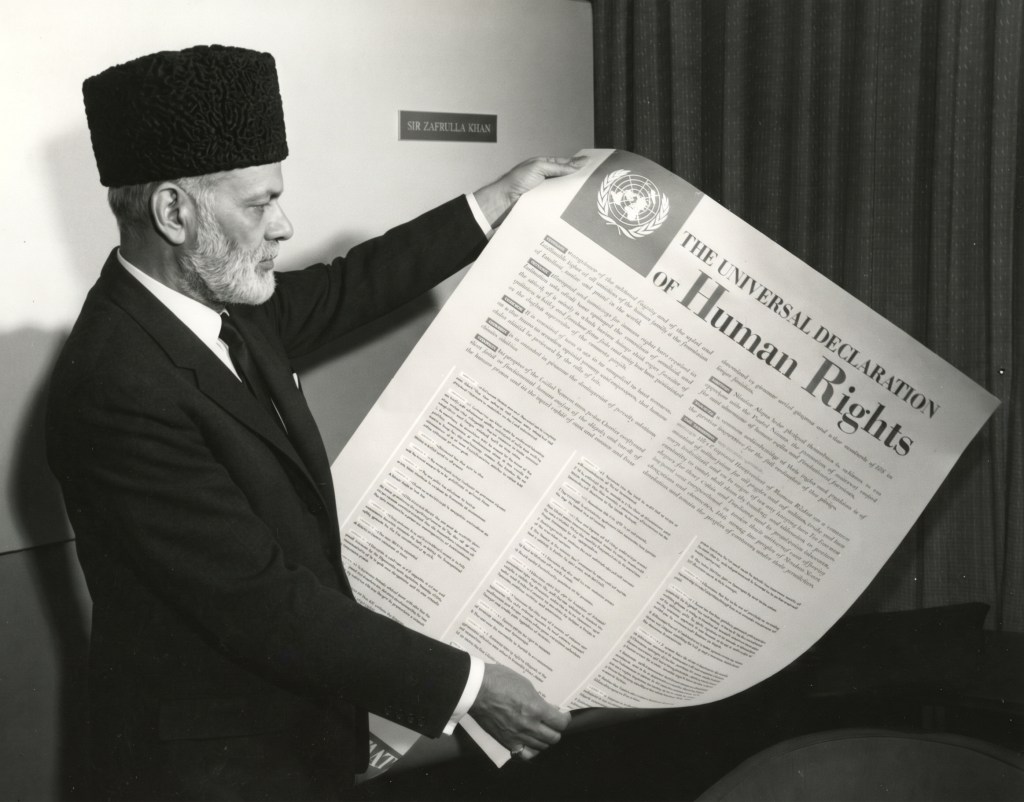
Crucially for the argument of this essay, the Muslim world was neither absent from nor merely acted upon by this process. When Saudi Arabia’s delegate Jamil Baroody objected to Article 18’s clause guaranteeing the freedom “to change his religion or belief,” it was Pakistan’s representative, Sir Muhammad Zafrulla Khan, who rose to defend it on explicitly Islamic grounds, declaring that the issue “involved the honour of Islam” and that Islam was itself “a missionary religion” which “recognized the same right of conversion for other religions as for itself.” According to the scholarship of Amjad Mahmood Khan (The Review of Faith & International Affairs, 2023), this intervention effectively prevented any Muslim-majority nation from voting against the Declaration; seven Muslim-majority states, including several that had earlier sided with Saudi Arabia in the Third Committee, voted in favor. It is a striking historical fact that the Qur’anic principle “There shall be no compulsion in religion” (Q 2:256) was pressed into the service of the modern right to freedom of conscience by a Muslim jurist on the floor of the General Assembly.
Zafrulla Khan later distilled the moral meaning of the moment in Islam and Human Rights. The Declaration, he wrote, “does not, in the accepted juristic sense of the term, constitute a ‘law’,” yet “stands, nevertheless, as a shining milestone along the long, and often difficult and weary, path trodden by Man down the corridors of History, through centuries of suffering and tribulation, towards the goal of freedom, justice and equality.” He posed the animating question of the post-war age: “How is it that in the last half of the twentieth century, after having passed through the shattering and devastating experience of two world wars and in the shadow of a nuclear holocaust … man continues to be the victim of discrimination, intolerance and cruelty at the hands of his fellow man?” His answer was a moral one: “the prosperity of all is promoted through mutual sharing and co-operation rather than through the exploitation and domination of some by others.” The Declaration, in this reading, is the point at which the conscience of humanity, having been “outraged” past endurance, at last articulated in common what it had always known. themuslimtimes + 2
Ma’roof: The Known Good as Humanity’s Shared Moral Vocabulary
That last phrase — “always known” — is the bridge to the Islamic framing. The Qur’anic term ma’roof (from the root ‘-r-f, “to know, to recognize”) is the passive participle meaning “that which is known.” It appears thirty-eight times in the Qur’an, most often in the exhortation amr bil-ma’roof wa nahy ‘anil-munkar, and is regarded — as A. Kevin Reinhart and others have observed — as one of the key words in the moral vocabulary of scripture: literally “what is commonly recognized,” translatable as “universally-shared values.” Classical exegesis anchors its authority precisely in its self-evidence: al-Tabari traces it to knowledge and recognition, indicating that its goodness is apparent to a sound conscience; Ibn Kathir treats it as comprehensive, encompassing everything Islam enjoins, “from the highest principle of monotheism to the simplest acts of kindness.” It is the good known to fitrah — the God-given original nature — and affirmed by revelation; it “stands for a natural lifestyle which is known and acknowledged in all places and all times.” Islam and the Quran
This is a concept of extraordinary ecumenical power, and Zafrulla Khan grasped it as the interpretive key to the entire Declaration. Commenting on the Preamble, he wrote that “Islam lays the duty of constantly promulgating Islamic values upon every individual Muslim. The generic word for these values is ma’roof, meaning that which is good, equitable, desirable.” Ma’roof is not a parochial or sectarian good; it is the good that human beings recognize as good because they are human. Precisely because it is “known,” it can serve as the common ground on which a Muslim jurist and a Confucian philosopher, a French secular jurist and a Lebanese Christian, might build a shared house of rights. The UDHR’s own claim — that its rights are “inherent,” belonging to “all members of the human family” and knowable by “reason and conscience” (Article 1) — is, in Islamic terms, a claim about ma’roof. themuslimtimes
The Qur’an deploys ma’roof with remarkable concreteness, above all in the domain of family life and equitable dealing, where the abstract good becomes the texture of daily justice. Divorce must proceed on the principle that the parties “either hold together on equitable terms (bi-ma’roof), or separate with kindness (bi-ihsan)” (Q 2:229); divorced women “have rights similar to those of men in equity” (bil-ma’roof, Q 2:228); reconciliation or separation at the end of the waiting period must likewise be “on equitable terms” (Q 65:2); husbands are commanded to “live with them in kindness” (‘ashiruhunna bil-ma’roof, Q 4:19); nursing mothers are to be provided for “equitably” (Q 2:233). The Ahlul Bait Foundation of South Africa notes that of the term’s Qur’anic occurrences, “circa 50% (around 20 verses) where this term ‘Ma’ruf’ is used, relates to the relationship between male and female,” and is “directed more towards men in their relation, association and overall behaviour with women” — an ethic that builds public morality by first establishing recognized fairness in the home. The recurrent Qur’anic coupling of ma’roof with the setting of divine “limits” (hudud Allah) makes plain that “the known good” is not mere custom but a moral order that reason recognizes and revelation confirms.
Amr bil-Ma’roof: The Duty to Promulgate the Good
If ma’roof is the content, amr bil-ma’roof wa nahy ‘anil-munkar — “enjoining the good and forbidding the wrong” — is the imperative. This is among the most insistent commands of the Qur’an, and the user’s assembled verses stand at its heart. “Let there arise out of you a band of people inviting to all that is good, enjoining what is right (ma’roof) and forbidding what is wrong; they are the ones to attain felicity” (Q 3:104). “You are the best nation produced for mankind: you enjoin what is right and forbid what is wrong and believe in Allah” (Q 3:110). The duty is not gendered or reserved to an elite: “The believing men and believing women are allies (awliya’) of one another; they enjoin what is right and forbid what is wrong” (Q 9:71). And it is transmitted as intimate paternal counsel in the advice of the sage Luqman to his son: “O my son, establish prayer, enjoin what is right, forbid what is wrong, and be patient over what befalls you; indeed, that is of the matters requiring determination” (Q 31:17). Wikipedia
The tradition debates whether this duty is fard ‘ayn (binding on every individual) or fard kifayah (a collective obligation discharged on behalf of all if enough undertake it), and most jurists locate it in the latter category while insisting that a residue of individual responsibility always remains — a duty of the hand, the tongue, and, at minimum, the heart. This structure — a good that is universally known, coupled with a standing obligation on the community to proclaim and secure it — is the deep grammar that the modern human-rights project shares with Islamic ethics. When fifty-eight nations gathered to name the rights of all and to pledge their promotion “in cooperation with the United Nations,” they performed, in the idiom of this essay, a collective amr bil-ma’roof: an authoritative summoning of humanity to the known good, and a forbidding of the munkar — the “denied,” the reprehensible — that the war had revealed. It bears noting, however, that the tradition sharply distinguishes legitimate promulgation of the good from coercion: reformist scholars such as Muhammad Yunus (whose Qur’anic commentary was endorsed by Khaled Abou El Fadl of UCLA) have argued that enforcing ma’roof through a coercive religious police contradicts the very message of Islam, since “there shall be no compulsion in religion” (Q 2:256). The good is to be invited, not imposed.
Stewardship, Dignity, and Accountability: The Human Person Before God
Three further principles supply the anthropological foundation on which both ma’roof and human rights rest.
First, stewardship (khilafah) and trust (amanah). The Qur’an announces the human vocation at creation: “I am going to place upon the earth a vicegerent (khalifah)” (Q 2:30). Humanity is entrusted with the amanah, the moral trust that the heavens, the earth, and the mountains declined to bear (Q 33:72). In the commentary of the Ma’arif al-Qur’an, this vicegerency is precisely “the responsibility of upholding … Divine injunctions,” so that “the Law of Allah be implemented on the earth.” To be human is thus to be a responsible moral agent, a bearer of delegated authority — and therefore a bearer of rights commensurate with that dignity.
Second, dignity (karamah). The charter verse is Q 17:70: “We have certainly honoured the children of Adam, and carried them on land and sea, and provided them with good things, and preferred them above much of what We have created.” Scholars of Islamic ethics identify this as the principal Qur’anic source of the concept of human dignity — a dignity conferred by God on all the children of Adam, prior to and independent of any human judgment, and, as commentators stress (noting that the verb karramna, “We have honoured,” is an active divine bestowal), an honoring that entails the responsibilities of stewardship. Coupled with the declaration that humanity was created “from a single soul” (Q 4:1) and fashioned into “nations and tribes that you may know one another,” with nobility measured only by righteousness (Q 49:13), karamah grounds the Declaration’s first article — that all are “born free and equal in dignity and rights” — in the very act of creation.
Third, accountability (huquq al-‘ibad). Islamic jurisprudence distinguishes the rights of God (huquq Allah) from the rights of God’s servants (huquq al-‘ibad) — the interpersonal rights of life, property, honor, and dignity. The tradition holds these latter rights with peculiar seriousness: sins against God may be forgiven through repentance, but a wrong done to another human being is not remitted until amends are made to the one wronged. Undergirding all is the Qur’an’s radical individual moral responsibility: “So whoever does an atom’s weight of good will see it, and whoever does an atom’s weight of evil will see it” (Q 99:7–8); “Whoever is guided is only guided for [the benefit of] his soul … and no bearer of burdens will bear the burden of another” (Q 17:15). Every violation of another’s rights is a debt recorded, answerable before God. This is the theological engine that transforms rights from claims into sacred duties — the note Zafrulla Khan sounds throughout, rendering each right of one person as the God-commanded obligation of another.
The Thirty Articles as Articulations of Ma’roof
Zafrulla Khan’s method — which this essay follows and extends — was disciplined and honest. “While Islam lays down broad values and standards which clearly endorse the spirit and purpose of the Declaration,” he wrote, “it does not pronounce verbatim on all the specific provisions of the Declaration.” The claim is convergence of spirit, not one-to-one legal identity. In that spirit, the thirty articles are treated below in coherent clusters, each read as an articulation of the known good. themuslimtimes
Dignity and Equality (Articles 1–2)
Article 1 (all born free and equal in dignity and rights, endowed with reason and conscience, to act toward one another in brotherhood) and Article 2 (entitlement without distinction of race, color, sex, language, religion, or other status) are the seedbed of the whole. Their Qur’anic correlates are exact: the honoring of the children of Adam (Q 17:70); creation from a single soul (Q 4:1); and the great charter of human equality, “O mankind, We created you from a male and a female and made you into nations and tribes that you may know one another; verily the most honoured of you before God is the most righteous” (Q 49:13). The Prophet Muhammad’s Farewell Sermon (632 CE), delivered on the plain of Arafat, is widely regarded as an early declaration of these very principles — “no Arab has superiority over a non-Arab, nor a non-Arab over an Arab; nor a white over a black nor a black over a white, except by righteousness” — and the sanctity of life, property, and honor. Here ma’roof and Article 1 are, in substance, the same recognition.
Life, Liberty, and Bodily Integrity (Articles 3–5)
Article 3 (life, liberty, security of person), Article 4 (freedom from slavery), and Article 5 (freedom from torture and cruel, inhuman, or degrading treatment) find their governing principle in the Qur’an’s incomparable valuation of the single life: “whoever kills a soul … it is as if he had slain all mankind, and whoever saves one, it is as if he had saved all mankind” (Q 5:32). On slavery, honesty requires acknowledging a genuine tension: the Qur’an strongly encourages manumission — freeing a slave stands among the highest good deeds (Q 90:12–13) and serves as expiation for various faults — and the trajectory of its teaching is emancipatory, yet classical law regulated rather than abolished the institution. The fair historical statement is that the Qur’anic spirit points toward abolition, and that all Muslim-majority states have since outlawed slavery, aligning practice with that spirit. On Article 5, the Qur’an couples justice with mercy — “God commands justice and good conduct (ihsan)” (Q 16:90) and forbids transgressing limits (Q 2:190); critics note the fixed hudud penalties, while Zafrulla Khan and reformist readers emphasize mercy, reform, and the extraordinarily high evidentiary bars the classical law imposed.
Legal Personhood and Due Process (Articles 6–11)
Articles 6–8 (recognition as a person before the law, equality before the law, effective remedy before competent tribunals) follow directly from the equal creation and stewardship of every human being: one who is a khalifah accountable to God is necessarily a person before the law. Articles 9–11 (freedom from arbitrary arrest, fair and public hearing, presumption of innocence) rest on the Qur’an’s uncompromising command of scrupulous, impartial justice: “O you who believe, be persistently standing firm in justice, witnesses for God, even if it be against yourselves or parents and relatives” (Q 4:135), and “let not the hatred of a people prevent you from being just; be just, that is nearer to righteousness” (Q 5:8). The Ma’arif al-Qur’an draws from 4:135 the principle that “justice is not something to be demanded from others only … it should also be exacted from one’s own self” — the ethical core of due process.
Privacy, Movement, Asylum, and Nationality (Articles 12–15)
Article 12 (protection from arbitrary interference with privacy, family, home, correspondence, and attacks upon honor) is anticipated in the Qur’anic prohibitions on spying and backbiting and the protection of honor: “do not spy on one another, nor backbite one another” (Q 49:12). Articles 13–15 (freedom of movement, the right to seek asylum, the right to a nationality) resonate with the foundational Islamic narratives of migration: the hijra to Abyssinia, where the persecuted early Muslims were granted refuge by the Christian Negus, is the classic Islamic asylum story, and the hijra to Medina inaugurated a covenanted political community. That community’s founding charter, the Constitution (or Covenant) of Medina of 622 CE, whose clauses recognized Jews and other groups as one ummah entitled to practice their own religion, is frequently cited as history’s earliest written constitution to establish religious freedom and equal communal protection as fundamental rights.
Family and Property (Articles 16–17)
Article 16 (the right to marry and found a family, with free and full consent, and the family as “the natural and fundamental group unit of society”) is deeply congenial to the Qur’an, which makes marriage a covenant of tranquility, “love and mercy” (Q 30:21) and saturates its marital law with the standard of ma’roof — equitable, kind, recognized treatment (Q 2:228–229, 4:19). This is also, candidly, a tension point: classical rules on interfaith marriage, testimony, and divorce differ by gender, and Zafrulla Khan (as in his Woman in Islam) tended to frame these as complementary roles rather than inequality — a reading many contemporary human-rights scholars find insufficient on strict-equality grounds. Article 17 (the right to own property and freedom from arbitrary deprivation) is firmly grounded: the Qur’an protects lawful property, forbids consuming others’ wealth “unjustly” (Q 2:188), and mandates ordered inheritance (Q 4:7).
Conscience, Expression, and Assembly (Articles 18–20)
Article 18 (freedom of thought, conscience, and religion, including the freedom to change one’s belief) is the centerpiece of Zafrulla Khan’s book and of his life. Its Qur’anic anchor is categorical: “There shall be no compulsion in religion; the right way has become distinct from error” (Q 2:256). This is another honest tension: several classical schools historically prescribed punishment for apostasy, and — according to Humanists International’s Freedom of Thought Report — apostasy remains a criminal offence in some seventeen countries and is punishable by death in at least ten to thirteen Muslim-majority states (among them Afghanistan, Iran, Malaysia, Maldives, Mauritania, Nigeria, Qatar, Saudi Arabia, the United Arab Emirates, and Yemen). Zafrulla Khan’s position — that Islam guarantees complete freedom of conscience and permits no temporal punishment for changing belief — is a reformist reading, powerfully text-supported (Q 2:256; the logic that God rejects hypocrisy, so coerced belief is worthless; the Abyssinian precedent) but not the majority classical view. This essay takes the position that Khan’s reading is both the more humane and the more Qur’anically faithful, and that its adoption on the world stage in 1948 was a genuine achievement of Islamic conscience. Articles 19–20 (freedom of opinion and expression; peaceful assembly and association) correspond to the duty of enjoining the good — which presupposes the freedom to speak it — and to the principle of consultation (shura): believers are those “whose affairs are a matter of counsel among them” (Q 42:38), and even the Prophet is commanded, “consult them in the matter” (Q 3:159).
Political Participation (Article 21)
Article 21 (the right to take part in government, directly or through freely chosen representatives, with the will of the people as the basis of authority) is read through shura. The Ma’arif al-Qur’an observes that by ordaining the selection of leadership through consultation, “Islam laid the foundation of real democracy by ending autocracy,” bringing to a close “the autocratic rule of kings … who used to take the state as an inherited estate.” Reformist scholarship stresses that the placement of shura in Q 42:38 alongside prayer, as a defining mark of the believing community, elevates it from optional courtesy to a structural feature of legitimate governance.
Economic, Social, and Cultural Rights (Articles 22–27)
Here, Zafrulla Khan is at his most persuasive, and here the convergence is least strained. Articles 22–26 (social security, the right to work and to just remuneration, rest and leisure, an adequate standard of living, education) find native expression in the Qur’anic institution of zakat and in the principle that the wealth of the affluent contains an enforceable claim of the poor: “and in their wealth there was a rightful share for the beggar and the deprived” (Q 51:19), and the sweeping definition of righteousness as giving wealth, “in spite of love for it,” to relatives, orphans, the needy, the traveler, and those who ask (Q 2:177). The classical commentators are emphatic that this is a right (haqq) of the poor, not a favor of the rich — economic justice as divine command. Article 26’s right to education rests on Islam’s foundational exaltation of knowledge, beginning with the first revealed word, “Read” (Q 96:1). Article 27 (participation in cultural life) may be read through the Qur’an’s celebration of the diversity of peoples and tongues as “signs” of God (Q 30:22).
Social Order, Duties, and Limits (Articles 28–30)
Article 28 (entitlement to a social and international order in which these rights can be realized) found a natural champion in Zafrulla Khan, whose service at the UN and the International Court of Justice embodied the conviction that justice must be built into the architecture of the international order itself. Article 29 (everyone has duties to the community; rights are subject only to such limits as secure due recognition of the rights of others and the general welfare) is the article most congenial to the Islamic conception, in which every right is correlated to a duty and individual freedom is balanced against communal responsibility — the ma’roof/munkar structure in miniature. Article 30 (nothing in the Declaration may be used to destroy the rights of others) accords with the Qur’anic prohibition on transgressing limits (Q 2:190) and the principle that no right may be turned into an instrument of oppression.
A Note on Genuine Tensions
Intellectual honesty forbids presenting this convergence as seamless. Zafrulla Khan’s book is, by design, a work of advocacy: it aims to demonstrate harmony, and its publisher’s framing even asserts Islam’s “distinct superiority,” a triumphalism more pronounced than Khan’s own measured prose. Three tensions in particular — the classical law of apostasy, gender differentials in family and testimony law, and the historical regulation of slavery — are places where Khan’s optimism runs ahead of the classical juristic record. The reformist Qur’an-centered readings he advances (and which scholars such as Abdulaziz Sachedina, who grounds pluralism in Q 2:256 as “the Qur’an’s profound statement on basic individual religious freedom,” have developed at length) are minority positions within the classical tradition, and readers unfamiliar with intra-Islamic debate should not mistake them for consensus. The competing tendency is visible in the 1990 Cairo Declaration on Human Rights in Islam — adopted by forty-five states of the Organisation of the Islamic Conference at Cairo on 5 August 1990 — whose Article 24 provides that “all the rights and freedoms stipulated in this Declaration are subject to the Islamic Shari’ah,” and whose Article 25 makes the Shari’a “the only source of reference” for the document; it conspicuously omits any unqualified right to change one’s religion. The argument of this essay is not that all Muslims read the sources as Zafrulla Khan did, but that his reading is available, defensible, and — measured against the plain sense of verses like Q 2:256, Q 4:135, Q 5:8, Q 49:13, and Q 17:70 — the stronger one.
Thematic Epilogue: The Known Good and the Answerable Conscience
There is a deep fittingness in the fact that the Qur’an names the good ma’roof — “the known.” It locates morality not in the arbitrary will of the powerful, nor in the shifting consensus of the moment, but in something recognizable to every sound conscience across “all places and all times.” The Universal Declaration, born of the moment when human conscience was most grievously “outraged,” is best understood as an act of collective recognition: the community of nations, having seen the munkar in its most industrialized and merciless form, gathered to name aloud the good it had always known but too often betrayed. That the naming was done by a Christian and a Confucian, a Jew and a secular jurist, a Hindu and a Muslim, working in concert, is itself a demonstration that ma’roof is real — that the good is, in fact, knowable in common.
Sir Zafrulla Khan’s singular contribution was to show that a Muslim need not receive this document as an alien imposition but may recognize in it the lineaments of his own scripture — the dignity of Adam’s children, the sanctity of the single life, justice even against oneself, no compulsion in religion, the rightful share of the poor. Read through the lens of amr bil-ma’roof, the UDHR becomes not merely a legal instrument but a summons: the believer is not permitted to be a spectator to human rights, for the duty to enjoin the known good and forbid the known wrong is laid, the Qur’an insists, upon every believing man and woman (Q 9:71). And read through the lens of huquq al-‘ibad and the atom’s-weight verses (Q 99:7–8), that duty is not discretionary. To violate the rights of another human being — of any race, creed, or nation — is to incur a debt that no ritual piety can discharge and that will be produced, weighed, and answered for on the Day when “no bearer of burdens shall bear the burden of another.” The Declaration’s thirty articles, in this light, are thirty ways of describing the rights of God’s servants; and the God who honored the children of Adam will ask, of every steward to whom the trust was given, what he did with them. The conscience of mankind, once outraged, has spoken; the believer’s task — indeed, every human being’s task — is to keep faith with what it knew.



Leave a Reply