

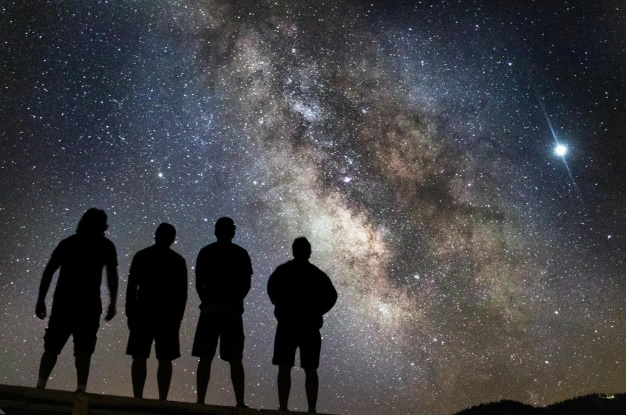
Prepared by Claude for thequran.love — “The Glorious Quran and Science” — in the scholarly voice of Zia H. Shah, MD
Abstract
The five verses that close the first movement of Sūrat al-Takwīr — fa-lā uqsimu bil-khunnas, al-jawāri al-kunnas; wal-layli idhā ʿasʿas; waṣ-ṣubḥi idhā tanaffas; innahu la-qawlu rasūlin karīm (Q 81:15–19) — constitute one of the Qurʾān’s most compressed and luminous oath-clusters. This commentary argues that these verses are not ornamental rhetoric but istidlāl: a divine summoning of the most reliable phenomena of the observable heavens — the receding and hiding planets, the departing night, the breathing dawn — as witnesses (shawāhid) to the truthfulness of revelation, the object sworn to (muqsam ʿalayh) being “truly this is the word of a noble messenger.” Following the interpretive method established by Zia H. Shah, MD, on thequran.love, and drawing on the argumentative theory of oaths advanced by Ḥamīd al-Dīn Farāhī, the article reads the oath as a bridge from the seen to the unseen. It presents the verified Arabic text with five well-known English renderings; surveys the classical philology and tafsīr (ʿAlī ibn Abī Ṭālib, Ibn Masʿūd, al-Ṭabarī, al-Zamakhsharī, al-Rāzī, al-Qurṭubī, Ibn Kathīr); and then reads the oath through modern astronomy (planetary retrograde motion as an artifact of heliocentric geometry, stellar life-cycles, and the cautiously-held modern reading of black holes), atmospheric physics (Earth’s rotation and the Rayleigh scattering that makes the dawn “breathe” light), and the philosophy and theology of the two Books. Throughout, science–Qurʾān correspondences are framed as resonances and anticipations — invitations to tafakkur — and explicitly distinguished from the concordist “scientific miracle” apologetics of Maurice Bucaille and Zakir Naik.
I. Introduction: An Oath as an Argument
Sūrat al-Takwīr (“The Overthrowing” or “The Turning Into a Sphere”), the eighty-first chapter of the Qurʾān, is a Meccan surah of twenty-nine verses in the thirtieth juzʾ. Its structure is famously bipartite. The first fourteen verses unleash the cosmic dissolution of the Last Day in a cascade of idhā (“when”) clauses: the sun folded up (kuwwirat), the stars falling and losing their light (inkadarat), the mountains set moving, the seas set ablaze, and — in a verse of piercing moral force — the infant girl buried alive asked “for what crime she was killed.” Then, at verse 15, the register changes utterly. The convulsions cease; a serene, ordered night sky appears; and God swears by it. Islam AwakenedIslam Awakened
This juxtaposition is the interpretive key. Having depicted the day when cosmic order will be undone, the surah swears by the cosmic order as it now reliably stands — the planets faithfully running and returning, the night faithfully departing, the dawn faithfully breaking — to certify the single claim that follows: innahu la-qawlu rasūlin karīm, “truly this is the word of a noble messenger.” The same Lord who so precisely governs Saturn and Sirius, the night and the dawn, is the Author of the Book; the reliability of the one vouches for the truth of the other.
On thequran.love, Zia H. Shah, MD, has consistently read the Qurʾān’s oaths (aqsām) in exactly this way: not as decorative emphasis but as evidentiary arguments — the muqsam bihi (the thing sworn by) functioning as a witness (shāhid) or proof (dalīl) for the muqsam ʿalayh (the thing sworn to). This reading has deep roots in the Muslim tradition and its most rigorous modern formulation in the Farāhī school, to which we return below. The present commentary follows that method for Q 81:15–19.
II. The Text: Qurʾān 81:15–19 in Arabic and Five English Translations
Below is the verified ʿUthmānī Arabic text of each verse with transliteration, followed by five widely used English translations presented in parallel: Sahih International, Abdullah Yusuf Ali, Marmaduke Pickthall, Muhammad Asad, and Dr. Mustafa Khattab (The Clear Quran).
Verse 15 — فَلَآ أُقْسِمُ بِٱلْخُنَّسِ — Fa-lā uqsimu bil-khunnas
- Sahih International: “So I swear by the retreating stars —”
- Yusuf Ali: “So verily I call to witness the Planets — that recede,”
- Pickthall: “Oh, but I call to witness the planets,”
- Muhammad Asad: “BUT NAY! I call to witness the revolving stars,”
- Khattab (Clear Quran): “I do swear by the receding stars” Islam AwakenedQuran.com
Verse 16 — ٱلْجَوَارِ ٱلْكُنَّسِ — Al-jawāri al-kunnas
- Sahih International: “Those that run [their courses] and disappear [i.e., set] —” Quran.com
- Yusuf Ali: “Go straight, or hide;” Blogger
- Pickthall: “The stars which rise and set,”
- Muhammad Asad: “the planets that run their course and set,”
- Khattab (Clear Quran): “which travel and hide,” Quran.com
Verse 17 — وَٱلَّيْلِ إِذَا عَسْعَسَ — Wal-layli idhā ʿasʿas
- Sahih International: “And by the night as it closes in” islamawakened
- Yusuf Ali: “And the Night as it dissipates;” islamawakened
- Pickthall: “And the close of night,” islamawakened
- Muhammad Asad: “and the night as it darkly falls,” islamawakened
- Khattab (Clear Quran): “and the night as it falls” islamawakened
Verse 18 — وَٱلصُّبْحِ إِذَا تَنَفَّسَ — Waṣ-ṣubḥi idhā tanaffas
- Sahih International: “And by the dawn when it breathes” Quranic Arabic Corpus
- Yusuf Ali: “And the Dawn as it breathes away the darkness;” Blogger
- Pickthall: “And the breath of morning,” alim
- Muhammad Asad: “and the morn as it softly breathes:” alim
- Khattab (Clear Quran): “and the day as it breaks!” alim
Verse 19 — إِنَّهُۥ لَقَوْلُ رَسُولٍ كَرِيمٍ — Innahu la-qawlu rasūlin karīm
- Sahih International: “[That] indeed, the Qurʾān is a word [conveyed by] a noble messenger [i.e., Gabriel],” Quran O
- Yusuf Ali: “Verily this is the word of a most honourable Messenger,” Islam Awakened
- Pickthall: “That this is in truth the word of an honoured messenger,” Islam Awakened
- Muhammad Asad: “behold, this [divine writ] is indeed the [inspired] word of a noble apostle,” Alim
- Khattab (Clear Quran): “Indeed, this ˹Quran˺ is the Word of ˹Allah delivered by Gabriel,˺ a noble messenger-angel,” Quran.comIslam Awakened
A note on the translational spread is itself instructive. The very first word, fa-lā, is rendered by some (“So I swear,” “I do swear”) as a straightforward affirmation and by others (“But nay! I call to witness,” “Oh, but”) as a rhetorical rebuttal followed by an oath. Verse 17’s ʿasʿas is split between “closes in / darkly falls” (night advancing) and “dissipates / close of night” (night departing) — a genuine lexical ambiguity, discussed below. And verse 19’s rasūl karīm is glossed variously as an unnamed “honourable Messenger” or explicitly as “Gabriel,” reflecting the classical consensus that the messenger here is the angelic conveyor of revelation. These are not translator errors but faithful registrations of a text whose Arabic is deliberately capacious.
III. Linguistic and Classical-Tafsīr Analysis
The three descriptors: al-khunnas, al-jawār, al-kunnas
The oath’s power lies in three participles built on precise triliteral roots:
- al-khunnas (from kh-n-s): to recede, retreat, withdraw, lag behind, shrink back. The same root names Satan as al-khannās, “the one who withdraws / the slinking whisperer” (Q 114:4) — that which retreats from view.
- al-jawār (from j-r-y): to run, flow, course, proceed — the participle of steady onward motion, as water runs or a ship courses.
- al-kunnas (from k-n-s): to hide, to enter a covert or lair (kinās, the den of a gazelle or oryx). From the same root comes miknasa, “a broom” — hence the associated sense of sweeping.
The genius of the phrase is that these three verbs describe a single class of celestial objects performing three motions: they run (jawār), they recede/retreat (khunūs), and they hide/sweep into concealment (kunūs).
The interpretation of ʿAlī ibn Abī Ṭālib and the planetary reading
The most influential early gloss is preserved by al-Ṭabarī via Khālid ibn ʿArʿara, who reports that ʿAlī ibn Abī Ṭālib, asked about al-khunnas al-jawāri al-kunnas, replied: “These are the stars that withdraw (disappear) during the day and sweep across the sky (appear) at night.” Ibn Kathīr records this and the prophetic context: the Prophet recited these very verses in the dawn prayer (per Muslim, from ʿAmr ibn Ḥurayth). ContemplateQuran + 2
The dominant classical view — held by al-Ṭabarī, al-Zamakhsharī, al-Rāzī, al-Qurṭubī, and Ibn Kathīr — identifies these as the five planets visible to the naked eye: Mercury, Venus, Mars, Jupiter, and Saturn. Tafsīr al-Jalālayn is explicit that these are “the five planets; Saturn, Jupiter, Mars, Venus and Mercury,” which “sink away during their orbit” and “retreat into their setting-places,” and notes the retrograde motion directly: “the planets which in a retrograde motion do proceed.” Quran O + 2
Al-Zamakhsharī, in al-Kashshāf, defines al-khunnas as “the receding/returning ones — while you see the star at the end of the zodiacal sign, it suddenly reverts back toward its beginning,” al-jawār as “the moving (traveling) planets,” and al-kunnas as “those that hide, from kanasa al-waḥshī — when the wild animal enters its lair.” He names the five planets and states the mechanism with striking economy: “their khunūs is their receding (retrograde), and their kunūs is their hiding beneath the sun’s light.” quranpedia + 2
Fakhr al-Dīn al-Rāzī, in Mafātīḥ al-Ghayb, subdivides the stellar reading and identifies as “the most apparent” (al-aẓhar) the view that the words describe “the retrograde motion (rujūʿ) and direct motion (istiqāma) of the five wandering planets” — their rujūʿ being their khunūs, and their disappearance under the sun’s glare their kunūs. He calls the planets al-kawākib al-mutaḥayyira (“the wandering / bewildered planets”) and remarks that “there is no doubt that this is a wondrous state, containing great and dazzling secrets.” theoceanofthequran + 2
The minority reading: wild oxen and gazelles
A significant minority of Companions read al-khunnas al-kunnas not as celestial bodies but as wild animals — oxen or gazelles that retreat and hide in their lairs. Al-Qurṭubī preserves the famous exchange in which Ibn Masʿūd asks ʿAmr ibn Shuraḥbīl, “You are an Arab people — what is al-khunnas?” and receives (and endorses) the answer, “wild oxen (baqar al-waḥsh).” Ibn ʿAbbās (via ʿIkrima) is reported as glossing “al-khunnas = the oxen, al-kunnas = the gazelles; they are khunnas because when they see a human they shrink back, retreat, and enter their lairs.” On this reading, khunas is linked to al-khanas fī al-anf, the concave or pug-nosed shape characteristic of such animals. Quran + 4
Both al-Rāzī and al-Qurṭubī nonetheless prefer the stellar reading, and on the same grounds: the succeeding oaths are by the night and the dawn, so celestial bodies are the more fitting company. As al-Qurṭubī puts it: “The more correct view is to take it as the stars, because of the mention of night and dawn afterward; the mention of stars is more fitting.” Al-Rāzī adds an argument from dignity — that the loftier the object of a divine oath, the more fitting, “and there is no doubt the celestial bodies are higher in rank than wild oxen” — and a morphological argument that the intensive plural al-khunnas (with shadda) derives from khunūs (hiding), not from the noun for “nose.” Al-Ṭabarī, characteristically, declines to adjudicate, holding that the words are best taken in their general sense: things that hide at times, move at times, and settle into concealment at other times — a description the Arabic accommodates for both planets and animals. Al-Māwardī records a further view that they are the angels. Quran + 6
Al-Qurṭubī closes with a principle that Zia H. Shah repeatedly emphasizes on thequran.love: “God may swear by whatever He wishes of His creation, animate or inanimate,” even where the full wisdom is not disclosed. This is the counterpart to Ash-Shaʿbī’s dictum, cited by Ibn Kathīr: “the Creator swears by whatever He wills among His creation, but the created only vow by the Creator.” QuranSurah Quran
ʿasʿas: the night that both comes and goes
Verse 17’s ʿasʿas is a celebrated ḍidd (contronym / min al-aḍdād) — a word bearing opposite senses. Al-Rāzī, al-Zamakhsharī, and al-Qurṭubī all note that the lexicographers (al-Khalīl, al-Farrāʾ) recognized both “the night advanced (its darkness came on)” and “the night departed (turned away).” Ibn Kathīr concludes that “the word ʿasʿas is used to mean advancing and retreating, with both meanings sharing the same word. Therefore, it is correct that the intent could be both of them.” Al-Māwardī traces the root to imtilāʾ (fullness), which coheres with both the onset and the completion of night. Context — the preceding stars and the following dawn — inclines many, including Asad’s “as it darkly falls” versus Yusuf Ali’s “as it dissipates,” toward the moment of transition itself: the hinge between darkness and light. IslamWeb + 2
tanaffas: the dawn that breathes
Verse 18’s tanaffas (“to breathe, to respire”) is one of the Qurʾān’s most exquisite personifications. Al-Zamakhsharī explains: “When the dawn advances, there advances with it a spirit and a breeze (rawḥ wa-nasīm), so that is made into a ‘breath’ for it metaphorically.” Al-Qurṭubī offers a rich cluster: the dawn “extends until it becomes clear day”; “the meaning of tanaffus is the emergence of the breeze/breath from within”; and, remarkably, “idhā tanaffas means it split and cleaved open (inshaqqa wa-nfalaq).” Yusuf Ali captures the phenomenology in his gloss: “The slow ‘breathing out’ of the darkness by the Dawn.” Dawn, in the Qurʾānic image, is a living exhalation of light — a figure to which the atmospheric physics below gives startling literal support. quranpedia + 2
The muqsam ʿalayh: “the word of a noble messenger”
The object sworn to arrives in verse 19: innahu la-qawlu rasūlin karīm — “truly it (the Qurʾān) is the word of a noble messenger.” The classical consensus, against a possible surface reading, is that the “noble messenger” here is the angel Gabriel (Jibrīl) — the exalted conveyor of revelation — not the Prophet Muhammad. Al-Zamakhsharī: “the pronoun refers to the Qurʾān; la-qawlu rasūlin karīm — he is Jibrīl.” Ibn Kathīr attributes this reading to Ibn ʿAbbās, al-Shaʿbī, Maymūn ibn Mihrān, al-Ḥasan al-Baṣrī, Qatāda, al-Rabīʿ ibn Anas, al-Ḍaḥḥāk, “and others.” The following verses confirm it: the messenger is “possessed of power, secure with the Lord of the Throne, obeyed there [in the heavens], trustworthy” (81:20–21) — angelic attributes — after which the surah turns to the Prophet: “and your companion is not mad; he certainly saw him on the clear horizon” (81:22–23), and finally, “nor is it the word of an outcast devil” (81:25). The architecture is deliberate: the Qurʾān is certified as descending through the most trustworthy of intermediaries, Gabriel, to the sane and truthful “companion,” Muhammad, and is neither poetry, nor soothsaying, nor satanic suggestion. quranpedia + 8
The contrast with the near-identical phrase in Sūrat al-Ḥāqqa (69:40, innahu la-qawlu rasūlin karīm) is illuminating: there the “noble messenger” is generally understood as Muhammad, because that context denies he is a poet or soothsayer — accusations leveled at the human Prophet, not the angel. The same words, differently framed, name the two links of a single chain of transmission — a point Zia H. Shah develops in his commentary on Q 69:38–43.
IV. Scientific Commentary: The Book of Nature as Witness
The methodological caution must be stated at the outset, because it is central to the thequran.love project and distinguishes it sharply from popular “scientific miracle” (iʿjāz ʿilmī) apologetics. We do not claim that Q 81:15–19 states modern astronomy in code, nor that it “proves” the Qurʾān by predicting discoveries. That concordist approach — associated with Maurice Bucaille’s The Bible, the Qurʾān and Science and popularized by Zakir Naik — is methodologically fragile: it reads present science back into the text, hostage to the next paradigm shift. The approach here is different and more modest: these seventh-century oaths, whose plain classical meaning is the observable behavior of the planets, night, and dawn, acquire under modern science a depth their first hearers could not have measured. The correspondence is a resonance, an occasion for tafakkur (reflection), consistent with the Qurʾān’s own repeated invitation to “consider” the heavens — and with its own extraordinary self-aware clause elsewhere in the same idiom: “a tremendous oath, if only you knew” (Q 56:76). New Age Islam
Al-khunnas al-jawār al-kunnas and planetary retrograde motion
The classical exegetes had already isolated the single most puzzling fact of naked-eye planetary astronomy: the five visible planets normally track eastward against the fixed stars, but periodically appear to slow, stop, reverse westward for weeks, stop again, and resume — the phenomenon of apparent retrograde motion, precisely the rujūʿ (“returning/receding”) that al-Rāzī, al-Zamakhsharī, al-Farrāʾ, and al-Qurṭubī identify as the planets’ khunūs. That the Qurʾān swears by a counter-intuitive motion visible only to the attentive sky-watcher is itself notable: the address is not merely to the casual observer but to the seeker of deeper knowledge. theoceanofthequranQuran Gallery App
Modern astronomy explains this apparent reversal not as any real backward motion but as an artifact of perspective within a heliocentric solar system. Retrograde motion occurs because Earth and the planets orbit the Sun at different speeds and distances. For the outer planets (Mars, Jupiter, Saturn), the faster-orbiting Earth periodically overtakes the slower outer planet near opposition; as Earth passes it “on the inside track,” the planet appears to loop backward against the background stars — exactly as a faster car overtaking a slower one on a highway makes the slower car seem to drift backward. For the inner planets (Mercury, Venus), the reverse geometry applies as they overtake Earth near inferior conjunction. The ancient geocentric astronomers, from Ptolemy onward, were forced into an elaborate apparatus of epicycles to save the appearances; Copernicus’s heliocentric model (De revolutionibus orbium coelestium, 1543) dissolved the puzzle into a simple consequence of relative orbital motion. The very word the Companions reached for — khunūs, “receding/retreating” — names with uncanny economy a phenomenon whose true mechanism would not be understood for nearly nine centuries.
The second verb, kunūs (“hiding”), the classical commentators glossed two ways, both scientifically apt: the planets’ setting below the horizon, and — for the inner planets especially — their disappearance into the Sun’s glare (a state Arabic astronomy called iḥtirāq, “burning”), when a planet passes behind or in front of the Sun and is lost to view. The first is a consequence of the third scientific theme below (Earth’s rotation); the second is a real orbital occultation. The third verb, jawār (“running”), names the planets’ genuine, ceaseless orbital travel along the ecliptic.
Stars that “vanish by day and return by night”: Earth’s rotation and lookback time
ʿAlī ibn Abī Ṭālib’s gloss — stars that “withdraw during the day and sweep across the sky at night” — describes the daily disappearance and reappearance of the stars. The phenomenological “fixed dome” turning overhead is, we now know, the signature of the Earth’s own rotation: the stars do not wheel around us; we spin beneath them. The stars “vanish by day” not because they depart but because the scattered sunlight of our atmosphere outshines them — the same Rayleigh scattering that governs the dawn (below). ContemplateQuranQuranpedia
A deeper marvel attends any oath “by the stars”: starlight is old light. Because light travels at finite speed, we see every star not as it is but as it was when its light departed — years, centuries, or millennia ago (the phenomenon of lookback time). The star-positions by which humanity has always navigated are a mosaic of different epochs; some visible stars have already died, their light still in transit. To swear “by the receding stars” is, unknowingly to its first hearers, to swear by ancient photons crossing an immense gulf — a fitting emblem for revelation, which likewise “comes down” across a vast distance and carries timeless news. Revell Photography
The scale revealed by modern astronomy magnifies the oath immeasurably. What the naked eye takes for a few thousand pinpoints are suns, many far larger than ours, in a galaxy of hundreds of billions of stars, within a cosmos of at least two trillion galaxies — the finding of the study led by Christopher Conselice (University of Nottingham), “The Evolution of Galaxy Number Density at z < 8,” published in The Astrophysical Journal on October 13, 2016, which concluded that the observable universe holds “at least 2 × 10¹² (two trillion) galaxies… the vast majority of which cannot be observed with present-day technology as they are too faint” — roughly a tenfold upward revision of prior estimates, with about ninety percent of galaxies too dim to see. And we are, quite literally, made of the stuff these oaths invoke: the carbon, nitrogen, oxygen, phosphorus, sulfur, and iron of our bodies were forged in stellar cores and supernovae by stellar nucleosynthesis. This is Carl Sagan’s “we are made of star-stuff,” now placed on an empirical footing by the Sloan Digital Sky Survey’s APOGEE (Apache Point Observatory Galactic Evolution Experiment) catalog of more than 150,000 Milky Way stars, announced at the 229th meeting of the American Astronomical Society on January 5, 2017. As astronomer Sten Hasselquist of New Mexico State University put it, “The elements we measure include the atoms that make up 97% of the mass of the human body” — the six CHNOPS elements (carbon, hydrogen, nitrogen, oxygen, phosphorus, sulfur). The witness and the witnessed share a substance: to swear by the stars is, obliquely, to swear by our own cosmic genealogy. Brainybio
The cautiously-held modern reading: neutron stars and black holes
Some contemporary devotional commentators have proposed that the triad khunnas (receding/hidden), jawār (running), kunnas (sweeping) evocatively fits objects unknown to premodern astronomy — neutron stars and especially black holes: entities that “run” through space, “recede” from all visibility (a black hole traps even light behind its event horizon), and “sweep” (recall miknasa, “broom,” from the same root k-n-s) surrounding matter into themselves. The parallel is aesthetically arresting and has been developed on thequran.love in connection with the galactic anchor Sagittarius A*. Quran Gallery Appthequran
This reading must be flagged, clearly and repeatedly, as modern, speculative, and emphatically not classical tafsīr. The classical consensus is the five visible planets; no Companion or classical mufassir spoke of black holes, and reputable authorities (e.g., IslamWeb) explicitly identify the black-hole gloss as a contemporary iʿjāz claim, not traditional exegesis. It should be received not as the meaning of the verse but as precisely the kind of “if you only knew” resonance the platform highlights — a later generation, equipped with new instruments, finding in an ancient phrase a depth it could not previously plumb. The companion oath in Sūrat al-Ṭāriq (86:1–3) — “the piercing star” (al-najm al-thāqib) — has been linked similarly to pulsars (rapidly rotating neutron stars whose beamed radiation reaches Earth as rhythmic pulses; the first, CP 1919 / PSR B1919+21, was discovered by Jocelyn Bell Burnell at Cambridge in late 1967 and announced in Nature by Hewish et al. in 1968). Again this is a modern analogy, not a classical claim, and al-Qurṭubī and Mufti Shafīʿ rightly caution that al-najm al-thāqib denotes any bright piercing star and names no specific body. thequran
Wal-layli idhā ʿasʿas and waṣ-ṣubḥi idhā tanaffas: the physics of night’s departure and dawn’s breath
The oaths by night and dawn (81:17–18) invoke the most universal of human experiences and, beneath it, some of the most elegant physics. The alternation of night and day is the direct consequence of the Earth’s rotation on its axis — the same rotation responsible for the daily “vanishing” of the stars. Night does not travel; the terminator, the moving line between illuminated and dark hemispheres, sweeps across the turning globe. That ʿasʿas can mean both night’s onset and its departure captures, in a single word, both edges of this rotating boundary.
The dawn’s “breathing” (tanaffas) is where the correspondence becomes most vivid. As the Earth rotates a location toward the Sun, sunlight begins to reach the upper atmosphere while the Sun is still below the horizon (astronomical dawn begins when the Sun’s center is 18° below the horizon). This light is not delivered all at once but diffuses — is scattered gradually into the sky by air molecules. The mechanism is Rayleigh scattering, named for the nineteenth-century British physicist Lord Rayleigh (John William Strutt): air molecules (mainly nitrogen and oxygen), far smaller than the wavelength of visible light, scatter shorter (blue) wavelengths far more efficiently than longer (red) ones — the intensity of scattering varying inversely with the fourth power of wavelength. At dawn, when the Sun is low, its light traverses a long slant path through the atmosphere; the blue light is scattered away, and the longer red, orange, and gold wavelengths dominate — producing the progression of colors that “breathes out” across the sky, from deep indigo through crimson and gold to full day. Yusuf Ali’s rendering — “the Dawn as it breathes away the darkness” — and al-Qurṭubī’s gloss (the dawn “split and cleaved open,” and “the emergence of the breeze from within”) together anticipate what is, physically, an exhalation of scattered light accompanied by the characteristic pre-dawn breeze. The Qurʾānic personification and the atmospheric physics converge on the same image: dawn as a living breath. EBSCOAlim
V. Philosophical Commentary: The Epistemology of the Oath
Why does God swear by created things?
A genuine theological puzzle attends the divine oaths: human beings may swear only by God, yet here God swears by created things — planets, night, dawn. The classical tradition offered two complementary resolutions. First, an implied “Lord of” is elided: “By the Lord of the receding stars.” Second, and more profoundly, God swears by created things to exalt them as signs (āyāt) and to summon them as evidence. Ibn al-Qayyim, in his monograph al-Tibyān fī Aqsām al-Qurʾān, held that the single ground of every divine oath is the attributes of God manifested in the thing sworn by; the greatness of the sign points to the greatness of its Maker.
The Farāhī thesis: oaths as evidence
The decisive modern development is the argumentative theory of the oath advanced by Ḥamīd al-Dīn Farāhī (1863–1930) and elaborated by his student Amīn Aḥsan Iṣlāḥī. Against the older view — represented by al-Zarkashī’s definition of an oath as “a sentence that confirms a statement through emphasis” and al-Suyūṭī’s “to confirm a statement and place emphasis upon it” — Farāhī argued in his monograph Imʿān fī Aqsām al-Qurʾān that the Qurʾānic oaths are fundamentally argumentative: the muqsam bihi serves as dalīl (proof) and shahādah (testimony) for the muqsam ʿalayh. Surveying oath-conventions across Arabic, Greek, and Hebrew, Farāhī contended that glorification of the object is not the necessary function; evoking it as evidence is. This is precisely the reading Zia H. Shah adopts throughout his oath-corpus: the Qurʾān “draws attention to the order and purpose in nature” and uses these signs “as evidence of the truth of God’s message.” The oath, in his framing, is istidlāl — a pointing to āyāt in the cosmos, an invitation to infer the unseen from the seen. Wikipedia + 6
For Q 81:15–19 the argument runs thus: the planets that unfailingly recede and return, the night that faithfully departs, the dawn that faithfully breaks — this is a cosmos of law-like reliability. The reliability of the visible order is offered as a warrant for trust in the invisible claim: that this Book is a true transmission from God through Gabriel. As Shah observes of the parallel oath in Sūrat al-Dhāriyāt, the form itself “engages human reason”: rather than demanding blind faith, it uses “something our intellect can grasp… as a premise to trust in something beyond immediate experience.” Thequran
The argument from cosmic order and the two witnesses of awe
The oath trades in what natural theology calls the teleological argument: order implies an Orderer. To swear by the calibrated courses and returning cycles of the planets is to point at a fine-tuned celestial mechanics — Kepler’s and Newton’s laws, general relativity — of astonishing precision. The cosmological argument is served too: the planets “run” and “recede” not by autonomous power but, in the Ghazālian occasionalist framework that recurs across thequran.love, by God’s continual sustaining act — “God’s customary actions [sunnat Allāh], not necessary truths.” Al-Ghazālī’s dictum that “fire does not burn cotton by its own power; rather, God causes the burning each time” implies that even the visible regularity of nature is not self-grounding but continuously upheld — the “laws of nature” being, in Muhammad Asad’s fine formulation of this very passage, “but the observable elements of God’s plan of creation.” Thequran
Above all, these verses trade in wonder as a gateway to the transcendent — the register of Immanuel Kant’s famous close to the Critique of Practical Reason (1788, Conclusion, Ak. 5:161–62): “Two things fill the mind with ever new and increasing admiration and awe, the oftener and more steadily we reflect on them: the starry heavens above me and the moral law within me.” The oaths of Sūrat al-Takwīr yoke exactly these two: the starry heavens (81:15–18) and the moral-spiritual truth of revelation and judgment, insisting they issue from one Author. Contemporary philosopher-scientists give this intuition modern voice. John Polkinghorne, in Belief in God in an Age of Science (Yale University Press, 1998, pp. 10–11), argues that “science rejoices in the rational accessibility of the physical world… but it is unable of itself to offer any reason why these laws take the particular (anthropically fruitful) form that they do, or why we can discover them through mathematical insight.” Paul Davies presses the same point in his New York Times essay “Taking Science on Faith” (November 24, 2007): “All science proceeds on the assumption that nature is ordered in a rational and intelligible way. You couldn’t be a scientist if you thought the universe was a meaningless jumble of odds and ends haphazardly juxtaposed.” The Qurʾānic oath ritualizes precisely this awe, summoning the ordered heavens as a standing invitation to reflection.
VI. Theological Commentary: The Harmony of the Two Books
Theologically, the five verses converge on a single jawāb al-qasam: the vindication of revelation. The cosmos authenticates the scripture; the God who orders Saturn and the dawn attests to the Book conveyed by Gabriel. This is the governing frame of thequran.love — the classical “two Books” intuition, expanded by Zia H. Shah into a “Four Books” thesis (Revelation, Nature, the Self, and History): the Book of Nature and the Book of Scripture issue from one Author and therefore cannot truly contradict, as the Qurʾān itself asserts — “Do they not reflect upon the Qurʾān? Had it been from other than Allah, they would have found much contradiction” (4:82). thequran
Two theological accents matter for the platform’s ecumenical register. First, the anti-idolatry polemic: by swearing by the very planets and celestial bodies that some pagans venerated, the Qurʾān de-deifies the heavens, redirecting awe from the sign to the Signifier — the same logic as “prostrate not to the sun nor the moon, but to Allah who created them” (41:37). The receding, hiding planets are not gods; they are witnesses. Second, the placement of the oath within the surah’s eschatology: the opening verses (81:1–14) depict the undoing of cosmic order at the Hour; the oath (81:15–18) invokes the standing order; and the payload (81:19–29) certifies the revelation that announces both. The reliability of the present order becomes the guarantor of the promised future one — the same God who now returns the planets to their courses will one day fold up the sun. thequran
This eschatological linkage answers a question a modern reader might pose: why place an oath by the serene night sky immediately after a vision of cosmic catastrophe? Because the two are one argument. The order you can count on every night is the signature of the Power that can also end it — and the Word that tells you so is “the word of a noble messenger.”
VII. The Broader Theology of Quranic Oaths
Q 81:15–19 belongs to a great family of Qurʾānic celestial oaths that Zia H. Shah has treated across thequran.love, and reading them together clarifies the method. In Sūrat al-Najm (53:1), “By the star when it descends,” the oath is answered by the Prophet’s vindication: “your companion has neither strayed nor erred… it is not but a revelation revealed” (53:2–4). In Sūrat al-Wāqiʿa (56:75–76), “I swear by the positions of the stars (mawāqiʿ al-nujūm) — and indeed it is a tremendous oath, if only you knew,” the answer is the protected, noble Qurʾān (56:77–80); the clause “if only you knew” is itself a summons to future knowledge that modern astronomy — lookback time, the scale of the cosmos, stellar nucleosynthesis — amply supplies. And in Sūrat al-Ḥāqqa (69:38–43), “I swear by all that you see and all that you do not see,” the answer is again “truly it is the word of a noble messenger.” thequranQuran
That last oath is central to Shah’s corpus. In “The Oath on the Unseen” and related essays, he identifies the pairing of the seen and the unseen as a “prophetic signature for the modern age,” observing that a seventh-century audience “had no knowledge of the microscopic world, electromagnetic waves, or the fact that 95% of the universe’s mass-energy content (dark matter and dark energy) is invisible.” The oath by “what you do not see” reframes the visible order as a “localized phenomenon” masking a vaster reality — precisely the point on which Q 81:15–19 turns, since its planets khunnas (“recede/hide”) and the night and dawn continually trade visibility for invisibility. The Takwīr oath is thus a special case of the Ḥāqqa oath: the seen heavens testifying to an unseen truth. In “The Architecture of Divine Volition,” Shah reads these oaths as an “ontological exhibit” for al-Ghazālī’s occasionalism — the visible cosmos a “mask” for the continuous divine agency operating beneath it. ThequranThequran
The cumulative case is the heart of the matter. Taken singly, each oath is a jewel; taken together, they constitute a sustained argument that the reliability of nature warrants trust in revelation — an argument, Shah contends, that grows more profound in the scientific age, not less. Where the concordist reads a coded prediction and stakes the Qurʾān’s authority on a scientific claim that may be overturned, the istidlāl reading stakes nothing so fragile: it asks only that the reader reflect on an order that science has rendered more astonishing, and follow that wonder toward its Author. This is the disciplined middle path between naïve concordism and dismissive skepticism — and it is the path Q 81:15–19 itself lays down, swearing by phenomena any human can observe and inviting the mind to move from the seen to the unseen.
VIII. Thematic Epilogue: The Receding and the Returning
There is a quiet theology encoded in the very motions the oath names. The planets recede — and return. The night departs — and the dawn breathes. Nothing in this oath is static; everything withdraws and comes back, hides and reappears, exhales darkness and inhales light. The Qurʾān swears not by fixity but by faithful recurrence — by a cosmos whose reliability is the reliability of return.
This is why the oath is placed where it is. A surah that opens with the sun folded up and the stars falling — the final, irreversible khunūs of all things — pauses, before certifying its message, to swear by the daily, reversible khunūs of the planets and the night. The rhythm of recession and return that governs every night sky is a rehearsal, in miniature, of the greater departure and return the surah proclaims: the folding up of one order and the breaking of a new dawn beyond it. The gazelle that hides in its lair emerges again; the planet that slips behind the Sun’s glare rides out again into the evening sky; the night that closes in is always, always followed by a dawn that breathes.
For the believer, the person of another faith, and the scientifically literate seeker alike, the invitation is the same one the Qurʾān has issued for fourteen centuries and now issues with augmented force: to look up. To watch Mars trace its slow backward loop against the stars and know it for the geometry of a moving Earth. To watch the terminator sweep the turning globe and the blue light scatter into gold. And to consider whether an order this reliable, this beautiful, this fine-tuned — an order of which we ourselves, star-forged, are a conscious part — might be, as the noble messenger conveyed, not an accident but a Word. Innahu la-qawlu rasūlin karīm.


Leave a Reply