
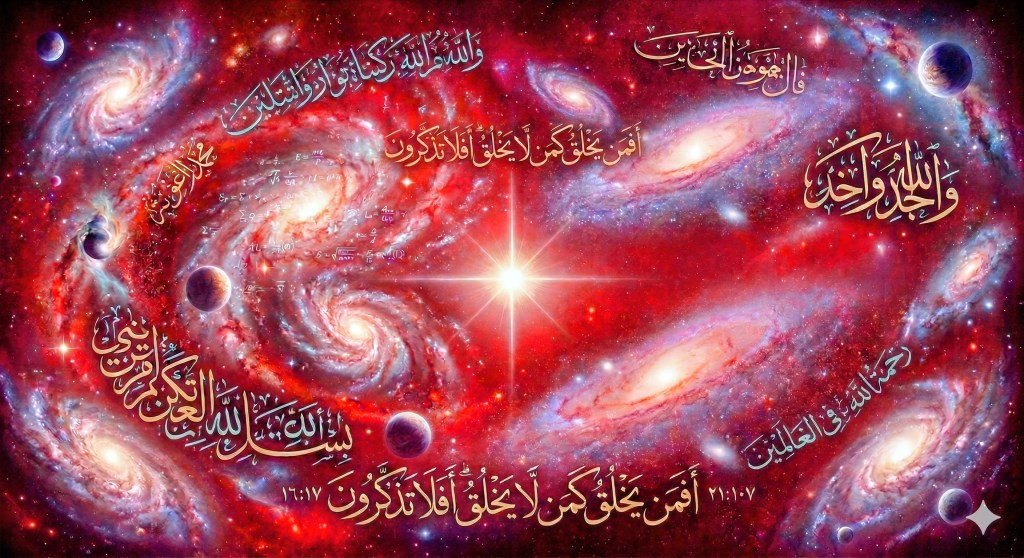
Presented by Claude for Zia H Shah MD
Abstract
The Quranic oaths by the stars and celestial bodies — supremely An-Najm 53:1, Al-Wāqiʿah 56:75–76, and At-Takwīr 81:15–16 — are not decorative rhetoric but istidlāl: divine summonses of the “Book of Nature” to testify to the truth of the “Book of Revelation.” Following the interpretive approach of Zia H. Shah MD on thequran.love, the thesis of this commentary is that each oath is a bridge from the observable to the unseen. God calls the most reliable, awe-inspiring phenomena in the sky as evidence (dalīl / shāhid) for three intertwined truths: the truthfulness of the Prophet Muhammad, the divine origin and protection of the Quran, and the certainty of the Hereafter. Read through the lens of modern astrophysics — lookback time, stellar nucleosynthesis, retrograde motion, neutron stars, and black holes — these seventh-century oaths acquire a depth their first hearers could not have measured, exactly as 56:76 anticipates: “a tremendous oath, if only you knew.”
TL;DR
- The oaths are arguments, not ornaments. In each case a celestial muqsam bihi (thing sworn by) testifies to a jawāb al-qasam (thing sworn to): the star that sets (53:1) vindicates the Prophet; the positions of the stars (56:75) vindicate the protected Quran; the receding, hiding planets (81:15–16) vindicate the message conveyed by Gabriel. This is the istidlāl reading — nature summoned as witness.
- The science deepens the oath rather than dating it. Mawāqiʿ al-nujūm (56:75) resonates with lookback time and the staggering precision and scale of stellar positions; al-khunnas al-jawār al-kunnas (81:15–16), which ʿAlī ibn Abī Ṭālib explained as the stars/planets that recede by day and sweep across the night sky, aligns with planetary retrograde motion, and — in modern devotional readings — with neutron stars and black holes.
- The frame is the harmony of the two Books. Consistent with the thequran.love “Four Books” thesis, the cosmos (Nature) and the Quran (Revelation) issue from one Author and cannot truly contradict; the starry heavens are a standing invitation to tafakkur and tadabbur — reflection that carries the awe of Kant’s “starry heavens above me” toward the transcendent.
Key Findings
- The oath structure is uniform: a muqsam bihi (a celestial phenomenon) evidences a muqsam ʿalayhi / jawāb al-qasam (the truth of revelation). Classical scholars (Ibn al-Qayyim, al-Rāzī, al-Suyūṭī, al-Zarkashī) and the modern Farāhī school treat this as argument, not merely emphasis.
- In all three primary verses the payload is the same: the divine origin and protection of the Quran and the vindication of the Prophet — 53:2–4, 56:77–80, 81:19–25.
- The science coheres remarkably: 56:75’s mawāqiʿ al-nujūm invites reflection on lookback time and the vast precision of stellar positions; 81:15–16’s al-khunnas al-jawār al-kunnas was read by ʿAlī ibn Abī Ṭālib as the planets/stars that recede and hide, and by modern commentators as candidate descriptions of retrograde motion, neutron stars, and black holes.
- The platform’s signature moves — treating every scientific discovery as a testament to the Quran’s truth, and reading the cosmos and scripture as two harmonizing “books” — provide the governing frame.
Details
I. The grammar of the divine oath (qasam)
In Arabic rhetoric an oath (qasam) has constituent parts: the particle of oath (wa-, bi-, ta-), the muqsam bihi (that which is sworn by), and the muqsam ʿalayhi or jawāb al-qasam (the statement the oath affirms). Al-Zarkashī (d. 1392) defined the oath as “a sentence that confirms a statement through emphasis”; al-Suyūṭī (d. 1505) as words whose purpose is “to confirm a statement and place emphasis upon it.” The muqsam bihi lends its glory (ʿaẓamah) to guarantee the muqsam ʿalayhi.
A theological problem arises: humans may swear only by God, yet God swears by created things. The classical resolutions (surveyed on darulfiqh.com and by al-Rāzī and Ibn al-Qayyim) are twofold: (1) an implied “Lord of” is elided — “By the Lord of the star”; and (2) God swears by created things to exalt them as signs. As Ibn al-Qayyim held in his monograph al-Tibyān fī Aqsām al-Qurʾān, the single base of all divine oaths is the attributes of God: when God swears “by the star when it descends,” the ground is His own greatness manifested in that sign. Ash-Shaʿbī’s dictum, cited by Ibn Kathīr, captures the asymmetry: “the Creator swears by whatever He wills among His creation, but the created only vow by the Creator.” Athari CreedAlim
The Farāhī school (Ḥamīd al-Dīn Farāhī, followed by Amīn Aḥsan Iṣlāḥī) sharpened this: the principal function of the oath is to provide dalīl (argument) and shahādah (evidence); the muqsam bihi is a witness to the truth of the muqsam ʿalayhi. This is exactly the reading Zia H. Shah MD adopts on thequran.love: the Quran’s oaths “draw attention to the order and purpose in nature” and use these signs “as evidence of the truth of God’s message.” The oath, in his framing, is istidlāl — a pointing to āyāt (signs) in the cosmos.
II. Sūrah An-Najm 53:1 — “By the star when it descends”
Arabic: وَٱلنَّجْمِ إِذَا هَوَىٰ
Five translations:
- Sahih International: “By the star when it descends,” Quran
- Yusuf Ali: “By the Star when it goes down,—” My Islam
- Pickthall: “By the Star when it setteth,” My Islam
- Muhammad Asad: renders najm as the gradual unfolding of the revelation — “Consider this unfolding [of God’s message], as it comes down from on high!”
- Dr. Mustafa Khattab (The Clear Quran): “By the stars when they fade away!”
Context and jawāb al-qasam. The oath is immediately answered in 53:2–4: “Your companion has neither strayed nor erred; nor does he speak from [his own] inclination. It is not but a revelation revealed.” An-Najm is, per al-Bukhārī (from Ibn Masʿūd), the first surah publicly recited aloud at the Kaʿbah, at whose close the whole assembly — believers and pagans — prostrated. The surah goes on to describe the Prophet’s vision of Gabriel and the ascension of the Miʿrāj (53:5–18).
Classical tafsīr. An-najm is glossed variously: the Pleiades (Ibn ʿAbbās, Mujāhid, Sufyān al-Thawrī, preferred by Ibn Jarīr and Zamakhsharī), Sirius, Venus (al-Suddī), or the generic “stars when they set at dawn” (Abū ʿUbaidah). Ibn ʿAbbās also read najm as the Quran’s piecemeal revelation (nujūman) — a reading Asad and the Ahmadi commentator Maulana Muhammad Ali both develop: every installment of the Quran, as it “descends,” is evidence the Prophet is not in error. Maududi notes the aptness of the setting star: in the darkness one may mistake a rope for a snake, but when the stars set and day dawns, everything appears in its true form — so with the Prophet, whose truth is plain to those who have known him a lifetime as al-Amīn.
Scientific commentary. The “setting” of a star is the phenomenological signature of Earth’s rotation — the ancients’ fixed dome is in fact our own spin. But the deeper marvel is that starlight is old light: we see stars in their past positions because light takes years, centuries, or millennia to reach us (lookback time). To swear “by the star when it descends” is therefore to swear by a photon that left its source long ago — a fitting emblem for revelation, which likewise “comes down” across a gulf and carries timeless news. Nouman Ali Khan and others draw precisely this parallel: the light of distant stars is ancient, as the wisdom of the Quran comes from beyond this world. That some Arabs venerated Sirius makes the oath a quiet polemic: by the very star you idolize — which sets and vanishes — the Messenger is guided and true. Thequran
III. Sūrah Al-Wāqiʿah 56:75–76 — “By the positions of the stars… a tremendous oath”
Arabic: فَلَا أُقْسِمُ بِمَوَاقِعِ النُّجُومِ وَإِنَّهُ لَقَسَمٌ لَّوْ تَعْلَمُونَ عَظِيمٌ
Five translations (v.75 / v.76):
- Sahih International: “Then I swear by the setting of the stars, / And indeed, it is an oath — if you could know — [most] great.”
- Yusuf Ali: “Furthermore I call to witness the setting of the Stars,— / And that is indeed a mighty adjuration if ye but knew,—”
- Pickthall: “Nay, I swear by the places of the stars — / And lo! that verily is a tremendous oath, if ye but knew —”
- Muhammad Asad: “Nay, I call to witness the coming-down in parts [of this Qurʾan] / and, behold, this is indeed a most solemn affirmation, if you but knew it!”
- Dr. Mustafa Khattab (The Clear Quran): “So I do swear by the positions of the stars— / and this, if only you knew, is indeed a great oath—”
The particle lā and the jawāb al-qasam. The lā in fa-lā uqsimu is not a negation of the oath but an emphatic idiom (like lā wallāh), often read as first rebutting the deniers’ claim (“No! — the truth is not as you suppose”) and then swearing. The answer follows in 56:77–80: “Indeed, it is a noble Quran, in a Register well-protected, which none touch except the purified [angels], a revelation from the Lord of the worlds.” Maududi and Maʿāriful Qurʾān make the structure explicit: after refuting the Meccans’ charges that the Quran is sorcery or human forgery, God swears by the star-positions that it is an exalted, protected Book.
Meaning of mawāqiʿ al-nujūm. Mawqiʿ (pl. mawāqiʿ) means the place, time, or manner of falling/occurring. Interpretations: (1) the setting/rising points of stars on the horizon (Mujāhid, Qatādah, al-Ḥasan, preferred by al-Ṭabarī); (2) the piecemeal “coming-down” of the Quran (Ibn ʿAbbās, ʿIkrimah, al-Suddī — the reading Asad follows); and (3) the places where stars will fall at the Last Hour.
Scientific commentary. The phrase “a tremendous oath, if you only knew” is itself a summons to future knowledge — an implicit acknowledgment that the greatness of the star-positions exceeds seventh-century perception. Modern astronomy amply supplies the “if you knew.” First, the sheer scale: what look like pinpoints are suns, often vastly larger than ours, scattered across a galaxy of hundreds of billions of stars — in a cosmos of at least two trillion galaxies, per the study led by Christopher Conselice (University of Nottingham) published October 13, 2016 in The Astrophysical Journal, which found “at least 2 × 10¹² (two trillion) galaxies in the currently visible universe, the vast majority of which cannot be observed with present-day technology as they are too faint” — roughly a tenfold upward revision of the earlier ~100–200 billion estimate. Second, lookback time: a star’s apparent “position” is where it was when its light departed; the mapped positions we navigate by are a mosaic of different epochs. Third, precision: the celestial mechanics binding these positions — Kepler’s and Newton’s laws, general relativity — are astonishingly exact. Fethullah Gülen’s reflection on this verse dwells on that dazzling harmony of star systems held in balance by the All-Powerful. On the thequran.love platform, Zia H. Shah connects mawāqiʿ al-nujūm directly to the astrophysics of galactic anchoring (e.g., the supermassive black hole Sagittarius A*) and reads “the positions of the stars… if you could know” as implying knowledge mankind did not yet possess in the seventh century.
A further scientific resonance amplifies the oath’s grandeur: we are made of the very stars whose positions God invokes. Stellar nucleosynthesis forged the carbon, nitrogen, oxygen, calcium, and iron of our bodies in stellar cores and supernovae. As the Sloan Digital Sky Survey’s APOGEE study announced January 5, 2017 at the American Astronomical Society meeting, astronomer Sten Hasselquist (New Mexico State University) put it: “The elements we measure include the atoms that make up 97% of the mass of the human body” — the six CHNOPS elements (carbon, hydrogen, nitrogen, oxygen, phosphorus, sulfur) measured across some 150,000 Milky Way stars. This is the literal substance behind Carl Sagan’s phrase “we are made of star-stuff.” To swear by the positions of the stars is thus, obliquely, to swear by our own cosmic genealogy.
IV. Sūrah At-Takwīr 81:15–16 — “The receding stars that travel and hide” (al-khunnas al-jawār al-kunnas)
Arabic: فَلَا أُقْسِمُ بِالْخُنَّسِ الْجَوَارِ الْكُنَّسِ
Five translations (v.15 / v.16):
- Sahih International: “So I swear by the retreating stars — / Those that run [their courses] and disappear —”
- Yusuf Ali: “So verily I call to witness the planets — that recede, / Go straight, or hide;”
- Pickthall: “Oh, but I call to witness the planets, / The stars which rise and set,” Substack
- Muhammad Asad: “But nay! I call to witness the revolving stars, / the planets that run their course and set,”
- Dr. Mustafa Khattab (The Clear Quran): “I do swear by the receding stars, / which travel and hide,” Quran.comQuran.com
Context and jawāb al-qasam. The oath answers in 81:19–25: “Indeed, this [Quran] is the word of a noble messenger [Gabriel], possessor of power, secure with the Lord of the Throne, obeyed and trustworthy. And your companion [Muhammad] is not mad. He certainly saw him on the clear horizon… nor is it the word of a devil, expelled.” The surah opens with the cosmic upheavals of judgment (81:1–14) — the sun rolled up, the stars falling — then swears by the orderly night sky to authenticate the revelation.
Classical tafsīr — the interpretation of ʿAlī ibn Abī Ṭālib. Ibn Jarīr al-Ṭabarī records via Khālid bin ʿArʿarah that ʿAlī ibn Abī Ṭālib, asked about al-khunnas al-jawār al-kunnas, said: “These are the stars that withdraw (disappear) during the day and sweep across the sky (appear) at night.” The dominant classical view (Ibn Kathīr, al-Ṭabarī) identifies them as the five visible planets — Mercury, Venus, Mars, Jupiter, Saturn — that are al-jawārī (“runners”) in their orbits, khunnas (“recede,” entering retrograde motion where they appear to halt and move backward), and kunnas (“hide,” entering their “lair,” kinās, like a gazelle, as they set or vanish in the sun’s glare). A minority view (Ibn Masʿūd) read them as wild animals (gazelles). Jalālayn explicitly notes the retrograde motion: “the planets which in a retrograde motion do proceed.”
Scientific commentary. The three verbs map onto real celestial behavior with uncanny economy. Al-jawārī — motion — describes the planets’ constant travel across the ecliptic. Al-khunnas — receding/retreating — describes the retrograde apparent motion of the planets (an artifact of Earth overtaking the outer planets in their orbits) and their disappearance by day. Al-kunnas — hiding, sweeping into concealment — describes their setting below the horizon. Modern commentators (and the qurangallery and islamicbridge treatments) note that the same root khunnas describes what is hidden or invisible (Satan is al-khannās in 114:4), and have proposed that the trio evocatively fits neutron stars and black holes: objects that “run” through space, “recede” from visibility (a black hole traps even light behind its event horizon), and “sweep” up surrounding matter. This is emphatically not classical tafsīr and must be flagged as a modern, speculative reading — the classical consensus is the planets — but it is precisely the kind of “if you only knew” resonance the platform highlights, treating each discovery as a fresh testament.
The companion oath in At-Ṭāriq (86:1–3) — “the piercing star” (al-najm al-thāqib) — has likewise been linked by contemporary writers to pulsars. The first pulsar, CP 1919 (now PSR B1919+21), was discovered by Jocelyn Bell Burnell at Cambridge on November 28, 1967, with a pulsation period of 1.337 seconds; the discovery was announced in Nature (Hewish et al., 1968, vol. 217, p. 709). Pulsars are rapidly rotating neutron stars whose beamed radiation reaches Earth as rhythmic pulses — a “knocking” that some connect to the root sense of ṭāriq (“the knocker / night-visitor”). Again this is a modern analogy, not a classical claim: Mufti Shafiʿ and al-Qurṭubī caution that al-najm al-thāqib denotes any bright star whose light pierces the darkness and names no specific body.
V. The complementary celestial oaths
- At-Ṭāriq 86:1–3: “By the sky and the night-comer — and what will make you know what the night-comer is? — the piercing star.” Al-Ṭāriq (“the knocker/night-visitor”) and al-najm al-thāqib (“the piercing star”) are answered in 86:11–14 by an oath on heaven and earth that “this [Quran] is a decisive word.”
- Al-Burūj 85:1: “By the sky containing great stars (dhāt al-burūj)” — the constellations/towers — answered (85:21–22) with the Quran preserved on a “Guarded Tablet.” Ibn al-Qayyim noted this short surah is dense with proofs of tawḥīd.
- Ash-Shams 91:1–2: “By the sun and its brightness, and the moon as it follows it” — a chain of seven oaths (the most in any surah) culminating in the moral truth that “he who purifies his soul succeeds.”
- Adh-Dhāriyāt 51:1–4, 51:7: “By the winds that scatter…” answered by “what you are promised is true” (51:5); and “By the sky full of pathways (dhāt al-ḥubuk)” (51:7). Zia H. Shah’s own commentaries on 51:1–6 and 51:7 read al-ḥubuk as the “woven,” structured cosmos — anticipating the filamentary “cosmic web” of modern cosmology.
VI. Philosophical commentary — why God swears by created things
The epistemology of the oath is the heart of the matter. Ibn Ḥazm, unable to systematize the oaths, consigned them to the mutashābihāt (ambiguous verses). Ibn al-Qayyim answered that the oaths are transparent once one sees the muqsam bihi as evidence of the muqsam ʿalayhi. The Farāhī school made this a full theory: the oath is an argument by analogy — the reliability of nature (the star that always sets, the planet that always returns) grounds trust in the unseen (revelation, judgment). This is natural theology in miniature: the āyāt of the cosmos point beyond themselves.
The move engages the great Western arguments. The teleological argument — order implies an Orderer — is implicit in swearing by the calibrated positions and courses of the stars; the fine-tuning of celestial mechanics, and of the day-night cycle al-Rāzī reflected upon, reads as calibration and intent. The cosmological argument — contingent motion implies a First Cause — is served by the platform’s Ghazālian occasionalism: the stars “run” and “recede” not by autonomous power but by God’s continual act, “God’s customary actions, not necessary truths.”
Above all, the oaths trade in wonder as a gateway to the transcendent — the register of Kant’s famous close to the Critique of Practical Reason: “Two things fill the mind with ever new and increasing admiration and awe… the starry heavens above me and the moral law within me.” The Quranic oaths yoke exactly these two — the starry heavens (56:75, 81:15–16) and the moral/spiritual truth of revelation and judgment — insisting they issue from one Author. Where William James located the roots of faith in the numinous quality of religious experience, the Quran ritualizes that awe: the night sky is summoned as a standing invitation to tafakkur (reflection). The anthropic resonance — that we, made of stardust, are the cosmos contemplating itself — deepens the point: the witness and the witnessed share a substance.
VII. Theological commentary — the harmony of the two Books
Theologically the three oaths converge on one jawāb: the vindication of revelation. 53:1 → the Prophet neither strays nor errs and speaks only revelation. 56:75 → the Quran is noble, protected in a guarded Register, untouched but by the pure. 81:15 → the Quran is the word conveyed by Gabriel, the noble, trustworthy messenger, and Muhammad is not mad. The cosmos authenticates the scripture; the God who orders Sirius and Saturn attests to the Book. myislam
Two theological accents matter for the platform’s ecumenical tone. First, the anti-idolatry polemic: by swearing by the very stars and planets the pagans revered — and by conditioning some oaths (“the moon when it follows”) — the Quran de-deifies the heavens, redirecting awe from the sign to the Signifier (cf. 41:37, “prostrate not to the sun nor the moon, but to Allah who created them”). Second, the Ahmadiyya-friendly and mainstream readings agree that these are Meccan oaths marshaling nature as testimony against a skeptical audience; Maulana Muhammad Ali’s gloss on 53:1 (the Quran’s installments as evidence of the Prophet’s rectitude) sits comfortably beside Ibn Kathīr’s. The classical “two books” intuition — the Book of Nature and the Book of Scripture, both authored by God and therefore incapable of true contradiction (cf. 4:82, “Do they not reflect upon the Quran? Had it been from other than Allah, they would have found much contradiction”) — is the governing frame of thequran.love‘s “Four Books” thesis (Revelation, Nature, the Self, and History).


Leave a Reply