
A scholarly-commentary essay for The Glorious Quran and Science (thequran.love) Written and collected by Claude for Zia H. Shah, MD
Abstract
This essay examines one of the most philosophically consequential contrasts in the Qur’an: the opposition between ẓann (ظَنّ)—conjecture, assumption, unfounded surmise—and al-Ḥaqq (الْحَقّ)—the Truth, the Reality, and one of the Beautiful Names of Allah. Drawing on classical Arabic lexicography (Rāghib al-Iṣfahānī’s Al-Mufradāt), the tafsīr tradition (al-Ṭabarī, al-Qurṭubī, Ibn Kathīr, Maʿārif al-Qurʾān), and contemporary scholarship (Abdulla Galadari’s philological re-reading of ẓann, Murtaḍā Muṭahharī’s account of the Qur’anic “sources of error,” and Mehdi Golshani’s Qur’anic philosophy of science), I argue that the Qur’an constructs a rigorous epistemic hierarchy—wahm (delusion) → ẓann (conjecture) → ʿilm (knowledge) → yaqīn (certainty)—and insists that in matters of ultimate reality, “conjecture avails nothing against the Truth” (53:28; 10:36). The essay develops the semantic range of the root ẓ-n-n (including the minority of contexts where it denotes near-certainty, e.g., 2:46), the epistemology of accountability for the faculties of perception (17:36), the fallacy of majority opinion and ancestral imitation (6:116; 6:148), the social ethic of avoiding negative suspicion (49:12), and the cosmological doctrine of creation bi-l-ḥaqq—that the universe is made “in truth,” a law-governed, mathematically intelligible reality that both invites and rewards scientific inquiry. I conclude that the Qur’anic critique of ẓann is a double-edged sword: it cuts against religious superstition and against materialist dogmatism alike (45:24), calling humanity from the noise of opinion to the discipline of evidence and the serenity of al-Ḥaqq.
I. The Problem: Opinion Masquerading as Truth
Every generation faces a perennial temptation: to mistake what it merely assumes for what it actually knows, and to mistake what most people say for what is actually true. The Qur’an names this temptation with a single, recurring word—ẓann—and sets against it a single, luminous counter-term: al-Ḥaqq. The contrast is not incidental. It runs like a load-bearing beam through the Qur’anic architecture, surfacing in Meccan polemics against idolatry, in critiques of the People of the Book, in refutations of the deniers of the Hereafter, and in the ethics of everyday social life.
The thesis of this essay is that the Qur’an articulates, with a clarity remarkable for a seventh-century text, an epistemology that anticipates central concerns of modern philosophy of science: the demand that beliefs about reality be grounded in evidence rather than surmise, the warning against confusing probability with certainty, and the insistence that reality is objective and indifferent to human wishful thinking. As Ayatollah Murtaḍā Muṭahharī writes in “The Qur’anic Viewpoint Regarding the Sources of Error” (in Understanding the Uniqueness of the Quran, Al-Tawhid Vol. 1, No. 1, on Al-Islam.org): “Among various sources of error mentioned by the Qur’an, one is that of taking conjecture and hypothesis for certainty and conviction… the Qur’an lays great emphasis on this problem, and has clearly stated in one place that one of the biggest errors of the human mind is pursuit of conjectures and hypotheses.” Al-Islamal-islam
II. The Semantics of Ẓann: The Root ẓ-n-n and Its Range
In classical Arabic, the triliteral root ẓ-n-n (ظ ن ن) spans a spectrum of cognitive states. The great Qur’anic lexicographer Rāghib al-Iṣfahānī (d. 502/1108), in his Al-Mufradāt fī Gharīb al-Qurʾān, gives the definitive gloss: al-ẓann is “a name for that [belief] which is produced from an indication or sign (amāra); when the indication grows strong, it leads to knowledge (ʿilm), and when it grows very weak, it does not pass beyond the limit of delusion (wahm).” In the original: الظَّنُّ اسمٌ لما يحصل عن أمارة، ومتى قويت أدَّت إلى العلم، ومتى ضعفت جداً لم يتجاوز حدَّ الوهم. The Arabic Lexicon
This lexical insight is crucial. Ẓann is not a single fixed value but a variable positioned between two poles. When the evidential “sign” (amāra) is strong, ẓann shades into ʿilm (knowledge); when the sign is weak, it collapses into wahm (baseless delusion). This is why the Qur’an can use the same root in seemingly opposite senses. In the overwhelming majority of its occurrences, ẓann carries the pejorative sense of baseless conjecture set against truth. But in a significant minority—most notably 2:46—it denotes settled, near-certain conviction: Tohed
الَّذِينَ يَظُنُّونَ أَنَّهُم مُّلَاقُو رَبِّهِمْ وَأَنَّهُمْ إِلَيْهِ رَاجِعُونَ “Who are certain that they will meet their Lord and that they will return to Him.” (2:46)
Here yaẓunnūna is rendered “who are certain”—because the believers’ conviction about meeting their Lord rests on the strongest of indications: divine revelation. The classical exegete Ibn Jarīr al-Ṭabarī noted that “the Arabs call certainty as well as doubt ẓann,” an instance of the phenomenon in Arabic where a word can carry a meaning and its opposite (al-aḍdād).
A provocative contemporary re-reading deserves mention. Abdulla Galadari (Khalifa University), in “Re-Visiting the Meaning of ẓann in the Qurʾān” (The Muslim World 112, no. 4 [2022]: 436–456; DOI 10.1111/muwo.12450), argues on philological and comparative-Semitic grounds that the Qur’an does not primarily use ẓann to mean “conjecture” at all, but rather “dogmatic zeal or, in other words, being zealous to a certain belief.” He observes that for the neutral act of forming an opinion or hypothesis the Qur’an tends to use the root ḥ-s-b (as in a-yaḥsabu), which it does not condemn, whereas it consistently condemns ẓann. On this reading, when the Qur’an requires people to shun most ẓann, “it is asking to shun zealous beliefs and dogmas, and it is not asking to shun the formulation of conjectures.” Whether or not one accepts Galadari’s full thesis, it sharpens a vital point: what the Qur’an censures is not the disciplined, provisional hypothesis of the honest inquirer, but the confident clinging to unfounded belief as though it were established truth. Wiley Online Library
III. Ẓann in Its Native Habitat: The Condemnation of Baseless Belief
The fallacy of the majority (6:116)
The Qur’an’s most direct assault on the equation of popular opinion with truth is Sūrat al-Anʿām 6:116:
وَإِن تُطِعْ أَكْثَرَ مَن فِى ٱلْأَرْضِ يُضِلُّوكَ عَن سَبِيلِ ٱللَّهِ ۚ إِن يَتَّبِعُونَ إِلَّا ٱلظَّنَّ وَإِنْ هُمْ إِلَّا يَخْرُصُونَ “And if you obey most of those upon the earth, they will mislead you from the way of Allah. They follow not except assumption, and they are not but falsifying.” (6:116)
The verse is epistemologically radical: numerical majority is severed entirely from truth-value. Al-Ṭabarī glosses the closing verb yakhruṣūn as “they lie/guess,” and al-Qurṭubī explains that its root khaṛs means to estimate or guess without certainty—the same word used for guessing the yield of dates on a palm before harvest. To follow the crowd, the verse implies, is often merely to follow a collective guess dressed up as consensus. Quran
The excuse of the idolaters and the demand for evidence (6:148)
When the polytheists sought to justify their idolatry and self-imposed taboos by appeal to divine predestination, the Qur’an demanded that they produce knowledge:
سَيَقُولُ ٱلَّذِينَ أَشْرَكُوا۟ لَوْ شَآءَ ٱللَّهُ مَآ أَشْرَكْنَا وَلَآ ءَابَآؤُنَا وَلَا حَرَّمْنَا مِن شَىْءٍ ۚ كَذَٰلِكَ كَذَّبَ ٱلَّذِينَ مِن قَبْلِهِمْ حَتَّىٰ ذَاقُوا۟ بَأْسَنَا ۗ قُلْ هَلْ عِندَكُم مِّنْ عِلْمٍ فَتُخْرِجُوهُ لَنَآ ۖ إِن تَتَّبِعُونَ إِلَّا ٱلظَّنَّ وَإِنْ أَنتُمْ إِلَّا تَخْرُصُونَ “Those who associated with Allah will say, ‘If Allah had willed, we would not have associated [anything] and neither would our fathers, nor would we have prohibited anything.’ Likewise did those before them deny until they tasted Our punishment. Say, ‘Do you have any knowledge that you can produce for us? You follow not except assumption, and you do not but guess.’” (6:148) Quran O
The demand—hal ʿindakum min ʿilmin fa-tukhrijūhu lanā (“Do you have any knowledge you can produce for us?”)—is essentially a call for verifiable evidence. It is the ancient counterpart of the modern maxim that extraordinary claims require justification. The excuse of the idolaters is dismissed not because it is theologically inconvenient but because it is epistemically bankrupt: it rests on ẓann and khaṛs (guesswork), not ʿilm.
Idolatry and angelology as guesswork (10:36, 10:66, 53:23, 53:28)
Twice in Sūrat Yūnus the Qur’an diagnoses the root of idolatry as conjecture:
وَمَا يَتَّبِعُ أَكْثَرُهُمْ إِلَّا ظَنًّا ۚ إِنَّ ٱلظَّنَّ لَا يُغْنِى مِنَ ٱلْحَقِّ شَيْـًٔا ۚ إِنَّ ٱللَّهَ عَلِيمٌۢ بِمَا يَفْعَلُونَ “And most of them follow not except assumption. Indeed, assumption avails not against the truth at all. Indeed, Allah is Knowing of what they do.” (10:36) My Islamthequran
إِن يَتَّبِعُونَ إِلَّا ٱلظَّنَّ وَإِنْ هُمْ إِلَّا يَخْرُصُونَ “…They follow not except assumption, and they are not but conjecturing.” (10:66)
The formula inna al-ẓanna lā yughnī mina al-ḥaqqi shayʾan—”conjecture avails nothing against the truth”—recurs verbatim in Sūrat al-Najm, in the context of the pagans who named the angels as female deities:
إِنْ هِيَ إِلَّا أَسْمَآءٌ سَمَّيْتُمُوهَآ أَنتُمْ وَءَابَآؤُكُم مَّآ أَنزَلَ ٱللَّهُ بِهَا مِن سُلْطَٰنٍ ۚ إِن يَتَّبِعُونَ إِلَّا ٱلظَّنَّ وَمَا تَهْوَى ٱلْأَنفُسُ ۖ وَلَقَدْ جَآءَهُم مِّن رَّبِّهِمُ ٱلْهُدَىٰ “They are not but [mere] names you have named them—you and your forefathers—for which Allah has sent down no authority. They follow not except assumption and what [their] souls desire, and there has already come to them from their Lord guidance.” (53:23) Quran
وَمَا لَهُم بِهِۦ مِنْ عِلْمٍ ۖ إِن يَتَّبِعُونَ إِلَّا ٱلظَّنَّ ۖ وَإِنَّ ٱلظَّنَّ لَا يُغْنِى مِنَ ٱلْحَقِّ شَيْـًٔا “And they have thereof no knowledge. They follow not except assumption, and indeed, assumption avails not against the truth at all.” (53:28) Islam Awakenedthequran
Verse 53:23 exposes the psychological engine of ẓann: it is powered by mā tahwā al-anfus—”what the souls desire.” Conjecture is rarely disinterested; it is typically the projection of desire onto reality, the manufacture of a comforting or convenient belief and its subsequent treatment as fact. The Maʿārif al-Qurʾān commentary on these verses notes that ẓann here is “baseless thoughts,” and stands as the antonym of yaqīn—”assured or definitive knowledge about something that really exists, not the figment of someone’s imagination.” Quran.com
Scripture reduced to wishful thinking (2:78)
The critique is not reserved for pagans. The Qur’an levels it at any community that substitutes hearsay and desire for genuine knowledge of revelation:
وَمِنْهُمْ أُمِّيُّونَ لَا يَعْلَمُونَ ٱلْكِتَٰبَ إِلَّآ أَمَانِىَّ وَإِنْ هُمْ إِلَّا يَظُنُّونَ “And among them are unlettered ones who do not know the Scripture except [indulgence in] wishful thinking, but they are only assuming.” (2:78) Quran O
Here ẓann is twinned with amāniyy (wishful fancies). A religion built on folk tales, inherited slogans, and comfortable illusions—rather than on real knowledge of the revealed text—is, in the Qur’an’s judgment, merely a structured form of conjecture.
IV. The Materialist as Conjecturer: 45:24
Crucially, the Qur’an’s critique of ẓann is not a weapon aimed only at religious superstition. It cuts with equal force against confident metaphysical claims made by deniers of the transcendent. In Sūrat al-Jāthiyah, the deniers of the Hereafter advance a thoroughly naturalistic creed—and are met with precisely the same charge leveled at the idolaters:
وَقَالُوا۟ مَا هِىَ إِلَّا حَيَاتُنَا ٱلدُّنْيَا نَمُوتُ وَنَحْيَا وَمَا يُهْلِكُنَآ إِلَّا ٱلدَّهْرُ ۚ وَمَا لَهُم بِذَٰلِكَ مِنْ عِلْمٍ ۖ إِنْ هُمْ إِلَّا يَظُنُّونَ “And they say, ‘There is not but our worldly life; we die and we live, and nothing destroys us except time.’ But they have of that no knowledge; they are only conjecturing.” (45:24) Quran O
This verse is of extraordinary contemporary relevance. The claim “there is nothing but our worldly life” is a metaphysical assertion—a universal negative about the whole of reality—and the Qur’an classifies it, too, as ẓann, belief unsupported by knowledge (wa-mā lahum bi-dhālika min ʿilmin). The point is methodologically even-handed: dogmatic materialism, when it asserts more than the evidence warrants, is as much a species of conjecture as dogmatic superstition. The reductive certainty that “time” (al-dahr) alone governs life and death is not the deliverance of knowledge but the projection of an assumption. In modern terms, the Qur’an distinguishes between what science can actually establish and the metaphysical overreach of scientism—the unwarranted leap from “science studies the material world” to “only the material world exists.”
V. The Epistemology of Accountability: 17:36
If ẓann is the disease, the Qur’an also prescribes the discipline. Sūrat al-Isrāʾ 17:36 lays down what may be the most concise epistemological injunction in scripture:
وَلَا تَقْفُ مَا لَيْسَ لَكَ بِهِۦ عِلْمٌ ۚ إِنَّ ٱلسَّمْعَ وَٱلْبَصَرَ وَٱلْفُؤَادَ كُلُّ أُو۟لَٰٓئِكَ كَانَ عَنْهُ مَسْـُٔولًا “And do not pursue that of which you have no knowledge. Indeed, the hearing, the sight and the heart—about all those [you] will be questioned.” (17:36) Quran O
The verb taqfu means to follow, track, or pursue something without warrant. The prohibition is on asserting, acting upon, or transmitting claims for which one has no ʿilm. What follows is remarkable: the Qur’an makes the faculties of knowledge acquisition—al-samʿ (hearing), al-baṣar (sight), and al-fuʾād (the heart/intellect)—themselves objects of divine accountability. Muhammad Asad noted that this relates to “statements based on guesswork unsupported by evidence.” The verse thereby dignifies empirical perception and rational reflection as trust-bearing instruments: they are given to ascertain reality, and their misuse—accepting the unverified, transmitting the unconfirmed—is a moral failing for which one is answerable. This is, in embryo, an ethic of belief: one is responsible not only for what one does but for how one comes to believe what one believes. Alim
VI. The Epistemic Hierarchy: Wahm → Ẓann → ʿIlm → Yaqīn
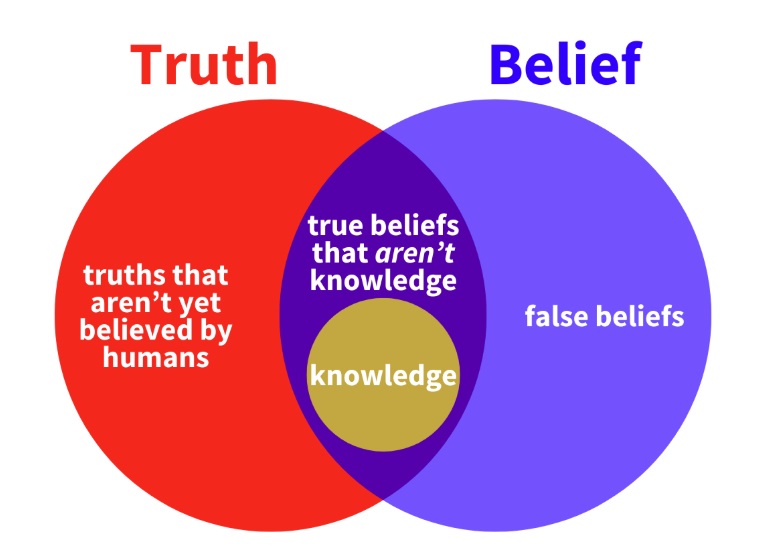
Reading these verses together with the lexical tradition yields a coherent Qur’anic epistemology arranged as an ascending hierarchy of cognitive states. At the base lies wahm—pure delusion or baseless imagining. Above it sits ẓann—conjecture, an opinion inclined toward one probability but lacking decisive warrant. Higher still is ʿilm—knowledge grounded in evidence, whether the evidence of the senses, sound reasoning, or reliable revelation. At the summit is yaqīn—certainty, the settled, unshakeable grasp of reality.
The Semantics-of-Ḥaqq analysis on thequran.love maps the highest tier further into the classical triad of certainty: ʿilm al-yaqīn (the knowledge of certainty—inferring fire from smoke), ʿayn al-yaqīn (the eye of certainty—seeing the flames), and ḥaqq al-yaqīn (the truth of certainty—feeling the heat itself). The Qur’an describes itself as reaching that highest register: wa-innahu la-ḥaqqu al-yaqīn (“And indeed, it is the truth of certainty,” 69:51). The entire ethical-intellectual project of the Qur’an, on this reading, is to move the human being up this ladder—from delusion and conjecture toward knowledge and certainty—rather than allowing him to remain, as most do, “in orbit of conjecture.” thequranthequran
Sayyid Wahid Akhtar’s exposition of the Islamic concept of knowledge captures the nuance that not all ẓann is condemned wholesale: conjecture “is sometimes essential for knowledge as a means, but not as an end.” The provisional hypothesis is a legitimate rung on the ladder; the error is to treat the rung as the destination—to enshrine conjecture as final truth. Al-Islam
VII. Al-Ḥaqq: The Truth as Divine Name and Ontological Reality
Against ẓann the Qur’an sets al-Ḥaqq. The triliteral root ḥ-q-q is among the most productive in the Qur’anic corpus, occurring exactly 287 times in seven derived forms (per the Quranic Arabic Corpus Dictionary entry for the root ح ق ق), and it denotes firmness, established reality, and the absolute correspondence of a statement or entity to fact. It stands in direct antithesis to al-bāṭil (falsehood, vanity, the void). thequran
At its apex, al-Ḥaqq is a Name of God. Allah is not merely truthful in speech; He is the Real, the necessarily existent Ground of all contingent being: thequran
ذَٰلِكَ بِأَنَّ ٱللَّهَ هُوَ ٱلْحَقُّ وَأَنَّهُۥ يُحْىِ ٱلْمَوْتَىٰ وَأَنَّهُۥ عَلَىٰ كُلِّ شَىْءٍ قَدِيرٌ “That is because Allah is the Truth (al-Ḥaqq), and because He gives life to the dead, and because He has power over all things.” (22:6) thequran
The ontological contrast with false objects of worship is drawn explicitly:
ذَٰلِكَ بِأَنَّ ٱللَّهَ هُوَ ٱلْحَقُّ وَأَنَّ مَا يَدْعُونَ مِن دُونِهِ هُوَ ٱلْبَٰطِلُ وَأَنَّ ٱللَّهَ هُوَ ٱلْعَلِىُّ ٱلْكَبِيرُ “That is because Allah is the Truth (al-Ḥaqq), and that which they call upon besides Him is falsehood (al-bāṭil), and because Allah is the Most High, the Great.” (22:62) thequran
Because Allah is al-Ḥaqq, reality is objective and independent of human belief. This is why “conjecture avails nothing against the truth” (53:28): human surmise cannot alter what is. The relationship is captured with unmatched force in Sūrat Yūnus:
فَذَٰلِكُمُ ٱللَّهُ رَبُّكُمُ ٱلْحَقُّ ۖ فَمَاذَا بَعْدَ ٱلْحَقِّ إِلَّا ٱلضَّلَٰلُ ۖ فَأَنَّىٰ تُصْرَفُونَ “For that is Allah, your Lord, the Truth. And what can be beyond truth except error? So how are you turned away?” (10:32) thequran
The dichotomy is total: beyond al-Ḥaqq lies only ḍalāl (error). There is no neutral third territory. To depart from truth is, by definition, to fall into misguidance—which is precisely the fate of one who follows ẓann.
VIII. Creation Bi-l-Ḥaqq: Truth as the Fabric of a Law-Governed Cosmos
The most scientifically pregnant dimension of al-Ḥaqq is cosmological. Repeatedly the Qur’an declares that the heavens and the earth were created bi-l-ḥaqq—”in truth,” “with truth,” through an ordered, purposeful, non-arbitrary design:
وَهُوَ ٱلَّذِى خَلَقَ ٱلسَّمَٰوَٰتِ وَٱلْأَرْضَ بِٱلْحَقِّ ۖ وَيَوْمَ يَقُولُ كُن فَيَكُونُ ۚ قَوْلُهُ ٱلْحَقُّ “And He is the One who created the heavens and the earth in truth (bi-l-ḥaqq). And the Day He says, ‘Be,’ and it is; His word is the truth.” (6:73) thequran
وَمَا خَلَقْنَا ٱلسَّمَآءَ وَٱلْأَرْضَ وَمَا بَيْنَهُمَا لَٰعِبِينَ ﴿٣٨﴾ مَا خَلَقْنَٰهُمَآ إِلَّا بِٱلْحَقِّ وَلَٰكِنَّ أَكْثَرَهُمْ لَا يَعْلَمُونَ “We did not create the heavens and the earth and that between them in play. We created them not except in truth (bi-l-ḥaqq), but most of them do not know.” (44:38–39)
مَا خَلَقْنَا ٱلسَّمَٰوَٰتِ وَٱلْأَرْضَ وَمَا بَيْنَهُمَآ إِلَّا بِٱلْحَقِّ وَأَجَلٍ مُّسَمًّى “We did not create the heavens and the earth and what is between them except in truth (bi-l-ḥaqq) and for a specified term.” (46:3) thequran
The theological claim that creation is bi-l-ḥaqq, not bāṭil (vain) and not laʿib (sport), carries a momentous implication: the universe possesses an objective, discoverable structure. It operates by consistent, reliable law—what the Islamic tradition calls sunnat Allāh, the unchanging pattern of God’s action. As commentators note, this “implies that the laws of nature are inviolable,” a conviction that helped “set the stage for the scientific revolution” by assuring inquirers that nature is orderly and truth-based rather than capricious. Sūrat Yūnus 10:5 makes the mathematical corollary explicit, tying the sun’s radiance and the moon’s phases to ḥisāb (calculation): “Allah did not create this except in truth (bi-l-ḥaqq).” thequranthequran
Here the two halves of the essay converge. Because the cosmos is ḥaqq, the honest study of the cosmos yields ḥaqq. Every genuine scientific discovery is thus, in the Qur’anic frame, the recovery of a fragment of divine truth embedded in creation. And this is the very mechanism the Qur’an promises will vindicate its own claim to be al-Ḥaqq:
سَنُرِيهِمْ ءَايَٰتِنَا فِى ٱلْءَافَاقِ وَفِىٓ أَنفُسِهِمْ حَتَّىٰ يَتَبَيَّنَ لَهُمْ أَنَّهُ ٱلْحَقُّ ۗ أَوَلَمْ يَكْفِ بِرَبِّكَ أَنَّهُۥ عَلَىٰ كُلِّ شَىْءٍ شَهِيدٌ “We will show them Our signs in the horizons and within themselves until it becomes clear to them that it is the truth. But is it not sufficient concerning your Lord that He is, over all things, a Witness?” (41:53) thequran
The trajectory of knowledge—outward into the cosmos (al-āfāq) and inward into the self (anfusihim)—is a movement from ẓann toward al-Ḥaqq. This is why Muṭahharī, in his encounter with modern science, insisted that the friction between faith and science usually lies in the philosophical underpinnings of science rather than in science itself—that is, in the smuggling of metaphysical ẓann into empirical work. And it is why Mehdi Golshani, in “Philosophy of Science from the Qur’anic Perspective” (Al-Tawhid Vol. 2, No. 1, Muharram 1405 AH, on Al-Islam.org), writes that “one of the main sources of error in judgments is due to the replacement of knowledge by conjecture,” citing precisely 53:28.
IX. The Social Ethics of Ẓann: Suspicion and the Dignity of Persons (49:12)
The Qur’an’s epistemic vigilance extends from cosmology to the intimate texture of community life. If conjecture is dangerous in creed, it is corrosive in human relations, where it takes the form of sūʾ al-ẓann—negative suspicion of others:
يَٰٓأَيُّهَا ٱلَّذِينَ ءَامَنُوا۟ ٱجْتَنِبُوا۟ كَثِيرًا مِّنَ ٱلظَّنِّ إِنَّ بَعْضَ ٱلظَّنِّ إِثْمٌ ۖ وَلَا تَجَسَّسُوا۟ وَلَا يَغْتَب بَّعْضُكُم بَعْضًا ۚ أَيُحِبُّ أَحَدُكُمْ أَن يَأْكُلَ لَحْمَ أَخِيهِ مَيْتًا فَكَرِهْتُمُوهُ ۚ وَٱتَّقُوا۟ ٱللَّهَ ۚ إِنَّ ٱللَّهَ تَوَّابٌ رَّحِيمٌ “O you who have believed, avoid much [negative] assumption. Indeed, some assumption is sin. And do not spy or backbite each other. Would one of you like to eat the flesh of his brother when dead? You would detest it. And fear Allah; indeed, Allah is Accepting of repentance and Merciful.” (49:12) Quran
The structure of the verse is a small treatise in social epistemology. It forbids three linked evils in ascending sequence: ẓann (unfounded suspicion), tajassus (spying to confirm the suspicion), and ghība (backbiting to broadcast it). The Maʿārif al-Qurʾān commentary observes that the command is calibrated—”avoid much of suspicion”—because not all ẓann is sinful; the believer must discern which suspicions are baseless conjecture (which is forbidden) and which are warranted, evidence-based judgments (as are required in, say, a court of law under al-ẓann al-ghālib, preponderant probability). The Prophet’s warning—narrated by Abū Hurayrah and recorded in Ṣaḥīḥ al-Bukhārī (hadith 6064, also 6066 and 5143) and Ṣaḥīḥ Muslim (2563, Kitāb al-Birr wa-l-Ṣila)—seals the point: “Beware of suspicion, for suspicion is the falsest of speech” (iyyākum wa-l-ẓanna fa-inna al-ẓanna akdhabu al-ḥadīth). To convict a fellow human being in the private courtroom of one’s mind, on evidence one would never accept in any other domain, is to prefer conjecture to truth—and, the verse insists with its arresting image, to feast on a brother’s corpse. WikipediaQuran.com
X. Synthesis: The Qur’anic Argument for Intellectual Integrity
Assembled, these verses articulate a unified vision. Reality (al-Ḥaqq) is grounded in the necessarily existent God who is Himself al-Ḥaqq; the cosmos He made bi-l-ḥaqq is objective, ordered, and intelligible; human beings are equipped with faculties of hearing, sight, and heart precisely to apprehend this reality, and are held accountable for using them honestly (17:36). Against this stands ẓann: belief driven by desire (53:23), inherited by imitation (6:148), amplified by majorities (6:116), and mistaken for knowledge by pagans and materialists alike (10:36; 45:24). The Qur’an’s verdict is uncompromising and repeated as a refrain: inna al-ẓanna lā yughnī mina al-ḥaqqi shayʾan—conjecture avails nothing against the truth.
The philosophical payload is threefold. First, an epistemology of evidence: truth claims about ultimate reality require ʿilm, not surmise. Second, an ethic of belief: one is morally responsible for the discipline of one’s cognition. Third, a metaphysics of realism: truth is objective, anchored in al-Ḥaqq, and therefore impervious to consensus, tradition, or wishful thinking. This is a worldview that, far from being hostile to science, supplies its deepest presuppositions—an ordered cosmos, a mind fitted to know it, and a duty to follow the evidence wherever it leads.
Epilogue: From the Noise of Conjecture to the Music of Truth
The journey from ẓann to al-Ḥaqq is the journey of every honest soul. The Qur’an stages it as a movement out of noise into music—out of the cacophony of competing surmises, inherited slogans, and desires-mistaken-for-facts, into the clear and single tone of reality. It is telling that the same book which commands “do not pursue that of which you have no knowledge” (17:36) also promises “We will show them Our signs in the horizons and within themselves until it becomes clear to them that it is the truth” (41:53). The prohibition and the promise are two sides of one coin: refuse the counterfeit, and the genuine will be shown to you.
In this vision, faith is not the enemy of reason but its fulfillment. The believer is summoned to be a ḥāmil al-ḥaqq, a bearer of truth—one who grounds conviction in evidence, who tests the crowd’s opinion against reality, who studies the law-governed cosmos as an open scripture of divine truth, and who guards even his private thoughts about his neighbor from the corrosion of baseless suspicion. Against every idol of the mind—whether the idol of the ancestors, the idol of the majority, the idol of desire, or the idol of a dogma that overreaches its evidence—the Qur’an lifts a single, steadying standard:
وَقُلْ جَآءَ ٱلْحَقُّ وَزَهَقَ ٱلْبَٰطِلُ ۚ إِنَّ ٱلْبَٰطِلَ كَانَ زَهُوقًا “And say, ‘Truth has come, and falsehood has departed. Indeed, falsehood is ever bound to depart.’” (17:81)
For as the deepest logic of al-Ḥaqq assures us, conjecture, however loud and however popular, avails nothing against the Truth.





Leave a Reply