
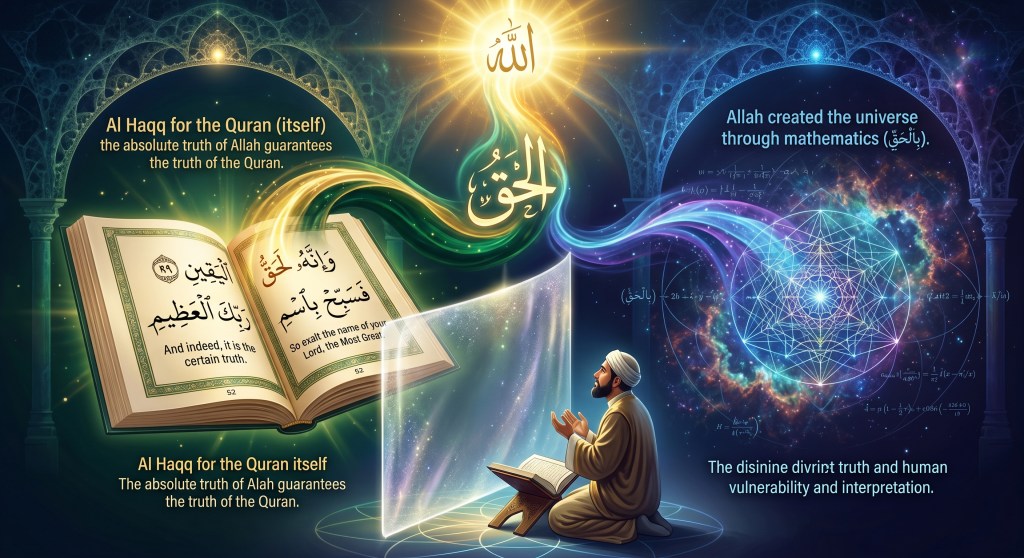
Presented by Gemini
Audio teaser: How Haqq Bridges Divine Reality and Justice:
Abstract
The Arabic triliteral root ḥaˉ-qaˉf-qaˉf (H-Q-Q) constitutes one of the most morphologically productive and conceptually central semantic families in the Quranic corpus, appearing in various derived forms across approximately 287 instances. This research report provides a comprehensive lexicological and theological investigation of the word Haqq (Truth/Right/Reality) and its derivatives in the Glorious Quran. The analysis demonstrates how the Quranic discourse deploys the concept of Haqq across six distinct yet interconnected semantic dimensions: as an ontological description of the Divine Essence (Al-Haqq), as a cosmological blueprint of physical creation designed through mathematics (bi-al-ḥaqq), as an epistemological validation of the Quranic revelation, as a historical justification for Prophetic agency, as an eschatological reality of ultimate accountability (Al-Hāqqah), and as a socio-legal framework for human rights and justice (huquq). Crucially, this study explores the epistemological guarantee wherein the absolute reality of Allah secures the integrity of the Quranic text, while concurrently establishing that this guarantee protects the objective truth of the revelation rather than the fallible, historically contingent interpretations of human commentators.
Morphological and Lexicological Taxonomy of the Root H-Q-Q
In classical Arabic lexicography, the triliteral root ḥaˉ-qaˉf-qaˉf (H-Q-Q) primarily denotes firmness, constancy, established reality, and the absolute correspondence of a statement or entity to objective fact. It stands in direct antithesis to Bāṭil (falsehood, vanity, or non-existence). When a matter is described as haqqa, it means it has been established as an undeniable truth, has become obligated by law, or has rightfully fallen due.
The morphological richness of this root in the Quranic corpus directly mirrors its theological priority. The derived forms span multiple verbal conjugations and nominal patterns, mapping out a sophisticated network of meanings that govern Islamic metaphysics, ethics, and law.
The following taxonomy outlines the morphological distribution of the root H-Q-Q in the Quran:
| Morphological Derivation | Grammatical Category | Quranic Frequency (Approx.) | Primary Semantic Gloss in Context | Key Quranic Occurrences |
|---|---|---|---|---|
| حَقَّ (Haqqa) | Verb (Form I, Active) | 18 | To prove true, to be justified, to become due or obligated. | Surah Al-A’raf (7:30), Surah Yunus (10:33), Surah Ya-Sin (36:7). |
| حُقَّتْ (Huqqat) | Verb (Form I, Passive) | 2 | To be obligated, to be made duty-bound, to listen obediently. | Surah Al-Inshiqaq (84:2), Surah Al-Inshiqaq (84:5). |
| يُحِقَّ (Yuḥiqqa) | Verb (Form IV, Active) | 4 | To establish, to manifest as true, to justify through action. | Surah Al-Anfal (8:7), Surah Al-Anfal (8:8), Surah Yunus (10:82). |
| اسْتَحَقَّ (Istahaqqa) | Verb (Form X, Active) | 2 | To be guilty of, to have a lawful claim or right to. | Surah Al-Ma’idah (5:107). |
| حَقّ / الْحَقّ (Haqq / Al-Haqq) | Noun (Singular) | Over 220 | Truth, reality, justice, due, right, obligation. | Surah Al-Baqarah (2:147), Surah Al-Isra (17:105), Surah Al-Hajj (22:62). |
| أَحَقّ (Ahaqq) | Elative Adjective | 12 | More entitled, truer, possessing greater right. | Surah At-Tawbah (9:13), Surah At-Tawbah (9:62), Surah Yunus (10:35). |
| حَآقَّة (Hāqqah) | Active Participle (Fem.) | 3 | The Inevitable Hour, the Sure Reality, the Day of Judgment. | Surah Al-Haqqah (69:1), Surah Al-Haqqah (69:2), Surah Al-Haqqah (69:3). |
| حَقِيق (Haqīq) | Adjective | 1 | Proper, bound by duty, worthy. | Surah Al-A’raf (7:105). |
This morphological taxonomy underscores the versatility of the root, showing how it transitions from an active verb demonstrating the historical realization of divine decrees to an elative adjective establishing supreme ethical authority, and finally to a nominal form capturing the ultimate reality of both the Creator and His creation.
Al-Haqq as the Ontological Anchor: Allah as the Ultimate Reality
The foundational use of Al-Haqq in the Quranic text is theological, serving as one of the Beautiful Names (Al-Asmāʾ al-Ḥusnā) of Allah. In Islamic metaphysics, Allah is not merely “truthful” in His speech; He is Al-Haqq—the Absolute Reality, the Self-Sufficient Source of all existence, whose being is necessary, eternal, and independent, whereas all other creations are contingent and dependent on His divine will.
The Quran explicitly frames Allah as Al-Haqq to contrast His absolute, unchanging nature with the ephemeral, false deities fabricated by human delusion. This ontological contrast is illustrated in several key verses:
Surah Al-Hajj (22:6)
ذَٰلِكَ بِأَنَّ اللَّهَ هُوَ الْحَقُّ وَأَنَّهُ يُحْيِي الْمَوْتَىٰ وَأَنَّهُ عَلَىٰ كُلِّ شَيْءٍ قَدِيرٌ
“That is because Allah is the Truth (Al-Haqq), and because He gives life to the dead, and because He has power over all things.”
In this context, Allah’s identity as Al-Haqq is linked directly to His cosmological power to generate life, govern death, and bring about the resurrection. The absolute reality of the Divine Essence guarantees the reality of physical processes and their ultimate eschatological fulfillment.
Surah Al-Hajj (22:62)
ذَٰلِكَ بِأَنَّ اللَّهَ هُوَ الْحَقُّ وَأَنَّ مَا يَدْعُونَ مِنْ دُونِهِ هُوَ الْبَاطِلُ وَأَنَّ اللَّهَ هُوَ الْعَلِيُّ الْكَبِيرُ
“That is because Allah is the Truth (Al-Haqq), and that which they call upon besides Him is falsehood (Al-Bāṭil), and because Allah is the Most High, the Great.”
Here, the Quran establishes a strict binary between Al-Haqq and Al-Bāṭil. The idols and material constructs worshipped by humanity possess no intrinsic reality; they are ontologically vacant and logically inconsistent. This formulation is repeated in Surah Luqman (31:30), cementing the principle that monotheism (Tawḥīd) is rooted in the recognition of Allah as the sole Ontological Anchor of the cosmos.
Surah Ta-Ha (20:114)
فَتَعَالَى اللَّهُ الْمَلِكُ الْحَقُّ ۗ وَلَا تَعْجَلْ بِالْقُرْآنِ مِنْ قَبْلِ أَنْ يُقْضَىٰ إِلَيْكَ وَحْيُهُ ۖ وَقُلْ رَبِّ زِدْنِي عِلْمًا
“So high [above all] is Allah, the Sovereign, the Truth (Al-Malik al-Haqq). And, [O Muhammad], do not hasten with the Quran before its revelation is completed to you, and say, ‘My Lord, increase me in knowledge.’”
This verse couples Al-Haqq with Al-Malik (The Sovereign, the King), emphasizing that ultimate authority and ultimate reality are identical. The pursuit of knowledge is framed as an advancement toward the Divine Truth, requiring patience and humility. Similarly, Surah Al-Mu’minun (23:116) affirms:
فَتَعَالَى اللَّهُ الْمَلِكُ الْحَقُّ ۖ لَا إِلَٰهَ إِلَّا هُوَ رَبُّ الْعَرْشِ الْكَرِيمِ
“So exalted is Allah, the Sovereign, the Truth (Al-Malik al-Haqq); there is no deity except Him, Lord of the Noble Throne.”
These attributes signify that the governance of the universe is not arbitrary or chaotic; rather, it is anchored in a Sovereign whose laws—both physical and moral—reflect His perfect, unchanging truth.
To provide a comprehensive overview of how the Quran employs the word Haqq to designate the Divine Essence, the following table presents key ontological occurrences:
| Verse Reference | Arabic Text | English Translation | Theological Context |
|---|---|---|---|
| Surah Al-An’am (6:62) | ثُمَّ رُدُّوا إِلَى اللَّهِ مَوْلَاهُمُ الْحَقِّ ۚ أَلَا لَهُ الْحُكْمُ وَهُوَ أَسْرَعُ الْحَاسِبِينَ | “Then they are returned to Allah, their True Master. Unquestionably, His is the judgment, and He is the swiftest of accountants.” | Establishes Allah as the ultimate sovereign return of all souls. |
| Surah Yunus (10:32) | فَذَٰلِكُمُ اللَّهَ رَبُّكُمُ الْحَقُّ ۖ فَمَاذَا بَعْدَ الْحَقِّ إِلَّا الضَّلَالُ ۖ فَأَنَّىٰ تُصْرَفُونَ | “For that is Allah, your Lord, the Truth. And what can be beyond truth except error? So how are you turned away?” | Contrasts divine truth with human misguidance. |
| Surah Al-Kahf (18:44) | هُنَالِكَ الْوَلَايَةُ لِلَّهِ الْحَقِّ ۚ هُوَ خَيْرٌ ثَوَابًا وَخَيْرٌ عُقْبًا | “There, authority belongs to Allah, the True One. He is the best for reward and the best for outcome.” | Demonstrates that spiritual and worldly protection lies solely with the Divine. |
| Surah An-Nur (24:25) | يَوْمَئِذٍ يُوَفِّيهِمُ اللَّهُ دِينَهُمُ الْحَقَّ وَيَعْلَمُونَ أَنَّ اللَّهَ هُوَ الْحَقُّ الْمُبِينُ | “On that Day, Allah will pay them in full their deserved recompense, and they will know that Allah is the manifest Truth.” | Eschatological revelation of Allah’s absolute justice and reality. |
| Surah Al-Mu’min (40:20) | وَاللَّهُ يَقْضِي بِالْحَقِّ ۖ وَالَّذِينَ يَدْعُونَ مِنْ دُونِهِ لَا يَقْضُونَ بِشَيْءٍ | “And Allah judges with truth, while those they invoke besides Him judge not with anything.” | Contrasts active divine justice with the impotence of false deities. |
Cosmological Mathematics: Creating the Cosmos and Multiverse “Bil-Haqq”
A major theme in Quranic cosmology is the assertion that Allah created the physical cosmos bi-al-ḥaqq (بِالْحَقِّ—in truth, with purpose, and through a design of absolute integrity). This concept stands in sharp contrast to ancient mythologies that viewed the universe as a chaotic accident, a divine whim, or a deceptive illusion.
Surah Ibrahim (14:19)
أَلَمْ تَرَ أَنَّ اللَّهَ خَلَقَ السَّمَاوَاتِ وَالْأَرْضَ بِالْحَقِّ ۚ إِنْ يَشَأْ يُذْهِبْكُمْ وَيَأْتِ بِخَلْقٍ جَدِيدٍ
“Have you not seen that Allah created the heavens and the earth with truth (bi-al-ḥaqq)? If He wills, He can do away with you and bring forth a new creation.”
Surah Ar-Rum (30:8)
أَوَلَمْ يَتَفَكَّرُوا فِي أَنْفُسِهِم… مَا خَلَقَ اللَّهُ السَّمَاوَاتِ وَالْأَرْضَ وَمَا بَيْنَهُمَا إِلَّا بِالْحَقِّ وَأَجَلٍ مُسَمًّى
“Do they not contemplate within themselves? Allah did not create the heavens and the earth and what is between them except with truth (bi-al-ḥaqq) and for an appointed term.”
The theological phrase bi-al-ḥaqq implies that the cosmos is built upon an objective, discoverable structure of physical and mathematical laws. The universe operates with consistency, predictability, and order—qualities that reflect the reliability of its Creator. In modern Islamic scientific philosophy, this Quranic principle is interpreted as a declaration that the universe (or multiverse) is constructed through mathematics.
Mathematics is the universal language of Haqq in the physical realm. The precise fine-tuning of cosmological constants, the geometric symmetries of subatomic particles, and the equations governing space-time curvature are all physical expressions of this divine truth. For instance, the gravitational dynamics that sustain galaxies and stellar systems are mathematically described by Einstein’s Field Equations:
Gμν+Λgμν=c48πGTμν
In this mathematical model, the cosmological constant (Λ), the gravitational constant (G), and the speed of light (c) must be precisely calibrated to allow for a stable, life-permitting universe. The slightest deviation in the fine-structure constant (α), represented by:
α=4πε0ℏce2≈1371
would prevent the formation of atoms, stars, and biological life.
The Quranic assertion of creation bi-al-ḥaqq guarantees that the laws of nature are mathematical, elegant, and permanent. Just as Euler’s Identity (eiπ+1=0) elegantly links five fundamental mathematical constants in a single statement of absolute truth, the physical universe is bound together by a unified, mathematical design. Creation bi-al-ḥaqq means that the natural sciences are not studying a random, deceptive illusion, but a structured reality that testifies to the absolute truth of its Source.
To catalog the extensive structural application of bi-al-ḥaqq in the creation of the cosmos, the following table presents key mathematical and cosmological occurrences:
| Verse Reference | Arabic Text | English Translation | Scientific/Mathematical Implication |
|---|---|---|---|
| Surah Al-An’am (6:73) | وَهُوَ الَّذِي خَلَقَ السَّمَاوَاتِ وَالْأَرْضَ بِالْحَقِّ ۖ وَيَوْمَ يَقُولُ كُنْ فَيَكُونُ ۚ قَوْلُهُ الْحَقُّ | “And He is the One who created the heavens and the earth in truth (bi-al-ḥaqq). And the Day He says, ‘Be,’ and it is; His word is the truth.” | Points to the instantaneous and mathematically perfect transition from non-existence to existence. |
| Surah Yunus (10:5) | هُوَ الَّذِي جَعَلَ الشَّمْسَ ضِيَاءً وَالْقَمَرَ نُورًا وَقَدَّرَهُ مَنَازِلَ لِتَعْلَمُوا عَدَدَ السِّنِينَ وَالْحِسَابَ ۚ مَا خَلَقَ اللَّهُ ذَٰلِكَ إِلَّا بِالْحَقِّ | “He is the One who made the sun a shining light and the moon a derived light and determined for it phases—that you may know the number of years and calculation. Allah did not create this except in truth (bi-al-ḥaqq).” | Explicitly connects physical celestial orbits to mathematical calculations, calendars, and human computation. |
| Surah Al-Ankabut (29:44) | خَلَقَ اللَّهُ السَّمَاوَاتِ وَالْأَرْضَ بِالْحَقِّ ۚ إِنَّ فِي ذَٰلِكَ لَآيَةً لِلْمُؤْمِنِينَ | “Allah created the heavens and the earth in truth (bi-al-ḥaqq). Indeed in that is a sign for the believers.” | Identifies physical reality as an open textbook of divine mathematics and logical order. |
| Surah Az-Zumar (39:5) | خَلَقَ السَّمَاوَاتِ وَالْأَرْضَ بِالْحَقِّ ۖ يُكَوِّرُ اللَّيْلَ عَلَى النَّهَارِ وَيُكَوِّرُ النَّهَارَ عَلَى اللَّيْلِ | “He created the heavens and the earth in truth (bi-al-ḥaqq). He wraps the night over the day and wraps the day over the night.” | Celestial mechanics, rotational geometry, and spherical dynamics of the planet described through perfect balance. |
| Surah Al-Jathiyah (45:22) | وَخَلَقَ اللَّهُ السَّمَاوَاتِ وَالْأَرْضَ بِالْحَقِّ وَلِتُجْزَىٰ كُلُ service بِمَا كَسَبَتْ وَهُمْ لَا يُظْلَمُونَ | “And Allah created the heavens and the earth in truth (bi-al-ḥaqq) and so that every soul may be recompensed for what it has earned, and they will not be wronged.” | Integrates physical order with moral causality, showing that natural and ethical laws are unified in truth. |
| Surah Al-Ahqaf (46:3) | مَا خَلَقْنَا السَّمَاوَاتِ وَالْأَرْضَ وَمَا بَيْنَهُمَا إِلَّا بِالْحَقِّ وَأَجَلٍ مُسَمًّى | “We did not create the heavens and the earth and what is between them except in truth (bi-al-ḥaqq) and for a specified term.” | Implies thermodynamic limits and a finite lifetime for physical matter, governed by decay rates and mathematical constants. |
The Revelation as Al-Haqq: The Epistemology of the Quranic Text
Just as the physical universe is created bi-al-ḥaqq, the metaphysical guidance sent to humanity—the Holy Quran—is also defined as Al-Haqq. The Quranic text describes its own descent as an operation of absolute truth, ensuring that its transmission, content, and ultimate impact are entirely free from corruption.
Surah Al-Isra (17:105)
وَبِالْحَقِّ أَنْزَلْنَاهُ وَبِالْحَقِّ نَزَلَ ۗ وَمَا أَرْسَلْنَاكَ إِلَّا مُبَشِّرًا وَنَذِيرًا
“And with the truth We have sent it down, and with the truth it has descended. And We have not sent you except as a bearer of glad tidings and a warner.”
This verse describes a dual preservation: the Quran was sent down with truth, and it descended with truth. This means that the path of revelation from the Divine Presence, through the agency of the Archangel Gabriel, to the heart of the Prophet Muhammad (ﷺ) was guarded from any satanic interference or human alteration. The message arrived in its original, uncompromised state.
Surah Muhammad (47:2)
وَالَّذِينَ آمَنُوا وَعَمِلُوا الصَّالِحَاتِ وَآمَنُوا بِمَا نُزِّلَ عَلَىٰ مُحَمَّدٍ وَهُوَ الْحَقُّ مِنْ رَبِّهِمْ ۙ كَفَّرَ عَنْهُمْ سَيِّئَاتِهِمْ وَأَصْلَحَ بَالَهُمْ
“And those who believe and work righteousness and believe in what was sent down to Muhammad—and it is the truth (Al-Haqq) from their Lord—He will remove from them their misdeeds and amend their condition.”
By designating the revelation as “the truth from their Lord,” the Quran links human salvation to the acceptance of this objective, divinely verified reality.
The Climax of Certainty: Surah Al-Haqqah (69:51-52)
وَإِنَّهُ لَحَقُّ الْيَقِينِ * فَسَبِّحْ بِاسْمِ رَبِّكَ الْعَظِيمِ
“And indeed, it (this Quran) is the absolute truth with certainty (Haqq al-Yaqīn). So glorify the Name of your Lord, the Most Great.”
To understand the weight of this declaration, one must analyze the three distinct levels of certainty (Yaqīn) established in Islamic epistemology:
- ʿIlm al-Yaqīn (Knowledge of Certainty): Certainty derived through logical deduction, textual proof, or intellectual inference. For instance, inferring the existence of fire by observing smoke from a distance.
- ʿAyn al-Yaqīn (Vision of Certainty): Certainty achieved through direct observation and sensory experience. For instance, walking closer and physically seeing the flames of the fire.
- Ḥaqq al-Yaqīn (Truth of Certainty): The highest, most profound level of certainty, achieved through direct experience and total realization of the reality itself. For instance, stepping into the fire and directly feeling its heat.
By declaring the Quran to be Ḥaqq al-Yaqīn in Surah Al-Haqqah (69:51), the text positions itself as more than just a book of logical proofs or historical narratives. It is an experiential reality that provides human consciousness with direct, unshakeable access to divine truth. The absolute truth of Allah (Al-Haqq) serves as the ontological guarantor for the absolute truth of the Quran (Ḥaqq al-Yaqīn).
To demonstrate the semantic field of Al-Haqq as applied directly to the Quranic text, the following comprehensive list catalogs these key instances:
| Verse Reference | Arabic Text | English Translation | Interpretive and Epistemological Scope |
|---|---|---|---|
| Surah Al-Baqarah (2:26) | فَأَمَّا الَّذِينَ آمَنُوا فَيَعْلَمُونَ أَنَّهُ الْحَقُّ مِنْ رَبِّهِمْ | “And as for those who have believed, they know that it is the truth from their Lord.” | Establishes that belief unlocks the cognitive recognition of the Quran’s absolute validity. |
| Surah Al-Baqarah (2:176) | ذَٰلِكَ بِأَنَّ اللَّهَ نَزَّلَ الْكِتَابَ بِالْحَقِّ ۗ وَإِنَّ الَّذِينَ اخْتَلَفُوا فِي الْكِتَابِ لَفِي شِقَاقٍ بَعِيدٍ | “That is because Allah has sent down the Book in truth (bi-al-ḥaqq). And indeed, those who differ over the Book are in extreme dissension.” | Outlines that fragmentation and sectarian division are a departure from the unified truth of the text. |
| Surah Ali ‘Imran (3:3) | نَزَّلَ عَلَيْكَ الْكِتَابَ بِالْحَقِّ مُصَدِّقًا لِمَا بَيْنَ يَدَيْهِ وَأَنْزَلَ التَّوْرَاةَ وَالْإِنْجِيلَ | “He has sent down upon you, [O Muhammad], the Book in truth (bi-al-ḥaqq), confirming what was before it, and He revealed the Torah and the Gospel.” | Frames the Quran as the final judge and standard of truth over all previous textual histories. |
| Surah Ar-Ra’d (13:1) | المر ۚ تِلْكَ آيَاتُ الْكِتَابِ ۗ وَالَّذِي أُنْزِلَ إِلَيْكَ مِنْ رَبِّكَ الْحَقُّ وَلَٰكِنَّ أَكْثَرَ النَّاسِ لَا يُؤْمِنُونَ | “Alif, Lam, Meem, Ra. These are the verses of the Book; and what has been revealed to you from your Lord is the truth (Al-Haqq), but most of the people do not believe.” | Establishes that popular opinion or consensus does not dictate objective truth. |
| Surah Fatir (35:31) | وَالَّذِي أَوْحَيْنَا إِلَيْكَ مِنَ الْكِتَابِ هُوَ الْحَقُّ مُصَدِّقًا لِمَا بَيْنَ يَدَيْهِ | “And that which We have revealed to you, [O Muhammad], of the Book is the truth (Al-Haqq), confirming what was before it.” | Solidifies the status of the Quran as an active, living verification of spiritual history. |
| Surah Az-Zumar (39:41) | إِنَّا أَنْزَلْنَا عَلَيْكَ الْكِتَابَ لِلنَّاسِ بِالْحَقِّ ۖ فَمَنِ اهْتَدَىٰ فَلِنَفْسِهِ ۖ وَمَن ضَلَّ فَإِنَّمَا يَضِلُّ عَلَيْهَا | “Indeed, We sent down to you the Book for the people in truth (bi-al-ḥaqq). So whoever is guided—it is for his soul, and whoever goes astray only goes astray against it.” | Highlights individual moral responsibility and intellectual accountability before the objective text. |
Epistemological Preservation and Human Interpretive Fallibility
The theological axiom that the absolute truth of Allah guarantees the absolute truth of the Quranic text requires a precise, nuanced hermeneutical distinction. While the Quranic text itself is divinely preserved, inerrant, and represents the absolute truth, this guarantee does not extend to human interpretations, explanations, or commentaries (Tafsīr).
              │
              ▼ (Absolute Preservation - Qat'i al-Thubut)
   ◄── Epistemological Infallibility Guaranteed
              │
              ▼ (Human Engagement - Tafsir / Ijtihad)
  ◄── Prone to Contextual Bias and Fallibility
              │
      ┌───────┴───────┐
      ▼               ▼

(Definitive Meaning) (Speculative Meaning)
In Islamic legal theory (Uṣūl al-Fiqh), scholars draw a sharp line between the authenticity of transmission (Al-Thubūt) and the certainty of meaning (Al-Dalālah) :
- Qaṭʿī al-Thubūt (Definitive Transmission): The entire Quranic text is Qaṭʿī al-Thubūt. Because it was compiled and transmitted through mass-concurrence (Tawātur), there is absolute, mathematical certainty that every letter and word of the Arabic text is exactly as revealed to the Prophet Muhammad (ﷺ).
- Qaṭʿī al-Dalālah vs. Ẓannī al-Dalālah (Definitive vs. Speculative Meaning): While the transmission of the text is certain, the interpretation of its meanings can be either definitive (Qaṭʿī) or speculative (Ẓannī).
- Qaṭʿī al-Dalālah refers to texts that have only one clear, unambiguous meaning, such as the basic articles of faith (ʿAqīdah) and core devotional acts (ʿIbādah).
- Ẓannī al-Dalālah refers to verses containing allegorical language, multiple grammatical possibilities, or historical contexts that allow for varied interpretations. Most legal, social, and cosmological verses fall under this speculative category.
The divine guarantee of truth applies to the best, most objective understanding of the Quranic text as intended by Allah, not to the subjective, historically bounded interpretations of any human commentator, regardless of their historical authority, popularity, or consensus.
For example, classical Islamic scholarly consensus has always maintained that even the most revered human interpreters are fallible. Abdullah ibn Abbas (ra), celebrated as the “Translator of the Quran” (Tarjumān al-Qurʾān), was a human mufassir whose individual interpretations were subject to debate. Classical jurists and scholars frequently disagreed with his rulings and interpretations on issues of law, inheritance, and cosmology, demonstrating that no individual human mind can claim a monopoly on the divine intent.
This differentiation between divine revelation and human commentary is outlined in the following comparative table:
| Dimension of Authority | Divine Revelation (The Quran) | Human Interpretation (Tafsir / Ijtihad) |
|---|---|---|
| Epistemological Status | Qaṭʿī al-Thubūt (Definitive, absolute authenticity). | Ẓannī al-Thubūt/Dalālah (Speculative, analytical, subjective). |
| Infallibility | Infallible (Maʿṣūm)—guaranteed by Allah’s absolute truth. | Fallible—subject to cognitive biases, historical limitations, and errors. |
| Binding Force | Absolute, eternal, and universally binding upon all believers. | Non-binding; subject to critique, comparative analysis, and refinement. |
| Scope of Application | Unchangeable core truth (Asl) transcending space and time. | Historically situated application (Furu’) dependent on human reasoning. |
This distinction is crucial for maintaining the dynamic, intellectual character of Islamic scholarship. To elevate any human commentary to the level of absolute, unquestionable truth is to conflate the human with the Divine, committing an epistemological error that threatens the preservation of Al-Haqq. The absolute truth of the Quran remains a standard against which all human interpretation must be judged.
Prophetic Verification: Muhammad ﷺ Sent with the Truth
The Quranic discourse positions the Prophet Muhammad (ﷺ) not as the author of the revelation, but as its faithful transmitter and primary physical witness. His prophetic character is validated by his complete alignment with Al-Haqq.
Surah Al-Baqarah (2:119)
إِنَّا أَرْسَلْنَاكَ بِالْحَقِّ بَشِيرًا وَنَذِيرًا ۖ وَلَا تُسْأَلُ عَنْ أَصْحَابِ الْجَحِيمِ
“Indeed, We have sent you with the truth (bi-al-ḥaqq) as a bringer of good tidings and a warner, and you will not be asked about the companions of Hellfire.”
The phrase bi-al-ḥaqq indicates that the Prophet’s mission is rooted in reality and historical necessity. He does not call to myths or fairy tales, but to the ultimate truths of monotheism and moral accountability.
Surah As-Saffat (37:37)
بَلْ جَاءَ بِالْحَقِّ وَصَدَّقَ الْمُرْسَلِينَ
“Rather, he has come with the truth (bi-al-ḥaqq) and confirmed the [previous] messengers.”
The Quran positions the Prophet Muhammad (ﷺ) as the culmination of a continuous historical line of prophets. His message does not contradict the essential truths revealed to Abraham, Moses, and Jesus, but confirms and completes them.
The Triumph of Truth over Falsehood: Surah Al-Isra (17:81)
وَقُلْ جَاءَ الْحَقُّ وَزَهَقَ الْبَاطِلُ ۚ إِنَّ الْبَاطِلَ كَانَ زَهُوقًا
“And say, ‘Truth (Al-Haqq) has come, and falsehood (Al-Bāṭil) has departed. Indeed, falsehood is bound to depart.’”
This verse, historically recited by the Prophet (ﷺ) as he shattered the 360 idols surrounding the Kaaba during the Conquest of Mecca, highlights a profound metaphysical law: falsehood possesses no intrinsic power or permanence. Falsehood is merely the absence of truth, much like darkness is the absence of light. When the light of Al-Haqq is introduced, Al-Bāṭil naturally vanishes, as it lacks any real foundation to sustain its existence.
The following table presents a structured catalog of verses verifying the Prophetic mission through the semantic lens of Haqq:
| Verse Reference | Arabic Text | English Translation | Prophetic and Historical Implications |
|---|---|---|---|
| Surah Al-Baqarah (2:109) | حَتَّىٰ يَأْتِيَ اللَّهُ بِأَمْرِهِ ۗ إِنَّ اللَّهَ عَلَىٰ كُلِّ شَيْءٍ قَدِيرٌ | “Until Allah brings His command. Indeed, Allah is over all things competent.” | Outlines the historical clash of the Prophet’s true mission with the jealousy and denial of political opponents. |
| Surah Ali ‘Imran (3:86) | كَيْفَ يَهْدِي اللَّهُ قَوْمًا كَفَرُوا بَعْدَ إِيمَانِهِمْ وَشَهِدُوا أَنَّ الرَّسُولَ حَقٌّ | “How shall Allah guide a people who disbelieved after their belief and had witnessed that the Messenger is true (Haqq)?” | Declares that intellectual apostasy after witnessing the moral truth of the Prophet’s character is a self-inflicted spiritual blindness. |
| Surah An-Nisa (4:170) | يَا أَيُّهَا النَّاسُ قَدْ جَاءَكُمُ الرَّسُولُ بِالْحَقِّ مِنْ رَبِّكُمْ فَآمِنُوا خَيْرًا لَكُمْ | “O mankind, the Messenger has come to you with the truth (bi-al-ḥaqq) from your Lord, so believe; it is better for you.” | Universally addresses humanity, anchoring the obligation of faith in the objective reality of the Prophetic character. |
| Surah Al-Ma’idah (5:84) | وَمَا لَنَا لَا نُؤْمِنُ بِاللَّهِ وَمَا جَاءَنَا مِنَ الْحَقِّ | “And why should we not believe in Allah and what has come to us of the truth (Al-Haqq)?” | Captures the natural, rational response of honest seekers of truth when they encounter the Prophet’s message. |
| Surah Yunus (10:94) | فَلَقَدْ جَاءَكَ الْحَقُّ مِنْ رَبِّكَ فَلَا تَكُونَنَّ مِنَ المُمْتَرِينَ | “The truth (Al-Haqq) has certainly come to you from your Lord, so never be among the doubters.” | Comforts and strengthens the Prophet, emphasizing that the truth of his mission is backed by divine authority. |
Eschatological Reality: Al-Haqqah and the True Promise
In Quranic eschatology, the afterlife is not presented as a distant possibility, but as the ultimate realization of truth, when the veil of worldly illusion is removed and absolute justice is established. The Day of Judgment is named Al-Hāqqah—the Inevitable Reality, the Inevitable Hour—because its occurrence is a logical consequence of a universe created bi-al-ḥaqq.
Surah Al-Haqqah (69:1-3)
الْحَاقَّةُ * مَا الْحَاقَّةُ * وَمَا أَدْرَاكَ مَا الْحَاقَّةُ
“The Inevitable Hour! What is the Inevitable Hour? And what will make you realize what the Inevitable Hour is?”
By beginning the Surah with this triple repetition, the Quran emphasizes the overwhelming, undeniable reality of the Day of Judgment. It is an event that cannot be averted, doubted, or delayed.
Surah An-Naba (78:39)
ذَٰلِكَ الْيَوْمُ الْحَقُّ ۖ فَمَنْ شَاءَ اتَّخَذَ إِلَىٰ رَبِّهِ مَآبًا
“That is the True Day (Al-Yawm al-Haqq); so he who wills, let him take to his Lord a return.”
Surah Al-Anbiya (21:97)
وَاقْتَرَبَ الْوَعْدُ الْحَقُّ فَإِذَا هِيَ شَاخِصَةٌ أَبْصَارُ الَّذِينَ كَفَرُوا يَا وَيْلَنَا قَدْ كُنَّا فِي غَفْلَةٍ مِنْ هَذَا بَلْ كُنَّا ظَالِمِينَ
“And the True Promise (Al-Wa’d al-Haqq) draws near; then behold, staring wide in terror are the eyes of those who disbelieved: ‘O woe to us! We were indeed heedless of this; nay, we were wrongdoers.’”
On the Day of Judgment, all human actions, motivations, and hidden thoughts are brought to light. This absolute verification of human history is the final manifestation of Haqq as justice in action.
The following table presents a structured catalog of verses mapping out the eschatological reality of Haqq:
| Verse Reference | Arabic Text | English Translation | Eschatological Framework |
|---|---|---|---|
| Surah Yunus (10:4) | إِلَيْهِ مَرْجِعُكُمْ جَمِيعًا ۖ وَعْدَ اللَّهِ حَقًّا | “To Him is your return all together. The promise of Allah is truth (Haqqan).” | Guarantees that the physical resurrection is a binding reality based on divine integrity. |
| Surah Al-Kahf (18:29) | وَقُلِ الْحَقُّ مِنْ رَبِّكُمْ ۖ فَمَنْ شَاءَ فَلْيُؤْمِنْ وَمَنْ شَاءَ فَلْيَكْفُرْ | “And say, ‘The truth is from your Lord, so whoever wills—let him believe; and whoever wills—let him disbelieve.’” | Affirms that free choice in this life determines one’s eternal fate on the True Day. |
| Surah Al-Kahf (18:98) | فَإِذَا جَاءَ وَعْدُ رَبِّي جَعَلَهُ دَكَّاءَ ۖ وَكَانَ وَعْدُ رَبِّي حَقًّا | “But when the promise of my Lord comes, He will make it level, and the promise of my Lord is truth (Haqqan).” | Outlines the collapse of the material world as the fulfillment of divine reality. |
| Surah Fatir (35:5) | يَا أَيُّهَا النَّاسُ إِنَّ وَعْدَ اللَّهِ حَقٌّ ۖ فَلَا تَغُرَّنَّكُمُ الْحَيَاةُ الدُّنْيَا | “O mankind, indeed the promise of Allah is truth (Haqq), so let not the worldly life deceive you.” | Warns against being distracted by worldly illusions instead of preparing for the ultimate reality. |
| Surah Qaf (50:42) | يَوْمَ يَسْمَعُونَ الصَّيْحَةَ بِالْحَقِّ ۚ ذَٰلِكَ يَوْمُ الْخُرُوجِ | “The Day they will hear the blast in truth (bi-al-ḥaqq); that is the Day of Emergence.” | Describes the physical process of resurrection as an objective, natural phenomenon. |
Socio-Legal Ethics and Rights: Huquq in the Social Order
The Quranic deployment of Haqq is not confined to metaphysics, cosmology, and theology. It translates directly into an ethical and legal framework governing human relations, social justice, and economic responsibility. In this context, Haqq refers to a “right,” “due,” or “lawful obligation” that must be fulfilled to maintain social and spiritual balance.
Surah Adh-Dhariyat (51:19)
وَفِي أَمْوَالِهِمْ حَقٌّ لِلسَّائِلِ وَالْمَحْرُومِ
“And in their wealth was a rightful share (haqq) for the beggar and the deprived.”
This formulation is repeated in Surah Al-Ma’arij (70:24-25) with the addition of the adjective maʿlūm (specified/known right). In Islamic economics, charity is not viewed as a voluntary favor bestowed by the wealthy upon the poor. Rather, it is a right (haqq) that belongs to the marginalized, and withholding it is a violation of cosmic and social justice.
Surah Ar-Rum (30:38)
فَآتِ ذَا الْقُرْبَىٰ حَقَّهُ وَالْمِسْكِينَ وَابْنَ السَّبِيلِ ۚ ذَٰلِكَ خَيْرٌ لِلَّذِينَ يُرِيدُونَ وَجْهَ اللَّهِ ۖ وَأُولَٰئِكَ هُمُ الْمُفْلِحُونَ
“So give the relative his right (haqqahu), as well as the needy and the traveler. That is best for those who desire the countenance of Allah, and it is they who will be the successful.”
Family ties, social safety nets, and hospitality to strangers are framed as structural obligations (huquq) rather than optional acts of kindness.
Surah Al-Isra (17:33)
وَلَا تَقْتُلُوا النَّفْسَ الَّتِي حَرَّمَ اللَّه… إِلَّا بِالْحَقِّ
“And do not kill the soul which Allah has forbidden, except by right (bi-al-ḥaqq).”
In this verse, the taking of human life is strictly prohibited, with the sole exception of legal, judicial execution carried out bi-al-ḥaqq (under due process of law, such as capital punishment for murder). Justice, order, and human rights are thus presented as direct applications of Divine Truth in the social sphere.
The following table presents a structured catalog of verses utilizing the term Haqq to define socio-legal rights, duties, and justice:
| Verse Reference | Arabic Text | English Translation | Socio-Legal and Ethical Framework |
|---|---|---|---|
| Surah Al-Baqarah (2:180) | كُتِبَ عَلَيْكُمْ إِذَا حَضَرَ أَحَدَكُمُ الْمَوْتُ… الْوَصِيَّةُ… حَقًّا عَلَى الْمُتَّقِينَ | “Prescribed for you when death approaches any of you… is making a bequest… a duty (Haqqan) upon the righteous.” | Establishes the legal necessity of property distribution as a binding religious obligation. |
| Surah Al-Baqarah (2:241) | وَلِلْمُطَلَّقَاتِ مَتَاعٌ بِالْمَعْرُوفِ ۖ حَقًّا عَلَى الْمُتَّقِينَ | “And for divorced women is a provision according to what is acceptable—a duty (Haqqan) upon the righteous.” | Protects the financial rights of divorced women, framing their post-marital support as an obligation. |
| Surah Al-Baqarah (2:282) | وَلْيُمْلِلِ الَّذِي عَلَيْهِ الْحَقُّ وَلْيَتَّقِ اللَّهَ رَبَّهُ | “And let the one who has the obligation (Al-Haqq) dictate, and let him fear Allah, his Lord.” | Governs the law of contracts and financial debt, placing the responsibility of documentation on the debtor. |
| Surah An-Nisa (4:105) | إِنَّا أَنْزَلْنَا إِلَيْكَ الْكِتَابَ بِالْحَقِّ لِتَحْكُمَ بَيْنَ النَّاسِ بِمَا أَرَاكَ اللَّهُ | “Indeed, We have revealed to you the Book in truth (bi-al-ḥaqq) that you may judge between the people by that which Allah has shown you.” | Demands absolute impartiality in judicial processes, positioning the Quran as a manual for objective justice. |
| Surah Al-An’am (6:141) | كُلُوا مِنْ ثَمَرِهِ إِذَا أَثْمَرَ وَآتُوا حَقَّهُ يَوْمَ حَصَادِهِ | “Eat of its fruit when it yields and give its due (haqqahu) on the day of its harvest.” | Outlines agricultural tax obligations (Zakat) as a social right that must be distributed immediately upon harvest. |
| Surah Al-A’raf (7:105) | حَقِيقٌ عَلَىٰ أَنْ لَا أَقُولَ عَلَى اللَّهِ إِلَّا الْحَقَّ | “Proper (Haqīqun) it is for me that I say not of Allah except the truth.” | Defines ethical speech and theological integrity as a primary requirement for spiritual leadership. |
Conclusions
Through this exhaustive semantic and structural analysis, several key conclusions emerge regarding the role of Haqq in the Glorious Quran:
- Integrated Semantic Framework: The word Haqq in the Quran acts as a bridge between theology, cosmology, and sociology. It connects the absolute nature of the Divine Essence with the mathematical design of the universe and the ethical rights governing human society.
- Divine Preservation and Objective Truth: The ultimate truth of Allah guarantees the absolute, eternal preservation of the Quranic text. The text stands as an uncorrupted source of guidance, designated as Haqq al-Yaqīn.
- Critical Distinction in Human Exegesis: A vital boundary exists between the infallible divine text and the fallible, human efforts of commentary (Tafsīr). While the Quran is preserved and absolute, human interpretations remain subjective, context-dependent, and prone to error.
- Cosmological and Mathematical Sincerity: The phrase bi-al-ḥaqq in cosmological verses indicates that the physical universe is an orderly, mathematically coherent structure designed with divine purpose, providing a firm foundation for both scientific discovery and theological contemplation.
Thematic Epilogue
أَنْزَلَ مِنَ السَّمَاءِ مَاءً فَسَالَتْ أَوْدِيَةٌ بِقَدَرِهَا فَاحْتَمَلَ السَّيْلُ زَبَدًا رَابِيًا ۚ وَمِمَّا يُوقِدُونَ عَلَيْهِ فِي النَّارِ ابْتِغَاءَ حِلْيَةٍ أَوْ مَتَاعٍ زَبَدٌ مِثْلُهُ ۚ كَذَٰلِكَ يَضْرِبُ اللَّهُ الْحَقَّ وَالْبَاطِلَ ۚ فَأَمَّا الزَّبَدُ فَيَذْهَبُ جُفَاءً ۖ وَأَمَّا مَا يَنْفَعُ النَّاسَ فَيَمْكُثُ فِي الْأَرْضِ ۚ كَذَٰلِكَ يَضْرِبُ اللَّهُ الْأَمْثَالَ
“He sends down water from the sky, and valleys flow according to their capacity, and the torrent carries a rising foam. And from that [ore] which they heat in the fire, desiring adornments or utensils, is a foam likewise. Thus Allah presents truth (Al-Haqq) and falsehood (Al-Bāṭil). As for the foam, it vanishes, cast off; but as for that which benefits the people, it remains on the earth. Thus Allah presents examples.” (Surah Ar-Ra’d, 13:17)
The semantic tapestry of Haqq in the Glorious Quran represents a cohesive worldview where reality, truth, and justice are inextricably bound together. From the necessary existence of Allah as the ultimate Reality (Al-Haqq), truth flows downward into the physical universe through precise mathematical laws (bi-al-ḥaqq), and into human history through preserved divine guidance (Ḥaqq al-Yaqīn). This divine order requires human societies to uphold these principles through economic justice, socio-legal rights (huquq), and the intellectual humility to recognize the limitations of human understanding. In this Quranic paradigm, while falsehood may rise to the surface like temporary foam, it is destined to vanish, leaving behind only the permanent, enduring truth of Al-Haqq.






Leave a Reply