
Epigraph
وَقَالَ الَّذِينَ كَفَرُوا لَوْلَا نُزِّلَ عَلَيْهِ الْقُرْآنُ جُمْلَةً وَاحِدَةً ۚ كَذَٰلِكَ لِنُثَبِّتَ بِهِ فُؤَادَكَ ۖ وَرَتَّلْنَاهُ تَرْتِيلًا
وَلَا يَأْتُونَكَ بِمَثَلٍ إِلَّا جِئْنَاكَ بِالْحَقِّ وَأَحْسَنَ تَفْسِيرًا
(Al Quran 25:32-33)
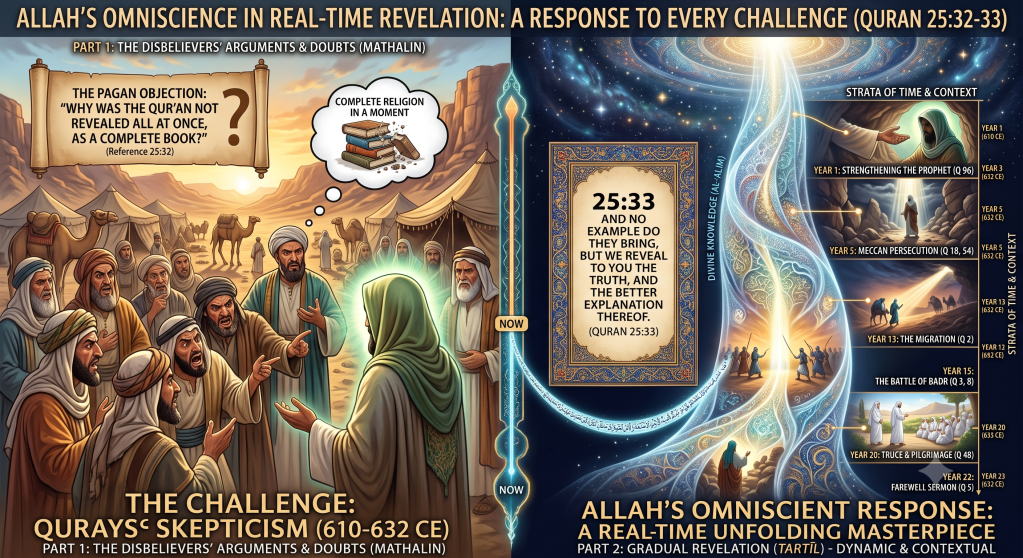
Presented by Gemini for Zia H Shah MD
Audio teaser: How the Quran outsmarted its critics
Abstract
This commentary offers a comprehensive historical, philosophical, and theological examination of Quran 25:32–33, contextualized through the opening movement of Surah Al-Furqan (25:1–6) and supported by the metaphysical case study of Quran 17:85. Verse 25:33 articulates an unprecedented epistemological claim: that divine revelation enters the dynamic arena of human history to engage real-time intellectual, polemical, and theological challenges, invariably responding with objective truth (al-ḥaqq) and superior conceptual exposition (aḥsana tafsīran). Set against the socio-historical backdrop of seventh-century pre-Islamic Arabia—an environment characterized by functional illiteracy, oral literary traditions, and the total absence of formal libraries, philosophical institutions, or written Arabic translations of biblical or classical corpora—the Quranic mode of real-time response presents a profound challenge to naturalistic theories of human authorship. By examining the structural opposition between the skeptics’ accusations in 25:4–5 and the divine counter-framework in 25:32–33, this study demonstrates how gradual revelation (tanzīl) serves as a deliberate pedagogical and epistemological mechanism. Furthermore, this commentary analyzes Quran 17:85—the query regarding the Spirit (al-Rūḥ)—as a primary empirical illustration of this real-time dialectical mastery. The analysis demonstrates how the Quran gracefully demarcates the boundaries of human cognition regarding consciousness, offering a metaphysical framework that has resisted reductionist refutation across fourteen centuries.
The Socio-Historical and Epistemological Landscape of Seventh-Century Arabia
To evaluate the claims inherent in Quran 25:32–33, the socio-historical, linguistic, and literary landscape of early seventh-century Arabia must be rigorously established. The Hijaz during the late antique period was an environment shaped primarily by oral communication, tribal jurisprudence, and poetic panegyrics. Functional literacy was restricted to a minuscule fraction of the population, limited chiefly to basic mercantile ledger keeping and sporadic epigraphic inscriptions. Crucially, the region lacked formal academic institutions, philosophical academies, monastic scriptoria, or physical libraries.
A central question in modern historical-critical scholarship has concerned the availability of written religious scriptures in the Arabic language prior to or during the prophetic mission. Rigorous historical and philological research, notably synthesized by Sidney H. Griffith, demonstrates that there is no extant textual or historical evidence indicating the existence of a written Arabic translation of the Bible—either the Hebrew Tanakh or the Greek New Testament—in pre-Islamic Arabia. While Jewish and Christian communities resided in regions such as Najran, Yathrib, and the northern borders of the Levant, their sacred texts circulated in non-Arabic liturgical tongues, including Syriac, Aramaic, Ethiopic (Ge’ez), and Hebrew.
Far from being the product of a pre-existing written translation movement, the publication and oral recitation of the Arabic Quran was itself the primary historical catalyst that spurred subsequent Christian and Jewish communities in the Middle East to translate their scriptures into written Arabic during the eighth and ninth centuries under the Umayyad and Abbasid caliphates. Prior to the advent of the Quran, biblical narratives and theological ideas circulated within the Arabian Peninsula exclusively through oral modalities, folk memory, and inter-communal dialogue.
| Intellectual & Cultural Dimension | Seventh-Century Pre-Islamic Arabia | Epistemological Demands of Real-Time Polemical Response |
|---|---|---|
| Primary Media Mode | Oral poetry, genealogical transmission, spoken rhetoric. | Immediate, precise, and permanent text-level conceptual responses. |
| Textual Infrastructure | Complete absence of public or private libraries; no formal scriptoria. | Universal access to historical, theological, and philosophical repositories. |
| Scriptural Availability | Zero written Arabic translations of biblical or classical texts. | In-depth textual cross-examination of prior monotheistic traditions. |
| Literacy & Education | Highly restricted functional literacy; no centers of higher learning. | Real-time synthesis of complex metaphysical, legal, and logical queries. |
| Pedagogical Dynamic | Retrospective tradition and poetic improvisation within fixed motifs. | Prospective, unyielding claim to absolute real-time truth (al-ḥaqq). |
In this resource-constrained socio-intellectual environment, a human author attempting to construct an ongoing dialectical discourse against diverse, hostile interlocutors—ranging from Meccan pagan traditionalists to learned Jewish rabbis and Christian monophysites—would face insurmountable epistemological barriers. A human claimant lacking written reference texts, libraries, or systematic training would inevitably succumb to internal contradictions, factual inaccuracies, or logical evasions when subjected to twenty-three years of unscripted, highly hostile questioning. The Quranic assertion in 25:33 that every incoming objection (mathal) is immediately intercepted and answered with perfect exposition (aḥsana tafsīran) directly challenges these historical constraints.
The Structural and Thematic Unity of Surah Al-Furqan (25:1–6 and 25:32–33)
Surah Al-Furqan opens with a majestic theological declaration that establishes the overarching framework for the entirety of the chapter:
“Blessed is He who sent down the Criterion [Al-Furqan] upon His servant that he may be to the worlds a warner—He to whom belongs the dominion of the heavens and the earth and who has not taken a son and has not had a partner in dominion and has created each thing and determined it with [precise] determination.” (Quran 25:1–2)
The term Al-Furqan derives from the Arabic root f-r-q, denoting the physical or conceptual separation of distinct entities. In its Quranic application, Al-Furqan signifies the ultimate epistemic standard—the Criterion that decisively demarcates truth (al-ḥaqq) from falsehood (al-bāṭil), guidance from error, and divine reality from human illusion. Verse 25:6 explicitly grounds the ontological origin of this Criterion in divine omniscience: “Say: It has been sent down by Him who knows the secret within the heavens and the earth.”.
The thematic coherence of the Surah becomes fully visible when examining the structural relationship between the early accusations recorded in 25:4–5 and the structural defense provided in 25:32–33. In verses 25:4–5, the disbelievers launch a two-fold critique aimed at undermining the divine provenance of the text:
First, they raise the charge of forgery and human collaboration, asserting that the recitation is merely an invention supported by undisclosed external informants. Here, critics attempt a naturalistic explanation, speculating that local scriptural experts or unlettered foreigners were secretly feeding historical narratives to the Prophet. Second, they advance the charge of antiquated borrowing, labeling the revelations as “fables of the ancients” (asāṭīr al-awwalīn) that have been transcribed and read back to him in continuous cycles. This accusation assumes a static, pre-arranged human composition process wherein transcribed folklore is memorized and mechanically recited to simulate prophecy.
Verses 25:32–33 represent the direct historical and pedagogical reversal of these skeptical premises. In 25:32, the adversaries shift their strategy from accusing the Prophet of copying written scripts to questioning the very delivery mechanism of the revelation, demanding why the text was not sent down as a single, fully bound volume (jumlatan wāḥidatan). The opponents argued that if the scripture were genuinely divine, it ought to have descended as a complete, codified manuscript, analogous to their stereotypical perception of the Tablets of Moses. They assumed that a gradual, piecemeal revelation (tanzīl) indicated improvised composition designed to adapt to shifting personal or political fortunes.
The divine response in 25:32–33 completely subverts this critique by offering two profound justifications for piecemeal revelation. The first is psychological and pastoral: li-nuthabbita bihi fu’ādaka (“that We may strengthen your heart therewith”). The psychological sustenance of the Prophet required an ongoing, living connection with the divine realm throughout twenty-three years of severe persecution, social ostracization, military conflict, and personal loss. The second justification is structural and hermeneutical: wa-rattalnāhu tartīlā (“and We have rehearsed/arranged it in gradual, measured rehearsal”). As classical commentators such as Al-Zamakhshari and Fakhr al-Din al-Razi note, and as modern scholars such as Mohammad Asad emphasize, tartīl denotes not merely measured phonetic recitation, but the systemic, harmonious synthesis of the text’s constituent parts. The piecemeal descent allowed the Quran to establish an intricate network of cross-referencing, inner consistency, and structural perfection despite being revealed across disparate historical events.
Thus, verse 25:33 forms the climax of this structural defense by declaring that no argument or parable is brought forward by critics except that divine revelation responds with absolute truth and superior exposition. By operating dynamically within historical time, the Quran demonstrates that it is not a static, outdated book copied from ancient folklore, but a living divine discourse controlled by an Omniscient Mind that actively monitors, anticipates, and neutralizes every intellectual challenge in real time.
Exegetical, Philosophical, and Philological Analysis of Quran 25:32–33
A rigorous philological analysis of the Arabic text of Quran 25:33 reveals the deep epistemological mechanics of Quranic dialectics:
Quran 25:33: وَلَا يَأْتُونَكَ بِمَثَلٍ إِلَّا جِئْنَاكَ بِالْحَقِّ وَأَحْسَنَ تَفْسِيرًا
Transliteration: Wa-laˉ ya’tuˉnaka bi-mathalin illaˉ ji’naˉka bi-l-ḥaqqi wa-aḥsana tafsıˉran.
Philological Analysis of Key Terms
While the word mathal is often translated literally as “parable,” “example,” or “similitude,” in the context of polemical engagement it signifies a strange query, an evasive argument, a parabolic objection, or a deceptive half-truth devised by opponents to create doubt. It encapsulates any intellectual trap, reductio ad absurdum, or logical dilemma brought forth by critics to find fault with the prophetic message.
The term al-ḥaqq represents absolute, immutable, and objective truth. In the Quranic worldview, al-ḥaqq is both an essential attribute of the Divine Being and the ontological baseline of reality. When an incoming mathal (false objection) collides with al-ḥaqq, the falsity is dismantled not through rhetorical sophistry, but through the exposition of underlying reality.
The phrase aḥsana tafsīran utilizes the elative form aḥsan to denote “the absolute best,” “most beautiful,” or “most superior.” Tafsīr derives from the root f-s-r, meaning to uncover, expose, clarify, or render intelligible that which was obscured. Thus, aḥsana tafsīran signifies ultimate conceptual exposition, superior hermeneutical resolution, and self-explanatory clarity.
| Exegetical / Philosophical Layer | Arabic Term | Structural & Epistemological Function in Real-Time Dialectics |
|---|---|---|
| The Adversarial Challenge | Lā ya’tūnaka bi-mathalin | Encompasses every possible dialectical critique, logical objection, or polemical query raised by critics. |
| The Divine Interception | Illā ji’nāka | Indicates immediate, real-time divine intervention without human lag, debate, or trial-and-error. |
| The Ontological Reality | Bi-l-Haqq | Replaces speculative premises and deceptive half-truths with verifiable, absolute objective reality. |
| The Hermeneutical Resolution | Wa-Aḥsana Tafsīran | Provides superior explanatory power, logical clarity, and ultimate conceptual resolution (tafsīr). |
In his classical commentary Mafātīḥ al-Ghayb, Fakhr al-Din al-Razi observes that verse 25:33 lays down an unprecedented rule of engagement between the Creator and creation. Al-Razi explains that if the Quran had been revealed in a single, complete manuscript, adversaries could have studied its contents over time to formulate specialized, highly technical objections tailored to confuse the early Muslim community. By revealing the text piecemeal in direct response to evolving historical conditions, Allah effectively invited the disbelievers to bring forth their most sophisticated arguments, only to immediately dismantle them upon arrival.
Abul A’la Maududi notes in his commentary that the Quran was not intended to be an abstract, static academic treatise written for isolated library study. Rather, it was revealed as the operational manual for an active ideological and spiritual movement designed to overturn established systems of ignorance (Jāhiliyyah). A dynamic movement requires real-time tactical guidance, ongoing answers to hostile propaganda, and living solutions to complex sociopolitical and philosophical challenges as they arise in the field.
From an epistemological standpoint, the claim of aḥsana tafsīran implies complete cognitive dominance over all potential domains of discourse. To guarantee the “best explanation” for any incoming question—whether concerning historical ancient nations, legal ethics, cosmological structure, or metaphysical ontology—requires nothing short of absolute omniscience. A finite human mind operating in seventh-century Arabia would inevitably encounter queries that exposed the limits of its knowledge. The Quran’s standing invitation for adversaries to present any query, combined with its historical success in answering them, constitutes an empirical demonstration of its transcendent source.
Metaphysical Case Study: The Soul, Consciousness, and the Verification of Real-Time Omniscience in Quran 17:85
To evaluate how Quran 25:32–33 functions in practice, one must examine a specific historical challenge wherein adversaries presented a technical, highly complex question designed to expose prophetic vulnerability. Such a case study is preserved in Surah Al-Isra (17:85), where Jewish rabbis of Medina, acting in consultation with Meccan interlocutors, posed a deep metaphysical inquiry regarding the nature of the Spirit (Al-Rūḥ):
Quran 17:85: وَيَسْأَلُونَكَ عَنِ الرُّوحِ ۖ قُلِ الرُّوحُ مِنْ أَمْرِ رَبِّي وَمَا أُوتِيتُم مِّنَ الْعِلْمِ إِلَّا قَلِيلًا
Transliteration: Wa-yas’aluˉnaka ’ani l-ruˉḥi quli l-ruˉḥu min amri rabbıˉ wa-maˉ uˉtıˉtum mina l-’ilmi illaˉ qalıˉlaˉ.
Translation: “And they ask you concerning the Spirit [Al-Ruˉḥ]. Say: The Spirit is from the command of my Lord, and of knowledge, you mankind have been given but little.” [cite: 14, 15, 16, 17]
According to classical historical traditions (Asbāb al-Nuzūl) recorded by Ibn Jarir al-Tabari, Ibn Kathir, and Al-Qurtubi, the Meccan polytheists dispatched delegation members to consult the Jewish scholars of Medina, recognizing their mastery over ancient scriptural lore and metaphysical traditions. The scholars advised them to inquire about three specific matters: the story of the young men who disappeared in ancient times (the Sleepers of the Cave), the mighty traveler who traversed the east and west (Dhul-Qarnayn), and the fundamental nature of the Spirit (Al-Rūḥ). The query regarding the Spirit was explicitly selected because it represented the ultimate boundary of human philosophical and theological speculation. Ancient Greek philosophy, Jewish Kabbalistic traditions, and early Christian pneumatology had all wrestled inconclusively with the definition, substance, and origin of the animating life force and human consciousness.
The Quranic response in 17:85 provides an exemplary demonstration of aḥsana tafsīran by restructuring the very epistemological framework through which the soul is understood. Rather than succumbing to false categorizations or delivering a speculative physicalist explanation that would be superseded by later scientific discoveries, the Quran articulates a profound metaphysical boundary.
In classical Islamic philosophical theology (Kalām and Falsafah), particularly as elaborated by Fakhr al-Din al-Razi, Ibn Sina (Avicenna), and Abu Hamid al-Ghazali, reality is divided into two primary ontological realms. The first is ‘Ālam al-Khalq (the Realm of Creation), which encompasses the physical, material world governed by spatial extension, temporal sequence, composition, decay, and empirical cause-and-effect mechanisms. The second is ‘Ālam al-Amr (the Realm of Command), which designates the non-material, spiritual realm originating directly from the divine word (Kun / “Be”), characterized by immediacy, simplicity, immateriality, and freedom from spatio-temporal decay.
By declaring al-rūḥu min amri rabbī, the Quran establishes that the Spirit or Consciousness is an immaterial substance (jawhar ma’nawī) belonging to ‘Ālam al-Amr rather than ‘Ālam al-Khalq. It is not a physical compound composed of elementary particles that can be dissected through empirical reductionism; rather, it is a non-corporeal, created entity animated directly by divine decree. Furthermore, the verse concludes with a humbling epistemological statement: wa-mā ūtītum mina l-‘ilmi illā qalīlā (“and you have been given of knowledge but a little”). This clause asserts that the human cognitive apparatus, bound as it is by empirical sense data and temporal categories, possesses an inherently limited capacity to comprehend non-material substances.
| Philosophical Epoch | Dominant Scientific / Philosophical Paradigm | Quranic Stance (Quran 17:85) | Status of the Hard Problem |
|---|---|---|---|
| Classical Antiquity | Aristotelian Hylomorphism; Galenic Humoral Theory. | Al-Rūḥ is an immaterial divine command (Min Amri Rabbī). | Unresolved by materialist/hylomorphic frameworks. |
| Enlightenment Era | Cartesian Dualism vs. Hobbesian Mechanical Materialism. | Affirms non-material essence while rejecting speculative dualist mechanics. | Cartesian interaction problem remains unsolved. |
| 20th Century | Logical Positivism, Behaviorism, Physical Identity Theory. | Rejects total material reductionism; highlights human cognitive limits. | Identity theory fails to explain subjective experience (qualia). |
| 21st Century | Neuroscience, Computational Functionalism, Quantum Consciousness. | Immaterial origin remains secure; physical correlates do not equal cause. | Chalmers’ “Hard Problem of Consciousness” remains intact. |
In contemporary philosophy of mind, David Chalmers famously formulated the “Hard Problem of Consciousness,” distinguishing between functional neural processing (mapping sensory inputs and brain chemistry) and the problem of subjective awareness (explaining how physical electro-chemical activity gives rise to qualitative inner experience, or qualia). Despite centuries of rigorous scientific progress, neurophysics and materialist philosophy have failed to bridge the explanatory gap between physical matter and subjective awareness.
The Quranic resolution in 17:85 has stood unrefuted across fourteen centuries. By designating the Spirit as an immaterial entity originating from the divine command (min amri rabbī) while explicitly noting the strict limitations of human knowledge regarding its ultimate essence (mā ūtītum mina l-‘ilmi illā qalīlā), the Quran provided an answer that was historically accessible to seventh-century listeners, philosophically profound to medieval theologians, and scientifically impregnable in the modern era. This capability to navigate complex metaphysical terrain in real time provides concrete empirical support for the general challenge set forth in 25:33.
Thematic Epilogue: Omniscience in Real Time and the Criterion of Divine Origin
The structural, historical, and philosophical convergence between Quran 25:1–6, Quran 25:32–33, and Quran 17:85 articulates a unified theological argument regarding the nature of divine revelation. Quran 25:32–33 does not merely offer a retrospective defense of piecemeal revelation; it lays down an active, prospective challenge to the entire arena of human history.
The triadic epistemic architecture connecting these passages illuminates the Quranic claim to divine authorship. In the opening movement of Surah Al-Furqan (25:1–6), revelation is established as Al-Furqan—the ultimate Criterion grounded in the omniscience of Him who knows every secret in the heavens and the earth. In 25:32–33, this theoretical framework is translated into a living, historical challenge: the Quran promises that no incoming objection (mathal) can be raised by human critics without revelation providing its absolute truth (al-ḥaqq) and superior conceptual exposition (aḥsana tafsīran). Finally, Quran 17:85 serves as the historical and philosophical verification of this challenge, offering a timeless resolution to the mystery of consciousness (Al-Rūḥ) that bypasses the pitfalls of physical reductionism.
In the socio-historical reality of seventh-century Arabia—a world lacking libraries, written Arabic translations of prior scriptures, or formal philosophical institutions—the realization of such real-time dialectical mastery cannot be reconciled with naturalistic models of human authorship. Had the author of the Quran been a human being improvising answers under the intense pressure of hostile, continuous cross-examination by diverse critics, the text would inevitably have shown signs of intellectual fatigue, factual error, or internal self-contradiction over its twenty-three-year revelation period. Instead, as emphasized by the Quranic concept of tartīl in 25:32, the piecemeal descent resulted in a perfectly integrated, self-explanatory, and internally consistent text.
Ultimately, Surah Al-Furqan establishes that the Quran is not merely a static book recorded in history, but an active divine discourse that engaged history as it unfolded. By intercepting every polemical and philosophical challenge with objective truth and superior exposition, the Quran validated its claim to be the ultimate Criterion (Al-Furqan) sent down by the All-Knowing Creator. The enduring stability of its answers across fourteen centuries serves as a lasting testament to an Author whose knowledge encompasses all reality, transcending the temporal limitations of human intellect.





Leave a Reply