
Presented by Gemini for Zia H Shah MD
Audio teaser: The physics of Earth’s guarded canopy
Abstract
The Quranic conceptualization of the sky as a “protected ceiling” (saqfan maḥfūẓan) in Surah Al-Anbiya (21:32) serves as an intricate nexus where divine revelation, theoretical cosmology, planetary physics, and philosophical teleology intersect. This report provides an exhaustive, multi-layered exegesis of verse 21:32 alongside related cosmic passages, including 41:11-12, 37:6-7, and 15:16-18, and further embellishes the analysis through the structural lenses of 67:3-4, 79:27-29, and 50:6.
Through an interdisciplinary investigation, this study demonstrates how classical exegesis (tafsīr)—spanning the traditionist transmission of Ibn Kathir and Al-Tabari, the rationalist discourse of Fakhr al-Din al-Razi, the rhetorical depth of Al-Zamakhshari, and the jurisprudential framework of Al-Qurtubi—harmonizes with modern astrophysics and geophysics.
Scientifically, the “protected ceiling” corresponds to Earth’s multi-tiered defensive system, encompassing the stratified atmosphere, the stratospheric ozone shield (O3), the magnetosphere, and the Van Allen radiation belts, which collectively deflect lethal cosmic radiation, absorb high-energy ultraviolet photons, and ablate high-velocity meteoroids.
Philosophically, these physical mechanisms are analyzed through the framework of cosmic fine-tuning, the Anthropic Principle, and the immaterial nature of physical laws operating as universal information systems.
Theologically, the celestial canopy is framed as an active manifestation of divine Lordship (Rubūbiyyah) and grace (Raḥmah), contrasting cosmic obedience (ṭaw‘an) with the existential pathology of human heedlessness (i‘rāḍ).
Primary Textual Analysis and Translation Synthesis
To understand the scope of the Quranic celestial paradigm, the core verses must be evaluated across multiple translation methodologies. The following section presents Surah Al-Anbiya (21:32), Surah Fussilat (41:11-12), Surah As-Saffat (37:6-7), and Surah Al-Hijr (15:16-18) using six English translations: Abdullah Yusuf Ali, Marmaduke Pickthall, Saheeh International, M.A.S. Abdel Haleem, Muhammad Asad, and Mustafa Khattab.
Quran 21:32
Arabic Text: وَجَعَلْنَا السَّمَاءَ سَقْفًا مَّحْفُوظًا ۖ وَهُمْ عَنْ آيَاتِهَا مُعْرِضُونَ
| Translator | Rendered Text |
|---|---|
| Abdullah Yusuf Ali | “And We have made the heavens as a canopy well-guarded: Yet do they turn away from the Signs which these things (point to)!” |
| Marmaduke Pickthall | “And We have made the sky a roof withheld (from them). Yet they turn away from its portents.” |
| Saheeh International | “And We made the sky a protected ceiling, but they, from its signs, are turning away.” |
| M.A.S. Abdel Haleem | “And We made the sky a protected ceiling, yet from its wonders they turn away.” |
| Muhammad Asad | “And [that] We have set up the sky as a canopy well-secured? And yet, they stubbornly turn away from [all] the signs of this [creation].” |
| Mustafa Khattab | “And We have made the sky a well-protected canopy, still they turn away from its signs.” |
Quran 41:11-12
Arabic Text: ثُمَّ اسْتَوَىٰ إِلَى السَّمَاءِ وَهِيَ دُخَانٌ فَقَالَ لَهَا وَلِلْأَرْضِ ائْتِيَا طَوْعًا أَوْ كَرْهًا قَالَتَا أَتَيْنَا طَائِعِينَ • فَقَضَاهُنَّ سَبْعَ سَمَاوَاتٍ فِي يَوْمَيْنِ وَأَوْحَىٰ فِي كُلِّ سَمَاءٍ أَمْرَهَا ۚ وَزَيَّنَّا السَّمَاءَ الدُّنْيَا بِمَصَابِيحَ وَحِفْظًا ۚ ذَٰلِكَ تَقْدِيرُ الْعَزِيزِ الْعَلِيمِ
| Translator | Rendered Text (Verse 11 & Verse 12) |
|---|---|
| Abdullah Yusuf Ali | (11) “Moreover He Comprehended in His design the sky and it had been (as) smoke: He said to it and to the earth: ‘Come ye together willingly or unwillingly.’ They said: ‘We do come (together) in willing obedience.’” (12) “So He completed them as seven firmaments in two Days, and He assigned to each heaven its duty and command. And We adorned the lower heaven with lights, and (provided it) with guard. Such is the Decree of (Him) the Exalted in Might, Full of Knowledge.” |
| Marmaduke Pickthall | (11) “Then turned He to the heaven when it was smoke, and said unto it and unto the earth: Come both of you, willingly or loth. They said: We come, obedient.” (12) “Then He ordained them seven heavens in two Days and inspired in each heaven its mandate; and We decked the nether heaven with lamps, and rendered it inviolable. That is the measuring of the Mighty, the Knower.” |
| Saheeh International | (11) “Then He directed Himself to the heaven while it was smoke and said to it and to the earth, ‘Come [into being], willingly or unwillingly.’ They said, ‘We have come willingly.’” (12) “And He completed them as seven heavens within two days and inspired in each heaven its command. And We adorned the nearest heaven with lamps and as protection. That is the determination of the Exalted in Might, the Knowing.” |
| M.A.S. Abdel Haleem | (11) “Then He turned to the sky, which was then smoke, and said to it and to the earth, ‘Come into being, willingly or unwillingly.’ They said, ‘We come willingly.’” (12) “And He completed them as seven heavens in two Days and assigned to each heaven its duty; We adorned the nearest heaven with lamps and guarded it well. Such is the design of the Almighty, the All-Knowing.” |
| Muhammad Asad | (11) “And He [it is who] applied His design to the skies, which were [yet but] smoke; and He said to them and to the earth, ‘Come [into being], both of you, willingly or unwillingly!’ – to which both responded, ‘We do come in obedience.’” (12) “And He decreed that they be seven heavens in two eons, and imparted unto each heaven its function. And We adorned the skies nearest to the earth with lights, and made them secure: such is the ordaining of the Almighty, the All-Knowing.” |
| Mustafa Khattab | (11) “Then He turned towards the heaven when it was ‘still like’ smoke, saying to it and to the earth, ‘Submit, willingly or unwillingly.’ They both responded, ‘We submit willingly.’” (12) “So He formed them into seven heavens in two days, assigning to each its mandate. And We adorned the lowest heaven with lamps, and guarded it well. That is the design of the Almighty, the All-Knowing.” |
Quran 37:6-7
Arabic Text: إِنَّا زَيَّنَّا السَّمَاءَ الدُّنْيَا بِزِينَةٍ الْكَوَاكِبِ • وَحِفْظًا مِّن كُلِّ شَيْطَانٍ مَّارِدٍ
| Translator | Rendered Text (Verse 6 & Verse 7) |
|---|---|
| Abdullah Yusuf Ali | (6) “We have indeed decked the lower heaven with beauty (in) the stars, —” (7) “And (for guard) against all obstinate rebellious spirits.” |
| Marmaduke Pickthall | (6) “Lo! We have adorned the lowest heaven with an ornament, the planets;” (7) “And have guarded it from every rebellious devil.” |
| Saheeh International | (6) “Indeed, We have adorned the nearest heaven with an adornment of stars” (7) “And as protection against every rebellious devil,” |
| M.A.S. Abdel Haleem | (6) “We have adorned the lowest heaven with the grandeur of the stars,” (7) “and guarded it against every rebellious devil:” |
| Muhammad Asad | (6) “Behold, We have adorned the skies nearest to the earth with the beauty of stars,” (7) “and have made them secure against every rebellious satanic force:” |
| Mustafa Khattab | (6) “We have indeed adorned the lowest heaven with the beauty of the stars,” (7) “and safeguarded it against every rebellious devil.” |
Quran 15:16-18
Arabic Text: وَلَقَدْ جَعَلْنَا فِي السَّمَاءِ بُرُوجًا وَزَيَّنَّاهَا لِلنَّاظِرِينَ • وَحَفِظْنَاهَا مِن كُلِّ شَيْطَانٍ رَّجِيمٍ • إِلَّا مَنِ اسْتَرَقَ السَّمْعَ فَأَتْبَعَهُ شِهَابٌ مُّبِينٌ
| Translator | Rendered Text (Verses 16–18) |
|---|---|
| Abdullah Yusuf Ali | (16) “It is We Who have set out the zodiacal signs in the heavens, and made them fair-seeming to (all) beholders;” (17) “And We have guarded them from every cursed devil:” (18) “But any that gains a hearing by stealth, is pursued by a fiery comet, bright (manifest).” |
| Marmaduke Pickthall | (16) “And verily We have set in the heaven mansions of the stars and We have beautified it for the beholders.” (17) “And We have guarded it from every outcast devil,” (18) “Save him who stealeth the hearing, and them doth a clear flame pursue.” |
| Saheeh International | (16) “And We have placed within the heaven constellations and have adorned it for the observers.” (17) “And We have protected it from every accursed devil —” (18) “Except one who steals a hearing, so he is pursued by a clear burning flame.” |
| M.A.S. Abdel Haleem | (16) “We have set constellations in the sky and made them beautiful for all to see,” (17) “and guarded them from every rejected devil:” (18) “any that eavesdrops is pursued by a fiery comet.” |
| Muhammad Asad | (16) “And, indeed, We have set up in the heavens great constellations, and have beautified them for all to see;” (17) “and We have guarded them against every accursed satanic force,” (18) “so that anyone who tries to eavesdrop is pursued by a clear flame.” |
| Mustafa Khattab | (16) “We have indeed placed constellations in the sky and adorned them for all to see.” (17) “And We protected them from every rejected devil.” (18) “Except any who eavesdrops, only to be pursued by a clearly visible meteor.” |
Lexical and Morphological Foundations
To establish hermeneutical precision, key Arabic roots used across these passages require rigorous linguistic dissection:
- [S-Q-F] (سَقْف – Saqf): Denotes an overhead protective covering, roof, or elevated canopy that shelters the space beneath it from external elements.
- [Ḥ-F-Ẓ] (مَحْفُوظ – Maḥfūẓ): A passive participle signifying an entity that is actively guarded, preserved from degradation, shielded from intrusion, and held intact by an external power.
- [D-KH-N] (دُخَان – Dukhān): Refers to a gaseous, opaque, vaporous, or smoky physical state, corresponding cosmologically to primordial gaseous plasma or interstellar dust clouds.
- [S-M-W] (سَمَاء – Samā’): Rooted in height and elevation; encompasses the visible sky, the atmospheric column, the magnetospheric boundary, and the vast cosmic realm beyond.
- [B-R-J] (بُرُوج – Burūj): Plural of burj, meaning massive structural towers, prominent celestial formations, or stellar constellations organized in stable spatial domains.
Core Verse Exegesis: Scientific, Philosophical, and Theological Commentary
Exegesis of Quran 21:32
Classical Tafsīr and Classical Hermeneutics
In traditional Sunni exegesis, saqfan maḥfūẓan (“a protected ceiling”) received both physical and metaphysical interpretations. Al-Tabari records reports from early authorities such as Qatadah, who defined the protected sky as mawj makfūf (“a contained wave”), describing an overhead fluid body suspended and constrained by divine command.
Ibn Kathir cross-references 21:32 with Surah Al-Hajj (22:65)—which states that God holds the sky from falling upon the Earth—and Surah Ar-Ra’d (13:2), which describes the celestial realm elevated without visible pillars. Ibn Kathir emphasizes a dual protection: first, physical preservation against collapse, structural disintegration, or atmospheric loss; and second, spiritual/metaphysical protection against demonic intrusion (shayāṭīn), keeping the higher assemblies (al-mala’ al-a‘lā) secure.
Fakhr al-Din al-Razi, adopting a rationalist approach in Mafātīḥ al-Ghayb, argues that the protection of the sky must be understood through God’s maintenance of universal equilibrium. Razi asserts that if the sky were subject to random physical breakdown without a sustaining law, planetary life would be destroyed.
Al-Zamakhshari in Al-Kashshāf highlights the rhetorical power of pairing saqfan maḥfūẓan with wa-hum ‘an āyātihā mu‘riḍūn (“yet from its signs they turn away”), pointing out the irony of human beings living under a protective ceiling while remaining oblivious to its engineering.
Scientific Commentary: Atmospheric and Magnetospheric Geophysics
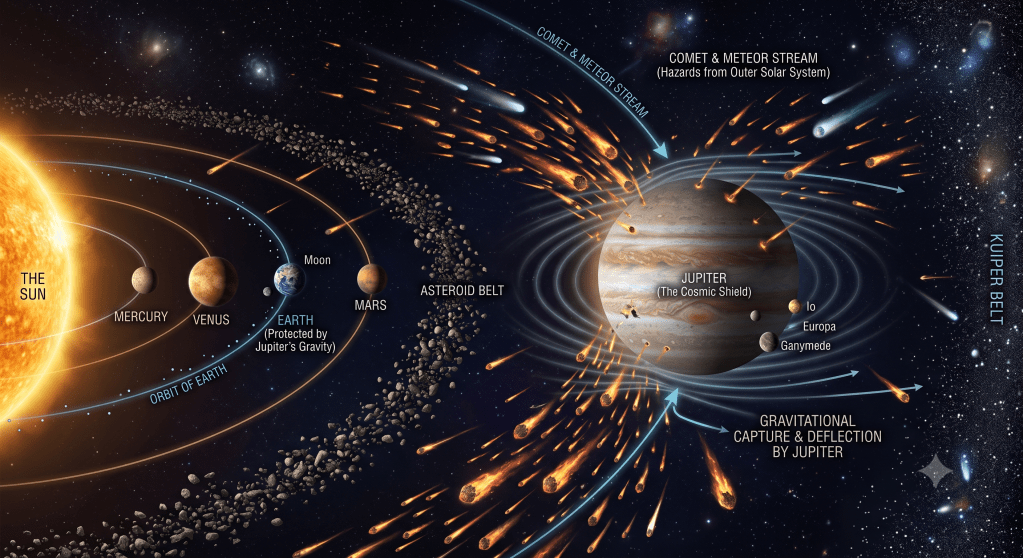
When analyzed through modern astrophysics, geophysics, and atmospheric sciences, the concept of a “protected ceiling” describes Earth’s protective shielding mechanisms. Earth is exposed to energetic phenomena from space, including solar wind, galactic cosmic rays, ultraviolet radiation, and meteoroid bombardments. The planet maintains habitability through an integrated, multi-tiered defensive architecture that filters these hazards.
At the outermost boundary, the magnetosphere and the Van Allen radiation belts form the first line of defense. Earth’s inner core dynamo, generated by convective currents of molten iron and nickel, creates a dipolar magnetic field that extends tens of thousands of kilometers into space. When solar plasma hits the magnetopause, the Lorentz force (F=q(E+v×B)) deflects charged particles around the planet. Trapped high-energy particles are funneled into the inner and outer Van Allen belts. Without this magnetic shield, solar wind would strip away Earth’s upper atmosphere over geological timescales—a stripping process observed on Mars—eroding the water layer and exposing the surface to sterilizing ionizing radiation.
Below the magnetosphere, the stratified atmosphere operates as a physical fluid barrier bound by gravity. Atmospheric pressure decays exponentially with altitude according to the hydrostatic equation:
P(z)=P0exp(−∫0zRT(z′)Mg(z′)dz′)
This pressure gradient maintains an atmospheric surface pressure of approximately 101.3 kPa, keeping water in a liquid state—a prerequisite for cellular life.
Within the stratospheric layer (15 to 35 km altitude), the ozone layer shields the surface from high-energy solar ultraviolet radiation. Through the photochemical Chapman cycle, stratospheric ozone dynamically absorbs UV photons:
O2+hν(λ<242 nm)→O+O
O+O2+M→O3+M
O3+hν(200 nm<λ<310 nm)→O2+O(1D)
This photochemical mechanism absorbs 97−99% of solar UV radiation (specifically UV-C and most UV-B). Without this protective ozone shield, nucleic acids (DNA/RNA) and essential cellular proteins would undergo destructive photolysis, making terrestrial life impossible.
Finally, the mesosphere (50−85 km altitude) acts as a physical impact shield against extraterrestrial debris. Earth is bombarded by tons of cosmic dust and meteoroids daily, entering the upper atmosphere at velocities between 11 km/s and 72 km/s. As these projectiles strike the denser gases of the mesosphere, ram pressure compresses the gas ahead of the object, raising its temperature to thousands of Kelvin. This intense thermal friction ablates and vaporizes meteoroids, incinerating potential impactors before they can strike the surface.
Philosophical Commentary: Teleology and the Anthropic Principle
Philosophically, verse 21:32 addresses teleology, natural law, and planetary habitability. The existence of a defensive planetary shell aligns with the Anthropic Principle, which points out that the fundamental constants and initial conditions of the universe fall within a narrow biophilic range.
If the Earth’s geomagnetic field strength (B0≈31 μT at the equator), the fine-structure constant (α≈1/137), or the gravitational constant (G) differed slightly, planetary defense systems would fail. A weaker magnetic field would allow atmospheric stripping; a denser atmosphere would trigger a runaway greenhouse effect like Venus; a thinner atmosphere would offer no thermal buffer or meteoroid protection.
Philosopher and theologian Wolfhart Pannenberg argued that physical laws should be understood as expressions of divine contingency and persistence. In this framework, the laws governing atmospheric shielding are not self-existent entities; they are immaterial instructions or informational codes governing material behavior. The phrase saqfan maḥfūẓan frames this physical reality as an intentional architecture rather than a random collision of particles.
Theological Commentary: Divine Sovereignty, Grace, and Human Insensibility
Theologically, verse 21:32 connects divine creation (Khalq) with sustained governance (Tadbīr). The protection of the sky demonstrates Rubūbiyyah—God’s role as the active Sustainer who provides the conditions necessary for life. The sky functions as a silent sign (āyah), protecting life every second without requiring human effort or maintenance.
The second half of the verse introduces a tragic psychological contrast: wa-hum ‘an āyātihā mu‘riḍūn (“yet from its signs they turn away”). The term i‘rāḍ denotes deliberate aversion or cognitive detachment. Humans become accustomed to the stability of their environment, mistaking continuous divine preservation for a static, self-sustaining necessity.
Classical exegesis emphasizes that turning away from cosmic signs is an epistemological failing: the observer looks through the protective sky without recognizing the underlying law and intent that makes their existence possible.
Exegesis of Quran 41:11-12
Cosmological Dynamics of Primordial Smoke (Dukhān)
Surah Fussilat (41:11-12) describes the early stage of cosmic structure formation. Verse 11 states that God turned to the heaven while it was dukhān (smoke/vapor). Muhammad Asad notes that dukhān corresponds to the primary gaseous phase of the universe—specifically hot hydrogen and helium plasma mixed with cosmic dust before star formation.
In modern physical cosmology, after the Big Bang and subsequent recombination epoch (z≈1100, approximately 380,000 years after creation), the universe was filled with a warm, nearly uniform gas composed of neutral hydrogen (75%) and helium (25%), alongside cosmic microwave background radiation. This state was dark, dense, and opaque—resembling a vast cosmic cloud or “smoke”. Through gravitational instability (Jeans instability), dense regions within this gaseous cloud collapsed to form the first stars, galaxies, and cosmic structures.
This evolution moved from a primordial plasma phase to a dark recombination epoch, forming a vast gaseous “smoke” cloud. Under gravitational collapse and divine physical decrees (amr), this cloud condensed into galaxies, stellar systems, and structured orbital layers.
Universal Obedience (Ṭaw‘an) as Ontological Compliance
Verse 11 presents a dialogue where God commands the sky and the earth: “Come [into being], willingly or unwillingly” (i’tiyā ṭaw‘an aw karhan), to which both respond: “We come in willing obedience” (ataynā ṭā’i‘īn).
Al-Zamakhshari and Ibn Kathir explain that this dialogue is an allegory (majāz) illustrating the absolute power of divine volition (Irādah). When God orders matter to assume form, physical elements offer no resistance.
Philosophically, this response represents ontological submission (Islām). Matter, gravity, electromagnetism, and nuclear forces follow divine physical laws without deviation. Unlike human free will, which can choose to disobey moral commands, the physical universe operates in perpetual compliance (ṭā’i‘īn) with the mathematical parameters assigned to it.
Structural Framing: Seven Heavens and Celestial Safeguards (Ḥifẓan)
Verse 12 outlines two phases: first, the completion of seven heavens (sab‘a samāwāt) within two evolutionary periods (fī yawmayn); and second, the assignment of specific functions (amrahā) to each heaven, alongside the decoration and guarding of the lowest heaven (wa-zayyannā as-samā’a ad-dunyā bi-maṣābīḥa wa-ḥifẓan).
The term yawmayn (“two days”) refers not to solar days—which did not exist prior to Earth’s rotation—but to distinct cosmic epochs or phases of development. The lowest heaven (as-samā’ ad-dunyā) is adorned with “lamps” (maṣābīḥ, referring to stars and luminous bodies) and provided with ḥifẓan (a protective system). This links the atmospheric defense of 21:32 to a larger cosmic system: the lower celestial domain is structured to preserve life on Earth while maintaining order across stellar systems.
Exegesis of Quran 37:6-7 and 15:16-18
Celestial Architecture and Constellations (Burūj)
Surah As-Saffat (37:6-7) and Surah Al-Hijr (15:16-18) build upon the theme of cosmic protection by combining aesthetic order with structural defenses. Surah 15:16 states that God placed burūj (constellations/galactic structures) in the heavens, making them aesthetically pleasing to observers.
In classical astronomy, burūj referred to the twelve zodiacal constellations. In modern astrophysics, burūj can be understood as large-scale cosmic structures—stellar clusters, galactic arms, and cosmic filaments that structure the distribution of matter across space.
Defense Against Rebellious Forces (Shayṭān Mārid / Rajīm)
Both passages emphasize that these celestial domains are protected against rebellious intrusion:
- 37:7: wa-ḥifẓan min kulli shayṭānin mārid (“and a protection against every rebellious devil”).
- 15:17: wa-ḥafiẓnāhā min kulli shayṭānin rajīm (“and We have guarded them from every cursed devil”).
In traditional Islamic demonology and cosmology, shayāṭīn represent forces of disorder and corruption seeking to breach divine boundaries to steal unseen knowledge (istiraq as-sam‘). The text states that any intruding force is pursued by a “piercing flame” (shihāb thāqib) or a “manifest flame” (shihāb mubīn).
The Dual Physical and Metaphysical Shield
Scholars like Al-Razi and Ibn Kathir note that these verses convey a dual protection:
On a metaphysical level, the celestial order is governed by decrees that spiritual forces cannot corrupt or intercept. On a physical level, this protection manifests through energetic barriers. The phenomenon of meteors (shihāb) burning up in the upper atmosphere provides a physical illustration of this protection. High-velocity impactors that could disrupt the surface environment are incinerated, creating streak-lines across the night sky.
Thus, the celestial architecture balances beauty (zīnaha li-n-nāẓirīn) with defensive function (wa-ḥifiẓnāhā), combining visual harmony with cosmic protection.
Structural Embellishments: Secondary Celestial Passages
To complete this analysis, three complementary Quranic passages—67:3-4, 79:27-29, and 50:6—provide further structural context for the sky’s protective architecture.
Quran 67:3-4 – Flawless Cosmological Symmetry
Arabic Text: الَّذِي خَلَقَ سَبْعَ سَمَاوَاتٍ طِبَاقًا ۖ مَّا تَرَىٰ فِي خَلْقِ الرَّحْمَٰنِ مِن تَفَاوُتٍ ۖ فَارْجِعِ الْبَصَرَ هَلْ تَرَىٰ مِن فُتُورٍ • ثُمَّ ارْجِعِ الْبَصَرَ كَرَّتَيْنِ يَنقَلِبْ إِلَيْكَ الْبَصَرُ خَاسِئًا وَهُوَ حَسِيرٌ
| Translator | Rendered Text (Verse 3 & Verse 4) |
|---|---|
| Abdullah Yusuf Ali | (3) “He Who created the seven heavens one above another: No want of proportion wilt thou see in the Creation of (Allah) Most Gracious. So turn thy vision again: Seest thou any flaw?” (4) “Then turn thy vision again a second time: (thy) vision will come back to thee dull and discomfited, in a state worn out.” |
| Marmaduke Pickthall | (3) “Who hath created seven heavens in harmony. Thou canst see no fault in the Beneficent’s creation. Then look again: Canst thou see any rifts?” (4) “Then look again and yet again, thy sight will return unto thee weakened and made dim.” |
| Saheeh International | (3) “[And] who created seven heavens in layers. You do not see in the creation of the Most Merciful any inconsistency. So return [your] vision [to the sky]; do you see any breaks?” (4) “Then return [your] vision twice again. [Your] vision will return to you humbled while it is fatigued.” |
| M.A.S. Abdel Haleem | (3) “He who created seven heavens one above the other: you will not see any flaw in the creation of the Lord of Mercy. Look again! Do you see any rift?” (4) “Look again and again: your sight will return to you dazzled and exhausted!” |
| Muhammad Asad | (3) “[He] who has created seven heavens in harmony with one another: no fault wilt thou see in the creation of the Most Gracious! And turn thy vision [upon it] once more: canst thou see any flaw?” (4) “Yea, turn thy vision upon it again and yet again: [and every time] thy vision will fall back upon thee, dazzled and defeated.” |
| Mustafa Khattab | (3) “He is the One Who created seven heavens, one above the other. You will never see any imperfection in the creation of the Most Compassionate. So look again: do you see any flaws?” (4) “Then look again and again—your sight will return to you frustrated and exhausted.” |
Analysis
Surah Al-Mulk (67:3-4) calls for an empirical audit of the universe. The phrase sab‘a samāwāt ṭibāqan describes seven layered, harmonized celestial structures. The observer is challenged to find any tafāwut (inconsistency, structural flaw, or lack of equilibrium) or futūr (cracks, strain fractures, or decay).
The passage demands repeated observation (irji‘i l-baṣara karratayn), predicting that human inquiry will return fatigued and humbled (khāsi’an wa-huwa ḥasīr).
In physics, this absence of tafāwut reflects the consistency of physical laws across observable space. Whether analyzing thermodynamic equilibrium, orbital stability, or field propagation, the universe operates without local breakdowns in its fundamental physics. This structural cohesion ensures that the atmosphere remains stable over billions of years.
Quran 79:27-29 – Cosmic Elevation and Diurnal Equilibrium
Arabic Text: أَأَنتُمْ أَشَدُّ خَلْقًا أَمِ السَّمَاءُ ۚ بَنَاهَا • رَفَعَ سَمْكَهَا فَسَوَّاهَا • وَأَغْطَشَ لَيْلَهَا وَأَخْرَجَ ضُحَاهَا
| Translator | Rendered Text (Verses 27–29) |
|---|---|
| Abdullah Yusuf Ali | (27) “What! Are ye the more difficult to create or the heaven (above)? (Allah) hath constructed it:” (28) “On high hath He raised its canopy, and He hath given it order and perfection.” (29) “Its night doth He endow with darkness, and its splendour doth He bring out (with light).” |
| Marmaduke Pickthall | (27) “Are ye the harder to create, or is the heaven that He built?” (28) “He raised the height thereof and ordered it;” (29) “And He made dark the night thereof, and brought forth the morn thereof.” |
| Saheeh International | (27) “Are you a more difficult creation or is the heaven? Allah constructed it.” (28) “He raised its ceiling and proportioned it.” (29) “And He darkened its night and extracted its brightness.” |
| M.A.S. Abdel Haleem | (27) “Which is harder to create: you or the sky? He built it,” (28) “raised its vault high and proportioned it,” (29) “darkened its night and brought forth its daylight,” |
| Muhammad Asad | (27) “Are you more difficult to create than the sky which He has built?” (28) “He has raised its vault high and proportioned it,” (29) “and darkened its night and brought forth its daylight;” |
| Mustafa Khattab | (27) “Which is harder to create: you or the sky? He built it!” (28) “He raised its ceiling and proportioned it,” (29) “darkened its night, and brought forth its daylight.” |
Analysis
Surah An-Nazi’at (79:27-29) frames human ego against cosmic scale: “Are you a more difficult creation or is the sky?” The text highlights three cosmological actions: first, rafa‘a samkahā (raising the sky’s thickness and height); second, fa-sawwāhā (balancing and proportioning its physical properties); and third, aghṭasha laylahā wa-akhraja ḍuḥāhā (structuring the day-night cycle).
The term samk refers to structural thickness or vertical depth. Scientifically, Earth’s atmosphere is not a thin shell; its thickness (100 km to the Karman line, extending thousands of kilometers into the exosphere) provides the depth required to absorb cosmic impacts and solar radiation.
The term taswiyah (proportioning) describes the balance that keeps atmospheric density high enough to sustain respiration without creating crushing surface pressures. This balance produces the diurnal cycle (layl and ḍuḥā), where Rayleigh scattering in the atmosphere scatters sunlight to create bright daylight while shielding the surface from space’s thermal extremes.
Quran 50:6 – Celestial Cohesion and Seamless Geometry
Arabic Text: أَفَلَمْ يَنظُرُوا إِلَى السَّمَاءِ فَوْقَهُمْ كَيْفَ بَنَيْنَاهَا وَزَيَّنَّاهَا وَمَا لَهَا مِن فُرُوجٍ
| Translator | Rendered Text |
|---|---|
| Abdullah Yusuf Ali | “Do they not look at the sky above them?- How We have made it and adorned it, and there are no flaws in it?” |
| Marmaduke Pickthall | “Have they not then observed the sky above them, how We have constructed it and beautified it, and how there are no rifts therein?” |
| Saheeh International | “Have they not looked at the heaven above them – how We structured it and adorned it and how it has no rifts?” |
| M.A.S. Abdel Haleem | “Have they not thought about the sky above them, how We built it and adorned it, with no cracks in it at all?” |
| Muhammad Asad | “Have they not, then, looked up at the sky above them – how We have built it and adorned it, leaving no faults therein?” |
| Mustafa Khattab | “Have they not observed the sky above them—how We have built and adorned it, leaving no cracks in it?” |
Analysis
Surah Qaf (50:6) directs human attention to the overhead sky (afalam yanẓurū ilā as-samā’i fawqahum), emphasizing its construction (banaynāhā), aesthetic adornment (zayyannāhā), and complete structural continuity: wa-mā lahā min furūj (“leaving no rifts, gaps, or structural breaks”).
The term furūj (plural of farj) denotes cracks, gaps, or structural discontinuities. From a physical perspective, the atmosphere operates as a continuous fluid shield. Gravity and thermodynamic pressure maintain a uniform, seamless protective envelope around the globe. If there were physical “rifts” (furūj) or gaps in this atmospheric seal, planetary air pressure would vent into the vacuum of space, destroying the biosphere.
Integrated Interdisciplinary Synthesis
The following table synthesizes the analyzed Quranic verses, linking their linguistic concepts with corresponding scientific mechanisms, philosophical implications, and theological doctrines:
| Verse | Key Arabic Concept | Scientific Counterpart | Philosophical Implication | Theological Doctrine |
|---|---|---|---|---|
| 21:32[cite: 1, 10, 11] | Saqfan Maḥfūẓan (Protected Ceiling) | Magnetosphere, Van Allen Belts, Ozone Shield (O3), Atmospheric Friction | Anthropic Principle; Fine-Tuning of biophilic constants | Rubūbiyyah (Sustaining Lordship); Critique of I‘rāḍ (Human Heedlessness) |
| 41:11-12[cite: 3] | Dukhān (Smoke) / Ṭaw‘an (Obedience) | Primordial hydrogen plasma; Gravitational galaxy formation; Recombination | Physical laws operating as universal information systems | Universal Islām (Ontological compliance of non-conscious matter) |
| 37:6-7 | Ḥifẓan min Shayṭān Mārid (Guard against rebellious forces) | Upper atmospheric ablation of meteoroids; Deflection of charged ions | Order maintained against entropy and external disruption | Metaphysical integrity of divine revelations and cosmic boundaries |
| 15:16-18 | Burūj (Constellations) / Shihāb Thāqib (Piercing flame) | Large-scale galactic structures; Atmospheric meteor disintegration | Coexistence of aesthetic beauty and functional protection | Interconnectedness of visual signs (āyāt) and invisible shields |
| 67:3-4[cite: 1, 2] | Tafāwut / Futūr (Inconsistency / Rifts) | Universal constancy of physical laws; Equilibrium of fundamental forces | Limits of empirical critique when confronting fine-tuned order | Al-Raḥmān (Cosmic Order as an expression of divine grace) |
| 79:27-29 | Rafa‘a Samkahā (Raised its thickness) | Depth of atmospheric column; Rayleigh scattering; Diurnal insulation | Human insignificance relative to cosmic engineering | Divine power (Qudrah) contrasted with human frailty |
| 50:6[cite: 1] | Mā lahā min Furūj (No rifts/gaps) | Continuous fluid pressure containment; Global atmospheric envelope | Continuity and field-theoretical wholeness of physical space | Perfection of divine craftsmanship (Itqān) |
Synthesis of Cosmological Mechanics and Teleology
The convergence of these Quranic passages presents a coherent cosmological framework that moves seamlessly from cosmic origins to human existential responsibility. The primordial material origin of the cosmos developed from an opaque, gaseous state (dukhān), which submitted directly to physical laws (ṭaw‘an). This gaseous phase underwent structural differentiation, wherein space was organized into distinct realms (sab‘a samāwāt), adorned with stellar systems (burūj, maṣābīḥ), and bound by physical laws operating without structural decay (mā lahā min furūj, mā tarā fī khalqi ar-raḥmāni min tafāwut).
At the planetary level, Earth was provided with a multi-layered defensive canopy (saqfan maḥfūẓan) characterized by atmospheric depth (samk), photochemical ozone shielding, geomagnetic deflection, and meteoroid dissipation. This defensive infrastructure preserves the biosphere, transforming the planet into a habitable home for conscious life.
The stability of this canopy serves as a visible sign (āyah) of divine governance. Consequently, human beings are confronted with a moral choice: either recognize these fine-tuned signs through cognitive compliance or fall into heedlessness (i‘rāḍ) by taking continuous divine preservation for granted.
Thematic Epilogue: Cosmic Order, Human Perception, and Divine Signs
The Quranic analysis of the sky moves from physical mechanics to existential reflection. In Quranic discourse, natural phenomena are never merely mechanical processes; they are signs (āyāt) designed to direct human consciousness toward the Creator.
Surah Al-Anbiya (21:32) balances physical description with a critique of human psychology. The verse contrasts the sky’s dynamic protective function—working continuously through magnetospheric deflection, atmospheric friction, and stratospheric absorption—with human insensibility: wa-hum ‘an āyātihā mu‘riḍūn (“yet from its signs they turn away”).
This contrast highlights an epistemological challenge. Humans naturally pay attention to immediate disruptions, threats, and short-term changes, while taking long-term planetary stability for granted. The protective ceiling works so reliably that humanity treats it as a static background requirement rather than a finely tuned system. The atmospheric canopy, the ozone layer, and the geomagnetic field are treated as non-negotiable facts of nature, ignoring the delicate physics required to maintain them.
Modern scientific discovery does not lessen the force of this Quranic observation; it deepens its meaning. As science unpacks the physics of magnetohydrodynamics, atmospheric pressure gradients, and ultraviolet absorption, it reveals the detailed mechanisms behind the “protected ceiling”.
The Quran presents the natural world not as an autonomous machine separate from God, but as the visible expression of divine sustainment (Rubūbiyyah). The physical laws governing atmospheric protection are the functional expressions of divine grace (Raḥmah).
In this framework, the sky is both a physical shelter that keeps humanity alive and an intellectual sign urging human reflection. To look up at the overhead ceiling without recognizing its design is to experience the physical protection of the sky while missing the sign it displays.
The Quranic cosmic passages call human consciousness to look past familiarity, recognize the protective architecture overhead, and acknowledge the sustaining power that holds the canopy intact.


Leave a Reply