
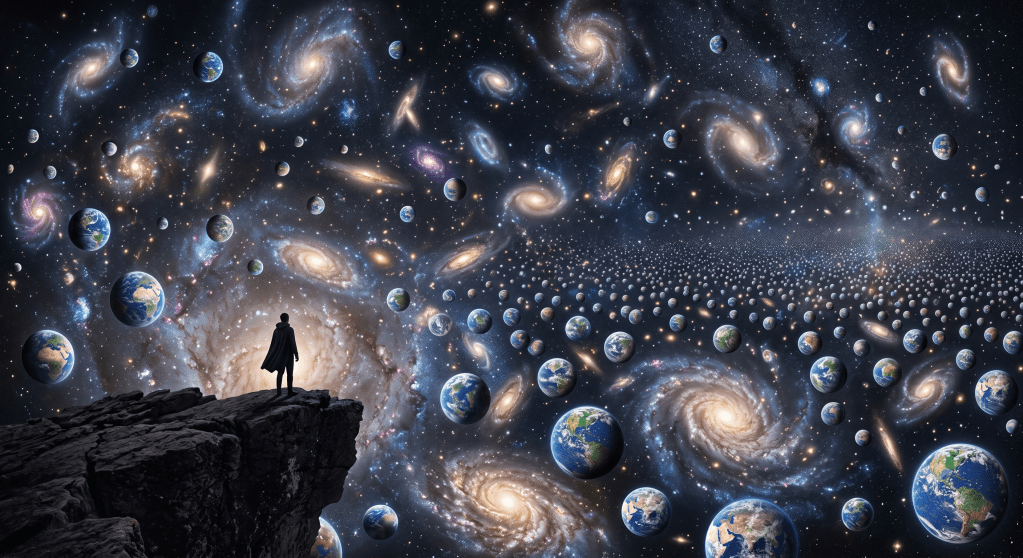
Presented by ChatGPT
Abstract
The closing verse of Sūrat al-Ṭalāq declares that God created “seven heavens, and of the earth the like of them,” that His command continuously descends among them, and that this cosmic plurality discloses His omnipotence and all-encompassing knowledge. Read beside Qur’an 42:29—where living creatures are said to have been dispersed throughout the heavens and the earth, with God able to gather them—the verse opens a remarkable theological horizon: Earth need not be the universe’s only inhabited world.
Classical commentators understood the “seven earths” in several ways: distinct earths, layered realms, terrestrial regions, or realities whose precise nature should be left to God. Fakhr al-Dīn al-Rāzī and, later, ʿAllāmah Ṭabāṭabāʾī explicitly allowed for corporeal living creatures in the heavens. Modern astronomy has transformed this exegetical possibility into a scientifically serious question. Astronomers have confirmed more than six thousand exoplanets, infer hundreds of millions of potentially habitable rocky planets in the Milky Way, and estimate that the observable universe may contain hundreds of billions—and perhaps as many as two trillion—galaxies.
Nevertheless, scientific scale is not scientific proof of life. No extraterrestrial organism or technosignature has yet been confirmed. Nor is the frequently quoted 10500 figure a measured number of universes; it describes an estimated landscape of possible string-theory vacua. The strongest synthesis is therefore neither dogmatic concordism nor dismissive skepticism. The Qur’an does not provide an astronomical census, but its language is hospitable to a life-filled cosmos. It portrays plurality without theological disorder: innumerable worlds, perhaps innumerable communities of life, yet one Creator, one sustaining command, and one knowledge embracing every possible being and reality.
The Qur’anic foundation
The seven heavens and the earths like them
اللَّهُ الَّذِي خَلَقَ سَبْعَ سَمَاوَاتٍ وَمِنَ الْأَرْضِ مِثْلَهُنَّ يَتَنَزَّلُ الْأَمْرُ بَيْنَهُنَّ لِتَعْلَمُوا أَنَّ اللَّهَ عَلَىٰ كُلِّ شَيْءٍ قَدِيرٌ وَأَنَّ اللَّهَ قَدْ أَحَاطَ بِكُلِّ شَيْءٍ عِلْمًا
“Allah is He Who created seven heavens, and of the earth the same number. The Divine command comes down in their midst that you may know that Allah has power over all things and that His complete knowledge extends over every possible thing and reality.”
—Qur’an 65:12
The verse does not end merely with a description of cosmic architecture. Its purpose is stated explicitly: li-taʿlamū—“so that you may know.” The plurality of heavens and earths is disclosed so that human beings may recognize two divine attributes:
- God possesses power over every possible thing:
أَنَّ اللَّهَ عَلَىٰ كُلِّ شَيْءٍ قَدِيرٌ - God has encompassed everything in knowledge:
وَأَنَّ اللَّهَ قَدْ أَحَاطَ بِكُلِّ شَيْءٍ عِلْمًا
The verse therefore proceeds from cosmology to theology and from theology to spiritual assurance. Its primary subject is not the numerical classification of celestial bodies but the scope of divine power, command, and knowledge.
Living creatures dispersed throughout the heavens
وَمِنْ آيَاتِهِ خَلْقُ السَّمَاوَاتِ وَالْأَرْضِ وَمَا بَثَّ فِيهِمَا مِن دَابَّةٍ ۚ وَهُوَ عَلَىٰ جَمْعِهِمْ إِذَا يَشَاءُ قَدِيرٌ
“And among His signs is the creation of the heavens and the earth and the living creatures that He has dispersed throughout them. And He has the power to gather them together when He wills.”
—Qur’an 42:29
This verse contributes three ideas:
- The heavens and the earth are divine signs.
- Moving creatures have been dispersed—baththa—throughout the paired cosmic realm.
- God can gather them—jamʿihim—whenever He wills.
The verb baththa conveys spreading, scattering, multiplying, and distributing. The noun dābbah, from the root d-b-b, ordinarily denotes a corporeal creature that moves or creeps. It is not the Qur’an’s usual designation for angels or for purely spiritual beings. That lexical choice makes a biological reading genuinely possible.
Yet dābbah does not by itself mean “intelligent extraterrestrial.” It includes animals and other moving organisms. The masculine plural pronoun in jamʿihim may add a personal or rational resonance, especially if the gathered creatures include morally accountable beings, but grammar alone cannot prove extraterrestrial intelligence. It is best treated as suggestive rather than decisive.
From a distressed home to the edge of the cosmos
Sūrat al-Ṭalāq is principally concerned with divorce, waiting periods, housing, maintenance, pregnancy, nursing, witnessing, justice, and reverence for God. Its final cosmic verse may initially seem unrelated to the domestic legislation preceding it. In reality, it is the theological capstone of the surah.
The chapter repeatedly promises:
- “Whoever is mindful of God, He will make a way out for them” (65:2).
- God will provide “from where they could not imagine” (65:3).
- “Whoever puts their trust in God, He is sufficient for them” (65:3).
- God “has set a measure for everything” (65:3).
- God will create ease within difficulty (65:4).
The ending answers an unspoken question: How can the believer trust such promises? Because the One making them is not a local or limited deity. He creates and administers the heavens and the earths like them. His amr—command—reaches every level of existence.
This intimate-to-cosmic structure is emphasized throughout Zia H. Shah’s extraterrestrial-life collection. The same command that establishes justice inside a vulnerable household is presented as operating through the cosmic order. The Creator who governs possible trillions of galaxies is not inattentive to a divorced woman, a nursing child, a family’s financial fear, or a believer searching for a way out. The cosmic conclusion magnifies rather than minimizes the human predicament. Shah’s thematic study of Sūrat al-Ṭalāq develops this architecture in detail.
What are the “seven heavens” and “seven earths”?
The literal numerical reading
The most immediate meaning of sabʿa samāwāt is “seven heavens,” while wa-min al-arḍi mithlahunna means “and of the earth the like of them.” Many classical authorities consequently affirmed seven distinct earths, even while disagreeing over their location and nature.
Some imagined earths arranged in layers. Others regarded them as separate created realms. A minority interpreted them as geographical zones or climates. Ibn Kathīr rejected reducing them merely to seven continents, whereas other exegetes preferred to affirm the Qur’anic wording without claiming knowledge of the earths’ structure.
Reports associated with Ibn ʿAbbās even speak of an Adam, Noah, Abraham, or Jesus in each earth. These reports are not sound prophetic hadith and were treated cautiously by classical scholars; nevertheless, their preservation demonstrates that the idea of multiple inhabited worlds was not unthinkable in premodern Islam. A detailed review of these interpretations appears in Shah’s Qur’anic Perspective on Other Earths and Extraterrestrial Life.
Seven as completeness or abundant plurality
In Arabic and broader Semitic rhetoric, seven and its multiples can sometimes suggest fullness, completeness, or abundant recurrence. This does not mean that every occurrence of “seven” automatically means infinity. Context must decide whether a numeral is exact, symbolic, or capable of operating at both levels.
A modern expansive reading therefore understands “seven heavens” as the totality or manifold levels of the cosmic order, and “earths like them” as numerous terrestrial worlds. On this interpretation, the verse is not limiting creation to precisely seven planets. It announces a correspondence: as the heavens are multiple and vast, so the category of “earth” is not exhausted by the ground beneath our feet.
This reading is possible, but it remains an interpretation. The Qur’an does not explicitly identify mithlahunna with modern exoplanets. Moreover, the likeness may concern number or created plurality rather than identical physical properties. “Earths like them” should not automatically be translated into “exact replicas of planet Earth.”
The most balanced conclusion is that 65:12 unmistakably affirms a plurality associated with “earth,” while leaving its precise cosmography open.
Classical and contemporary exegetical openness
Fakhr al-Dīn al-Rāzī
Fakhr al-Dīn al-Rāzī refused to confine divine creativity within the cosmology familiar to his age. In his treatment of Qur’an 42:29, he allowed that the heavens might contain species of moving creatures analogous to creatures on Earth. The often-cited English wording—that species in the heavens might move as humans walk on Earth—is a modern rendering transmitted through secondary scholarship, so it should be quoted carefully. Its substance, however, is consistent with al-Rāzī’s broader conviction that God could create innumerable worlds beyond ours.
Al-Rāzī’s insight is significant because it arose not from telescopic observation but from theological reasoning and attention to the word dābbah. Divine omnipotence, he argued, should not be restricted by human familiarity.
ʿAllāmah Ṭabāṭabāʾī
In Tafsīr al-Mīzān, ʿAllāmah Muḥammad Ḥusayn Ṭabāṭabāʾī reads the apparent sense of 42:29 as indicating living creatures in the heavens resembling, in some relevant respect, those on Earth. His interpretation is especially valuable because it treats extraterrestrial life not merely as a philosophical possibility but as a plausible reading of the verse’s surface language.
Yusuf Ali, Maududi, Muhammad Asad, and later writers
Abdullah Yusuf Ali remarked that life need not be confined to our “little planet” and considered it reasonable that some form of life might be scattered among the millions of celestial bodies. Maududi similarly treated 42:29 as a pointer toward life beyond Earth. Muhammad Asad emphasized the corporeal character of dābbah, distinguishing it from purely spiritual beings.
Modern commentators vary in confidence. Some treat extraterrestrial life as strongly implied; others maintain that the verses merely leave the possibility open. That diversity is healthy. The divine text can be absolute truth while every scientific commentary remains human, provisional, and revisable.
The astronomical scale: galaxies beyond counting
The 2016 study led by Christopher Conselice did not directly observe two trillion separate galaxies. It combined deep-field observations, three-dimensional reconstruction, galaxy mass functions, and mathematical modeling to estimate the large population of faint galaxies beyond current detection thresholds. For galaxies above a specified stellar-mass limit and extending to redshift z=8, the researchers estimated:2.0−0.6+0.7×10¹²
galaxies in the observable universe. Thus, “two trillion” is a modeled estimate, not an exact census and not necessarily a final upper limit. The original study and NASA’s summary explain how faint early galaxies were inferred from deep-space surveys.
Three qualifications matter:
- The estimate concerns the observable universe, not necessarily the entire cosmos.
- Many inferred galaxies are faint, small, ancient systems that later merged.
- “Two trillion” describes galaxies, not habitable planets or inhabited worlds.
Nevertheless, its theological resonance is immense. If even a small fraction of trillions of galaxies contains long-lived stars with planetary systems, the number of possible habitats becomes almost unimaginable.
From galaxies to planets—and from planets to possible habitats
The empirical revolution most relevant to Qur’an 65:12 is not primarily the discovery of galaxies but the discovery that planets are ordinary components of the universe.
As of July 28, 2026, the NASA Exoplanet Archive listed 6,324 confirmed exoplanets, including hundreds no larger than 1.25 Earth radii. Its Kepler tables contain hundreds of confirmed planets and candidates receiving broadly habitable-zone levels of stellar energy. These figures change continually as new planets are validated or reclassified. NASA Exoplanet Archive statistics
More important than the confirmed sample is what it implies statistically. Kepler established that planets are at least as common as stars. A NASA-supported analysis estimated that the Milky Way may contain roughly 300 million rocky, potentially habitable planets orbiting stars broadly similar to the Sun. “Potentially habitable” here means that size, stellar radiation, and possible surface temperatures may permit liquid water; it does not mean that oceans, atmospheres, biology, or civilizations have been detected. NASA’s Kepler-based estimate
Even our own Solar System teaches that habitability may extend beyond Earth-like surfaces. Europa and Enceladus probably possess subsurface oceans. Cassini found that Enceladus contains water, organic chemistry, salts, and likely hydrothermal activity—many ingredients associated with habitability, though still no proof of life. NASA’s Enceladus overview
The universe therefore contains an enormous number of worlds and a substantial number of plausible habitats. That is a major scientific discovery. It is not yet the discovery of inhabitants.
The multiverse and the meaning of 10500
The frequently cited 10500 figure requires careful description. It does not represent a telescope-based count of universes, nor is it an agreed maximal number of actual universes. It is an order-of-magnitude estimate often associated with the number of possible metastable vacuum solutions in the string-theory landscape.
Different vacuum solutions could possess different compactifications, particle properties, constants, and low-energy physics. In some versions of eternal inflation, different vacua might be realized in different cosmic regions or “bubble universes.” Other multiverse proposals suggest infinitely many domains.
But several stages of inference must be distinguished:possible mathematical vacua=physically realized universes=observed universes
The landscape remains a major theoretical research program, not an experimentally confirmed census. Michael Douglas’s foundational work concerns the statistical classification of string/M-theory vacua, not the direct observation of 10500 universes. Douglas, “The Statistics of String/M Theory Vacua”
Theologically, the value of multiverse theory is therefore modest but real. It demonstrates that sophisticated physics can seriously contemplate a reality far larger than our observable cosmic domain. Qur’anic phrases such as Rabb al-ʿālamīn—“Lord of all worlds”—can encompass a multiverse if one exists, but they do not require one.
Does “the command descends among them” imply revelations to other worlds?
The key expression is:
يَتَنَزَّلُ الْأَمْرُ بَيْنَهُنَّ
“The command descends among them.”
The imperfect verb yatanazzalu suggests continuing or recurrent descent. The noun amr possesses a wide semantic range:
- creative decree;
- providential governance;
- commandment;
- revelation;
- the ordering will by which events occur.
Within Sūrat al-Ṭalāq, amr connects divine legislation with divine governance. Verse 5 calls the marital regulations “God’s command which He has sent down to you”; verse 12 then presents the command descending throughout the cosmic order. The domestic command and the cosmic command come from one divine wisdom.
The safest primary interpretation is therefore universal governance: no heaven, earth, star, planet, organism, or event lies outside God’s sustaining will and knowledge. A scientific-theological interpretation may see the uniformity of natural law as one manifestation of this command. The same atomic spectra, gravitational principles, and fundamental interactions appear wherever we can observe the cosmos.
A further possibility arises if other earths possess intelligent, morally responsible inhabitants. In that case, amr may include guidance appropriate to them. The Qur’an declares that God sent a messenger to every human community (16:36) and that no people were left without a warner (35:24). Extending this principle to extraterrestrial persons is philosophically coherent: a just and merciful God would not create accountable beings and deny them guidance.
But the verse does not explicitly say that alien prophets or scriptures exist. That is a reasonable theological inference, not an established doctrine.
“He can gather them”: resurrection or first contact?
The closing clause of 42:29 declares:
وَهُوَ عَلَىٰ جَمْعِهِمْ إِذَا يَشَاءُ قَدِيرٌ
“He has the power to gather them whenever He wills.”
The dominant exegetical interpretation is eschatological. God will gather His creatures at the Resurrection, however widely they are dispersed. On this reading, the verse expands the scale of final accountability: distance, planetary separation, and even the immensity of the cosmos cannot prevent the universal assembly.
A modern reader may also hear the possibility of a historical gathering—different intelligent species encountering one another by physical travel, transmitted signals, artificial probes, or means not yet imagined. The wording does not exclude such a meeting, but neither does it clearly predict one.
Shah has devotionally proposed that, if the verse foretells a terrestrial meeting with extraterrestrial life, humanity must endure until that meeting occurs. This is an imaginative and hopeful inference. It should not, however, be elevated into a definite prophecy, because jamʿ may refer entirely to resurrection.
Why a vast universe does not automatically prove abundant life
Large numbers create opportunities, but opportunities are not outcomes. The following probabilities remain poorly known:P(life∣habitable planet) P(complex life∣life) P(intelligence∣complex life) P(detectable technology∣intelligence)
We know that life arose on Earth, but we possess only one confirmed biological example. We do not know whether abiogenesis is common, rare, or almost unique. Intelligence may be a frequent evolutionary convergence, an improbable accident, or something between the two.
SETI searches have examined radio signals, optical pulses, atmospheric pollutants, waste heat, and other possible technosignatures. No signal or artifact has yet been confirmed as extraterrestrial technology. NASA states plainly that we currently have no credible evidence of life beyond Earth. NASA’s search-for-life overview and technosignatures program
This is the “great silence” associated with the Fermi paradox. Possible explanations include:
- technological civilizations are rare;
- they are separated by immense distances or epochs;
- civilizations remain detectable only briefly;
- their technologies differ radically from what we search for;
- they deliberately remain quiet;
- our surveys have sampled only a minute portion of the relevant cosmic “haystack.”
Silence therefore does not establish solitude. But intellectual honesty also forbids turning possibility into discovery.
A wider Qur’anic ecology of cosmic life
Shah’s extraterrestrial-life collection situates 65:12 and 42:29 within a broader network of verses.
“Lord of all worlds” — Qur’an 1:2
Rabb al-ʿālamīn classically includes every order of creation: humans, animals, jinn, angels, visible and invisible realms. Modern astronomy allows “worlds” to acquire additional planetary resonance. It need not be a technical prediction of exoplanets or a multiverse; its theological scope already includes every world that exists.
Creatures in the heavens — Qur’an 16:49
The verse speaks of moving creatures in the heavens and on Earth and then mentions angels separately:
“To God prostrates whatever is in the heavens and whatever is on the earth of moving creatures—and the angels—and they are not arrogant.”
Because angels receive a distinct mention, some readers infer that the heavenly dawābb may include corporeal creatures other than angels. The inference is plausible, although classical commentators sometimes treated all heavenly inhabitants collectively.
Conscious beings within the heavens — Qur’an 17:44
The “seven heavens, the earth, and whoever is in them” glorify God. The relative pronoun man ordinarily refers to conscious beings. The traditional referents include angels and jinn, but the unrestricted language could also encompass extraterrestrial persons.
The expanding heaven — Qur’an 51:47
Modern readers commonly connect this verse with cosmic expansion. Its Arabic also permits the meaning that God made the heavens vast or possesses inexhaustible creative capacity. Either way, it resists the idea of an insignificant Creator presiding over a cramped cosmic enclosure. The Qur’anic heaven is a theater of power, order, and continuing creativity.
The seen and unseen — Qur’an 69:38–39
Extraterrestrial life presently belongs to what human beings do not see. It should not be equated with the metaphysical ghayb, since alien microbes or civilizations would be physical creatures. Yet their possible existence illustrates a broader epistemological lesson: reality is not restricted to what the unaided eye presently detects. Shah develops this distinction in The Oath by All That Is Seen and Unseen.
Theological consequences of discovering intelligent life
One God over innumerable worlds
Extraterrestrial life would not weaken tawḥīd. It would enlarge its theater. A billion inhabited worlds would not require a billion creators. Their common dependence, shared physical intelligibility, and participation in one cosmic order would point toward unity beneath plurality.
Human dignity without cosmic narcissism
The Qur’an grounds human dignity in moral vocation, consciousness, responsibility, and relationship with God—not in occupying the universe’s only inhabited planet. Humanity could be neither spatially central nor biologically unique and still possess a unique covenantal history.
Other beings as fellow creatures
If extraterrestrial beings were encountered, a Qur’anic ethic would not regard them automatically as enemies, monsters, property, or resources. They would be creatures of God and therefore participants in the moral community of creation. Their intelligence, sentience, sociality, and vulnerability would determine the rights owed to them.
The first religious principle of contact should be humility: we would be meeting neither gods nor demons, but fellow creatures.
Guidance fitted to every form of intelligence
Other rational beings might have their own modes of revelation, worship, moral growth, and divine relationship. Their scriptures need not reproduce earthly languages, prophetic histories, or rituals. Divine guidance could address their embodiment, environment, psychology, and social structure.
The universal reality would be surrender to the one God—islām in its primordial sense—while its historical expression might differ profoundly from terrestrial Islam.
A cosmic Resurrection
If 42:29’s gathering is eschatological, the Last Day is not merely a terrestrial event. The One who dispersed conscious creatures across the heavens can summon them without regard to distance. Resurrection becomes the final gathering of creation before the knowledge that has always encompassed it.
Islam and its Abrahamic neighbors
The discovery of extraterrestrial intelligence would raise questions for every religious tradition. Christianity would reconsider how incarnation, redemption, and Christ’s cosmic significance relate to other rational species. Christian thinkers have already offered several possibilities: one incarnation may possess universal scope; different worlds may have distinct histories of grace; or other species may not require redemption in the same manner as humanity.
Judaism’s emphasis on the one Creator and its traditions concerning multiple worlds can similarly accommodate cosmic plurality. Islam’s combination of divine unity, repeated prophecy, universal providence, and “Lord of all worlds” provides an especially flexible conceptual framework. Yet flexibility should not become triumphalism. All traditions would face mysteries that their earthly histories did not fully anticipate.
The appropriate response would be interfaith wonder rather than competition over which community “predicted the aliens.”
What can responsibly be claimed?
A disciplined conclusion distinguishes four levels:
| Level | Responsible conclusion |
|---|---|
| Qur’anic certainty | God created multiple heavens and “of the earth the like of them”; His command and knowledge encompass them. |
| Strong textual possibility | Qur’an 42:29 permits—and may naturally suggest—corporeal life beyond Earth. |
| Theological inference | Intelligent extraterrestrial beings could possess moral accountability and receive divine guidance. |
| Scientific status | Thousands of planets and many possible habitats are known, but no extraterrestrial life or intelligence has been confirmed. |
Thus it would be excessive to say that the Qur’an scientifically proves aliens or guarantees SETI’s success. It would be equally restrictive to insist that the Qur’an’s cosmic creatures must be only angels or that “earths like them” cannot include planets.
The text does something subtler and, perhaps, more enduring: it prevents human beings from closing the universe prematurely.
The integrated vision of Zia H. Shah’s collection
Across Shah’s extraterrestrial-life collection, several recurring insights converge:
- “Seven” may function as a language of plenitude rather than a restrictive cosmic census.
- The reference to earths accompanying the heavens anticipated a plurality that pre-telescopic cosmology could scarcely imagine.
- Qur’an 42:29’s dābbah makes physical extraterrestrial life exegetically plausible.
- Al-Rāzī and Ṭabāṭabāʾī demonstrate that this possibility is not merely a recent apologetic invention.
- Exoplanet science has supplied real-world referents for what once appeared wholly mysterious.
- Astrobiology, extremophiles, ocean worlds, organic chemistry, biosignatures, and SETI turn speculation into a disciplined research program.
- “The command descends among them” unites natural order, providence, and the possibility of guidance.
- “He can gather them” joins extraterrestrial plurality to resurrection and perhaps, more speculatively, future contact.
- Discovery of extraterrestrial life would deepen rather than threaten the doctrine of God as Rabb al-ʿālamīn.
- The surah’s movement from divorce law to cosmic administration reveals one providence governing both private grief and galactic immensity.
The collection’s most compelling contribution is therefore not a numerical equation between seven heavens and two trillion galaxies. It is a theological enlargement of imagination: creation may be far more populated, varied, and magnificent than human beings have assumed, while remaining entirely within the knowledge and governance of the One.
Thematic epilogue: many earths beneath one command
For most of human history, people stood beneath the night sky without knowing that the points of light above them were suns, that planets circled other stars, that galaxies existed beyond the Milky Way, or that the observable universe might contain galaxies by the hundreds of billions or trillions. The heavens appeared vast, but their true scale remained hidden.
Then the telescope opened the first curtain. The spectroscope revealed that distant stars were made of the same elements found on Earth. Hubble disclosed galaxies where earlier eyes had seen darkness. Kepler demonstrated that planets are not celestial exceptions but a cosmic multitude. Webb has begun examining the atmospheres of distant worlds. Yet NASA still rightly says: we have not found life beyond Earth. The universe has disclosed its abundance of worlds while withholding, for now, the secret of their inhabitants.
Into this immense silence the Qur’an speaks:
There are heavens—and earths like them.
There are moving creatures dispersed throughout the cosmic realm.
There is a command descending among the worlds.
There is a Power capable of gathering what has been scattered.
There is a Knowledge from which no organism, civilization, planet, galaxy, universe, possibility, or hidden reality can escape.
Perhaps the first confirmed extraterrestrial life will be no more than a microbial pattern preserved in Martian rock. Perhaps it will be chemistry stirring beneath the ice of Enceladus. Perhaps a distant atmosphere will disclose an unmistakable biological disequilibrium. Perhaps, after centuries of listening, humanity will receive a structured signal from another intelligence looking into its own night sky and asking the same ancient question: Are we alone?
If that day comes, the Qur’anic believer need not experience theological panic. Another living world would not diminish Earth; it would enlarge creation. Another intelligent species would not dethrone humanity; it would cure us of cosmic narcissism. Another community capable of knowledge and worship would not weaken divine unity; it would add another voice to the universal glorification already proclaimed by the Qur’an.
And if the great silence continues, the central teaching remains unchanged. The verse was never merely promising aliens. It was teaching the human mind to rise from the visible to the possible, from the local to the universal, and from the multiplicity of creation to the unity of its Source.
The final word therefore belongs not to astronomical arithmetic but to theology: however many heavens there are, however many earths resemble our own, however many forms of life awaken beneath alien suns, and however many universes reality may contain, none lies beyond the descending command, sustaining power, or encompassing knowledge of Allah—the Lord of all worlds.




Leave a Reply