
Epigraph
اللَّهُ الَّذِي خَلَقَ سَبْعَ سَمَاوَاتٍ وَمِنَ الْأَرْضِ مِثْلَهُنَّ يَتَنَزَّلُ الْأَمْرُ بَيْنَهُنَّ لِتَعْلَمُوا أَنَّ اللَّهَ عَلَىٰ كُلِّ شَيْءٍ قَدِيرٌ وَأَنَّ اللَّهَ قَدْ أَحَاطَ بِكُلِّ شَيْءٍ عِلْمًا
Al Quran 65:12
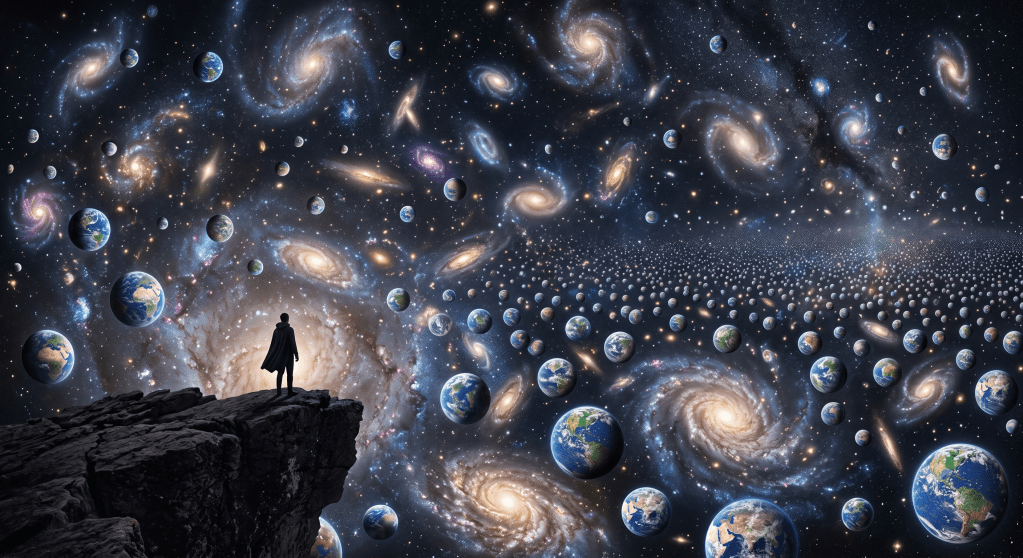
Presented by Gemini for Zia H Shah MD
Audio teaser: Why the Quran Predicts Alien Life
Abstract
This research report evaluates the Islamic perspective on extraterrestrial life through an analytical synthesis of Quranic hermeneutics, classical exegesis (tafsir), and modern astrophysics, focusing on the writings and analytical framework of Dr. Zia H. Shah MD. By examining key verses—most notably Surah At-Talaq (65:12) and Surah Ash-Shuraa (42:29)—alongside classical linguistic nuances, this study demonstrates that the Quranic worldview inherently accommodates, and arguably prophesies, a cosmos teeming with physical, intelligent beings. The classical Arabic metaphorical use of the number “seven” to denote numerical infinity or vastness aligns with contemporary astrophysical observations, including the estimation of two trillion galaxies in the observable universe and billions of exoplanets in stellar habitable zones. The report examines the Arabic term da’bbah, establishing its reference to physical, biological creatures dispersed across celestial realms, and contrasts Islamic cosmic pluralism (Rabb al-‘Alamin) with Christian soteriological dilemmas regarding universal redemption. Ultimately, this synthesis demonstrates a convergence between scripture and astrobiological exploration, proposing that divine law and moral guidance operate dynamically across a populated universe.
Exegetical and Linguistic Foundations of Cosmic Pluralism
The Semantics of Numerical Plurality: The Metaphor of Seven
The textual cornerstone of Islamic cosmic pluralism rests upon Surah At-Talaq, verse 12, which states: “Allah is He Who created seven heavens, and of the earth the same number. The Divine command comes down in their midst that you may know that Allah has power over all things and that His complete knowledge extends over every possible thing and reality”. In seventh-century Classical Arabic idiom, the numeral seven (sab’a) frequently functioned as a linguistic trope representing hyperbole, signifying an indefinite, vast, or innumerable quantity rather than a strict arithmetic constraint. This linguistic flexibility is observed across broader Islamic rituals and scriptural contexts—such as the seven circumambulations (tawaf) around the Kaaba or the running (sa’i) between Safa and Marwa—where the number symbolizes completeness and boundless repetition.
A structural analysis of Quranic syntax reveals that while the phrase “seven heavens” appears across multiple chapters—including Surah Al-Baqarah (2:29), Surah Al-Isra (17:44), Surah Al-Mu’minun (23:17, 23:86), Surah Fussilat (41:12), Surah Al-Mulk (67:3), Surah Nuh (71:15), and Surah An-Naba (78:12)—the specific formulation of “seven earths” (wa min al-ardi mithlahunna) appears exclusively once in Surah At-Talaq (65:12). This deliberate exegetical contrast reflects divine pedagogy. Introducing the reality of numerous terrestrial worlds without overburdening the seventh-century pre-scientific Arabs ensured that early believers were not distracted by cosmological concepts that were unverifiable with contemporary technology.
In the contemporary scientific paradigm, the classical Arabic metaphorical designation of “seven heavens” correlates with the vast ensemble of observable galaxies. Correspondingly, the single scriptural mention of “seven earths” translates to the vast distribution of terrestrial, habitable exoplanets scattered across those galaxies. By reading the text through its native rhetorical structure, the verse indicates that the cosmos contains an abundance of Earth-like planets, each serving as a potential stage for physical biological existence.
Ontological Divergence of Da’bbah versus Spiritual Entities
A second foundational verse for Quranic exotheology is Surah Ash-Shuraa (42:29): “And among His signs is the creation of the heavens and the earth and the living creatures that He has dispersed throughout them. And He has the power to gather them together when He wills”. The precise semantic weight of this verse hinges on the term da’bbah (plural dawab), derived from the Arabic root da-ba-ba, signifying organisms that crawl, walk, or tread physically upon a surface.
Lexically and taxonomically, da’bbah designates biological, physical entities, sharply distinguishing them from purely non-physical or spiritual beings such as angels (mala’ikah) or jinn. This ontological boundary is explicitly maintained in Surah An-Nahl (16:49), which lists da’bbah separately from the angels: “To Allah prostrates whatever is in the heavens and whatever is on the earth of living creatures (da’bbah), and the angels [too], and they are not arrogant”. By placing da’bbah in the heavens (fi-hinna) alongside those on Earth, the Quran establishes that physical, biological life forms are distributed across extraterrestrial environments.
Furthermore, the final phrase of Surah 42:29—“And He has the power to gather them together when He wills”—carries profound astrobiological implications. Modern commentators, including Dr. Shah, interpret this clause as a direct prophecy of exotheological convergence: an intentional, future physical encounter or communication between human civilization and extraterrestrial biological entities.
Cosmic Lordship: Rabb al-’Alamin and Divine Governance
The opening declaration of the Quran in Surah Al-Fatiha (1:2)—“All praise belongs to Allah, Lord of all worlds (Rabb al-‘Alamin)”—establishes a theological framework of cosmic pluralism. The term ‘Alamin is the plural form of ‘alam (world, domain, or realm). Historically, classical theologians defined ‘alam as distinct categories of creation, such as the realm of humans, jinn, angels, or animals. However, when synthesized with Surah At-Talaq (65:12) and Surah Ash-Shuraa (42:29), Rabb al-‘Alamin expands to denote physical sovereignty over populated biospheres across the cosmos.
The descent of divine command (yatanazzalu al-amru baynahunna) across these multiple earths indicates that divine governance is not confined to Earth. Instead, moral, physical, and spiritual laws radiate throughout the cosmos, implying that extraterrestrial civilizations operate under divine providence and may receive tailored spiritual guidance appropriate to their physical and cognitive natures.
Scientific Harmonization: Modern Astrophysics and Exoplanetary Horizons
Galaxy Counts, Depth-Scaling, and the Multiverse
Contemporary observational cosmology has systematically expanded humanity’s understanding of the universe’s scale. Initial deep-field analyses conducted using data from the Hubble Space Telescope during the 1990s and early 2000s yielded an estimated baseline of 100 to 200 billion galaxies within the observable universe. However, subsequent mathematical modeling and 3D depth-scaling led by astrophysics teams—notably Christopher Conselice et al.—revised this figure upward, demonstrating that the observable universe contains approximately two trillion (2×10¹²) galaxies. Accounting for space expansion, the observable universe spans roughly 93 billion light-years in diameter, representing only the light that has reached Earth since the Big Bang approximately 13.8 billion years ago.
| Cosmological Epoch / Model | Structural Universe Estimate | Exoplanetary / World Implications |
|---|---|---|
| Classical Pre-Modern View | Concentric planetary spheres / Earth-centered realms | Literal 7 Earth layers or regional continents |
| Early Hubble Deep Field (1990s) | 100 to 200 billion galaxies[cite: 3] | Billions of planetary systems inferred |
| Conselice et al. 3D Scaling (2016) | 2 trillion galaxies (2×10¹²)[cite: 3] | 1020 to 1022 potential terrestrial planets |
| String Theory Landscape (Multiverse) | 10500 distinct vacuum configurations [cite: prompt setup] | Near-infinite ensemble of distinct universes [cite: prompt setup] |
In theoretical physics, multiverse models derived from the string theory landscape project a finite set of approximately 10500 potential vacuum configurations, each possessing distinct physical constants and dimensions [cite: prompt setup]. Within the analytical framework advanced by Dr. Shah, whether one considers the two trillion galaxies of our observable universe or the theoretical 10500 universes of the string landscape, the Quranic phrasing “seven heavens and a similar number of earths” provides a symbolic framework capable of accommodating these vast physical scales.
Exoplanetary Habitability and Astrobiology
The observational confirmation of exoplanets has revolutionized modern astrobiology. Beginning with the detection of 51 Pegasi b in 1995, astronomers transitioned from theoretical models to empirical planet-hunting. Data collected by NASA’s Kepler Space Telescope indicates that approximately 20% of Sun-like stars harbor an Earth-sized planet within their circumstellar habitable zone—the region where surface liquid water can persist.
Extrapolating Kepler metrics across the Milky Way yields an estimated 300 million potentially habitable exoplanets in our galaxy alone, with several located within 30 light-years of Earth. When scaled across two trillion galaxies, the cumulative count of terrestrial biospheres reaches numbers that match the Quranic concept of “innumerable earths”. Advanced observational tools—including the Gemini Planet Imager (GPI) in Chile and the James Webb Space Telescope (JWST)—continue to analyze exoplanetary atmospheres for atmospheric chemical biosignatures, bridging the gap between theoretical scripture and empirical astrobiology.
SETI and Theoretical Astrobiology Frameworks
The Search for Extraterrestrial Intelligence (SETI) monitors electromagnetic spectra for non-random radio and optical signals produced by technological civilizations. SETI’s theoretical foundation relies on the Drake Equation:
N=R∗⋅fp⋅ne⋅fl⋅fi⋅fc⋅L
Where N represents the number of communicative civilizations in our galaxy; R∗ is the rate of star formation; fp is the fraction of stars with planetary systems; ne is the number of planets per system suitable for life; fl is the fraction where life emerges; fi is the fraction developing intelligence; fc is the fraction developing communication technology; and L is the lifespan of such civilizations.
While empirical science works to quantify parameters like fl and fi, the Quranic text asserts that life (da’bbah) has been deliberately dispersed across celestial realms. Scriptural assertions provide believers with a theological foundation for expecting positive results from exoplanetary research. Dr. Shah highlights that researchers like Jeff Coughlin, Director of Kepler’s Science Office, ground their work in empirical observations of bio-friendly worlds, aligning with the Quranic expectation of a cosmos populated with physical life.
Intellectual Traditions and Classical Exegesis
Pre-Modern Tafsir and Cosmic Pluralism
Long before the invention of optical telescopes or space probes, classical Islamic scholars engaged in nuanced debates regarding the plurality of worlds (ta’addud al-‘awalim). Exegetes drew upon both textual transmission (naql) and rational philosophy (‘aql) to evaluate the structure of creation.
| Scholar / Classical Exegete | Primary Analytical Framework | Interpretive Conclusion on 65:12 & 42:29 |
|---|---|---|
| Abdullah Ibn ‘Abbas (d. 687 CE) | Companionship Exegesis (Athar) | Asserted parallel earths featuring corresponding prophets (e.g., an Adam like Adam, a Jesus like Jesus). |
| Abu Ja’far al-Tabari (d. 923 CE) | Textual / Historical Transmission | Detailed accounts of layered earths, acknowledging possibilities of inhabitants unknown to humanity. |
| Fakhr al-Din al-Razi (d. 1210 CE) | Rationalist / Philosophical Cosmology | Confirmed that God could create thousands of worlds populated by intelligent beings beyond Earth. |
| Al-Qurtubi (d. 1273 CE) | Jurisprudential / Lexical Tafsir | Analyzed da’bbah lexically, allowing for physical entities across celestial realms. |
| Ibn Kathir (d. 1373 CE) | Traditionalist Textual Synthesis | Cited the Ibn ‘Abbas traditions cautioning against taking parallel worlds literally without sound proof, yet affirming God’s absolute creative capacity (Qudrah). |
| Allamah Tabatabai (d. 1981 CE) | Modern Holistic Quranic Exegesis | Concluded in Al-Mizan that 42:29 explicitly confirms living, physical creatures residing in celestial bodies similar to Earth. |
The most remarkable classical tradition regarding Surah 65:12 is attributed to the Prophet’s companion Abdullah Ibn ‘Abbas. When asked about the “seven earths,” Ibn ‘Abbas reportedly stated: “Seven lands: in each land there is a prophet like your prophet, an Adam like Adam, a Noah like Noah, an Abraham like Abraham, and a Jesus like Jesus”. Recognizing how radically this idea challenged medieval geocentric assumptions, Ibn ‘Abbas remarked: “Were I to tell you of the interpretation of it, you would disbelieve, and your disbelief would be your denial of it”. This classical commentary explicitly outlined a model of parallel evolutionary and spiritual histories across multiple habitable planets.
In Tafsir al-Kabir, the medieval theologian Fakhr al-Din al-Razi argued that God’s power (Qudrah) is infinite, noting it is entirely plausible that God created thousands of worlds beyond ours, each inhabited by unique physical species. Modern commentators like Allamah Tabatabai affirmed in Al-Mizan that the literal meaning of 42:29 indicates living organisms (dawab) exist across extraterrestrial bodies in space. Additional commentators, including Abdullah Yusuf Ali and Agha Mahdi Puya, similarly maintained that life is scattered throughout millions of heavenly bodies, emphasizing that the Creator possesses the ultimate power to gather these dispersed creatures.
Exotheological Implications: Islamic Monotheism versus Soteriological Bottlenecks
The prospect of extraterrestrial intelligence introduces differing theological challenges across world religions, a topic thoroughly analyzed in the works of Dr. Zia H. Shah. Christianity faces a soteriological challenge centered on the doctrines of the Incarnation and Atonement. Christian theology asks: “Did Jesus die for the sins of the aliens as well?”. Because traditional Christian dogma ties cosmic redemption to a singular historical event—God incarnating as a human being on planet Earth to redeem creation—discovering intelligent alien civilizations forces difficult choices: either extraterrestrial civilizations are redeemed by an Earth event they never experienced, or Christ must repeatedly undergo incarnation, suffering, and death across millions of alien worlds.
In contrast, Islamic exotheology avoids these soteriological issues due to its unyielding monotheism (Tawhid) and transcendent view of divine sovereignty (Rabb al-‘Alamin). Salvation in Islam does not rely on a proxy sacrifice or a singular planetary incarnation; rather, it depends on submission to divine guidance, moral accountability, and direct worship of the Creator.
Under the Quranic principle outlined in Surah At-Talaq (65:12)—“The Divine command comes down in their midst”—every extraterrestrial civilization receives divine revelation and law suited to its own biology, environment, and cognitive needs. Divine guidance (hidayah) manifests independently across biospheres, requiring no cross-planetary redemption mechanisms. From this theological framework, Dr. Shah presents a notable conclusion: if one accepts the Quranic prophecy of extraterrestrial physical life and eventual contact (yajma’ahum), humanity and planet Earth will endure at least until such contact is made.
Synthesis of Exotheological Dimensions
| Philosophical / Theological Dimension | Traditional Geocentric Model | Quranic Cosmic Pluralism Framework | Modern Astrobiological Parallel |
|---|---|---|---|
| Cosmic Ontology | Earth as the sole locus of physical life and divine concern | Cosmos containing innumerable earths (mithlahunna) | Estimated 1020 to 1022 habitable planets in observable universe |
| Nature of Alien Entities | Metaphorical, spiritual, or demonic beings | Physical, surface-dwelling creatures (da’bbah) | Carbon-based or alternative biological organisms |
| Mechanism of Divine Guidance | Single historical revelation centered on Earth | Decentralized descent of revelation (yatanazzalu al-amru) | Independent moral development across civilizations |
| Eschatological Outlook | Perpetual cosmic isolation of Earth | Prophesied gathering/contact of dispersed species (yajma’ahum) | Technological SETI signal detection or atmospheric biosignatures |
Thematic Epilogue
The convergence of Quranic hermeneutics, classical exegesis, and modern astrophysics reveals an integrated paradigm of cosmic pluralism. Far from presenting a human-centric or Earth-isolated view of creation, the Quranic narrative reveals a vast cosmos sustained by a single Creator whose creative power (Qudrah) and providential care (Rububiyyah) extend to innumerable worlds.
The linguistic flexibility of Classical Arabic—where “seven” signifies boundless abundance—bridges the gap between seventh-century revelations and modern scientific discoveries. Modern observations confirm the existence of two trillion galaxies containing countless planetary systems, matching the scriptural vision of “innumerable earths”. Furthermore, the choice of the word da’bbah in Surah Ash-Shuraa (42:29) establishes that physical, biological creatures are dispersed throughout these celestial biospheres.
This exotheological perspective also highlights the structural adaptability of Islamic monotheism (Tawhid). Free from the soteriological bottlenecks that complicate doctrines centered on single-world incarnations, Islam views extraterrestrial life as a natural expression of God’s universal lordship. Divine guidance descends upon every world independently, ensuring that all intelligent species receive moral principles suited to their nature.
As SETI and modern astronomy search the stars for signs of life, scripture offers a clear expectation: humanity inhabits a cosmos populated by living entities dispersed across space. The Quranic prophecy that God will “gather them together when He wills” serves as an enduring invitation for human inquiry. It suggests that the eventual discovery of extraterrestrial intelligence will not undermine religious faith, but will instead expand humanity’s appreciation for the boundless power, knowledge, and sovereignty of Rabb al-‘Alamin.




Leave a comment