
Presented by Claude, in the spirit of The Glorious Quran and Science (thequran.love), after Zia H. Shah, MD
Abstract
This treatise offers an interdisciplinary commentary on Qurʾān 79:27–33, a compact but cosmologically dense passage of Sūrat al-Nāziʿāt in which the Qurʾān answers the deniers of resurrection not with abstract argument but by directing the human gaze upward and outward — to the built heaven, the darkened night and its emergent daybreak, the outspread earth with its water and pasture, and the anchored mountains. Reading the passage through six major English renderings and the five classical mufassirūn most frequently engaged on this site — al-Ṭabarī, al-Zamakhsharī, Fakhr al-Dīn al-Rāzī, al-Qurṭubī, and Ibn Kathīr — we then set the verses in resonance (not concordist “proof”) with modern cosmology and geology. The darkness of the night sky (verse 29) is illuminated through Olbers’ paradox and its resolution in a finite, expanding universe; the built and proportioned heaven (verses 27–28) is read alongside the fine-tuning of physical constants that render the cosmos biophilic; and the spread earth, its water and pasture, and its firmly-set mountains (verses 30–33) are placed beside plate tectonics, isostasy, and the hydrological cycle. Throughout, the argument is framed by three recurring theses: natural regularities as sunnat Allāh (the unchanging way of God), creation bi’l-ḥaqq (in truth, with purpose), and the harmony of the “Two Books” of Revelation and Nature. The convergences are offered as anticipations and invitations to wonder — signs (āyāt) — rather than as apologetic demonstrations in the manner of Bucaille or Naik.
The Arabic Text (Qurʾān 79:27–33)
٢٧ أَأَنتُمْ أَشَدُّ خَلْقًا أَمِ ٱلسَّمَآءُ ۚ بَنَىٰهَا
٢٨ رَفَعَ سَمْكَهَا فَسَوَّىٰهَا
٢٩ وَأَغْطَشَ لَيْلَهَا وَأَخْرَجَ ضُحَىٰهَا
٣٠ وَٱلْأَرْضَ بَعْدَ ذَٰلِكَ دَحَىٰهَآ
٣١ أَخْرَجَ مِنْهَا مَآءَهَا وَمَرْعَىٰهَا
٣٢ وَٱلْجِبَالَ أَرْسَىٰهَا
٣٣ مَتَٰعًا لَّكُمْ وَلِأَنْعَٰمِكُمْ
Transliteration: (27) A-antum ashaddu khalqan ami s-samāʾu banāhā (28) rafaʿa samkahā fa-sawwāhā (29) wa-aghṭasha laylahā wa-akhraja ḍuḥāhā (30) wa’l-arḍa baʿda dhālika daḥāhā (31) akhraja minhā māʾahā wa-marʿāhā (32) wa’l-jibāla arsāhā (33) matāʿan lakum wa-li-anʿāmikum.
Six English Renderings
Sahih International: “Are you a more difficult creation or is the heaven? Allah constructed it. He raised its ceiling and proportioned it. And He darkened its night and extracted its brightness. And after that He spread the earth. He extracted from it its water and its pasture, and the mountains He set firmly, as provision for you and your grazing livestock.”
Abdel Haleem: “Which is harder to create: you people or the sky that He built, raising it high and perfecting it, giving darkness to its night and bringing out its morning brightness, and the earth, too, He spread out, bringing waters and pastures out of it, and setting firm mountains in it, for you and your animals to enjoy?”
Yusuf Ali: “What! Are ye the more difficult to create or the heaven (above)? (Allah) hath constructed it: On high hath He raised its canopy, and He hath given it order and perfection. Its night doth He endow with darkness, and its splendour doth He bring out (with light). And the earth, moreover, hath He extended (to a wide expanse); He draweth out therefrom its moisture and its pasture; And the mountains hath He firmly fixed — for use and convenience to you and your cattle.”
Pickthall: “Are ye the harder to create, or is the heaven that He built? He raised the height thereof and ordered it; And He made dark the night thereof, and He brought forth the morn thereof. And after that He spread the earth, And produced therefrom the water thereof and the pasture thereof, And He made fast the hills, A provision for you and for your cattle.”
Muhammad Asad: “[O MEN!] Are you more difficult to create than the heaven which He has built? High has He reared its vault and formed it in accordance with what it was meant to be; and He has made dark its night and brought forth its light of day. And after that, the earth: wide has He spread its expanse, and has caused its waters to come out of it, and its pastures, and has made the mountains firm: [all this] as a provision for you and for your animals.”
Maulana Muhammad Ali (Lahore edition): “Are you the harder to create or the heaven? He made it. He raised high its height, then put it into a right good state, And He made dark its night and brought out its light, And the earth, He cast it after that. He brought forth from it its water and its pasture. And the mountains, He made them firm, A provision for you and for your cattle.”
The Setting: A Sūrah Against the Denial of the Return
Sūrat al-Nāziʿāt is a Meccan sūrah of the earliest period, revealed — according to the traditional ordering associated with Ibn ʿAbbās — shortly after Sūrat al-Nabaʾ. Its overarching theme is the affirmation of resurrection (al-baʿth) and the life to come. The sūrah opens with a cascade of oaths sworn by angelic agents who “tear out” souls, who “glide,” who “race,” and who “arrange affairs” (79:1–5) — an evocation of the cosmic order that God’s servants execute — and moves through the terror of the Day when “a violent convulsion will convulse [the world]” (79:6–14), the cautionary story of Moses and a Pharaoh who declared himself “your Lord All-Highest” (79:15–26), and, at last, to our passage.
The classical commentators are unanimous that verses 27–33 form the argumentative hinge of the sūrah. The deniers had scoffed: “What! Are we indeed to be restored to our former state — even though we may have become [a heap of] crumbling bones?” (79:10–11). The Qurʾān’s reply is an a fortiori argument grounded in creation itself: the One who built the vast heaven and outspread the life-bearing earth can surely reconstitute a human being. As Ibn Kathīr frames verse 27, the meaning is “rather, the heaven is more difficult to create than you,” a reading he supports by cross-reference to Qurʾān 40:57 (“The creation of the heavens and the earth is greater than the creation of mankind”) and 36:81 (“Is not the One Who created the heavens and the earth capable of creating the like of them? Yes indeed!”). The passage is therefore not a stand-alone cosmology lecture; it is theology in the key of wonder, marshalling the architecture of the cosmos as evidence for the certainty of the Return. My IslamMy Islam
Verses 27–28: A-antum ashaddu khalqan ami s-samāʾu banāhā — rafaʿa samkahā fa-sawwāhā
The Language
The rhetorical question a-antum ashaddu khalqan ami s-samāʾ (“Are you harder to create, or the heaven?”) opens with a shift of address — an iltifāt — from speaking about the deniers in the third person (“they say,” 79:10) to confronting them directly in the second person (“you”). Al-Zamakhsharī, in al-Kashshāf, states plainly that “the address is to the deniers of resurrection” (al-khiṭāb li-munkirī al-baʿth). The verb banāhā (“He built it”) introduces the metaphor of the heaven as an edifice — a structure raised, roofed, and finished. Al-Zamakhsharī and the tradition that condensed him (al-Bayḍāwī, al-Jalālayn) treat banāhā as bayān li-kayfiyyat khalqihā — “an explication of the manner of its creation.”
Verse 28 unpacks the building in two motions. Rafaʿa samkahā — “He raised its samk.” The word samk denotes vertical extension measured from below upward (height/loftiness), which several commentators distinguish from ʿumq, depth measured downward; hence Sahih International’s “ceiling,” Asad’s “vault,” Yusuf Ali’s “canopy.” Fa-sawwāhā — “then He proportioned / evened / perfected it” — carries the sense, in al-Zamakhsharī’s gloss, of making it “even, with no unevenness or defect” (mustawiya bilā ʿayb, without tafāwut or fuṭūr). Muhammad Asad’s rendering, “formed it in accordance with what it was meant to be,” captures the teleological charge of the verb sawwā, the same root used in Qurʾān 91:7 of the soul “proportioned” for its moral vocation.
The Classical Tafsīr
Al-Ṭabarī reads the passage as the standard argument against the resurrection-deniers: the God who fashioned so mighty a structure is not incapable of restoring the dead. Fakhr al-Dīn al-Rāzī, in Mafātīḥ al-Ghayb, situates the entire unit as addressed to the munkirī al-baʿth and draws the same parallel to 40:57 — that the creation of the heavens is objectively “greater” than the creation of humankind, so the lesser re-creation follows a fortiori. Ibn Kathīr glosses verse 28: God “made it a lofty structure, vast in its expanse, with balanced sides, and adorned with stars.” The commentators thus read samk and sawwā together as height plus equilibrium plus adornment — a built order that is at once immense, balanced, and beautiful.
Scientific Resonance: The Built Heaven and the Fine-Tuned, Biophilic Cosmos
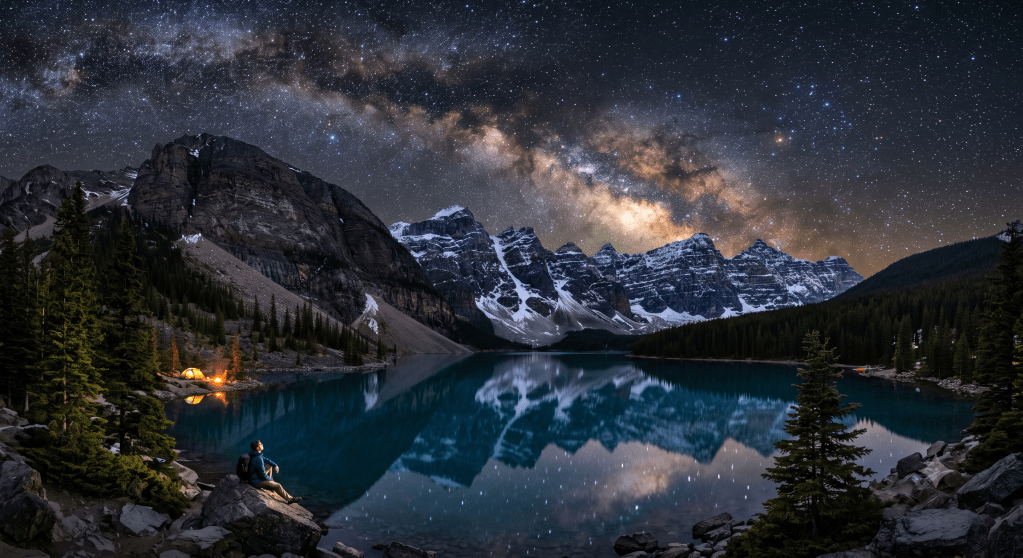
A modern reader standing beneath the “raised ceiling” of the heaven and hearing that it was “proportioned” (sawwā) — evened, balanced, made without tafāwut (disproportion) — may find an unexpected resonance in what contemporary physics calls the fine-tuning of the universe. The claim is not that the verse “predicts” fine-tuning; it is that the Qurʾānic vocabulary of a heaven built, raised, and balanced invites precisely the kind of contemplation that the fine-tuning data provoke.
The core observation is that the fundamental constants and initial conditions of the cosmos fall within extraordinarily narrow ranges that permit the emergence of complex structure and life. Physicist and cosmologist Paul Davies describes the universe as “biophilic” — friendly toward life — and cautions that “the conclusion is not so much that the Universe is fine-tuned for life; rather it is fine-tuned for the building blocks and environments that life requires.” Martin Rees, Astronomer Royal, organized the argument around his Just Six Numbers (1999) — six dimensionless constants that jointly shape the cosmos: among them N (the ratio of electromagnetic to gravitational force between two protons, ~10³⁶), ε (the nuclear efficiency of hydrogen fusion, 0.007), Ω (the cosmic density parameter), and Λ (the cosmological constant). Rees’s point is that, were any of these significantly different, the universe “would be a very different place” — often inert, structureless, or too short-lived for life. As he puts it, if ε were 0.006 no fusion chain could proceed, and if it were 0.008 all hydrogen would have been consumed in the Big Bang. Ethosinstitute
The cosmological constant Λ furnishes the most dramatic instance. As Scientific American summarizes the problem (“The Cosmological Constant Is Physics’ Most Embarrassing Problem”), “the vacuum energy in the universe must be very small — about 120 orders of magnitude smaller than what quantum theory predicts… The discrepancy has prompted some scientists to call vacuum energy ‘the worst theoretical prediction in the history of physics.’” Were Λ much larger, cosmic expansion would have torn matter apart before galaxies, stars, or planets could form; were it appreciably negative, the universe would have recollapsed. It was in the face of such numbers that Paul Davies wrote (in The Guardian, 2007) that “the universe looks suspiciously like a fix,” and that Fred Hoyle, having predicted the carbon-12 resonance level (found at 7.6549 MeV) required for stellar nucleosynthesis, concluded that “a common sense interpretation of the facts suggests that a superintellect has monkeyed with physics.” thequran
On this site’s framing (following the fine-tuning collection at thequran.love), such data are read neither as a knock-down proof nor as an embarrassment to be explained away. The Anglican physicist-priest John Polkinghorne — one of the recurring interlocutors in Dr. Shah’s fine-tuning essays — held that “anthropic fine tuning is too remarkable to be dismissed as just a happy accident,” while also insisting that the deepest wonder is that the universe is “rationally transparent,” intelligible to minds like ours. For Polkinghorne, the rationality of the cosmos and the rationality of the mathematics we use to describe it both point to a common ground in the rationality of God (the Logos). This is exactly the register of Qurʾān 79:27–28: a heaven “built” and “proportioned” is a heaven whose order is legible, and whose legibility is itself a sign. Thequran
Two of this author’s recurring frameworks illuminate the point. First, creation bi’l-ḥaqq — the Qurʾānic insistence (e.g., 39:5, “He created the heavens and the earth in truth”) that the cosmos is made purposefully and truly, not idly. A “proportioned” heaven is a ḥaqq-heaven. Second, the harmony of the “Two Books”: the Book of Revelation says the heaven was raised and evened; the Book of Nature, read through cosmology, shows a universe balanced on a knife-edge of constants. Neither compels assent to the other, but on the thesis of the unity of truth they converge. The alternative explanations offered within science — most prominently the multiverse — do not, on this framing, dissolve the wonder; as Dr. Shah argues in his “Lord of the Worlds” essay, an ensemble of universes would itself require an explanation and, if anything, “magnifies the creative scope attributable” to the Creator. Thequran
Verse 29: Wa-aghṭasha laylahā wa-akhraja ḍuḥāhā
The Language and Classical Tafsīr
Aghṭasha — a rare and vivid verb — means “He made intensely dark.” Ibn ʿAbbās glossed it simply: “He made it dark,” and Mujāhid, ʿIkrima, and Saʿīd b. Jubayr concurred. Its partner akhraja ḍuḥāhā — “He brought out its forenoon-brightness” (ḍuḥā, the light of mid-morning) — completes the pairing of concealment and disclosure. Ibn Kathīr: “He made its night dark and extremely black, and its day bright, luminous, shining and clear.” QuranXQuranX
A subtle grammatical point occupied the classical commentators: the possessive pronoun in laylahā (“its night”) and ḍuḥāhā (“its brightness”) refers back to al-samāʾ, the heaven. Al-Ṭabarī explains that night and day are attributed to the heaven because night falls when the heaven’s sun sets and day dawns when it rises — the iḍāfa (“night of it”) is thus phenomenological, describing what appears in the sky to the observer, not a claim that the entire cosmos undergoes a terrestrial day/night cycle. This is an important interpretive restraint: the verse speaks in the register of lived human experience while pointing beyond it to divine agency and order. Surah QuranMy Islam
Scientific Resonance: Why the Night Sky Is Dark
Here we draw directly on two essays by Dr. Zia H. Shah — “Why the Night Sky Is Dark” (April 6, 2026) and “The Quranic Night: The Cosmic Curtain” (April 7, 2026), both at thequran.love — which take verse 29 as their epigraph and develop its scientific resonance with unusual depth.
Ordinarily, night is dismissed as the mere absence of sunlight from one rotating hemisphere. But the darkness of the night sky conceals one of the profoundest puzzles in the history of cosmology: Olbers’ paradox. If the universe were infinite in extent, infinite in age, static, and uniformly filled with stars, then every line of sight would eventually terminate on a stellar surface, and the entire night sky should blaze as brightly as the surface of the Sun. It does not. The resolution — and, on Dr. Shah’s reading, the “scientific embellishment” of the Qurʾānic claim that God actively “darkened” (aghṭasha) the night — rests on the actual character of the cosmos we inhabit: thequran
- The finite age of the universe. The observable universe is 13.787 ± 0.020 billion years old (Planck Collaboration 2018 final data release, ΛCDM); light from beyond the cosmic horizon has not had time to reach us.
- Cosmic expansion and redshift. As space expands, light from distant galaxies is stretched to longer, invisible wavelengths (infrared, microwave), diluting and “hiding” the background glow. thequran
- The finite lifetimes and evolving history of stars. Stars do not burn forever, and there were epochs before galaxies lit up; the universe has never been “saturated” with starlight.
Dr. Shah’s essay presses a striking illustration: Sirius — 25 times as luminous as the Sun and the seventh-nearest star system, lying 8.6 light-years away — nonetheless appears roughly ten billion times fainter to us than the Sun, which is a mere astronomical unit distant. It is a vivid demonstration of how the inverse-square law and cosmic distance conspire to keep the sky dark, resonating with the “proportioning” (sawwā) of the heavens’ distances.
Crucially, “the missing brightness has not vanished.” A large part of the universe’s background radiation is simply outside human vision — most famously the Cosmic Microwave Background (CMB), the relic afterglow of the hot early universe, discovered by Penzias and Wilson, filling the entire sky at 2.72548 ± 0.00057 K (D. J. Fixsen, “The Temperature of the Cosmic Microwave Background,” Astrophysical Journal 707, 2009). In Dr. Shah’s memorable phrase, the night is thus a “cosmic curtain”: a “protected canopy” that shields us from the blinding fire of a trillion suns and the searing radiation of the Big Bang, while simultaneously revealing — once the Sun’s local glare is withdrawn — the true scale of the heavens. The darkness, far from being a void, is a “cosmological signature” of a finite, expanding, dynamic universe with a beginning.
Philosophical and Theological Commentary
Philosophically, the night performs a dual office: it conceals and it reveals. By day, the Sun’s local light obscures the cosmos; only when the veil of night is drawn do the billions of galaxies become visible. Night, then, is “the veil that reveals.” Dr. Shah invokes Richard Dawkins’s phrase, the “anaesthetic of familiarity” — the cognitive habituation by which we cease to see the miraculous ordinariness of the dark sky. The Qurʾān’s active verb aghṭasha (“He darkened”) resists that anaesthesia: darkness is not a passive default but a deliberate act of construction, a curtain God draws so that rest, introspection, and wonder become possible.
Theologically, the passage belongs to a rich Qurʾānic constellation on night as sign (āya), mercy, and order — a garment (libās, 25:47; 78:10), a source of tranquility (sakan, 6:96), the “stripping” of day from night (36:37), the “wrapping” of night and day around each other (39:5), and the thought-experiment of a perpetual night from which only God could deliver light (28:71). Here the deeper Qurʾānic logic connects to the sūrah’s resurrection theme: the same God who nightly withdraws the light and daily restores it — a small daily “death” and “resurrection” of the visible world — is the God who can restore the dead. The regular alternation is, in the framework of sunnat Allāh, the unchanging way of God in nature: a lawful, dependable rhythm on which calendars, livelihoods, and life itself are calibrated. As Dr. Shah notes, the more precisely we understand the physics of rotation and cosmic expansion, the deeper our appreciation of “the design of the Almighty” — science functioning here as a servant-commentary on Revelation, in keeping with the Two Books thesis.
Verses 30–31: Wa’l-arḍa baʿda dhālika daḥāhā — akhraja minhā māʾahā wa-marʿāhā
The Language: The Debated Daḥāhā
Verse 30 turns from heaven to earth: wa’l-arḍa baʿda dhālika daḥāhā — “and the earth, after that, He spread it out.” The verb daḥā is the interpretive crux of the passage. The classical lexical consensus, reported by al-Ṭabarī and al-Rāzī, is that daḥāhā means basaṭahā — “He spread it, extended it” — with an underlying sense of clearing, leveling, and preparing a surface. Al-Rāzī notes that the root d-ḥ-w fundamentally means “removing/clearing something from place to place and leveling it” (al-izāla wa’l-tamhīd), and he adduces the telling lexical fact that the ostrich’s nest is called udḥiyy because the bird clears the ground of pebbles and levels it flat. Al-Qurṭubī records the same: “the Arabs say daḥawtu al-shayʾ (‘I spread the thing’); and the ostrich’s nest is called udḥiyy because it is spread flat upon the ground.” In classical usage, then, the d-ḥ-w/udḥiyy connection points to flatness and preparedness, not — as some modern popularizers claim — to an “egg shape.” The reading of daḥāhā as “made egg-shaped” is a modern retrojection unsupported by the classical philology; we note it here only to set it aside, consistent with this site’s non-Bucaillist commitments. SeekersGuidance
The following verse, akhraja minhā māʾahā wa-marʿāhā — “He brought forth from it its water and its pasture” — supplies, in the commentators’ reading, the purpose of the spreading. Al-Rāzī explains that daḥw means spreading and preparing the earth for habitation, which necessarily involves “settling the matter of drink and food” — bringing forth water and pasture and anchoring the mountains as pegs — “so that the earth is stable and can be dwelt upon.” Al-Zamakhsharī observes that marʿā (properly, grazing-land for livestock) is extended metaphorically (istiʿāra) to cover human food as well — “what livestock graze of trees and grass, and what people eat of foods and fruits.” Al-Rāzī similarly treats marʿā as embracing all herbal produce and sustenance for man and beast. SeekersGuidanceAlim
The Order-of-Creation Question
The phrase baʿda dhālika (“after that”) generated one of the most discussed puzzles in classical tafsīr: does it mean the earth was created after the heaven, when Qurʾān 41:9–12 (Fuṣṣilat) and 2:29 seem to present the earth first? The commentators resolved this with notable sophistication:
- Ibn Kathīr (following the view Ibn Jarīr al-Ṭabarī preferred, from Ibn ʿAbbās): the earth was created before the heaven, but only spread out (daḥw) after the heaven’s completion. The verb refers to the spreading, not the origination. QuranX
- Al-Rāzī offers three reconciliations: (1) God created the earth first “like a gathered sphere” (ka’l-kura al-mujtamiʿa), then created the heaven, then spread the earth third; (2) daḥw denotes not mere spreading but “spreading in a manner prepared for growing sustenance,” which could only follow the heaven’s existence — “the earth being like the mother, the heaven like the father”; (3) baʿda here means maʿa (“along with,” concurrently), citing the grammatical parallel of Qurʾān 68:13. Thequran
- Al-Qurṭubī records three readings of baʿda dhālika — “after,” “along with” (maʿa), and even “before” (qabla, citing 21:105) — and concludes that “the meanings are close” (al-maʿnā mutaqārib).
- Maulana Muhammad Ali and Maududi both stress that the sequence is rhetorical, not chronological: the Qurʾān mentions heaven and earth “in succession, not in chronological order,” to draw the reader’s attention from one to the other; the aim is to display divine power and blessing, not to lecture on the timeline of creation. Islamic Studies
Notably, al-Rāzī’s image of the earth as first “a gathered sphere” that God then “extended and spread” is a striking anticipation of the language of resonance: the classical scholar, working from the text and the Arabic lexicon alone, arrived at a two-stage picture (compact origin, then differentiation and spreading) that a modern reader may find suggestive.
Scientific Resonance: The Prepared Earth, Its Water and Pasture
Read as an account of the earth prepared for life, verses 30–31 resonate with the geological and hydrological story of a habitable planet. The classical insistence that daḥw means not raw creation but the spreading-and-preparing of the earth “for habitation” — the settling of water and pasture — maps naturally onto the scientific understanding that Earth’s habitability is not a given but the outcome of a long process: the differentiation of the crust, the outgassing and delivery of water, the emergence of the hydrological cycle, and the greening of the continents by photosynthetic life. SeekersGuidance
The pairing of “water” and “pasture” is itself apt: liquid water is the sine qua non of life as we know it, and the Qurʾān repeatedly ties the two — “We made from water every living thing” (21:30). The water cycle by which oceans evaporate, clouds transport moisture inland, and rain revives the soil to bring forth vegetation is one of the Qurʾān’s most frequent signs of both providence and resurrection (e.g., 50:9–11, where the revival of dead land by rain is an explicit sign of the Return — the very theme of Sūrat al-Nāziʿāt). Here again the framework of sunnat Allāh applies: the water cycle is a lawful, dependable regularity, a “way of God” in nature that sustains the “provision” (matāʿ) named in verse 33.
Verse 32: Wa’l-jibāla arsāhā — “And the mountains He anchored”
The Language and Classical Tafsīr
The verb arsā means to make firm, to anchor, to set fast — the same root (r-s-w) that yields rawāsī, the “firm mountains” of some ten other Qurʾānic passages, and mursāhā, the “anchoring” of a ship (11:41). As Dr. Shah’s lexical survey “Quranic Verses about the Mountains” (thequran.love, July 2026) documents, the triliteral root r-s-w occurs fourteen times in the Qurʾān, and the mountain-verses cluster around a consistent functional claim: mountains are set firm “lest the earth shift/sway with you” (an tamīda bikum, 16:15; 21:31; 31:10). A parallel image calls the mountains awtād — “pegs” or “stakes” (78:7). thequran + 4
Al-Zamakhsharī glosses arsāhā: “He fixed them firmly upon the earth’s surface so that it be stable.” Ibn Kathīr: “He settled them, made them firm, and established them in their places… so that the earth would be calmly settled with its dwellers.” Al-Rāzī ties the mountains directly to the theme of habitability: they are “anchored as pegs (awtād) for the earth so that it is stable and can be dwelt upon.” The classical reading is thus functional and stabilizing — mountains as that which steadies the ground beneath human and animal life. Home
Scientific Resonance: Isostasy, Roots, and Crustal Stability — Framed as Resonance, Not Proof
Modern geology offers a genuinely striking parallel to the “peg” and “anchor” imagery, one that Dr. Shah develops across several essays in the geology collection at thequran.love (“Mountains as Earth’s Natural Shock Absorbers,” March 2025; “…how they are anchored?”, March 2025; and the mountain-formation timescales essay, June 2025). The key concept is isostasy: mountains are not merely surface protrusions but have deep “roots” of lighter crustal material extending down into the denser mantle, so that the crust floats in gravitational equilibrium much as an iceberg floats with most of its mass submerged. Under the largest ranges the crust thickens dramatically — Airy-isostasy estimates for the Himalayas imply roots on the order of 70–80 km. This root structure was first inferred in 1855, when Sir George Everest’s Great Trigonometrical Survey found a discrepancy between plumb-line deflections at Kaliana and Kalianpur near the Himalayas; that same year John Henry Pratt and Astronomer Royal George Biddell Airy proposed the two competing isostasy models, with Airy likening mountains to icebergs whose roots extend below the surface (Encyclopædia Britannica, “Isostasy”). The visible peg above ground and the far larger root below is a real, and genuinely evocative, match to the watad (“peg”) image. ThequranQuran Worlds
We are careful, however, to state this as resonance rather than as a scientific “miracle proof.” Several qualifications, which honest treatments (including on this site) acknowledge, are important:
- Mountains do not stop earthquakes; on the contrary, the most mountainous regions — plate boundaries — are the most seismically active. As the U.S. Geological Survey notes, “90 percent of the world’s earthquakes occur at the margins of the Earth’s major crustal plates,” which is precisely where mountains form. The Qurʾānic claim, fairly read with the classical commentators, is about the crust’s large-scale isostatic balance and steadiness, not about the suppression of all ground motion.
- The “peg/anchor” language was understood by the classical exegetes (Ibn Kathīr, al-Rāzī) in terms of stabilizing and settling the earth for habitation — a reading that comfortably accommodates the isostatic picture without over-claiming.
Placed within plate tectonics — the theory, developed between the 1950s and 1970s, that Earth’s lithosphere is divided into moving plates whose collisions raise mountain belts — the mountains emerge as participants in the dynamic system that continually renews and stabilizes the habitable surface. On the Two Books framing, this is a satisfying convergence: the Book of Revelation calls mountains “anchors” and “pegs” that steady the earth for its dwellers; the Book of Nature, read through geophysics, shows deep-rooted ranges in isostatic equilibrium contributing to crustal stability. The convergence is offered, in Dr. Shah’s own words about such matches, “as resonance, not proof.” Thequran
Verse 33: Matāʿan lakum wa-li-anʿāmikum — “A provision for you and your livestock”
The passage closes by naming its purpose: all of this — the built heaven, the alternation of dark night and bright day, the outspread earth, its water and pasture, its anchored mountains — is matāʿ, “provision,” “enjoyment,” “use,” for human beings and their grazing animals. Grammatically, as al-Zamakhsharī and al-Jalālayn note, matāʿan is an accusative of purpose (mafʿūl li-ajlih): God did all this in order to provide for you. Al-Rāzī and Ibn Kathīr read the whole sequence as a single argument that terminates in gratitude: the earth was spread, its springs made to gush, its rivers made to flow, its vegetation and fruits brought forth, and its mountains set firm — “as provision for you and your cattle.” HomeMy Islam
Muhammad Asad draws the theological moral explicitly: the closing phrase implies (as in 80:24–32) that “man ought to be grateful to God, and should always be conscious of His being the Provider” — which is why the discourse then returns, in the verses that follow, to the theme of resurrection and final judgment (79:34ff). The logic is seamless: the God who provisions you in this life, through an ordered and generous cosmos, is the God to whom you will return to account for that provision. Cosmology becomes ethics; the architecture of the heavens and the earth grounds the certainty of the Return. Alim
Synthesis: The Two Books, Sunnat Allāh, and Creation bi’l-Ḥaqq
Read whole, Qurʾān 79:27–33 moves in a deliberate arc — from the macrocosmic (the built, proportioned heaven), through the rhythmic (the darkened night and emergent day), to the terrestrial and intimate (the spread earth, its water and pasture, its anchored mountains) — and lands on the human being and his animals, provisioned and therefore accountable. At every stage the passage names an āya, a sign, and every sign does double duty: it testifies to the Creator’s power and it demonstrates, by the ease of the greater creation, the certainty of the lesser re-creation.
Three of this author’s recurring frameworks bind the commentary together. Sunnat Allāh: the alternation of night and day, the water cycle, the isostatic balance of the crust are not random but lawful — the unchanging “way of God” that science studies as the laws of nature and that the Qurʾān presents as dependable signs. Creation bi’l-ḥaqq: the cosmos is made in truth and for a purpose, not idly (cf. 38:27, 21:16); a “proportioned” (sawwā) heaven and a “prepared” (daḥā) earth are purposive, not accidental. And the Two Books: Revelation and Nature, being emanations of one Author, must ultimately harmonize; the convergences traced here — Olbers’ paradox and the “darkened night,” fine-tuning and the “proportioned heaven,” isostasy and the “anchored mountains” — are read as resonances and anticipations that reward contemplation, never as coercive proofs.
This is emphatically not the concordism of Maurice Bucaille or Zakir Naik, who treat scientific findings as apologetic trump cards proving the Qurʾān’s divine origin. The claim here is gentler and, we think, truer to both the text and the science: the Qurʾān is not a physics textbook, and its purpose is to summon wonder, gratitude, and the moral seriousness that follows from recognizing a Creator. When modern cosmology and geology deepen our appreciation of the very phenomena the Qurʾān points to — the dark sky, the balanced heaven, the steadied earth — they function, in the classical Islamic idiom, as commentary on the signs, not as substitutes for them.
Thematic Epilogue: The Curtain, the Balance, and the Return
There is a quiet unity to the images of this passage. The night is a curtain (verse 29) — drawn to conceal the day’s glare and, in that concealing, to reveal the depth of the heavens and the humility of the human station beneath them. The heaven is a balance (verses 27–28) — raised and evened, its constants poised on a knife-edge that makes the cosmos biophilic, legible, and generous. The earth is a cradle (verses 30–32) — spread, watered, greened, and anchored, prepared for the brief tenancy of creatures who did not build it and cannot sustain it.
Each image humbles a particular human pretension. The dark sky humbles our sense of scale: Sirius, brilliant among stars, is dimmed ten-billion-fold by mere distance, and we ourselves are dimmer still against the cosmic vault. The fine-tuned heaven humbles our sense of necessity: the universe did not have to be this way, and its being just so is a fact that reason cannot shrug off. The anchored earth humbles our sense of ownership: the ground is steadied for us, not by us.
And all three converge on the single argument the sūrah was making from the start. To the one who scoffs, “Who can restore crumbling bones?” the Qurʾān answers by pointing at the sky, the night, and the mountains: the One who did all this — and did it, moreover, as unearned provision for you — is not to be doubted when He promises the Return. In the darkness between the stars lies not emptiness but the afterglow of a beginning; and a universe with a beginning is a universe in the hands of a Beginner, whose “way” (sunna) it is to bring forth light from darkness, life from dead earth, and — the sūrah insists — the living from the dead. The dark, as Dr. Shah writes, is not empty. It is a structured silence, a cosmic curtain, and a doorway to wonder.



Leave a Reply