
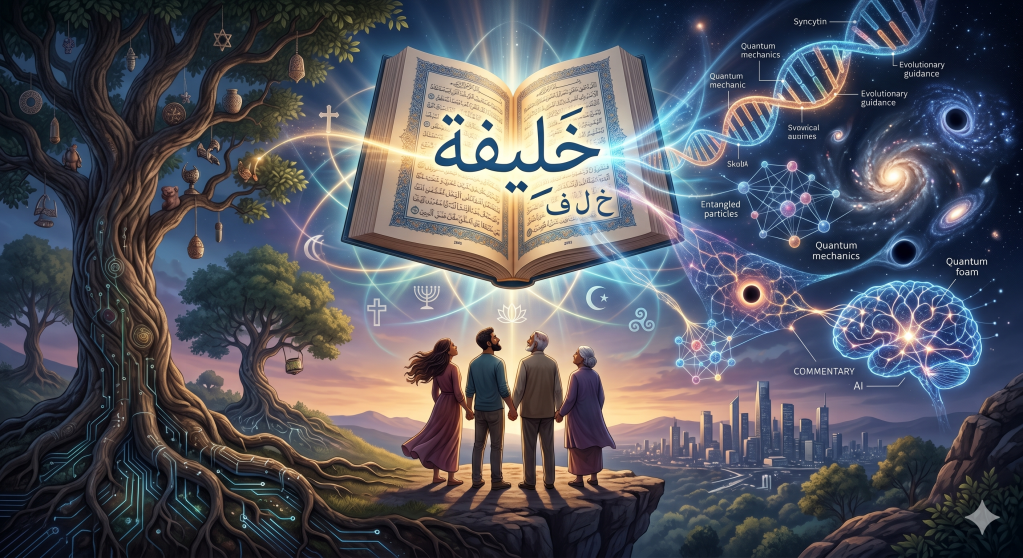
Audio teaser: From Ancient Caliphs to Modern Environmentalism:
Presented by Gemini
Abstract
This study provides a comprehensive linguistic and theological examination of the triliteral root kh-l-f (خ ل ف) within the Quranic corpus, where it occurs exactly 127 times across 18 distinct derived morphological forms. At the center of this semantic system are the nine occurrences of the nominal form khalīfah (خَلِيفَة) and its plurals, khulafā’ (خُلَفَاء) and khalā’if (خَلَائِف). By analyzing classical Arabic lexicography—including the vocalic distinction between the terms khalf (corrupt descendants) and khalaf (righteous successors)—this report traces the semantic development of the root from basic physical succession to highly structured models of divine delegation, temporal governance, and ecological stewardship. This academic inquiry explores how physical alternation in the natural world mirrors the moral trial of human agency, while also addressing the historical, sectarian, and environmental debates surrounding this key vocabulary in Islamic theology.
Morphological Architecture and Derived Forms of the Root
The Quranic text utilizes the triliteral root kh-l-f to denote sequence, replacement, delegation, opposition, and divergence. Across its 127 occurrences, the root is articulated through a diverse matrix of verbs, nouns, participles, and verbal nouns. This linguistic variation demonstrates the dynamic nature of classical Arabic, wherein a single semantic core is modified to convey distinct legal, historical, physical, and ethical realities.
To comprehend the linguistic framework of this root, the following table catalogs all 18 derived forms as recorded in the classical text, along with their frequencies and primary semantic focus:
| Morphological Category | Derived Arabic Form | Occurrences in Quran | Primary Semantic Focus & Contextual Gloss |
|---|---|---|---|
| Form I Verb | khalafa (خَلَفَ) | 5 | To succeed, replace, or come after another. |
| Form II Verb | khullifu (خُلِّفُ) | 1 | To be left behind or have judgment deferred. |
| Form III Verb | yukhālifu (يُخَالِفُ) | 2 | To actively oppose, contradict, or differ from. |
| Form IV Verb | akhlafu (أَخْلَفُ) | 14 | To break a promise, fail an agreement, or compensate. |
| Form V Verb | yatakhallafu (يَتَخَلَّفُ) | 1 | To remain behind or fail to join an endeavor. |
| Form VIII Verb | ikh’talafa (ٱخْتَلَفَ) | 35 | To differ, engage in disputation, or vary in form. |
| Form X Verb | is’takhlafa (ٱسْتَخْلَفَ) | 5 | To establish as a successor or grant authority. |
| Noun | khilāf (خِلَٰف) | 6 | Structural opposition, physical behind, or contrariwise. |
| Nominal | khalf (خَلْف) | 22 | Physical space behind, or temporal sequence after. |
| Noun | khil’fat (خِلْفَة) | 1 | Rhythmic succession or physical alternation. |
| Noun | khalīfat (خَلِيفَة) | 9 | Delegated successor, ruler, or custodian (includes plurals). |
| Noun | khawālif (خَوَالِف) | 2 | Those who remain behind (historically excused from battle). |
| Active Participle | khālifīn (خَٰلِفِين) | 1 | Those who are physically remaining or lagging behind. |
| Form II Passive Participle | mukhallafūn (مُخَلَّفُون) | 4 | Those left behind or excluded from an expedition. |
| Form IV Active Participle | mukh’lif (مُخْلِف) | 1 | One who fails to keep a covenant or promise. |
| Form VIII Verbal Noun | ikh’tilāf (ٱخْتِلَٰف) | 7 | Diversity, variation, or the alternation of natural phenomena. |
| Form VIII Active Participle | mukh’talif (مُّخْتَلِف) | 10 | Diverse, varying in color, type, or theological stance. |
| Form X Passive Participle | mus’takhlafīn (مُّسْتَخْلَفِين) | 1 | Those made custodians or entrusted with wealth. |
This structural mapping reveals a profound linguistic symmetry. The root moves between spatial positions (being physically “behind” or “after”), natural variations (the alternation of day and night), ethical actions (breaking a covenant, opposing guidance, or lagging behind in moral duty), and sociopolitical elevation (being established as successors or custodians on Earth). Consequently, the morphological derivatives of kh-l-f are not merely grammatical variations, but rather a cohesive vocabulary that links physical order with moral accountability.
Lexicographical Distinctions: The Phonetic and Semantic Split of Khalf and Khalaf
In classical Arabic lexicography, particularly within authoritative works such as Ibn Manzur’s Lisan al-Arab and Al-Raghib al-Isfahani’s Mufradat Alfadh al-Quran, the vocalization of derivatives from kh-l-f marks crucial semantic distinctions. A prime example of this semantic shift occurs in the vocalic alteration between the nouns khalf (خَلْف) and khalaf (خَلَف). Although both terms physically denote that which comes after or succeeds, classical philologists maintain a strict division based on the moral quality of the succession.
The classical consensus establishes that the term khalaf (vocalized with a fatḥah on the second radical, Laˉm) is reserved for a worthy, righteous, and noble replacement or successor. It signifies a generation or individual who preserves the legacy, virtues, and covenants of their predecessors. Conversely, the term khalf (vocalized with a sukūn on the second radical, Laˉm) is used to designate an unworthy, corrupt, or degenerated successor. It refers to descendants who squander their heritage, neglect their duties, and violate established covenants.
This precise lexicographical rule is directly mirrored in the Quranic narrative. In Surah Al-A’raf, the text describes the moral decline of a community, stating that there succeeded after them an evil generation (khalf) who inherited the Book, but chose the fleeting goods of this low life. Similarly, in Surah Maryam, a comparable decline is identified where a generation (khalf) succeeded who neglected prayer and followed lusts. In both instances, the use of the sukūn serves as a phonetic and semantic marker of moral decay, distinguishing these figures from worthy heirs (khalaf).
This linguistic paradigm is so deeply embedded in Semitic culture that it extends into traditional personal names like Khalfan, which signifies a successor or heir, carrying connotations of legacy and continuity within Arab and Swahili contexts. Through this subtle vocalic shift, classical Arabic demonstrates how morphological adjustments can convey profound ethical judgments, transforming a basic description of lineage into an evaluation of a generation’s spiritual integrity.
Exegetical Breakdown of the Nine Noun Occurrences of Khalīfah, Khulafā’, and Khalā’if
The noun khalīfah and its direct plurals, khulafā’ and khalā’if, appear exactly nine times in the Quranic text. While the modern political term “Caliphate” (khilāfah) does not appear in the Quran, these nine occurrences lay the theological and conceptual foundations for human authority, delegation, and historical succession.
The following table outlines these nine occurrences, detailing their structural forms, locations, and primary exegetical themes:
| Surah and Verse | Specific Arabic Term | Grammatical Form | Primary Exegetical Theme & Narrative Context |
|---|---|---|---|
| QS 2:30 | khalīfah (خَلِيفَةً) | Singular Noun | The primordial appointment of humanity/Adam on Earth, prompting angelic questioning regarding potential corruption and bloodshed. |
| QS 38:26 | khalīfah (خَلِيفَةً) | Singular Noun | The functional appointment of David as a prophet-king tasked with implementing absolute justice and avoiding personal desire. |
| QS 7:69 | khulafā’ (خُلَفَاءَ) | Plural Noun | Historic succession granted to the people of ‘Aad after the destruction of the generation of Noah. |
| QS 7:74 | khulafā’ (خُلَفَاءَ) | Plural Noun | Historic succession granted to the people of Thamud after the decline of ‘Aad, emphasizing physical construction and the warning against land corruption. |
| QS 27:62 | khulafā’ (خُلَفَاءَ) | Plural Noun | The universal human experience of divine relief during distress, establishing humanity as inheritors and protectors of the Earth. |
| QS 6:165 | khalā’if (خَلَائِفَ) | Plural Noun | Collective human succession across generations, with differing social ranks established to serve as a divine test. |
| QS 10:14 | khalā’if (خَلَائِفَ) | Plural Noun | Post-destruction succession, where newer generations are positioned to have their actions observed and evaluated. |
| QS 10:73 | khalā’if (خَلَائِفَ) | Plural Noun | The physical survival and succession of Noah’s ark companions after the drowning of the deniers. |
| QS 35:39 | khalā’if (خَلَائِفَ) | Plural Noun | Sovereign human presence on Earth, where individual choices of belief or disbelief carry personal and generational consequences. |
Classical commentators, such as Al-Tabari, Al-Zamakhshari, and Al-Tusi, draw a functional distinction between the two plural forms, khulafā’ and khalā’if. The term khulafā’ is consistently utilized when referring to specific, localized historical groups or civilizations that physically replaced prior dominant societies. For instance, the people of ‘Aad succeeded Noah’s generation (QS 7:69), and the people of Thamud succeeded the ‘Aad (QS 7:74). This term emphasizes the physical inheritance of land, structures, and regional power, serving as a warning that material dominance is contingent upon moral behavior.
Conversely, the term khalā’if is applied in a broader, universal, and cross-generational sense. It describes the perpetual human condition: the continuous cycle of births, deaths, and civilizational shifts across the entire planet. As highlighted in Surah Al-An’am (QS 6:165) and Surah Yunus (QS 10:14), this form of succession is not merely a historical transition of power, but a universal moral test. It positions humanity as a collective trustee of the natural world, indicating that physical dominance is not absolute ownership, but a delegated responsibility subject to divine assessment.
Semantic Mapping of Key Derived Forms: Alternation, Promise, and Divergence
The remaining occurrences of the 127 root uses in the Quran demonstrate how kh-l-f builds a comprehensive theological framework where physical natural laws are linked to human moral choices. By looking closely at the verbs, participles, and verbal nouns derived from this root, one observes how the physical idea of sequence is elevated into a system of cosmic balance and divine promises.
Physical Succession and Cosmic Alternation
The single occurrence of the noun khil’fat (خِلْفَة) in Surah Al-Furqan provides the physical foundation for the entire root, stating that God made the night and the day in succession (khil’fat) for whoever desires to remember or show gratitude (QS 25:62). Here, the cosmic cycle of day and night represents a physical transition where one replaces the other in perfect equilibrium. This physical alternation mirrors the biological transition of human generations, showing that both natural cycles and human lifespans are designed to encourage spiritual reflection and gratitude.
This spatial dimension is further emphasized by the nominal form khalf (خَلْف), which appears 22 times in the Quran, often meaning “behind” or “after”. For example, in Surah Ar-Ra’d, the text mentions that every human has guardian angels in front of him and behind him (min khalfihi), protecting him by God’s command (QS 13:11). In Surah Yunus, Pharaoh’s body is preserved so that he may be a sign for those who come after him (li-man khalfaka) (QS 10:92). These spatial and historical uses show that human life is positioned within a specific physical space and historical sequence, where actions are shaped by the past and carry consequences for the future.
The linguistic structure of this root also displays interesting quantitative patterns in the classical text. Computational studies of Quranic orthography show that letters associated with this root, such as the letter lām, are distributed with high precision across initialed chapters, mirroring the rhythmic patterns of classical spelling variations like al-layl (the night) and allātī (those who) found in early manuscripts.
The Reliability of Divine Promises
This physical regularity of cosmic succession stands in contrast to the moral choices of humanity, a theme highlighted by the 14 occurrences of the Form IV verb akhlafu (أَخْلَفُ). This form is primarily used to describe the act of breaking a promise, violating a covenant, or failing to meet an agreement. The Quran contrasts human unreliability with divine truthfulness, repeatedly emphasizing that God never fails His promise (lā yukhlifu al-mī’ād) (QS 3:9, 13:31, 39:20). While human leaders and nations frequently break their oaths—such as the Israelites who broke their promise to Moses (QS 20:86) or Satan who admits to betraying his followers (QS 14:22)—the divine promise of ultimate justice and resurrection remains absolute.
Furthermore, the Form IV verb is used in a positive sense to mean “to compensate” or “to replace,” as seen in Surah Saba, which states that whatever charity is spent, God replaces it (fahuwa yukhlifuhu), for He is the best of providers (QS 34:39). This usage shows that while human breach of promise results in moral loss, divine replacement ensures that physical and spiritual sacrifice is always rewarded and restored.
Disputation and Intellectual Divergence
The ethical aspect of the root is further developed through the 35 occurrences of the Form VIII verb ikh’talafa (ٱخْتَلَفَ) and its related verbal noun ikh’tilāf (ٱخْتِلَٰف). These terms describe differences, disputes, and intellectual divergence. The Quran uses this form to describe human division over revelation, noting that communities often did not differ (mā ikhtalafū) until after knowledge had come to them, out of mutual rivalry (QS 45:17). This division is presented as a moral trial, with the assurance that God will judge between them on the Day of Resurrection concerning that wherein they used to differ (yakhtalifūna) (QS 22:69, 45:17).
However, the Quran also shows that difference is not always negative. In Surah Ar-Rum, the diversity of human languages and colors (ikh’tilāf alsinatikum wa-alwānikum) is described as a sign of divine creativity (QS 30:22). Similarly, the alternation of night and day (ikh’tilāf al-layl wa-al-nahār) is framed as an invitation to contemplation and mindfulness (QS 45:5). This distinction shows that while natural and linguistic diversity is a source of beauty and harmony, sectarian division and moral divergence represent a failure of human responsibility.
Theological Interpretations and Sectarian Divergences
The singular occurrences of khalīfah—namely in Surah Al-Baqarah (QS 2:30) and Surah Sad (QS 38:26)—have led to key theological discussions and sectarian developments within Islamic scholarship. These debates focus on the exact nature of this successorship: whom the successor replaces, and what authority this title grants.
The Primordial Appointment of Adam (QS 2:30)
In the dialogue of Surah Al-Baqarah, the Creator announces to the angels: “Indeed, I am going to place a successive authority (khalīfah) on earth”. This declaration leads to key theological questions:
The first question concerns the object of succession: whom does this khalīfah succeed? Early exegetes recorded by Al-Tabari and Ibn Kathir offer two primary views. One view suggests that human creation succeeded previous terrestrial inhabitants, such as the Jinn, who had corrupted the earth and shed blood, which explains the angels’ questioning. The other view, supported by Al-Qurtubi and Al-Baqillani, suggests that khalīfah refers to humans succeeding one another, generation after generation, establishing a continuous chain of human existence.
The second question concerns the concept of Divine Vicegerency (Khalīfat Allāh). Some classical scholars argue that the khalīfah acts as a direct representative of God on Earth to implement divine law and justice. However, traditionalists like Ibn Kathir caution against using the phrase Khalīfat Allāh (successor of God) in an absolute sense, arguing that succession (khilāfah) implies the absence or replacement of a predecessor, whereas God is ever-present. Instead, they prefer the term khalīfat rasūl Allāh (successor to the Messenger of God) or successors who implement the divine command in their lives.
The third question is the angelic anticipation of corruption. The angels’ response—asking if God would place a being who would “spread corruption therein and shed blood”—indicates they understood the implications of this new creation. Exegetes suggest the angels either drew this conclusion from the history of prior earthly creations, or understood that a physical being endowed with free will and desire would inevitably face moral struggle.
A final perspective is found in a notable linguistic variant of this passage. According to Zayd ibn Ali, the verse was also read as khaliqah (خَلِيقَة) meaning “creation” instead of khalīfah. This reading shifts the focus from a status of succession to the introduction of a new physical design on Earth, demonstrating how early scholars explored different semantic dimensions of the passage.
Prophetic Governance and Davidic Rule (QS 38:26)
In Surah Sad, the title of khalīfah is explicitly given to a historical prophet: “O David, indeed We have made you a successor (khalīfah) upon the earth, so judge between the people in truth…”.
Commentators such as Ibn Taymiyyah explain that David’s appointment represents both spiritual guidance (nubuwwah) and temporal leadership (imāmah). Here, the khalīfah is charged with the administration of justice, the defense of the oppressed, and the implementation of divine law. The title carries an explicit warning: the legitimacy of this authority depends entirely on adhering to truth (al-ḥaqq) and avoiding personal desire (al-hawā).
Sectarian Divergences in Succession Theory
The interpretation of these passages contributed directly to the political and theological division between Sunni and Shi’i scholarship.
In the Sunni exegetical model, scholarship historically linked the linguistic concept of successorship to the political and legal institution of the Caliphate (khilāfah). Citing QS 2:30, commentators like Al-Qurtubi argued for the collective obligation of the Muslim community to appoint a single leader (Imam or Caliph) to preserve unity, enforce the penal code, and administer the state. This political authority was viewed as a contract executed through human mechanisms such as consultation (shūrā), direct selection by a predecessor, or consensus (ijmā’).
In the Shi’i exegetical model, commentators reject the idea that true successorship can be established by human choice or political consensus. They argue that true successorship is a divine appointment of spiritual authority (wilāyah or imāmah). Under this framework, the true khalīfah must possess spiritual purity and infallibility (‘ismah), a status they maintain belongs exclusively to the Household of the Prophet (Ahl al-Bayt).
Shi’i scholars support this view with key traditions, such as the Hadith of the Two Weighty Things (Thaqalayn), where the Prophet leaves the Quran and his Ahl al-Bayt as guides that will never separate. They also cite the Hadith of the Ship (Safinah), which compares the Household of the Prophet to Noah’s Ark, asserting that those who follow them are saved, while those who turn away are lost. Thus, while the Sunni model developed a political theory of state governance around the term, the Shi’i model focused on a spiritual lineage of divine guides.
Dual Dimensions of Succession: Spiritual and Temporal Structures
A comprehensive analysis of Quranic usage reveals a structural division between two forms of successorship: the spiritual (al-khilāfah al-rūḥāniyyah) and the temporal (al-khilāfah al-dunyawiyyah). Understanding this division is critical to deciphering the moral framework the Quran applies to human authority.
Spiritual Successorship
Spiritual successorship is a divinely ordained position determined directly by God. It operates independently of worldly power structures and is divided into two distinct modes :
Direct divine appointment is the first mode, where God directly designates an individual as a prophet-steward, referred to as khalīfat Allāh (such as Adam in QS 2:30 or David in QS 38:26). This role is characterized by receiving direct revelation and possessing the spiritual authority to guide humanity.
Indirect prophetic succession is the second mode, which refers to leadership that succeeds a messenger, operating in accordance with prophetic principles. Known as khilāfah ‘alā minhāj al-nubuwwah (successorship upon the methodology of prophethood), this role focuses on preserving spiritual teachings and guiding the community of believers without claiming new prophecy.
Temporal Successorship
Temporal successorship refers to the physical dominion, political authority, and material wealth granted to various nations, dynasties, or individuals over time. This form of khilāfah is not a guarantee of spiritual approval, but rather a trial of moral character.
This distinction is illustrated in Surah Yunus, where the text states that God made people successors (khalā’if) in the land after their predecessors to observe how they would act (QS 10:14). Here, temporal authority is stripped of inherent sanctity; it is framed as a test of righteousness. Historic dynasties, whether righteous like Umar bin Abdul Aziz or unjust like certain ancient monarchs, participate in this temporal succession.
Reconciliation of Human Action and Divine Decree
A common theological question arises regarding this dual model: if a temporal successor is chosen through human processes (such as a council, election, or military transition), how can their appointment be attributed to divine action? Classical theology resolves this apparent contradiction through the principle of divine permit and consequence :
Human Choice (Agency)Historical ActionDivine Manifestation (Decree)
Under this theological logic, human efforts, debates, and selections serve as the physical means through which the ultimate will of God is realized in history. While humans exercise their free will and make choices, the resulting rise and fall of nations or leaders aligns with divine laws of cause and effect. Thus, temporal succession is both a human responsibility and a divine outcome, serving as a reflection of a society’s collective moral state.
Environmental Stewardship and Ecological Balance
In contemporary Islamic philosophy, the concept of khilāfah has emerged as a primary foundation for developing a comprehensive environmental ethic. Modern eco-theologians utilize the Quranic model of succession to reframe the relationship between humanity and the natural world, actively moving away from models of absolute dominion toward a model of ethical stewardship.
This ecological framework is built upon three interconnected Quranic principles :
The first is tawḥīd (divine oneness), which establishes the absolute unity of God and the interconnectedness of all created things. Because everything originates from a single Creator, the universe is viewed as a unified whole where every element possesses intrinsic value and purpose.
The second is mīzān (cosmic balance), representing the natural equilibrium and order established by God within creation. Humanity is warned not to disrupt, pollute, or damage this delicate balance, as doing so constitutes a violation of cosmic justice.
The third is amānah (the sacred trust), representing the moral responsibility and free will accepted by humanity. Under this framework, the Earth is not human property, but a trust held on behalf of the Creator, to whom all generation-by-generation stewards must eventually account.
By linking these concepts, the role of khalīfah shifts from an anthropocentric right to exploit resources to a moral obligation of preservation. The Quran repeatedly warns against causing fasād (corruption or destruction) upon the Earth, commanding believers not to cause corruption on the earth after it has been set in order (QS 7:56). Classical jurists, such as Al-Qurtubi, interpreted this as a broad prohibition against destroying natural resources, harming animal habitats, and polluting water supplies.
This stewardship is practically demonstrated in prophetic traditions, which mandate the preservation of water (prohibiting waste even when performing ablutions beside a flowing river), the planting of trees as an act of ongoing charity, and the establishment of ḥimā (conservation zones). Modern scholars like Fazlun Khalid have argued that the concept of khilāfah is the most important concept in Islamic environmentalism, as it reframes humanity’s authority as a delegated responsibility that comes with strict accountability. Thus, within this theological framework, caring for the environment, practicing sustainability, and protecting biodiversity are not merely modern choices, but central obligations of honoring the primordial covenant of khilāfah.
Thematic Epilogue
When traced through its 127 occurrences, the linguistic journey of the root kh-l-f reveals a systematic transition from physical descriptions of sequence to profound ethical lessons. At its most basic physical level, the root describes natural, recurring sequence. This physical alternation of day and night serves as a foundational signpost (āyah) of order, rhythm, and replacement, reminding humanity of a larger cosmic structure that operates independently of human desire.
From this physical rhythm, the Quran constructs a parallel model of historical and generational succession. Just as the day replaces the night, older generations depart to be succeeded by new ones. However, unlike the natural, passive movement of astronomical bodies, human succession is defined by moral agency and choice. The transition of societies is not a directionless historical process, but a deliberate trial of stewardship. Those who succeed previous nations must choose between two paths: they can become khalaf, worthy heirs who maintain justice, preserve the cosmic balance, and honor their covenants; or they can decline into khalf, unworthy successors who neglect spiritual values, engage in exploitation, and spread corruption across the Earth.
The ultimate purpose of the human appointment as khalīfah is to manifest divine justice within physical reality. By placing humanity on Earth as successive trustees, the Creator establishes a dynamic arena of moral accountability. Every generation inherits the physical and moral ledger of its predecessors, and every individual acts as a minor custodian over their immediate environment and choices. Ultimately, the linguistic architecture of the root kh-l-f serves to remind humanity that physical dominance is temporary. The alternation of civilizations, the transition of wealth, and the replacement of generations are all part of a larger divine design. True authority is not found in absolute ownership, but in a community’s ability to act as just, conscious, and responsible stewards of the trust they have been given.




Leave a Reply