
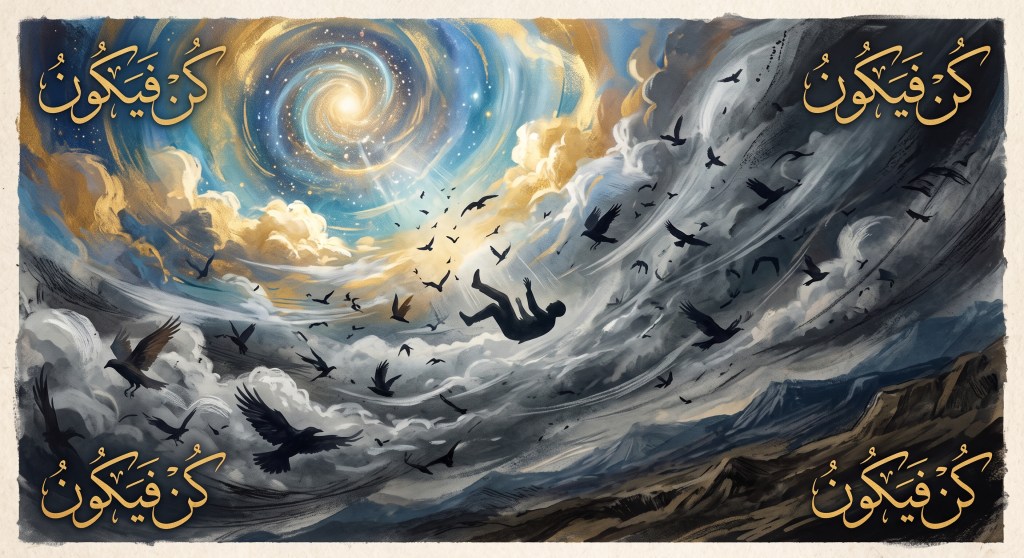
Presented by Claude for Zia H Shah MD
Abstract
Eight times the Qurʾān places on the divine tongue the shortest and most consequential of all creative formulas: كُنْ فَيَكُونُ — Kun fayakūn, “Be, and it is.” This commentary examines all eight occurrences (2:117; 6:73; 3:47; 3:59; 19:35; 16:40; 36:82; 40:68), quoting each verse in full vocalized Arabic with English translation, and reads them across three horizons. Scientifically, the formula resonates with the modern picture of a universe with a finite past (the Big Bang and the Borde–Guth–Vilenkin theorem), with the biology of the virgin birth (genomic imprinting), and with information-theoretic analogies for resurrection — always distinguishing responsible resonance from forced concordism. Philosophically, Kun fayakūn is the Qurʾān’s own statement of a divine-command metaphysics of creation, and it stands at the center of the great debate over creatio ex nihilo versus the eternal universe — the kalām cosmological argument of al-Kindī and al-Ghazālī against the necessitarian cosmos of the falāsifa (Ibn Sīnā, Ibn Rushd). Theologically, the classical mufassirūn (al-Ṭabarī, al-Rāzī, al-Qurṭubī, Ibn Kathīr) and the Ashʿarite–Muʿtazilite controversy over the nature of divine speech illuminate what it means for God to “say” Be; and the formula becomes the Qurʾān’s decisive answer to the divinization of Jesus (3:59; 19:35), set beside the biblical “Let there be light” (Genesis 1:3) and the Logos of John 1:1. The commentary culminates in a dedicated treatment of al-Ghazālī’s occasionalism — the doctrine, argued in the seventeenth discussion of the Tahāfut al-Falāsifa, that God is the only true cause and that fire does not burn cotton — as revived and developed for the modern era by Zia H. Shah, MD, whose “Inshallah Universe” and “Four Books of God” frameworks read Kun fayakūn as continuous creation: every instant of existence is God’s fresh command. A thematic epilogue ties creation, miracle, resurrection, and occasionalism into a single vision of a cosmos ceaselessly spoken into being.
I. Introduction: The Grammar of Omnipotence
The phrase kun fayakūn is built from the root k-w-n (كون), “to be, to become.” Kun is the imperative — “Be!” — and fayakūn is the imperfect indicative with the connective fa-: “and it is / and it comes to be.” Grammatically the formula is arresting: the response fayakūn is in the present-future tense rather than a past tense (fakāna, “and it was”). Classical grammarians and exegetes noticed this: the effect is not merely of a single completed act in the past but of an ongoing, ever-renewed bringing-into-being. The command and its fulfillment are inseparable; there is no gap, no tool, no labor, no delay between the divine will and the existence of the willed thing.
The eight verses cluster naturally into three themes, which structure this commentary:
- Cosmogony — the origination of the heavens and the earth (2:117; 6:73).
- The miraculous births of the prophets — the conception of Jesus without father and the creation of Adam (3:47; 3:59; 19:35) either through guided evolution or through direct creation as majority of the Muslims believed prior to Charles Darwin.
- The general divine decree — life, death, and resurrection (16:40; 36:82; 40:68).
Across all three, a single metaphysical claim recurs: that being is not self-standing but is continuously conferred by a sovereign, personal will.
II. The Creation of the Heavens, the Earth, and the Universe
Sūrat al-Baqarah 2:117
بَدِيعُ ٱلسَّمَٰوَٰتِ وَٱلْأَرْضِ ۖ وَإِذَا قَضَىٰ أَمْرًا فَإِنَّمَا يَقُولُ لَهُۥ كُن فَيَكُونُ
“Originator of the heavens and the earth. When He decrees a matter, He only says to it, ‘Be,’ and it is.” surah
The verse opens with بَدِيع (Badīʿ), a divine name meaning “the Originator” — one who brings forth without prior model or precedent. The Arabic ibdāʿ connotes creation ex nihilo, without pre-existing pattern, in contrast to khalq (fashioning) which can operate on existing matter. Al-Ṭabarī and al-Rāzī note that Badīʿ signifies bringing the heavens and earth into existence with no antecedent likeness. This is the Qurʾān’s most direct affirmation of origination without template.
Scientific horizon. For most of the twentieth century, the reigning cosmological intuition — shared by Aristotle and by many modern physicists — was that the universe is eternal. The overturning of that assumption is among the most striking developments of modern science. The standard Hot Big Bang model, derived from the Friedmann–Lemaître solutions to general relativity, describes a universe that “came into being a finite time ago,” and, as William Lane Craig underscores, “the origin it posits is an absolute origin ex nihilo. For not only all matter and energy but also space and time themselves come into being at the initial cosmological singularity.” Substack The 2003 Borde–Guth–Vilenkin (BGV) theorem strengthened this: on very general assumptions, any universe that is on average expanding cannot be past-eternal but must have a boundary — a beginning. Alexander Vilenkin’s much-quoted verdict, in his 2006 book Many Worlds in One, is: “It is said that an argument is what convinces reasonable men and a proof is what it takes to convince even an unreasonable man. With the proof now in place, cosmologists can no longer hide behind the possibility of a past-eternal universe. There is no escape: they have to face the problem of a cosmic beginning.”
Two cautions preserve intellectual honesty. First, the BGV theorem is a classical result about expanding spacetimes; it points to where known physics breaks down (the singularity) and explicitly notes that “physics other than inflation” is needed to describe that boundary. Speculative quantum-gravity, cyclic, and multiverse models continue to be proposed. Second, a scientific “beginning” is not identical to the theological ibdāʿ; the concordance is a resonance, not a proof. Nonetheless, the shift from an assumed eternal cosmos to a cosmos with a finite past has made the Qurʾānic and kalām picture of an originated universe scientifically respectable in a way it was not a century ago.
Philosophical horizon. Verse 2:117 is, in nucleus, the kalām cosmological argument. Developed by the ninth-century philosopher al-Kindī and given its classic form by al-Ghazālī in the eleventh century, the argument runs: whatever begins to exist has a cause; the universe began to exist; therefore the universe has a cause. philosophersmag Al-Ghazālī argued against the possibility of an actual infinite regress of past events: if the chain of causes stretched infinitely into the past, the present moment would never be reached; since it has been reached, the past must be finite and the universe created. philosophersmag Craig revived this argument for contemporary philosophy in his 1979 The Kalām Cosmological Argument, epfl arguing that the cause of the universe must be “beginningless, changeless, immaterial, timeless, spaceless and enormously powerful” bme — and personal, since only a free agent can produce a temporal effect from a changeless state. That last point is precisely the force of kun: the beginning of the universe is not an impersonal emanation but a decree, an act of will.
Sūrat al-Anʿām 6:73
وَهُوَ ٱلَّذِي خَلَقَ ٱلسَّمَٰوَٰتِ وَٱلْأَرْضَ بِٱلْحَقِّ ۖ وَيَوْمَ يَقُولُ كُن فَيَكُونُ ۚ قَوْلُهُ ٱلْحَقُّ ۚ وَلَهُ ٱلْمُلْكُ يَوْمَ يُنفَخُ فِى ٱلصُّورِ ۚ عَٰلِمُ ٱلْغَيْبِ وَٱلشَّهَٰدَةِ ۚ وَهُوَ ٱلْحَكِيمُ ٱلْخَبِيرُ
“And it is He who created the heavens and the earth in truth. And the day He says, ‘Be,’ and it is, His word is the truth. And His is the dominion the Day the Horn is blown. Knower of the unseen and the witnessed; and He is the Wise, the Aware.” surahquran
Here kun fayakūn is coupled with بِٱلْحَقِّ (bi’l-ḥaqq), “in truth / with purpose.” Creation is not frivolous or random but purposive and grounded in reality. The verse then extends the creative command forward to the eschaton — “the Day the Horn is blown” — binding the first creation to the re-creation of the Resurrection under one and the same word.
Scientific horizon. The phrase bi’l-ḥaqq — creation with truth, order, and purpose — invites reflection on the fine-tuning of the physical constants. The values of the fundamental parameters (the strength of gravity, the cosmological constant, the ratios governing nuclear physics) fall within extraordinarily narrow ranges compatible with the existence of stable structures, chemistry, and life. Whether one reads fine-tuning as evidence of design, as an artifact of a multiverse, or as brute fact remains contested; but the Qurʾānic insistence that the cosmos is made bi’l-ḥaqq — lawful, ordered, non-arbitrary — is congruent with the deep intelligibility of nature that makes science itself possible. The regularities we call “laws of nature” are, on this reading, the reliable word of a wise Creator.
Theological horizon. Al-Qurṭubī emphasizes that the dominion (mulk) on the Day of Resurrection belongs to God alone, and that His word is al-ḥaqq — self-realizing truth. quranworld The verse thus does double duty: it is a cosmogonic statement and an eschatological one, establishing the identity of the God who first said Be with the God who will say it again over the resurrected dead.
III. The Miraculous Births of the Prophets
Three of the eight verses deploy kun fayakūn not for the cosmos but for the human body — specifically for two births that break the ordinary chain of biological causation: the fatherless conception of Jesus and the parentless creation of Adam in the conservative view and through guided evolution in the contemporary view of Zia H Shah MD.
Sūrat Āl ʿImrān 3:47
قَالَتْ رَبِّ أَنَّىٰ يَكُونُ لِى وَلَدٌ وَلَمْ يَمْسَسْنِى بَشَرٌ ۖ قَالَ كَذَٰلِكِ ٱللَّهُ يَخْلُقُ مَا يَشَآءُ ۚ إِذَا قَضَىٰ أَمْرًا فَإِنَّمَا يَقُولُ لَهُۥ كُن فَيَكُونُ
“She said, ‘My Lord, how will I have a child when no man has touched me?’ [The angel] said, ‘Such is Allah; He creates what He wills. When He decrees a matter, He only says to it, “Be,” and it is.’” surahquran
Mary’s question is precisely the question of biology: how can there be conception without a father? The answer does not offer a mechanism; it relocates the event from the order of secondary causes to the order of the direct divine command.
Scientific horizon. Modern biology makes the miracle sharper, not softer. Natural parthenogenesis — virgin birth — occurs in some reptiles, fish, and insects, but is impossible in mammals because of genomic imprinting. mentalfloss As the geneticist Jenny Graves of La Trobe University explains, “there are more than 30 imprinted genes that are active only if they come from a father through sperm. There are another 30-plus that are active only if they come from the mother.” The correct combination of maternal and paternal imprints is required for a viable embryo and, crucially, for placental development: “an egg with two maternal nuclei goes some of the way to making an embryo, but it shrivels up because there is little development of placenta.” Graves’ conclusion is categorical: “genomic imprinting prevents virgin birth in all mammals, including humans.” theconversation Scientists have engineered viable mice from two mothers only by artificially editing the imprinting marks. sciencemediacentre The upshot for the commentator is not that science “explains” the virgin birth — it does the opposite: it shows that a healthy fatherless human birth is not a mere gap in current knowledge but a barrier written into mammalian genetics. The Qurʾān presents it exactly as such: an event that suspends the ordinary law, produced by kun and God’s ultimately complete mastery of all of creation as suggested in Al Ghazali’s Occasionalism.
Sūrat Āl ʿImrān 3:59
إِنَّ مَثَلَ عِيسَىٰ عِندَ ٱللَّهِ كَمَثَلِ ءَادَمَ ۖ خَلَقَهُۥ مِن تُرَابٍ ثُمَّ قَالَ لَهُۥ كُن فَيَكُونُ
“Indeed, the likeness of Jesus to Allah is like that of Adam. He created him from dust; then He said to him, ‘Be,’ and he was.” quranworld
This is the Qurʾān’s central argument against the divinity of Jesus, and it is an a fortiori argument. Ibn Kathīr and al-Ṭabarī explain: if a miraculous origin proved divinity, then Adam — created with neither father nor mother, from dust — would have a greater claim to be “son of God” than Jesus, who at least had a mother. Since no one deifies Adam, the fatherless birth of Jesus cannot establish his divinity. The very same word — kun — that created Adam from dust created Jesus in the womb of Mary. Both are creatures of the command, not sharers in the commander.
Scientific horizon. The verse’s “from dust” (min turāb) has invited reflection on the chemistry of life: the elements of the human body (carbon, oxygen, hydrogen, nitrogen, calcium, phosphorus) are indeed the common elements of the earth’s crust and of stellar nucleosynthesis. One should not over-read this — the verse is theological, not a chemistry lesson — but the motif of humanity formed from ordinary matter, then animated by the divine command, maps intelligibly onto the scientific picture of life assembled from non-living elements. Al-Ghazālī himself, remarkably, in the Tahāfut uses the ordinary developmental sequence — “Dust and all other elements are transformed into plants … plants are transformed into blood. Blood becomes sperm. Sperm fertilises the womb, and develops into a living being” ghazali — to argue that God, who rotates matter through these phases over a long time, has the power to accelerate the same process into a miracle.
Sūrat Maryam 19:35
مَا كَانَ لِلَّهِ أَن يَتَّخِذَ مِن وَلَدٍ ۖ سُبْحَٰنَهُۥٓ ۚ إِذَا قَضَىٰٓ أَمْرًا فَإِنَّمَا يَقُولُ لَهُۥ كُن فَيَكُونُ
“It is not befitting for Allah to take a son; exalted is He! When He decrees an affair, He only says to it, ‘Be,’ and it is.” quranworld
Where 3:59 argues from analogy, 19:35 states the conclusion as doctrine: divine sonship is metaphysically inappropriate to God (mā kāna lillāhi — “it does not befit God”). quranworld The One who creates by sheer command has no need of, and no ontological room for, biological generation. The word سُبْحَٰنَهُ (subḥānahu, “glory be to Him / exalted is He”) marks the transcendence that the notion of a “son” would compromise.
Theological horizon — Christian–Muslim dialogue. These verses (3:47, 3:59, 19:35) form the Qurʾān’s sustained response to the delegation of Christians of Najran and to Christological claims generally. The Qurʾānic logic is that the miraculous conception, far from proving Jesus divine, is itself the strongest demonstration of God’s unshared creative power: Jesus is the result of kun, therefore a creature. This can be set in respectful counterpoint to the Christian reading. In the prologue of John, the divine Word (Logos) is not a creature but the eternal agent through whom all things are made: “In the beginning was the Word, and the Word was with God, and the Word was God … all things were made through him” (John 1:1–3). Christians have historically connected the creative “And God said” of Genesis 1:3 — “Let there be light, and there was light” — to this eternal Word, identifying Christ with the divine speech that creates. The theological fork is precise and illuminating: both traditions hold that God creates by His Word; they divide over whether that Word is an eternal divine person (Christian Logos theology) or the sovereign command of the one indivisible God, under which even Jesus is created (Qurʾānic kun). The comparison with Genesis is instructive: the Hebrew va-yomer Elohim (“and God said”) kjvstudy and the Qurʾānic yaqūlu lahu kun share the same theology of effortless creation by decree, standing together against the ancient Near Eastern myths of creation by combat or sexual generation.
A note on divine speech. Does God literally utter the sound “kun“? Here the classical schools divide. The Muʿtazila held that God’s speech is created — sounds and letters brought into being — so that kun would be a created utterance. The Ashʿarites distinguished kalām nafsī (eternal, inner divine speech, an attribute of the essence) urd from kalām lafẓī (its articulated expression), holding the divine word to be uncreated and eternal. Al-Rāzī and others further observed that kun cannot be a literal temporal command addressed to a thing, because the thing does not yet exist to be commanded; the formula is therefore understood by many mufassirūn as a figurative expression of the immediacy and irresistibility of God’s creative will rather than as literal phonetic speech. (The later philosopher-mystic Mullā Ṣadrā and the modern exegete al-Ṭabāṭabāʾī extended this further, treating “all creation, which came into being with the existential word of ‘Be’,” as itself a level of divine speech.) This debate — over whether the creative word is literal utterance or the sheer efficacy of will — feeds directly into the metaphysics of occasionalism.
IV. The General Divine Decree: Life, Death, and Resurrection
The final three verses generalize the formula: from specific creations to the universal principle of divine action, and especially to the re-creation of the dead.
Sūrat an-Naḥl 16:40
إِنَّمَا قَوْلُنَا لِشَىْءٍ إِذَآ أَرَدْنَٰهُ أَن نَّقُولَ لَهُۥ كُن فَيَكُونُ
“Indeed, Our word to a thing when We intend it is but that We say to it, ‘Be,’ and it is.” surahquran
The immediate context is the mockery of resurrection by the deniers. Ibn Kathīr glosses: when God wills to raise and resurrect the dead, nothing can prevent Him — He need only say Be. The verse answers the incredulity of “who will revive these bones?” by pointing to the effortlessness of the command. It is also the one instance of the formula in the divine first-person plural (qawlunā, “Our word”; aradnāhu, “We intend it”), the plural of majesty underscoring sovereign authorship.
Sūrat Yā-Sīn 36:82
إِنَّمَآ أَمْرُهُۥٓ إِذَآ أَرَادَ شَيْـًٔا أَن يَقُولَ لَهُۥ كُن فَيَكُونُ
“His command is only when He intends a thing that He says to it, ‘Be,’ and it is.” quranworld
This is perhaps the most famous of the eight. It concludes Sūrat Yā-Sīn’s climactic argument for the Resurrection, which begins with the man who asks, holding up a decayed bone, “Who will give life to bones while they are disintegrated?” The sura answers: the One who first created them, who “produces fire for you from the green tree,” whose command over life and matter is total. Al-Qurṭubī notes that this refutes the idea that creation requires time or effort. أَمْرُهُ (amruhu, “His command / His affair”) ties the creative word to the divine will (irāda): intention and existence are joined without intermediary.
Scientific horizon — resurrection and information. Modern commentators, including physician-writers, have drawn an analogy between resurrection and information theory. The identity of a living organism is, at one level, a matter of information — the sequence and arrangement of its molecular and neural structure. The Qurʾān repeatedly grounds the plausibility of resurrection in the reality of first creation (“As We began the first creation, We will repeat it,” 21:104). If the pattern that constitutes a person is fully known to the Creator (“We know what the earth diminishes of them, and with Us is a retaining record,” 50:4), then re-instantiation of that pattern is, in principle, not incoherent — much as information can be preserved and restored across a change of physical substrate. This is an analogy, not a demonstration, and must not be pressed into a literal mechanism; but it renders the Qurʾānic argument — He who made it the first time can remake it — conceptually intelligible in contemporary terms.
Sūrat Ghāfir (al-Muʾmin) 40:68
هُوَ ٱلَّذِى يُحْىِۦ وَيُمِيتُ ۖ فَإِذَا قَضَىٰٓ أَمْرًا فَإِنَّمَا يَقُولُ لَهُۥ كُن فَيَكُونُ
“It is He who gives life and causes death; and when He decrees a matter, He but says to it, ‘Be,’ and it is.” quranworld
Here the formula is bound explicitly to يُحْىِ وَيُمِيتُ (yuḥyī wa yumīt, “He gives life and causes death”). Ibn Kathīr’s abridged commentary connects this verse directly to 36:82: God’s intending “to give life, cause death, and resurrect is also like that” — a single command. Life and death are not autonomous natural processes but direct divine acts. This is the theological doorway to occasionalism: if giving life and causing death are the direct work of God’s command, and if — as the next section argues — all events are so, then the entire causal fabric of the world is the moment-by-moment enactment of kun fayakūn.
V. Al-Ghazālī’s Occasionalism: Kun Fayakūn as Continuous Creation
The doctrine and its classic argument
Occasionalism is the doctrine that God is the only true cause (al-ʿilla al-ḥaqīqiyya), and that what we call natural causes are merely the “occasions” on which God directly produces effects. The regularities we perceive as causation are God’s habit (ʿāda, sunnat Allāh), not a necessary connection inhering in things. The most famous exposition is the seventeenth discussion of al-Ghazālī’s Tahāfut al-Falāsifa (The Incoherence of the Philosophers, c. 1095), titled “Refutation of their belief in the impossibility of a departure from the natural course of events.”
Al-Ghazālī opens with a thesis of startling clarity: “the connection between what are believed to be the cause and the effect is not necessary.” ghazalighazali Taking the burning of cotton by fire as his example, he argues:
“We say that it is God who — through the intermediacy of angels, or directly — is the agent of the creation of blackness in cotton … Fire, which is an inanimate thing, has no action. How can one prove that it is an agent? The only argument is from the observation of the fact of burning at the time of contact with fire. But observation only shows that one is with the other, not that it is by it.” ghazalighazali
This is the decisive move: observation reveals conjunction, not causation. We see burning with contact; we never see the causal power itself. Fire has no inherent agency; God creates the burning aryaakasha on the occasion of the contact, vlatkovedral according to His customary pattern, and could refrain — as He did when Abraham was thrown into the fire and it was made “coolness and safety” (21:69). Al-Ghazālī defends this against the charge of absurdity (that it would make the world unpredictable) by his doctrine of God’s ʿāda: God has “created for us the knowledge that He would not do these things, although they are possible,” ghazali so that the ordinary course is reliable precisely because God reliably maintains it — not because things have autonomous natures.
This occasionalism did not originate with al-Ghazālī; it develops the atomism of the earlier Ashʿarite school, in which the world is composed of atoms and accidents that do not endure but are re-created by God at every instant fountainmagazine — an “atomism of time” in which God “creates a new world every moment that is not causally connected to the one in the moment before.” Kun fayakūn is the scriptural ground of this vision: existence is not a possession things hold but a gift renewed at every instant by the ongoing command Be.
The great debate: al-Ghazālī vs. Ibn Rushd
Ibn Rushd (Averroes) replied in his Tahāfut al-Tahāfut (The Incoherence of the Incoherence), defending Aristotelian causality and warning that denying real natures and necessary causes would destroy the intelligibility of the world and, with it, science and even the knowledge of God through His effects. The dispute frames a perennial tension: Ibn Rushd prizes the demonstrative science that requires stable natures; al-Ghazālī prizes the absolute divine freedom that miracles and the Qurʾānic kun require. Modern scholarship (Marmura, Frank, Griffel) debates how thoroughgoing al-Ghazālī’s occasionalism actually was — Frank Griffel argues that al-Ghazālī remained “uncommitted” as to whether God acts by occasionalism or through secondary causes, and even that he was “the first Muslim theologian who actively promotes the naturalization of the philosophical tradition into Islamic theology.” But the seventeenth discussion remains, as Griffel concedes, “the locus classicus for an occasionalist critique of the concept of causality.” (It is worth noting that a competing scholarly reading, associated with Lenn Goodman, holds that al-Ghazālī denied only the necessity of the cause–effect link, not the existence of observed worldly causation.)
The Western parallels: Malebranche and Hume
Occasionalism reappears in early modern Europe. Nicolas Malebranche (1638–1715) argued, on grounds partly Cartesian and partly theological, that finite things cannot be true causes at all; God is the sole genuine cause, and creatures are merely “occasional causes.” David Hume (1711–1776), though no theist in this matter, arrived by empirical analysis at a conclusion strikingly parallel to al-Ghazālī’s: we never observe a necessary connection between cause and effect, only constant conjunction and the habit of expectation it breeds in the mind. darulqasim The Oxford physicist Vlatko Vedral notes the convergence directly: “Al-Ghazali – in a remarkable anticipation of David Hume some seven centuries later – maintained that material things cannot be considered causes of things that happen in the universe. The ultimate cause is always God.” The parallel is exact on the epistemology (conjunction, not connection, is all we observe) and divides only on the metaphysics (for al-Ghazālī and Malebranche the missing necessity is supplied by God; for Hume it is supplied by nothing).
The quantum resonance and the modern revival by Zia H. Shah, MD
In the modern era, this doctrine has been most systematically reintroduced and developed for a scientific readership by Zia H. Shah, MD, a physician-writer, in an extensive series of articles on his site The Glorious Quran and Science (thequran.love), collected under the category “Occasionalism.” Shah’s project is to show that al-Ghazālian occasionalism, far from being a medieval relic, is uniquely suited to the age of quantum physics, and that kun fayakūn names a continuous creation: God does not merely start the universe and withdraw but sustains every moment of existence by an ever-renewed command. His body of work on the theme is substantial, ranging across articles such as “Dr. Zia H. Shah’s Occasionalism: A Comprehensive Synthesis,” “The Ontological Architecture of Occasionalism,” and “The Omnipresent Sustainer: An Exhaustive Scientific, Philosophical, and Theological Defense of Al-Ghazalian Occasionalism in the Quantum Age.”
Several of Shah’s signature frameworks organize this reading:
- The “Inshallah Universe.” In articles such as “Quantum Interpretations and the Ghazalian Inshallah Universe” and “The Inshallah Universe and the Boundaries of the Will” (a commentary on Qurʾān 8:24, 76:30, and 81:29), Shah frames reality as radically contingent at every instant on the divine will — the universe is literally an “if-God-wills” universe, in which nothing has independent, self-standing existence, and each moment is conferred anew.
- The “Four Book Thesis” / “Four Books of God.” In “From Quantum Realities to ‘Four Book Thesis’ and ‘Inshallah Universe’” and “The Thunder That Glorifies,” thequran Shah reads nature, scripture, and the other “books” of God as complementary disclosures of the one Author, so that the laws of physics are the legible handwriting of the continuously creating God.
- Laws of nature as divine habit. In “The Quantum Multiplicity and the Divine Habit: An Occasionalist Paradigm of Theoretical Physics,” thequran Shah identifies the “laws of nature” with God’s ʿāda / sunnat Allāh — reliable custom rather than autonomous necessity — exactly al-Ghazālī’s move, now applied to physical law.
- The divine names of power. In “The Metaphysical and Physical Architecture of Divine Omnipotence: Al-Qadir, Al-Qadeer, and Al-Muqtadir,” thequran Shah grounds occasionalism in the divine attributes of power (qudra), so that the sole efficient agency in the cosmos is God’s.
- Human freedom preserved. In “The Ever-Present God: Al-Ghazālī’s Occasionalism as Presented by Zia H. Shah, MD,” he frames the doctrine as “a defense of divine participation without denying human free will,” addressing the standard objection that occasionalism reduces humans to puppets.
The scientific linchpin of Shah’s argument is the analogy — first drawn by Karen Harding in her 1993 paper “Causality Then and Now: Al-Ghazali and Quantum Theory” (The American Journal of Islamic Social Sciences, vol. 10, no. 2, July 1993) — between occasionalism and the Copenhagen interpretation of quantum mechanics. Harding argues that in both al-Ghazālī’s occasionalism and the Copenhagen interpretation, “objects are viewed as having no inherent properties and no independent existence. In order for an object to exist, it must be brought into being either by God (al-Ghazali) or by an observer (the Copenhagen Interpretation).” She adds that the relationships “commonly referred to as causal are a result of God’s habits rather than because one event inevitably leads to another. God creates everything in the universe continuously; if He ceased to create it, it would no longer exist.” Quantum indeterminacy — the breakdown of classical determinism, the absence of definite properties prior to measurement, the probabilistic rather than necessitated character of events — is, for Shah, precisely the “gap” in natural necessity that al-Ghazālī’s God fills: what looks like intrinsic randomness at the quantum level is the space of divine action, the moment-by-moment kun.
Shah’s synthesis thus reads all eight kun fayakūn verses as a single doctrine: the creation of the cosmos (2:117; 6:73), the miraculous births (3:47; 3:59; 19:35), and the giving of life, death, and resurrection (16:40; 36:82; 40:68) are not eight isolated interventions but eight windows onto one continuous reality — a God who at every instant, over every atom, speaks Be, and it is.
Assessment
Occasionalism is not without cost. Its critics, from Ibn Rushd onward, warn that it threatens the intelligibility of science and the reality of human agency; if God is the only cause, in what sense do we act, and in what sense does the world have discoverable laws? Al-Ghazālī’s answer — that God’s habit is reliable, and that this reliability is what science studies — preserves the practice of science while reinterpreting its metaphysics: the scientist charts the customary patterns of divine action. Shah, following this line and the Ashʿarite mainstream, argues that occasionalism secures rather than dissolves human moral responsibility. Whether one embraces full occasionalism, a mitigated version, or Ibn Rushd’s secondary causality, the doctrine performs an enduring service: it refuses to let the regularity of nature become a substitute for God, insisting that the laws themselves are held in being by the same will that first uttered kun.
VI. Thematic Epilogue: The Cosmos as Continuous Utterance
The eight verses of kun fayakūn trace an arc from the first instant of the heavens and the earth (2:117; 6:73), through the singular bodies of Adam and Jesus (3:47; 3:59; 19:35), to the universal facts of life, death, and the resurrection of all (16:40; 36:82; 40:68). Read together, they resolve into a single vision.
The beginning of the universe — now, after the Big Bang and the BGV theorem, a scientifically serious proposition rather than a mere article of faith — is the first kun: not an impersonal fluctuation but a decree. The miracles — the fatherless conception that mammalian genetics declares impossible, the creation of a man from dust — are not violations of a self-sufficient natural order but revelations that the order was never self-sufficient in the first place: the same command that upholds the ordinary suspends it at will. The resurrection is the last kun, the re-speaking of a pattern the Creator never forgot. And occasionalism is the metaphysical thread that binds all three: if the world has no causal power of its own — if fire does not burn and semen does not beget except as God creates burning and begetting on those occasions — then there is, strictly, no difference in kind between the “natural” and the “miraculous.” Both are kun fayakūn. The sunrise is as much a direct divine act as the parting of the sea; it only seems otherwise because God’s habit in the one is constant and in the other rare.
This is the unified vision that al-Ghazālī articulated against the philosophers, that Malebranche recovered and Hume unwittingly echoed, that the Copenhagen interpretation made newly thinkable, and that Zia H. Shah has gathered into his “Inshallah Universe”: a cosmos not wound up once and left to run, but continuously conferred — every electron, every heartbeat, every photon of starlight held in existence by a will that does not tire (2:255). The grammar of the formula says it exactly. It is not kun fakāna, “Be, and it was,” a finished act sealed in the past. It is kun fayakūn — “Be, and it is” — present tense, unfinished, ongoing. The universe is not a thing God made. It is a word God is still speaking.


Leave a Reply