
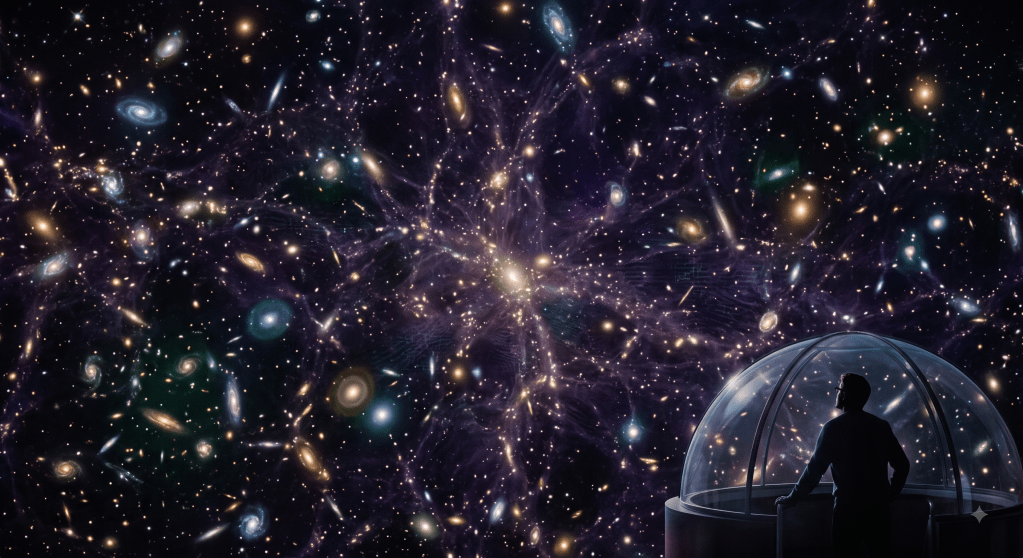
Presented by ChatGPT for Zia H Shah MD
Abstract
The final verse of Sūrat al-Ṭalāq is among the Qur’an’s most remarkable transitions from the intimate to the infinite. After regulating divorce, waiting periods, housing, maintenance, pregnancy, nursing, consultation, testimony, and financial responsibility, the sūrah concludes by declaring that Allah created “seven heavens and, of the earth, their like,” while His command continually descends among them. The placement is not accidental. The cosmic conclusion supplies the metaphysical foundation for the practical promises made earlier: whoever remains conscious of God will receive a way out, provision from an unforeseen source, sufficiency, ease, forgiveness, and magnificent reward.
Read by itself, 65:12 unambiguously affirms a plurality of “earths” under active divine government. Read with 42:29—which speaks of living creatures dispersed throughout both the heavens and the earth—the implication of extraterrestrial life becomes exceptionally strong. Verses 30:17–18 and 10:65–66 further portray the heavens as realms of praise, possession, knowledge, and perhaps conscious inhabitants. Modern astronomy does not prove this Qur’anic interpretation, but it has transformed it from an apparently fantastic speculation into a scientifically serious possibility: more than 6,000 exoplanets have been confirmed, our galaxy probably contains at least hundreds of billions of planets, and a widely cited model estimates approximately two trillion galaxies in the observable universe. Yet no life beyond Earth has been empirically confirmed. The proper conclusion is therefore carefully calibrated: the Qur’an speaks unmistakably of multiple earths and cosmic creatures, while science has discovered an immense planetary stage upon which such life could exist.
The surah’s central message is ultimately pastoral. The God whose knowledge encompasses every particle, planet, creature, and need across the cosmos is not overwhelmed by the disintegration of a marriage or the financial insecurity that follows it. The believer’s trust is not placed in an abstraction but in the Lord whose command governs every world.
Sūrat al-Ṭalāq: Arabic Text and a Contextual Translation
The following translation is a close rendering, drawing especially on M. A. S. Abdel Haleem while preserving the cosmic plurality and continuous divine government expressed in the Arabic. The complete Arabic text is included because the relationship between the final verse and everything preceding it is essential to the argument. The complete chapter may also be consulted at Quran.com.
Verse 1: Restraint, calculation, and the possibility of a new future
يَـٰٓأَيُّهَا ٱلنَّبِىُّ إِذَا طَلَّقْتُمُ ٱلنِّسَآءَ فَطَلِّقُوهُنَّ لِعِدَّتِهِنَّ وَأَحْصُوا۟ ٱلْعِدَّةَ ۖ وَٱتَّقُوا۟ ٱللَّهَ رَبَّكُمْ ۖ لَا تُخْرِجُوهُنَّ مِنۢ بُيُوتِهِنَّ وَلَا يَخْرُجْنَ إِلَّآ أَن يَأْتِينَ بِفَـٰحِشَةٍۢ مُّبَيِّنَةٍۢ ۚ وَتِلْكَ حُدُودُ ٱللَّهِ ۚ وَمَن يَتَعَدَّ حُدُودَ ٱللَّهِ فَقَدْ ظَلَمَ نَفْسَهُۥ ۚ لَا تَدْرِى لَعَلَّ ٱللَّهَ يُحْدِثُ بَعْدَ ذَٰلِكَ أَمْرًۭا
“O Prophet, when you divorce women, divorce them with due regard for their waiting period, and count the period accurately. Be conscious of God, your Lord. Do not expel them from their homes, nor should they leave, unless they commit a manifest indecency. These are God’s limits. Whoever transgresses God’s limits wrongs his own soul. You do not know: perhaps God may bring about a new situation after this.”
Verses 2–3: Honorable separation, testimony, the way out, and unexpected provision
فَإِذَا بَلَغْنَ أَجَلَهُنَّ فَأَمْسِكُوهُنَّ بِمَعْرُوفٍ أَوْ فَارِقُوهُنَّ بِمَعْرُوفٍۢ وَأَشْهِدُوا۟ ذَوَىْ عَدْلٍۢ مِّنكُمْ وَأَقِيمُوا۟ ٱلشَّهَـٰدَةَ لِلَّهِ ۚ ذَٰلِكُمْ يُوعَظُ بِهِۦ مَن كَانَ يُؤْمِنُ بِٱللَّهِ وَٱلْيَوْمِ ٱلْـَٔاخِرِ ۚ وَمَن يَتَّقِ ٱللَّهَ يَجْعَل لَّهُۥ مَخْرَجًۭا
وَيَرْزُقْهُ مِنْ حَيْثُ لَا يَحْتَسِبُ ۚ وَمَن يَتَوَكَّلْ عَلَى ٱللَّهِ فَهُوَ حَسْبُهُۥٓ ۚ إِنَّ ٱللَّهَ بَـٰلِغُ أَمْرِهِۦ ۚ قَدْ جَعَلَ ٱللَّهُ لِكُلِّ شَىْءٍۢ قَدْرًۭا
“When they approach the end of their term, either retain them honorably or separate from them honorably. Call two just persons from among you as witnesses, and give true testimony for God. This is an admonition for whoever believes in God and the Last Day. Whoever is conscious of God, He will make a way out for them and provide for them from where they could never have calculated. Whoever places trust in God, He is sufficient for them. God always brings His command to fulfillment; God has appointed a measure for everything.”
Verses 4–5: Vulnerability, ease, forgiveness, and reward
وَٱلَّـٰٓـِٔى يَئِسْنَ مِنَ ٱلْمَحِيضِ مِن نِّسَآئِكُمْ إِنِ ٱرْتَبْتُمْ فَعِدَّتُهُنَّ ثَلَـٰثَةُ أَشْهُرٍۢ وَٱلَّـٰٓـِٔى لَمْ يَحِضْنَ ۚ وَأُو۟لَـٰتُ ٱلْأَحْمَالِ أَجَلُهُنَّ أَن يَضَعْنَ حَمْلَهُنَّ ۚ وَمَن يَتَّقِ ٱللَّهَ يَجْعَل لَّهُۥ مِنْ أَمْرِهِۦ يُسْرًۭا
ذَٰلِكَ أَمْرُ ٱللَّهِ أَنزَلَهُۥٓ إِلَيْكُمْ ۚ وَمَن يَتَّقِ ٱللَّهَ يُكَفِّرْ عَنْهُ سَيِّـَٔاتِهِۦ وَيُعْظِمْ لَهُۥٓ أَجْرًا
“For those of your women who no longer menstruate, if you are uncertain, their waiting period is three months; the same applies to those who have not menstruated. The term of pregnant women ends when they deliver. Whoever is conscious of God, He will create ease within their affair. This is God’s command, which He has sent down to you. Whoever is conscious of God, He will erase their misdeeds and magnify their reward.”
Verses 6–7: Housing, maintenance, nursing, consultation, and proportional responsibility
أَسْكِنُوهُنَّ مِنْ حَيْثُ سَكَنتُم مِّن وُجْدِكُمْ وَلَا تُضَآرُّوهُنَّ لِتُضَيِّقُوا۟ عَلَيْهِنَّ ۚ وَإِن كُنَّ أُو۟لَـٰتِ حَمْلٍۢ فَأَنفِقُوا۟ عَلَيْهِنَّ حَتَّىٰ يَضَعْنَ حَمْلَهُنَّ ۚ فَإِنْ أَرْضَعْنَ لَكُمْ فَـَٔاتُوهُنَّ أُجُورَهُنَّ ۖ وَأْتَمِرُوا۟ بَيْنَكُم بِمَعْرُوفٍۢ ۖ وَإِن تَعَاسَرْتُمْ فَسَتُرْضِعُ لَهُۥٓ أُخْرَىٰ
لِيُنفِقْ ذُو سَعَةٍۢ مِّن سَعَتِهِۦ ۖ وَمَن قُدِرَ عَلَيْهِ رِزْقُهُۥ فَلْيُنفِقْ مِمَّآ ءَاتَىٰهُ ٱللَّهُ ۚ لَا يُكَلِّفُ ٱللَّهُ نَفْسًا إِلَّا مَآ ءَاتَىٰهَا ۚ سَيَجْعَلُ ٱللَّهُ بَعْدَ عُسْرٍۢ يُسْرًۭا
“House them, during their waiting period, where you yourselves live, according to your means, and do not harass them in order to make life difficult for them. If they are pregnant, maintain them until they deliver. If they nurse your child, pay them their due compensation and consult one another courteously. If you encounter difficulty, another woman may nurse the child. Let the person of abundance spend according to his abundance, and let the one whose provision is restricted spend from what God has given him. God does not burden a soul beyond what He has given it. God will bring ease after hardship.”
Verses 8–10: Societies that rebel against the divine command
وَكَأَيِّن مِّن قَرْيَةٍ عَتَتْ عَنْ أَمْرِ رَبِّهَا وَرُسُلِهِۦ فَحَاسَبْنَـٰهَا حِسَابًۭا شَدِيدًۭا وَعَذَّبْنَـٰهَا عَذَابًۭا نُّكْرًۭا
فَذَاقَتْ وَبَالَ أَمْرِهَا وَكَانَ عَـٰقِبَةُ أَمْرِهَا خُسْرًا
أَعَدَّ ٱللَّهُ لَهُمْ عَذَابًۭا شَدِيدًۭا ۖ فَٱتَّقُوا۟ ٱللَّهَ يَـٰٓأُو۟لِى ٱلْأَلْبَـٰبِ ٱلَّذِينَ ءَامَنُوا۟ ۚ قَدْ أَنزَلَ ٱللَّهُ إِلَيْكُمْ ذِكْرًۭا
“How many communities defiantly rebelled against the command of their Lord and His messengers! We called them to a severe account and punished them with a terrible punishment. They tasted the evil consequences of their conduct, and the outcome of their affair was loss. God has prepared severe punishment for them. Be conscious of God, therefore, O people of understanding who believe. God has sent down to you a Reminder—”
Verse 11: Revelation, light, resurrection, and perfect provision
رَّسُولًۭا يَتْلُوا۟ عَلَيْكُمْ ءَايَـٰتِ ٱللَّهِ مُبَيِّنَـٰتٍۢ لِّيُخْرِجَ ٱلَّذِينَ ءَامَنُوا۟ وَعَمِلُوا۟ ٱلصَّـٰلِحَـٰتِ مِنَ ٱلظُّلُمَـٰتِ إِلَى ٱلنُّورِ ۚ وَمَن يُؤْمِنۢ بِٱللَّهِ وَيَعْمَلْ صَـٰلِحًۭا يُدْخِلْهُ جَنَّـٰتٍۢ تَجْرِى مِن تَحْتِهَا ٱلْأَنْهَـٰرُ خَـٰلِدِينَ فِيهَآ أَبَدًۭا ۖ قَدْ أَحْسَنَ ٱللَّهُ لَهُۥ رِزْقًا
“a messenger reciting God’s clarifying revelations to you, so that He may bring those who believe and do good works out of darkness into light. Whoever believes in God and acts righteously, He will admit them into Gardens graced with flowing streams, remaining there forever. God will have granted them an excellent provision.”
Verse 12: The cosmic foundation of the entire surah
ٱللَّهُ ٱلَّذِى خَلَقَ سَبْعَ سَمَـٰوَٰتٍۢ وَمِنَ ٱلْأَرْضِ مِثْلَهُنَّ يَتَنَزَّلُ ٱلْأَمْرُ بَيْنَهُنَّ لِتَعْلَمُوٓا۟ أَنَّ ٱللَّهَ عَلَىٰ كُلِّ شَىْءٍۢ قَدِيرٌۭ وَأَنَّ ٱللَّهَ قَدْ أَحَاطَ بِكُلِّ شَىْءٍ عِلْمًۢا
“God is the One who created seven heavens and, of the earth, their like. The divine command continually descends among them, so that you may know that God has power over every possible thing and that God has encompassed everything in knowledge.”
The Astonishing Architecture of the Surah
Sūrat al-Ṭalāq begins inside a distressed home and ends at the limits of the cosmos. That movement is the key to its theological architecture.
A marriage may be collapsing. There may be anger, humiliation, fear of homelessness, arguments about money, uncertainty concerning pregnancy, and anxiety over the welfare of children. Precisely here, where emotion may overwhelm conscience, the Qur’an commands calculation, restraint, documentation, testimony, housing, maintenance, consultation, and kindness.
Then, almost without warning, the horizon opens:
“God created seven heavens and, of the earth, their like.”
The transition is not an irrelevant astronomical appendix. It answers the frightened questions implicit in divorce:
- Who will provide for me?
- Where will I live?
- What will happen to my children?
- Is my future now closed?
- Does God know the injustice I have suffered?
- Can any genuinely new possibility arise from this ruin?
Verse 12 responds: the One making the promises of verses 2–7 is the Creator and Governor of a manifold cosmos. His knowledge is not local; His power is not exhausted; His providence is not restricted by the channels visible to the anxious believer.
The earlier essay on Surah al-Ṭalāq and infinite providence rightly describes 65:12 as a “cosmic anchor.” The more extensive thematic tafsīr of the surah develops the same insight: the cosmic crescendo is the metaphysical guarantee of the surah’s domestic promises.
The Vocabulary That Binds the Home to the Cosmos
The surah is woven together by recurring terms:
| Theme | Domestic expression | Cosmic fulfillment |
|---|---|---|
| Amr—command or affair | God may bring about “a new affair” after divorce (65:1); God fulfills His command (65:3); the divorce law is His descending command (65:5) | The divine command continually descends among all the heavens and earths (65:12) |
| Qadar—measure | Waiting periods must be counted; expenditure is proportionate; God appoints a measure for everything (65:1–7) | The cosmos itself exists under precise measure, governance, and knowledge |
| Rizq—provision | Unexpected provision (65:3); maintenance according to means (65:7) | Excellent provision in the Hereafter (65:11), guaranteed by the Lord of all worlds |
| Yusr—ease | God creates ease within difficulty and after hardship (65:4, 7) | His infinite power means that no difficulty exhausts His possibilities |
| Taqwā—God-consciousness | Repeatedly required during divorce (65:1, 2, 4, 5, 10) | The believer stands before the omniscient Governor of all creation |
The lexical bridge involving amr is particularly striking. In verse 5:
ذَٰلِكَ أَمْرُ ٱللَّهِ أَنزَلَهُۥٓ إِلَيْكُمْ
“This is God’s command, which He has sent down to you.”
In verse 12:
يَتَنَزَّلُ ٱلْأَمْرُ بَيْنَهُنَّ
“The command continually descends among them.”
The rules protecting a divorced woman are therefore not detached social conventions. They are one terrestrial manifestation of the same divine wisdom that governs the worlds. The moral order and the cosmic order have one Author.
This also explains why tawakkul, reliance upon God, never means passivity. The surah commanding trust also commands counting, witnesses, contracts, housing, payment, consultation, and proportional expenditure. Reliance upon God does not replace responsible action; it delivers responsible action from despair.
“Seven Heavens and, of the Earth, Their Like”
Three expressions in 65:12 deserve particular attention.
1. Wa-min al-arḍi mithlahunna—“and, of the earth, their like”
The most direct grammatical reading is that God created earths corresponding in some respect to the seven heavens. Classical commentators commonly understood the correspondence numerically: seven heavens and seven earths. Ibn Kathīr took the plurality seriously, while Maʿārif al-Qur’an acknowledges that the verse raises questions about whether the earths are layers, separate realms, and possibly inhabited worlds, although it warns that the Qur’an does not specify their form. The same commentary observes that any creatures inhabiting them would remain under God’s creative command. Its discussion is available here.
Two cautions are necessary.
First, mithlahunna means “their like” or “the like of them”; it does not say that these earths are chemically or geographically identical to ours. Analogy is not identity. An “earth” in the relevant Qur’anic sense may be a created world that serves as a settled abode, cradle, or locus of embodied life.
Second, “seven” may be read as an exact number, but seven can also function in Semitic rhetoric as a number of fullness, completion, or abundant multiplicity. One need not decide between the two readings to reach the essential conclusion. Even the strictly literal reading destroys the assumption of a solitary earth. The more expansive reading makes the verse resonate with innumerable planetary worlds.
The strongest claim, therefore, is not that the Qur’an gives the modern astronomical number of exoplanets. It is that the Qur’an explicitly pluralizes earth and places those earths within an actively governed cosmos.
2. Yatanazzalu al-amru baynahunna—“the command continually descends among them”
The imperfect verb yatanazzalu suggests continuing or recurring descent. Creation is not portrayed as a machine abandoned after its manufacture. The worlds remain under ongoing command.
Classical theology distinguishes two dimensions of the divine command:
- the tashrīʿī command: revelation, moral law, and guidance;
- the takwīnī command: the creative decree through which things come into existence, develop, live, die, and undergo transformation.
We are not entitled to assert that every inhabited world has received a revelation identical to ours, or even that every extraterrestrial organism is morally responsible. But every world, every physical process, and every living system would exist under the takwīnī command.
From an occasionalist perspective associated with al-Ghazālī, what science calls the laws of nature are the stable regularities of divine action—the dependable custom of God—not autonomous powers independent of Him. Orbital mechanics, stellar nucleosynthesis, chemistry, evolution, and biological metabolism describe the regular patterns of creation. They do not remove creation from its Creator.
3. Power and knowledge
The verse gives its own purpose:
لِتَعْلَمُوٓا۟ أَنَّ ٱللَّهَ عَلَىٰ كُلِّ شَىْءٍۢ قَدِيرٌۭ وَأَنَّ ٱللَّهَ قَدْ أَحَاطَ بِكُلِّ شَىْءٍ عِلْمًۢا
“So that you may know that God has power over every possible thing and that God has encompassed everything in knowledge.”
The verse is not primarily intended to satisfy astronomical curiosity. It is intended to produce knowledge of God.
The multitude of worlds manifests power. Their coordinated government manifests knowledge. Their possible inhabitants manifest providence. Their eventual gathering manifests judgment.
To say that God’s knowledge “encompasses” everything means more than that He possesses a catalogue of objects. He knows every dependency, possibility, need, history, intention, consequence, and future. The knowledge that encompasses the needs of creatures across a cosmos of staggering scale also encompasses the unspoken fears of a woman completing her waiting period and the moral choices of a man determining her maintenance.
The Scientific Horizon: Two Trillion Galaxies and Innumerable Worlds
The often-repeated estimate of approximately two trillion galaxies comes from a 2016 study led by Christopher Conselice. The authors combined deep-field observations, galaxy stellar-mass functions, three-dimensional reconstruction, and mathematical extrapolation to account for small, faint, and distant galaxies below existing detection limits. Their estimate was:2.0−0.6+0.7×10¹²
galaxies above the study’s adopted mass threshold and out to redshift z∼8. This was nearly ten times the earlier working estimate of roughly 100–200 billion galaxies. The original research is available in The Evolution of Galaxy Number Density at z<8 and Its Implications, while NASA’s Hubble summary explains the observational and modeling basis.
The figure should nevertheless be described accurately. It is a high, model-dependent estimate, not a direct count of two trillion photographed galaxies and not a fixed upper boundary accepted without qualification. Later measurements of the cosmic optical background did not directly disprove it; NASA clarified that those measurements constrained the integrated light of galaxies, not their total number. Thus, “roughly two trillion” remains a legitimate and widely cited maximal estimate of the observable-universe galaxy population, but not an exact census. NASA discusses this distinction here.
The scale remains overwhelming under any reasonable estimate:
- The Milky Way alone contains hundreds of billions of stars.
- Planets are now understood to be ordinary products of star formation.
- NASA passed the milestone of 6,000 confirmed exoplanets in September 2025, with more than 8,000 additional candidates then awaiting confirmation. The official NASA announcement stresses that the total continues to grow.
- Rocky planets are common, although detecting true Earth analogues around Sun-like stars remains difficult.
- The “habitable zone” only identifies distances at which liquid surface water might be possible; it does not establish that a planet is inhabited. NASA’s explanation of habitable zones emphasizes these limitations.
Astronomy has therefore established three important facts:
- Earth is not the only planet.
- Planetary systems are common rather than exceptional.
- The number of possible biological environments is enormous.
It has not yet established that life exists on any of them. NASA states plainly that, despite thousands of discovered worlds, humanity presently has no confirmed evidence of life beyond Earth. It also notes that the galaxy may contain trillions of planets. NASA’s current overview of the search for life captures both the promise and the evidential restraint.
This distinction serves the Qur’anic epistemic ethic: let the strength of the claim correspond to the strength of its warrant.
The Most Direct Companion Verse: Living Creatures Throughout the Heavens
Sūrat al-Shūrā 42:29
وَمِنْ ءَايَاتِهِۦ خَلْقُ ٱلسَّمَـٰوَٰتِ وَٱلْأَرْضِ وَمَا بَثَّ فِيهِمَا مِن دَآبَّةٍۢ ۚ وَهُوَ عَلَىٰ جَمْعِهِمْ إِذَا يَشَآءُ قَدِيرٌۭ
“Among His signs is the creation of the heavens and the earth, and all the living creatures He has scattered throughout both; and He has the power to gather them all whenever He wills.”
This is the verse that turns the plurality of earths in 65:12 into a powerful argument for extraterrestrial life.
Baththa—to scatter or disperse
The verb baththa does not suggest a single accidental organism. It means to scatter, disseminate, or spread abroad. The universe is linguistically pictured as a field through which life has been dispersed.
Fīhimā—“in both of them”
The dual pronoun refers to the two previously named domains: the heavens and the earth. Translations that say living creatures are scattered “throughout them” or “throughout both” preserve the striking force of the Arabic. The Clear Qur’an rendering similarly says “all living beings He dispersed throughout both”.
Dābbah—an embodied moving creature
A dābbah is ordinarily a living, moving, corporeal creature. It is not the Qur’an’s standard designation for angels. Ibn Kathīr interpreted the category broadly enough to include angels, humans, jinn, and animals, but other commentators have emphasized its embodied biological sense.
Fakhr al-Dīn al-Rāzī allowed that species of moving creatures could exist in the heavens. In the twentieth century, ʿAllāmah Ṭabāṭabāʾī understood the apparent sense as indicating heavenly creatures analogous to terrestrial ones. Abul Aʿlā Maududi was even more direct: he regarded “in both” as a clear pointer that life is not restricted to Earth. Maududi’s commentary is available here.
The diverse classical and modern readings collected in Zia H Shah MD’s Qur’anic Perspective on Other Earths and Extraterrestrial Life demonstrate that extraterrestrial interpretation is not a forced reaction to contemporary science. Modern astronomy has given new plausibility to possibilities already present within the language of revelation and the premodern exegetical tradition.
“He can gather them”
The verse concludes:
وَهُوَ عَلَىٰ جَمْعِهِمْ إِذَا يَشَآءُ قَدِيرٌۭ
“He has the power to gather them whenever He wills.”
The primary theological interpretation is eschatological: no matter how widely life is dispersed, resurrection can gather every creature before its Creator. Distance is an obstacle for creatures, not for God.
Some modern readers have also wondered whether the words permit an eventual meeting between terrestrial and extraterrestrial civilizations. That is an intriguing secondary possibility, reflected in Shah’s essay “Where Are They, All Those Aliens?”. It should not, however, be converted into a definite prediction of contact. The eschatological gathering is contextually stronger; interstellar contact remains a permissible speculation.
The personal plural pronoun in jamʿihim—“their gathering”—makes “gathering them” natural, but grammar alone cannot prove that all the dispersed creatures are intelligent persons. Intelligence remains possible, perhaps highly plausible within so immense a creation, but it is not defined by this pronoun alone.
Two Further Qur’anic Windows onto a Populated Cosmos
Sūrat al-Rūm 30:17–18
فَسُبْحَـٰنَ ٱللَّهِ حِينَ تُمْسُونَ وَحِينَ تُصْبِحُونَ
وَلَهُ ٱلْحَمْدُ فِى ٱلسَّمَـٰوَٰتِ وَٱلْأَرْضِ وَعَشِيًّۭا وَحِينَ تُظْهِرُونَ
“So glorify God when you enter the evening and when you enter the morning. To Him belongs all praise in the heavens and the earth—in the late afternoon and when you reach midday.”
These verses directly regulate human worship through terrestrial times: morning, evening, afternoon, and noon. But between those terrestrial times comes the cosmic declaration:
“To Him belongs all praise in the heavens and the earth.”
This interrupts any narrowly geocentric conception of worship. Earth has its dawns and evenings, while innumerable worlds have their own rotations, cycles, skies, and temporal experiences. At every moment, somewhere in the cosmos a world may be entering morning while another enters night.
The verse does not independently prove biological extraterrestrials, but in conjunction with 42:29 it evokes a universe in which praise is not confined to one planet. Every order of being praises through its existence and obedience to divine law; conscious beings praise knowingly and devotionally.
Sūrat Yūnus 10:65–66
وَلَا يَحْزُنكَ قَوْلُهُمْ ۘ إِنَّ ٱلْعِزَّةَ لِلَّهِ جَمِيعًا ۚ هُوَ ٱلسَّمِيعُ ٱلْعَلِيمُ
أَلَآ إِنَّ لِلَّهِ مَن فِى ٱلسَّمَـٰوَٰتِ وَمَن فِى ٱلْأَرْضِ ۗ وَمَا يَتَّبِعُ ٱلَّذِينَ يَدْعُونَ مِن دُونِ ٱللَّهِ شُرَكَآءَ ۚ إِن يَتَّبِعُونَ إِلَّا ٱلظَّنَّ وَإِنْ هُمْ إِلَّا يَخْرُصُونَ
“Do not let their words grieve you. All power and honor belong entirely to God; He is the All-Hearing, the All-Knowing. Indeed, to God belong all those who are in the heavens and all those who are on the earth. Those who invoke supposed partners besides God do not follow any true partners; they follow only conjecture, and they merely invent.”
The Arabic uses man—“whoever” or “all those who”—rather than merely mā, “whatever.” At minimum this naturally accommodates conscious inhabitants of the heavens, traditionally including angels. Read alongside 42:29, it also leaves ample room for other conscious creatures.
More importantly, these verses establish the universal sovereignty of God. If intelligent extraterrestrial beings exist, they are not gods, rival creators, or beings outside divine jurisdiction. They belong to Allah as surely as humanity does.
The final clause is an essential warning:
إِن يَتَّبِعُونَ إِلَّا ٱلظَّنَّ
“They follow only conjecture.”
It would be ironic to use a verse condemning conjecture as permission for undisciplined speculation. The Qur’anic case for extraterrestrial life is strong, but we must not invent the creatures’ appearance, civilization, theology, technology, moral history, or relationship to humanity. Revelation establishes a capacious cosmic ontology; empirical science must investigate its physical particulars.
In What Sense Does the Qur’an Speak “in No Uncertain Terms”?
A careful formulation is possible:
- In no uncertain terms, 65:12 affirms multiple earths or earth-like created realms.
- In no uncertain terms, 42:29 speaks of living creatures dispersed in the heavens and the earth.
- In no uncertain terms, 10:66 speaks of “those who” inhabit or exist in the heavens and on Earth as belonging to God.
- The Qur’an does not specify that these beings possess DNA, resemble humans, build technological civilizations, or live on planets conforming to our present astrophysical definitions.
- Science has not yet confirmed extraterrestrial life.
Thus, the Qur’an is more definite about cosmic plurality and cosmic creatures than it is about their modern biological classification. The most responsible conclusion is not “science has proved the Qur’an’s aliens,” but rather: “The Qur’an articulated a non-geocentric, potentially inhabited cosmos long before astronomy discovered the planetary abundance that makes such a reading scientifically intelligible.”
This is the recurring insight across Zia H Shah MD’s collection on extraterrestrial life, especially “The Miracle of the Quran: It Speaks of Innumerable Stars and Innumerable Earths” and “Our Universe May Be Teeming with Intelligent Life”.
Philosophical Implications
Humanity is not cosmically central, but remains morally significant
The discovery that Earth is not spatially central does not imply that human life is valueless. Spatial magnitude and moral value belong to different categories. A galaxy is larger than a child, but not therefore more morally valuable than a child.
The Qur’an dethrones human spatial centrality while intensifying human responsibility. Humanity is one community within an immense creation, yet each person is accountable. The final verse of Sūrat al-Ṭalāq does not render the struggling believer insignificant. It says that divine knowledge is sufficiently comprehensive to embrace both galaxies and grief.
The vastness of creation is not waste
A naturalistic observer may ask why so much universe exists if life occupies only one microscopic planet. The possibility of widespread life offers one response: the universe may be not merely enormous but fecund. Stars produce the heavier elements from which planets and bodies are formed; galaxies become workshops of cosmic chemistry; immense stretches of time permit complexity to develop.
Yet the Qur’an does not make God’s creativity dependent on human notions of utility. Even an uninhabited nebula can manifest beauty, power, order, and possibility. Extraterrestrial life would enrich that manifestation, not rescue creation from meaninglessness.
Probability is not observation
The number of planets makes extraterrestrial life intuitively plausible, but multiplication by a huge number does not settle an unknown probability. If the probability of life beginning is appreciable, the cosmos may teem with life. If it is extraordinarily small, life may remain rare. Because we possess only one confirmed example, Earth, the probability of abiogenesis and the frequency of intelligence remain deeply uncertain.
This is why the Fermi paradox—“Where is everybody?”—has force. Possible answers include vast distances, short technological lifetimes, incompatible communication methods, deliberate silence, or simple rarity. None presently commands certainty.
Discovery would enlarge theology, not overthrow it
Finding extraterrestrial life would pose many new questions:
- Are any such beings rational and morally responsible?
- Do they possess freedom, revelation, religion, or prophetic histories?
- Are they fallen, innocent, or spiritually developed in ways unlike us?
- Does “Lord of the worlds” include distinct communities with distinct covenants?
- How should humanity ethically approach them?
The Qur’an does not pre-answer every detail. But it supplies the essential framework: they would be creatures, signs, communities under divine knowledge, and participants in an ultimately unified moral cosmos. Islam would not face the theological shock produced by a doctrine requiring Earth to be the sole possible theater of divine creativity.
Infinite Providence: From Two Trillion Galaxies Back to One Troubled Home
The culmination of the argument is devotional.
Suppose the observable universe contains approximately two trillion galaxies. Suppose each contains, on average, billions of stars and an enormous population of planets. Suppose life exists on even a small fraction of suitable worlds. Each inhabited environment would require an astonishing coordination of conditions: stable energy sources, chemistry, material cycles, protection from lethal radiation, and countless dependencies that living creatures themselves do not control.
The Qur’anic claim is that none of this lies outside divine knowledge or providence:
وَأَنَّ ٱللَّهَ قَدْ أَحَاطَ بِكُلِّ شَىْءٍ عِلْمًۢا
“God has encompassed everything in knowledge.”
The Creator who sustains the cosmic order and whatever lives within it can provide:
- housing for a woman during her waiting period;
- maintenance during pregnancy;
- compensation for nursing;
- another nursing arrangement if agreement fails;
- proportionate obligations for rich and poor;
- a way out of apparently closed circumstances;
- provision from beyond the believer’s calculation;
- ease emerging from within hardship;
- forgiveness for past failures;
- light after emotional darkness;
- and final provision in the Hereafter.
This does not mean that every believer will immediately receive the precise material outcome desired. Providence is not a mechanism for controlling God. The surah itself acknowledges hardship, limited provision, moral testing, failed societies, and final judgment. Its promise is deeper: obedience is never lost within a meaningless universe, no faithful action escapes divine knowledge, and no circumstance exhausts God’s ability to create a new way forward.
The expression min ḥaythu lā yaḥtasib—“from where one does not calculate”—is especially appropriate. Human calculation is limited to known salaries, legal outcomes, family support, property, and visible opportunities. Divine providence operates through a network of causes far larger than the believer can map. The God whose command traverses the heavens is not restricted to the columns of our personal spreadsheet.
Thematic Epilogue: The Lord of Every World and Every Wounded Heart
Sūrat al-Ṭalāq begins with a door that seems to be closing. A marriage is ending; a household is being divided; familiar forms of provision appear threatened. Yet the first verse refuses finality:
لَا تَدْرِى لَعَلَّ ٱللَّهَ يُحْدِثُ بَعْدَ ذَٰلِكَ أَمْرًۭا
“You do not know: perhaps God may bring about a new situation after this.”
The surah then unfolds the disciplines by which hope becomes morally serious: count accurately, respect limits, do not expel, do not harass, testify truthfully, spend according to means, consult honorably, protect pregnancy, compensate nursing, and remain conscious of God. Tawakkul is embodied in justice.
At the end, the same word amr—the new affair God may bring about, the command He fulfills, and the law He sends down—expands until it fills the heavens:
يَتَنَزَّلُ ٱلْأَمْرُ بَيْنَهُنَّ
“The command continually descends among them.”
The movement is complete. The command that protects one vulnerable woman belongs to the same sovereignty that governs multiple earths. The provision promised to one anxious believer flows from the same inexhaustible providence that sustains a cosmos possibly alive across billions of worlds. The knowledge that encompasses every creature dispersed through the heavens also encompasses every fear concealed in a human heart.
The final verse therefore does more than hint powerfully at extraterrestrial life. It liberates faith from a cramped conception of God. Allah is not merely the Lord of one tribe, one nation, one planet, or one visible order. He is the Lord of all worlds—seen and unseen, known and undiscovered, inhabited and uninhabited.
And precisely because His dominion is so vast, no sincere believer is too small to be known, too wounded to be heard, or too trapped to be given a way out.



Leave a Reply