
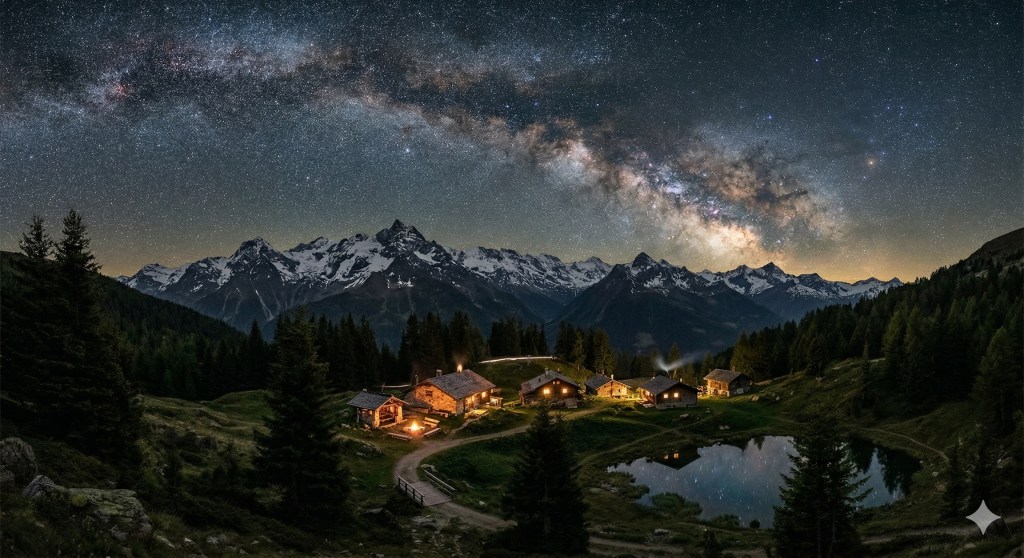
Presented by CloudGPT for Zia H Shah MD
Abstract
Qur’an 79:27–33 presents a majestic movement from the heavens to the earth, from cosmic architecture to terrestrial habitability, and from the first creation to the possibility of resurrection. Addressing those who regarded renewed life after death as inconceivable, the passage asks whether human re-creation could be difficult for the One who constructed and proportioned the heavens, ordered night and daylight, prepared the earth for life, brought forth water and vegetation, and established the mountains.
Read scientifically, these verses evoke a universe governed by intelligible laws, delicate life-permitting conditions, an evolving cosmos whose visible night is dark, a water-bearing planet with productive ecosystems, and a geologically dynamic earth. Philosophically, they constitute a cumulative argument from contingency, intelligibility, order, and provision. Theologically, they disclose Allah as Creator, Fashioner, Sustainer, and Lord of resurrection. Yet responsible commentary must distinguish the Qur’an’s enduring theological claims from changing scientific models: the verses invite investigation of nature without reducing revelation to a modern science textbook.
The Arabic Text
Qur’an 79:27–33
أَأَنتُمْ أَشَدُّ خَلْقًا أَمِ السَّمَاءُ ۚ بَنَاهَا ٢٧
رَفَعَ سَمْكَهَا فَسَوَّاهَا ٢٨
وَأَغْطَشَ لَيْلَهَا وَأَخْرَجَ ضُحَاهَا ٢٩
وَالْأَرْضَ بَعْدَ ذَٰلِكَ دَحَاهَا ٣٠
أَخْرَجَ مِنْهَا مَاءَهَا وَمَرْعَاهَا ٣١
وَالْجِبَالَ أَرْسَاهَا ٣٢
مَتَاعًا لَّكُمْ وَلِأَنْعَامِكُمْ ٣٣
The Arabic text and a range of translations may be compared at Quran.com.
Six Popular English Translations
Translations of the Qur’an are interpretations of its meaning; differences among them often illuminate the semantic range of the Arabic.
1. Sahih International
Are you a more difficult creation or is the heaven? Allah constructed it. He raised its ceiling and proportioned it. And He darkened its night and extracted its brightness. And after that He spread the earth. He extracted from it its water and its pasture, and the mountains He set firmly, as provision for you and your grazing livestock.
2. Abdullah Yusuf Ali
What! Are ye the more difficult to create or the heaven (above)? (Allah) hath constructed it: on high hath He raised its canopy, and He hath given it order and perfection. Its night doth He endow with darkness, and its splendour doth He bring out (with light). And the earth, moreover, hath He extended (to a wide expanse); He draweth out therefrom its moisture and its pasture; and the mountains hath He firmly fixed—for use and convenience to you and your cattle.
3. Marmaduke Pickthall
Are ye the harder to create, or is the heaven that He built? He raised the height thereof and ordered it; and He made dark the night thereof, and He brought forth the morn thereof. And after that He spread the earth, and produced therefrom the water thereof and the pasture thereof, and He made fast the hills, a provision for you and for your cattle.
4. M. A. S. Abdel Haleem
Which is harder to create: you people or the sky that He built, raising it high and perfecting it, giving darkness to its night and bringing out its daylight, and the earth, too, He spread out, bringing waters and pastures out of it, and setting firm mountains [in it] for you and your animals to enjoy?
5. Abul A‘la Maududi
Is it harder to create you or the heaven? But Allah built it, and raised its vault high and proportioned it; and covered its night with darkness and brought forth from it its day; and thereafter spread out the earth, and brought out of it its water and its pasture, and firmly fixed in it mountains; all this as provision for you and your cattle.
6. Mustafa Khattab, The Clear Quran
Which is harder to create: you or the sky? He built it, raising it high and forming it flawlessly. He dimmed its night, and brought forth its daylight. As for the earth, He spread it out as well, bringing forth its water and pastures and setting the mountains firmly upon it—all as a means of sustenance for you and your animals.
The wording of several established translations can be compared verse by verse in this translation and tafsīr compilation.
I. Literary and Theological Context
Sūrat al-Nāziʿāt is fundamentally an eschatological chapter. Its opening oaths evoke powerful agents and irresistible motion. Verses 6–14 describe the convulsion of the Last Hour and humanity’s sudden restoration to conscious life. Verses 15–26 recount Pharaoh’s arrogance and destruction. The present passage, verses 27–33, then answers disbelief in resurrection by directing attention to the first creation. Immediately afterward comes:
“But when the overwhelming catastrophe comes…” (79:34)
The cosmological and geological description is therefore not an isolated lesson in natural history. It is an argument:
- Allah created an order vastly greater than the human body.
- He fashioned that order with proportion and intelligibility.
- He prepared the earth as a life-supporting habitation.
- The One capable of the first creation is capable of another.
- The gifts of the first creation establish moral responsibility before the second.
This is the same Qur’anic reasoning expressed elsewhere:
“The creation of the heavens and earth is greater than the creation of mankind, though most people do not know.” (40:57)
And:
“Is not He who created the heavens and earth able to create the likes of them? Yes indeed! He is the All-Knowing Creator.” (36:81)
Ibn Kathīr accordingly interprets 79:27 as a refutation of those who regarded resurrection as impossible: the creation of the heavens is greater than the recreation of human beings. He understands verses 30–33 as the furnishing of the earth with water, vegetation, mountains, and benefits for living creatures. Ibn Kathīr’s commentary on 79:27–33
II. Verse-by-Verse Commentary
Verse 27: “Are you more difficult to create, or the heaven? He built it”
The language of construction
The verb banāhā—“He built it”—presents the heaven as an ordered construction. The Qur’an is not saying that Allah works with materials and tools as a human builder does. It uses an intelligible analogy: what appears above us is neither self-created nor inherently necessary. It possesses structure, relations, regularities, and an ordered history.
The singular al-samāʾ can signify the visible sky, the celestial realm, or, in a contemporary cosmological reading, the universe beyond the earth. One should not force every occurrence of samāʾ to carry precisely the same modern technical meaning. Here its contrast with humanity and the subsequent references to height, night, and daylight make the whole celestial order the natural focus.
Scientific perspective: magnitude and cosmic history
Modern astronomy expands the rhetorical force of the question. A human body contains trillions of cells, but the observable universe contains hundreds of billions of galaxies, immense networks of matter, stars spanning enormous ranges of mass, and physical processes extending across approximately 13.8 billion years of cosmic history.
The Qur’anic argument, however, does not depend upon any particular estimate of the number of galaxies. Its logic remains valid at every scale: if the vastly greater cosmic order is an effect of divine power, the restoration of a human being cannot exceed that power.
Philosophical perspective: greater and lesser creation
The question is not intended to measure how much “effort” an omnipotent God expends. For Allah, neither creation is difficult. Rather, it is an argument directed to human imagination. People who accept the existence of the heavens but deny resurrection are asked to confront an inconsistency:
- They acknowledge the more encompassing act of creation.
- Yet they declare a more limited act—human re-creation—impossible.
The verse moves from what the hearer observes to what the hearer doubts. It is therefore an argument from the first creation to the second, from actuality to possibility, and from divine power already manifested to divine power promised.
Theological perspective
“Are you more difficult to create?” also dethrones human self-importance. Humanity is morally significant but not cosmically self-sufficient. The verse simultaneously humbles and dignifies us: we are small compared with the heavens, yet we are beings whom God addresses, teaches, judges, and promises to raise again.
Verse 28: “He raised its height and proportioned it”
Samkahā: height, vault, or structure
The word samk denotes height, elevation, or the vertical extent of a construction. Classical commentators naturally understood it through the experienced appearance of the elevated sky. The verse does not require an obsolete solid-dome cosmology. Its enduring point is that the heavens possess immensity and ordered structure.
Fa-sawwāhā: He proportioned, perfected, or ordered it
The verb sawwā is especially significant. It can mean to make even, proportion, fashion appropriately, complete, or bring something into a harmonious state. It does not necessarily mean “perfect” according to every imagined human preference. Rather, the cosmos has been constituted according to a coherent order in which its components, forces, and developmental history fit together.
Cosmic proportion and the biophilic universe
Modern fine-tuning discussions concern the observation that the emergence of long-lived stars, complex chemistry, planets, and embodied observers depends upon a conjunction of laws, constants, and initial conditions. Zia H. Shah’s fine-tuning collection reads Qur’anic terms such as taqdīr, mīzān, and taswiyah as a theological vocabulary of measure, balance, and proportion.
Among the relevant scientific considerations are:
- Gravity must permit structure formation. A universe in which gravity could not gather matter would lack galaxies and stars; radically stronger gravity could produce very different, short-lived or violently collapsing structures.
- Nuclear interactions permit stellar energy and elements. Stable hydrogen, helium, carbon, oxygen, and heavier elements depend upon relationships among particle masses and the strong, weak, and electromagnetic interactions.
- Cosmic expansion must allow matter to assemble. If expansion had overwhelmed gravitational clustering too early, galaxies would not have formed; a radically different cosmic history could also have led to premature collapse.
- Primordial density fluctuations required an appropriate amplitude. They had to be large enough to seed galaxies but not so large that the early universe was dominated by extremely dense structures.
- The initial universe exhibited extraordinary order. Its low gravitational entropy remains a profound feature requiring cosmological explanation.
- The laws are mathematically intelligible and widely uniform. The same basic physics that governs atoms on earth also governs light and matter from distant galaxies.
The small observed vacuum-energy density is particularly important because a much larger positive value would have accelerated expansion before galaxies could form. Nevertheless, popular figures such as “one part in 10120” must be used carefully: this usually describes the enormous disagreement between naïve quantum-field estimates and observation, not a straightforwardly calculated probability that a universe would exist.
Three broad philosophical explanations
Fine-tuning is an observation or family of observations; its ultimate explanation remains debated. Three broad approaches are commonly proposed:
- Deeper necessity: a future fundamental theory may show that the constants could not have been otherwise.
- A multiverse with observational selection: many domains may realize different conditions, with observers necessarily finding themselves in a life-permitting one.
- Purposeful design: the laws and conditions were selected by an intelligent cause intending a universe capable of life and consciousness.
The anthropic principle explains why observers cannot observe an observer-prohibiting universe, but it does not by itself explain why any life-permitting reality exists. A multiverse may strengthen the selection explanation, but then questions arise about the origin, laws, and generative mechanism of the multiverse.
Conversely, fine-tuning is not a deductive scientific proof of God. It functions philosophically as an inference to the best explanation. The case for design becomes cumulative when fine-tuning is considered together with cosmic contingency, mathematical intelligibility, consciousness, moral awareness, and the Qur’anic claim of purposeful creation. The academic debate includes both strong defenses and serious qualifications; the Stanford Encyclopedia of Philosophy surveys design, multiverse, necessity, and critical responses.
Theological synthesis
The Qur’an’s term fa-sawwāhā is not a numerical fine-tuning formula. It is broader and more profound: Allah brought the heavens into an ordered, integrated condition. Modern physics can deepen appreciation of this claim, but the verse should not be made dependent upon one disputed fine-tuning calculation.
The heavens are biophilic—not necessarily in the sense that every part is filled with life, but in the more defensible sense that their laws and history permit at least one world containing water, metabolism, consciousness, moral agency, and revelation.
Verse 29: “He darkened its night and brought forth its daylight”
This verse is among the most evocative Qur’anic descriptions of night and light.
The meanings of aghtasha and ḍuḥā
Aghṭasha laylahā means that Allah made its night dark, dim, or obscure. The word conveys the suppression of visibility. Akhraja ḍuḥāhā means that He brought forth its morning brightness or broad daylight. Ḍuḥā is not merely the instant of sunrise; it evokes the expanding clarity and radiance of morning.
The parallel is beautifully asymmetrical:
- Night is darkened or veiled.
- Daylight is brought forth and made manifest.
This imagery corresponds with the Qur’an’s description elsewhere:
“The night is a sign for them: We strip the daylight from it, and suddenly they are in darkness.” (36:37)
The first scientific level: planetary night
At the terrestrial level, night results from the earth’s rotation. The hemisphere turned away from the Sun is no longer directly illuminated. During daylight, molecules and particles in the atmosphere scatter sunlight, producing the luminous daytime sky. When direct solar illumination ceases, this scattering is drastically reduced.
Thus daylight is local and conditional. It depends upon a nearby star, planetary rotation, atmospheric properties, and the observer’s location. Cosmic space is not filled with blue daylight. The Qur’anic imagery of daylight being “brought forth” or “stripped away” resonates powerfully with this physical asymmetry.
The deeper question: why is the cosmic night dark?
Zia H. Shah’s essays “Why the Night Sky Is Dark” and “The Quranic Night: The Cosmic Curtain” connect verse 29 with Olbers’ paradox.
Suppose that the universe were:
- static,
- infinitely old,
- infinitely extended,
- and uniformly populated with eternal stars.
In such a universe, almost every line of sight should eventually terminate at a stellar surface. The greater number of stars in successively distant shells would offset their individual dimness. The entire sky should therefore approach stellar brightness rather than appearing black.
Interstellar dust cannot permanently solve the problem. In an eternal universe, dust absorbing limitless radiation would heat up and eventually reradiate the energy.
The actual night is dark because the real universe does not satisfy the assumptions of that model:
- The luminous universe has a finite history. Light has had only a finite time to reach us.
- The universe expands. Expansion stretches radiation to longer wavelengths and reduces the energy received.
- Stars and galaxies have histories. There was an early period before stars; star formation developed, peaked, and declined rather than continuing eternally at a constant rate.
- Much cosmic light lies outside human vision. The early universe still fills the sky with the cosmic microwave background, but human eyes cannot see microwaves.
NASA notes that if our eyes were sensitive to microwave radiation, the sky would appear filled with the afterglow of the hot early universe. The darkness visible to our eyes therefore belongs to a dynamic, evolving cosmos, not an eternally static stellar enclosure. NASA’s explanation of Olbers’ paradox
“Dark” does not mean empty
The night between the stars contains:
- faint light from distant galaxies;
- infrared and radio radiation;
- the cosmic microwave background;
- interstellar and intergalactic matter;
- dark matter inferred through gravitational effects;
- quantum fields and vacuum phenomena;
- airglow and zodiacal light nearer the earth.
The verse should not be read as saying that the night contains literally nothing. It describes the darkness of the night as experienced by ordinary human sight. Science reveals that this visual darkness conceals an abundance of invisible radiation and structure.
The cosmic curtain
Shah’s “cosmic curtain” metaphor captures a profound paradox: night conceals the immediate terrestrial landscape but reveals the greater universe. In daylight the nearby Sun overwhelms our view of the stars. In darkness, the local world recedes and the cosmic environment becomes perceptible.
Night therefore both hides and discloses. It is a veil that reveals.
Biological significance
Life on earth depends not only upon light but upon rhythmic alternation between light and darkness. Circadian systems regulate sleep, hormonal cycles, metabolism, immune function, plant growth, flowering, pollination, and animal behavior. Perpetual illumination would not simply provide “more day”; it would disrupt biological systems adapted to temporal cycles.
The Qur’an accordingly presents night as sakan, a condition of tranquility, and as libās, a garment or covering. Darkness is not a defective form of existence. It is a positive component of the created order.
Philosophical meaning: the anesthesia of familiarity
The night sky is so familiar that its strangeness disappears. Shah employs the idea of an “anesthesia of familiarity”: repeated exposure can make an astonishing phenomenon seem self-explanatory.
Olbers’ paradox breaks that anesthesia. It teaches that the darkness above us carries cosmological information. What appears to be the absence of something—light—is evidence of cosmic history, expansion, horizons, finite stellar lifetimes, and the limitations of human perception.
Theological meaning
The verse does not state Olbers’ paradox in scientific language. Rather, the modern resolution of the paradox enriches our appreciation of its theological claim: the night is not outside divine creation. Its darkness emerges through the same ordered laws by which stars shine and planets rotate.
Allah is Lord not only of luminous objects but of the conditions that make darkness possible, beneficial, and revelatory.
Verse 30: “And the earth, after that, He spread it out”
The meaning of daḥāhā
The verb daḥā means to spread, extend, level, or prepare an area. In this context, the next verses explain its practical meaning: bringing forth water and pasture and setting mountains in place. Classical exegetes therefore understood the earth’s “spreading” primarily as its preparation for habitation and sustenance. Lexical and classical discussion of daḥāhā
The verse does not teach that the earth is geometrically flat. A spherical planet can possess an extended, traversable surface. Human beings experience the earth locally as spread beneath them even while its global form is approximately spherical.
It is also unwise to claim that daḥāhā literally means “made egg-shaped.” The primary classical meaning is spreading or preparing. The Qur’an does not need a questionable lexical claim to remain compatible with the earth’s spherical form.
“After that” and the order of creation
Baʿda dhālika can mean “after that,” while in some rhetorical contexts it may carry the sense of “moreover” or “beyond that.” Two classical approaches developed:
- Some commentators held that the earth’s basic substance was created earlier but was spread, furnished, and made habitable after the formation of the heavens.
- Others treated the expression as a rhetorical transition rather than a strict chronology.
Ibn Kathīr takes the former approach: the earth existed but its waters, vegetation, and habitable features were subsequently brought forth. Maududi emphasizes that the passage’s chief purpose is not to provide a complete chronological sequence but to draw attention from the grandeur of heaven to the provisions of earth.
Modern cosmology is entirely compatible with the broad sequence in which the universe precedes the fully formed, habitable earth. The universe is about 13.8 billion years old; the solar system and earth formed much later, roughly 4.6 billion years ago; oceans, continents, atmosphere, and life-supporting environments then developed across immense spans of geological time.
Theological meaning of “spreading”
The earth was not merely made to exist. It was made accessible to embodied creatures. “Spreading” therefore includes a teleological dimension: preparation, accommodation, and hospitality.
Verse 31: “He brought forth from it its water and its pasture”
Water as the foundation of the biosphere
The possessive expression māʾahā—“its water”—portrays water as belonging to the earth’s prepared system. It includes, at the level of ordinary experience, springs, rivers, rainfall, lakes, and groundwater.
Scientifically, the earth’s water participates in an integrated cycle involving:
- oceanic and terrestrial evaporation;
- atmospheric transport;
- condensation and precipitation;
- surface runoff;
- infiltration into soil;
- groundwater storage and discharge;
- glaciers and snowpack;
- uptake and transpiration by vegetation.
Water covers most of the earth’s surface and continually moves among oceans, atmosphere, land, organisms, ice, and subsurface reservoirs. USGS overview of the water cycle
The Qur’an’s statement that water is “brought forth from” the earth is compatible with springs and groundwater emerging from below, just as other passages emphasize water descending from clouds. Revelation describes the cycle from multiple observational perspectives.
Pasture as the visible product of a deeper system
Marʿāhā literally refers to pasture or grazing vegetation, but by extension it evokes the earth’s plant productivity. Vegetation depends upon a remarkable conjunction:
- sunlight in biologically useful wavelengths;
- atmospheric carbon dioxide;
- liquid water;
- fertile minerals and soils;
- photosynthetic pigments;
- cellular machinery;
- climate and seasonal cycles;
- pollinators, decomposers, microbes, and food webs.
Through photosynthesis, plants convert light energy into chemical energy, making most terrestrial food chains possible. “Water and pasture” is therefore a compact Qur’anic expression for the hydrological and biological foundations of sustenance.
A relational rather than atomistic world
The verse does not present water, vegetation, animals, and humans as isolated objects. They form a network:Cosmic order→Sunlight and climate→Water cycle→Vegetation→Humans and animals
Theologically, this interdependence is providence expressed through lawful natural processes. Divine action and natural causation are not competitors. The laws and causal networks through which water circulates and vegetation grows are themselves part of the created order.
Verse 32: “And the mountains He firmly established”
The meaning of arsāhā
Arsāhā comes from a root associated with making something firm, fixed, settled, or anchored. The same root can be used for a ship coming to rest or being anchored. Ibn Kathīr paraphrases the verse as God settling the mountains, making them firm, and establishing them in their locations.
The statement is observationally exact at the human scale: mountains appear vast, enduring, and deeply situated within the earth. Yet the Qur’an also teaches elsewhere that on the Last Day mountains will move, crumble, or disappear. Their firmness is therefore created and conditional, not absolute.
Mountain formation in modern geology
Mountains form through several geological processes:
- collision of continental plates, producing crustal shortening and fold mountains;
- subduction, producing volcanic arcs;
- faulting and crustal extension, producing fault-block ranges;
- mantle hot spots and volcanic activity;
- uplift followed by erosion and isostatic adjustment.
The National Park Service explains that plate motion deforms rocks through faulting, folding, extension, and mountain building, while collisional boundaries produce many folded ranges. NPS overview of mountain building
Mountain ranges generally form across millions or tens of millions of years. This supports the broader theme emphasized in Shah’s geological writings: Qur’anic creation should not be imagined as an instantaneous tableau. The earth underwent successive stages of formation, uplift, erosion, sedimentation, and biological colonization. Shah’s essay on mountain-building timescales
Mountain roots and isostasy
Many great ranges possess thickened crust extending far beneath the visible peaks. In simplified isostatic models, relatively buoyant crust “floats” upon denser material below, so high topography is commonly accompanied by a deep crustal root—somewhat like the submerged portion of an iceberg.
This gives a legitimate scientific resonance to the Qur’anic vocabulary of setting or anchoring mountains. Shah highlights these subsurface structures in his essay “And look at the mountains, how they are anchored?”.
However, important precision is needed. A crustal root is not a rigid nail hammered through a plate into an immovable mantle. Isostasy describes gravitational equilibrium and compensation within a dynamic lithosphere. Mountains and their roots can rise, deform, erode, and adjust.
Do mountains prevent earthquakes?
Some popular presentations describe mountains as “shock absorbers” that stop the crust from shaking. This is too strong if understood literally. Many major mountain belts—the Himalayas, Andes, Alps, and Zagros—exist precisely because tectonic plates are colliding, and such regions can be intensely seismic. Beneath parts of the Hindu Kush and surrounding mountain systems, earthquakes occur at great depth as a consequence of ongoing tectonic processes. USGS on regional tectonics and seismicity
A scientifically cautious formulation is therefore preferable:
- Mountains are integrated expressions of crustal thickness, tectonic forces, and isostatic balance.
- Their roots participate in vertical gravitational equilibrium.
- Mountain belts redistribute mass, affect crustal stress, and evolve with tectonic systems.
- But mountains should not simply be said to prevent earthquakes; often mountain building and earthquakes share the same tectonic cause.
Verse 79:32 itself says that Allah established the mountains firmly. It does not explicitly claim that mountains eliminate seismic activity.
Mountains and habitability
Mountains contribute profoundly to the earth’s life-supporting systems. They:
- redirect atmospheric circulation;
- generate orographic precipitation;
- store snow and glacial ice;
- feed rivers and aquifers;
- create diverse climates and ecological niches;
- expose minerals through uplift and erosion;
- produce sediments that help renew soils;
- provide pasture and habitats for animals.
Thus verse 32 belongs organically between “water and pasture” and “provision for you and your animals.” Mountains are not mentioned solely as monuments of power; they participate in the provisioning of life.
Verse 33: “As provision for you and your animals”
Matāʿ: beneficial but temporary provision
The word matāʿ denotes something used or enjoyed for a time—a provision, benefit, or means of livelihood. It contains both generosity and limitation. Earthly goods are real gifts, but they are not eternal possessions.
The verse gathers the whole passage into a teleological conclusion:
- the ordered heavens,
- the alternation of night and daylight,
- the habitable earth,
- water,
- vegetation,
- and mountains
constitute a system of provision.
Humans and animals
The explicit inclusion of anʿām—grazing livestock—prevents a crudely human-exclusive reading. Allah’s providence embraces nonhuman creatures. The vegetation is not only “for you” but also “for your animals.” Elsewhere the Qur’an says that there is no creature on earth whose provision is not known to God (11:6) and that animals form communities like human beings (6:38).
The verse therefore implies responsibility:
- Water is provision, so it should not be poisoned or monopolized unjustly.
- Pasture is provision, so land should not be exhausted through greed.
- Animals share divine provision, so they should not be treated with cruelty.
- Mountains and ecosystems are signs and trusts, not merely raw materials without moral limits.
The passage moves naturally from cosmology to environmental ethics.
III. The Unified Scientific Vision
The seven verses describe not disconnected objects but a nested hierarchy of conditions required for embodied life:
- A structured universe exists.
- Its laws and conditions permit complexity.
- Stars provide energy and chemical elements.
- A planet experiences ordered cycles of darkness and light.
- Its surface becomes habitable.
- Water circulates through it.
- Vegetation converts light, water, and matter into food.
- Mountains shape climate, rivers, habitats, and soils.
- Humans and animals receive provision.
The final phrase, matāʿan lakum wa-li-anʿāmikum, interprets everything preceding it. The scientific systems are also systems of sustenance.
The Qur’an does not replace cosmology, astronomy, geology, hydrology, or biology. Rather, it provides a metaphysical interpretation of their discoveries: what science describes through mechanisms and equations is, at another explanatory level, creation, measure, and providence.
IV. The Philosophical Argument
1. The argument from contingency
Neither the universe nor its particular laws explain why they exist. Scientific explanation ordinarily describes how one state follows from another under given laws. The metaphysical question remains: why is there any law-governed reality at all?
The Qur’an answers by identifying the heavens and earth as dependent creation rather than self-explanatory necessity.
2. The argument from intelligibility
The universe is not only ordered; it is accessible to rational minds. Human mathematics can describe planetary motion, atomic spectra, stellar evolution, and cosmic expansion. This correspondence among mind, mathematics, and reality is philosophically remarkable.
The verse’s movement from divine taswiyah—proportioning—to human reflection suggests that the cosmos is intelligible because both nature and human reason originate from the same ultimate source.
3. The argument from fine-tuning
Life-permitting conditions are more expected if reality originates in purposeful intelligence than if the universe is treated as an unexplained, randomly selected brute fact. This does not yield a mathematical proof, but it can substantially alter the comparative plausibility of competing worldviews.
4. The argument from coordinated provision
Water alone is insufficient. Sunlight alone is insufficient. Carbon alone is insufficient. Habitability depends upon the coordination of cosmic, planetary, chemical, geological, and biological conditions.
This coordination is what makes verse 33 philosophically decisive. The text does not merely list objects; it interprets their convergence as provision.
5. The anthropic principle and its limits
It is true that observers can exist only where observer-permitting conditions occur. But this observation does not answer every explanatory question. Saying “we observe a habitable universe because otherwise we would not be here” explains a selection effect; it does not necessarily explain the origin of the life-permitting laws, the universe-generating mechanism, or the existence of consciousness.
6. From the first creation to resurrection
The argument reaches beyond natural theology. A Creator who originates matter, laws, living systems, consciousness, and personal identity is not limited by the decay of a corpse. The particles of the human body may disperse, but divine knowledge does not.
Resurrection is not predicted by cosmology. It is promised by revelation. Cosmology nevertheless removes the claim that resurrection would exceed the Creator’s power.
V. Theological Synthesis
Several divine attributes converge in this passage:
- Al-Khāliq—the Creator: He brings beings into existence.
- Al-Bāriʾ—the Originator: He originates an ordered creation without precedent.
- Al-Muṣawwir—the Fashioner: He gives creation its forms and proportions.
- Al-Qadīr—the All-Powerful: Neither first creation nor resurrection exceeds His power.
- Al-Ḥakīm—the All-Wise: Creation possesses order, purpose, and moral consequence.
- Al-Razzāq—the Provider: Water, pasture, and the earth’s systems sustain creatures.
- Al-Muḥyī—the Giver of Life: He brings life from earth and will restore life after death.
The passage unites transcendence and providence. The One who constructed the heavens also provides pasture for cattle. Divine greatness does not make God remote from the smallest creature; it is the ground of His universal care.
The same Lord is active at every scale:Heavens⟶Night and daylight⟶Earth⟶Water and vegetation⟶Human and animal life
The divine unity behind this hierarchy is the theological meaning of tawḥīd: one Creator, one coherent order, one economy of provision, and one final judgment.
VI. Principles for a Responsible Qur’an-and-Science Commentary
A fruitful scientific commentary should maintain four distinctions.
1. Resonance is not identity
Verse 79:29 resonates with the modern explanation of the dark night sky, but it is not a technical statement of Olbers’ paradox.
2. Compatibility is not prediction
A verse may be strikingly compatible with later scientific knowledge without having explicitly predicted a particular equation or model.
3. Scientific models remain revisable
The theological claim that creation is ordered does not depend on every present estimate of a physical constant, the depth of a mountain root, or one model of cosmic origins.
4. Lexical integrity comes first
Arabic words should be interpreted through their established linguistic and exegetical ranges. Claims such as “daḥāhā means ostrich egg” or “mountains prevent all earthquakes” should not be used when the language or science does not support them.
Such restraint does not weaken Qur’anic reflection. It protects it from becoming attached to exaggerations and allows the genuine scientific and philosophical depth of the passage to emerge.
Thematic Epilogue: The Greater Creation and the Returning Human
The passage begins with a question that breaks the illusion of human greatness: “Are you more difficult to create, or the heaven?” It then raises our gaze to the cosmic architecture, lowers it through the darkness and brightness of the sky, and finally returns us to the ground beneath our feet—to water, pasture, mountains, animals, and daily provision.
The darkness of night is no longer empty. It testifies to an evolving universe with a history, a horizon, and radiation beyond human vision. The heavens are no longer a decorative ceiling. They constitute an immense, mathematically ordered reality whose laws permit stars, elements, planets, and conscious life. The earth is no longer inert soil. It is a dynamic planet in which atmosphere, water, rock, vegetation, animals, and human beings participate in one interdependent system. Mountains are no longer merely picturesque masses. They are products of deep geological history and contributors to climate, rivers, habitats, and terrestrial diversity.
Yet the verses do not end with the cosmos. They end with provision—and then turn immediately toward judgment. The gifts of creation are evidence not only of power but of responsibility. Water asks for gratitude and justice. Pasture asks for stewardship. Animals ask for mercy. The ordered universe asks for intellectual humility. The first creation asks us to take the second creation seriously.
Human beings may appear insignificant before galaxies and geological ages, but the Qur’an does not leave us insignificant. The Creator of the heavens addresses us personally. The Lord who proportioned the cosmos knows every human intention. The One who brings daylight from darkness, water from the earth, and vegetation from lifeless soil can bring the dead from their graves.
Thus Qur’an 79:27–33 transforms cosmology into eschatology, geology into gratitude, and scientific wonder into moral awakening. The heavens declare power; their proportion declares wisdom; the dark night declares hidden depth; the fertile earth declares mercy; and all together declare that the God of the first creation is fully able to accomplish the last.






Leave a comment