
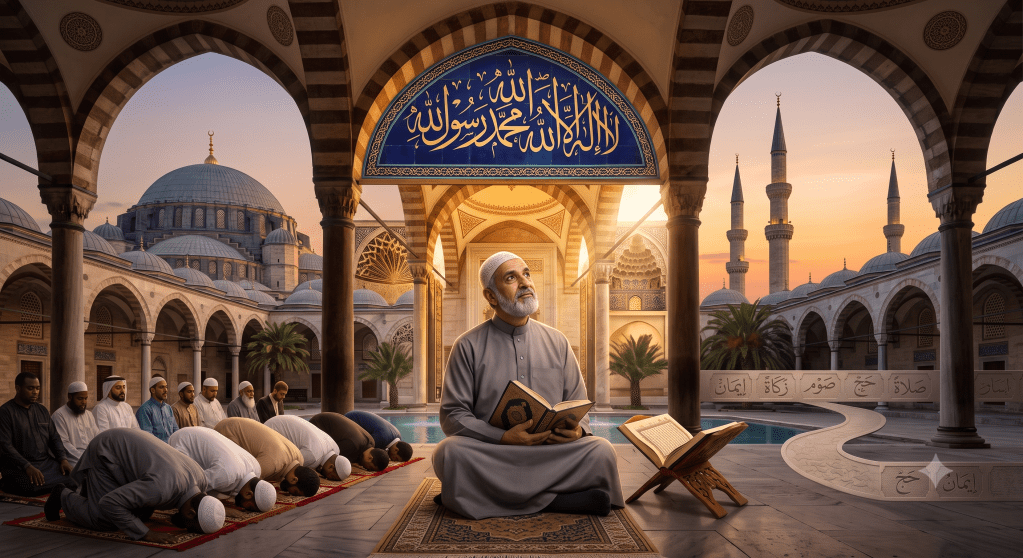
A Study of Sūrat al-Baqarah 2:1–5, 2:177, 2:285, and Sūrat al-Nisāʾ 4:136, with Reflections on 5:3, 3:7, and 8:22
By Claude for Zia H. Shah, MD — thequran.love (The Glorious Qurʾān and Science)
Abstract
This article offers an integrated, source-critical exposition of the fundamental beliefs — the articles of faith (īmān) — as they are articulated in the Qurʾān itself, prior to and independent of any later creedal systematization. Taking four passages as its scriptural spine — the opening portrait of the God-conscious in Sūrat al-Baqarah (2:1–5), the “Verse of Righteousness” (āyat al-birr, 2:177), the believers’ collective affirmation that closes Sūrat al-Baqarah (2:285), and the direct command to belief in Sūrat al-Nisāʾ (4:136) — it demonstrates how the Qurʾān enumerates belief in God, His angels, His books, His messengers, the Last Day, and, in the wider Qurʾānic and exegetical tradition, divine decree (qadar). For each passage the study provides the verified Arabic text, a single consistent English rendering (Sahih International), and commentary drawn from the five major classical exegetes (mufassirūn): Muḥammad ibn Jarīr al-Ṭabarī, Maḥmūd al-Zamakhsharī, Fakhr al-Dīn al-Rāzī, Muḥammad al-Qurṭubī, and Ismāʿīl Ibn Kathīr. The exposition is then enriched by three further verses: 5:3, the declaration of the perfection of religion revealed on the Day of ʿArafah during the Farewell Pilgrimage; 3:7, on the decisive (muḥkamāt) and allegorical (mutashābihāt) verses, whose famous punctuation (waqf) debate frames a discussion of epistemic humility; and 8:22, the Qurʾān’s stern censure of those “who do not use reason,” which grounds faith in the dignity of the intellect. The article’s register is deliberately non-sectarian, pluralist, and interfaith-friendly: it presents the creed as a coherent architecture of meaning rather than a badge of communal boundary, and closes with a thematic epilogue on faith, reason, and transcendence.
I. Introduction: Where the Qurʾān Places Its Foundations
Every religious tradition carries an implicit answer to the question, What must one hold to be true? In Islam that answer is not first supplied by later theologians but is embedded in the Qurʾān’s own language, distributed across passages that repeatedly return to the same cluster of convictions. Where later systematic theology (ʿilm al-kalām) and catechism would speak of “pillars” and “articles,” the Qurʾān speaks more organically — weaving belief, worship, ethics, and eschatology into single breathless sentences.
Four passages stand out because in them the Qurʾān does something rare: it lists. It names, in sequence, the objects of faith. Read together, Sūrat al-Baqarah 2:1–5, 2:177, 2:285, and Sūrat al-Nisāʾ 4:136 furnish what may be called the scriptural charter of Islamic belief. Five objects of faith appear explicitly and repeatedly across them — God, the angels, the revealed Books, the messengers, and the Last Day — while a sixth, belief in divine decree (qadar), is developed elsewhere in the Qurʾān and in the wider tradition. This article examines each passage in turn, then embellishes the account with three further verses that illuminate, respectively, the completion of the religion (5:3), the limits of interpretation (3:7), and the rational vocation of the believer (8:22).
II. The Opening Portrait: Sūrat al-Baqarah 2:1–5
Arabic Text
﴿الٓمٓ ذَٰلِكَ ٱلْكِتَٰبُ لَا رَيْبَ ۛ فِيهِ ۛ هُدًى لِّلْمُتَّقِينَ ٱلَّذِينَ يُؤْمِنُونَ بِٱلْغَيْبِ وَيُقِيمُونَ ٱلصَّلَوٰةَ وَمِمَّا رَزَقْنَٰهُمْ يُنفِقُونَ وَٱلَّذِينَ يُؤْمِنُونَ بِمَآ أُنزِلَ إِلَيْكَ وَمَآ أُنزِلَ مِن قَبْلِكَ وَبِٱلْءَاخِرَةِ هُمْ يُوقِنُونَ أُو۟لَٰٓئِكَ عَلَىٰ هُدًى مِّن رَّبِّهِمْ ۖ وَأُو۟لَٰٓئِكَ هُمُ ٱلْمُفْلِحُونَ﴾
Translation (Sahih International)
“Alif, Lām, Mīm. This is the Book about which there is no doubt, a guidance for those conscious of Allāh — who believe in the unseen, establish prayer, and spend out of what We have provided for them, and who believe in what has been revealed to you, [O Muḥammad], and what was revealed before you, and of the Hereafter they are certain [in faith]. Those are upon [right] guidance from their Lord, and it is those who are the successful.”
Commentary
The Qurʾān’s grand exposition — for Sūrat al-Baqarah is, after the brief overture of al-Fātiḥah, its first and longest surah — opens not with a command but with a portrait. Before it tells the reader what to do, it describes what a rightly oriented human being is. The passage is thus a natural place to begin a study of the articles of faith, because it discloses the interior architecture of the believer.
The surah opens with the disconnected letters (al-ḥurūf al-muqaṭṭaʿāt) Alif, Lām, Mīm. Ibn Kathīr records the range of classical opinion faithfully: some Companions and their successors, including reports from Abū Bakr and ʿAlī, held that these letters are among the matters whose knowledge God has reserved to Himself; others, following Mujāhid and cited by Ibn Jarīr al-Ṭabarī, treated them as an arresting rhetorical opening drawn from the very alphabet in which the Arabs took such pride. The tradition’s willingness to leave the question open is itself instructive — a first, quiet instance of the epistemic humility that verse 3:7 will make explicit.
The claim that follows is bold: dhālika al-kitāb lā rayba fīh — “This is the Book about which there is no doubt.” Al-Ṭabarī notes the grammatical subtlety that the demonstrative dhālika (“that”) is used for something distant, though the Book is present; the classical exegetes read this as conferring elevation and honor, “that exalted Book.” Ibn Kathīr records that some reciters preferred a pause at lā rayba (“there is no doubt”) and then began afresh with fīhi hudan lil-muttaqīn (“in it is guidance for the God-conscious”), though he judges it better to pause at fīh — a small textual detail that again shows the exegetical tradition attending scrupulously to how meaning is shaped by phrasing.
The Book is “guidance for those conscious of Allāh” — al-muttaqīn, from taqwā. Here the Qurʾān sets a precondition that is at once moral and epistemic: guidance discloses itself to those already disposed toward reverence. Ibn ʿAbbās, as reported by Ibn Kathīr, glossed al-muttaqīn as “those who fear Allāh’s punishment were they to abandon the guidance they recognize, and who hope in His mercy by believing in what He revealed.” Taqwā is thus not paralyzing fear but a vigilant God-consciousness that keeps the heart oriented.
Verses 3–4 then enumerate the marks of these God-conscious souls, and the list is remarkable for how tightly it braids creed and conduct. First: “who believe in the unseen” (yuʾminūna bi-l-ghayb). Belief in al-ghayb — that dimension of reality beyond the reach of the senses — is the hinge of the entire creed. Ibn Kathīr, transmitting through Abū Jaʿfar al-Rāzī from al-Rabīʿ ibn Anas from Abū al-ʿĀliyah, preserves a definition that is, in effect, an early inventory of the articles of faith: to believe in the unseen is “to believe in Allāh, His angels, Books, Messengers, the Last Day, His Paradise, Fire and in the meeting with Him. They also believe in life after death and in Resurrection.” The articles of faith are the content of al-ghayb. Ibn Kathīr further records the striking testimony of the Companion ʿAbd Allāh ibn Masʿūd: “By Him besides whom there is no god, no person will ever acquire a better type of faith than believing in the unseen,” a saying he offered while reciting precisely these verses.
Second and third come worship and charity: “establish prayer, and spend out of what We have provided for them.” Faith in the unseen immediately expresses itself vertically (prayer, ṣalāt) and horizontally (spending, infāq). Fourth: belief “in what has been revealed to you… and what was revealed before you” — an explicit affirmation of prior revelation, and thus of the continuity of the prophetic tradition, a theme that will recur with force in 2:285 and 4:136. Fifth: certainty regarding “the Hereafter” (al-ākhirah). That the passage names belief in the unseen, prior revelation, and the Hereafter — three of the six articles — while framing them with prayer and charity, shows how seamlessly the Qurʾān integrates dogma and life. The passage closes with a verdict of success (al-mufliḥūn): these, and not the merely outwardly religious, are the ones who flourish.
III. The Verse of Righteousness: Sūrat al-Baqarah 2:177
Arabic Text
﴿لَّيْسَ ٱلْبِرَّ أَن تُوَلُّوا۟ وُجُوهَكُمْ قِبَلَ ٱلْمَشْرِقِ وَٱلْمَغْرِبِ وَلَٰكِنَّ ٱلْبِرَّ مَنْ ءَامَنَ بِٱللَّهِ وَٱلْيَوْمِ ٱلْءَاخِرِ وَٱلْمَلَٰٓئِكَةِ وَٱلْكِتَٰبِ وَٱلنَّبِيِّـۧنَ وَءَاتَى ٱلْمَالَ عَلَىٰ حُبِّهِۦ ذَوِى ٱلْقُرْبَىٰ وَٱلْيَتَٰمَىٰ وَٱلْمَسَٰكِينَ وَٱبْنَ ٱلسَّبِيلِ وَٱلسَّآئِلِينَ وَفِى ٱلرِّقَابِ وَأَقَامَ ٱلصَّلَوٰةَ وَءَاتَى ٱلزَّكَوٰةَ وَٱلْمُوفُونَ بِعَهْدِهِمْ إِذَا عَٰهَدُوا۟ ۖ وَٱلصَّٰبِرِينَ فِى ٱلْبَأْسَآءِ وَٱلضَّرَّآءِ وَحِينَ ٱلْبَأْسِ ۗ أُو۟لَٰٓئِكَ ٱلَّذِينَ صَدَقُوا۟ ۖ وَأُو۟لَٰٓئِكَ هُمُ ٱلْمُتَّقُونَ﴾
Translation (Sahih International)
“Righteousness is not that you turn your faces toward the east or the west, but [true] righteousness is [in] one who believes in Allāh, the Last Day, the angels, the Book, and the prophets and gives wealth, in spite of love for it, to relatives, orphans, the needy, the traveler, those who ask [for help], and for freeing slaves; [and who] establishes prayer and gives zakāh; [those who] fulfill their promise when they promise; and [those who] are patient in poverty and hardship and during battle. Those are the ones who have been true, and it is those who are the righteous.”
Commentary
If 2:1–5 offers a portrait, 2:177 offers a definition. Its occasion, as al-Ṭabarī and others report, was the controversy that followed the change of the qiblah (the direction of prayer) from Jerusalem to the Kaʿbah in Mecca. Some seized on the matter of orientation as though the whole of religion turned on which way one faced. The verse cuts through the dispute with a redefinition so sweeping that it has been called āyat al-birr, the Verse of Righteousness. Ibn Kathīr transmits, on the authority of al-Ḥasan al-Baṣrī and al-Rabīʿ ibn Anas, that turning toward Jerusalem or the Kaʿbah is “faith, and its essence requires implementation” — that is, ritual orientation matters only as obedience, never as an end in itself.
The verse’s structure is theologically deliberate. It opens the definition of birr with belief, and it names five objects: “Allāh, the Last Day, the angels, the Book, and the prophets.” Here five of the six classical articles of faith stand enumerated in a single clause. Ibn Kathīr comments that whoever truly acquires these beliefs “will have indeed embraced all aspects of Islam” — belief in God as the only object of worship, in the angels as the emissaries between God and His messengers, in the Books as the revealed scriptures culminating in the Qurʾān, and in the prophets collectively. The ordering is worth pausing over: the Last Day is named immediately after God, before the angels and Books, underscoring how central eschatological accountability is to the moral seriousness the verse demands.
The classical commentators note that after establishing belief, the verse turns to action, and that the sequence is comprehensive. Belief is followed by the giving of wealth “in spite of love for it” — a phrase the exegetes dwell on, since it locates charity’s virtue precisely in the cost it exacts from a heart that loves what it gives. The recipients are enumerated with tender specificity: kin, orphans, the poor (al-masākīn — whom, as Ibn Kathīr notes, are those lacking enough to meet basic needs), the stranded traveler, those who ask, and captives to be freed. Al-Qurṭubī observes that “freeing slaves” (fī al-riqāb) embraces both helping a bondsman purchase his freedom and ransoming prisoners. Only then does the verse name the two great acts of worship, prayer and zakāh, followed by the keeping of covenants and, finally, patience “in poverty and hardship and during battle.”
The commentators of the classical tradition read this architecture as a complete map of the religious life: creed, worship, social ethics, and moral character woven into one. As the maʿārif tradition summarizes, the verse gathers “the articles of belief, the deeds in accordance with them, and the morals” that are “the essence of all religious injunctions.” A saying attributed to the Prophet (may peace be on him) holds that whoever acts by this verse has perfected his faith. The verse’s closing judgment is that such people “have been true” (ṣadaqū) and are “the righteous” (al-muttaqūn) — binding the portrait of the God-conscious in 2:1–5 to the definition of righteousness here.
IV. The Believers’ Affirmation: Sūrat al-Baqarah 2:285
Arabic Text
﴿آمَنَ الرَّسُولُ بِمَا أُنزِلَ إِلَيْهِ مِن رَّبِّهِ وَالْمُؤْمِنُونَ ۚ كُلٌّ آمَنَ بِاللَّهِ وَمَلَائِكَتِهِ وَكُتُبِهِ وَرُسُلِهِ لَا نُفَرِّقُ بَيْنَ أَحَدٍ مِّن رُّسُلِهِ ۚ وَقَالُوا سَمِعْنَا وَأَطَعْنَا ۖ غُفْرَانَكَ رَبَّنَا وَإِلَيْكَ الْمَصِيرُ
Translation (Sahih International)
“The Messenger has believed in what was revealed to him from his Lord, and [so have] the believers. All of them have believed in Allāh and His angels and His books and His messengers, [saying], ‘We make no distinction between any of His messengers.’ And they say, ‘We hear and we obey. [We seek] Your forgiveness, our Lord, and to You is the [final] destination.’”
Commentary
Where 4:136 will issue a command, 2:285 records a response. It is the creed rendered as a confession — the voice of the community affirming what it holds. The classical commentators note the honor implicit in the verse’s opening: it names the Prophet (may peace be on him) not by name but by title, al-rasūl, “the Messenger,” and then immediately joins “the believers” to him, so that the faith of the community is described in the same breath as the faith of the one who received the revelation.
The objects of belief are again enumerated: “Allāh and His angels and His books and His messengers.” Ibn Kathīr comments that each believer thereby affirms that God is One and the sole Sustainer, that the angels are real, that the revealed Books are true, and that the messengers were genuinely sent. The verse then places on the believers’ lips a declaration of profound ecumenical weight: lā nufarriqu bayna aḥadin min rusulih — “We make no distinction between any of His messengers.”
The meaning of this phrase is important and easily misread, and the classical tradition is precise about it. It does not deny that prophets differ in rank; the Qurʾān itself says elsewhere that God preferred some messengers over others. Rather, as the exegetes explain — and as Tafsīr al-Jalālayn states plainly — the “distinction” being refused is “believing in some and disbelieving in others in the manner of” earlier communities. The commentators note pointedly that past peoples “planted seeds of discord among the messengers of Allāh by accepting some as prophets and denying that status to others.” The Muslim confession, by contrast, is that all the messengers of God — from Adam through the whole prophetic line — are to be believed as messengers. This is one of the most interfaith-significant statements in the entire Qurʾān: the believer’s faith is structurally bound to affirm, not deny, the messengers who came before.
The confession closes with the posture of the true servant: “We hear and we obey” (samiʿnā wa-aṭaʿnā), followed by a plea for forgiveness and an acknowledgment that all return to God. Both al-Bukhārī and Muslim preserve the Prophet’s teaching that these last two verses of Sūrat al-Baqarah carry special merit; in the wording recorded by al-Bukhārī (no. 5009), “Whoever recites the last two verses of Sūrat al-Baqarah at night, they will suffice him” — a mark of how central this compact affirmation of the creed became in the community’s devotional life.
V. The Command to Believe: Sūrat al-Nisāʾ 4:136
Arabic Text
يَٰٓأَيُّهَا ٱلَّذِينَ ءَامَنُوٓا۟ ءَامِنُوا۟ بِٱللَّهِ وَرَسُولِهِۦ وَٱلْكِتَٰبِ ٱلَّذِى نَزَّلَ عَلَىٰ رَسُولِهِۦ وَٱلْكِتَٰبِ ٱلَّذِىٓ أَنزَلَ مِن قَبْلُ ۚ وَمَن يَكْفُرْ بِٱللَّهِ وَمَلَٰٓئِكَتِهِۦ وَكُتُبِهِۦ وَرُسُلِهِۦ وَٱلْيَوْمِ ٱلْءَاخِرِ فَقَدْ ضَلَّ ضَلَٰلًۢا بَعِيدًا
Translation (Sahih International)
“O you who have believed, believe in Allāh and His Messenger and the Book that He sent down upon His Messenger and the Scripture which He sent down before. And whoever disbelieves in Allāh, His angels, His books, His messengers, and the Last Day has certainly gone far astray.”
Commentary
This verse presents an arresting paradox at its opening: “O you who have believed, believe.” Why command belief of those already described as believers? The classical exegetes offer a rich answer. Ibn Kathīr explains that God “commands His faithful servants to adhere to all the elements of faith, its branches, pillars, and cornerstones” — that this is “not stated as mere redundancy, but from the view of completing faith and the continual maintenance of it.” Faith, on this reading, is not a static possession acquired once but a dynamic state to be renewed, deepened, and preserved. Just as the believer asks in every prayer to be guided to the straight path — though already, in a sense, upon it — so the believer is commanded to keep believing, to increase in and hold fast to faith.
Read as a checklist, 4:136 is the most complete single enumeration among our four passages. The positive command names God, His Messenger, the Book revealed to him (the Qurʾān), and the Scripture revealed before — again affirming prior revelation. The negative clause, warning of those who disbelieve, then names five objects together: “Allāh, His angels, His books, His messengers, and the Last Day.” Here the articles are set out fully, and the gravity of the matter is marked by the verdict: to reject them is to have “gone far astray” — ḍalālan baʿīdan, a straying so extreme that no landmark of guidance remains in view.
The verse also carries the same continuity of revelation seen throughout: to believe in “the Scripture which He sent down before” is to affirm that the God who spoke through Muḥammad (may peace be on him) is the same God who spoke through the earlier prophets. Refusing that continuity — believing in one’s own scripture while denying others — is precisely the “distinction” that 2:285 forbids. The two verses thus form a matched pair: 2:285 is the believers’ affirmation; 4:136 is the divine command that grounds it.
VI. The Sixth Article: Belief in Divine Decree (Qadar)
Four passages have now yielded five recurring objects of faith: God, the angels, the Books, the messengers, and the Last Day. The classical and later tradition names a sixth — belief in divine decree (al-qadar), “the good of it and the bad of it.” While our four core passages do not enumerate qadar in their lists, the Qurʾān affirms it elsewhere with great clarity — most concisely in Sūrat al-Qamar: innā kulla shayʾin khalaqnāhu bi-qadar (“Indeed, all things We created with predestination,” 54:49) — and the wider tradition draws it out as the sixth article of īmān.
Qadar derives from a root (q-d-r) conveying measure, proportion, and power, and it names God’s eternal knowledge of, and sovereignty over, all that comes to be. The tradition has been careful to distinguish this belief from fatalism. Classical scholars, notably Ibn al-Qayyim, articulated qadar in several dimensions — God’s comprehensive knowledge (ʿilm), His writing of all things, His will (mashīʾah), and His creation — while insisting that human beings retain genuine moral responsibility for their choices. The Qurʾān itself holds both truths in tension: many verses affirm God’s all-encompassing decree, and many affirm real human agency and accountability. The mature theological position refuses both extremes — neither a determinism that reduces humans to puppets nor a denial of divine sovereignty — and treats qadar rightly understood as a source of serenity: the conviction that no hardship is random and that the moral universe is finally just.
VII. Embellishment I — The Perfection of Religion: Sūrat al-Māʾidah 5:3
Arabic Text (the final segment)
الْيَوْمَ أَكْمَلْتُ لَكُمْ دِينَكُمْ وَأَتْمَمْتُ عَلَيْكُمْ نِعْمَتِي وَرَضِيتُ لَكُمُ الْإِسْلَامَ دِينًا
Translation (Sahih International)
“This day I have perfected for you your religion and completed My favor upon you and have approved for you Islām as religion.”
Occasion and Time of Revelation
Among all the verses of the Qurʾān, this segment carries a uniquely charged sense of moment — al-yawm, “this day.” The classical sources locate its revelation with unusual precision: it came down on the Day of ʿArafah, the ninth of Dhū al-Ḥijjah, a Friday, during the Prophet’s Farewell Pilgrimage (ḥajjat al-wadāʿ) in the tenth year after the Hijrah, as he stood at ʿArafah.
The most celebrated report is preserved in both Ṣaḥīḥ al-Bukhārī and Ṣaḥīḥ Muslim on the authority of Ṭāriq ibn Shihāb. ʿUmar ibn al-Khaṭṭāb related that a Jewish man once said to him: “O Commander of the Believers, there is a verse in your Book which you recite; had it been revealed to us, we would have taken that day as a festival (ʿīd).” ʿUmar asked which verse, and the man recited, “This day I have perfected for you your religion…” ʿUmar replied, in the wording recorded by al-Bukhārī (no. 45): “By Allāh, I know the day and the place in which it was revealed… he was standing at ʿArafah on a Friday.” The exchange is instructive on several levels. It records a respectful interreligious conversation; it shows a person outside the Muslim community recognizing the theological weight of the verse; and it preserves ʿUmar’s insistence on precise historical memory. In a related transmission ʿUmar adds that both days — the Friday and the Day of ʿArafah — were already festivals for the Muslim community, so that the completion the verse proclaims was joined to days of celebration.
Commentary
What does it mean that the religion was “perfected” on that day? The classical exegetes are careful, and their care preserves the verse from misreading. Al-Ṭabarī and al-Zamakhsharī, according to the surveys of the commentary tradition, connected the perfection of religion and the completion of favor especially to the removal of idolatry from the pilgrimage — that year the sacred precincts were, for the first time, free of the old polytheistic rites — and they explain that no further ritual or legal ruling of the core religious law was revealed after this verse. Al-Qurṭubī offers a refinement: he holds that some legal injunctions were revealed after this verse, but no further ritual obligations, so that the “perfection” refers principally to the completion of the acts of worship and the essential framework of the faith. Al-Ṭabarī and al-Qurṭubī also read the verse’s opening (the despair of the disbelievers, in the preceding clause) as meaning that the enemies of the faith had lost all hope of extinguishing it.
Ibn Kathīr draws out the pastoral meaning: “This day I have perfected your religion” means that the faith needs no addition, and “completed My favor upon you” means that the divine blessing has reached its fullness. He preserves a poignant tradition: some of the Companions, and notably ʿUmar, understood that the perfection of the religion carried an intimation of the Prophet’s approaching death — for once a thing is complete, its season begins to close. Ibn Kathīr and others record that ʿUmar wept, and that the Prophet (may peace be on him) did indeed pass away not long after.
A grammatical observation preserved in the commentary tradition (through Ibn al-Qayyim) is worth noting: the verse attributes “religion” (dīn) to the people — “your religion” — because religion is enacted through what the community does, while it attributes “favor” (niʿmah) to God — “My favor” — because the blessing flows entirely from Him. The commentators also caution against a misreading: that the religion was “perfected” on this day does not imply that the faith of earlier prophets was deficient. As the tradition transmitted from al-Qaffāl al-Marwazī holds, each prophet’s dīn was complete and perfect for its own time; what 5:3 proclaims is the completion of the final dispensation. Finally, al-Zamakhsharī and others dwell on the last clause — raḍītu lakum al-islāma dīnā, “I have approved for you Islām as religion” — reading islām here in its root sense of wholehearted submission and self-surrender to the one God, the disposition that unites all the prophets.
VIII. Embellishment II — Decisive and Allegorical Verses: Sūrat Āl ʿImrān 3:7
Arabic Text
هُوَ ٱلَّذِىٓ أَنزَلَ عَلَيْكَ ٱلْكِتَٰبَ مِنْهُ ءَايَٰتٌ مُّحْكَمَٰتٌ هُنَّ أُمُّ ٱلْكِتَٰبِ وَأُخَرُ مُتَشَٰبِهَٰتٌ ۖ فَأَمَّا ٱلَّذِينَ فِى قُلُوبِهِمْ زَيْغٌ فَيَتَّبِعُونَ مَا تَشَٰبَهَ مِنْهُ ٱبْتِغَآءَ ٱلْفِتْنَةِ وَٱبْتِغَآءَ تَأْوِيلِهِۦ ۗ وَمَا يَعْلَمُ تَأْوِيلَهُۥٓ إِلَّا ٱللَّهُ ۗ وَٱلرَّٰسِخُونَ فِى ٱلْعِلْمِ يَقُولُونَ ءَامَنَّا بِهِۦ كُلٌّ مِّنْ عِندِ رَبِّنَا ۗ وَمَا يَذَّكَّرُ إِلَّآ أُو۟لُوا۟ ٱلْأَلْبَٰبِ
Translation (Sahih International)
“It is He who has sent down to you, [O Muḥammad], the Book; in it are verses [that are] precise — they are the foundation of the Book — and others unspecific. As for those in whose hearts is deviation [from truth], they will follow that of it which is unspecific, seeking discord and seeking an interpretation [suitable to them]. And no one knows its [true] interpretation except Allāh. But those firm in knowledge say, ‘We believe in it. All [of it] is from our Lord.’ And no one will be reminded except those of understanding.”
Commentary: The Muḥkamāt, the Mutashābihāt, and the Waqf Debate
This verse supplies the Qurʾān’s own account of how it is to be read, and in doing so it plants epistemic humility at the heart of the creed. It distinguishes two kinds of verses: the muḥkamāt, decisive and clear, which it calls umm al-kitāb, “the foundation of the Book”; and the mutashābihāt, the allegorical or ambiguous, whose meaning is not fixed on the surface. Ibn Kathīr explains the interpretive rule that follows: the muḥkamāt are the plain foundation to which the ambiguous must be referred; one who returns the mutashābih to the muḥkam is rightly guided, while one who does the reverse falls into error. Al-Ṭabarī’s linguistic analysis stresses that mutashābih implies resemblance and hence the possibility of confusion — the very ambiguity that becomes a trial. The verse itself diagnoses the motive of the misguided: those “in whose hearts is deviation” pursue the ambiguous verses “seeking discord (fitnah)” and a self-serving interpretation.
The most famous crux of this verse — a genuine crux interpretum — concerns where one pauses (waqf) in the clause wa-mā yaʿlamu taʾwīlahu illā Allāhu wa-l-rāsikhūna fī al-ʿilm. On one reading, one stops after “except Allāh” (illā Allāh): God alone knows the interpretation of the ambiguous verses, and a new sentence begins — “And those firm in knowledge say, ‘We believe in it.’” On the other reading, the wāw is a conjunction (the “wāw of coordination”), so that “those firm in knowledge” also know the interpretation. The distinction is grammatically technical — between the wāw of coordination (ʿaṭf) and the wāw that begins a new sentence (istiʾnāf) — but its theological stakes are large: does the deepest meaning of Scripture’s ambiguous verses lie with God alone, or is it accessible to the learned? Answering Islam BlogAnswering Islam Blog
The five major exegetes divide on this question in a way that maps neatly onto their broader intellectual temperaments. Al-Ṭabarī favors the stop at “except Allāh,” treating “those firm in knowledge” as a distinct group who profess belief without claiming to penetrate the ultimate interpretation. Ibn Kathīr likewise leans toward the stop: he reports that the pause after the divine name was transmitted from ʿĀʾishah, ʿUrwah, Abū al-Shaʿthāʾ, and others, and he resolves the matter by distinguishing two senses of taʾwīl — if it means “the ultimate reality of things,” then only God knows it and one stops after “Allāh”; if it means “explanation,” then the learned share in it. Al-Qurṭubī and al-Rāzī are also generally ranged with the majority Sunnī preference for the stop, al-Rāzī holding that those firm in knowledge, when they encounter the ambiguous, “accept that it has a sound meaning with God and believe in it without knowing its exact meaning.” By contrast al-Zamakhsharī, the Muʿtazilite rationalist, prefers reading the wāw as coordination — consistent with his conviction that reason grants the learned access to the meaning of the ambiguous verses; the same coordination-reading is accepted as valid by the Muʿtazilī Qāḍī ʿAbd al-Jabbār. Uin-suska + 3
The variant-reading evidence bears directly on the debate. The irregular codices attributed to Ubayy ibn Kaʿb and Ibn Masʿūd are preserved in al-Farrāʾ’s Maʿānī al-Qurʾān (1:191); in Ibn Masʿūd’s reported reading the divine name appears in the genitive while rāsikhūn stands in the nominative — a case-mismatch that makes coordination grammatically impossible and thus supports the stop. On the other side, Ibn Kathīr records (via Mujāhid) that Ibn ʿAbbās said, “I am among those who know its interpretation,” pairing this with the Prophet’s supplication for him: “O Allāh, give him understanding in the religion (faqqihhu fī al-dīn) and teach him the interpretation (taʾwīl).” Two of the greatest early authorities, in other words, could be read on opposite sides — testimony to the verse’s irreducible richness. (One caution for readers of the commentary literature: the Imāmī Shīʿī reading, which identifies “those firm in knowledge” with the Prophet’s family, is associated with the Persian commentator Abū al-Futūḥ al-Rāzī and should not be confused with the position of Fakhr al-Dīn al-Rāzī, the author of Mafātīḥ al-ghayb.)
Whichever reading one adopts, the verse’s deepest lesson is the same, and it is a lesson in humility. The truly learned — al-rāsikhūn fī al-ʿilm — are marked not by the pretense of total comprehension but by the confidence to say, “We believe in it; all is from our Lord.” Knowledge, at its summit, includes the disciplined acknowledgment of what one does not and cannot fully know. This is epistemic humility built into the structure of the creed itself: a faith that can hold firmly to its foundations (the muḥkamāt) while remaining reverently open before its mysteries (the mutashābihāt).
IX. Embellishment III — The Vocation of Reason: Sūrat al-Anfāl 8:22
Arabic Text
إِنَّ شَرَّ ٱلدَّوَآبِّ عِندَ ٱللَّهِ ٱلصُّمُّ ٱلْبُكْمُ ٱلَّذِينَ لَا يَعْقِلُونَ
Translation (Sahih International)
“Indeed, the worst of living creatures in the sight of Allāh are the deaf and dumb who do not use reason.”
Commentary: Faith That Engages the Intellect
If 3:7 marks the limits of the intellect, 8:22 insists on its dignity and its duty. The verse’s rhetoric is startling: those who refuse to reason are called “the worst of living creatures” (sharr al-dawābb) — a phrase that, as the commentators note, uses a word for beasts that walk the earth and thereby places willfully unreasoning humans below the animals. Ibn Kathīr explains the paradox: every other creature “abides by the way that Allāh created in them,” fulfilling its nature; but these people were created to know and worship God, endowed with the very faculty that would raise them above the animals, and they let it lie idle. The “deafness” and “dumbness” here are not physical disabilities — the tradition is explicit that the verse concerns those who are deaf to the truth and unable to speak it, not the hard of hearing or mute. As the maʿārif tradition puts it, human beings were made “the superior-most among the created,” and it is precisely by turning away from hearing and understanding the truth that a person forfeits that rank.
The operative phrase is lā yaʿqilūn — “who do not use reason,” from ʿaql, intellect. The Qurʾān returns to this root persistently: the triliteral root ʿ-q-l occurs exactly forty-nine times in the Qurʾān (per the Quranic Arabic Corpus), always in conjugated verb forms such as taʿqilūn and yaʿqilūn — “you reason,” “they reason” — and never as the static noun ʿaql. That grammatical fact is itself eloquent: the Qurʾān treats reason less as a possession than as an activity to be performed, an obligation exercised rather than a faculty merely owned. This is why the classical theological tradition, and especially al-Rāzī, could build so ambitious a rational edifice upon the Qurʾān. Al-Rāzī’s monumental Mafātīḥ al-ghayb treats each verse as an occasion for theological and philosophical inquiry. He is famous — and, to his critics, infamous — for formulating a “universal rule” (al-qānūn al-kullī): where reason and the plain sense of a revealed text appear to conflict, precedence is given to reason, and the text is either reinterpreted (taʾwīl) to accord with reason or its meaning consigned to God. (This very principle would later be the target of Ibn Taymiyya’s massive rebuttal in Darʾ taʿāruḍ al-ʿaql wa-l-naql, “Averting the Conflict between Reason and Revelation” — evidence of how seriously the tradition debated the question.) For al-Rāzī, reason establishes the very foundations of belief — the existence of the Creator, upon which the credibility of revelation itself rests — and is therefore not the adversary of faith but its indispensable servant and gatekeeper.
Read alongside 3:7, then, 8:22 completes a balanced epistemology. Faith in Islam is neither credulity nor rationalism run amok. It engages the intellect fully — indeed it condemns the abdication of reason in the harshest terms — while acknowledging, with 3:7, that the human mind meets a horizon beyond which it must bow. The believer is called to think, to weigh, to understand; and also to recognize, at the edge of understanding, that “all is from our Lord.”
X. Thematic Epilogue: The Coherence of the Creed
Stepping back from the particulars, what emerges from these seven passages is not a list but an architecture — a structure whose parts support one another.
At its foundation lies belief in the unseen (2:3). Every article of faith — God, the angels, the Books, the messengers, the Last Day, and the divine decree — is a specification of al-ghayb, that reality which exceeds the senses. The Qurʾān presents this not as a leap into the dark but as the natural orientation of a mind that recognizes the limits of the visible. And here the creed’s inner logic becomes visible. Belief in the unseen is not fideism, because 8:22 makes the use of reason a sacred duty and condemns those who will not think as lower than the beasts. Nor is it rationalism, because 3:7 teaches that even the most deeply learned reach a point where the honest and knowledgeable response is, “We believe in it; all is from our Lord.” Faith in the unseen is thus grounded in reason and bounded by humility — reason clears the ground and builds the foundation; humility keeps the structure open to the sky.
Upon that foundation the articles of faith form a single continuous affirmation. The passages we have examined return, again and again, to the same convictions: God first and always; His angels; His Books, culminating in but not cancelling those revealed before; His messengers, believed in together and without the divisive “distinction” that 2:285 forbids; and the Last Day, whose certainty gives moral weight to every choice. The tradition’s sixth article, divine decree, completes the picture by affirming that this ordered cosmos rests in the knowledge and wisdom of its Maker. What binds these together is their coherence: to believe in the God of the unseen is already to expect His messengers, His Books, His angels, and a final accounting.
And then, in 5:3, the arc closes: “This day I have perfected for you your religion.” Revealed at ʿArafah in the Prophet’s final pilgrimage, the verse proclaims a completed dispensation — not the abolition of what came before, for the commentators are unanimous that the faith of every prophet was perfect in its time, but the fullness of the final form. It is fitting that the verse was recognized, in ʿUmar’s celebrated exchange, by someone outside the Muslim community as worthy of festival; for the completion it announces is, in its self-understanding, the completion of a revelation continuous with all that God had spoken before.
It would be untrue to the spirit of this inquiry to close without noting how these themes touch questions that belong to no single tradition. The human longing to know whether the visible is all there is; the tension between the reach of reason and the mystery it cannot dissolve; the intuition that a moral life must finally answer to something beyond itself — these are not the property of any one faith but the common inheritance of reflective persons everywhere. The Qurʾānic creed offers one coherent set of answers to them: that the unseen is real, that reason is a gift to be exercised and not buried, that humility is the highest form of knowledge, and that the human story moves toward a just and meaningful end. One need not share those answers to recognize in them a serious and internally coherent response to the perennial questions. And for those who do share them, the passages studied here map the whole terrain of faith — from the first portrait of the God-conscious in the opening lines of al-Baqarah to the declaration of a completed religion at ʿArafah — as a single, integrated, and reasoned vision of the human being before God.




Leave a Reply