God’s Omniscience, the Hard Problem of Consciousness and Multi-Dimensional Physics
Presented by Gemini Audio teaser: Divine Omniscience and 11-Dimensional Physics The Epistemology of Absolute Cognition: A Multidisciplinary Analysis of Quran 64:4 in Light of the Hard Problem of Consciousness and Multi-Dimensional Physics Abstract This report investigates the profound ontological and epistemological assertions of Quran 64:4, which declares divine omniscience over both the macroscopic physical cosmos…
Audio teaser: Divine Omniscience and 11-Dimensional Physics
The Epistemology of Absolute Cognition: A Multidisciplinary Analysis of Quran 64:4 in Light of the Hard Problem of Consciousness and Multi-Dimensional Physics
Abstract
This report investigates the profound ontological and epistemological assertions of Quran 64:4, which declares divine omniscience over both the macroscopic physical cosmos and the microscopic, private domain of human consciousness. Grammatically situated within the Al-Musabbihat surahs, which establish the baseline of divine transcendence, the verse asserts that God possesses complete, unmediated access to the sudur (the breasts or innermost thoughts) of human beings—a domain that remains entirely closed to external human observation and scientific replication. This absolute cognitive penetration is evaluated against the backdrop of the “hard problem of consciousness” in modern philosophy of mind. Despite the modern proliferation of over 200 distinct theories of consciousness surveyed in contemporary neurophysiology and philosophy, the transition from physical brain activity to subjective experience (qualia) remains an unresolved mystery. This report explores how this explanatory gap is metaphysically bridged through divine “knowledge by presence”. Furthermore, the analysis demonstrates how contemporary physics, specifically quantum mechanics (incorporating non-locality, entanglement, and quantum computation) and multi-dimensional cosmology (such as String Theory and M-Theory), offers viable conceptual schemas for understanding divine omnipresence and omniscience. Finally, the report examines the integrative, extra-dimensional theological framework of Zia H. Shah, MD, illustrating how an extra-dimensional perspective mathematically resolves the classical tension between divine transcendence and immanence.
Exegetical Foundations and Linguistic Analysis of Quran 64:4
Quran 64:4, positioned in the twenty-eighth Juz of the Quranic corpus as part of Surat at-Taghabun (“Mutual Loss and Gain”), stands as a foundational scriptural pillar for the Islamic doctrine of absolute divine omniscience (al-Inkishaf). The surah belongs to a cohesive liturgical cluster known as Al-Musabbihat. These chapters commence with a declaration of the continuous glorification (tasbih) of God by all entities in the heavens and the earth, derived from the Arabic triliteral root s-b-h, which lexically denotes swimming, floating, or rising above, metaphorically signifying divine elevation and absolute purity from defect. Within this theological framework of cosmic praise, verse 4 transitions from macro-cosmic sovereignty to micro-cosmic cognitive surveillance:
The precise transliteration of this passage is: YaAAlamu ma fee alssamawati waal-ardi wayaAAlamu ma tusirroona wama tuAAlinoona waAllahu AAaleemun bithati alssudoori. To comprehend the linguistic nuances of this declaration, it is necessary to examine it through multiple authoritative English translations that highlight different dimensions of the Arabic text.
Translator
English Translation of Quran 64:4
Semantic Focus
Yusuf Ali
He knows what is in the heavens and on earth; and He knows what ye conceal and what ye reveal: yea, Allah knows well the (secrets) of (all) hearts.
Translates sudur as “hearts” and bi-dhati as “(secrets) of”, emphasizing the emotional and hidden moral locus of consciousness.
Pickthall
He knoweth all that is in the heavens and the earth, and He knoweth what ye conceal and what ye publish. And Allah is Aware of what is in the breasts (of men).
Translates sudur literally as “breasts” and uses “Aware” for Alim, emphasizing the structural, internal physical container of the mind.
Shakir
He knows what is in the heavens and the earth, and He knows what you hide and what you manifest; and Allah is Cognizant of what is in the hearts.
Employs “Cognizant” for Alim, accentuating the active, conscious, and deliberate nature of divine knowing.
Arberry
He knows whatever is in the heavens and the earth, and He knows what you conceal and what you publish. God knows the thoughts within the breasts.
Directly translates dhat al-sudur as “the thoughts within the breasts,” linking the metaphysical essence to actual cognitive processes.
Mohsin Khan
He knows what is in the heavens and on earth, and He knows what you conceal and what you reveal. And Allah is the All-Knower of what is in the breasts (of men).
Uses “All-Knower” to capture the intensive Form I active participle Alim, reinforcing the absolute and unlimited scope of divine knowledge.
Sahih International
He knows what is within the heavens and earth and knows what you conceal and what you declare. And Allah is Knowing of that within the breasts.
Translates tu’linun as “declare,” underscoring the legal and communicative aspect of manifested thoughts.
Linguistically, the clause ya’lamu ma fi-s-samawati wal-ard utilizes the active present-tense verb ya’lamu (from the root ʿ-l-m, meaning to possess certain, structured, and exhaustive knowledge) to establish that divine cognition encompasses the entire spatio-temporal universe. The text then narrows its focus through the verbs tusirrun (from the root s-r-r, meaning to conceal, hide, or harbor internally) and tu’linun (from the root ʿ-l-n, meaning to manifest, publish, or declare openly). This juxtaposition serves as a linguistic bridge, demonstrating that the boundary of human privacy is transparent to the divine observer.
The climax of the verse lies in the phrase Allahu Alīmun bi-dhati-s-sudur. The term sudur (plural of sadr, meaning chest or breast) is classically understood in Semitic and Arabic idioms as the physical container of the heart (qalb), which functions as the epistemic, rational, and emotional center of human awareness. Most significantly, the feminine noun dhat (literally meaning “owner of,” “essence of,” or “identity of”) modifies sudur. Thus, bi-dhati-s-sudur translates literally to “with that which owns the breasts” or “the very identity and essence of the thoughts contained within the breasts”. It signifies that God does not merely observe thoughts as externalized objects, but is fully aware of the underlying conscious substrate, the subtle intentions (niyyah), and the raw subjective energy that constitutes the human self.
The Theological Spectrum: Classical and Contemporary Scholarly Commentary
The assertion that the human mind is entirely transparent to the Creator has been a central point of discussion across different eras of Islamic scholarship, shaping debates in exegesis (tafsir), rationalist theology (kalam), and mystical philosophy (tasawwuf).
Classical Theological and Exegetical Formulations
The classical Sunni schools of theology, primarily the Ash’ari and Maturidi formulations, maintained that God is completely transcendent (tanzih)—He does not possess a physical body, is not confined to a spatial location, and is not subject to the passage of time. Consequently, classical theologians interpreted the extreme closeness of God described in verses like Quran 64:4 and Quran 50:16 (“closer to him than his jugular vein”) not as physical proximity, but as an expression of His all-encompassing knowledge, power, and existential sustenance.
In his monumental commentary Jami’ al-Bayan, Abu Ja’far al-Tabari analyzes the depth of divine access to human thoughts by drawing a distinction between a conscious secret (sirr) and that which is even more hidden (akhfa), referencing Quran 20:7. Al-Tabari defines sirr as a secret thought that an individual is actively aware of and consciously conceals from other human beings. In contrast, akhfa (that which is more hidden) refers to cognitive potentials, subconscious motivations, and future ideas that have not yet even formed in the individual’s conscious mind, but will arise later. Al-Tabari asserts that God’s knowledge of a person’s consciousness is so absolute that it transcends the person’s own self-awareness, perceiving the latent structures of the mind before they manifest as active thoughts.
This absolute cognitive access is further illustrated by the companion Ibn ʿAbbās, as cited by both al-Tabari and al-Qurtubi, in his contextualization of Quran 11:5, which describes individuals “folding up their breasts” to hide from God. Ibn ʿAbbās notes that this historical behavior referred to hypocrites like al-Akhnas ibn Sharīq, who outwardly pretended to be allies of the Prophet Muhammad but “hid within their breasts” deep-seated enmity, spite, and hatred. The classical commentators used this historical context to demonstrate that human social performances and insincere outward declarations can never mislead or obscure the divine gaze, which sees through cognitive pretense with absolute clarity.
Even the Mu’tazilites, a classical theological school that strongly emphasized human free will and moral agency, agreed on this point. While they differed with orthodox Sunni theologians on the exact metaphysical mechanics of how divine knowledge interacts with future free-will decisions, they fully affirmed that God’s knowledge is all-encompassing, recognizing that any limitation on divine knowledge would imply an ontological defect in the Creator.
                     [The Classical Theological Spectrum]
                                      |
         +----------------------------+----------------------------+
         |                                                         |
[Sunni Orthodoxy]                                            [The Mu'tazilites]
* Ash'ari/Maturidi schools.                                  * Emphasized human free agency.
* Divine attributes are real, eternal.                       * God knows all future actions
* Closeness is through unmediated                             and contingencies without
  knowledge and power, not physical                           imposing physical compulsion
  or spatial location.                                        on the human actor.
Mystical and Psychological Dimensions of the Heart
In the spiritual tradition of Islam (Sufism), the human heart (qalb) is viewed as a delicate, multi-layered spiritual organ that acts as the primary interface between the human soul (nafs) and the divine presence.
Imam Al-Ghazali and the modern intellectual Said Nursi, whose ideas heavily influenced contemporary scholars like Fethullah Gülen, wrote extensively on this spiritual psychology. In this framework, the heart is not merely a pump for blood, but the locus of reason, spiritual perception, and moral conscience.
The heart’s natural state of rest and calm after periods of turbulence is defined as tuma’nina (tranquility), which is achieved when the heart aligns itself with divine remembrance.
Because the human spirit (ruh) is breathed directly from the divine command, it remains in a state of constant exposure to the divine gaze.
Early Muslim communities were initially anxious when verses like Quran 2:284 (“Whether you reveal or conceal what is in yourselves, Allah will call you to account for it”) were revealed, fearing they would be condemned for fleeting, involuntary thoughts. The Prophet Muhammad clarified this anxiety by explaining that Allah’s absolute omniscience is paired with perfect justice and mercy. God knows the precise difference between a fleeting, involuntary mental whisper (waswas) and a resolved, deliberate intention (niyyah), and only holds human beings accountable for the latter.
The Enigma of Consciousness: The Hard Problem and the Epistemic Gap
The assertion in Quran 64:4 that a conscious being can have complete, unmediated access to the private internal states of another being is a profound ontological claim when examined against modern philosophy of mind and cognitive neuroscience.
The Explanatory Gap and the Hard Problem
In contemporary philosophy, the mind-body problem is defined by the distinction between what David Chalmers termed the “easy problems” and the “hard problem” of consciousness.
The Easy Problems: These involve cognitive mechanics—explaining how the brain integrates sensory information, focuses attention, processes language, regulates sleep, or controls behavior. While technically challenging, these processes can be mapped through functional neuroimaging, neurochemistry, and computational models of neural networks.
The Hard Problem: This asks why and how these physical, neurochemical processes are accompanied by an inner, subjective, first-person experience. Why is it that when electromagnetic waves of a specific wavelength strike the retina and trigger neural signals in the visual cortex, we do not merely process the data like a computer, but actually experience the qualitative, subjective vividness of “redness” (a quale, plural qualia)? As Chalmers and others argue, there is an “explanatory gap” between the quantitative physical substrate of the brain and the qualitative phenomenal reality of subjective experience.
Kuhn’s Landscape and Theoretical Proliferation
To appreciate the depth of this mystery, we can turn to the work of Robert Lawrence Kuhn, creator and host of the public television series Closer to Truth. Kuhn, who holds a PhD in neurophysiology from UCLA’s Brain Research Institute, conducted a comprehensive survey of the mind-brain problem, interviewing over 200 of the world’s leading neuroscientists, philosophers, and cosmologists.
In his landmark taxonomy, “A Landscape of Consciousness” (published in Progress in Biophysics and Molecular Biology), Kuhn analyzed over 200 distinct theories that attempt to explain the nature of subjective awareness. Kuhn observed a highly unusual phenomenon: unlike other scientific fields where the accumulation of empirical data narrows down the number of viable hypotheses, the study of consciousness produces more theories the more we learn. This continuous divergence of intellectual frameworks—ranging from the complete denial of subjective experience (illusionism) to asserting that electrons possess minds (panpsychism)—demonstrates that modern science lacks even a basic consensus on what consciousness is, let alone how to access it.
The primary categories of theories of consciousness surveyed by Kuhn include:
Theory Category
Primary Ontological Premise
Neurobiological or Philosophical Commitment
Representative Subtypes
Materialism / Physicalism
Consciousness is entirely physical, generated by neural computation; subjective experience is either an emergent property or an illusion.
Brain processes generate subjective experiences; there is no non-physical residue.
Eliminative Materialism (Dennett), Attention Schema Theory (Graziano), Global Workspace Theory (Baars/Dehaene), Electromagnetic Field Theories (McFadden).
Non-Reductive Physicalism
Consciousness is physically rooted in the brain, but its properties cannot be fully reduced to or explained by basic physical laws alone.
Physicalism is true, but higher-level mental states possess unique emergent causal powers.
Emergentism, Hylomorphism (Jaworski).
Quantum Theories
Consciousness is not a product of classical neural computation, but involves quantum processes (superposition, entanglement) in the brain.
Subjective experience arises from quantum wave-function collapse within cellular structures.
Even the “Godfather of AI,” Geoffrey Hinton, has entered this debate, suggesting that advanced artificial intelligence chatbots may already possess a form of subjective experience. Hinton argues that human-only consciousness may be a myth, as advanced machine-learning models can represent meaning, simulate internal states, and make decisions in ways that mirror human cognition.
However, philosophers of mind point out that this perspective often performs a “bait and switch”. While a neural network or a digital chatbot can easily replicate the functional aspects of cognition (the “easy problems”), this does not address whether the machine actually feels anything—whether there is “something it is like” to be that computer.
Because of this explanatory gap, the human mind remains a closed, first-person domain. A neuroscientist can monitor blood flow in the visual cortex or use machine-learning algorithms to decode neural patterns, but they can never experience the subject’s unique grief, the precise quality of their joy, or the silent, unuttered whisper of their self-talk. To another human, the mind of a neighbor is an inference, never a direct observation.
The assertion in Quran 64:4 that God is Alīmun bi-dhati-s-sudur (Knowing of the essence of the breasts) highlights a feat of absolute cognitive penetration. It claims that what is completely closed to the entirety of human scientific enterprise is fully transparent to God.
In Islamic philosophy, this is explained through knowledge by presence (al-ilm al-huduri). Unlike human knowledge, which is “acquired” (al-ilm al-husuli) through sensory representations and conceptual mediation, divine knowledge is unmediated. Because God is the ultimate sustainer of existence, His relationship to conscious minds is not that of an external observer looking in. Rather, He is present with the conscious subject, bypassing all physical barriers, skulls, and neural networks, holding direct cognitive contact with the very substrate of subjective experience.
Quantum Reality as an Informational Medium for Divine Omniscience
To explore how such absolute omniscience might interface with the physical universe, contemporary theologians and physicists have turned to quantum mechanics. Twentieth-century discoveries in quantum theory have dismantled the rigid, deterministic “clockwork universe” of classical Newtonian physics, revealing a microscopic substrate that is fluid, non-local, and highly informational.
Quantum Entanglement and Non-Locality
In classical physics, objects can only affect one another across space through local interactions limited by the speed of light. In quantum mechanics, however, particles can become “entangled”. When two particles are entangled, their quantum states are linked: measuring the state of one instantly determines the state of the other, regardless of whether they are separated by centimeters or light-years. This phenomenon of non-locality suggests that at its most fundamental level, physical reality is not a collection of isolated, independent objects, but a unified, interconnected web of information.
This non-local substrate provides a compelling physical metaphor for divine omniscience and omnipresence: if the universe is fundamentally non-local, then information at any single point in space is instantly accessible across the entire system, suggesting a physical architecture that is naturally receptive to an all-pervading observer.
                     [Quantum Models of Information]
                                    |
            +-----------------------+-----------------------+
            |                                               |
[Quantum Non-Locality]                          [Quantum Superposition]
* Instantaneous connection                      * Particles exist in multiple
  between entangled states                        states simultaneously until
  across any distance.                            measured or observed.
            |                                               |
            +-----------------------+-----------------------+
                                    |
                       [Unified Information Field]
                         (Metaphor for unmediated
                          divine awareness)
Quantum Computation and the Multiverse
The connection between quantum physics and vast informational capacity is illustrated by quantum computing. Traditional computers operate using binary bits (ones and zeros), processing information in linear sequences. Quantum computers utilize quantum bits, or “qubits”. Because of quantum superposition—where a particle can exist in multiple states simultaneously—and entanglement, a quantum computer can evaluate an astronomical number of possibilities at the same time.
This capability is demonstrated by Google’s new quantum computer chip, Willow. Willow completed a benchmark calculation in under five minutes that would take one of today’s fastest classical supercomputers approximately 1025 (ten septillion) years to complete—a timescale that vastly exceeds the actual age of our universe. This extreme processing power has led prominent theoretical physicists, such as David Deutsch (the “father of quantum computing” and author of The Fabric of Reality), to argue that quantum computation provides direct physical evidence for the Many-Worlds Interpretation (MWI) of quantum mechanics.
Deutsch’s landmark 1985 paper, “Quantum theory, the Church–Turing principle and the universal quantum computer,” introduced the Church–Turing–Deutsch principle: “every finitely realizable physical system can be perfectly simulated by a universal model computing machine operating by finite means”. Because classical physics is continuous and the classical Turing machine is discrete, classical physics does not obey this principle. By defining the quantum Turing machine, Deutsch showed that quantum theory is compatible with this principle, famously noting that a quantum model was urgent simply because “classical physics is false”.
Deutsch challenged single-universe theorists to explain where the computation is performed when Peter Shor’s quantum algorithm factors a massive number. Shor’s algorithm utilizes a superposition containing roughly 10500 components—vastly more than the 1080 atoms in our visible universe. Deutsch argues that the computation must be performed simultaneously across the parallel universes of the multiverse.
While the scientific community remains divided between the Copenhagen Interpretation and the Many-Worlds Interpretation, these discoveries demonstrate that physical reality possesses a near-infinite, hidden computational capacity. From a theological perspective, if a physical quantum processor can calculate across parallel realities to achieve unimaginable computational speeds, then the divine mind, operating from the ultimate foundation of existence, can easily manage, perceive, and sustain the complex mental and physical operations of the entire cosmos without any informational bottleneck.
Extra-Dimensional Cosmology: The Perspectives of Zia H. Shah, MD
A key contribution to the contemporary dialogue between Quranic omniscience and modern theoretical physics is the work of Zia H. Shah, MD, Chief Editor of The Muslim Times. In his extensive writings on cosmology, theoretical physics, and theology, Shah explores how the concepts of divine omniscience, omnipresence, and cosmic record-keeping correspond with extra-dimensional models of the universe. This research is compiled and discussed on his specialized digital platform:
Shah’s theological model is anchored in what he terms a “reversed paradigm”. Instead of attempting to prove the Quran using modern scientific discoveries, his approach assumes that God exists and that the Quran is the literal word of the All-Knowing God. Under this assumption, one can look at what the Quran reveals about the cosmos to guide our physical models and cosmological hypotheses. Shah’s foundational argument is structured as follows:
Omniscience of God⟹Omnipresence of God⟹Extra-Dimensional Physics
He posits that if God is to know the state of every particle, atom, and conscious thought in the universe, He must have a presence at every coordinate of reality. This requirement of omnipresence “speaks of extra dimensions”. Shah asserts that a believing Muslim, looking at the descriptions of divine action in the Quran, must conclude that physical reality contains more dimensions than the three dimensions of space and one of time that humans can perceive.
                     [The Flatland Analogy]

         [3D Being]  --->  Can look "above" 2D walls
                           Can see inside closed 2D shapes
                           Can appear instantly at any 2D point
                              |
                              v
         [Divine Being] -> Operating in higher dimensions (e.g., 10D / 11D)
                           Can see inside closed 3D breasts (Sudur)
                           Is closer than the 3D jugular vein
                           Transcends 3D boundaries effortlessly
The “Flatland” Analogy and Cognitive Transparency
To explain how extra dimensions enable divine omniscience and the ability to know our innermost thoughts, Shah utilizes the classic mathematical analogy of “Flatland” (originally conceived by Edwin A. Abbott).
Imagine a two-dimensional universe populated by flat geometric creatures living on a sheet of paper. These flat creatures have length and width, but no concept of height. If a 2D circle is locked inside a closed square on the paper, it cannot escape, and other 2D creatures cannot see inside the square because their vision is blocked by the 2D walls.
However, a three-dimensional being (like a human) looking down from above has access to a higher dimension:
Total Transparency: The 3D observer can look down into the locked square and see the internal organs and thoughts of the 2D circle without opening the walls.
Instant Presence: The 3D observer can touch the inside of the square or appear inside it instantly without crossing the intervening 2D space, appearing to “materialize” out of nowhere.
Shah applies this analogy to our three-dimensional universe. If there is a fourth (or higher) spatial dimension, an entity operating from that higher-dimensional hyperspace would have complete, unhindered access to our 3D world. To this higher-dimensional observer, our closed 3D structures—such as sealed vaults, locked rooms, or the physical bones and tissues of the human skull—are entirely open and transparent.
This higher-dimensional access explains how God can be “closer to man than his jugular vein” (Quran 50:16) and know the “contents of the breast” (bi-dhati-s-sudur). The spatial barriers that preserve our cognitive privacy from other 3D humans are completely open to a higher-dimensional perspective. Shah also references the “Finn” analogy from science fiction to illustrate this point: just as a fictional character named Finn is unable to easily perceive or appreciate the additional dimensions of his own universe, humans are similarly constrained by their sensory apparatus to perceive only three spatial dimensions, even if the universe itself contains many more.
Alignment with String Theory, M-Theory, and General Relativity
Shah demonstrates that this metaphysical framework aligns with contemporary developments in theoretical physics. In our everyday experience, we perceive the universe as having three spatial dimensions and one temporal dimension. This four-dimensional spacetime framework is described by Einstein’s theory of general relativity, which effectively explains gravitational phenomena and the large-scale structure of the cosmos.
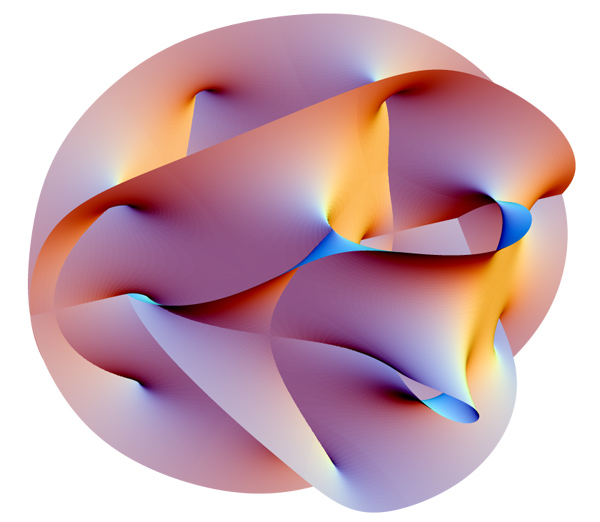
However, theoretical models, particularly String Theory, propose additional spatial dimensions. String theory suggests that the universe comprises up to ten dimensions: the four known dimensions and six extra spatial dimensions that are curled up or “compactified” at sub-microscopic scales (such as Calabi-Yau manifolds).
M-Theory, an extension of string theory, posits 11 dimensions (10 of space and 1 of time). These dimensions are represented in the following table:
Physical Theory
Total Space-Time Dimensions
Curled Up / Hidden Dimensions
Theological Correspondence
General Relativity
4 Dimensions (3 Space+1 Time)
None
Explains the physical, observable world (Shahadah).
String Theory
10 Dimensions (3 Space+1 Time+6 Extra)
6 curled-up spatial dimensions at microscopic scales.
Parallel to the “hidden” or unseen realms (Ghaib).
M-Theory
11 Dimensions (10 Space+1 Time)
7 compactified spatial dimensions.
Represents a multi-dimensional cosmos that allows for divine omnipresence.
Shah notes that while mainstream physics does not discuss God directly, it does accept the existence of unseen dimensions permeating every point of the universe. This physical model resonates with religious descriptions of an invisible realm that sustains the visible world.
Scriptural Anchors in Shah’s Cosmology
Shah anchors his theological cosmology in several key Quranic passages that describe how God interacts with the universe and human consciousness.
Quran 6:103 (“Eyes cannot reach Him, but He reaches human consciousness”): Shah argues that this verse explicitly separates God from the physical limitations of our three-dimensional space. It indicates that while human sensory organs are physically locked into a 3D perspective and cannot perceive the divine essence, the divine consciousness has unhindered access to human thoughts and awareness, operating from a higher dimension.
Quran 50:17-18 (“When the two Recording angels record…”): Shah suggests that the meticulous recording of every human thought and action by angels sitting on our right and left requires a multi-dimensional infrastructure. These agents can monitor and record the internal states of human beings without being physically visible inside our 3D space. This suggests that the universe has additional, hidden dimensions that facilitate cosmic record-keeping.
Quran 2:115 (“Whichever way you turn, there is the Face of God”) and Quran 57:4 (“He is with you wheresoever you may be”): Shah notes that these verses establish God’s absolute omnipresence. In a 3D universe, a physical object cannot be in more than one place at a time. However, a being operating from a higher-dimensional bulk can encompass and touch multiple points in our 3D space simultaneously, providing a physical metaphor for how God can be intimately present with every individual across the cosmos.
Quran 57:21 (“A Garden as wide as the heavens and earth”): Shah points out that the vast, expansive nature of Paradise, which is described as stretching over the entirety of the observable universe, suggests a multi-dimensional structure. This physical space can exist parallel to our own universe without interfering with our visible coordinates.
Shah integrates these physical and metaphysical concepts in his research papers, such as “Stellar Positions, Terminal Physiology, and the Ontological Sovereignty of Awareness”. In these works, he examines “terminal physiology”—the physical limits of human biological and sensory systems—arguing that human consciousness is biologically constrained to a narrow slice of reality.
Shah asserts that “the ontological sovereignty of awareness” belongs to God, whose absolute consciousness is not bound by spatial coordinates or physical organs. By synthesizing quantum mechanics, general relativity, and multi-dimensional string theory, Shah’s writings provide a coherent framework showing how modern physics can help us conceptualize the absolute omniscience and omnipresence of the Creator.
Thematic Epilogue
The commentary on Quran 64:4, when examined at the intersection of classical theology, philosophy of mind, quantum mechanics, and extra-dimensional cosmology, reveals a unified, coherent picture of divine omniscience.
Historically, theologians struggled to explain how an immaterial, transcendent God could be intimately aware of and present within a physical, spatial universe without being limited by it. Classical solution frameworks, while logically rigorous, had to rely on abstract metaphysical categories to preserve divine transcendence. Modern theoretical physics provides a new set of metaphors that resolve this ancient tension. By showing that our 3D universe can be a subset of a larger, higher-dimensional reality, string theory and M-theory show how a being can transcend our physical world while remaining intimately present at every point in space and time.
Similarly, the “hard problem of consciousness” highlights the limits of reductionist materialism, showing that the subjective human mind cannot be fully explained by physical processes alone. The privacy of our inner world, which remains an impenetrable mystery to human science, is completely open to the Creator.
In this way, the ancient words of Quran 64:4 continue to engage with the frontiers of human knowledge. By asserting that the Creator of the universe is also the Knower of our innermost thoughts, the text presents a picture of a cosmos where the laws of physics, the mysteries of consciousness, and the demands of absolute justice are woven into a single, elegant, and multi-dimensional tapestry.
[…] omniscience and extra dimensions. God’s Omniscience, the Hard Problem of Consciousness and Multi-Dimensional Physics and the commentary on Q 64:4 read God’s knowledge of “what is in the breasts” […]
[…] “God’s Omniscience, the Hard Problem of Consciousness and Multi-Dimensional Physics” argues that the private, first-person character of consciousness intensifies the problem: human instruments observe neural correlates, while God knows the experience itself. […]
[…] Your collection relates divine omniscience to a standpoint unconstrained by ordinary spatial barriers. Its useful intuition is that what appears inaccessible from our position need not be inaccessible to God. Omniscience and consciousness […]







Leave a Reply