
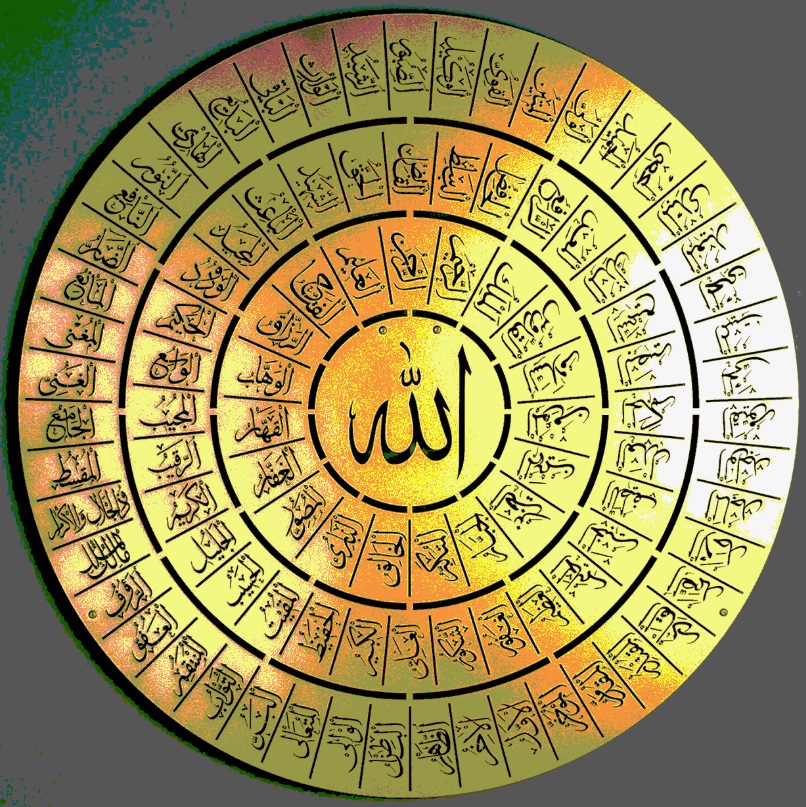
An essay by Zia H Shah MD with help of Claude
Abstract
This essay advances a single thesis with two faces. Just as the verses of the Qur’an comment upon one another—so that the fullest commentary on the Qur’an is the Qur’an itself (tafsīr al-Qurʾān bil-Qurʾān)—so too the Most Beautiful Names of God (al-Asmāʾ al-Ḥusnā) interpret one another, each name conditioning, qualifying, and completing the rest. The Qur’an itself supplies the warrant for the first claim in two verses: Q 39:23, which calls the Book “the best of statements, a Book self-consistent, oft-repeated” (kitāban mutashābihan mathāniya), and Q 4:82, which challenges the reader that had the Book been from other than God “they would surely have found in it much inconsistency.” From the internal coherence of the text I argue to the internal coherence of the theology it discloses. Taking the four foundational attributes of Sūrat al-Fātiḥa—Rabb al-ʿĀlamīn (Lord of all the worlds), al-Raḥmān (the Most Gracious), al-Raḥīm (the Most Merciful), and Māliki Yawm al-Dīn (Master of the Day of Judgment)—as the “mothers” or roots from which the other names branch, I trace how power is read through wisdom, knowledge through mercy, and majesty (jalāl) through beauty (jamāl). Two crown passages anchor the argument: Āyat al-Kursī (Q 2:255) and the closing cascade of Sūrat al-Ḥashr (Q 59:22–24), the densest cluster of divine names in the Qur’an. Drawing on al-Ghazālī, al-Rāzī, al-Qurṭubī, Ibn Kathīr, al-Zamakhsharī, and Ibn al-Qayyim, and integrating the primacy of mercy (“My mercy encompasses all things,” 7:156; “My mercy prevails over My wrath”) with the theology of omnipotence (al-Qādir, al-Qadīr, al-Muqtadir), I argue that the ninety-nine names form a self-interpreting theology whose center of gravity is mercy and whose horizon is unity (tawḥīd). Science–Qur’an convergences are framed throughout as resonances, not proofs.
I. A Book That Comments on Itself
The oldest and soundest principle of Qur’anic interpretation is that the Qur’an explains itself. What is stated in brief in one place is expanded in another; what is absolute in one verse is qualified in a second; a word whose sense is uncertain is fixed by its recurrence elsewhere. The classical exegetes called this the noblest method of commentary, and the Qur’an grounds it in its own self-description.
The first anchor is Q 39:23. Here is the Arabic:
اللَّهُ نَزَّلَ أَحْسَنَ الْحَدِيثِ كِتَابًا مُّتَشَابِهًا مَّثَانِيَ تَقْشَعِرُّ مِنْهُ جُلُودُ الَّذِينَ يَخْشَوْنَ رَبَّهُمْ ثُمَّ تَلِينُ جُلُودُهُمْ وَقُلُوبُهُمْ إِلَىٰ ذِكْرِ اللَّهِ ۚ ذَٰلِكَ هُدَى اللَّهِ يَهْدِي بِهِ مَن يَشَاءُ ۚ وَمَن يُضْلِلِ اللَّهُ فَمَا لَهُ مِنْ هَادٍ
Transliteration: Allāhu nazzala aḥsana l-ḥadīthi kitāban mutashābihan mathāniya taqshaʿirru minhu julūdu alladhīna yakhshawna rabbahum thumma talīnu julūduhum wa-qulūbuhum ilā dhikri llāhi; dhālika hudā llāhi yahdī bihi man yashāʾu; wa-man yuḍlili llāhu famā lahu min hād.
The parallel translations:
- Sahih International: “Allah has sent down the best statement: a consistent Book wherein is reiteration. The skins shiver therefrom of those who fear their Lord; then their skins and their hearts relax at the remembrance of Allah…”
- Yusuf Ali: “Allah has revealed (from time to time) the most beautiful Message in the form of a Book, consistent with itself, (yet) repeating (its teaching in various aspects)…”
- Pickthall: “Allah hath (now) revealed the fairest of statements, a Scripture consistent, (wherein promises of reward are) paired (with threats of punishment)…”
- Muhammad Asad: “God bestows from on high the best of all teachings in the shape of a divine writ fully consistent within itself, repeating each statement [of the truth] in manifold forms…”
- Mustafa Khattab (The Clear Quran): “It is Allah Who has sent down the best message—a Book of perfect consistency and repeated lessons—which causes the skin ˹and hearts˺ of those who fear their Lord to tremble…”
- Maulana Muhammad Ali (marked as a distinct sixth rendering): “Allah has revealed the best announcement, a Book consistent, repeating (its injunctions), whereat do shudder the skins of those who fear their Lord, then their skins and their hearts soften to Allah’s remembrance…” Wikisource
Two words carry the weight: mutashābih and mathānī. Mutashābih here does not mean “ambiguous” as it does in Q 3:7; it means that the parts of the Book resemble and agree with one another—”congruous and compliant,” as classical lexicographers gloss it. Mathānī, from a root meaning to double or fold back, means that its themes are repeated and paired, folded over one another so that one part explains and confirms another. As al-Zamakhsharī and al-Rāzī note in commenting on the term, the “pairing” (mathnā) refers to the Qur’an’s habit of holding contraries together—command and prohibition, reward and punishment, promise and warning, majesty and mercy. Maulana Muhammad Ali captured the point precisely: “The consistency of its various parts, however, signifies more than a mere uniformity; it signifies that some parts explain other parts.” That single sentence is the hinge of this essay. Ahmadiyya
The second anchor is Q 4:82:
أَفَلَا يَتَدَبَّرُونَ الْقُرْآنَ ۚ وَلَوْ كَانَ مِنْ عِندِ غَيْرِ اللَّهِ لَوَجَدُوا فِيهِ اخْتِلَافًا كَثِيرًا
Transliteration: Afalā yatadabbarūna l-qurʾāna; wa-law kāna min ʿindi ghayri llāhi la-wajadū fīhi ikhtilāfan kathīran.
The parallel translations:
- Sahih International: “Then do they not reflect upon the Qur’an? If it had been from [any] other than Allah, they would have found within it much contradiction.”
- Yusuf Ali: “Do they not consider the Qur’an (with care)? Had it been from other than Allah, they would surely have found therein much discrepancy.”
- Pickthall: “Will they not then ponder on the Qur’an? If it had been from other than Allah they would have found therein much incongruity.”
- Muhammad Asad: “Will they not, then, try to understand this Qur’an? Had it issued from any but God, they would surely have found in it many an inner contradiction!”
- Maududi: “Do they not ponder about the Qur’an? Had it been from any other than Allah, they would surely have found in it much inconsistency.”
- Maulana Muhammad Ali (distinct sixth rendering): “Will they not then meditate on the Qur’an? And if it were from any other than Allah, they would have found in it many a discrepancy.”
Ibn Kathīr’s comment is direct: the Qur’an contains “no inconsistencies, contradictions, conflicting statements or discrepancies… because it is a revelation from the Most-Wise, Worthy of all praise. Therefore, the Qur’an is the truth coming from the Truth.” Maulana Muhammad Ali observed that the Book was delivered piecemeal across roughly twenty-three years, under the most varied conditions imaginable—persecution and power, defeat and victory, the solitary preacher of Mecca and the head of state at Medina—and yet “keeps up one and the same strain.” An uninspired book composed under such conditions would drift; this one does not.
These two verses establish a hermeneutic. If the Book is internally coherent and self-interpreting, then the God it describes must be coherent too. The names it uses of Him cannot be a heap of unrelated titles; they must form a system in which each name is read in the light of the others. That is the bridge from the coherence of scripture to the coherence of theology.
II. The Four Mothers of the Names: Sūrat al-Fātiḥa
The opening chapter of the Qur’an, which the Prophet called “the greatest sūra” and which is recited in every unit of every prayer, introduces God through four attributes in three verses:
الْحَمْدُ لِلَّهِ رَبِّ الْعَالَمِينَ الرَّحْمَٰنِ الرَّحِيمِ مَالِكِ يَوْمِ الدِّينِ
Transliteration: Al-ḥamdu lillāhi rabbi l-ʿālamīn. Al-raḥmāni l-raḥīm. Māliki yawmi l-dīn.
Maulana Muhammad Ali renders these: “Praise be to Allah, the Lord of the worlds, the Beneficent, the Merciful, Master of the day of Requital.” Sahih International: “Lord of the worlds, the Entirely Merciful, the Especially Merciful, Sovereign of the Day of Recompense.” These four—Rabb al-ʿĀlamīn, al-Raḥmān, al-Raḥīm, Māliki Yawm al-Dīn—are, I contend, the mothers or roots from which the remaining names descend.
Ibn al-Qayyim al-Jawziyya, in his Madārij al-Sālikīn, makes exactly this observation about the Fātiḥa’s names, and it deserves to stand at the center of any treatment of the divine names. He notes that these five Names (counting Allāh itself with the four attributes) are “far from random qualities of His perfection”; they are distinguished from all the other names because they best introduce the reader to the comprehensive divine reality. From the word Allāh itself, Ibn al-Qayyim says, “every quality related to His glory (jalāl) and beauty (jamāl) is derived.” The attributes of omnipotence flow from His being Rabb of all. His grace, generosity, affection, and love are disclosed through al-Raḥmān and al-Raḥīm. And Māliki Yawm al-Dīn discloses His sovereign justice, most perfectly manifest on the Day of Recompense. The four attributes of the Fātiḥa are thus a compressed taxonomy of the entire divine nature: lordship, all-encompassing mercy, particular mercy, and sovereign justice.
Consider how they already interpret one another within the opening lines. Rabb is not simply “Lord” in the sense of a distant ruler; the root points to nurturing a thing stage by stage to its completion. As Maulana Muhammad Ali glossed it, there is no single English word for Rabb, and “Nourisher to perfection would be nearest.” Immediately the note of authority is softened: the Lord of the worlds is the one who cherishes them toward their fulfillment. Then al-Raḥmān and al-Raḥīm follow, both from the root r-ḥ-m, mercy. Grammatically the two forms differ in a way the tradition has long noticed: raḥmān is on the intensive faʿlān pattern, describing an overflowing, all-embracing mercy that reaches believer and disbeliever, human and animal alike; raḥīm is on the faʿīl pattern, describing a constant, settled quality, the mercy God shows specially and repeatedly to those who turn to Him. The universal and the particular are placed side by side, so that neither is misread: the cosmic breadth of al-Raḥmān is kept from vagueness by the intimate constancy of al-Raḥīm, and the particular favor of al-Raḥīm is kept from tribal narrowness by the universality of al-Raḥmān.
Then comes the decisive juxtaposition. After two names of mercy, the Fātiḥa says Māliki Yawm al-Dīn—Master of the Day of Judgment. Al-Qurṭubī captured the logic exactly: having described Himself as al-Raḥmān al-Raḥīm after saying Rabb al-ʿĀlamīn, God’s words contain “a warning and then an encouragement… Rabb contains a warning while ar-Raḥmān ar-Raḥīm encourages,” and the sequence balances hope with awe. Mercy without judgment collapses into indulgence; judgment without mercy hardens into terror. The Fātiḥa refuses both errors by naming them together. The believer is caught between fear and hope—the classical khawf and rajāʾ—because the God of the opening chapter is named in both registers at once.
There is a reading question at Māliki worth noting, because it too illustrates how the names interpret one another. The seven canonical readings divide between Māliki (“Owner/Master”) and Maliki (“King”). The grammarians al-Qurṭubī reports were themselves split: Abū ʿUbayda and al-Mubarrad preferred Maliki (King) as more comprehensive and more in tune with verses like “Whose is the kingdom this Day?”; others preferred Māliki (Owner) as expressing something Malik does not. Maulana Muhammad Ali preferred “Master,” reasoning that “Allah can forgive His servants, because He is not a mere king or a mere judge, but more properly a Master”—a master’s relationship to those under him carries a tenderness that bare kingship does not. Both readings are canonical and both are true; and the fact that the tradition holds them together, rather than forcing a choice, is itself an instance of the mathānī principle at the level of a single word.
III. How the Names Interpret One Another: The Grammar of the Pairs
The clearest textual proof that the names interpret one another is the Qur’an’s own literary habit at the ends of its verses. Classical scholars gave these verse-endings a technical name, fawāṣil, and studied them closely, because the Qur’an very frequently closes a verse with a pair of divine names, and the pairing is never accidental. The pairing is the commentary.
Consider the most common couplings. ʿAzīzun Ḥakīm—”Mighty, Wise”—recurs constantly. Ghafūrun Raḥīm—”Forgiving, Merciful”—is one of the most frequent pairings in the entire Qur’an; Understand Quran Academy notes that “one of the most common pairs is Allah’s name Al-Ghafoor combined with Ar-Raheem, which is repeated 72 times in the Quran,” while the name al-Ghafūr on its own occurs some ninety-one times. Samīʿun ʿAlīm—”Hearing, Knowing”—recurs around forty-five times. ʿAlīmun Ḥakīm—”Knowing, Wise.” Each pair performs a specific interpretive work, and the classical exegetes said so explicitly.
Take ʿAzīzun Ḥakīm. Al-ʿAzīz is the Mighty, the One who cannot be overcome. But raw might, in our experience, is often hasty, reactive, and prone to transgress. So the Qur’an almost never leaves al-ʿAzīz to stand alone at a verse’s end; it couples it with al-Ḥakīm, the Wise. The message, as al-Rāzī and al-Zamakhsharī note in their comments on such endings, is that God’s power is never blind force; it is always exercised with perfect wisdom. Al-Zamakhsharī, commenting on Q 5:118—where Jesus says of his people, “If You punish them, they are Your servants; and if You forgive them, You are the Mighty, the Wise”—observes that the verse might have been expected to end “the Forgiving, the Merciful,” but instead ends “the Mighty, the Wise,” precisely so that it not be read as Jesus interceding for those who died as idolaters. The choice of names at the verse’s end interprets the verse’s meaning. This is tafsīr al-Qurʾān bil-Qurʾān operating at the level of the divine names themselves.
Or take al-ʿAzīz coupled with al-Raḥīm in Sūrat al-Shuʿarāʾ. Al-Rāzī notes that the Mighty is mentioned first, precisely to forestall the doubt that God might be merciful to rebels merely because He is unable to punish them. He is fully able—al-ʿAzīz—and yet chooses mercy—al-Raḥīm. The order of the names carries the theology. As al-Ṭabarī glossed the same pairing, none can escape His power once He decrees punishment, and yet He is merciful to those who repent.
The pairings also expand our understanding by addition. Ghafūrun Raḥīm tells us that God not only forgives (wipes away the past) but shows mercy (bestows good in the future); forgiveness and mercy are related but not identical, and the pair holds both. Samīʿun ʿAlīm tells us He not only hears all but knows all. And in the beautiful coupling al-Ghafūr al-Wadūd—”the Forgiving, the Loving”—the Qur’an preempts the fear that God might forgive a sinner and yet not love him; the pairing assures the repentant that forgiveness is followed by tender affection.
The general principle is captured in two verses that the Qur’an offers as explicit meta-statements about the names. Q 7:180: “And to Allah belong the best names, so invoke Him by them” (wa-lillāhi l-asmāʾu l-ḥusnā fa-dʿūhu bihā). And Q 17:110:
قُلِ ادْعُوا اللَّهَ أَوِ ادْعُوا الرَّحْمَٰنَ ۖ أَيًّا مَّا تَدْعُوا فَلَهُ الْأَسْمَاءُ الْحُسْنَىٰ
Transliteration: Quli dʿū llāha awi dʿū l-raḥmāna; ayyan mā tadʿū fa-lahu l-asmāʾu l-ḥusnā.
- Sahih International: “Say, ‘Call upon Allah or call upon the Most Merciful. Whichever [name] you call—to Him belong the best names.’” AmraynQuranic Arabic Corpus
- Maulana Muhammad Ali: “Say: Call on Allah or call on the Beneficent. By whatever (name) you call on Him, He has the best names.” 2pm
Ibn Kathīr, commenting on this verse, immediately cites the opening of Sūrat al-Ḥashr (59:22–24) as the demonstration: to call on “Allah” and to call on “al-Raḥmān” is to call on the same One, because all the beautiful names are His and none contradicts another. The name is not a separate deity; it is a window onto the single Named. This is the theological form of tawḥīd: the many names disclose the one Essence, and therefore they must cohere, exactly as the many verses disclose the one Author, and therefore they cohere.
The tradition organized this coherence under two great headings: names of majesty (jalāl) and names of beauty (jamāl). The names of jalāl—al-Malik, al-ʿAzīz, al-Jabbār, al-Qahhār, al-Mutakabbir—express God’s greatness, transcendence, and awe-inspiring power. The names of jamāl—al-Raḥmān, al-Raḥīm, al-Laṭīf, al-Wadūd, al-Karīm—express His nearness, mercy, gentleness, and love. Ibn ʿArabī devoted a treatise, Kitāb al-Jalāl wa-l-Jamāl, to their interplay, and al-Ghazālī, in his Kitāb al-Maḥabba, discussed how majesty and beauty relate. The scholars’ summary is striking: the two are not opposed but interwoven—”the majesty of God is His beauty, and His beauty is His majesty.” A believer who acquires the traces of the names of severity without tempering them with the names of mercy becomes harsh and arrogant; only the harmony of the two, the tradition insists, allows the full flowering of a human character. What is true of the human soul is a reflection of what is true of the divine names: they must be read together or they are misread.
IV. The Crown Verse: Āyat al-Kursī (Q 2:255)
The Prophet, when asked which verse of the Qur’an was the greatest, was told by his Companion Ubayy ibn Kaʿb: “Allah! There is no god but He, the Living, the Self-Subsisting.” As recorded in Ṣaḥīḥ Muslim (no. 810), the Prophet asked, “O Abū al-Mundhir, do you know the verse from the Book of Allah which is the greatest?”; when Ubayy answered with the opening of Āyat al-Kursī, “he struck me on my breast and said: May knowledge be pleasant for you, O Abū al-Mundhir!” Āyat al-Kursī is the crown verse because, as al-Rāzī observed, it gathers “the chief names and attributes of God” into a single sustained declaration. Here the mutual interpretation of the names is on fullest display. Makkah Live
The Arabic:
اللَّهُ لَا إِلَٰهَ إِلَّا هُوَ الْحَيُّ الْقَيُّومُ ۚ لَا تَأْخُذُهُ سِنَةٌ وَلَا نَوْمٌ ۚ لَّهُ مَا فِي السَّمَاوَاتِ وَمَا فِي الْأَرْضِ ۗ مَن ذَا الَّذِي يَشْفَعُ عِندَهُ إِلَّا بِإِذْنِهِ ۚ يَعْلَمُ مَا بَيْنَ أَيْدِيهِمْ وَمَا خَلْفَهُمْ ۖ وَلَا يُحِيطُونَ بِشَيْءٍ مِّنْ عِلْمِهِ إِلَّا بِمَا شَاءَ ۚ وَسِعَ كُرْسِيُّهُ السَّمَاوَاتِ وَالْأَرْضَ ۖ وَلَا يَئُودُهُ حِفْظُهُمَا ۚ وَهُوَ الْعَلِيُّ الْعَظِيمُ
Transliteration: Allāhu lā ilāha illā huwa l-ḥayyu l-qayyūm. Lā taʾkhudhuhu sinatun wa-lā nawm. Lahu mā fī l-samāwāti wa-mā fī l-arḍ. Man dhā lladhī yashfaʿu ʿindahu illā bi-idhnih. Yaʿlamu mā bayna aydīhim wa-mā khalfahum, wa-lā yuḥīṭūna bi-shayʾin min ʿilmihi illā bimā shāʾ. Wasiʿa kursiyyuhu l-samāwāti wa-l-arḍ, wa-lā yaʾūduhu ḥifẓuhumā. Wa-huwa l-ʿaliyyu l-ʿaẓīm.
The parallel translations:
- Sahih International: “Allah—there is no deity except Him, the Ever-Living, the Sustainer of [all] existence. Neither drowsiness overtakes Him nor sleep. To Him belongs whatever is in the heavens and whatever is on the earth. Who is it that can intercede with Him except by His permission? He knows what is [presently] before them and what will be after them, and they encompass not a thing of His knowledge except for what He wills. His Kursī extends over the heavens and the earth, and their preservation tires Him not. And He is the Most High, the Most Great.”
- Yusuf Ali: “Allah! There is no god but He,—the Living, the Self-subsisting, Eternal. No slumber can seize Him nor sleep. His are all things in the heavens and on earth… His Throne doth extend over the heavens and the earth, and He feeleth no fatigue in guarding and preserving them for He is the Most High, the Supreme (in glory).” Surah Quran
- Pickthall: “Allah! There is no god save Him, the Alive, the Eternal. Neither slumber nor sleep overtaketh Him… His throne includeth the heavens and the earth, and He is never weary of preserving them. He is the Sublime, the Tremendous.”
- Muhammad Asad: “God—there is no deity save Him, the Ever-Living, the Self-Subsistent Fount of All Being. Neither slumber overtakes Him, nor sleep…”
- Maududi: “Allah, the Ever-Living, the Self-Subsisting by Whom all subsist, there is no god but He. Neither slumber seizes Him, nor sleep… His Dominion overspreads the heavens and the earth, and their upholding wearies Him not. He is All-High, All-Glorious.”
- Maulana Muhammad Ali (distinct sixth rendering): “Allah is He besides Whom there is no god, the Ever-living, the Self-subsisting by Whom all subsist; slumber does not overtake Him nor sleep… His knowledge extends over the heavens and the earth, and the preservation of them both tires Him not; and He is the Most High, the Great.”
The verse opens with Allāh, the name that, in al-Ghazālī’s words in al-Maqṣad al-Asnā, “is the greatest of the ninety-nine names because it indicates the essence that brings together all the divine attributes in such a way that no part of them is lacking.” Every other name indicates a single attribute—knowledge, or power, or mercy; the name Allāh denotes the Essence in which they all inhere. All other names, al-Ghazālī says, “are defined in relationship to it.” So the crown verse begins from the source and unfolds outward. ghazalighazali
Then come the two “axis names,” as al-Rāzī called them: al-Ḥayy (the Ever-Living) and al-Qayyūm (the Self-Subsisting by whom all subsist). Al-Rāzī argued that from these two all the other names branch, and the pairing itself is instructive. Several early authorities held that al-Ḥayy al-Qayyūm together constitute the Greatest Name of God (al-ism al-aʿẓam). Life and self-subsistence interpret one another: al-Ḥayy is the perfection of life that never dies; al-Qayyūm is the perfection by which He upholds all else. A life that needed rest could not sustain others; therefore the verse immediately adds, “Neither drowsiness overtakes Him nor sleep”—the perfect life of al-Ḥayy is guarded against any imperfection precisely so that the sustaining work of al-Qayyūm can be unceasing. One name explains the qualification attached to the other. Ayatulkursi + 2
The verse then moves through ownership (“To Him belongs whatever is in the heavens and the earth”), the impossibility of independent intercession (“except by His permission”), the reach of His knowledge over past and future, and the strict limit on creaturely knowledge (“they encompass nothing of His knowledge except what He wills”). Here the name of knowledge is bounded by the name of will: what creatures know is a gift of His willing, not a conquest of His secrecy. The verse closes on two names of majesty, al-ʿAliyy (the Most High) and al-ʿAẓīm (the Most Great)—and yet the whole architecture has been about God’s tireless care for creation (“their preservation tires Him not”). The names of majesty at the end do not cancel the sustaining tenderness of the middle; they crown it. This is the jalāl–jamāl balance within a single verse: the Most High is also the ceaseless Sustainer, and neither reading is complete without the other.
I have argued elsewhere that Āyat al-Kursī is also a charter of the scope and the limits of human knowledge—”they encompass nothing of His knowledge except what He wills” reads, in the age of quantum mechanics and the irreducible horizons it has disclosed, as a startlingly apt statement of epistemic humility. But I frame this strictly as resonance, not proof: the verse is not a physics paper, and physics does not establish theology. What the verse and the physics share is a refusal of the old dream of total, God’s-eye transparency for the finite knower.
V. The Densest Cascade: Sūrat al-Ḥashr (Q 59:22–24)
If Āyat al-Kursī is the crown, the closing three verses of Sūrat al-Ḥashr are the treasury—the single densest cluster of divine names in the entire Qur’an, and therefore the supreme scriptural demonstration that the names are meant to be read as a coherent sequence. There is a well-known report, narrated by Maʿqil ibn Yasār and recorded by al-Tirmidhī (no. 2922, in the Chapters on the Virtues of the Qur’an), that whoever recites the closing verses of Sūrat al-Ḥashr in the morning has seventy thousand angels appointed to pray for him until evening; al-Tirmidhī graded the report gharīb, and later hadith scholars classify its chain (through Nāfiʿ ibn Abī Nāfiʿ) as weak (ḍaʿīf), so I cite it as a devotional tradition, not as firmly established. What is beyond dispute is the passage’s stature as the Qur’an’s richest concentration of divine names. Here it is.
هُوَ اللَّهُ الَّذِي لَا إِلَٰهَ إِلَّا هُوَ ۖ عَالِمُ الْغَيْبِ وَالشَّهَادَةِ ۖ هُوَ الرَّحْمَٰنُ الرَّحِيمُ هُوَ اللَّهُ الَّذِي لَا إِلَٰهَ إِلَّا هُوَ الْمَلِكُ الْقُدُّوسُ السَّلَامُ الْمُؤْمِنُ الْمُهَيْمِنُ الْعَزِيزُ الْجَبَّارُ الْمُتَكَبِّرُ ۚ سُبْحَانَ اللَّهِ عَمَّا يُشْرِكُونَ هُوَ اللَّهُ الْخَالِقُ الْبَارِئُ الْمُصَوِّرُ ۖ لَهُ الْأَسْمَاءُ الْحُسْنَىٰ ۚ يُسَبِّحُ لَهُ مَا فِي السَّمَاوَاتِ وَالْأَرْضِ ۖ وَهُوَ الْعَزِيزُ الْحَكِيمُ
Transliteration: Huwa llāhu lladhī lā ilāha illā huwa, ʿālimu l-ghaybi wa-l-shahādah; huwa l-raḥmānu l-raḥīm. Huwa llāhu lladhī lā ilāha illā huwa, l-maliku l-quddūsu l-salāmu l-muʾminu l-muhayminu l-ʿazīzu l-jabbāru l-mutakabbir; subḥāna llāhi ʿammā yushrikūn. Huwa llāhu l-khāliqu l-bāriʾu l-muṣawwir; lahu l-asmāʾu l-ḥusnā; yusabbiḥu lahu mā fī l-samāwāti wa-l-arḍ; wa-huwa l-ʿazīzu l-ḥakīm.
The parallel translations of verse 22, with the cascade of 23–24 following:
- Sahih International (22): “He is Allah, other than whom there is no deity, Knower of the unseen and the witnessed. He is the Entirely Merciful, the Especially Merciful.” (23): “He is Allah, other than whom there is no deity, the Sovereign, the Pure, the Perfection, the Bestower of Faith, the Overseer, the Exalted in Might, the Compeller, the Superior. Exalted is Allah above whatever they associate with Him.” (24): “He is Allah, the Creator, the Inventor, the Fashioner; to Him belong the best names…”
- Yusuf Ali (22): “Allah is He, than Whom there is no other god;—Who knows (all things) both secret and open; He, Most Gracious, Most Merciful.” (23): “…the Sovereign, the Holy One, the Source of Peace (and Perfection), the Guardian of Faith, the Preserver of Safety, the Exalted in Might, the Irresistible, the Supreme…” (24): “…the Creator, the Evolver, the Bestower of Forms (or Colours). To Him belong the Most Beautiful Names…”
- Pickthall (22): “He is Allah, than Whom there is no other God, the Knower of the Invisible and the Visible. He is the Beneficent, Merciful.” (23): “…the Sovereign Lord, the Holy One, Peace, the Keeper of Faith, the Guardian, the Majestic, the Compeller, the Superb…” (24): “…the Creator, the Shaper out of naught, the Fashioner. His are the most beautiful names…”
- Muhammad Asad (22): “God is He save whom there is no deity: the One who knows all that is beyond the reach of a created being’s perception, as well as all that can be witnessed… the Most Gracious, the Dispenser of Grace.”
- Maududi (23): “…the Holy, the All-Peace, the Giver of security, the Overseer, the Most Mighty, the Overpowering, the All-Great…”
- Maulana Muhammad Ali (distinct sixth rendering) (22): “He is Allah besides Whom there is no God: the Knower of the unseen and the seen; He is the Beneficent, the Merciful.” (23): “He is Allah, besides Whom there is no God; the King, the Holy, the Author of Peace, the Granter of Security, Guardian over all, the Mighty, the Supreme, the Possessor of greatness. Glory be to Allah from what they set up (with Him)!” (24): “He is Allah; the Creator, the Maker, the Fashioner. His are the most beautiful names. Whatever is in the heavens and the earth declares His glory; and He is the Mighty, the Wise.” Wikisource
Now watch how the cascade interprets itself. Al-Rāzī, whose Mafātīḥ al-Ghayb is famous for demonstrating the deliberate interconnection (munāsaba) of the Qur’an’s words, notes that the passage begins from the name Allāh and the affirmation of oneness, moves to knowledge (ʿĀlim al-ghayb wa-l-shahāda, Knower of the unseen and the witnessed), and then to mercy (al-Raḥmān al-Raḥīm). He even observes a rational secret (sirr ʿaqlī) in placing the unseen before the witnessed. The order is not arbitrary: God is named, then known as One, then known as All-Knowing, then—before any name of power is uttered—named as Merciful. Mercy is placed first, structurally, exactly as it is placed first in the Fātiḥa and in the basmala that opens every sūra.
Verse 23 then unfolds the names of sovereignty and majesty in a sequence whose internal logic the commentators traced with care. Ibn ʿĀshūr, whose analysis synthesizes the classical tradition, notes that al-Malik (the Sovereign King) is placed “perfectly between His all-encompassing mercy and His freedom from defect.” For the very next name is al-Quddūs (the Holy), which Ibn Kathīr glosses, on the authority of the early exegetes, as “the Pure,” “the Blessed,” the One whom the noble angels glorify. The King is at once declared a flawless King: al-Malik al-Quddūs. Then al-Salām (the Source of Peace)—which Ibn Kathīr explains as “free from any defects or shortcomings that lessen His perfect attributes and actions.” The Holy One who is free of defect in His essence is now declared free of defect in His actions, and the source of peace for others. yaqeeninstitute
Then al-Muʾmin (the Granter of Security). Ibn Kathīr records the interpretation of Ibn ʿAbbās that this means “Who has granted safety to His servants by promising that He will never be unjust to them,” and the interpretation of Qatāda that it means “Allah affirms that His statements are true.” Note the interpretive chain: the Source of Peace grants security; and lest we imagine He grants security out of weakness or fear, the very next name is al-Muhaymin (the Guardian, the Overseer), which Ibn Kathīr, again on the authority of Ibn ʿAbbās, glosses as “the Witness over His servants’ deeds,” the One in total control. The order forestalls a doubt: He secures because He oversees all, not because He needs anything. Quran.com + 2
Then the names of overwhelming power—al-ʿAzīz (the Mighty, “Dominant over all things”), al-Jabbār (the Compeller, which the lexicographers note also carries the sense of jabr, the mending of the broken, as a splint mends a bone), and al-Mutakabbir (the Supreme in greatness)—rise to a climax and then immediately dissolve into Subḥāna llāhi ʿammā yushrikūn, “Glory be to Allah above what they associate with Him.” The peak of majesty issues directly in tanzīh, the declaration of God’s transcendence above all partners. Al-Zamakhsharī’s al-Kashshāf, built on the theory of the Qur’an’s inimitable arrangement (naẓm), foregrounds exactly this rhetorical climax and its resolution into pure oneness. Surah Quran
Verse 24 turns from majesty to creativity with three names that the classical exegetes were at pains to distinguish precisely, because their distinctness is the whole point. Al-Qurṭubī, in his al-Jāmiʿ li-Aḥkām al-Qurʾān, writes: “Al-Khāliq here means the One who measures and determines (al-muqaddir); al-Bāriʾ means the One who originates and brings into being from nothing (al-munshiʾ al-mukhtariʿ); and al-Muṣawwir means the Fashioner of forms, who composes them in varied shapes. So fashioning (al-taṣwīr) is arranged upon, and consequent to, creating and originating.” He insists on the sequence: “Some make khalq synonymous with taṣwīr, but it is not so: fashioning is last, determining is first, and origination is in between.” Ibn Kathīr agrees exactly: “Al-Khāliq refers to measuring and proportioning; al-Bāriʾ refers to inventing and bringing into existence what He has created and measured… none except Allah is able to measure, bring forth, and create.” Al-Ghazālī offered a memorable analogy in al-Maqṣad al-Asnā: the three names are like the architect who draws the plan (al-Khāliq), the builder who executes it (al-Bāriʾ), and the artist who gives the final distinctive form (al-Muṣawwir). Quran.comAllahuakbarofficial
Here the mutual interpretation of the names is not a scholar’s imposition; it is written into the grammar of the verse. Three names, arranged in a strict order that tracks the three moments of any act of making—design, execution, formation—so that each name is unintelligible without the others, and together they say what no single name could say. And the passage closes, having named the Creator, with lahu l-asmāʾu l-ḥusnā, “to Him belong the most beautiful names,” and then wa-huwa l-ʿazīzu l-ḥakīm—”the Mighty, the Wise.” The cascade of creation ends where the whole essay began: on the pairing of might with wisdom, power read through wisdom.
There is a modern resonance worth naming carefully. The three creative names track a staged, ordered process—determination, origination, formation—rather than an instantaneous, structureless flash. A reader today may hear in taqdīr (the measuring and proportioning of al-Khāliq) an anticipation of the fine-tuned, law-governed, and developmental character of the cosmos and of life as the sciences have disclosed them—a universe measured with exquisite precision and unfolded in stages. I offer this as resonance and anticipation, explicitly not as concordist proof. The verse was not predicting cosmology; it was disclosing God. That its disclosure of a God who measures before He forms rhymes with what we have since learned of an ordered, developmental cosmos is a harmony to be contemplated, not a theorem to be brandished.
VI. The Primacy of Mercy
If the names interpret one another, one name governs the reading of all the rest. That name is mercy. The evidence is structural, textual, and prophetic.
Structurally: every sūra but one opens with Bismi-llāhi l-Raḥmāni l-Raḥīm, “In the name of Allah, the Most Gracious, the Most Merciful.” Before any command, any law, any warning, any account of judgment, the reader meets mercy—113 times, at the head of the Book’s chapters, and again within Sūrat al-Naml. I have elsewhere catalogued the sheer density of the Qur’an’s insistence on compassion; when one counts the openings of the sūras together with the recurrences of raḥīm and the commands to do good (iḥsān), the theme of mercy and compassionate living saturates the text on a scale no other theme approaches. The Qur’an does not merely mention that God is merciful; it frames itself in mercy, so that every other divine name is encountered inside a frame the basmala has already set.
Textually: Q 7:156 places in God’s own mouth the decisive statement.
قَالَ عَذَابِي أُصِيبُ بِهِ مَنْ أَشَاءُ ۖ وَرَحْمَتِي وَسِعَتْ كُلَّ شَيْءٍ
Transliteration: Qāla ʿadhābī uṣību bihi man ashāʾu; wa-raḥmatī wasiʿat kulla shayʾ.
Sahih International: “[Allah] said, ‘My punishment—I afflict with it whom I will, but My mercy encompasses all things.’” Maulana Muhammad Ali: “My chastisement—I bring it on whom I please, and My mercy encompasses all things.” Maududi’s commentary on this verse states the principle exactly: “It is false to assume that the general rule underlying God’s governance of His realm is that of wrath which is occasionally tempered with mercy. On the contrary, the general rule is that of mercy and benevolence, and wrath is the exception.” Punishment is bounded—”whom I will”; mercy is unbounded—”all things.” The two are not symmetrical. One name conditions the other. Al-Hadees
Prophetically: the ḥadīth qudsī recorded in both Ṣaḥīḥ al-Bukhārī (no. 3194) and Ṣaḥīḥ Muslim (no. 2751), on the authority of Abū Hurayra, states that when God decreed creation He wrote in a Book kept with Him above the Throne: inna raḥmatī ghalabat ghaḍabī—”My mercy prevails over My wrath.” Mercy is not merely one attribute among the ninety-nine; it is the attribute in the light of which the rest are to be read. The Prophet also taught that God divided mercy into a hundred parts, keeping ninety-nine and sending down one, by which all creation shows compassion to itself—the tenderness of an animal lifting its hoof from its young. And of the Prophet himself the Qur’an says, “We have sent thee not but as a mercy to all the worlds” (21:107). 99 Names of Allah
This is why al-Ghazālī, in al-Maqṣad al-Asnā, could write that God’s mercy “is perfect and all-inclusive… perfect in the sense that He not only wills the satisfaction of the needs of the needy but actually satisfies them,” and all-inclusive in that it embraces “the worthy and the unworthy, this life and that which is to come.” Commenting on “My mercy precedes My anger,” al-Ghazālī offered a metaphysical reading that goes to the heart of this essay: God “wills good for the good itself, whereas He wills evil… only accidentally, for the good within it. Good is determined essentially (bi’l-dhāt), but evil is required accidentally (bi’l-ʿaraḍ).” Mercy is essential to the divine nature; wrath is derivative and instrumental. The names of severity are real, but they serve; the names of mercy are sovereign. ghazali + 2
This has a direct ethical corollary that I have long emphasized: because God’s own self-description places mercy first, the believer’s imitation of God (the takhalluq of which the Sufis spoke) must place mercy first too. Al-Ghazālī draws exactly this conclusion: the human share in al-Raḥmān is “that he should have mercy upon the servants of God who neglect Him… he should look upon the sinners with eyes of mercy, not eyes of censure.” To know that mercy governs the names is to know that compassion must govern the life. The Qur’an makes the point in a hundred verses: righteousness is not the direction one faces in prayer but the compassion one shows to orphan, traveler, neighbor, and the enslaved (2:177). The litmus test of true belief, on this reading, is not correctness of dogma but a life made merciful by contact with the Merciful. ghazali
VII. Power Read Through Mercy and Wisdom: The Omnipotence Names
The names of power complete the picture, and they too are governed by the interpretive principle. The Qur’an expresses divine omnipotence through a family of terms from the root q-d-r: al-Qādir (the One fully able), al-Qadīr (the One whose power is perfect and inexhaustible), and al-Muqtadir (the sovereign Executor whose decree unfailingly prevails), together with the refrain that closes so many verses: ʿalā kulli shayʾin qadīr, “powerful over all things.” The precise clausula inna llāha ʿalā kulli shayʾin qadīr—”God has power over everything”—occurs, as Nicolai Sinai has noted (cited in George Archer, A Place Between Two Places: The Quranic Barzakh, Gorgias Press, 2020), no fewer than eight times across the Qur’an, while the participle qadīr is predicated of God in various case-forms far more often, on the order of forty-five times.
What is decisive for this essay is that the Qur’an almost never lets power stand alone. It conditions omnipotence with the other names, exactly as it conditions might with wisdom at the ends of verses. Consider Q 30:54, which uses the definite form al-Qadīr: “He creates what He wills, and He is the All-Knowing, the All-Powerful” (al-ʿalīmu l-qadīr). Power is governed by knowledge; omnipotence is not blind force. In 35:44 God is “All-Knowing, All-Powerful”; in 4:149 “Pardoning, Powerful”; in 60:7 “Powerful, Forgiving, Merciful.” As I have argued at length in my study of the omnipotence names, the theological rule is precisely that the attributes interpret one another: knowledge prevents the image of blind force, wisdom prevents the image of meaningless caprice, justice prevents tyranny, and mercy prevents power from collapsing into mere punishment. The God of the Qur’an is not merely able to produce any effect; He knows what He produces, wills it, measures it (taqdīr), and places it within a moral and purposive order.
Al-Ghazālī’s formulation of omnipotence in al-Maqṣad al-Asnā is illuminating here: the truly powerful is one who acts when He wills and refrains when He wills—so that omnipotence includes sovereign non-action, and God’s forbearance is not inability but restraint. This coheres exactly with the primacy of mercy: the All-Powerful who could punish and chooses to forgive is more fully disclosed by the pairing “Mighty, Merciful” than by “Mighty” alone. The very grammar of the verse-endings teaches the theology.
It is here that my own constructive proposal, which I have called the “Inshallah universe,” finds its place—offered as a philosophical reading, not as a scientific result. Following al-Ghazālī’s occasionalism, I read the created order as genuinely lawful and fully open to scientific investigation, yet not metaphysically self-sufficient: the regularities we call laws of nature are the dependable habit of God (sunnat Allāh), a description of how He customarily acts, not an autonomous machinery that acts on its own. The name al-Muqtadir—the One whose determination unfailingly takes effect—names the sovereignty that underlies every regularity. On this reading, “if God wills” (in shāʾ Allāh) is not merely a pious formula about an uncertain future; it is an ontological confession about every event. And modern physics, while it proves none of this, can at least discipline the older mechanistic confidence: quantum indeterminacy and entanglement have shown that nature is stranger, less locally deterministic, and less pictorially transparent than the clockwork universe once imagined. I stress the epistemic boundary firmly: quantum mechanics does not identify God as the selector of outcomes, and God must never be reduced to a force among forces or a being lodged in some higher dimension. The convergence is a resonance that loosens an old dogmatism; it is not a proof. What the omnipotence names finally teach, read together with the names of mercy and wisdom, is that existence is “neither abandoned to chance nor imprisoned by necessity”—it is held, measured, and continuously bestowed by a Power that is also Wisdom and also Mercy.
VIII. Thematic Epilogue: The One Book and the One God
We began with two verses about a Book and end with a vision of God. The link between them is not decorative; it is the argument itself.
Q 39:23 calls the Qur’an mutashābihan mathāniya—self-resembling and paired, folded over on itself so that each part illumines the others. Q 4:82 dares the reader to find a contradiction and promises he will not, because the Book issues from a single, undivided source. These two verses describe a text that is a self-interpreting book. And precisely because the Book is one, the God it names must be one; and precisely because the God is one, His names must cohere. The many verses disclose the one Author; the many names disclose the one Named. To read either well is to read the parts in the light of the whole.
This is why the divine names constitute a self-interpreting theology. Rabb is read through Raḥmān, so that lordship is nurture. Raḥmān is read through Raḥīm, so that cosmic mercy is also intimate constancy. Both are read through Māliki Yawm al-Dīn, so that mercy is not indulgence and judgment is not cruelty. Might (al-ʿAzīz) is read through wisdom (al-Ḥakīm), so that power is never rash. Knowledge (al-ʿAlīm) is joined to mercy and to will, so that the Knower of all is also the Merciful who reveals what He wills. The King (al-Malik) is at once the Holy (al-Quddūs), the Peace (al-Salām), the Granter of Security (al-Muʾmin), the Overseer (al-Muhaymin)—majesty and gentleness in a single breath. The Creator (al-Khāliq), the Originator (al-Bāriʾ), and the Fashioner (al-Muṣawwir) are three moments of one creative act, no one of them intelligible alone. And over the whole assembly of names presides the word written above the Throne: My mercy prevails over My wrath.
The tradition expressed this unity-in-multiplicity in its own idiom. Al-Ghazālī taught that the name Allāh is greatest because it gathers all the attributes with nothing lacking, and that all the other names are “defined in relationship to it.” Ibn al-Qayyim taught that the whole call of the prophets was, at bottom, “knowing Allah through His Names, His Attributes, and His Actions.” Ibn ʿArabī explored how majesty is the inward face of beauty and beauty the outward face of majesty. What they were each describing, in different registers, is the same thing this essay has traced from the side of the text: coherence. The ninety-nine names are not ninety-nine gods, nor ninety-nine unrelated facts; they are ninety-nine windows onto one Light, and the light that comes through any one window is colored by all the rest. ghazaliMwrc
And so the two coherences meet. The internal coherence of scripture—tafsīr al-Qurʾān bil-Qurʾān, verse illuminating verse—is the audible form of the internal coherence of the divine nature, name illuminating name. The Book is one because its Author is one; the names cohere because the Named is One. To recite al-Fātiḥa is already to hold lordship, grace, mercy, and judgment together in a single sentence; to recite Āyat al-Kursī is to watch life and self-subsistence, knowledge and will, majesty and care unfold from the single name Allāh; to recite the close of al-Ḥashr is to see the whole treasury of names spill out and then gather again into lahu l-asmāʾu l-ḥusnā—”to Him belong the most beautiful names.” All of them belong to Him; and because they are His, they are one; and because they are one, they interpret one another; and the name in whose light they are all finally read is Mercy. That is the unity (tawḥīd) toward which every name, and every verse, quietly bends.



 The Glorious Quran and Science
Leave a comment