
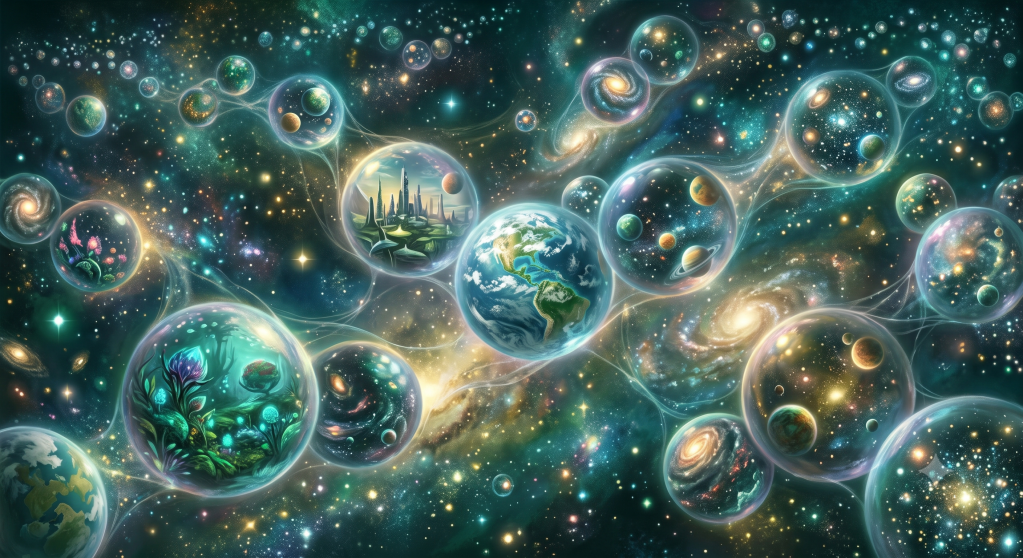
Presented by Claude
Abstract
This article offers a scientific, philosophical, and theological commentary on the exact Arabic phrase رَبِّ الْعَالَمِينَ (Rabb al-ʿĀlamīn, “Lord of the Worlds”), which occurs 42 times across 21 Surahs of the Holy Quran. It argues that this phrase is the Quran’s master key to cosmology. The plural al-ʿālamīn (“the worlds”) is read not as a mere rhetorical flourish but as a term of unbounded scope: it embraces the world of humans, jinn, and angels, and by extension every galaxy, universe, and — should one exist — the entire multiverse. Remarkably, the twelfth-century mufassir Fakhr al-Din al-Razi, engaging this very phrase, affirmed that God has the power to create “a thousand thousand worlds beyond this world,” an astonishing classical Islamic anticipation of the modern multiverse debate. The central thesis is twofold. First, Islam has no theological stake against the multiverse: whether the cosmos is singular or numbers the roughly 10^500 vacua of the string landscape, Rabb al-ʿĀlamīn is Lord of them all — a position that starkly distinguishes the theist, who wins either way, from the atheist, who needs the multiverse to escape the evidence of fine-tuning. Second, cosmic fine-tuning — the cosmological constant tuned to one part in 10^120, Penrose’s initial-entropy figure of one part in 10^10^123, the carbon-12 resonance — is presented unapologetically as evidence for God the Creator, and the standard objections (multiverse-as-escape, the anthropic selection effect, “who designed the designer”) are refuted. Throughout, science-Quran convergences are framed as resonances and remarkable anticipations, never as concordist proofs, following the epistemological restraint.
1. Introduction: The Phrase That Opens the Book
Every complete recitation of the Holy Quran begins with it. Every canonical unit of Muslim prayer returns to it. The second verse of Surah al-Fatihah — الْحَمْدُ لِلَّهِ رَبِّ الْعَالَمِينَ, al-ḥamdu lillāhi rabbil-ʿālamīn, “All praise is due to Allah, Lord of the Worlds” — is, according to the count preserved by careful students of the text, one of exactly 42 occurrences of the phrase Rabb al-ʿĀlamīn spread across 21 different Surahs. As one careful tabulation notes, “the name Rabb Al-‘Alameen … appears in the Quran 42 times in 42 verses in 21 suras,” never twice in the same verse, and among these 42 verses, 7 are verses of praise like Q 1:2 — an elegant numerical patterning in which both 42 (6×7) and 21 (3×7) are multiples of seven.
Because al-Fatihah is recited in every rakʿah of every prayer, the worshipper who prays the five obligatory prayers encounters Rabb al-ʿĀlamīn a minimum of seventeen times each day — and far more when the supererogatory prayers are added. Maulana Muhammad Ali observed that the Oft-repeated Seven Verses “constitute the prayer for guidance of every Muslim at least thirty-two times a day.” The believer who bows in prayer is therefore making, several times daily, what may be the most profound cosmological claim ever uttered: that behind all that exists stands a single sustaining Lord.
The morphology of Rabb
The word Rabb is inexhaustibly rich. Lexicographers assign it three overlapping registers: (i) Lord and Master; (ii) Sustainer, Provider, Nourisher, Cherisher, and Guardian; and (iii) Sovereign, Ruler, the One who controls and directs. As the classical dictionaries (drawn upon by Raghib al-Isfahani in his Mufradat and by Edward Lane in his Lexicon) make clear, Rabb derives from the root r-b-b, connected to tarbiyah — the fostering of a thing stage by stage until it attains its completion.
Maulana Muhammad Ali’s footnote on Q 1:2 renders this technical sense unforgettably: “the Arabic word Rabb conveys not only the idea of fostering, bringing-up, or nourishing, but also that of regulating, completing, and accomplishing … i.e. of the evolution of things from the crudest state to that of the highest perfection.” He continues: “According to Rgh [Raghib], Rabb signifies the fostering of a thing in such a manner as to make it attain one condition after another until it reaches its goal of completion. Hence Rabb is the Author of all existence, Who has not only given to the whole creation its means of nourishment but has also beforehand ordained for each a sphere of capacity and within that sphere provided the means by which it continues to attain gradually to its goal of perfection.” This is the Lahore Ahmadiyya reading of Rabb as implying a guided, staged development — evolution understood not as blind accident but as divinely superintended ascent.
The plural al-ʿālamīn
The second term is grammatically curious and theologically explosive. Al-ʿĀlamīn is the plural of ʿālam (world). As the classical commentators note, ʿālam is itself already a collective noun with no singular form, so ʿālamīn is, remarkably, “the plural of a plural.” A whole scholarly literature grew up around explaining a term that was felt “at least grammatically, to be anomalous” (as a study by K. Zebiri in the Bulletin of the School of Oriental and African Studies, vol. 57, 1994, documented).
The exegetes offered a spectrum of meanings. Some, following al-Farraʾ and Abu ʿUbayda, restricted ʿālam to beings endowed with intellect, in four categories — mankind, jinn, angels, and devils. Others, following Qatada and al-Tabari, took it to mean every race, species, and generation of creation. Ibn Kathir summarized in his Tafsir: “Al-‘Alamin is plural for ‘Alam, which encompasses everything in existence except Allah. The word ‘Alam is itself a plural word, having no singular form. The ‘Alamin are different creations that exist in the heavens and the earth, on land and at sea. Every generation of creation is called an ‘Alam.” And some scholars, as al-Qurtubi records, derived ʿālam from ʿalāma (“sign”) — “because the existence of the world is a sign, without doubt, of the existence of its Creator.” On this reading, the very name of the cosmos encodes the cosmological argument: to call the universe al-ʿālam is to call it a sign pointing beyond itself.
It is this plural — “the worlds” — that carries the whole cosmological freight of this essay. If God is not merely Lord of the world but Lord of the worlds, then the Quran’s opening declaration already gestures toward a plurality of realms whose full extent it leaves open.
2. The Five Anchor Verses
We now treat five anchor verses in full, each with its Arabic text and transliteration, six parallel English translations (with Maulana Muhammad Ali of Lahore distinctively marked as the sixth), classical tafsir, and modern commentary.
2.1 Q 1:2 (al-Fatihah) — The Opening Declaration
Arabic: الْحَمْدُ لِلَّهِ رَبِّ الْعَالَمِينَ Transliteration: al-ḥamdu lillāhi rabbil-ʿālamīn
Six translations:
- Sahih International: “[All] praise is [due] to Allah, Lord of the worlds.”
- Yusuf Ali: “Praise be to Allah, the Cherisher and Sustainer of the worlds.”
- Pickthall: “Praise be to Allah, Lord of the Worlds.”
- Muhammad Asad: “All praise is due to God alone, the Sustainer of all the worlds.”
- Mustafa Khattab (The Clear Quran): “All praise is for Allah—Lord of all worlds.”
- Maulana Muhammad Ali (Lahore, 1917/1951): “All praise is due to Allah, the Lord of the worlds.”
Classical tafsir. Al-Tabari, in the linguistic mode for which he is famous, distinguishes al-ḥamd (praise) as more comprehensive than ash-shukr (thanks), because praise acknowledges Allah’s inherent perfection and not merely His favors. Ibn Kathir treats “al-Hamdu lillahi Rabbil ‘Alamin” as a complete declaration of praise owed exclusively to Allah, and it was Ibn Jarir al-Tabari who noted that al-Fatihah is called Umm al-Kitab (the Mother of the Book) because “the meaning of the entire Qur’an is summarised therein.” Al-Qurtubi expands Rabb as Master, Sustainer, and the One who nurtures all creation to its completion, and preserves the derivation of ʿālam from ʿalāma (sign).
The richest classical material comes from Fakhr al-Din al-Razi (d. 1210), whose Mafatih al-Ghayb (also al-Tafsir al-Kabir, “The Great Exegesis,” 32 volumes) devotes an entire volume to al-Fatihah alone. His commentary surveys the classification of the ʿālamīn into the categories of rational beings — angels, humans, jinn, and devils — following the exegetical consensus that each order of creation is itself a “world.” But it is al-Razi’s philosophical engagement with the very phrase “Lord of the Worlds” that is historically astonishing, and to it we return in §4.
Modern commentary. Why does the Quran open — after the Basmalah — not with law, not with ritual, but with cosmology? Because the entire moral and spiritual architecture of the Book rests on a single ontological claim: that reality is not self-existent but sustained, that behind the worlds stands a Lord who cherishes them stage by stage toward perfection. The opening word al-ḥamd — comprehensive praise — is the fitting human response to a comprehended cosmos. The believer’s first utterance is gratitude for existence itself.
2.2 Q 6:162 (al-Anʿam) — Total Existential Orientation
Arabic: قُلْ إِنَّ صَلَاتِي وَنُسُكِي وَمَحْيَايَ وَمَمَاتِي لِلَّهِ رَبِّ الْعَالَمِينَ Transliteration: qul inna ṣalātī wa nusukī wa maḥyāya wa mamātī lillāhi rabbil-ʿālamīn
Six translations:
- Sahih International: “Say, ‘Indeed, my prayer, my rites of sacrifice, my living and my dying are for Allah, Lord of the worlds.’” Quranic Arabic Corpus
- Yusuf Ali: “Say: ‘Truly, my prayer and my service of sacrifice, my life and my death, are (all) for Allah, the Cherisher of the Worlds.’” islamawakened
- Pickthall: “Say: Lo! my worship and my sacrifice and my living and my dying are for Allah, Lord of the Worlds.” islamawakened
- Muhammad Asad: “Say: ‘Behold, my prayer, and [all] my acts of worship, and my living and my dying are for God [alone], the Sustainer of all the worlds.’” islamawakened
- Mustafa Khattab (The Clear Quran): “Say, ‘Surely my prayer, my sacrifice, my life, and my death are all for Allah—Lord of all worlds.’” Quran.com
- Maulana Muhammad Ali (Lahore): “Say: My prayer and my sacrifice and my life and my death are surely for Allah, the Lord of the worlds.” Ahmadiyya
Commentary. Here the cosmic title becomes intensely personal. The believer offers the totality of his existence — worship, sacrifice, living, dying — to the same Lord who sustains all worlds. There is a sublime logic in the pairing: only a Lord vast enough to be Rabb al-ʿĀlamīn is worthy of the entire self. The vastness of the cosmos measured against the smallness of the individual is not cause for existential despair but for existential orientation: the atom of the human life is aligned with the axis of all being. The verse continues, in Maulana Muhammad Ali’s rendering, “no associate has He; and this am I commanded, and I am of those who submit” — echoing Abraham’s turning of his face “to Him Who originated the heavens and the earth.”
2.3 Q 41:9 (Fussilat) — Creation in Stages, Deep Time
Arabic: قُلْ أَئِنَّكُمْ لَتَكْفُرُونَ بِالَّذِي خَلَقَ الْأَرْضَ فِي يَوْمَيْنِ وَتَجْعَلُونَ لَهُ أَندَادًا ۚ ذَٰلِكَ رَبُّ الْعَالَمِينَ Transliteration: qul a-innakum latakfurūna billadhī khalaqa l-arḍa fī yawmayni wa tajʿalūna lahu andādan dhālika rabbul-ʿālamīn
Six translations:
- Sahih International: “Say, ‘Do you indeed disbelieve in He who created the earth in two days and attribute to Him equals? That is the Lord of the worlds.’”
- Yusuf Ali: “Say: Is it that ye deny Him Who created the earth in two Days? And do ye join equals with Him? He is the Lord of (all) the Worlds.”
- Pickthall: “Say (O Muhammad, unto the idolaters): Disbelieve ye verily in Him Who created the earth in two Days, and ascribe ye unto Him rivals? He (and none else) is the Lord of the Worlds.”
- Muhammad Asad: “SAY: ‘Would you indeed deny Him who has created the earth in two aeons? And do you claim that there is any power that could rival Him, the Sustainer of all the worlds?’”
- Mustafa Khattab (The Clear Quran): “Ask ˹them, O Prophet˺, ‘How can you disbelieve in the One Who created the earth in two Days? And how can you set up equals with Him? That is the Lord of all worlds.’”
- Maulana Muhammad Ali (Lahore): “Say: What! do you indeed disbelieve in Him Who created the earth in two periods, and do you set up equals with Him? He is the Lord of the worlds.”
Classical tafsir. Ibn Kathir glosses dhālika Rabbul-ʿālamīn (“That is the Lord of the worlds”) as “the Creator of all things is the Lord of all the creatures,” and notes that the verse begins with the earth “because it is the foundation,” to be followed by the heavens. The subsequent verses (41:10–12) describe the apportioning of the earth’s sustenance and the completion of the seven heavens in further stages.
Modern commentary. The Quran here describes creation as unfolding in ayyām — “days,” but better rendered “periods,” “stages,” or (with Asad) “aeons.” The passage’s theological point is that the God who works through vast stretches of ordered time — geological epochs, cosmological deep time — is precisely Rabb al-ʿĀlamīn. The concept of staged creation dovetails naturally with the meaning of Rabb as the One who develops things gradually, and with the modern scientific picture of a universe that is 13.8 billion years old and an Earth that is 4.5 billion years old, in which stars forged the carbon of our bodies over billions of years. We frame this as a resonance, not a proof: the Quran is not a geology textbook, but its insistence on staged rather than instantaneous creation is a remarkable anticipation of deep time.
2.4 Q 45:36 (al-Jathiyah) — The Threefold Lordship Crescendo
Arabic: فَلِلَّهِ الْحَمْدُ رَبِّ السَّمَاوَاتِ وَرَبِّ الْأَرْضِ رَبِّ الْعَالَمِينَ Transliteration: falillāhi l-ḥamdu rabbi s-samāwāti wa rabbi l-arḍi rabbil-ʿālamīn
Six translations:
- Sahih International: “Then, to Allah belongs [all] praise—Lord of the heavens and Lord of the earth, Lord of the worlds.”
- Yusuf Ali: “Then Praise be to Allah, Lord of the heavens and Lord of the earth,—Lord and Cherisher of all the Worlds!”
- Pickthall: “Then praise be to Allah, Lord of the heavens and Lord of the earth, the Lord of the Worlds.”
- Muhammad Asad: “AND THUS, all praise is due to God, Sustainer of the heavens and Sustainer of the earth: the Sustainer of all the worlds!”
- Mustafa Khattab (The Clear Quran): “So all praise is for Allah—Lord of the heavens and Lord of the earth, Lord of all worlds.”
- Maulana Muhammad Ali (Lahore): “So praise be to Allah, the Lord of the heavens and the Lord of the earth, the Lord of the worlds.”
Commentary. This verse builds a rhetorical crescendo: Rabb of the heavens, Rabb of the earth, Rabb of the worlds. The threefold repetition moves from the cosmos above, to the earth beneath, to the totalizing embrace of “all the worlds.” The structure mirrors an ascent of comprehension: the mind rises from the visible heavens, to its own planet, to the totality of realms seen and unseen. The final term subsumes the first two and everything beyond them. It is the perfect textual home for a theology of the multiverse: whatever heavens, whatever earths, whatever worlds exist, one Rabb sustains them all. The following verse (45:37) crowns the passage: “And to Him belongs [all] grandeur within the heavens and the earth, and He is the Exalted in Might, the Wise.”
2.5 Q 56:80 (al-Waqiʿah) — Revelation from the Lord of the Worlds
Arabic: تَنزِيلٌ مِّن رَّبِّ الْعَالَمِينَ Transliteration: tanzīlun min rabbil-ʿālamīn
Six translations:
- Sahih International: “[It is] a revelation from the Lord of the worlds.” Quran Translate
- Yusuf Ali: “A Revelation from the Lord of the Worlds.” islamawakened
- Pickthall: “A revelation from the Lord of the Worlds.” islamawakened
- Muhammad Asad: “a revelation from the Sustainer of all the worlds.” islamawakened
- Mustafa Khattab (The Clear Quran): “˹It is˺ a revelation from the Lord of all worlds.” Quran.com
- Maulana Muhammad Ali (Lahore): “A revelation from the Lord of the worlds.” islamawakened
Commentary. This brief verse makes the decisive link that governs the entire essay: the same Lord who sustains the cosmos is the Author of the Book. Revelation (tanzīl, “sending down”) flows from Rabb al-ʿĀlamīn. The laws of nature and the words of scripture issue from one Source. This is the Quranic foundation for what the present author has elsewhere called the Four Books of God — Revelation, Nature, the Self (or Destiny), and Deeds — all authored by the one Lord. The Book of Nature and the Book of Revelation cannot ultimately contradict one another, because they share an Author. When we read the fine-tuning of the cosmos as a signature of the Creator, we are simply reading the Book of Nature; when we recite al-Fatihah, we read the Book of Revelation; and both, the Quran insists, come min Rabbil-ʿĀlamīn.
3. Thematic Clusters: The Remaining Occurrences
The 37 further occurrences of Rabb al-ʿĀlamīn fall into five thematic clusters.
Cluster A: The Prophetic Formula — One Lord of All Worlds, One Message to All Nations
Across the Quran, prophet after prophet identifies himself with the same credential: he is a messenger from the Lord of the Worlds. Noah declares it (7:61); Hud declares it (7:67); Moses announces to Pharaoh, “I am a messenger from the Lord of the Worlds” (7:104; 26:16). Most striking is the great refrain of Surah ash-Shuʿaraʾ (Chapter 26), where five prophets in succession — Noah, Hud, Salih, Lot, and Shuʿayb — each proclaim, “I ask of you no reward for it; my reward is only from the Lord of the Worlds” (26:109, 26:127, 26:145, 26:164, 26:180), the refrain also sounding at 26:77, 26:98, and 26:192.
The theological force is immense. Because there is one Lord of all the worlds, there is in principle one message to all nations. The universality of the divine Lordship entails the universality of revelation. This connects directly to the Quran’s explicit pluralism: “there was no people but a warner had passed among them” (35:24), and “for every nation there is a messenger” (10:47). The God of Islam is not a tribal deity but the Sustainer of the cosmos, and His guidance was accordingly sent to every people.
Cluster B: Submission (islām) to the Lord of the Worlds
A second cluster gathers the verses of submission. Abraham, commanded “Submit!”, responds, “I have submitted to the Lord of the Worlds” (2:131). The believers are commanded, “We have been commanded to submit to the Lord of the Worlds” (6:71; cf. 40:66). Most dramatic is the conversion of Pharaoh’s own magicians: confronted with the truth, they fall prostrate and declare, “We believe in the Lord of the Worlds, the Lord of Moses and Aaron” (7:121–122; 26:47–48). The magicians’ formulation is theologically precise: they recognize that “the Lord of Moses” is not a local god of the Hebrews but Rabb al-ʿĀlamīn, the Lord of all worlds. Their confession is a repudiation of tribalism in the name of a universal Sovereign.
Cluster C: Doxology and Eschatology — The Universe Begins and Ends in Praise
The phrase frames all of history. The Quran opens with praise of the Lord of the Worlds (1:2); and it depicts the end of history in the same words. The final call of the people of Paradise is: “Their prayer therein will be ‘Exalted are You, O Allah,’ … and the last of their call will be, ‘Praise to Allah, Lord of the worlds!’” (10:10). The angels who encircle the Throne, once judgment is concluded, likewise close with praise: “and it will be said, ‘Praise to Allah, Lord of the worlds’” (39:75). Surah as-Saffat closes its whole discourse with the doxology, “and praise be to Allah, Lord of the Worlds” (37:182); and the theme recurs at 6:45 and 45:36. The architecture is deliberate: existence begins in praise (1:2) and ends in praise (10:10, 39:75). The cosmos is bracketed by al-ḥamdu lillāhi Rabbil-ʿālamīn.
Cluster D: Revelation from the Lord of the Worlds
A fourth cluster reiterates the anchor of §2.5: the Quran is a tanzīl min Rabbil-ʿālamīn, a sending-down from the Lord of the Worlds (26:192; 32:2; 56:80; 69:43). The same Lord who calibrated the constants of nature sent the words of guidance. This is the Quranic warrant for reading the Book of Nature and the Book of Revelation as two works of one Author — the Four Books of God framework.
Cluster E: Warning and Negative Theology
A final cluster deploys the title in contexts of warning and awe. Satan, in a moment of self-exculpation, says he fears “Allah, Lord of the Worlds” (59:16). Abraham confronts his people’s idols by declaring all false gods his enemies “except the Lord of the Worlds” (26:77) — the sole exception that abolishes all rivals. At the burning bush, Moses hears the theophany: “Blessed is whoever is at the fire and whoever is around it. And exalted is Allah, Lord of the Worlds” (27:8). And the rhetorical challenge is thrown down: “Then what is your thought about the Lord of the Worlds?” (37:87) — a question that demands of every hearer a reckoning with the ultimate Sustainer.
4. The Lord of the Worlds and the Multiverse
4.1 The classical debate over “the worlds”
We have seen that the classical exegetes debated the scope of al-ʿālamīn: the worlds of humans, jinn, and angels; or every species and generation; or, most expansively, everything in existence other than God. A tradition transmitted in some early sources multiplied the worlds to a specific large number — the figure of eighteen thousand worlds. This report is attributed specifically to Wahb ibn Munabbih, preserved via al-Suyuti’s tafsir al-Durr al-Manthur (citing Abu al-Shaykh and Abu Nuʿaym’s Hilyat al-Awliyaʾ): “inna li-Llāhi ʿazza wa-jalla thamāniyata ʿashara alfa ʿālam, al-dunyā minhā ʿālam wāḥid” — “Allah has eighteen thousand worlds; this world (al-dunya) is but one of them.” (Ibn al-Wardi’s Kharidat al-ʿAjaʾib lists as many as eight distinct opinions on the number of worlds, attributing the eighteen-thousand figure to Wahb ibn Munabbih.) Whatever the status of such reports, the semantic direction is clear: the plural strains toward comprehensiveness. God is Lord of all the worlds, however many there turn out to be.
4.2 Al-Razi’s thousand thousand worlds
The most breathtaking classical anticipation belongs to Fakhr al-Din al-Razi. In his philosophical summa al-Maṭālib al-ʿĀliya (The Higher Objectives, vol. 4) — discussing precisely the Quranic phrase “All praise belongs to God, Lord of the Worlds” — al-Razi rejected the Aristotelian and Avicennian dogma of a single world and wrote: Wikipedia
“It is established by evidence that there exists beyond the world a void without a terminal limit (khalaʾ lā nihāyata lahā), and it is established as well by evidence that God Most High has power over all contingent beings (al-mumkināt). Therefore He the Most High has the power (qādir) to create a thousand thousand worlds (alfa alfi ʿawālim) beyond this world such that each one of those worlds be bigger and more massive than this world as well as having the like of what this world has of the throne (al-ʿarsh), the chair (al-kursiyy), the heavens (al-samāwāt) and the earth (al-arḍ), and the sun (al-shams) and the moon (al-qamar). The arguments of the philosophers for establishing that the world is one are weak, flimsy arguments founded upon feeble premises.” Wikipedia
(This translation traces to Adi Setia, “Fakhr al-Din al-Razi on Physics and the Nature of the Physical World,” Islam & Science 2, 2004.) Al-Razi even argued that each of these worlds might have its own “natural order” or physical laws — a startling premonition of the modern notion that other universes might instantiate different constants. He grounded this in Ashʿarite atomism, which required a vacuum (khalaʾ) in which atoms move, and argued in volume 5 of the Matalib for an infinite outer space beyond the known world that God has the power to fill with an unlimited number of universes. Here, eight centuries before Everett and Tegmark, a leading Muslim theologian read “Lord of the Worlds” as consistent with — indeed as underwriting — a genuine plurality of worlds. (A philological note: alfa alfi ʿawālim literally means “a thousand thousand worlds”; some modern paraphrases render it “millions of worlds,” but the literal “thousand thousand” best preserves the idiom.) Wikipedia
That the Quran itself speaks of “seven heavens” (and “of the earth the like thereof,” 65:12) further reinforces a cosmology of plural realms: “Allah is He Who created seven heavens, and of the earth the like of them.”
4.3 Modern multiverse proposals
Contemporary physics has produced several distinct multiverse concepts, which Max Tegmark organized into a four-level taxonomy in his influential surveys (“Parallel Universes,” 2003; “The Multiverse Hierarchy,” 2009):
- Level I — regions beyond our cosmic horizon. A generic prediction of inflation is an infinite, ergodic space containing Hubble volumes that realize all initial conditions, including, as Tegmark memorably put it, “an identical copy of you about 10^(10^29) m away.” Same laws, same constants, different local arrangements.
- Level II — other post-inflation bubbles. In chaotic eternal inflation, distinct thermalized regions may have “different physical constants, dimensionality and particle content.”
- Level III — the many-worlds interpretation of quantum mechanics (Everett), where branches of the universal wavefunction realize all quantum outcomes. Tegmark notes this level “adds nothing qualitatively new” beyond Levels I–II in terms of the range of realized possibilities.
- Level IV — Tegmark’s own Mathematical Universe Hypothesis, in which every mathematically consistent structure exists physically. This level “sits firmly in the domain of philosophy rather than testable physics.”
Alongside these run the mechanisms of eternal inflation (Guth, Linde, Vilenkin) and the string theory “landscape.” The iconic figure of roughly 10^500 possible vacua originates in Michael R. Douglas’s flux-compactification counting (Ashok & Douglas, “Counting Flux Vacua,” JHEP 0401:060, 2004); estimates in fact range from a lower bound of order 10^272,000 upward, with 10^500 the most commonly cited value — an unimaginably vast ensemble of possible universes, each with its own low-energy physics. Leonard Susskind has argued that such a landscape is motivated precisely by the extreme fine-tuning of the cosmological constant.
4.4 The key theological argument
Here is the decisive move, and it is distinctively available to the Muslim theist. Whether or not the multiverse exists, Rabb al-ʿĀlamīn covers it. If there is one universe, God is its Lord. If there are 10^500, He is Lord of them all. The plural al-ʿālamīn was, on this reading, waiting for the multiverse all along. Islam has no theological stake against the multiverse.
The atheist’s position is exactly the reverse. For the atheist, the multiverse is not one hypothesis among many but a necessity — the only naturalistic escape from the evidence of fine-tuning. This is stated with disarming candor by the cosmologist Bernard Carr of Queen Mary University of London, quoted in Discover magazine (Tim Folger, “Science’s Alternative to an Intelligent Creator,” December 2008): “If there is only one universe, you might have to have a fine-tuner. If you don’t want God, you’d better have a multiverse.” The multiverse is thus, for the unbeliever, not a discovery but a refuge.
Sober physicists have registered how speculative that refuge is. John Polkinghorne dismissed the invocation of a vast ensemble of unobservable universes as a metaphysical guess no more economical — indeed less economical — than theism. Paul Davies, in The Goldilocks Enigma, subjected the multiverse to sustained critique as an explanation that merely relocates the mystery. And George Ellis, one of the world’s foremost relativists, together with Joe Silk, issued a now-famous warning in Nature (vol. 516, 18 December 2014), “Scientific method: Defend the integrity of physics,” arguing that “attempts to exempt speculative theories of the Universe from experimental verification undermine science.” They wrote that the multiverse “is not, in our opinion, robust, let alone testable,” and warned against those who “would like to abandon testability for elegance, and reality for fairy tales.”
The theist, then, holds a doubly advantageous position: unlike the atheist he does not need the multiverse, and unlike the atheist he can accommodate it. Either way, al-ḥamdu lillāhi Rabbil-ʿālamīn.
5. Fine-Tuning as Unapologetic Evidence for God
We now present the fine-tuning evidence robustly and without apology. The universe appears exquisitely calibrated for the possibility of complexity, chemistry, stars, and life.
5.1 The cosmological constant
The most severe case is the cosmological constant (or vacuum energy density, Λ). Quantum field theory’s naive estimate of the vacuum energy exceeds the observed value by about 120 orders of magnitude — a discrepancy the textbook of Burgess and Moore calls “arguably the most severe theoretical problem in high-energy physics today.” Leonard Susskind has called it “the mother of all physics problems,” and in The Cosmic Landscape observed that “to make the first 119 decimal places of the vacuum energy zero is most certainly no accident.” Susskind elsewhere put the point starkly: “this cosmological constant is tuned to one part in 10^120 — a hundred and twenty decimal places. Nobody thinks that’s accidental.” Had Λ been much larger, the universe would have inflated so violently that galaxies could never have formed.
5.2 The initial low-entropy state
Roger Penrose calculated the precision required for the universe’s low-entropy initial state. Estimating the total phase-space volume via the Bekenstein–Hawking entropy of a maximal black hole, he found that “in order to produce a universe resembling the one in which we live, the Creator would have to aim for an absurdly tiny volume of the phase space of possible universes — about 1/10^10^123 of the entire volume” (The Emperor’s New Mind). He added: “This now tells us how precise the Creator’s aim must have been … one part in 10^10^123. This is an extraordinary figure. One could not possibly even write the number down in full … it would be ‘1’ followed by 10^123 successive ‘0’s!” — more zeros than there are particles in the observable universe.
5.3 The carbon resonance
Fred Hoyle, working out stellar nucleosynthesis, realized that the abundance of carbon in the universe demanded a specific resonance in the carbon-12 nucleus. He predicted this “Hoyle state” at approximately 7.68 MeV in 1953; Ward Whaling’s group at Caltech’s Kellogg Radiation Laboratory (via the ¹⁴N(d,α)¹²C reaction) soon measured it at 7.68 ± 0.03 MeV, a value later refined to 7.653 ± 0.008 MeV — within about 30 keV of Hoyle’s prediction (per Helge Kragh, “When is a prediction anthropic? Fred Hoyle and the 7.65 MeV carbon resonance”). Reflecting on this and the fine coordination of the carbon and oxygen energy levels, Hoyle — a lifelong atheist — famously wrote: “A common sense interpretation of the facts suggests that a superintellect has monkeyed with physics, as well as with chemistry and biology, and that there are no blind forces worth speaking about in nature. The numbers one calculates from the facts seem to me so overwhelming as to put this conclusion almost beyond question.” He called the arrangement “a put-up job.”
5.4 The other numbers
The fine-tuning is not confined to these headline cases. The ratio of the electromagnetic force to gravity, the neutron–proton mass difference, the strong nuclear force’s coupling, the flatness and horizon conditions of the early universe — all fall within narrow life-permitting windows. Martin Rees, Astronomer Royal, in Just Six Numbers, identified six dimensionless constants (N, the ratio of electromagnetic to gravitational strength; ε, the efficiency of nuclear binding; Ω, the cosmic density parameter; λ, the cosmological constant; Q, the amplitude of density fluctuations; and D, the number of spatial dimensions) whose values jointly make a complex cosmos possible. Barrow and Tipler’s The Anthropic Cosmological Principle and, more recently, Luke Barnes and Geraint Lewis’s A Fortunate Universe have catalogued the phenomenon in rigorous detail.
5.5 Testimony of the physicists
The response of many leading physicists has been awe bordering on theological. Freeman Dyson wrote in Disturbing the Universe (1979): “The more I examine the universe and study the details of its architecture, the more evidence I find that the universe in some sense must have known that we were coming.” Eugene Wigner marveled at “the unreasonable effectiveness of mathematics in the natural sciences.” Albert Einstein famously remarked that the eternal mystery of the world is its comprehensibility. Whatever their metaphysics, these thinkers register a cosmos that seems bespoke.
5.6 The Quranic resonance: taqdīr and qadar
The Quran’s own vocabulary for the ordered cosmos is the language of measure and proportion. “Indeed, We have created everything in due measure (bi-qadar)” (54:49). “He created everything and determined it with precise determination (fa-qaddarahu taqdīran)” (25:2). “And there is not a thing but that with Us are its depositories, and We do not send it down except according to a known measure (bi-qadarin maʿlūm)” (15:21). And the challenge to inspect the cosmos for flaws: “You do not see in the creation of the Most Merciful any inconsistency. So return your vision [to the sky]; do you see any breaks? Then return your vision twice again; your vision will return to you humbled while it is fatigued” (67:3–4).
We advance this as a resonance, not a proof: the Quranic concept of taqdīr / qadar — divine calibration, the sending down of each thing in a “known measure” — is fine-tuning avant la lettre. It is not that the Quran computed the cosmological constant; it is that the Quran’s picture of a Creator who calibrates all things “in due measure” is strikingly congruent with what physics has discovered about the calibration of the constants.
6. Refutation of the Critics
We now address, and refute, the standard objections.
6.1 The multiverse-as-escape objection
The most common naturalistic response is that fine-tuning is only apparent: in a vast multiverse with randomly varying constants, some universe would inevitably be life-permitting, and we necessarily find ourselves in one such. Steven Weinberg gave this argument its most celebrated application in his paper “Anthropic Bound on the Cosmological Constant” (Physical Review Letters 59, 2607–2610, 30 November 1987), using anthropic reasoning to derive an upper bound on Λ of ρΛ,max ≈ 550 ρ₀ ≈ 3×10⁻¹²¹ — about two orders of magnitude above the later-observed value of ρΛ ≈ 1.2×10⁻¹²³. Victor Stenger (The Fallacy of Fine-Tuning) and Sean Carroll have argued that fine-tuning is weak or non-existent evidence for God.
These arguments fail for several converging reasons.
(i) The multiverse generator itself requires fine-tuning. A universe-producing mechanism — for instance, the inflaton field of eternal inflation — must itself be law-governed and appropriately configured to spawn universes at all. As Robin Collins and John Polkinghorne have pointed out, the multiverse merely pushes the fine-tuning up a level. Even a proponent like Sean Carroll concedes that “inflation only occurs in a negligibly small fraction of cosmological histories,” an admission that the inflationary mechanism is itself special.
(ii) The multiverse is empirically untestable. As Ellis and Silk argued in Nature, the multiverse “relies on string theory, which is as yet unverified, and on speculative mechanisms for realizing different physics in different sister universes. It is not, in our opinion, robust, let alone testable.” A hypothesis invoked precisely because it cannot be observed forfeits its scientific standing.
(iii) The Boltzmann brain problem. In a sufficiently large or long-lived multiverse (or even in our own universe’s de Sitter far future), thermal and quantum fluctuations should produce vastly more disembodied “Boltzmann brains” — momentary conscious observers with false memories — than evolved observers embedded in an ordered cosmos. If the theory predicts that a typical observer is a Boltzmann brain, then our ordered, coherent experience becomes overwhelmingly improbable on that theory. Physicists including Sean Carroll treat this as a reductio ad absurdum: a cosmological model dominated by Boltzmann brains is “cognitively unstable” and should be rejected. The multiverse escape thus threatens to undercut the very rationality it presupposes.
(iv) Even granting the multiverse, Rabb al-ʿĀlamīn encompasses it. This is the distinctively Islamic move. The theist loses nothing if the multiverse turns out to be real, because God is Lord of all the worlds. The multiverse removes, at best, one argument for God (as Weinberg himself conceded: “I don’t think that the multiverse idea destroys the possibility of an intelligent, benevolent creator … what it does is remove one of the arguments for it”). It does not touch the deeper metaphysical need for a sustaining ground of all contingent being.
(v) Occam’s razor. Positing 10^500 (or infinitely many) unobservable universes to avoid positing one Mind is a spectacular violation of parsimony. The single Necessary Being is ontologically far more economical than an unbounded ensemble of concrete worlds.
6.2 The anthropic selection-effect objection
A subtler version holds that we should not be surprised to observe a fine-tuned universe, since we could not exist to observe any other kind (the Weak Anthropic Principle). But as John Leslie showed with his firing-squad analogy, this confuses the conditions of observation with the demand for explanation. Leslie asks us to imagine a prisoner facing a firing squad of, say, a hundred trained marksmen (in Swinburne’s version, twelve marksmen firing twelve rounds each). All of them miss. It is true that the prisoner could not have observed his survival had he died — but his survival still cries out for explanation (either the marksmen colluded to miss, or an extraordinary run of luck occurred). “The prisoner’s comment [that no explanation is needed] is absurd,” Leslie notes. Likewise, that we could observe only a life-permitting universe does not dissolve our astonishment that there is one. Richard Swinburne deploys a parallel card-shuffling analogy to the same end. The Weak Anthropic Principle, taken as a tautology, is true but explanatorily empty; taken as an explanation, it is a fallacy.
6.3 The “who designed the designer?” objection
Richard Dawkins, in Chapter 4 of The God Delusion (“Why there almost certainly is no God”), advances what he calls the “Ultimate Boeing 747 gambit”: any designer capable of designing a fine-tuned universe would have to be at least as complex and improbable as the universe, so invoking God explains nothing and merely raises the question, “Who designed the designer?” (“However statistically improbable the entity you seek to explain by invoking a designer, the designer himself has got to be at least as improbable.”)
This objection rests on a category error, and classical theism from al-Ghazali to Aquinas dismantles it.
(i) God is not a complex physical assembly. Dawkins’s argument assumes that God is a contingent, complex material object whose improbability must be computed like that of an eye or an aircraft. But the God of classical theism is wājib al-wujūd — the Necessary Existent of Ibn Sina (Avicenna) — not a contingent being at all. As a simple, non-composite, necessary ground of being, God is not the sort of thing whose “assembly” requires explanation. Dawkins argues against a deity no sophisticated theist holds.
(ii) Explanation does not require explaining the explanation. As philosophers of science routinely note, to accept an explanation one need not first explain the explainer. Archaeologists infer intelligent artisans from artifacts without needing to explain the origin of the artisans; a computer found on the moon warrants the inference of intelligence even if we cannot say who put it there. This point is pressed by Swinburne and by William Lane Craig: an inference to the best explanation is not defeated by our inability to explain the explanation in turn.
(iii) The contingency/necessity distinction. The whole force of the cosmological tradition — Ibn Sina’s argument from contingency, refined by al-Ghazali and paralleled in Aquinas — is that the chain of contingent explanations terminates in a necessary being that does not itself require a cause. Dawkins’s demand “who made God?” is, applied to a necessary being, a malformed question, like asking what is north of the North Pole.
6.4 The puddle objection
Douglas Adams’s witty “puddle argument” imagines a puddle marveling that its hole fits it so perfectly, concluding the hole must have been designed for it — whereas in fact the puddle simply conformed to whatever hole it found. The analogy is meant to suggest life merely adapts to whatever conditions obtain. But it fails, because fine-tuning is not the claim that life is suited to its particular niche. It is the far deeper claim that, across enormous ranges of possible constants, there would be no stable matter, no chemistry, no stars, no complexity of any kind — no “hole” of any shape for any “puddle” to fill. The puddle presupposes a universe already capable of containing puddles; fine-tuning concerns whether any such universe is possible at all. The analogy begs the question.
7. Al-Ghazali, Occasionalism, and the “Inshallah Universe”
Rabb is not a deist watchmaker who wound the cosmos and withdrew. The Quranic Rabb is the continuous Sustainer: “Whoever is within the heavens and earth asks Him; every day He is engaged in some affair (kulla yawmin huwa fī shaʾn)” (55:29). This ceaseless divine engagement is the scriptural root of al-Ghazali’s occasionalism: the doctrine that God alone is the true cause — lā muʾaththira fiʾl-wujūd illā Allāh, “there is no effective agent in existence except God.” What we call causation is, for al-Ghazali, the constant conjunction that God habitually maintains; the “laws of nature” are, properly speaking, the regularities of God’s own action. On this view the universe is re-created moment by moment by the Lord of the Worlds — a doctrine of continuous creation.
Remarkably, modern physics has reopened conceptual space for exactly this picture. The 2022 Nobel Prize in Physics was awarded to Alain Aspect, John F. Clauser, and Anton Zeilinger for experiments demonstrating the violation of Bell inequalities — establishing that nature does not obey “local realism,” that physical systems do not possess definite locally-determined properties independent of measurement. Nature, at its foundations, is not the closed, locally-deterministic clockwork of classical physics. Whatever one’s preferred interpretation of quantum mechanics, this indeterminacy leaves conceptual room for divine action at the quantum level and undercuts the mechanistic determinism that once seemed to render God superfluous. Rabb as continuous Sustainer — not absentee engineer — fits an occasionalist reading of a quantum world in which the persistence and behavior of every atom is, at each moment, upheld by the one Lord. This is the author’s “Inshallah universe”: a cosmos whose every next instant is contingent upon the will of Rabb al-ʿĀlamīn.
Epilogue
Resonance, not concordism
A methodological caution must be stated plainly. Every science-Quran convergence in this essay is offered as a resonance and a remarkable anticipation, never as a concordist “proof.” This distinguishes the present method sharply from the concordism of Maurice Bucaille, of Mirza Tahir Ahmad’s Revelation, Rationality, Knowledge and Truth, and of popular apologists such as Zakir Naik, who tend to claim that the Quran stated modern scientific findings in advance. Science changes; today’s cosmology may be revised tomorrow; and to stake the truth of revelation on the current state of physics is to build on sand. The Quran’s declared purpose is not to be a physics textbook but to be hudan lil-muttaqīn, “a guidance for the righteous” (2:2). Its cosmological verses invite reflection (tafakkur) and wonder, not the settling of technical disputes. We read the resonance between Rabb al-ʿĀlamīn and the multiverse, or between taqdīr and fine-tuning, as an occasion for awe — not as a QED.
The Lord of all worlds is the Lord of all peoples. There is no tribal deity here, no chosen-nation exclusivism. This grounds the Quran’s recurring pluralism: “Indeed, those who believed and those who were Jews or Christians or Sabeans — those who believed in Allah and the Last Day and did righteousness — will have their reward with their Lord” (2:62); “for each of you We prescribed a law and a method … so race to [all that is] good” (5:48); and the defense of “monasteries, churches, synagogues, and mosques in which the name of Allah is much mentioned” (22:40). A God who is Rabb al-ʿĀlamīn cannot be the property of one nation; His revelation went to every people (35:24; 10:47), and His mercy embraces all worlds.
Closing reflection
The phrase recited at least seventeen times a day in the five prayers is, at one and the same time, the humblest devotional formula and the most audacious cosmological claim ever made. When the Muslim bows and says al-ḥamdu lillāhi Rabbil-ʿālamīn, he affirms the Lordship of God over whatever worlds exist — seen and unseen, the world of humans and the world of angels, this universe and, if it exists, the entire multiverse of some 10^500 vacua. The little word al-ʿālamīn, the plural of a plural, was capacious enough for al-Razi’s thousand thousand worlds in the twelfth century and is capacious enough for Tegmark’s four-level hierarchy in the twenty-first. Fine-tuning points, unapologetically, to the Fine-Tuner; and the Fine-Tuner has a name that opens the Book and closes it, that every prophet proclaimed and every saved soul will utter last of all: Rabb al-ʿĀlamīn, the Lord of the Worlds. And the last of their call will be: praise to Allah, Lord of the Worlds.





Leave a comment