

By Dr. Zia H. Shah, MD — Chief Editor, The Muslim Times; thequran.love with the help of Claude
Abstract
This essay undertakes a sustained comparison between two families of contemplative discipline: on one side, Western secular meditation (Jon Kabat-Zinn’s Mindfulness-Based Stress Reduction, Herbert Benson’s relaxation response, and the contemplative neuroscience of Richard Davidson, Sara Lazar, and Judson Brewer) together with the great Buddhist traditions of samatha, vipassana, anapanasati, and metta; and on the other, the Muslim disciplines of Salat (the five daily prayers) and Zikr e Ilahi (remembrance of God), including silent dhikr and muraqaba. I argue that these traditions share a large and genuine common core — attention regulation, repetition of sacred formulae, breath and posture, present-moment awareness, interruption of rumination, cultivation of compassion, and measurable neuroplastic and physiological benefits — and that this shared core is now well documented by neuroscience. Yet they differ decisively in orientation: Salat and Zikr are relational and theistic, directed toward a personal God (the ʿabd–Rabb relationship), aiming at connection, gratitude, submission, and love, whereas Buddhist practice is non-theistic and secular mindfulness agnostic, aiming at the cessation of suffering or stress. Working from the Qur’anic anthropology of the three states of the soul — al-nafs al-ammāra (12:53), al-nafs al-lawwāma (75:2), and al-nafs al-muṭmaʾinnah (89:27) — I propose that meditation is best understood as a subset and early stage of Salat and Zikr: the attentional calm it cultivates is contained within, and presupposed by, khushūʿ and muraqaba, upon which the theistic superstructure of prayer then builds toward the soul at peace. In my progressive Islamic spirit, all science-religion correspondences are presented as resonances and remarkable anticipations, never as proofs, and the essay honours Buddhist and secular contemplatives as fellow travellers, invoking Q 35:24 that “there is not a people but a warner has gone among them.”

I. Two Rivers, One Thirst
Across the world’s contemplative traditions, human beings sit, still the body, quiet the tongue, gather the scattered mind, and turn inward. The Buddhist monk following the breath in a Burmese forest monastery, the stressed executive in a Massachusetts hospital learning Mindfulness-Based Stress Reduction, the Sufi in a Naqshbandi lodge performing silent dhikr, and the ordinary Muslim standing in the pre-dawn Fajr prayer are, at one level of description, doing something remarkably similar. They are all training attention, all interrupting the mind’s habitual churning, all seeking a stillness the ordinary waking life does not give.
This essay is an attempt to map both the genuine convergence and the genuine divergence between these disciplines — and to advance a thesis: that the mental training which secular and Buddhist meditation isolate and perfect is contained within, and presupposed by, the Muslim disciplines of Salat and Zikr e Ilahi, so that meditation may fairly be described as a subset, or an early stage, of the fuller theistic practice. The mindful calm is the vestibule; the audience with God is the throne room.
I write in the intellectual tradition of non-sectarian or Sufi Islam, which has always insisted that truth is one, that God has spoken through the “Four Books” of nature, scripture, the human self, and history, and that a warner was raised among every people (Q 35:24). In that spirit I approach Buddhism not as a rival to be refuted but as a contemplative treasury to be honored — and, as the Ahmadiyya tradition has long held, with openness to the possibility that Gautama Buddha was among the prophets or sages raised by God. This liberal outlook recognizes that Buddha, Krishna, Zoroaster, Confucius and Guru Nanak were among those through whom divine light reached humanity.
II. What Western Meditation Is
Western meditation is not one thing. Three streams deserve separate mention.
Herbert Benson and the relaxation response. In the late 1960s and early 1970s, the Harvard cardiologist Herbert Benson (1935–2022) studied practitioners of Transcendental Meditation and discovered that a simple contemplative technique reliably produced a coordinated physiological shift — decreased metabolism, slower heart rate, slower breathing, and reduced blood pressure — which he named the “relaxation response,” the mirror opposite of Walter Cannon’s “fight-or-flight” response. Benson’s genius was to strip the technique to two essential steps: (1) the silent repetition of a word, sound, phrase, prayer, or movement; and (2) the passive setting-aside of intruding thoughts and a gentle return to the repetition. Crucially, Benson insisted that the response was religion-neutral: any repeated word would do — he wryly used “one” — and any prayer from any tradition would serve equally. He explicitly noted that “every religion” has prayers capable of eliciting the response. Here already is a hint of our thesis: the physiology Benson isolated is a common substrate, available to a mantra, a secular word, or a divine Name alike.
Jon Kabat-Zinn and MBSR. In 1979 Jon Kabat-Zinn founded the Mindfulness-Based Stress Reduction program at the University of Massachusetts Medical School, deliberately extracting the attentional techniques of Buddhist vipassana and stripping them of religious content so they could be offered in a secular clinical setting as an eight-week course. Kabat-Zinn defined mindfulness as “paying attention in a particular way: on purpose, in the present moment, and non-judgmentally.” MBSR became the vehicle through which Buddhist-derived meditation entered Western medicine, psychology, schools, and workplaces.
Contemplative neuroscience. From the 1990s onward, a rigorous science of meditation emerged. Richard Davidson at the University of Wisconsin–Madison, working with the Dalai Lama’s monks, showed that long-term meditators self-induce extraordinary states of brain activity. Sara Lazar at Harvard used MRI to show that meditation physically reshapes the brain. Judson Brewer at Yale (later Brown) showed that meditation quiets the “default mode network,” the brain’s self-referential, mind-wandering system. We will return to each in detail.
III. What Buddhist Meditation Is
Buddhist meditation is far older and richer than its secular derivatives, and it is worth describing on its own terms before comparison.
The Theravada tradition distinguishes two great families. Samatha (“calm-abiding” or tranquility meditation) cultivates one-pointed concentration by resting attention on a single object, classically the breath. As concentration deepens, the meditator may pass through the jhānas, states of progressively refined absorption and joy. Vipassana (“insight”) uses that gathered attention to observe the arising and passing of physical and mental phenomena, seeing directly their impermanence (anicca), unsatisfactoriness (dukkha), and not-self (anattā).
The foundational text is the Satipaṭṭhāna Sutta, the discourse on the Four Foundations of Mindfulness — mindfulness of the body, of feelings, of mind, and of mental objects. Ānāpānasati, mindfulness of breathing, is the Buddha’s own method, described in sixteen steps grouped into four tetrads corresponding to the four foundations; it serves both calm and insight. Mettā (loving-kindness) meditation cultivates boundless goodwill toward all sentient beings. The Mahayana and Zen traditions develop further forms, but the common thread is the disciplined training of attention and the transformation of the heart.
Two features must be held clearly in view for the comparison ahead. First, classical Buddhism is non-theistic: it does not direct the practice toward a personal Creator, and its ultimate goal is nibbāna (nirvana), the extinction of craving and thereby of suffering. Second, its anthropology is the doctrine of anattā — there is no permanent, substantial self. This will contrast sharply with the Qur’anic doctrine of the nafs that is summoned, purified, and finally welcomed home to its Lord.
IV. What Salat and Zikr e Ilahi Are
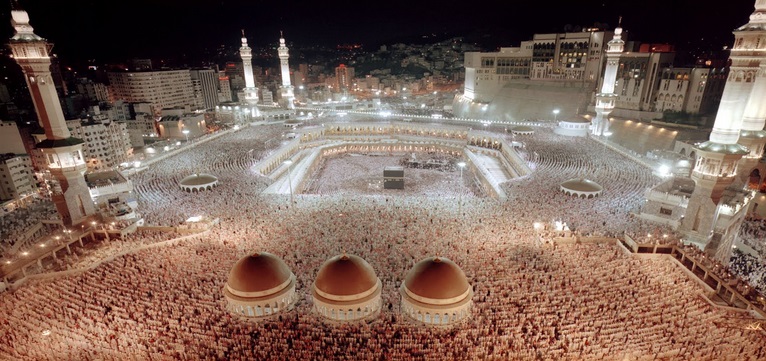
Salat, the five daily prayers, is the second pillar of Islam and the central act of Muslim worship. It is a structured liturgy of standing (qiyām), bowing (rukūʿ), prostration (sujūd), and sitting, coordinated with the recitation of the Qur’an — always beginning with al-Fātiḥah — and with formulae of glorification. It is preceded by ritual ablution (wuḍūʾ) and oriented physically toward the Kaʿba. Maulana Muhammad Ali, the great Lahore Ahmadiyya scholar, wrote in The Religion of Islam and in Islam — The Religion of Humanity that the whole apparatus of Islamic worship is “calculated to concentrate attention on one object: the realisation of the Divine presence,” and that “the ablution preceding prayer, the reverential attitude in standing, the bowing down, the prostration and the reverent sitting posture — all help the mind to realise the Divine presence as a fact.” Prayer, he insisted, is not “meaningless worship” but “the true means of that purification of the heart which is the only way to communion with God.”
At the inward heart of Salat is khushūʿ — humble, focused attentiveness. The Qur’an opens Sūrat al-Muʾminūn: qad aflaḥa al-muʾminūn, alladhīna hum fī ṣalātihim khāshiʿūn — “Successful indeed are the believers, who are humble in their prayers” (Q 23:1–2). Ibn Kathīr glosses khushūʿ as the state of one “who has completely emptied his heart” for the prayer and attends to nothing else. Salat without khushūʿ is body without soul.
Zikr e Ilahi — the remembrance of God — is both wider and more portable than Salat. It ranges from the vocal repetition of divine Names and formulae (Subḥān Allāh, al-ḥamdu lillāh, Allāhu akbar, lā ilāha illā Allāh) to silent, heart-centred remembrance, to the Sufi discipline of muraqaba. The Qur’an makes remembrance the very purpose of prayer — aqim al-ṣalāta li-dhikrī, “keep up prayer for My remembrance” (Q 20:14) — and promises: alā bi-dhikri Allāhi taṭmaʾinnu al-qulūb, “surely in the remembrance of Allah do hearts find rest” (Q 13:28). It commands abundant remembrance — udhkurū Allāha dhikran kathīran, “remember Allah with much remembrance” (Q 33:41) — and declares that “the remembrance of Allah is the greatest” (Q 29:45). Furqaan Project
V. The Common Core: Where the Rivers Meet
Let us now set the traditions side by side. The convergences are neither superficial nor coincidental; they reflect a shared human contemplative architecture.
Attention regulation and focus. Every one of these disciplines is, first and most basically, attention training. Samatha rests attention on the breath; Benson’s technique rests it on a repeated word; MBSR trains non-judgmental present-moment attention; Salat gathers attention through recitation and posture into khushūʿ; muraqaba is defined precisely as vigilant, sustained attentiveness. The Sufi Junayd of Baghdad said his teacher in muraqaba was a cat watching a mouse-hole, so absorbed “that not one of its hairs was moving” — a description any teacher of one-pointed concentration would recognise. Baharemadinah
Repetition of sacred formulae versus mantra. The repeated mantra of Transcendental Meditation, the repeated word of Benson’s protocol, and the repeated divine Name of dhikr are structurally identical techniques. Benson himself observed that a prayer-phrase works exactly as a mantra does to elicit the relaxation response. The difference, as we shall see, lies not in the mechanism but in the meaning of the word repeated.
Breath and bodily posture. Anapanasati is breath-centred; yoga and much Western meditation attend to breathing; and Salat is a sequence of deliberate postures, while rhythmic dhikr, as one review notes, “synchronizes breathing and heart rate,” triggering the parasympathetic “rest” response. The body is, in every case, a gateway to the mind. Medium
Present-moment awareness and the interruption of rumination. Mindfulness explicitly cultivates present-moment awareness and thereby interrupts the ruminative churning associated with anxiety and depression. Salat, performed five times across the day, repeatedly pulls the worshipper out of the stream of worldly preoccupation into a present standing-before-God. Maulana Muhammad Ali noted the psychological genius of this spacing: prayer is “the first daily act of a Muslim and it is also his last one,” with three more between, so that “even when busiest, a Muslim should still be able to disengage himself from all worldly occupations for a short while.” Islam, he added, thereby “has done away with all institutions of monkery” — communion with God is woven into an active life rather than requiring withdrawal from it.
Cultivation of compassion. Metta meditation deliberately generates loving-kindness; Davidson’s studies of compassion meditation are central to contemplative neuroscience; and Islam binds God-consciousness to compassion, for “Allah is with those who are God-conscious and are compassionate towards fellow humans” (Q 16:128). As I have argued in my Nafs-e-Mutmainnah writings, a moral and compassionate life is the indispensable foundation of the soul at peace — indeed Sūrat al-Fajr itself, before greeting the soul at peace, indicts those who fail the orphan and the poor (Q 89:17–20).
Discipline and regularity. All traditions insist that benefit comes only from regular practice. Benson recommended eliciting the response ten to twenty minutes daily; the Buddhist path is a lifelong training; and Salat’s five-times-daily rhythm is the very model of disciplined regularity.
Transcendence of ego. Buddhist practice aims to see through the illusion of a fixed self; Brewer’s neuroscience locates self-referential processing in the default mode network and shows meditation quieting it; and the Sufi path is the disciplining of the nafs, the ego-self, culminating in fanāʾ, the passing-away of the ego before God. Here the convergence is real but the destination differs — a point to which we return.
VI. The Neuroscience: Remarkable Resonances
The last three decades have produced a body of evidence that these practices measurably change the brain and body. I present it as resonance — a striking correspondence between ancient practice and modern measurement — not as proof of any theological claim.
The relaxation response and gene expression. Benson’s foundational finding was that meditation and repetitive prayer reduce metabolism, heart rate, breathing rate, and blood pressure. Later work led by Benson with the Genomics Center at Beth Israel Deaconess Medical Center (Towia Libermann, co-senior author; published in PLOS ONE, 2008 and 2013) reported that mind-body practices alter the expression of genes involved in immune function, energy metabolism, and insulin secretion. The participants used a striking variety of techniques — “repeating a mantra, mindfulness meditation, Transcendental Meditation, Vipassana meditation, breath focus, Kripalu or Kundalini yoga, and repetitive prayer. Despite the variety, all techniques yielded the same gene expression” — powerful confirmation of a common physiological substrate beneath outwardly different practices. Experience Life
Sara Lazar and cortical structure. Lazar’s landmark 2005 study found that experienced meditators had greater cortical thickness in the prefrontal cortex and insula, regions of attention and interoception, and that this effect countered normal age-related cortical thinning in mid-life practitioners. Her group’s 2011 study (Hölzel, Carmody, Vangel, Congleton, Yerramsetti, Gard & Lazar, Psychiatry Research: Neuroimaging 191:36–43) documented that eight weeks of MBSR increased gray matter concentration in the left hippocampus (learning, memory, emotion regulation), the posterior cingulate cortex, the temporo-parietal junction (empathy, perspective-taking), and the cerebellum, while gray matter density in the right amygdala — the brain’s threat-and-fear centre — decreased. Most tellingly, the participants who reported the greatest reduction in perceived stress showed the largest decreases in right amygdala gray matter density, tying an inner report of peace to a measurable structural change. Simply PsychologySimply Psychology
Judson Brewer and the default mode network. In a 2011 PNAS paper (Brewer, Worhunsky, Gray, Tang, Weber & Kober), Brewer and colleagues showed that in experienced meditators the main nodes of the default mode network — the medial prefrontal and posterior cingulate cortices — were relatively deactivated across concentration, loving-kindness, and choiceless-awareness meditations. Since the default mode network is the seat of mind-wandering and self-referential thought — which, as the authors note, “correlates with unhappiness” — this quieting is a plausible neural correlate of the traditions’ promise of inner stillness and freedom from the ego’s chatter. PNASPNAS
Richard Davidson and gamma synchrony. Lutz, Greischar, Rawlings, Ricard and Davidson, in their 2004 PNAS paper “Long-term meditators self-induce high-amplitude gamma synchrony during mental practice,” studied eight Tibetan Buddhist adepts trained in the Nyingmapa and Kagyupa traditions for an estimated 10,000 to 50,000 hours over 15 to 40 years, against ten meditation-naïve student controls. During compassion meditation the adepts produced gamma-band activity more than thirty-fold greater than controls, with long-distance neural phase-synchrony rising about 30 percent — oscillations that were, in the authors’ words, “the highest reported in the literature in a nonpathological context.” Compassion, it turns out, has a signature the brain can display. PNASDharmalab
The neuroscience of Salat and dhikr. Most remarkably for our purposes, a parallel literature now documents the same kinds of effects for Muslim worship. Doufesh, Ibrahim, Ismail and Wan Ahmad (2014, Journal of Alternative and Complementary Medicine 20(7):558–562), recording EEG and heart-rate variability in 30 healthy Muslim men with the BIOPAC MP150 system, found that “during salat, a significant increase (p<.05) was observed in the mean [alpha relative power] in the occipital and parietal regions and in the normalized unit of high-frequency (nuHF) power of HRV (as a parasympathetic index),” while the sympathetic indices decreased — concluding that “during salat, parasympathetic activity increased and sympathetic activity decreased.” This is the physiological picture of the relaxation response, produced by prayer. Arthur Saniotis (2018, Journal of Religion and Health 57:849–857) argued that salat and dhikr comprise genuine “mind/body medicine” through their positive effect on the psychoneuroimmunological response. And Andrew Newberg, the pioneer of “neurotheology,” used SPECT imaging to study intense Islamic prayer, finding decreased frontal-lobe activity associated with the experience of surrender. Sage Journals + 4
VII. Andrew Newberg and the Brain of Surrender
Newberg’s work deserves its own treatment because it directly addresses the theistic dimension that distinguishes prayer from secular meditation. Over three decades Newberg has scanned the brains of Franciscan nuns, Tibetan Buddhists, chanting Sikhs, Pentecostals speaking in tongues, and Muslims at prayer, founding the field he calls neurotheology.
In his case-series study, “A case series study of the neurophysiological effects of altered states of mind during intense Islamic prayer” (Journal of Physiology-Paris, 2015, 109(4–6):214–220), Newberg, Wintering, Yaden, Waldman, Reddin and Alavi measured cerebral blood flow using single photon emission computed tomography (SPECT) in three Islamic individuals, each while practising two different types of Islamic prayer. The finding, in their own words: “intense Islamic prayer practices generally showed decreased CBF in the prefrontal cortex and related frontal lobe structures, and the parietal lobes,” while several regions showed increased flow, “including increased CBF in the caudate nucleus, insula, thalamus, and globus pallidus.” Newberg’s interpretation is theologically resonant: “It is hypothesized that the changes in brain activity may be associated with feelings of ‘surrender’ and ‘connectedness with God’ described to be experienced during these intense Islamic prayer practices.” As Newberg has put it in interview, “in many of the practices we have studied, including Islamic prayer, in which there is a sense of surrender, we see a decrease of frontal lobe activity” — the frontal lobe being the seat of purposeful, effortful self-direction. The very act of islām — surrender — appears to leave a trace in the brain. johnshopkins + 3
I emphasise, in keeping with my method, that a case series of three subjects is a whisper, not a proof — and I note too that the study’s report does not specify the subjects’ particular Islamic tradition. But the resonance is arresting: the neuroscience of prayer converges on the theological essence of prayer, which is the surrender of the self to God.
VIII. Where the Rivers Part: The Decisive Differences
If the common core is real, the differences are more profound still, and they turn on a single axis: the presence or absence of a personal God to whom the practice is addressed.
Theistic and relational versus non-theistic and agnostic. This is the fundamental divide. Salat and Zikr are irreducibly relational. They are not techniques performed upon the self but a dialogue conducted with an Other — the living God, Allah, who hears, sees, and responds. Buddhist meditation is non-theistic: it is not addressed to a Creator, and secular mindfulness is deliberately agnostic, a technique available to atheist and believer alike. A mantra is a tool; a Name of God is an address. The word “one” repeated in Benson’s protocol quiets the body; the word “Allah” repeated in dhikr is understood by the worshipper as reaching toward a Beloved who is nearer than the jugular vein (Q 50:16).
The goal: connection versus cessation. Buddhism aims at the cessation of suffering through the extinction of craving; secular meditation aims, more modestly, at stress reduction and well-being. Salat and Zikr aim at something categorically different: connection with God, gratitude, submission, and love. The relief of suffering, in the Islamic frame, is a by-product — “in the remembrance of Allah do hearts find rest” (Q 13:28) — not the goal. The goal is the Face of God. As I have argued elsewhere, this parallels Viktor Frankl’s insight in Man’s Search for Meaning that fulfilment “ensues” only as a by-product of self-transcendence and cannot be pursued directly. thequranFurqaan Project
Prayer as dialogue and servanthood. The Islamic conception of prayer is structured by the ʿabd–Rabb relationship — the servant before the Lord. Maulana Muhammad Ali dwelt on the depth of the Qur’anic word Rabb, which conveys far more than “father”: the Sustainer who provides for, nourishes, and brings to perfection every creature long before it comes into existence. Prayer is the servant’s munājāt, intimate conversation, with this Lord. The oft-quoted saying that “prayer is the ascension (miʿrāj) of the believer,” while not established as a sound hadith (its chain is untraceable), captures a genuine Qur’anic and prophetic theme: that in prostration the servant is nearest to the Lord (“The place where a slave is closest to his Lord is the position of prostration,” Ṣaḥīḥ Muslim), and that Salat is an ascent into the Divine presence. WordPress
Liturgical, communal, and legal structure. Much Western meditation is individualistic and technique-focused, chosen and shaped by the practitioner. Salat is a revealed liturgy, fixed in form, governed by Islamic law (fiqh), performed in congregation and in unison across the world five times a day, orienting a billion bodies toward a single point. It is not a self-help technique but an act of collective servanthood and covenant.
The anthropology of the self: the three souls versus anattā. Here lies perhaps the deepest divergence. Buddhism teaches anattā, that there is no permanent self. The Qur’an, by contrast, presents a developmental psychology of the nafs — a real self that journeys through three named states, and that is finally addressed, summoned, and welcomed home as an enduring subject. It is to this anthropology that we now turn, for it is the spine of the whole comparison.
Grace and divine initiative versus self-effort. Finally, Buddhist and secular meditation are, in principle, self-powered: the practitioner’s own effort produces the result. Salat and Zikr, while demanding effort, are ultimately oriented toward divine grace and initiative — the sakīna (tranquility) that God “sends down” into hearts (Q 48:4), the soul that is summoned home. The soul does not climb to God unaided; it is called, and it returns.
IX. The Three Souls: The Spiritual-Developmental Backbone
The Qur’an names three states of the soul, and the classical and Sufi traditions built upon them an entire developmental psychology.
The lowest is al-nafs al-ammāra bi’l-sūʾ, “the soul that incites to evil” (Q 12:53): inna al-nafsa la-ammāratun bi’l-sūʾ illā mā raḥima rabbī — “surely the soul is prone to enjoin evil, except that whereon my Lord has mercy.” This is the self at the mercy of appetite and anger, the starting point of the journey of purification (tazkiyat al-nafs).
Next is al-nafs al-lawwāma, “the self-reproaching soul” (Q 75:2): wa lā uqsimu bi’l-nafsi al-lawwāmah — “Nay, I swear by the self-accusing soul.” This is the awakened conscience, which sins yet blames itself and strives to amend — structurally the equivalent of the Freudian superego, as I have argued in mapping the Qur’anic souls onto modern psychology, with the ammāra answering to the id and the muṭmaʾinnah naming a fourth, integrated condition that Freud never theorised.
Highest is al-nafs al-muṭmaʾinnah, “the soul at peace” (Q 89:27–30):
يَا أَيَّتُهَا النَّفْسُ الْمُطْمَئِنَّةُ ارْجِعِي إِلَىٰ رَبِّكِ رَاضِيَةً مَّرْضِيَّةً فَادْخُلِي فِي عِبَادِي وَادْخُلِي جَنَّتِي
Yā ayyatuhā al-nafsu al-muṭmaʾinnah. Irjiʿī ilā rabbiki rāḍiyatan marḍiyyah. Fa-dkhulī fī ʿibādī. Wa-dkhulī jannatī.
- Maulana Muhammad Ali (Lahore): “O soul that art at rest, return to thy Lord, well-pleased (with Him), well-pleasing (Him). So enter among My servants, and enter My Garden!”
- Pickthall: “But ah! thou soul at peace! Return unto thy Lord, content in His good pleasure! Enter thou among My bondmen! Enter thou My Garden!”
- Muhammad Asad: “O thou human being that hast attained to inner peace! Return thou unto thy Sustainer, well-pleased [and] pleasing [Him]: enter, then, together with My [other true] servants — yea, enter thou My paradise!”
- Sahih International: “O reassured soul, return to your Lord, well-pleased and pleasing [to Him], and enter among My [righteous] servants, and enter My Paradise.”
As I have written in my commentary on this passage, although the classical mufassirūn (al-Ṭabarī, al-Zamakhsharī, al-Rāzī, al-Qurṭubī, Ibn Kathīr) locate this address at death or resurrection, the soul-at-peace “is a state of mind achieved through a lifetime of righteous living and devotion to God”; the deathbed greeting ratifies a serenity already cultivated in life. The pivotal phrase rāḍiyatan marḍiyyah names a reciprocity of pleasure: the soul content with God, and God content with the soul — echoed across the Qur’an in raḍiya Allāhu ʿanhum wa-raḍū ʿanhu, “God being pleased with them and they with Him” (Q 98:8).
The Sufi orders elaborated this triad into seven stations, three of whose names — muṭmaʾinnah, rāḍiya, and marḍiyya — are mined from these four verses of al-Fajr alone. And the whole ascent is bound to remembrance, for the same Arabic root that names the soul at peace (ṭ-m-ʾ-n) names the resting of the heart in Q 13:28: “those who believe and whose hearts find rest in the remembrance of God.”
X. The Central Thesis: Meditation as a Subset and Early Stage of Salat and Zikr
We can now state the essay’s central claim precisely. The attentional calm, present-moment awareness, and physiological quieting cultivated by secular and Buddhist meditation are contained within the Muslim disciplines of Salat and Zikr, and constitute their early stage or lower rungs. Meditation is to Salat as the foundation is to the building, as the vestibule is to the audience chamber.
Consider the evidence for this nesting.
Khushūʿ presupposes and includes mindfulness. The humble attentiveness that is the soul of Salat cannot exist without exactly the attentional gathering that mindfulness trains. One cannot be present before God while lost in mind-wandering. The mindful quieting of the default mode network is, physiologically, precisely what khushūʿ requires — but khushūʿ adds to it the intentional object that mindfulness lacks: the living God. Mindfulness supplies the how of attention; khushūʿ supplies the toward-Whom.
Muraqaba literally contains mindfulness and adds God-consciousness. The Arabic murāqaba means watchfulness, vigilance, keeping watch — the very semantic field of “mindfulness.” A 2018 study in the Journal of Religion and Health (Kamran et al.) explicitly analysed muraqaba as a form of mindfulness-based therapy in Islamic psychotherapy. But muraqaba is mindfulness plus taqwā (God-consciousness): the practitioner watches the inner landscape knowing that God watches him. Al-Ghazālī, in the Iḥyāʾ ʿUlūm al-Dīn, defines muraqaba as internal watchfulness over the soul to conform it to the divine will — watchfulness under the gaze of God, guarding intention (niyya), thought, and feeling.
The Hadith of Gabriel defines the destination. When the angel Gabriel asked the Prophet about iḥsān (spiritual excellence), he answered: “It is to worship Allah as if you see Him, for though you do not see Him, He surely sees you” (Ṣaḥīḥ al-Bukhārī and Ṣaḥīḥ Muslim). This is the definitive statement of what mindfulness becomes when it is completed by theism. Bare mindfulness is non-referential awareness; iḥsān is awareness saturated with the Presence of the Beloved. The Sufi tradition explicitly traces muraqaba to this very hadith. Mindfulness watches the breath; iḥsān watches the breath as one watched by God. Ijma
The relaxation response as the physiological vestibule. The quieting of the sympathetic nervous system, the parasympathetic shift, the alpha waves, the calmed default mode network — these, documented in both meditation and salat, are the bodily threshold across which the worshipper passes into the spiritual audience with God. They are necessary but not sufficient. They prepare the vessel; they do not fill it. As al-Ghazālī said of dhikr, in its reality it is “the progressive Power of the Named One on the heart, while the dhikr itself wears away and disappears” — the technique consumes itself, leaving only the Presence.
The ladder. The image that gathers all this is the ladder. The lower rungs are the attentional and physiological disciplines that secular and Buddhist meditation isolate and perfect — and for which we owe those traditions genuine gratitude and respect. The higher rungs are Zikr and Salat, which take up that trained attention and direct it, in love and submission, toward the personal God. And the top of the ladder is al-nafs al-muṭmaʾinnah, the soul at peace, summoned home to its Lord, well-pleased and well-pleasing. Meditation can carry a person up the lower rungs — to real calm, real health, real freedom from rumination. But the Qur’anic promise is that only remembrance of God carries the heart to its final rest: alā bi-dhikri Allāhi taṭmaʾinnu al-qulūb.
Mapped onto the three souls: the disciplines of attention discipline the ammāra, the inciting self, quieting its clamour; the moral self-examination that mindfulness and muraqaba alike encourage awakens and strengthens the lawwāma, the reproaching self; and the loving, God-directed remembrance of Zikr and Salat ripens the soul toward the muṭmaʾinnah, the peace that is not merely the absence of stress but the presence of God. It is worth remembering that the Prophet’s own prophethood was preceded by years of solitary contemplation — taḥannuth — in the cave of Hira, the reflective seeking of a heart that would soon become the vehicle of revelation. Contemplation was the threshold; revelation was the gift.
XI. Honouring the Buddha and the Secular Contemplative
It would betray both the Qur’an and the Sufi Muslim tradition to present this nesting as a dismissal of Buddhism or of secular mindfulness. Quite the reverse. If a warner was raised among every people (Q 35:24), and if — the Buddha may be counted among the sages and prophets through whom God’s guidance reached humanity, then the profound contemplative science of Buddhism is not a rival revelation but a genuine, if partial, illumination. The Buddhist diagnosis of craving (taṇhā) as the root of suffering resonates deeply with the Qur’anic warning about the nafs that incites to evil, as I have explored in my comparative study of the Four Noble Truths and Islamic teachings on suffering. The metta that Davidson’s monks generated is not alien to the compassion the Qur’an binds to God-consciousness.
And the secular meditator — the atheist practising MBSR to survive depression — is climbing the lower rungs of a ladder whose higher reaches he may not yet see. There is no contempt owed to such a person, only the invitation, extended in love, to consider that the calm he has found is the threshold of a house, and that the house has an Owner who is calling him home.
XII. Thematic Epilogue
I have argued that Western and Buddhist meditation and Muslim Salat and Zikr share a large common core — attention, repetition, breath, presence, compassion, discipline, and a measurable reshaping of brain and body — and that they diverge on the single decisive question of whether there is a personal God at the far end of the practice. And I have proposed that meditation is best understood as a subset and early stage of the fuller theistic disciplines: the mindful calm is the vestibule, the audience with God is the throne room; the relaxation response is the lower rung, the soul at peace is the summit.
Let me be exact about the status of the convergences I have drawn between the neuroscience and the scripture. They are resonances and remarkable anticipations — never proofs. I do not claim, in the manner of Maurice Bucaille or the concordist apologetics of Zakir Naik, that the Qur’an “contains” the default mode network or “predicted” gamma synchrony. Such claims mistake the genre of scripture and hostage its dignity to the next revision of a journal. What I claim is humbler and, I think, truer: that when the Qur’an says the heart finds rest in remembrance, and neuroscience finds prayer calming the amygdala and quieting the self-referential mind, the believer may reasonably feel a resonance — a harmony between the Book of Revelation and the Book of Nature, two of the Four Books through which the one God speaks. The resonance invites reflection; it does not compel assent, and it can always be revised by better data.
The limits of our knowledge are real, and I hold them consciously. A SPECT study of three worshippers is a whisper, not a demonstration. The brain correlates of surrender are correlates, not the surrender itself, which is a matter between the servant and the Lord and beyond the reach of any scanner. “Of knowledge you have been given but little” (Q 17:85).
And so I close with an invitation, extended to readers of every faith and of none: to the Buddhist who has learned to watch the breath with a steadiness most of us will never attain; to the physician prescribing mindfulness to the anxious; to the Muslim who prostrates five times a day and wonders whether science has anything to say to his faith; and to the seeker of no fixed creed who has simply found, in stillness, a rumour of peace. The Qur’an addresses each of you with the same summons that it addresses to the soul at the end of its journey — a summons that is also a homecoming, and among the most gracious words ever spoken to a human being: yā ayyatuhā al-nafsu al-muṭmaʾinnah, irjiʿī ilā rabbiki rāḍiyatan marḍiyyah — “O soul at peace, return to thy Lord, well-pleased and well-pleasing. So enter among My servants, and enter My Garden.”




Leave a Reply