
Presented by ChatGPT
Abstract
The Qur’anic doctrine of the recording angels presents a striking metaphysical claim: human life is continuously observed, morally interpreted, and preserved in a hidden register. The angels called Kirāman Kātibīn are described as noble recorders appointed over human beings; elsewhere, the Qur’an speaks of two receivers on the right and left who note every utterance, and it also says that even secret conversations are recorded and that a complete book of deeds will be disclosed on the Day of Judgment. In that sense, revelation clearly affirms a real but unseen order of surveillance and accountability.
From that scriptural foundation, one may develop a philosophical argument: if angels record events that unfold in human space and time, then they must in some manner have access to our world without being limited by ordinary human visibility. In modern language, that can be described as access to our four-dimensional spacetime from beyond the constraints of our sensory apparatus. Yet it is crucial to distinguish doctrine from analogy. The Qur’an and hadith affirm the reality of angels and their recording function, but they do not explain that function through the categories of quantum physics or higher-dimensional geometry. Quantum mechanics describes matter and energy at extremely small scales, and some physical theories entertain extra dimensions, but neither quantum theory nor current experiments prove angelic agency. The sound conclusion is therefore disciplined rather than sensational: revelation gives the truth of the unseen record, while quantum and extra-dimensional language may serve only as a cautious philosophical model.
The Qur’anic Portrait of the Recording Angels
The central Qur’anic designation is indeed Kirāman Kātibīn, usually rendered “noble recorders” or “honorable scribes.” In Surah al-Infitar, the Qur’an states that there are watchers over human beings, noble ones who record and who know what people do. In Surah Qaf, the image becomes more intimate and immediate: two receivers sit to the right and left, and no word is uttered without an observer ready. In Surah az-Zukhruf, the scope widens further, because even secret talk is said to be heard and written by God’s messengers. Finally, the eschatological outcome of this hidden process appears in Surah al-Isra and Surah al-Kahf, where every person is confronted with an opened record that leaves nothing, small or great, uncounted. The Qur’anic picture is therefore not fragmentary; it is a coherent moral archive stretching from ordinary speech to final judgment.
Classical tafsir deepens this picture without changing its basic structure. Commentarial tradition, as preserved in widely used tafsir collections, explains the two receivers of Surah Qaf as the angels who accompany each person continuously, with the angel on the right recording good deeds and the one on the left recording bad deeds. That interpretive line does not invent a new doctrine; it clarifies how the Qur’anic imagery of “right” and “left” was understood in mainstream exegetical tradition. The result is a morally differentiated system, not a vague celestial symbolism.
What emerges from these passages is a theology of radical accountability. Human action is not lost in time. Words do not evaporate when sound dies. Secrets are not secure merely because other humans do not hear them. The unseen record means that existence is morally thick: every act passes through an invisible but exacting order before it disappears from public view.
Why the Angels Are Unseen
If one asks why these angels are “supernatural,” the most faithful Islamic answer is that they belong to al-ghayb, the unseen. The Qur’an identifies true believers as those who believe in the unseen, and angels belong centrally to that unseen order. The Qur’an also presents angels as divine messengers, and elsewhere describes them as utterly obedient beings who do not disobey the command of God. Hadith literature adds a further ontological note by saying that angels were created from light, and mainstream Sunni teaching institutions such as al-Azhar summarize this by describing angels as beings created from light who neither rebel against God nor resemble human biological life. In other words, they are real creatures, but not creatures of the ordinary visible, material, and appetitive order that defines embodied human existence.
That is why “supernatural,” while not itself a Qur’anic term, is a defensible English description. It does not have to mean irrational, mythical, or anti-scientific. In this context, it means that angels are not ordinarily available to the senses and are not bound to the same manifest conditions under which human beings live. Their hiddenness is not a weakness in the doctrine; it is part of the doctrine. One believes in them precisely because revelation describes a real order that exceeds what unaided perception can inspect.
This also explains why the Qur’an treats angelic reality as morally serious rather than visually demonstrative. The point is not to satisfy curiosity about invisible beings. The point is to awaken consciousness that human life unfolds before witnesses one does not see. The unseen, in this case, is not an escape from responsibility; it is what guarantees responsibility.
What Is Actually Recorded
The Qur’an is explicit about deeds, words, and even private conversations, but the broader Islamic record of accountability reaches deeper into the interior life through the category of intention. A foundational hadith states that God has written down good deeds and bad deeds in such a way that an intended good deed, even if not performed, is written as a full good deed, while an evil intention that is abandoned is not treated in the same way as a completed evil act. This shows that the moral ledger is not merely behavioral; it is also directional. The heart’s orientation matters, not just the body’s motion.
At the same time, the tradition draws an important distinction between settled intention and involuntary passing thought. Tafsir on Surah Qaf notes that God knows the thoughts that cross the human mind, yet authenticated hadith reports also say that this community is pardoned for what arises within the self so long as it is neither spoken nor acted upon. That nuance is crucial. Islamic theology does not flatten all inner movement into guilt. Fleeting whispers and unwanted thoughts are not morally identical to deliberate intention. So when one speaks of angels recording “intentions,” one should do so carefully: the tradition supports the moral significance of intention, but it does not equate every involuntary mental flash with a culpable entry in the record.
This distinction actually intensifies, rather than weakens, the grandeur of the doctrine. The unseen record is not mechanical surveillance; it is morally intelligent surveillance. It differentiates between a passing temptation, a chosen intention, a spoken word, and a completed act. The Qur’anic and hadithic system is therefore less like a crude camera and more like a perfect moral archive.
A Philosophical Reading of Dimensional Access
Here the philosophical question becomes compelling. Human words and deeds occur in what modern physics describes as spacetime: the ordinary world of three spatial dimensions and one dimension of time. CERN’s educational materials summarize this conventional framework by noting that physicists have long treated spacetime as four-dimensional in total. If the recording angels register speech, action, and hidden conversation as they occur in history, then one may reasonably infer that they have access to human spacetime. But because they are not ordinarily visible within that spacetime, their access need not imply confinement to the same sensory or material conditions that govern us. This is an inference from revelation and from modern physical language, not an explicit Qur’anic doctrine—but it is a philosophically coherent one.
Stated differently, the doctrine suggests asymmetrical access. We do not see them, but they see us. We do not measure their mode of presence, but they register the flow of our existence. In classical theological terms, this means they belong to the unseen while acting upon the seen by divine permission. In contemporary metaphysical language, one might say that they intersect our four-dimensional reality without being reducible to it. That language does not replace revelation; it translates revelation into a philosophical idiom intelligible to a reader shaped by modern science.
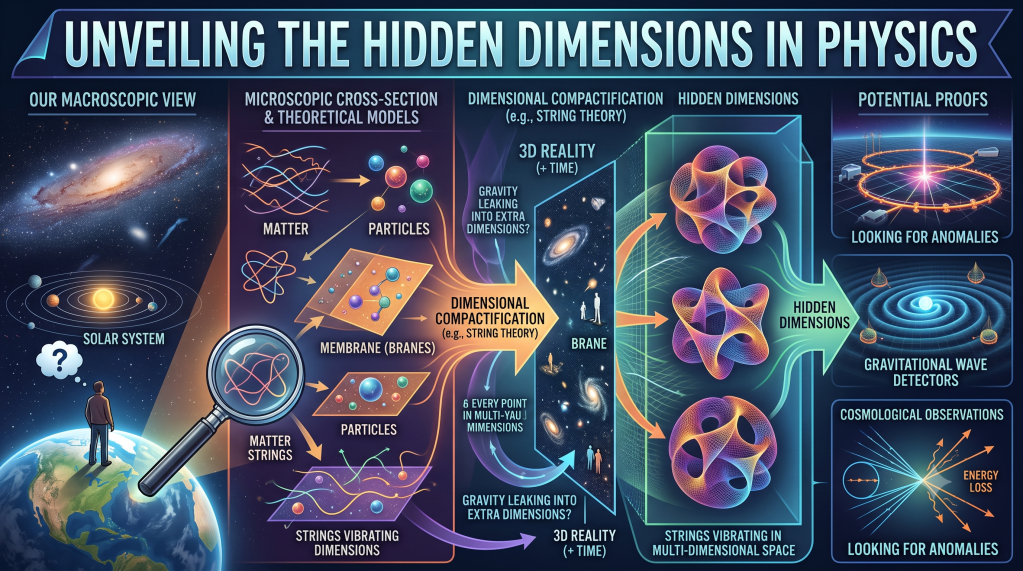
If one goes a step further and asks whether this access “has to be” quantum, the most careful answer is that quantum language provides a suggestive analogy, not a necessity. The U.S. Department of Energy and other official science sources describe quantum mechanics as the branch of physics dealing with extremely small objects and with matter, light, and energy at their most fundamental scales. So if someone insists on framing angelic access in physical terms, it is understandable that they would look beneath ordinary macroscopic perception to the microphysical level. Likewise, CERN explains that some modern theories, especially string-inspired ones, speculate about hidden extra dimensions that are not accessible to ordinary experience. These ideas make it imaginable—at the level of analogy—that an unseen order could interface with the visible world through a reality deeper than common sense reveals. But again, this remains a philosophical model, not a demonstrated scientific account of angels.
Where Physics Helps and Where It Cannot
Modern physics is most helpful here when it teaches intellectual humility. The 2022 Nobel Prize in Physics recognized experiments on entangled states that violated Bell inequalities. The Nobel materials explain that these experiments ruled out simple hidden-variable replacements for quantum mechanics and showed that quantum reality behaves in ways that resist ordinary classical intuitions about separateness and predetermined local properties. That matters philosophically because it warns us not to treat everyday macroscopic intuition as the measure of all reality. The world is already stranger than common sense. But that strangeness is not the same thing as proof of angelic agency. Bell-test experiments tell us something profound about quantum correlations; they do not identify spiritual beings or divine scribes.
Extra dimensions occupy a similar place. CERN explains that some theories propose hidden spatial dimensions and that experiments at the LHC search for signatures that could reveal them, such as heavier recurrences of standard particles or other exotic effects. Yet recent CMS summaries continue to report no significant deviation from the Standard Model, including in search programs that explicitly cover scenarios with extra dimensions. In other words, extra dimensions remain serious theoretical possibilities in some models, but they are not established empirical facts. It would therefore be premature to say that angels are scientifically explained by extra-dimensional physics. At present, the relation is at most analogical and speculative.
For that reason, the cleanest synthesis is this: revelation gives the ontological claim, physics offers possible metaphors of intelligibility, and neither discipline should be forced to say what belongs properly to the other. Theology can affirm that angels are real, unseen, obedient, and morally active. Physics can investigate whether reality is deeper, smaller, stranger, or more dimensional than ordinary perception suggests. But one should not confuse suggestive resonance with demonstrated equivalence. The unseen in the Qur’an is not a gap waiting to be filled by whatever the latest theory happens to be. It is a revealed dimension of reality that science may sometimes echo without ever exhausting.
Thematic Epilogue
The doctrine of Kirāman Kātibīn restores solemnity to ordinary life. It means that the universe is not morally empty, that speech is never merely air, that action is never merely motion, and that intention is never merely private weather inside the soul. Human beings live before an unseen tribunal long before they stand before the final one. The hidden record is not there to produce paranoia, but presence: presence before God, presence before truth, presence before the eventual unveiling of what one has made of oneself.
If one wishes to speak philosophically, one may say that the angels signify an ontological openness in reality: our visible world is not sealed off from deeper orders of being. If one wishes to speak scientifically, one may say that modern physics has at least taught us not to assume that reality is restricted to what the senses naively report. But if one wishes to speak faithfully, the deepest point is simpler and greater: the unseen witnesses make moral life irreversible. Every life is being written. Every self is becoming a text. And one day, according to the Qur’an, that text will be opened and read.
For references please see the Microsoft Word file:







Leave a comment