
Commentary in the tradition of thequran.love (“The Glorious Quran and Science”), Zia H. Shah MD, Chief Editor of The Muslim Times by Claude AI.
Abstract
Ayat al-Kursi, Quran 2:255, is celebrated across the Islamic tradition as the greatest single verse of the Quran — the “Crown Verse.” This commentary offers an extended scientific, philosophical, and theological reading, with special and sustained emphasis on the clause wa lā yuḥīṭūna bi-shayʾin min ʿilmihī illā bi-mā shāʾ (“they encompass nothing of His knowledge except what He wills”), which is read here as a Quranic charter of both the possibility and the limits of human knowledge. After presenting the Arabic text and transliteration, six named English translations (including, as a distinctively marked sixth, Maulana Muhammad Ali of the Lahore Ahmadiyya tradition), and close exegesis from five classical mufassirūn (al-Tabari, Ibn Kathir, al-Qurtubi, Fakhr al-Din al-Razi, and al-Zamakhshari), the essay develops the epistemic centerpiece in dialogue with Gödel’s incompleteness theorems, Heisenberg’s uncertainty principle, the hard problem of consciousness (Chalmers), Nagel’s bat, Kant’s phenomena/noumena, Hoffman’s interface theory, the observational horizons of cosmology and the dark sector, and the humility metaphors of Newton and Wheeler. It then reads al-Hayy al-Qayyum through al-Ghazali’s occasionalism and continuous creation, the Kursi through modern cosmology, and divine omniscience through relativity. Throughout, all convergences between the verse and modern science are framed as “remarkable anticipations” and “resonances” rather than proofs — the consistent methodology that distinguishes this platform from concordist predecessors. A thematic epilogue ties together Tawhid, epistemic humility, and the invitation to read the Book of Nature alongside the Book of Revelation, with explicit Lahore Ahmadiyya caveats.
I. The Arabic Text and Transliteration
Arabic (Quran 2:255):
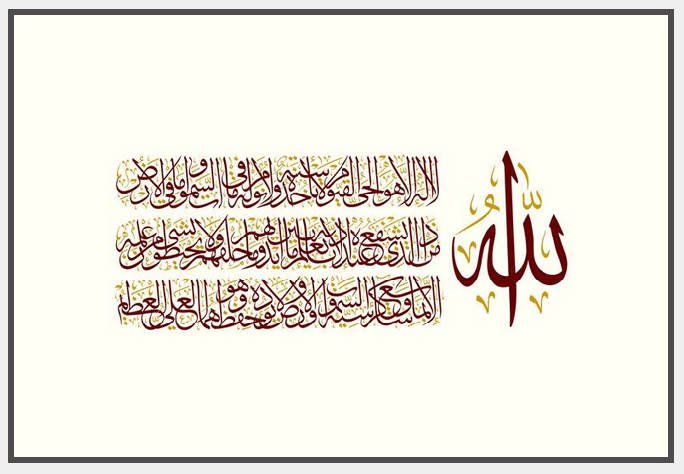
ٱللَّهُ لَآ إِلَـٰهَ إِلَّا هُوَ ٱلْحَىُّ ٱلْقَيُّومُ ۚ لَا تَأْخُذُهُۥ سِنَةٌۭ وَلَا نَوْمٌۭ ۚ لَّهُۥ مَا فِى ٱلسَّمَـٰوَٰتِ وَمَا فِى ٱلْأَرْضِ ۗ مَن ذَا ٱلَّذِى يَشْفَعُ عِندَهُۥٓ إِلَّا بِإِذْنِهِۦ ۚ يَعْلَمُ مَا بَيْنَ أَيْدِيهِمْ وَمَا خَلْفَهُمْ ۖ وَلَا يُحِيطُونَ بِشَىْءٍۢ مِّنْ عِلْمِهِۦٓ إِلَّا بِمَا شَآءَ ۚ وَسِعَ كُرْسِيُّهُ ٱلسَّمَـٰوَٰتِ وَٱلْأَرْضَ ۖ وَلَا يَـُٔودُهُۥ حِفْظُهُمَا ۚ وَهُوَ ٱلْعَلِىُّ ٱلْعَظِيمُ ٢٥٥
Transliteration:
Allāhu lā ilāha illā Huwa, al-Ḥayyu al-Qayyūm. Lā taʾkhudhuhū sinatun wa lā nawm. Lahū mā fī al-samāwāti wa mā fī al-arḍ. Man dhā alladhī yashfaʿu ʿindahū illā bi-idhnih. Yaʿlamu mā bayna aydīhim wa mā khalfahum, wa lā yuḥīṭūna bi-shayʾin min ʿilmihī illā bi-mā shāʾ. Wasiʿa kursiyyuhu al-samāwāti wa al-arḍ, wa lā yaʾūduhū ḥifẓuhumā. Wa Huwa al-ʿAliyyu al-ʿAẓīm.
II. Six Named English Translations
Because several modern English translations remain under copyright, this section gives full verbatim text for the public-domain renderings and source-attributed renderings that highlight distinctive phrasing for those still under copyright — following the author’s own established platform practice.
1. Sahih International (copyright; source-attributed). This contemporary, strongly literal rendering opens with “the Ever-Living, the Sustainer of [all] existence,” renders the epistemic clause as “they encompass not a thing of His knowledge except for what He wills,” retains the Arabic term in “His Kursi extends over the heavens and the earth,” and closes with “the Most High, the Most Great.”
2. Abdullah Yusuf Ali (1934; public domain):
“Allah! There is no god but He,—the Living, the Self-subsisting, Eternal. No slumber can seize Him nor sleep. His are all things in the heavens and on earth. Who is there can intercede in His presence except as He permitteth? He knoweth what (appeareth to His creatures as) before or after or behind them. Nor shall they compass aught of His knowledge except as He willeth. His Throne doth extend over the heavens and the earth, and He feeleth no fatigue in guarding and preserving them for He is the Most High, the Supreme (in glory).” Blogger
3. Marmaduke Pickthall (1930; public domain):
“Allah! There is no deity save Him, the Alive, the Eternal. Neither slumber nor sleep overtaketh Him. Unto Him belongeth whatsoever is in the heavens and whatsoever is in the earth. Who is he that intercedeth with Him save by His leave? He knoweth that which is in front of them and that which is behind them, while they encompass nothing of His knowledge save what He will. His throne includeth the heavens and the earth, and He is never weary of preserving them. He is the Sublime, the Tremendous.” Muslim Memo
4. Muhammad Asad, The Message of the Qur’an (1980; copyright; source-attributed). Asad’s philosophically tuned rendering is distinctive for translating al-Qayyum as “the Self-Subsistent Fount of All Being,” for glossing the knowledge clause as humankind being unable “to attain to aught of His knowledge save that which He wills,” and for rendering wasiʿa kursiyyuhu as “His eternal power overspreads the heavens and the earth.” quranv + 2
5. Dr. Mustafa Khattab, The Clear Quran (2015; copyright; source-attributed). Khattab reads devotionally but with explanatory clarity: “the Ever-Living, All-Sustaining”; the crucial epistemic clause becomes “no one can grasp any of His knowledge—except what He wills to reveal”; and kursi is rendered “His Seat encompasses the heavens and the earth,” closing with “the Most High, the Greatest.” quranv
6. Maulana Muhammad Ali of Lahore (Lahore Ahmadiyya tradition; public domain), distinctively marked as the sixth translation:
“Allah — there is no god but He, the Ever-living, the Self-subsisting by Whom all subsist. Slumber does not overtake Him, nor sleep. To Him belongs whatever is in the heavens and whatever is in the earth. Who is he that can intercede with Him but by His permission? He knows what is before them and what is behind them. And they encompass nothing of His knowledge except what He pleases. His knowledge extends over the heavens and the earth, and the preservation of them both does not tire Him. And He is the Most High, the Great.” Ahmadiyyaalahmadiyya
Two features mark this Lahore rendering as distinctive. First, Maulana Muhammad Ali expands al-Qayyum into an entire metaphysics — “the Self-subsisting by Whom all subsist” — capturing both aseity (God subsists of Himself) and continuous sustenance (all else subsists by Him). Second, and decisively for our theme, he translates wasiʿa kursiyyuhu not as “Throne” or “Seat” but directly as “His knowledge extends over the heavens and the earth,” and in his commentary he notes that the verse “goes under the name of āyat al-kursī, or the verse of knowledge, because it deals with the all-comprehensive knowledge of Allah.” The Lahore school thus reads the Crown Verse as, at its heart, a verse about knowledge — the interpretive key to this entire commentary. alahmadiyya + 2
III. Classical Tafsir: Five Mufassirūn
Al-Tabari (d. 923)
In his monumental Jāmiʿ al-bayān, al-Tabari treats the verse as compressed, anti-idolatrous theology. On “no slumber or sleep overtakes Him,” he reads the negation theologically rather than merely physiologically: sleep and drowsiness imply vulnerability, interruption, and incapacity, and he remarks that if the cosmic order depended on a sleeping governor it would collapse — God’s permanence as al-Qayyum means uninterrupted governance. On the epistemic clause, he explains that God’s knowledge encompasses all things, while no creature knows anything except what He wills to teach; and he sharpens the polemical edge — beings who are ignorant, limited, and dependent cannot be proper objects of worship. Notably, al-Tabari personally leans toward reading kursi as God’s knowledge, grounding this linguistically in the sense of a seat of learning and authority.
Ibn Kathir (d. 1373)
Ibn Kathir’s tafsir foregrounds the verse’s extraordinary virtues and treats it as a sequence of ten complete statements, each adding an aspect of divine lordship. He glosses al-Hayy as “the Ever Living, Who never dies” and al-Qayyum as the One who “sustains everyone and everything” while all creation stands in need of Him and He needs nothing. On wa lā yuḥīṭūna…, he writes that “no one ever acquires any part of Allah’s knowledge except what He conveys and allows.” He preserves the transmitted report from Ibn ʿAbbas that the kursi is the “footstool” (mawḍiʿ al-qadamayn), distinct from and dwarfed by the ʿArsh (Throne), citing the image that the seven heavens beside the kursi are “like a ring cast into a desert.” Yet his emphasis is theological, not cosmographic: if preserving realities of such unimaginable scale does not burden God, finite creatures have no basis for boasting or ontological self-sufficiency. My Islam
Al-Qurtubi (d. 1273)
Al-Qurtubi, an Ashʿari, calls Ayat al-Kursi “the chief of the verses of the Qur’an and the greatest verse.” His most valuable contribution to our theme is a conceptual refinement: ʿilm (“knowledge”) in the clause may mean maʿlūm (“the known”), so the verse does not imply that God’s own attribute of knowledge is partitioned into pieces; rather, creatures access only such portions of the knowable as God permits. This preserves divine simplicity while affirming real, finite creaturely knowledge, and it resonates with 2:32, where the angels confess, “We have no knowledge except what You have taught us.” On kursi, al-Qurtubi records the plurality of views — that it is God’s knowledge, or a real created entity beneath the Throne — while guarding transcendence: even a real created kursi entails no “place” for God, and al-ʿAlī denotes exaltation of rank and majesty, not spatial altitude. thequranthequran
Fakhr al-Din al-Razi (d. 1210)
In Mafātīḥ al-Ghayb, the most theologically dense of the classical tafsirs, al-Razi catalogues four opinions on kursi — (1) God’s knowledge; (2) His dominion; (3) a real created entity whose form is unknown; (4) a metaphor for His greatness — while holding that there is no genuine contradiction among them. He favors the interpretation, transmitted from al-Qaffāl, that such imagery describes God’s greatness in familiar terms: just as a king sits on a throne to manifest authority, so the language of a “seat” conveys majesty without implying bodily need. Crucially for us, al-Razi insists that anthropomorphic terms must be understood in light of God’s unlimited knowledge and being; before any mention of Throne or kursi, the verse underscores God’s knowledge and sovereign will, as if to say: whatever you imagine of God’s “seat,” His knowledge and permission extend over all, in a manner beyond your full comprehension.
Al-Zamakhshari (d. 1144)
The Muʿtazili exegete al-Zamakhshari, in al-Kashshāf, intensifies the demand for transcendence, resisting any construal that would collapse God’s majesty into physicality. He catalogues the figurative options for kursi — a representation of majesty, God’s knowledge, His dominion, or a created seat below the Throne — reflecting the school’s commitment to divine unity. His rhetorical sensitivity to the verse’s balanced negations (no drowsiness, no sleep, no fatigue) reinforces the reading of al-ʿAliyy al-ʿAẓīm as declaring incomparable, non-spatial exaltation.
A comparative note. Across Sunni, Shia, Ashʿari, Maturidi, and Muʿtazili readings, three stable conclusions emerge: God’s knowledge is exhaustive, non-derivative, and unrestricted; human knowledge is genuine but always donated, partial, and dependent; and the verse constrains theology itself — one may affirm God’s attributes but may not domesticate them into creaturely categories. The disagreements concern not whether God knows all and creatures know finitely, but how to construe the symbolic-literal grammar of kursi. Strikingly, the two exegetes most attentive to knowledge — al-Tabari and the Lahore school’s Maulana Muhammad Ali — converge on reading the kursi itself as knowledge, making this the natural bridge to our centerpiece.
IV. The Centerpiece: Wa lā yuḥīṭūna — A Quranic Charter of the Scope and Limits of Human Knowledge
The verb yuḥīṭūna, from the root ḥ-w-ṭ, means to encompass, to surround, to close over an object in totality. It is stronger than mere possession of facts. The Quran therefore does not deny human knowledge; it denies human totalization. This distinction is the heart of the matter. The verse affirms both a possibility and a limit: knowledge is real, valuable, even commanded elsewhere in the Quran (“Read!”; “He taught humankind what they knew not,” 96:1–5) — yet it is irreducibly partial, granted, and morally bounded. Above every possessor of knowledge stands one more knowing, culminating in the All-Knowing (cf. 12:76). This is a remarkably balanced epistemology that rejects both skepticism and arrogance.
What is striking is how precisely this fourteen-centuries-old clause anticipates a cluster of the deepest results and puzzles of modern thought — the discovery, again and again and in domain after domain, that inquiry runs into principled horizons it cannot cross. We present these as resonances and remarkable anticipations, not as proofs; the verse is not a hidden treatise on metamathematics or metrology.
Gödel’s incompleteness theorems (1931). Gödel proved that any consistent formal system powerful enough to express arithmetic contains true statements it cannot prove, and cannot establish its own consistency from within. Mathematics — the most rigorous language humans possess — cannot be closed, cannot “encompass” all its own truths. The dream of David Hilbert, a complete and self-certifying formalism, is impossible in principle. This is the crispest secular echo of lā yuḥīṭūna: the knower cannot surround the whole even of his own most exact discipline. MediumKronecker Wallis
Heisenberg’s uncertainty principle and quantum indeterminacy. In quantum mechanics, conjugate variables such as position and momentum cannot both be known to arbitrary precision — not because our instruments are crude, but as a structural feature of nature. Measurement itself has an irreducible reciprocal limit. Jim Al-Khalili’s exposition of the double-slit experiment, cited on this platform, underscores that “there are limits to what humans can know and those limits will not go away with technological advances.” The quantum world hands us, at the foundation of physics, a built-in boundary to encompassment. Thequran
The hard problem of consciousness (Chalmers) and Nagel’s bat. David Chalmers’s “hard problem” — why physical processes are accompanied by subjective experience at all — has resisted every reductive account. Thomas Nagel’s “What Is It Like to Be a Bat?” argues that the subjective character of experience is inaccessible from the objective, third-person stance of science; we cannot encompass another creature’s point of view. Galen Strawson and, in a different key, Colin McGinn — who has stated that consciousness is “a mystery that human intelligence will never unravel,” arguing in “Can We Solve the Mind–Body Problem?” (Mind, 1989) that we are “cognitively closed” to its causal basis — sharpen the point. This platform has long argued that consciousness is not a temporary gap awaiting closure but a permanent signpost — resonating with Quran 17:85, “you have not been given of knowledge except a little.” Thequran
Kant’s phenomena and noumena. Kant held that we know appearances (phenomena) shaped by the categories of our own cognition, never the thing-in-itself (noumenon). The knowing subject cannot step outside its own faculties to grasp reality unconditioned. This is a philosophical statement of lā yuḥīṭūna: our access to the real is real but structured, partial, granted by the conditions of our own minds.
Donald Hoffman’s interface theory of perception. Hoffman argues on evolutionary grounds that perception is a species-specific “user interface,” not a veridical window: natural selection favors fitness, not truth, so spacetime and objects function like desktop icons that hide rather than reveal the underlying reality. Commentators note the close parallel to Kant’s noumenal/phenomenal divide. Whatever one makes of Hoffman’s stronger metaphysics, his core claim — that we never encounter reality “in itself,” only an adaptive rendering — is one more independent arrival at the verse’s boundary. UC Irvine Language Science
The horizons of cosmology and the dark sector. Modern cosmology recognizes principled observational limits: because light travels at finite speed and the universe has a finite age (13.787 ± 0.020 billion years, per the Planck Collaboration’s final 2018 results, “Planck 2018 results. VI. Cosmological parameters,” A&A), there is an observable horizon beyond which we cannot, in principle, see. More humbling still, in the standard Lambda-CDM model ordinary/baryonic matter — everything ever seen, every star and galaxy and person — constitutes only about 4.9% of the mass-energy of the cosmos, while roughly 26.8% is dark matter and 68.5% dark energy (Ω_Λ = 0.6852 ± 0.0074, per the Planck 2018 ΛCDM parameters): about 95% of the universe is presently unknown in its nature. As astrophysicist Janna Levin puts it, “we are the luminous exception in a universe of darkness.” The most advanced science does not shrink the shoreline of ignorance; it lengthens it. Big Think
Newton and Wheeler on the shoreline of ignorance. Isaac Newton, as recorded in Sir David Brewster’s Memoirs of the Life, Writings, and Discoveries of Sir Isaac Newton (1855, Vol. II, Ch. 27), is remembered as saying: “I do not know what I may appear to the world, but to myself I seem to have been only like a boy playing on the seashore… whilst the great ocean of truth lay all undiscovered before me.” John Archibald Wheeler sharpened the image into a law of intellectual progress: “We live on an island surrounded by a sea of ignorance. As our island of knowledge grows, so does the shore of our ignorance.” Every advance — mapping the atom revealed quantum strangeness; charting the cosmos revealed dark matter and dark energy — enlarges the island and lengthens the shore. Arthur Eddington, too, insisted on the limits of physics as a description of the world’s “pointer readings” rather than its inner nature. The history of science is not the steady conquest of ignorance but the discovery of ever-vaster oceans — precisely the posture lā yuḥīṭūna commends. GoodreadsFixQuotes
Methodological caveat — resonances, not proofs. This platform consistently distinguishes its method from concordist predecessors. Where Maurice Bucaille sought detailed scientific miracles in scripture, and where popularizers such as Mirza Tahir Ahmad and Zakir Naik have treated verses as predictive proof-texts, the approach here is deliberately more modest and, we would argue, more defensible: the verse supplies a metaphysical frame in which scientific intelligibility — and scientific humility — becomes unsurprising, not a coded anticipation of specific results. The convergences above are genuine and remarkable, but they are offered as resonances that “embellish” faith, not as apodictic demonstrations that would compel the skeptic. Gödel, Heisenberg, and cosmic horizons do not “prove” Ayat al-Kursi; they offer disciplined analogies for the epistemic humility the verse teaches.
V. Scientific and Philosophical Sections
Al-Hayy al-Qayyum: The Self-Subsisting Sustainer and Occasionalism
The opening names are not merely doxological; they state a metaphysical grammar. God lives without borrowed life (al-Hayy) and subsists without support while all else subsists by Him (al-Qayyum). Classical philosophy heard in al-Qayyum the wājib al-wujūd, the Necessary Being of Ibn Sina, whose knowing is causally prior to and productive of things rather than receptive of an already-existing world. The Lahore rendering — “the Self-subsisting by Whom all subsist” — captures exactly this double movement.
Read through al-Ghazali’s occasionalism, al-Qayyum becomes the “metaphysics of Inshallah.” In the Ashʿari framework al-Ghazali defended in the Tahāfut al-Falāsifa, created things possess no intrinsic causal power; God is the sole efficient cause, recreating the world at every instant (tajdīd al-khalq). The verse’s own assurance — “the preservation of both does not tire Him” — is a scriptural statement of continuous creation: the cosmos persists not by inertia but by an unwearied, moment-by-moment upholding. This platform has repeatedly noted the structural resonance with quantum field theory, where even the vacuum is not passive but perpetually active with fluctuation, and with the “frame-by-frame” rendering of a simulation, mapped onto al-Qayyum as the Sustainer who updates reality at each instant. Al-Ghazali’s point is that the regularity we call “laws of nature” is God’s sunna — His habitual, reliable, but freely chosen mode of action — which is why, on this reading, the 2022 Nobel Prize in Physics (awarded jointly to Alain Aspect, John F. Clauser, and Anton Zeilinger “for experiments with entangled photons, establishing the violation of Bell inequalities and pioneering quantum information science,” per NobelPrize.org) could be said, playfully, to “also go to al-Ghazali”: the connection between “cause” and “effect” is not a physical necessity. Thequran
“His Kursi extends over the heavens and the earth”: Modern Cosmology
Whether one reads kursi as footstool, dominion, or (with al-Tabari and Maulana Muhammad Ali) knowledge, the verb wasiʿa signifies encompassment: everything in the heavens and earth lies within the reach of God’s authority. The classical image — the seven heavens beside the kursi like a ring in a desert — is a deliberate rhetoric of scale that modern cosmology has vindicated beyond anything the seventh century could imagine. The observable universe contains at least 2×10¹² (two trillion) galaxies, per Christopher Conselice et al., “The Evolution of Galaxy Number Density at z<8 and Its Implications,” The Astrophysical Journal 830:83 (2016), University of Nottingham — “at least 2×10¹² (two trillion) galaxies in the currently visible universe, the vast majority of which cannot be observed with present day technology” — each with hundreds of billions of stars, woven into the vast filaments and voids of the cosmic web. The Quran’s own image of an expanding heaven (51:47) and of a paradise “as vast as the heavens and the earth” (3:133; 57:21) coheres with a cosmos of staggering and growing scale. Any attempt to correlate kursi with the literal “framework” of spacetime remains, as the author himself insists, speculative reflection rather than demonstrable identification — a caution that is one of the platform’s methodological strengths.
“Preserving them tires Him not”: The Constancy of the Laws of Nature and Fine-Tuning
That God is never wearied by upholding the cosmos speaks to the constancy and reliability of natural law — the very regularity that makes science possible. In the occasionalist reading, this constancy is the faithfulness of God’s sunna, not the autonomy of matter. Contemporary cosmology has discovered that this reliable order is also exquisitely fine-tuned: the cosmological constant is calibrated to something like one part in 10^120; a small change in the strength of gravity or the strong nuclear force would yield a universe with no stars, no chemistry, no observers. The Quranic claim that the cosmos was created bil-Ḥaqq — “with truth,” purpose, and law (45:22) — provides a metaphysical “why” behind the scientific “how” of fine-tuning. This is offered, again, as a coherent and plausible frame, not a coercive proof; the same data can be met with the multiverse hypothesis, which itself, the platform argues, would only enlarge the creative scope attributable to God. Thequran + 2
“He knows what is before them and what is behind them”: Omniscience, Relativity, and Time
The central clause of the verse places divine knowledge — total, trans-temporal — at the structural pivot of the whole (the verse has a concentric, ring-like architecture, with knowledge at its center). Modern physics has dissolved the naive Newtonian picture of a single universal “now”: in relativity, simultaneity is relative to the observer, and gravitational time dilation means clocks run slower in stronger gravitational fields — dramatically so near neutron stars and black holes. The Quran’s own arresting images of relative time — “a Day the measure of which is fifty thousand years” (70:4) — read, in this platform’s treatment, as resonances with relativistic time rather than as physics lectures. The “block universe” of relativity, in which past, present, and future coexist in a four-dimensional whole, offers a suggestive analogy (never an identity) for a God who knows “what is before them and what is behind them” in a single, timeless act of knowing, and for whom foreknowledge does not coerce the free choices it eternally sees. Thequran
Free Will, Quantum Indeterminacy, and the Bounds of Permission
The verse frames intercession — and by extension all secondary agency — under the sign of bi-idhnih, “by His permission.” Secondary causes may exist and act, but never as rival sovereignties; it is a metaphysics of permission, not competition. This bears on the modern debate over free will. Some, following Eddington, saw in quantum indeterminacy “elbow room” for freedom; others, such as Sean Carroll (a determinist about the wavefunction’s evolution) and Jim Al-Khalili (who stresses genuine quantum unpredictability), read the physics differently. The platform’s position is that randomness alone is not freedom, and that both human agency and natural regularity operate within — not against — the all-encompassing knowledge and will the verse describes; our will cannot escape His will, yet we remain accountable for choosing within its bounds. This is also where the name al-Wakil (the Trustee, Disposer of affairs) and the recurring refrain wa Huwa ʿalā kulli shayʾin qadīr (“He has power over all things”) complete the portrait: a God whose power and trusteeship are total invites not fatalism but tawakkul — active reliance in which we “tie the camel” and entrust the outcome.
The Hard Problem and Fine-Tuning as Contemporary Pointers
Two of the most discussed frontiers of contemporary thought — the hard problem of consciousness and cosmic fine-tuning — function, in this reading, as pointers toward the necessity of a living, sustaining ground of being. Consciousness (Chalmers, Nagel, Strawson; and constructive proposals such as Federico Faggin’s quantum-information panpsychism and Donald Hoffman’s conscious realism) resists reduction to matter, suggesting that mind is fundamental rather than derivative — a resonance with al-Hayy, Life itself. Fine-tuning suggests that the order sustaining us is neither necessary nor accidental but given — a resonance with al-Qayyum, the Sustainer. Neither is a knock-down proof; both are, in the platform’s characteristic phrase, invitations to “wonder without presumption.”
VI. Devotional Significance in Hadith
The verse’s unique devotional prestige rests on well-attested reports. In Sahih Muslim, the Prophet ﷺ asked Ubayy ibn Kaʿb which verse in the Book of God was greatest; when Ubayy answered with Ayat al-Kursi, the Prophet struck his chest and said, “Congratulations on your knowledge, O Abu al-Mundhir.” In Sahih al-Bukhari, Abu Hurayra relates that a thieving jinn taught him that whoever recites Ayat al-Kursi on going to bed will have a guardian from God and no devil will approach him until morning — and the Prophet ﷺ confirmed, “He told you the truth, though he is a liar.” A further report, transmitted through al-Nasaʾi and others and widely circulated, promises Paradise to whoever recites it after each prescribed prayer (“nothing prevents him from entering Paradise except death”), though this report does not stand on the same canonical footing as the Muslim and Bukhari narrations. Ibn Kathir also notes reports associating al-Hayy al-Qayyum in this verse with the cluster of texts thought to contain the Greatest Name of God (ism Allah al-aʿẓam).
VII. Thematic Epilogue: Tawhid, Humility, and the Two Books
Ayat al-Kursi does not humiliate human knowledge; it rescues it. It rescues knowledge from idolatry by refusing to let the knower become sovereign; it rescues theology from superstition by denying any independent intercessor; it rescues metaphysics from triviality by grounding all being in the Ever-Living, Self-Subsisting One; and it rescues science from scientism by welcoming inquiry without allowing inquiry to mistake its horizon for the whole. The verse’s deepest lesson is not anti-intellectualism but proportion: learn, because God teaches; reason, observe, infer, test — but do not imagine that your models, however powerful, encompass the whole.
This is where Tawhid discloses itself as more than a doctrine about the number of gods. In this platform’s recurring thesis, Tawhid is also epistemic and psychological integration: because the One God authors a single, non-contradictory reality, His verbal revelation (the Book of Scripture) and His non-verbal revelation (the Book of Nature) cannot ultimately conflict, and the self that submits to One Master is freed from the fragmenting “double binds” of competing sovereignties. This is the intuition behind the platform’s “Four Books of God” thesis — Revelation, Nature, the Self (or Destiny), and Deeds — four converging witnesses to a single Author. It is also why the astonishing breadth of contemporary knowledge, and the equally astonishing breadth of contemporary ignorance, need not threaten faith: a large language model can hold a vast “context window” and still, like every finite knower, encounter the edge of what it can encompass; humanity’s collective mind, however extended by its technologies, remains a lamp lit in a world whose full light belongs to God alone.
Three caveats frame this commentary. First, none of the scientific resonances above is offered as proof of God or of the Quran’s divine origin; they are invitations to reflection, and a sincere skeptic may read them otherwise. Second, the Quran is a book of guidance, not a textbook of physics or biology; where it touches nature, it does so to draw moral and spiritual inferences and to argue the divinity of God from His creativity — “the Quran is not a book of science, but we need science to read many parts of it.” Third, in matters of the Unseen and of God’s essence, the only fitting posture is the one the verse itself teaches and the angels model: lā ʿilma lanā illā mā ʿallamtanā — “we have no knowledge except what You have taught us” (2:32). ThequranThequran
The one who recites the Crown Verse at night hears protection and praise; the one who studies it philosophically hears a doctrine of finite, granted knowing; the one who contemplates it scientifically hears a summons to wonder without presumption. All three, at their best, arrive at the same threshold, the still center of the greatest verse of the Book: wa lā yuḥīṭūna bi-shayʾin min ʿilmihī illā bi-mā shāʾ — “and they encompass nothing of His knowledge except what He wills.” Allāhu lā ilāha illā Hū — there is no god but He. آمين





Leave a comment