
Presented by Gemini
Audio teaser: Mormonism’s Global Shift and Islamic Parallels
Abstract
This report provides a multi-dimensional academic evaluation of the Church of Jesus Christ of Latter-day Saints, tracing its evolution from an early nineteenth-century restorationist movement in upstate New York to a global religious body nearing eighteen million members. It examines the historical role of its founder, Joseph Smith, and analyzes contemporary demographic shifts, characterized by stagnant or negative growth in the United States offset by rapid expansion across the Global South. The report dissects the fundamental theological tenets of the faith, emphasizing its non-creedal, physicalist Godhead, its pre-mortal Christology, and its triadic afterlife structure. It further examines the symbolic nature of the Latter-day Saint Sacrament, the ecclesiastical governance of its senior leadership under President Dallin H. Oaks, and the nuanced doctrine of apostolic fallibility. Finally, the study situates Latter-day Saint theology within the broader Abrahamic tradition, highlighting theological and sociological points of convergence and divergence with both mainstream Christianity and Islam.
Historical Foundations and the Prophetic Paradigm of Joseph Smith
The origins of the Church of Jesus Christ of Latter-day Saints are rooted in the religious turbulence of the Second Great Awakening in the United States. In the early 1830s, in upstate New York, Joseph Smith formally established the Church of Christ, initiating a movement defined by its restorationist impulse. Smith asserted that a universal apostasy had occurred shortly after the deaths of the original biblical apostles, during which the divine authority of the priesthood and the theological purity of the Christian gospel were lost. Consequently, Smith did not see his work as a reformation of existing Protestant denominations, but as a literal restoration of the primitive Church of Jesus Christ, complete with apostolic authority, spiritual gifts, and ongoing modern revelation.
The historical narrative of this restoration centers on Smith’s First Vision, in which he claimed to have seen God the Father and Jesus Christ as two distinct, glorified personages. This visionary experience directly challenged the prevailing Nicene and Athanasian Trinitarian formulations of traditional Christianity. Following this foundational event, Smith claimed to receive subsequent angelic visitations, most notably from the angel Moroni, who directed him to golden plates buried in a hill near his home. Smith translated these plates by the power of God, publishing the Book of Mormon in 1830 as an additional testament of Jesus Christ and a scriptural companion to the Holy Bible.
The early history of the movement was marked by severe societal hostility and physical displacement, driven by theological friction, economic differences, and controversial practices such as plural marriage. The Latter-day Saints migrated from New York to Ohio, Missouri, and Illinois, where they constructed theocratic communities, such as Nauvoo. Following the martyrdom of Joseph Smith in Carthage, Illinois, in 1844, a succession crisis ensued. The majority of the adherents followed Brigham Young, the President of the Quorum of the Twelve Apostles, on a westward migration to the Great Salt Lake Basin, establishing the geographical and administrative heartland of the Church in Utah, while smaller factions remained in the Midwest. Those who remained in the Midwest eventually coalesced under the leadership of Joseph Smith’s direct descendants to form the Reorganized Church of Jesus Christ of Latter Day Saints, known today as the Community of Christ, reflecting a fundamental split over succession protocol.
Global Demographics and the Modern Shift to the Global South
As of the close of 2025, the Church of Jesus Christ of Latter-day Saints has transitioned into a highly globalized organization, exhibiting a distinct divergence in demographic trends between its traditional domestic stronghold and emerging international sectors. The global membership has reached approximately 17.89 million, fueled by a record-setting surge in international convert baptisms. A comparative analysis of global indicators illustrates this institutional footprint.
| Institutional Category | Metric Value (Year-End 2025) | Absolute Change from 2024 | Percentage Change from 2024 |
|---|---|---|---|
| Total Global Membership | 17,887,212 | +377,431 | +2.16% |
| Convert Baptisms | 385,490 | +76,808 | +24.90% |
| Children of Record Added | 91,835 | +218 | +0.24% |
| Full-Time Teaching Missionaries | 78,596 | +4,469 | +6.03% |
| Wards and Branches | 32,046 | +370 | +1.17% |
| Stakes (Diocesan Units) | 3,695 | +87 | +2.41% |
| Districts (Developing Dioceses) | 488 | -6 | -1.20% |
| Missions | 451 | +1 | +0.22% |
| Senior Service Missionaries | 31,613 | — | — |
| Young Service Missionaries | 4,518 | — | — |
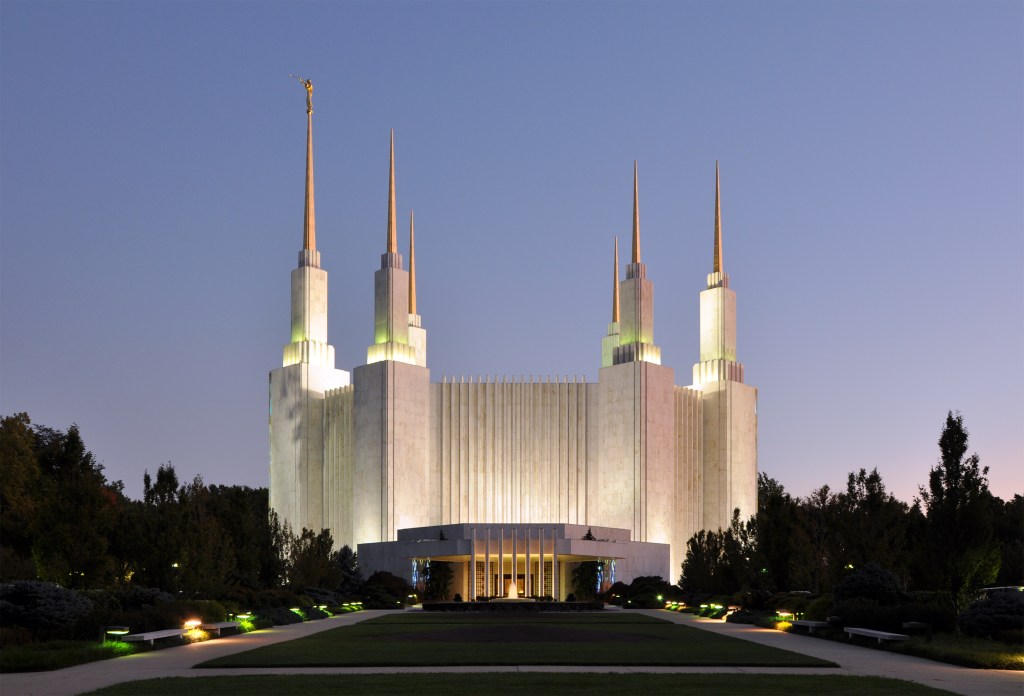
The global temple construction program continued to expand rapidly in 2025, reflecting a major institutional priority to bring sacred ordinances closer to the global membership. The physical infrastructure supporting these rituals is detailed below.
| Temple Operational Category | Count (Year-End 2025) |
|---|---|
| Temples in Operation | 204 |
| Temples under Renovation | 7 |
| Temples Announced or Under Construction | 172 |
During 2025, the Church dedicated nine new temples across several world regions, specifically in Auckland, New Zealand; Nairobi, Kenya; Abidjan, Cote d’Ivoire; Syracuse, Utah; Antofagasta, Chile; Farmington, New Mexico; Elko, Nevada; Grand Junction, Colorado; and Bahía Blanca, Argentina.
This global growth, however, conceals a profound demographic shift. In 2025, for the first time in its history, the Church recorded a net decrease in its total membership within the United States, experiencing a marginal raw loss of 186 members. This domestic stagnation is driven by a confluence of social factors, including declining birth rates among active Latter-day Saints, the removal of unbaptized children of record from official rolls after age eight, and an increasing rate of formal resignations and name removals. Furthermore, external sociological data from the Cooperative Election Study indicates that self-identification as a Latter-day Saint in the United States has dipped to approximately 0.9% of the population, which suggests a significant gap between the Church’s official administrative rolls of 6.9 million and those who actively claim the religious identity.
Conversely, the Church is experiencing unprecedented, double-digit annual growth rates in at least 44 nations and territories, predominantly concentrated within the Global South. Sub-Saharan Africa is the primary driver of this acceleration, highlighted by a 19.2% annual growth rate in the Democratic Republic of the Congo and a 10.6% growth rate in Zambia. Latin America and the Pacific Islands also show robust expansions; for example, the Solomon Islands recorded a 98.7% increase in membership, while Brazil officially bypassed Mexico in absolute membership and stake counts to become the largest national body outside the United States.
This demographic polarization presents a strategic challenge for the Church’s leadership. While the numeric center of gravity is rapidly shifting toward Sub-Saharan Africa and Latin America, the financial resources, administrative core, and senior leadership remain heavily concentrated in North America. The long-term viability of this global expansion depends on translating rapid baptism rates in the Global South into sustained local leadership, financial self-reliance, and high rates of convert retention, which have historically been areas of struggle in rapidly growing regions.
The LDS Godhead vs. The Nicene Trinity
The most significant theological departure of Latter-day Saint doctrine from mainstream Christianity lies in its rejection of classical Trinitarianism. While mainstream Christianity adheres to the Nicene and Athanasian Creeds, which define God as one divine essence or substance existing eternally as three distinct persons, Latter-day Saint theology embraces a social-trinitarian structure termed the “Godhead”.
The Godhead consists of three physically and ontologically separate and distinct divine beings: God the Eternal Father, His Son Jesus Christ, and the Holy Ghost. Latter-day Saint scripture explicitly rejects the notion of an immaterial, incorporeal deity. The Doctrine and Covenants states that the Father and the Son possess tangible, perfected, and glorified bodies of flesh and bones. In contrast, the Holy Ghost is a personage of spirit, lacking a physical tabernacle, which enables Him to dwell within the hearts of believers to perform His role as a witness, comforter, and agent of personal revelation.
| Theological Concept | Nicene/Traditional Christianity | Latter-day Saint Theology |
|---|---|---|
| Ontological Structure | One indivisible substance (Monotheism/Trinity) | Three distinct, separate beings (Social Trinitarianism) |
| Corporeality of the Father | Immaterial, incorporeal, omnipresent spirit | Perfected, tangible body of flesh and bones |
| Nature of Unity | Unity of ontological substance and essence | Absolute unity of purpose, will, and love |
| Origin of Humanity | Created ex nihilo (out of nothing); ontologically distinct | Spirit children of God; ontologically co-eternal in essence |
This ontological distinction is accompanied by a unique model of divine unity. The members of the Godhead are not “one” in substance, but are unified in purpose, mind, desire, and action. They operate in perfect alignment to execute the “plan of salvation,” which is designed to bring about the immortality and eternal life of humanity. Under this framework, God the Father serves as the supreme presiding authority within the Godhead, Jesus Christ acts as the Mediator and Redeemer, and the Holy Ghost serves as the witness of the Father and the Son.
Theology of Jesus Christ and the Pre-mortal Atonement
Latter-day Saint Christology centers on Jesus Christ as the literal Firstborn spirit child of God the Father. In the pre-mortal realm, known as the premortal existence, Jesus was known as Jehovah, a divine being who acted under the direction of the Father in the creation of worlds without number. During the Grand Council in Heaven, when the Father presented His plan of agency and testing for His spirit children, a conflict arose. Lucifer proposed a plan of coercion that would eliminate human agency, demanding all honor and glory for himself. In contrast, the pre-mortal Christ voluntarily covenanted with the Father, offering to descend to earth, preserve moral agency, and atone for the sins of humanity, returning all glory to the Father. This proposal led to a “war in heaven,” resulting in the expulsion of Lucifer and his followers.
To fulfill this pre-mortal covenant, Christ underwent what Latter-day Saint scripture terms the “condescension of God”. This refers to a divine being waiving the privileges of His celestial rank to be born into mortality. Christ was born of a mortal mother, Mary, from whom He inherited the capacity to die, and of an immortal Father, God Elohim, from whom He inherited power over physical death. Upon entering mortality, Christ passed through the “veil of forgetfulness,” requiring Him to grow from “grace to grace,” gradually reclaiming His divine identity and mission.
The Latter-day Saint understanding of the Atonement is expansive, encompassing Christ’s entire life, His suffering in the Garden of Gethsemane, His crucifixion at Calvary, and His physical resurrection. The Atonement operates on both universal and conditional levels:
- Universal Redemption: Through Christ’s physical resurrection, He unconditionally overcomes physical death for all of humanity. Every individual who has ever lived will be resurrected, receiving an immortal, glorified physical body, regardless of their belief or moral conduct.
- Conditional Redemption: Redemption from spiritual death—defined as separation from the presence of God due to personal sin—is conditional. It requires individual faith in Christ, repentance, baptism by proper priesthood authority, receipt of the Holy Ghost, and ongoing covenant keeping.
A distinct aspect of Latter-day Saint doctrine is that Christ’s suffering in Gethsemane was a primary component of the atoning sacrifice. In Gethsemane, Christ took upon Himself the personal sins, sicknesses, griefs, and infirmities of all mankind, suffering so intensely that He bled from every pore. This agonizing physical and spiritual experience is understood as the moment Christ satisfied the demands of justice, enabling Him to extend perfect, empathetic mercy and succor to humanity.
Cosmic Geography: The Kingdoms of Glory and Outer Darkness
The Latter-day Saint conception of the afterlife rejects the traditional Christian binary of heaven and hell, presenting instead a graded, multi-tiered cosmos. This model, rooted in a vision received by Joseph Smith and Sidney Rigdon in 1832, teaches that all resurrected individuals, save for a highly restricted group, will inherit one of three distinct kingdoms of glory. The level of glory inherited is determined by the individual’s desires, works, and the degree of their reception of the testimony of Jesus Christ.
| Kingdom of Glory | Scriptural Metaphor | Divine Presence | Primary Qualifications |
|---|---|---|---|
| Celestial Kingdom | Glory of the Sun | God the Father and Jesus Christ | Received testimony of Jesus, baptized, kept covenants, and sealed in temple marriage. Includes children dying before age 8. |
| Terrestrial Kingdom | Glory of the Moon | Jesus Christ (not the fullness of the Father) | Honorable individuals blinded by the craftiness of men, or those not sufficiently valiant in their testimony of Christ. |
| Telestial Kingdom | Glory of the Stars | Holy Spirit and Terrestrial messengers | Wicked individuals who rejected Christ and the prophets; redeemed after suffering in spirit prison/hell. |
| Outer Darkness | No Glory / Extinguishing of Light | None (banished with Satan) | Sons of Perdition; those who acquired a perfect knowledge of God’s power and willfully denied the truth. |
Within the highest tier, the celestial kingdom, there are three distinct degrees of glory. To attain the highest of these degrees—termed exaltation—an individual must enter into the new and everlasting covenant of marriage in a sacred temple, which enables the continuation of family relationships in the eternal world. Those who obtain exaltation are promised that they will inherit all that the Father has and progress to become gods themselves, participating in the ongoing creation of spiritual posterity. This kingdom also includes individuals who died without a knowledge of the gospel but would have received it with all their hearts if they had been permitted to tarry, as well as all children who die before they arrive at the years of accountability, which is defined as age eight.
Reinterpreting the Eucharist: The Sacrament of the Lord’s Supper
The Latter-day Saint equivalent to the Eucharist or Holy Communion is the “Sacrament,” a weekly ordinance administered during congregational worship. Its theological framing stands in stark contrast to Catholic transubstantiation, Lutheran consubstantiation, or high-church sacramentalism. The Church of Jesus Christ of Latter-day Saints views the bread and water as strictly symbolic emblems of the body and blood of Jesus Christ.
An immediate practical and theological adaptation is the substitution of water for wine. This practice is rooted in a revelation received by Joseph Smith in 1830, which declared that the specific liquid used is of secondary importance to the intent of the partaker, leading to the institutionalization of water to align with the Church’s health code, the Word of Wisdom.
The administration of the Sacrament is highly structured and must be performed by authorized holders of the Aaronic Priesthood. Young men holding the office of Priest recite specific, unalterable prayers over the emblems. The prayers outline a reciprocal covenant. By consuming the bread and water, congregants witness to God their willingness to take upon themselves the name of Jesus Christ, to always remember Him, and to keep His commandments. In return for keeping these commitments, God promises that the partakers may always have His Spirit to be with them. Rather than a means of imparting saving grace directly through the physical elements, the Sacrament functions as a weekly renewal of the covenants made at baptism.
Ecclesiastical Governance and the Fallibility of Modern Apostles
The governance of the Church of Jesus Christ of Latter-day Saints is structured as a highly centralized hierarchy. The supreme governing body is the First Presidency, consisting of the President of the Church and his chosen counselors. Directly subordinate to this body is the Quorum of the Twelve Apostles. Together, these fifteen men are sustained by the general membership as prophets, seers, and revelators.
The ecclesiastical structure underwent a major transition following the death of President Russell M. Nelson on September 27, 2025, at the age of 101. Following established protocol, the First Presidency was automatically dissolved, and the Quorum of the Twelve Apostles assumed collective leadership of the Church, led by its senior-most member, Dallin H. Oaks. On October 14, 2025, the Quorum met and formally reorganized the First Presidency, setting apart President Dallin H. Oaks as the 18th President and Prophet of the Church, an action subsequently sustained by a global solemn assembly on April 4, 2026.
| Ecclesiastical Office | Incumbent Leader (As of 2026) | Background and Tenure |
|---|---|---|
| Prophet and President of the Church | Dallin H. Oaks (93) | Former President of Brigham Young University; Justice of the Utah Supreme Court; called to the Apostleship in May 1984. |
| First Counselor (First Presidency) | Henry B. Eyring (92) | Former President of Ricks College; Stanford Business Faculty; sustained as an Apostle in April 1995. |
| Second Counselor (First Presidency) | D. Todd Christofferson (80) | Former corporate legal counsel; called to the Quorum of the Twelve Apostles in April 2008. |
| President of the Quorum of the Twelve | Jeffrey R. Holland (84) | Former President of Brigham Young University; called to the Apostleship in June 1994. |
A common point of confusion among external observers is the relationship between the intense devotion Latter-day Saints show their prophet and the official doctrine regarding his fallibility. The Church does not claim that its President or apostles are infallible. Official instructional materials declare that only Jesus Christ lived a perfect life; all other ecclesiastical leaders are subject to human weakness, limitations of knowledge, and personal errors. The Church openly references biblical and historical mistakes made by prophets—such as Jonah’s flight to Nineveh, Peter’s denial of Christ, or Joseph Smith’s loss of the translated manuscript pages—to demonstrate that God consistently works through imperfect, mortal instruments.
To balance this acknowledgment of human fallibility with the expectation of obedience, the Church emphasizes two primary safeguards:
- The Prophetic Promise: Reaffirming a declaration by the fourth President, Wilford Woodruff, the Church teaches that the Lord will never permit the President of the Church to lead the members astray. In a modern theological context, this does not mean the President will never make an administrative error or express a personal theological opinion that is later corrected. Rather, it guarantees that the Church will always retain the essential priesthood keys and saving ordinances, and that the prophet will consistently guide the institution toward its core mission of preparing humanity for eternal life.
- The Principle of Unanimity: Official Church doctrine is not established by the unilateral whim of the President. Following the pattern established in the Doctrine and Covenants, any declaration of binding doctrine or scriptural interpretation must be sustained by the First Presidency and the Quorum of the Twelve Apostles acting in complete unanimity. This collective requirement acts as a systemic check against individual biases, personal idiosyncrasies, and cultural limitations, ensuring that the Church is governed by a unified spiritual consensus.
Comparative Analysis: Latter-day Saint Theology, Traditional Christianity, and Islam
The position of Latter-day Saint theology within the landscape of world religions is unique, sharing deep historical and ethical values with traditional Christianity while exhibiting structural and sociological parallels with Islam that are distinct from both.
| Analytical Dimension | Traditional Christianity | Latter-day Saint Theology | Islam |
|---|---|---|---|
| Nature of the Divine | Creedal Trinity (three persons in one indivisible spiritual substance) | Godhead (three physically separate beings; Father/Son have physical bodies) | Tawhid (absolute, transcendent, incorporeal monotheism; no partners or offspring) |
| Status of Jesus Christ | Ontologically co-equal and co-eternal second person of the Trinity | Literal Firstborn spirit child of God; Jehovah of the Old Testament | Mortal prophet (Isa); highly revered but explicitly not divine or crucified |
| Scriptural Canon | Closed canon (Holy Bible only, Old and New Testaments) | Open canon (Bible, Book of Mormon, D&C, Pearl of Great Price) | Closed canon (Qur’an as the final literal word of Allah to humanity) |
| Soteriology | Salvation by grace alone through faith, or faith coupled with sacraments | Universal resurrection; conditional exaltation by grace through covenants | Submission to Allah; salvation through faith, obedience, and personal deeds |
| Ecclesiastical Continuity | Continuous institutional succession or doctrinal reformation | Disruption of authority (Great Apostasy) followed by a literal Restoration | Disruption/corruption of earlier messages, followed by a final restoration through Muhammad |
Points of Convergence with Mainstream Christianity
Despite significant theological differences, the Church of Jesus Christ of Latter-day Saints shares deep ecumenical and historical touchstones with mainstream Christianity. At its core, Latter-day Saint theology is christocentric. The entire faith is built upon the divinity, mission, and saving grace of Jesus Christ. The Church’s official name, the weekly Sacrament, and every formal prayer are centered on His authority. Both traditions worship Christ as the Son of God, the Savior of the world, and the conqueror of sin and death.
Latter-day Saints also share a deep reverence for the Holy Bible (specifically using the King James Version in the English-speaking world). The Old and New Testaments are studied, preached, and revered as the word of God, providing the historical and theological foundation upon which modern scriptures are built. Sociologically, Latter-day Saints and mainstream Christians share a nearly identical moral code. This includes an emphasis on personal integrity, family solidarity, charity, community service, the sanctity of life, and adherence to the Ten Commandments. Furthermore, both traditions reject physical death as the end of human existence, affirming a literal, physical resurrection of the dead made possible through the victory of Christ.
Points of Convergence with Islam
While the historical and cultural paths of Latter-day Saint theology and Islam are distinct, scholars of comparative religion have noted substantial structural parallels. Both Islam and Latter-day Saint theology are restorationist in their self-understanding. Islam teaches that it is the original religion of Adam, Abraham, and Moses, and that Judaism and Christianity corrupted the original text and message, requiring Muhammad to restore the pure, unadulterated truth. Similarly, Joseph Smith claimed that his movement restored the original Christian gospel that had been lost to apostasy.
The revelatory models of both faiths are remarkably similar. Both Muhammad and Joseph Smith claimed to have been visited by divine angelic messengers (Gabriel and Moroni, respectively) in their youth. These visitations led to the production of new sacred books—the Qur’an and the Book of Mormon—which adherents of both faiths believe could not have been written by their founders due to their lack of formal education. Over the course of their prophetic careers, both founders actively revised or clarified prior revelations, a process seen in the Medinan interpolations of Meccan surahs and in Joseph Smith’s textual updates to his early revelations.
Furthermore, both religions emphasize a comprehensive lifestyle rather than a mere creedal declaration. Sociological parallels are evident across several core practices:
- Prayer: Muslims participate in structured, daily prayer (Salah), while Latter-day Saints are commanded to pray always, including personal, family, and congregational prayers.
- Almsgiving: Islam requires Zakat (annual alms to support the poor), mirroring the Latter-day Saint requirement of tithing (ten percent of income) and fast offerings (donations representing skipped meals to assist the local needy).
- Fasting: Muslims fast during the holy month of Ramadan from sunrise to sunset, while Latter-day Saints observe a monthly “Fast Sunday,” abstaining from food and drink for two consecutive meals.
- Behavioral Prohibitions: Both traditions enforce strict dietary and health codes, notably prohibiting the consumption of alcohol, emphasizing modesty, and historically practicing plural marriage.
Historically, both movements faced severe, violent persecution in their early years, which forced them to migrate and establish distinct, self-governing physical communities—Medina under Muhammad and Nauvoo/Salt Lake City under Joseph Smith and Brigham Young. Interestingly, both faiths experienced an analogous leadership split after the deaths of their founders. Islam fractured into the Sunni, who supported leadership succession through a committee of companions, and the Shi’a, who believed succession should remain within the family of the Prophet. Similarly, the Latter-day Saint movement split into the mainstream Church of Jesus Christ of Latter-day Saints, which supported succession through the Quorum of the Twelve Apostles, and the Reorganized Church of Jesus Christ of Latter Day Saints, which maintained succession through Joseph Smith’s direct descendants.
Points of Divergence with Islam
Despite these structural similarities, the theological foundations of the two faiths represent opposite poles of Abrahamic theology. The most radical divergence lies in the ontology of God. Islam is anchored in Tawhid—the absolute, indivisible monotheistic unity of Allah. The Qur’an explicitly condemns any concept of plurality in the Godhead, physical anthropomorphism, or the idea of God having offspring. In stark contrast, Latter-day Saint theology is built upon a physical, social pluralism of three distinct Gods, coupled with the doctrine of eternal progression, which teaches that humans can progress to inherit the status of godhood themselves.
A second key divergence centers on the crucifixion and atoning mission of Jesus Christ. In Latter-day Saint theology, the physical crucifixion, death, and resurrection of Jesus are the central events of human history, without which salvation is impossible. Islam, however, explicitly denies the crucifixion, resurrection, and divine sonship of Jesus, viewing Him as a revered mortal prophet but rejecting any role for Him as a savior or a source of vicarious atonement.
Thematic Epilogue
The theological and sociological trajectory of the Church of Jesus Christ of Latter-day Saints in the modern era reveals a complex religious movement navigating the tensions of globalization, institutional preservation, and theological distinctiveness. Emerging from the nineteenth-century American frontier as a highly localized, persecuted sect, the Church has successfully institutionalized a global ecclesiastical structure capable of coordinating millions of volunteers, constructing hundreds of temples, and sustaining a vast missionary force.
Yet, this global success has introduced a distinct demographic paradox. The traditional cultural core in the United States is contracting, experiencing negative net growth for the first time. This decline is counterbalanced by rapid expansion in the Global South, particularly in Sub-Saharan Africa and South America. This shift demands a continuous administrative decentralization, requiring the Church to adapt its Western cultural inheritance to meet the needs of a diverse, global membership.
Theologically, the Church continues to occupy a unique space. It maintains its position as a Christian movement while rejecting the creedal foundations of Nicene Christianity, presenting instead a highly physicalist, social concept of the Godhead and an optimistic cosmology of eternal progression. The leadership succession of President Dallin H. Oaks demonstrates the durability of its highly structured, bureaucratic hierarchy, which manages the paradox of asserting divine, prophetic guidance through admittedly fallible human instruments. As the Church moves further into its third century, its enduring identity will be defined by how it balances these unique theological claims with the realities of an increasingly diverse and global congregation.




Leave a Reply