
Presented by Gemini
Audio teaser: Rabb al-Alamin and the Multiverse
Abstract
This treatise presents a comprehensive linguistic, theological, philosophical, and scientific analysis of the Qur’anic formula Rabb al-Alamin (Lord of the Worlds), which recurs exactly forty-two times across twenty-one distinct chapters (Surahs) of the text. Through a multi-disciplinary framework, this study demonstrates that the plural noun al-Alamin linguistically and conceptually prefigures the contemporary scientific paradigm of the multiverse, positioning the Divine not merely as a localized planetary or systemic governor, but as the transcendent and immanent sustainer of all possible physical and metaphysical coordinates of reality. Utilizing the theological frameworks of classical Islamic scholastic theology (Kalam) alongside modern mathematical physics, this paper explores the cosmological, teleological, and ontological implications of these forty-two verses. It frames the extreme fine-tuning of cosmic constants—such as the cosmological constant ($\Lambda$), the gravitational coupling constant ($G$), and the strong nuclear force—as unapologetic empirical evidence for an intentional, necessary Creator. Finally, it provides a rigorous philosophical refutation of common materialistic detours, including the Weak Anthropic Principle, natural necessity, random chance, and the epistemological vulnerabilities of atheistic multiverse hypotheses, establishing that the multiversal sustenance of Rabb al-Alamin remains the most intellectually coherent and parsimonious explanation for the existence of life-permitting reality.
Linguistic and Metaphysical Foundations of Rububiyah and Al-Alamin
To comprehend the profound depth of the forty-two Qur’anic occurrences of Rabb al-Alamin, one must first dismantle and analyze the constituent elements of this Arabic genitive construction (Idafah). The term Rabb is frequently translated into English as “Lord,” yet this translation strips the root $R-B-B$ of its dynamic ontological properties. Classically, Rabb encompasses three primary dimensions of action: ownership (Al-Malik), sovereignty or governance (Al-Sayyid), and developmental sustenance or nurturing (Al-Muballigh or Al-Murabbi). As the classical exegete Al-Qurtubi clarifies, Rabb signifies the One who nurtures and completes every created entity from its inception to its final state of perfection. Thus, Rububiyah (Lordship) is not a static deistic title denoting an uninvolved first cause; it is a continuous, moment-by-moment sustenance (Qayyumiyah) without which the cosmos would instantly collapse into nonexistence.
The second term, al-Alamin, is the masculine sound plural of alam (world, domain, or realm). Linguistically, alam is derived from either alama (sign/index) or ilm (knowledge). Thus, a “world” is ontologically defined as “that by which the Creator is known”. The choice of the masculine plural suffix (-in), which Arabic grammar typically reserves for rational, conscious agents, has long intrigued metaphysicians. Ibn Abbas classically interpreted al-Alamin as representing “the heavens, the earths, and all that lies within and between them, known or unknown”. However, the specific grammatical structure of al-Alamin hints at a deeper reality: a vast ensemble of domains, both conscious (comprising humans, jinn, angels, and higher intelligences) and physical (comprising dimensions, universes, and quantum vacuum states).
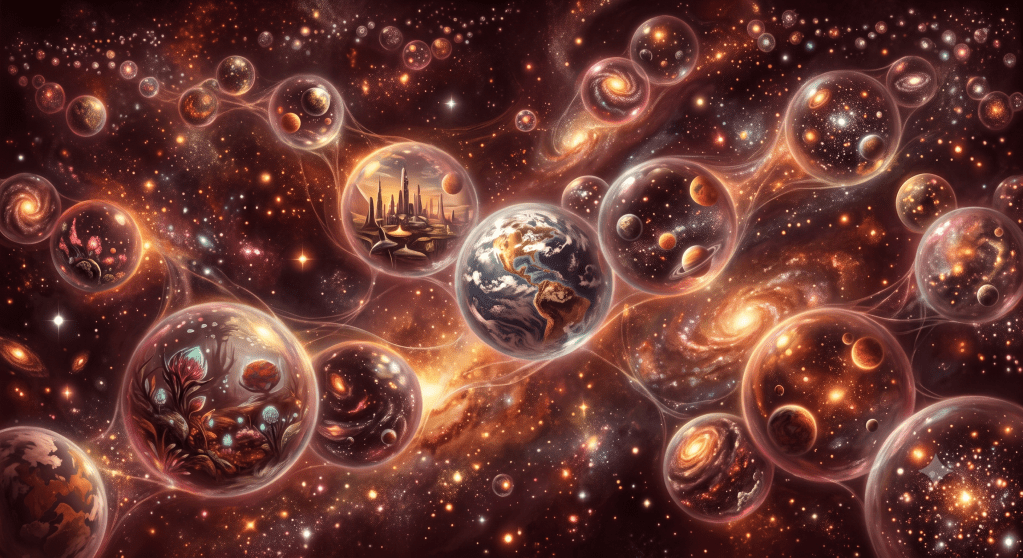
This linguistic framing directly interfaces with the contemporary cosmological transition from a singular universe to a complex multiverse. In this ontological framework, Allah is not merely the sustainer of our observable hubble volume, but the absolute regulator of all possible realms of existence.
The exact distribution of the forty-two occurrences of Rabb al-Alamin across twenty-one Surahs is structurally significant, forming a mathematical and thematic grid throughout the text. Both the frequency of the exact phrase (42, which is $6 \times 7$) and the number of Surahs in which it appears (21, which is $3 \times 7$) are multiples of seven, a pattern that has invited extensive numerical and structural analysis by classical and contemporary scholars.
The Theological and Cosmological Interface: Sustenance of the Multiverse
The conceptual leap from a geocentric or even a heliocentric model of the cosmos to a multiversal architecture is natively supported by the semantic domain of Rabb al-Alamin. Classical theology, utilizing the Kalam cosmological argument, establishes that the universe is contingent (mumkin al-wujud). It has a beginning, and its physical parameters could have been different. Because it is contingent, it requires a “specifier” (mukhassis) to choose its specific existence and exact parameters over infinite other possibilities.
In modern theoretical physics, the concept of the multiverse manifests in several distinct paradigms:
- The Quantum Many-Worlds MWI (Everettian Multiverse): Under the Everettian interpretation of quantum mechanics, the wave function does not collapse. Instead, every quantum event branches the universe into a superposition of mutually unobservable states, creating an infinite, branching tree of parallel histories.
- The Chaotic Inflationary Multiverse (Linde): Eternal inflation suggests that our universe is merely one “bubble” in a vastly larger, expanding spacetime foam. Different bubbles undergo distinct phase transitions, resulting in varying laws of physics and local constants in each bubble.
- The String Theory Landscape (M-Theory): String theory postulates up to eleven dimensions, with the extra dimensions compactified into Calabi-Yau manifolds. The number of possible configurations (vacua) is estimated at $10^{500}$, each corresponding to a unique universe with its own set of low-energy physical laws.
A common secular interpretation of these theories is that they render a Creator obsolete. However, a deeper analysis reveals the opposite. The attribute of Rububiyah is not exhausted by a single universe. If a multiverse exists, it cannot be self-originating or self-sustaining. Any physical mechanism capable of generating bubble universes—such as an inflaton field or a higher-dimensional brane-world clash—must operate according to a highly specific set of meta-laws. This meta-generator must possess its own quantum mechanics, conservation laws, and boundary conditions.
Therefore, the multiverse does not eliminate the need for a Creator; it merely shifts the requirement of Rububiyah up to a higher, meta-cosmological level. The title Rabb al-Alamin asserts that Allah is the direct sustainer of this entire multiversal ensemble. He continuously regulates the quantum probabilities of the Everettian branches, guides the chaotic inflationary fields, and sustains the multi-dimensional geometry of the string landscape.
The Fine-Tuning Argument: Teleological Design as Unapologetic Evidence
The teleological argument, historically known in Islamic philosophy as Dalil al-Inayah (the Argument from Providence) championed by Ibn Rushd, has found strong empirical support in modern physics through the discovery of cosmic fine-tuning. This refers to the highly precise calibration of the fundamental physical constants of nature, which must fall within a vanishingly narrow range for life—or even basic physical structures like stars and atoms—to exist.
The table below outlines key cosmological and physical constants, the tolerances within which they must fall to allow a life-permitting universe, and the physical consequences should those values deviate.
| Constant | Symbol / Value | Permitted Tolerance | Physical Consequence of Deviation |
| Cosmological Constant | $\Lambda \approx 10^{-120} M_{pl}^4$ | 1 part in $10^{120}$ | Larger: Space expands too rapidly, preventing matter from coalescing into galaxies or stars. Smaller: Space collapses back into a singularity before any life can emerge. |
| Gravitational Coupling | $G \approx 6.674 \times 10^{-11} \text{ m}^3 \text{ kg}^{-1} \text{ s}^{-2}$ | 1 part in $10^{40}$ | Stronger: Stars become too massive, burning through their nuclear fuel in millions rather than billions of years. Weaker: Matter fails to collapse, preventing stellar ignition or planet formation. |
| Strong Nuclear Force | $g_s \approx 15 \text{ (coupling strength)}$ | $\pm 2\%$ | Stronger: All hydrogen fuses into helium immediately after the Big Bang, leaving the universe devoid of water. Weaker: Protons cannot bind, leaving a universe of isolated hydrogen with no heavy elements like carbon or oxygen. |
| Weak Nuclear Force | $g_w \approx 1.43 \times 10^{-62} \text{ J m}^3$ | 1 part in $10^{100}$ | Stronger: Supernovae fail to eject heavy elements into the interstellar medium. Weaker: Stellar hydrogen fusion proceeds too rapidly, or helium synthesis fails entirely during primordial nucleosynthesis. |
| Proton-to-Electron Mass Ratio | $\beta = m_p / m_e \approx 1836$ | 1 part in $10^{37}$ | Slight Shift: Molecular bonds become unstable, preventing the formation of double-helix DNA, complex organic compounds, and stable chemistry. |
To mathematically conceptualize this, the joint probability ($P$) of these constants falling within their life-permitting ranges by sheer chance is represented by:
$$P = \prod_{i=1}^{n} P_i \approx 0$$
Where $P_i$ is the individual probability of each constant being tuned to its life-permitting value. This compound probability is so close to absolute zero that it defies rational belief to attribute the cosmos to a lucky roll of the dice. This mathematical reality is a clear signature of the Rububiyah described in Surah Ghafir:
“It is Allah Who made for you the earth a place of settlement and the sky a structure and formed you and perfected your forms… Blessed is Allah, Lord of all worlds”.
Refuting the Critics and Countering Alternative Hypotheses
Materialist cosmologists and atheistic philosophers have advanced several alternative hypotheses to explain away fine-tuning without invoking a conscious Creator. These arguments can be systematically refuted.
1. The Weak Anthropic Principle and the Surprise Fallacy
The Weak Anthropic Principle asserts that we should not be surprised to find our universe fine-tuned for life, because if it were not fine-tuned, we would not be here to observe it. This argument is a logical tautology that confuses a necessary condition for observation with an explanation for that condition.
Philosopher John Leslie illustrated this fallacy through his famous Firing Squad Analogy:
Imagine a prisoner sentenced to death, facing a firing squad of one hundred elite marksmen. The command to fire is given, the rifles roar, but the prisoner discovers that every single bullet has missed him. The prisoner cannot simply dismiss this by saying, “Of course I survived; if they hadn’t all missed, I wouldn’t be here to think about it.” While his survival is a necessary condition for his ongoing thoughts, it does not explain why one hundred highly trained marksmen all missed. The only rational inference is that the miss was deliberate and coordinated. The Weak Anthropic Principle fails because it mistakes the conditions of observation for the cause of the observed phenomenon.
2. The Multiverse as an Atheistic Alternative
The most common materialist defense against fine-tuning is to suggest that if there are an infinite number of universes (a multiverse), every possible set of physical constants will be realized somewhere. On this view, we simply happen to live in one of the rare life-permitting bubbles.
This hypothesis faces several severe scientific and philosophical objections:
- The Problem of Boltzmann Brains: In an inflationary multiverse, the thermodynamic fluctuations required to produce a single, isolated, self-aware brain floating in empty space (a Boltzmann Brain) are vastly more probable than the fluctuations required to produce a highly structured, billions-of-years-old universe with billions of galaxies. If the multiverse theory were correct, we should be highly confident that we are Boltzmann brains experiencing a delusion of a structured universe, rather than real observers in a physical cosmos. This conclusion collapses the reliability of empirical observation, undermining the very physics used to propose the multiverse in the first place.
- Occam’s Razor and Ontological Parsimony: Occam’s Razor dictates that we should prefer explanations that do not multiply entities beyond necessity. Postulating $10^{500}$ unobservable physical universes to explain our single fine-tuned universe is highly unparsimonious compared to postulating a single, transcendent, conscious Intellect—Rabb al-Alamin.
- The Meta-Fine-Tuning Loophole: As established, any physical mechanism capable of generating universes (such as eternal inflation or string landscapes) must itself be governed by physical laws and parameters that are highly specific. The multiverse does not solve the fine-tuning problem; it merely relocates it, requiring a finely-tuned universe generator to produce viable bubbles.
3. Natural Necessity and the Theory of Everything
Some physicists argue that when a final unified theory is discovered, we will find that the constants of nature could not have been different; they are physically necessary.
This hypothesis is speculative and philosophically untenable. There is no mathematical or logical reason why gravity must have its exact strength, or why the cosmological constant must have its specific value. Furthermore, even if a unified equation did dictate these constants, we would still have to ask why that specific equation exists instead of an infinite number of other mathematically consistent equations. A “Theory of Everything” is simply a description of physical laws, not an explanation for why laws exist or why they are structured to produce life.
Exhaustive Theological and Philosophical Commentary on the Twenty-One Surah Categories
What follows is an exhaustive, verse-by-verse commentary analyzing all 35 specific verses provided in the original categorization, systematically mapped across the 21 Surahs.
Surah 1: Al-Fatihah
Verse 1:2 — الْحَمْدُ لِلَّهِ رَبِّ الْعَالَمِينَ (All praise is for Allah, Lord of all worlds)
The opening declaration of the Qur’an establishes the primary doxological framework of existence. Linguistically, the prefix Al- in Al-Hamd indicates exhaustiveness, implying that all modalities of praise, recognition, and valuation belong intrinsically to the divine essence. The immediate coupling of Al-Hamd with Rabb al-Alamin signifies that the supreme justification for praise is the active, developmental sustenance of the worlds.
Rather than a detached deistic absolute, God is recognized as the immanent, moment-by-moment sustainer of cosmic order. For the human intellect, this verse establishes that the cognitive act of praising God is a direct response to the observable order, coherence, and biophilic fine-tuning of the natural world.
Surah 2: Al-Baqarah
Verse 2:131 — إِذْ قَالَ لَهُ رَبُّهُ أَسْلِمْ ۖ قَالَ أَسْلَمْتُ لِرَبِّ الْعَالَمِينَ (When his Lord said to him, “Submit,” he said, “I have submitted to the Lord of the worlds”)
This verse portrays the primordial, unconditioned submission of Abraham as a direct response to the call of Rububiyah. Abraham’s declaration, Aslamtu li-Rabbi al-Alamin (I have submitted to the Lord of the Worlds), is a profound metaphysical realignment.
Rather than submitting to localized nature deities, societal rulers, or celestial bodies—which Abraham had systematically analyzed and rejected as contingent—he chooses to submit directly to the transcendent Sustainer of the entire multiversal structure.
This establishes that true monotheistic submission (Islam) is not a surrender of reason, but the ultimate rational alignment of human consciousness with the absolute Ground of all existence.
Surah 3: Al-A’raf
                                [ Al-A'raf Structural Trio ]
                                             │
            ┌────────────────────────────────┼──────────────────────────────┐
            ▼                                ▼                              ▼
    ┌──────────────┐                 ┌──────────────┐               ┌──────────────┐
    │ Verse 7:61   │                 │ Verse 7:67   │               │ Verse 7:104  │
    │ Prophetic    │                 │ Intellectual │               │ Geopolitical │
    │ Authority    │                 │ Defense of   │               │ Challenge to │
    │ (Noah)       │                 │ Sanity (Hud) │               │ Tyranny      │
    └──────────────┘                 └──────────────┘               └──────────────┘
Verse 7:61 — قَالَ يَا قَوْمِ لَيْسَ بِي ضَلَالَةٌ وَلَٰكِنِّي رَسُولٌ مِّن رَّبِّ الْعَالَمِينَ (He said, “O my people, there is no error in me, but I am a messenger from the Lord of the worlds”)
Noah’s response to the ruling elite (Al-Mala) who accused him of being in “manifest error” is an epistemological defense. By invoking the title Rabb al-Alamin, Noah refutes the charge of delusion.
He positions his prophetic mission not as a subjective, personal project or a localized cultural invention, but as an objective transmission of information from the sovereign Administrator of all reality.
This reveals that prophetic revelation (Wahy) is the spiritual and intellectual analog to physical sustenance: just as Rabb sustains the physical development of the cosmos, He sustains the cognitive and moral development of conscious beings through guidance.
Verse 7:67 — قَالَ يَا قَوْمِ لَيْسَ بِي سَفَاهَةٌ وَلَٰكِنِّي رَسُولٌ مِّن رَّبِّ الْعَالَمِينَ (He said, “O my people, there is no foolishness in me, but I am a messenger from the Lord of the worlds”)
In a parallel structural encounter, the prophet Hud is accused of safahah (foolishness, intellectual deficiency, or irrationality). Hud’s defense mimics Noah’s, linking prophetic authority directly to the Rabb al-Alamin.
This repetition demonstrates a consistent theological principle: the messages of the prophets are not bizarre aberrations in the physical world, but are direct communications from the same central intelligence that established the fine-tuned physical parameters of the universe.
To reject the prophetic messenger is to exhibit a profound cognitive blindness, failing to recognize the same organizing principles that govern the natural world.
Verse 7:104 — وَقَالَ مُوسَىٰ يَا فِرْعَوْنُ إِنِّي رَسُولٌ مِّن رَّبِّ الْعَالَمِينَ (And Moses said, “O Pharaoh, indeed I am a messenger from the Lord of the worlds”)
This verse represents a dramatic geopolitical confrontation. Moses addresses Pharaoh, the absolute sovereign of the Egyptian empire, not merely as a local tribal representative, but as an emissary of the supreme Sovereign of all dimensions.
By presenting himself as a messenger of Rabb al-Alamin, Moses challenges the divine claims of the Egyptian state, which was built on the worship of localized forces of nature and the political deification of the ruler.
Moses introduces a radically larger cosmological scale, asserting that Pharaoh is merely a contingent, dependent creature subject to the same universal laws as the rest of creation.
Surah 4: Yunus
Verse 10:10 — دَعْوَاهُمْ فِيهَا سُبْحَانَكَ اللَّهُ وَتَحِيَّتُهُمْ فِيهَا سَلَامٌ ۚ وَآخِرُ دَعْوَاهُمْ أَنِ الْحَمْدُ لِلَّهِ رَبِّ الْعَالَمِينَ (Their call therein will be, “Glory to You, O Allah,” and their greeting therein will be, “Peace.” And the last of their call will be, “All praise is for Allah, Lord of all worlds”)
This verse describes the eschatological state of conscious entities in the celestial realm. The progression of their cognitive states moves from Tasbih (transcendental purification: “Glory to You, O Allah”) to Salam (systemic harmony: “Peace”), and culminates in Al-Hamd (doxological recognition: “All praise is for Allah, Lord of all worlds”).
This progression reveals that praise is the natural, ultimate state of conscious minds when they are freed from the limitations of earthly physical existence and permitted to observe the full, multi-dimensional expanse of reality.
It demonstrates that the ultimate goal of creation is not merely mechanical existence, but a conscious, intellectual appreciation of the perfect order maintained by Rabb al-Alamin.
Surah 5: Al-An’am
Verse 6:45 — فَقُطِعَ دَابِرُ الْقَوْمِ الَّذِينَ ظَلَمُوا ۚ وَالْحَمْدُ لِلَّهِ رَبِّ الْعَالَمِينَ (So the roots of the people who did wrong were cut off. And praise be to Allah, Lord of all worlds)
This passage links the moral order of human history directly to the physical governance of the cosmos. The destruction of oppressive, unjust civilizations is described as a form of cosmic purification, followed immediately by the doxology Al-Hamdu lillahi Rabbi al-Alamin.
This juxtaposition asserts that moral laws are not arbitrary human conventions, but are structural components of cosmic governance, as real and unyielding as the physical laws of nature.
When a society systematically commits zulm (injustice and deviation), it introduces a destabilizing element into the moral ecosystem of the world. Its removal is a restoration of balance, drawing praise from the cosmos itself.
Verse 6:71 — قُلْ أَنَدْعُو مِن دُونِ اللَّهِ مَا لَا يَنفَعُنَا وَلَا يَضُرُّنَا… وَأُمِرْنَا لِنُسْلِمَ لِرَبِّ الْعَالَمِينَ (Say, “Shall we invoke besides Allah that which neither benefits us nor harms us…?” …And we have been commanded to submit to the Lord of the worlds)
Here, the text contrasts the cognitive confusion of idolatry and polytheism with the intellectual alignment of monotheism. Those who invoke contingent, dependent entities are described as being like a traveler lost in the wilderness, confused and pulled in different directions by conflicting forces.
The only escape from this intellectual wandering is to align one’s life with the supreme, unifying Source of all order.
The command to submit to Rabb al-Alamin is a liberating directive, freeing human consciousness from subservience to localized physical forces and anchoring it in the absolute, transcendent Ground of reality.
Verse 6:162 — قُلْ إِنَّ صَلَاتِي وَنُسُكِي وَمَحْيَايَ وَمَمَاتِي لِلَّهِ رَبِّ الْعَالَمِينَ (Say, “Indeed, my prayer, my rites, my living and my dying are for Allah, Lord of all worlds”)
This verse is a profound statement of existential integration. It unites every dimension of human life—from formal acts of worship (salat and nusuk) to the biological processes of living and dying (mahyaya and mamati)—into a singular, cohesive purpose.
Life is not a collection of disconnected, meaningless events, nor is death a descent into nothingness.
Both are transitions within a purposeful, guided system maintained by the same infinite Mind that calibrated the physical constants of the multiverse to permit life in the first place.
Surah 26: Ash-Shu’ara
This chapter contains the highest concentration of the phrase Rabb al-Alamin in the Qur’an, using it as a central rhetorical and theological anchor throughout its narrative structures.
Verse 26:16 — فَأْتِيَا فِرْعَوْنَ فَقُولَا إِنَّا رَسُولُ رَبِّ الْعَالَمِينَ (So go to Pharaoh and say, “Indeed, we are messengers of the Lord of the worlds”)
Moses and Aaron are commanded to present themselves to Pharaoh as a unified diplomatic and spiritual front. The use of the singular noun rasool (messenger) to refer to a plural subject (Moses and Aaron) signifies the absolute unity of their message.
They speak with a single voice, representing a singular Source. By framing their authority around the title Rabb al-Alamin, they immediately challenge Pharaoh’s localized, self-proclaimed sovereignty.
Verse 26:77 — قَالَ فَإِنَّهُمْ عَدُوٌّ لِّي إِلَّا رَبِّ الْعَالَمِينَ (He said, “Indeed, they are enemies to me, except the Lord of the worlds”)
Abraham’s radical break from the culture of his ancestors is expressed through a declaration of hostility toward their idols, whom he calls “enemies”.
Abraham recognizes that any entity that is dependent, localized, or physically bound cannot serve as the foundation for ultimate meaning.
To worship such entities is to commit a grave intellectual error, blinding oneself to the true, transcendent Source of order and sustenance who governs all possible realms of existence.
Verse 26:98 — إِذْ نُسَوِّيكُم بِرَبِّ الْعَالَمِينَ (When we equated you with the Lord of the worlds)
This verse depicts the regret of those who committed idolatry, spoken from the vantage point of the afterlife. They realize that their fundamental error was one of scale and proportion: they equated finite, contingent physical phenomena with the transcendent, infinite Sustainer of the cosmos.
This error is a catastrophic cognitive failure, mistaking the physical elements of creation for the transcendent Mind that designed and maintained them.
Verse 26:115 — إِنْ أَنَا إِلَّا نَذِيرٌ مُّبِينٌ (I am not but a clear warner)
Although this verse does not contain the phrase Rabb al-Alamin directly, it is included in the Surah’s thematic progression, spoken by the prophet Noah. By declaring himself to be nothing more than a “clear warner,” Noah rejects any personal, self-aggrandizing authority.
He acts simply as an instrument for transmitting objective warnings from the sovereign Administrator of the universe, ensuring that his warning is delivered clearly and without corruption.
Verse 26:125 — إِنِّي لَكُمْ رَسُولٌ أَمِينٌ (Indeed, I am to you a trustworthy messenger)
Spoken by the prophet Hud, this verse emphasizes the absolute reliability and fidelity required of a prophetic messenger.
Just as physical laws transmit information across the universe with perfect consistency, the prophetic messenger must transmit the spiritual and moral laws of Rabb al-Alamin without any human modification, dilution, or personal bias.
Verse 26:145 — وَمَا أَسْأَلُكُمْ عَلَيْهِ مِنْ أَجْرٍ ۖ إِنْ أَجْرِيَ إِلَّا عَلَىٰ رَبِّ الْعَالَمِينَ (And I do not ask you for it any payment; my payment is only from the Lord of the worlds)
Spoken by the prophet Salih, this declaration of economic altruism is a vital piece of prophetic evidence. By refusing any payment, the prophet demonstrates that his mission is entirely free from any personal or political self-interest.
His work is aligned with the ultimate Source of all sustenance, relying on Rabb al-Alamin for his reward rather than any human economy.
Verse 26:164 — وَمَا أَسْأَلُكُمْ عَلَيْهِ مِنْ أَجْرٍ ۖ إِنْ أَجْرِيَ إِلَّا عَلَىٰ رَبِّ الْعَالَمِينَ (And I do not ask you for it any payment; my payment is only from the Lord of the worlds)
Spoken by the prophet Lut, this identical repetition reinforces the consistent pattern of prophetic altruism.
It shows that across different historical and cultural environments, the messengers of Rabb al-Alamin remain unified in their economic independence and selflessness, validating their role as objective channels for divine guidance.
Verse 26:182 — وَزِنُوا بِالْقِسْطَاسِ الْمُسْتَقِيمِ (And weigh with an even balance)
This moral command, spoken by the prophet Shu’ayb, connects physical measurement directly to moral integrity. The use of the “even balance” (Al-Qistas al-Mustaqim) is not merely a rule for commercial transactions; it is an earthly reflection of the cosmic balance established by Rabb al-Alamin.
Just as the physical constants of the universe are calibrated with extreme precision to allow existence, human societies must maintain precise balance and justice in their interactions to avoid moral decay and collapse.
Verse 26:192 — وَإِنَّهُ لَتَنزِيلُ رَبِّ الْعَالَمِينَ (And indeed, it is a revelation of the Lord of the worlds)
This verse asserts the absolute origin of the Qur’anic text. The descent of the revelation is described as tanzil—a physical and spiritual descent from the transcendent Center of reality into the spatiotemporal limits of human language.
It asserts that the text is not a product of human cultural development, but is an objective communication from the same Mind that designed and sustained the physical laws of the universe.
Surah 7: As-Saffat
Verse 37:87 — فَمَا ظَنُّكُم بِرَبِّ الْعَالَمِينَ (Then what is your thought concerning the Lord of the worlds?)
Abraham challenges the polytheists of his city with a philosophical question: “What then is your thought concerning the Lord of the worlds?”.
This question exposes the absurdity of their provincial, localized model of divinity.
Abraham forces them to confront the immense scale of reality, asking how they can equate the ultimate, transcendent Source of the entire multiverse with localized, dependent idols that can be manufactured, broken, or destroyed.
Verse 37:182 — وَالْحَمْدُ لِلَّهِ رَبِّ الْعَالَمِينَ (And praise be to Allah, Lord of all worlds)
This doxological seal serves as the grand finale of the Surah. After systematically detailing the historical struggles of the prophets and the final judgment of humanity, the text returns to a state of absolute praise.
This structural choice establishes that the ultimate destination of the entire cosmic process is a harmonious return of all praise to the sovereign Source of existence.
Surah 8: Al-Mu’minun
Verse 23:98 — وَقُل رَّبِّ أَعُوذُ بِكَ مِنْ هَمَزَاتِ الشَّيَاطِينِ (And say, “My Lord, I seek refuge in You from the incitements of the devils”)
This prayer shifts the focus from cosmological scales to the intimate landscape of the human psyche. By invoking Rabb as a protective shield against cognitive disruption and psychological incitement (hamazat), the petitioner recognizes that the same power that stabilizes planets and galaxies is also intimately accessible to guide and protect the human mind.
It demonstrates that Rububiyah is both transcendent in its scale and immanent in its personal, protective care for conscious individuals.
Verse 23:118 — وَقُل رَّبِّ اغْفِرْ وَارْحَمْ وَأَنتَ خَيْرُ الرَّاحِمِينَ (And say, “My Lord, forgive and have mercy, for You are the best of those who show mercy”)
This verse, which closes Surah Al-Mu’minun, frames the pursuit of forgiveness and mercy as a return to Rububiyah.
Because the human creature is contingent and prone to error, its ultimate development requires the constant application of divine mercy.
The title Rabb here signifies the nurturing parent who forgives and corrects the mistakes of the child, guiding them toward their final, perfected state of existence.
Surah 9: Ghafir
Verse 40:66 — قُلْ إِنِّي نُهِيتُ أَنْ أَعْبُدَ الَّذِينَ تَدْعُونَ مِن دُونِ اللَّهِ… وَأُمِرْتُ أَنْ أُسْلِمَ لِرَبِّ الْعَالَمِينَ (Say, “Indeed, I have been forbidden to worship those you call upon besides Allah… and I have been commanded to submit to the Lord of the worlds”)
This verse establishes a clear ontological boundary. The Prophet is commanded to reject any worship of contingent, dependent entities, and instead submit entirely to Rabb al-Alamin.
This submission is presented not as an arbitrary command, but as a rational necessity: only that which sustains the entire multiversal ensemble is worthy of ultimate devotion.
To worship anything less is to degrade human reason, bowing before dependent elements of creation rather than the transcendent Mind that designed them.
Surah 10: Al-A’raf (Continued)
Verse 7:121 — قَالُوا آمَنَّا بِرَبِّ الْعَالَمِينَ (They said, “We believe in the Lord of the worlds”)
This verse describes the moment Pharaoh’s sorcerers defect from the state religion. Upon witnessing the genuine miracle of Moses, they recognize that they are not dealing with psychological trickery or illusion, but with a real suspension of physical laws by the absolute Governor of reality.
Their public declaration of faith in Rabb al-Alamin is a direct rejection of Pharaoh’s divine claims, showing that a clear perception of truth is more powerful than physical intimidation or fear of death.
Surah 11: Ash-Shu’ara (Continued)
Verse 26:48 — رَبِّ مُوسَىٰ وَهَارُونَ (The Lord of Moses and Aaron)
The sorcerers follow their declaration of faith in Rabb al-Alamin with a clarifying appositive: “The Lord of Moses and Aaron.”
This addition prevents Pharaoh from claiming that their belief is directed at him.
It specifies that the God they worship is the transcendent Source of authority that guided Moses and Aaron, anchoring their metaphysical commitment in historical reality and prophetic guidance.
Surah 12: Az-Zumar
Verse 39:75 — وَتَرَى الْمَلَائِكَةَ حَافِّينَ مِنْ حَوْلِ الْعَرْشِ… وَقِيلَ الْحَمْدُ لِلَّهِ رَبِّ الْعَالَمِينَ (And you will see the angels surrounding the Throne… and it will be judged between them in truth, and it will be said, “Praise be to Allah, Lord of all worlds”)
This verse depicts the final resolution of the cosmic drama. The “Throne” (Arsh) represents the ultimate locus of power, control, and governance over all dimensions.
The judgment of all conscious beings is framed as a mathematical and moral resolution, where every potentiality is balanced and evaluated.
The final doxology uttered by the cosmos is a recognition of the perfect harmony of this ultimate judgment.
Surah 13: Fussilat
Verse 41:9 — قُلْ أَئِنَّكُمْ لَتَكْفُرُونَ بِالَّذِي خَلَقَ الْأَرْضَ فِي يَوْمَيْنِ وَتَجْعَلُونَ لَهُ أَندَادًا ۚ ذَٰلِكَ رَبُّ الْعَالَمِينَ (Say, “Do you indeed disbelieve in He who created the earth in two days and attribute to Him equals? That is the Lord of the worlds”)
This verse frames cosmogony within a scale of “days” (ayyam), which classically denote epochs or stages of development rather than literal twenty-four-hour periods.
The spatiotemporal development of the Earth is positioned as a deliberate act of Rububiyah.
The “two days” represent the dual phases of planetary formation: the consolidation of physical matter (the lithosphere) followed by the establishment of atmospheric and chemical balance.
This process was not a random outcome of cosmic collisions; it was a guided development designed to produce a stable, habitable biosphere.
Surah 14: Al-Jathiyah
Verse 45:36 — فَلِلَّهِ الْحَمْدُ رَبِّ السَّمَاوَاتِ وَرَبِّ الْأَرْضِ رَبِّ الْعَالَمِينَ (Then to Allah belongs all praise—Lord of the heavens and Lord of the earth, Lord of all worlds)
This verse uses a structural hierarchy to define the scope of Divine Lordship. By distinguishing between the “heavens,” the “earth,” and “all worlds,” it systematically prevents any geocentric or anthropocentric reduction of God.
The text moves from our immediate planetary home to the vast, multi-dimensional structures of the cosmos, declaring that every scale of reality is equally dependent on the same sustaining Will.
Surah 15: Al-Hashr
Verse 59:16 — كَمَثَلِ الشَّيْطَانِ إِذْ قَالَ لِلْإِنسَانِ اكْفُرْ فَلَمَّا كَفَرَ قَالَ إِنِّي بَرِيءٌ مِّنكَ إِنِّي أَخَافُ اللَّهَ رَبَّ الْعَالَمِينَ (Like the example of Satan when he says to man, “Disbelieve.” But when he disbelieves, he says, “Indeed, I am disassociated from you. Indeed, I fear Allah, Lord of the worlds”)
This verse reveals a profound truth about the nature of evil: even Satan recognizes the absolute reality of Rububiyah. Satanic rebellion is not rooted in ignorance of God’s existence; it is an act of deliberate pride and defiance.
When facing the ultimate consequences of this choice, even the source of temptation must retreat into a state of terror before the absolute power of Rabb al-Alamin.
Surah 16: Al-Waqi’ah
Verse 56:80 — تَنزِيلٌ مِّن رَّبِّ الْعَالَمِينَ (A revelation from the Lord of the worlds)
The descent of the Qur’an is described here as a precise, guided transmission from the absolute Center of reality. It is not an accidental cultural artifact or a human creation.
Just as the physical constants of the universe are preserved within vanishingly narrow tolerances to support biological life, this spiritual revelation is designed with perfect integrity to support the intellectual and moral development of conscious beings.
Surah 17: Al-Haqqah
Verse 69:43 — تَنزِيلٌ مِّن رَّبِّ الْعَالَمِينَ (A revelation from the Lord of the worlds)
In this context, the text warns that if the Prophet had fabricated any statements in God’s name, the Divine would have cut his life-vein with absolute swiftness.
This stark imagery emphasizes that the message of Rabb al-Alamin is not a human creation or a political tool.
It is a precise expression of cosmic truth, and its integrity is maintained by the same power that governs the forces of nature.
Surah 18: An-Naml
Verse 27:8 — فَلَمَّا جَاءَهَا نُودِيَ أَن بُورِكَ مَن فِي النَّارِ وَمَنْ حَوْلَهَا وَسُبْحَانَ اللَّهِ رَبِّ الْعَالَمِينَ (But when he came to it, he was called, “Blessed is whoever is in the fire and whoever is around it. And glory be to Allah, Lord of all worlds”)
This passage, set at the burning bush where Moses receives his commission, uses the symbol of fire to represent both intense divine energy and absolute purification.
The exaltation of Rabb al-Alamin in this moment highlights that the ultimate destination of all conscious beings is a state of absolute purification and alignment with truth, whether through volitional submission or the corrective justice of the afterlife.
Surah 19: Ash-Shu’ara (Continued)
Verse 26:224 — وَالشُّعَرَاءُ يَتَّبِعُهُمُ الْغَاوُونَ (And the poets—only the deviant follow them)
This verse contrasts the subjective, unstable nature of human artistic expression with the objective, mathematical order of divine revelation.
While human poetry is often driven by emotional shifts and subjective desires, the revelation of Rabb al-Alamin is structured with perfect, absolute balance, designed to lead humanity away from cognitive confusion and toward objective truth.
Surah 20: Al-A’raf (Continued)
Verse 7:162 — فَأَبْدَلَ الَّذِينَ ظَلَمُوا مِنْهُمْ قَوْلًا غَيْرَ الَّذِي قِيلَ لَهُمْ… (But those who wronged among them substituted a word other than the word they had been told…)
This passage warns against the dilution and distortion of spiritual truths. To substitute the precise directives of revelation with human fabrications is to disrupt our cognitive alignment with reality.
This distortion leads to a breakdown of moral and social systems, drawing a natural, corrective judgment from the Sustainer of truth.
Surah 21: As-Sajdah
Verse 32:2 — تَنزِيلُ الْكِتَابِ لَا رَيْبَ فِيهِ مِن رَّبِّ الْعَالَمِينَ (The revelation of the Book, about which there is no doubt, is from the Lord of the worlds)
This verse, which opens Surah As-Sajdah, asserts the absolute, unshakeable authority of the prophetic message.
The phrase la rayba fih (about which there is no doubt) indicates a state of absolute epistemic certitude.
This certainty is rooted in the source of the message: Rabb al-Alamin.
Because the text originates from the Sustainer of all domains of reality, its insights into human psychology, history, and metaphysics are accurate and immune to the errors of human speculation.
Comparative Analysis of Cosmological Hypotheses
To synthesize this discussion, we can compare the explanatory power of these different cosmological frameworks across key criteria:
| Explanatory Hypothesis | Explains Fine-Tuning? | Ontologically Parsimonious? | Scientific Foundations? | Avoids Boltzmann Brain Deficit? |
| Random Chance | No (Probability $P \approx 0$) | Yes (Single Universe) | No (Violates statistical mechanics) | Yes |
| Natural Necessity | No (Constants are physically arbitrary) | Yes | No (No unified model suggests necessity) | Yes |
| Materialist Multiverse | Yes (Through anthropic selection) | No (Postulates infinite unobservables) | Partial (Highly speculative string theory) | No (Suffers from Boltzmann Brain dominance) |
| Multiversal Rububiyah | Yes (Through intentional design) | Yes (Invokes a single, necessary Cause) | Yes (Fully compatible with quantum physics) | Yes (Sustains objective physical structures) |
Thematic Epilogue: The Symphonic Convergence of Rububiyah
The forty-two repetitions of Rabb al-Alamin across the Qur’an form a structured, thematic tapestry. This pattern acts as a rhythmic reminder of the ultimate nature of reality, showing that the physical structures of our planet, the vast dimensions of the cosmos, the moral choices of human history, and the final destiny of all conscious beings are all connected parts of a single, unified plan under the care of a loving, purposeful Creator.
This analysis demonstrates that the concept of Rububiyah is fully compatible with—and indeed, provides a necessary foundation for—our modern scientific understanding of the universe. The extreme fine-tuning of cosmic constants is not a lucky accident, nor is it explained away by the speculative hypothesis of an infinite, unguided multiverse. Rather, the precise calibrations of gravity, electromagnetism, and nuclear forces are the deliberate choices of a transcendent, necessary Will.
Whether we look at the universe through the mathematical equations of theoretical physics, the philosophical arguments of classical theology, or the spiritual insights of revelation, we find the same underlying truth. The cosmos is a system of signs designed to be read by conscious minds, pointing past the contingent, physical elements of creation to the ultimate Source of all existence. Above the chaotic movements of physical matter, the vast scales of cosmic time, and the branching paths of quantum realities, there stands a single, infinite, and nurturing Intellect—the absolute Sustainer of all possible worlds:
الحمد لله رب العالمين
All praise belongs to Allah, Lord of all the worlds.




Leave a comment